




The announcement came at a politically symbolic moment. On July 13, ten countries, including Ukraine and nine European states, launched the Integrated Anti-Ballistic Coalition (IABC) in Paris with the ambition of developing a sovereign upper layer of missile defense for Europe, a political initiative embodied by Project Freyja, which originated in Ukraine. Just one day later, Airbus Defense and Space, Destinus, MBDA Deutschland, Safran Electronics & Defense and Thales signed a Letter of Intent establishing the Bliksem EXO Consortium, with the stated objective of delivering Europe's first sovereign exo-atmospheric interceptor capable of defeating medium- and intermediate-range ballistic missiles during their mid-course flight, outside the Earth's atmosphere.
The companies aim to begin joint engineering work in August and conduct the first test of the Exo-atmospheric Kill Vehicle (EKV) in space as early as 2027. “Today’s agreement on Bliksem EXO marks an important step towards strengthening Europe’s collective defense capabilities through closer cooperation and shared expertise,” stated Thomas Gottschild, Managing Director of MBDA Deutschland. Rob Jetten, Prime Minister of the Netherlands, added: “This is how European cooperation becomes real protection against ballistic threats.”
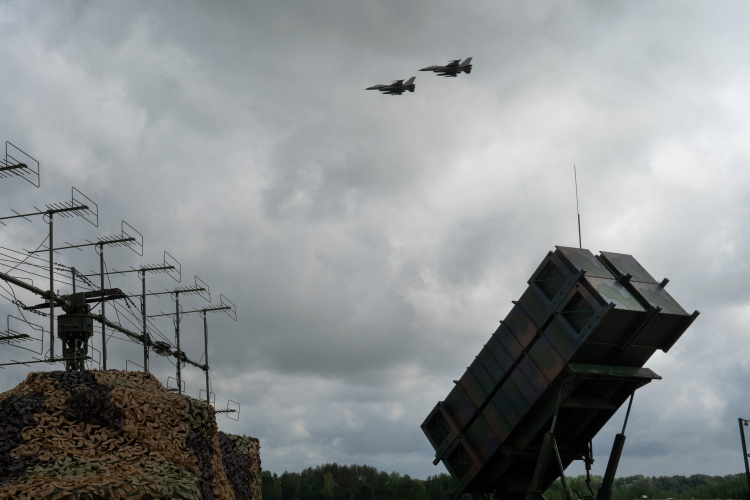
Such ambitious objectives reflect an increasingly urgent strategic reality. Russia's growing use of ballistic missiles in Ukraine, including the Oreshnik system unveiled in 2024, has exposed an important weakness in Europe's missile-defense architecture. Existing European capabilities, such as SAMP/T and the U.S.-made Patriot, remain highly effective against many aerial threats, but they operate in the lower layers of the battlespace with capabilities against SRBM. Intercepting longer-range ballistic missiles before they re-enter the atmosphere requires an entirely different class of weapon, a class Europe currently lacks.
Bliksem EXO is designed to fill precisely that gap. Rather than relying on an explosive warhead, the interceptor would destroy its target through direct kinetic impact, colliding with the warhead of a ballistic missile traveling several kilometers per second in the vacuum of space. It would complement, rather than replace, existing European missile-defense programs such as NATO Integrated Air and Missile Defense (IAMD) and the European Sky Shield Initiative (ESSI) by adding the upper tier currently missing from NATO's European architecture. On paper, therefore, the requirement is compelling. Building such a capability, however, means entering one of the most demanding technological fields in modern defense.
Building one of the world's most complex weapons
Europe has “strong lower-layer missile defenses but it still lacks a sovereign European upper layer against medium- and intermediate-range ballistic missiles,” said Mikhail Kokorich, Destinus CEO. This capability gap is in part explained by the complexity of developing such a missile. The whole system must detect, discriminate, track and physically collide with an incoming target traveling at extreme speed, often hundreds of kilometres above the Earth. Every element of the system must perform almost flawlessly.
The radar must detect the incoming threat at extreme range, and, in the case of the Oreshnik, reliably discriminating the warhead from decoys using radar remains beyond current capabilities. Be that as it may, battle-management software must calculate the engagement geometry within seconds. The interceptor booster must accelerate the kill vehicle into space before releasing it with extraordinary precision. The interceptor is then programmed to intercept a single designated target on a collision trajectory. Indeed, the challenge is to make trajectory adjustments accurate to within a few decimeters between two moving objects closing at a relative speed way above 5 km/s.
The margin for error is minute. This is why only a handful of countries have succeeded in developing operational hit-to-kill exo-atmospheric interceptors. The United States fields several such systems, including the recently tested Ground-Based Interceptor (GBI) protecting the American homeland against ICBMs, Raytheon’s SM3 Block IB and Block2 and Lockheed Martin’s Terminal High Altitude Area Defense (THAAD) systems. Israel, working closely with the United Stated, developed the Arrow family, to counter regional ballistic missile threats. Together, these programs represent decades of sustained research, repeated flight testing and billions of dollars of public investment. What the Bliksem EXO consortium is trying to do is join one of the most exclusive clubs in missile defense in just 2 years without an announced funding scheme.
To achieve this, the consortium has built an industrial partnership that is, on paper at least, exceptionally strong. Airbus Defense and Space will develop the command-and-control and battle-management architecture. Thales is responsible for the radar and sensor chain, from early warning to fire control. Safran Electronics & Defense will provide the Exo-atmospheric Kill Vehicle's seeker together with its guidance, navigation and control systems. These are all areas in which the three companies possess decades of recognized expertise. But the greater uncertainty lies in the interceptor itself. According to the consortium's own division of responsibilities, responsibility for the interceptor falls primarily to two companies: Dutch start-up Destinus, which will lead the consortium, oversee system integration and develop the Exo-atmospheric Kill Vehicle, and MBDA Deutschland, which will provide the interceptor booster, launcher and canister.
Experience still matters
This division of responsibilities also highlights where the greatest technological risks lie. Few observers would question Airbus Defense and Space's expertise in battle management, Thales' long experience in advanced military radars or Safran Electronics & Defense's capabilities in guidance and electro-optical systems. Even if little has so far been disclosed publicly about how the wider sensing and tracking network would be developed alongside the interceptor, those companies are operating within fields they have mastered over decades. The interceptor itself presents a different challenge.
With Destinus and MBDA Deutschland set to play central roles, it is important to note that neither company has previously fielded an operational high-end interceptor. That does not imply a lack of competence. MBDA Deutschland possesses considerable experience in missile propulsion, including licensed production linked to the Patriot program and ramjet propulsion for the Meteor missile. Destinus has demonstrated its ability to move quickly by developing the Ruta family of low-cost cruise missiles for Ukraine. But the idea that such experience can be translated into one of the most demanding interceptor projects ever attempted must be met with caution: the proposed timeline is historically unprecedented.
Political urgency cannot replace engineering
Destinus’ CEO Kokorich has compared the firm's approach to SpaceX, arguing that an agile start-up can disrupt a defense sector traditionally dominated by established contractors. It is an interesting comparison but deserves some scrutiny. SpaceX has benefited from decades of NASA research, billions of dollars in US government contracts and one of the world's most mature aerospace ecosystems. Its success was built through years of iterative testing before Falcon 9 became a reliable operational launcher. Conditions and resources that Kokorich and his team probably do not have at the moment.
None of this diminishes Europe's need for a sovereign exo-atmospheric capability. The real risk lies in confusing political momentum with technological readiness. As European institutions prepare future defense funding decisions, policymakers should avoid allowing enthusiasm for a newly announced program to overshadow more mature initiatives addressing different layers of the missile-defense challenge. Europe's ambition is necessary, but history suggests that credibility will ultimately depend not on announcing an interceptor, but on demonstrating one.
Donald Ramsay is an independent organizational consultant. Specializing in Defense and Security sectors, by passion and by profession.
