




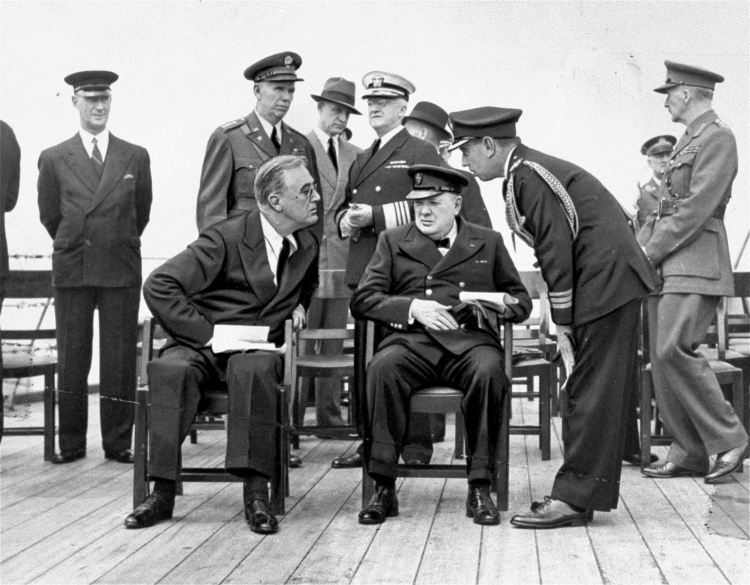
By August of 1941 most of Europe cowered under the heel of Hitler. Germany had reclaimed the Rhineland, annexed Austria, occupied Czechoslovakia, then invaded and occupied Poland, Denmark, Norway, Luxembourg, The Netherlands, Belgium, France, Yugoslavia and Greece, and in June had launched a seemingly unstoppable assault on the Soviet Union. Europe had completely submitted. Britain stood alone.
From far across the Atlantic President Roosevelt observed these events with growing consternation. The capitulation of the Old World democracies in the face of Fascism was an affront to the basic principles that, as an American, he held dear. Something had to be done, so Roosevelt secretly suggested that he and Churchill meet in person. With Britain fighting for her very survival, Churchill leapt at the opportunity. Europe had been thrown a lifeline.
A secret rendezvous was planned for August 9th 1941 at Placentia Bay off the coast of Newfoundland.
The meeting was rife with risk. Roosevelt was walking a political tightrope, constrained by an American public reluctant to enter another painful conflict, a sentiment embodied in the stridently isolationist America First Committee and its almost million members. Public opinion would remain divided up until Pearl Harbor, four months later, on December 7th 1941.
There was mortal danger too. German U-boats patrolled the Atlantic, and Churchill embarked on the perilous voyage in HMS Prince of Wales in utmost secrecy and radio silence. Roosevelt also undertook his journey by stealth, pretending to be on vacation on his private yacht, from which he was secretly transported to the Cruiser, USS Augusta.
The remarkable meeting between these two political giants, in the described setting, was a profound and deeply moving historical moment. Sunday August 10th, Roosevelt boarded HMS Prince of Wales, upon the deck of which, seated with Churchill, in the morning sunlight, joined in Sunday Service. Both flags were draped on the pulpit. Hymns were sung. Churchill noted that nearly half of those who sang were soon to die.
Roosevelt and Churchill got to work immediately. By August 12th a draft had been honed into what would become known as The Atlantic Charter, issued by both parties on August 14, 1941. It comprised eight core principles that addressed the self-determination of peoples to form their own governments, the freedom of trade, the economic and social welfare of all peoples, a lasting global peace, and the disarmament of aggressor nations. The Charter addressed the current war, but more prescient and far-reaching in scope, the state of the world to follow.
These were grand principles indeed.
The Atlantic Charter was not an official document. There is no signed original. Roosevelt was walking a fine line and was careful to state that these conversations had in no way been concerned with future commitments other than as authorised by Congress. But it endured. As the war came to an end it provided the template for the post-war world in the foundation of The United Nations. The term ‘United Nations’ was first coined by Roosevelt.
On June 26th 1945 the United Nations Charter was drafted and signed by 50 nations at a conference in San Francisco. The United Nations officially came into being on October 24th 1945, when the Charter was ratified. A mere 4 years, 10 months and 2 days had elapsed since the announcement of The Atlantic Charter.
So here we are, 85 years on to the day, and the question must be asked - do those grand principles still resonate with the United States and the Western nations of Europe today?
Do our leaders still revere The Constitution with the same veneration of Roosevelt? Congress holds the sole authority to declare war. Roosevelt repeatedly had to work with Congress and gain its approval before he could proceed. Even with Europe over-run by rampant fascist aggression it was unthinkable for him to take America to war without Congressional approval. After the Japanese attacked Pearl Harbor, he still had to wait for Congress to approve a declaration of war.
Considering all the armed conflicts the United States has been involved in since, there has never been another Declaration of War. Presidents Bush, Obama, Trump and Biden have instead invoked the Authorization For The Use Of Military Force, which greenlights the President to deploy the military. Under this guise of using force but not being at war, the United States has attacked over 30 countries.
Is the United States today in lockstep with the secular democracies of Britain and Western Europe as in 1941? Those principles are still honoured by the democracies of the Old World. They crave a relationship with the United States that was embodied in the very fibre of Roosevelt. They fear a rift. They are no longer in step.
Now, more than ever before, the United States under President Trump has become severed from the Old Alliance, ever reluctant to come to the aid of threatened democracies in the very European heartland where American soldiers died in their thousands so that people may be free. Instead he seems more comfortable aligning himself with dictators and war criminals, the very types that Roosevelt and Churchill would have loathed, as made clear in The Atlantic Charter.
P. Bruce McLaren is an historian and archaeologist who holds a Ph.D. from the University of Sydney.
