




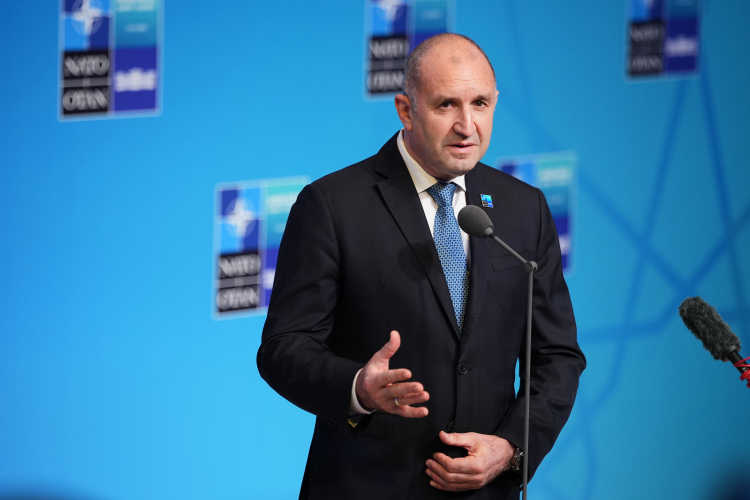
Prime Minister Rumen Radev can be quite pleased with his situation. His landslide in the April 19 elections gave his Progressive Bulgaria party a clear majority in parliament. Former Vice President Iliana Iotova slid into his old job and leads in the polls for the October 25 presidential election. His people are at all levels of government and his popularity remains high.
No party has governed Bulgaria alone since 2001 and no politician has held such sway in the country since 1989. One hundred days after being sworn in, what Radev has been doing with this power is clearer.
Corruption and State Capture
Radev has shown some progress on the corruption and state capture issues that voters most want him to fix, but he is moving slowly.
He quickly withdrew security from Magnitsky-sanctioned oligarch-turned-politician Delyan Peevski and former PM Boyko Borissov, both of whom many Bulgarians consider corrupt. But Radev’s MPs declined to constitute a committee to investigate Peevski, arguing it would be “just a talking shop.” Then in late July, the government presented a report on him, whereupon the National Audit Office opened an investigation, with a report due in three months.
To unlock the approximately 1.4 billion Euros the EU had suspended for rule of law and other concerns, the government established an Anti-Corruption Commission and passed laws on accountability for the Prosecutor General and countering corruption. These actions freed most of the EU funds; the deadline for remaining reforms is August 31.
Bulgarians will generally judge Radev on these issues. Opposition leaders have said they will support Radev if he tackles them but mobilize protests if he does not. Peevski is the litmus test but enjoys constitutional protections as a Member of Parliament.
Foreign Policy
PM Radev has clearly been pursuing a more independent foreign policy than his predecessors. His statements, actions, and travel indicate that he seeks maximum maneuverability within Bulgaria’s alliances as he tacks between NATO, the EU, Russia, and the United States.
Radev’s first parliamentary speech highlighted sovereignty, realism, and a more “pragmatic” foreignpolicy. He downgraded Bulgarian participation at key regional formats as President Iotova skipped the Three Seas Initiative and Bucharest 9 summits.
By travelling first to Berlin and Paris, Radev signaled that NATO and the EU were not his highest priorities, although Berlin remains a key reference point on the WWII-era Tsar Boris III principle “always with Germany, never against Russia.” Radev has been inconsistent with the United States, first setting impossible conditions to base aircraft for Iran operations and then agreeing until October 1.
Accommodating Russia
Radev accommodates Moscow more explicitly than his predecessors did. He has repeatedly called for a “new security architecture” in Europe, which would favor Russia. He declined to support a Council of Europe war crimes tribunal for Putin and studiously avoids criticizing Moscow.
Radev reduced ties with Ukraine, in June stopping arms deliveries after his predecessors had sent 13 packages. His FM caused a kerfuffle by associating Bulgaria with a Ukraine-related summit declaration from which the government distanced itself. After Radev announced Bulgaria’s withdrawal from the Coalition of the Willing, his FM said Sofia was never a member.
Commenting “the time for crusades is over,” Radev conditioned approval of the major 21st EU sanctions package on dropping three Russians: Patriarch Kirill, Lukoil’s Vagit Alekperov, and businessman Iskander Makhmudov.
Radev is not, however, acting like a complete “Putin proxy.” At the NATO Ankara Summit, he sought cooperation with Ukraine on energy and drones, although offered little support. He just sent an ambassador to Kyiv after a gap of 4.5 years, and commercial arms sales continue.
Radev’s approach instead is not to confront Russia, “promote peace,” and protect the Bulgarian economy. He wants it both ways: in the West, but not all-in and between East and West.
But Not “Another Orban” or “Another Fico”
Radev is not “another Viktor Orban.” He has neither a parliamentary supermajority nor the ambition to lead Europe’s patriots. Bulgaria isn’t as dependent on Russian energy, and he cannot afford EU punishment.
The analogy with Slovak Prime Minister Robert Fico also doesn’t fully fit. Radev does not deploy Fico’s aggressive rhetoric, cultural themes and grievances, and hasn’t been as hostile to media.
But Unique
Instead, Radev is charting his own course. He is a unique player and is pursuing his own interests in a unique way: balancing, hedging, and engaging in transactions with partners but fully satisfying no one.
Radev’s MPs call this "multi-layered diplomacy." Others call it “multi-vector” or “multi-voiced” for messaging different audiences differently. Opposition leaders call itschizophrenia.This approach will make getting to yes with Radev challenging. He remains the weak link and complicated partner he was as president. This will make putting wins on scoreboards difficult – as with other treaty allies – but it can be done.
Matthew Boyse is a senior fellow with Hudson Institute’s Center on Europe and Eurasia specializing in Central Europe. He is also an adjunct lecturer at the Johns Hopkins School of Advanced International Studies, the George Washington University, and American University.
