




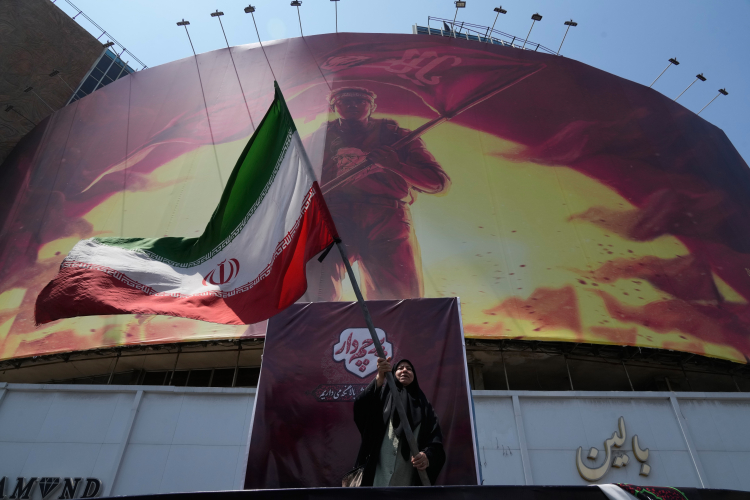
The war between the U.S. and Iran has now passed the five-month mark, and there is still no end in sight. The White House and the media have repeatedly teased imminent ceasefire agreements, only for it to become clear within days that the cycle of negotiation and conflict is returning directly to its starting position. The Islamic Republic therefore continues to suffer severe and wide-ranging losses and will no doubt continue to do so until something significant changes to upend the fruitless process that we have all been watching unfold repeatedly.
The Iranian regime is the intransigent party in this process, and it has shown no interest in finding a peaceful solution. All mainstream recommendations have simply vacillated between proposals for stronger military action and appeals for more negotiations. Both have proven ineffective.
Thirty-eight years ago, the Middle East faced a similar predicament regarding the Islamic Republic. The Iran-Iraq War had continued unabated for eight years, and the Iranian regime's founder, Ruhollah Khomeini, publicly presented an image of unparalleled intransigence. Khomeini vowed to continue the war for twenty years, even if it meant fighting from the last building left standing in Tehran.
Very much as it is today, the world could not understand why, despite the heavy losses and with no pathway to victory in sight, Khomeini remained so adamant about continuing the war. Iranian critics of his theocratic regime understood that the "supreme leader" cared neither for the people nor for the country. To him, Iran was a platform from which to promote religious extremism, launch terrorist operations abroad, subject non-extremist citizens to imprisonment, torture, and public execution, and fulfill his adage: "The road to Jerusalem runs through Karbala (Iraq)."
As the Iran-Iraq War continued in stalemate, Khomeini felt secure in maintaining his grip on power. Then the unexpected happened. The war's end was shaped to a significant degree by a factor in Iranian affairs that few had taken seriously until its presence became impossible to ignore. The principal Iranian resistance movement, the Mujahedin-e Khalq (MEK), translated as the People's Mojahedin Organization of Iran (PMOI), entered the battlefield.
In a lightning offensive on June 20, 1988, MEK forces, which were based in Iraq at the time, crossed into Iran and captured the strategically important border city of Mehran. The MEK inflicted a severe military and psychological blow on the regime and demonstrated a battlefield capability that Tehran had not anticipated.
MEK fighters were heard chanting, "Today Mehran; tomorrow Tehran." Their declared target was Tehran; their ultimate objective was to free all Iranians from tyranny. The message reverberated throughout Iran and beyond. Presented with a clear challenge from the Iranian people, Khomeini knew his theocracy was in peril.
The very next month, the supreme leader accepted the UN Security Council resolution that he had rejected only weeks earlier, setting the stage for a ceasefire with Iraq. In doing so, he left no doubt about his resentment of the forced concession, describing it as akin to "drinking a chalice of poison."
Fast-forward thirty-eight years, and the regime is living in fear of a major uprising that could prove even larger than those witnessed in recent years. The Islamic Republic has responded by initiating a wave of political executions focused on MEK activists, recalling the systematic massacre of political prisoners that followed soon after the organization's capture of Mehran.
Meanwhile, the MEK's nationwide network of "Resistance Units" has been carrying out operations on a near-daily basis despite a heavy crackdown and intensified repression at home. The persistence of such challenges to the regime's hold on power is a reminder of what might have been accomplished in 1988 if the international community had seen fit to help pro-democracy Iranian dissidents capitalize on their initial victories against theocratic authorities.
The failure to do so was a mistake. History offers an important lesson: meaningful political support for the Iranian Resistance can provide a means of confronting the recurring crises generated by the Islamic Republic. The West should therefore extend political support to the MEK and accord the Iranian Resistance the international recognition it merits. At a minimum, such a shift would alter Tehran's calculations and increase pressure on the regime to accept a ceasefire, just as it was ultimately compelled to do in 1988. More consequentially, it could help create the conditions under which the Iranian people themselves can bring an end to the ruling theocracy and establish a free and democratic Iran.
The familiar maxim holds that "extraordinary times demand extraordinary measures." Supporting the Iranian Resistance should no longer be regarded as an extraordinary or desperate course of action. If anything, the extraordinary policy has been the persistent refusal to recognize an organized opposition capable of challenging the regime from within, even as successive approaches to Tehran have failed to resolve the underlying crisis.
Support for the Iranian Resistance is a rational response to the realities of the present and to the lessons of history that policymakers have ignored for far too long.
Colonel Wes Martin (U.S. Army, ret.) served as the first Senior Antiterrorism Officer for all Coalitions in Iraq and holds an MBA in International Politics and Business
