




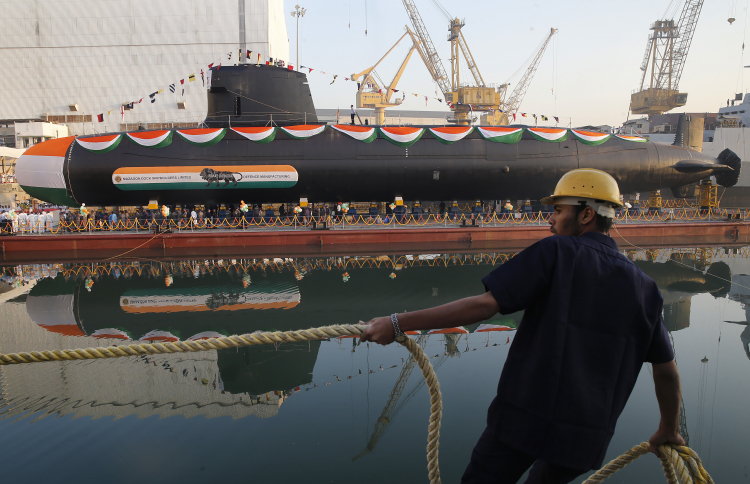
India’s growing fleet of nuclear-powered ballistic missile submarines has been garnering attention in defence circles, raising questions about whether Pakistan’s deterrent is being challenged. Those fears are misplaced. India’s expanding sea-based capability does not fundamentally alter the strategic balance because Pakistan’s deterrence has never depended on matching India submarine for submarine. It depends on convincing New Delhi that any war would carry unacceptable costs.
Has India gained an advantage at sea? Certainly. Nuclear powered ballistic missile submarines can remain hidden underwater for extended periods, ensuring part of India’s nuclear arsenal could survive even if its land-based missiles and air bases were destroyed. But a stronger second-strike capability does not automatically render Pakistan’s deterrent ineffective.
Rather than investing in an expensive fleet of nuclear-powered submarines, Islamabad has focused on preserving credible deterrence through dispersed nuclear forces, sophisticated conventional capabilities and sea-based cruise missiles.
“Deterrence is psychological, not mathematical,” says John Erath, Senior Policy Director at the Center for Arms Control and Non-Proliferation. “Pakistan’s nuclear capabilities should be sufficient for deterrence.”
Pakistan is estimated to possess about 170 nuclear warheads, compared with roughly 190 for India. Its nuclear posture rests primarily on mobile land-based missiles and combat aircraft, supported by a developing maritime component. Much of the force is designed to enhance survivability through mobility and surprise, making it difficult to neutralize in a first strike. Its military inventory includes more than 420 combat aircraft and eight submarines.
In 2017, Pakistan tested the nuclear-capable Babur-3 submarine-launched cruise missile, with a range of about 450 kilometres, as a step towards a sea-based second-strike capability. It is not equivalent to India’s SSBN fleet, but it complicates Indian military planning by introducing another potential location for Pakistan’s retaliatory forces.
Pakistan is also acquiring eight Chinese-designed Hangor-class submarines. While these are not ballistic missile submarines, they will strengthen Pakistan’s ability to operate at sea, protect its maritime approaches and complicate Indian naval planning.
According to Lt. Gen. (Retd.) Khalid Ahmed Kidwai, former Director General of Pakistan’s Strategic Plans Division and Adviser to the National Command Authority, Pakistan’s nuclear posture is based on “Full Spectrum Deterrence” within the ambit of “Credible Minimum Deterrence.” In practical terms, this means Pakistan maintains nuclear forces across all three services, possessing strategic-, operational, and tactical-level nuclear capabilities on land, at sea and in the air.
In other words, Pakistan seeks stable deterrence, not an open-ended arms race. But India should not assume there is a safe level of conflict to which Pakistan has no effective response.
Brig. (Retd.) Dr. Zahir Kazmi, Arms Control Adviser at Pakistan’s Strategic Plans Division, says there has been no shift from Credible Minimum Deterrence to Full Spectrum Deterrence. CMD remains the guiding doctrine, while FSD is its operational expression, allowing Pakistan to maintain a credible deterrent as the strategic environment changes.
Pakistan has not adopted a no-first-use pledge and deliberately avoids defining the point at which conventional retaliation would cross the nuclear threshold. That decision rests with the National Command Authority, which says Pakistan’s arsenal is protected by multilayered command-and-control safeguards. While this doctrine is presented as defensive, restraint should not be mistaken for weakness.
Naeem Salik, Executive Director of the Strategic Vision Institute in Islamabad, says Pakistan has strengthened its conventional forces both to respond effectively to sub-conventional and limited conventional attacks and “to raise its nuclear threshold to a reasonably high level” in order to avoid unintended nuclear escalation for as long as possible.
The May 2025 conflict tested that logic. Narendra Modi subsequently said India would strike across the border again after future attacks and would not be deterred by what he called “nuclear blackmail.” Despite such political rhetoric, Pakistan maintains that the May 2025 conflict reaffirmed the credibility of its conventional and nuclear deterrence, which continues to limit India’s military options. The lesson is not that nuclear weapons make conflict impossible. It is that Pakistan’s nuclear arsenal gives India a reason to think twice about how far conventional force can safely go.
Pakistan is therefore placing greater emphasis on advanced conventional capabilities, including precision missiles, modern fighters, drones, air defence, electronic warfare and submarines to strengthen its conventional deterrence against India’s so-called Dynamic Response Strategy.
Since 2019, Pakistan has added Chinese J-10C fighters and HQ-9 air defence systems while expanding its use of drones and precision missiles. India has acquired Rafale aircraft, S-400 air defences and additional missile and unmanned capabilities. India retains a far larger defence budget and industrial base, which Pakistan seeks to offset asymmetrically.
The May 2025 conflict also demonstrated how quickly modern warfare can escalate. Both sides employed long range precision missiles, advanced aircraft, drones, air defences, and electronic warfare. These capabilities may provide additional options the nuclear overhang, but they can also make escalation more dangerous. Faster missiles compress decision making, while dual capable systems and attacks on command facilities can be mistaken for attempts to disable nuclear forces.
India’s accidental launch of a missile into Pakistan in 2022 had already demonstrated how technical failures can create strategic crises. In a nuclearized relationship, even an accident can be interpreted as something more sinister. Some argued that the launch was a deliberate action to test Pakistan’s response.
Pakistani analysts have long regarded India’s ballistic-missile defences and MIRV-capable missiles as potentially destabilizing. They argue that MIRVs could expand India’s ability to target Pakistani nuclear forces, while missile defences could intercept part of a surviving retaliatory strike.
The May 2025 conflict brought the danger closer to the nuclear threshold when Indian missiles struck Nur Khan air base near the organisation responsible for Pakistan’s nuclear planning. U.S. diplomacy helped bring the two sides back from the brink, raising concern that confidence in managing escalation could encourage greater risk-taking.
The next crisis could move even faster. Hypersonic systems, cyber operations, space-based surveillance and AI-assisted warning systems could further compress decision times. Formal arms control mechanisms are almost absent, while nuclear powers are modernising their arsenals. The result could be a more dangerous nuclear environment, in which miscalculation matters as much as military capability.
Erath cautioned that “deterrence works today does not mean it will always do so”. He argues that India and Pakistan should adopt risk-reduction measures to limit misunderstanding and miscalculation, while mutual and verifiable arms control could help. The 2025 conflict, he says, “demonstrated the need for reliable means of de-escalation.”
One limited safeguard has survived. India and Pakistan continue to exchange annual lists of their nuclear installations under an agreement prohibiting attacks on those facilities. But this has not developed into a broader arms-control or crisis-management system.
Nor have the political sources of their rivalry disappeared. Kashmir remains at the heart of their hostility, while India’s suspension of the Indus Waters Treaty has added another source of tension.
Bilateral crisis communications remain weak, and outside mediation may not arrive quickly enough in a future confrontation.
India’s SSBN programme gives it an important and increasingly survivable sea-based nuclear force. Pakistan has no equivalent capability but strategic deterrence is not a contest in which the country with more sophisticated submarines automatically wins.
Pakistan does not need to match India weapon for weapon. It needs to preserve enough survivable capability to ensure that India cannot be confident of destroying its retaliatory forces or achieving a swift, decisive and cost free victory.
India’s nuclear submarines may be a significant strategic gain, but they do not change the basic reality. As long as uncertainty remains, so does deterrence.
That is the point often lost in the fixation over submarines. India may be gaining an important advantage at sea, but it has not achieved strategic checkmate. As long as New Delhi cannot be certain that a war would leave it better off than restraint, Pakistan’s deterrent still has a purpose.
Simonetta Fornasiero is an award-winning Italian broadcast journalist specializing in international affairs. She has held senior editorial positions at ARD German Radio and Television and Channel NewsAsia.
