




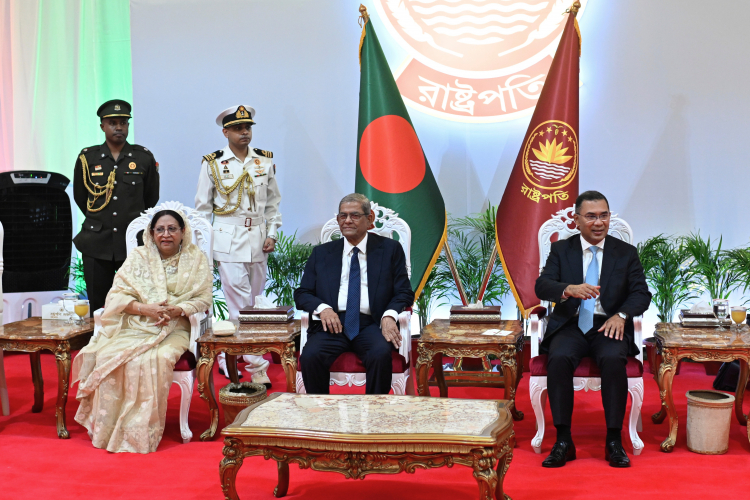
Bangladesh Prime Minister Tarique Rahman’s delayed first visit to India may appear to be another consequence of the Sheikh Hasina dispute. Its larger significance, however, lies elsewhere. The episode illustrates a structural shift in South Asia: India remains the region’s predominant power, but smaller neighbours increasingly possess enough external options to make Indian influence competitive rather than automatic.
New Delhi had hoped Rahman’s maiden visit would help reset relations after the political upheaval of 2024. Officials from both countries spent weeks discussing the trip, and India also invited him to the BRICS outreach summit. Yet the anticipated August visit did not materialise, with Dhaka maintaining that a more “propitious environment” was required.
The immediate friction is familiar. Hasina remains in India despite Bangladesh’s repeated extradition requests, while her August 5 interaction with journalists in New Delhi further aggravated Dhaka. But treating the stalled visit primarily as another Hasina story misses the more consequential development. Rahman’s “Bangladesh First” approach is testing whether Dhaka can use an increasingly competitive regional environment to expand its strategic autonomy without abandoning cooperation with India.
From Geographic Primacy to Competitive Influence
For decades, geography gave India extraordinary structural advantages in its immediate neighbourhood. Bangladesh illustrates them clearly. The two countries share more than 4,000 kilometres of border, while their interests intersect across trade, electricity, water, transit, security and regional connectivity.
Under Hasina, those structural advantages were reinforced by unusually close political relations. Cooperation expanded in counterterrorism and connectivity, while New Delhi enjoyed privileged access to Dhaka’s political leadership.
But that relationship also exposed a weakness in India’s approach: influence became closely associated with one political establishment. When Hasina’s government collapsed in 2024, India did not lose its geographic importance, but the political foundations supporting its privileged position changed dramatically.
Rahman’s government now emphasises sovereign equality, reciprocity and non-interference. That weeks of diplomacy failed to produce Rahman’s visit demonstrated Dhaka’s willingness to withhold a diplomatic prize that New Delhi clearly valued.
This is not evidence that Bangladesh can—or wants to—disengage from India. It shows instead that India’s structural importance no longer necessarily translates into political deference. That distinction is becoming increasingly important across South Asia.
Bangladesh Has More Options Than Before
Rahman’s June visit to China highlighted the changing equation. Dhaka pursued deeper economic engagement with Beijing, while China continues expanding its commercial and strategic footprint across South Asia.
But interpreting Bangladesh’s strategy simply as a “China tilt” would be misleading. Dhaka has simultaneously rebuilt engagement with Pakistan, maintained relations with Washington and pursued wider international partnerships.
The more useful concept is multi-alignment.
Bangladesh does not need to replace India with China. Its strategic advantage comes from maintaining productive relationships with several powers simultaneously. Each viable partnership gives Dhaka greater room to manoeuvre in dealing with its largest neighbour.
This pattern is hardly unique to Bangladesh. Across South Asia, smaller states have learned to leverage geopolitical competition without necessarily joining rigid blocs. Sri Lanka has sought investment and diplomatic support from competing partners. Nepal has long manoeuvred between India and China. The Maldives has demonstrated how domestic political change can rapidly alter the balance between New Delhi and Beijing.
Their circumstances differ substantially, but they point towards the same regional reality: proximity to India no longer means exclusivity.
China has been central to that transformation by providing infrastructure financing, investment and political engagement. Other powers are also widening the choices available to South Asian governments.
The result is not India’s displacement, but the emergence of a more competitive geopolitical order in its immediate neighbourhood.
“Bangladesh First” fits naturally into this environment. Its significance lies less in opposing India than in rejecting the proposition that close relations with India require an India-centric foreign policy.
India’s Neighbourhood Primacy Is Becoming Conditional
India still possesses advantages that China and other external powers cannot easily replicate. Geography matters. So do establish commercial networks, cross-border infrastructure, cultural connections and the capacity to cooperate on immediate security challenges.
The strategic question, therefore, is not whether India is “losing” Bangladesh. It is whether New Delhi can convert those enduring structural advantages into political influence when neighbouring governments have credible alternatives.
The Hasina experience offers an important lesson. Building exceptionally close relations with a friendly political leadership can produce substantial short-term gains, but influence centred too heavily on individuals becomes vulnerable when domestic politics changes.
Durable regional influence requires broader relationships with institutions, political parties, businesses and societies-that can survive electoral turnover and political upheaval. It also requires accepting that neighbouring states will maintain relationships with India’s competitors.
If New Delhi treats Chinese investment, renewed Pakistani engagement or expanded American involvement primarily through the lens of strategic competition, it risks encouraging precisely the distancing it seeks to prevent. India’s comparative advantage lies in making cooperation sufficiently valuable that neighbouring governments choose close relations without believing their autonomy is being compromised.
Dhaka faces its own constraints. “Bangladesh First” cannot succeed if strategic autonomy becomes permanent confrontation. Bangladesh remains deeply interconnected with India, and political disputes cannot substitute indefinitely for cooperation on trade, energy, water, transport and security.
Nor should multi-alignment merely exchange dependence on one larger state for dependence on another. Its value lies in expanding choices.
Rahman’s delayed visit therefore matters less because a diplomatic trip failed to happen than because of what its absence reveals. The old equation-India’s geographic dominance producing privileged political influence is becoming less reliable.
Bangladesh can seek economic engagement from Beijing, improve ties with Islamabad, work with Washington and still negotiate with New Delhi. India remains indispensable, but indispensability is no longer the same as unquestioned primacy.
That may be the most important message behind “Bangladesh First.” In an increasingly multipolar South Asia, India will retain enormous structural weight. But its neighbourhood influence will increasingly have to be earned through mutually beneficial partnerships rather than assumed from geography, historical relationships or privileged access to friendly governments.
Saima Afzal is a researcher specializing in South Asian security, counterterrorism, and broader geopolitical dynamics across the Middle East, Afghanistan, and the Indo-Pacific. Her work examines strategic affairs and evolving patterns of regional conflict. She is currently a Research Scholar at Justus Liebig University, Germany.
