




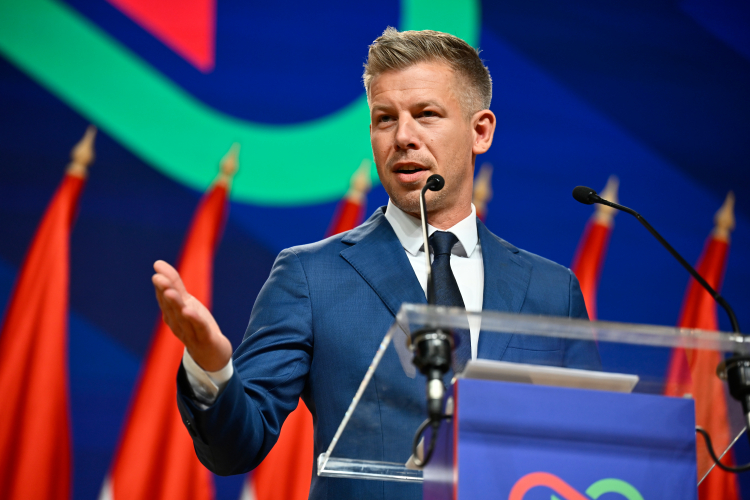
Sunday’s elections in Hungary made headlines far beyond its borders, as Prime Minister Viktor Orbán’s 16-year rule came to an end, conceding power to Péter Magyar and his Tisza Party. Magyar’s tenure will surely bring change to Hungary—but the implications of this change for U.S. foreign policy should not be overlooked, especially as Washington wrestles with the future of the war in Ukraine.
Orbán’s Fidesz not only lost its hold on the prime ministership, but the Tisza Party even secured a two-thirds parliamentary majority, positioning Hungary for sweeping change, including possible constitutional reforms aimed at reversing Orbán’s illiberal turn.
While it remains unclear where the war in Ukraine will fall among Magyar’s priorities, his leadership is expected to unlock €90 billion in credit for Ukraine—funding previously blocked by Orbán. In fact, Orbán repeatedly obstructed European efforts to take on greater responsibility for the war in Ukraine, including delaying new rounds of EU sanctions on Russia and resisting moves toward full energy independence from Moscow. This shift could enable the United States to scale back its role and allow Europe to take more responsibility, freeing Washington to focus on other pressing national security commitments.
In effect, it would mark a clear and welcome case of burden-shifting from the United States to its European allies.
Orbán’s defeat came on the heels of U.S. vice president JD Vance’s highly controversial visit to Hungary just days before the election—an episode that stands out as one of the most overt instances of U.S. election interference in recent years. While the U.S. intervening in other countries is hardly unprecedented, it is unusual for a senior American official to travel to a country on the eve of a pivotal election, thereby breaking with longstanding diplomatic norms.
More striking still, Vance did not merely visit; he appeared at a political rally in a football stadium, leaving little doubt about the intent behind the trip. Past administrations of both parties have generally exercised restraint when it came to appearing to tip the scales in allied nations’ domestic politics.
However, another notable exception, which likewise proved ineffective, occurred when Barack Obama visited the United Kingdom in 2016 ahead of the Brexit referendum, urging voters to remain in the European Union. According to a BBC editor, there was “disquiet at Obama’s blatant meddling in UK politics.” All of this serves to demonstrate that Washington openly expressing a preference for a foreign election outcome rarely produces the intended result.
More important, however, is what Hungary’s new prime minister will mean for U.S.–Hungary relations. While many Western leaders, including those of France, the United Kingdom, and Germany, have congratulated Péter Magyar, Donald Trump has yet to congratulate Magyar on his victory. Still, Trump’s apparent lack of enthusiasm does not necessarily mean that the Tisza Party’s victory will be fruitless for the United States.
While Ukraine will likely not constitute the main priority for Magyar, he is expected not to stand in the way of the €90 billion loan for Ukraine that has been held up by Orbán since the beginning of 2026. This would allow the European Union to offer more meaningful support to Ukraine, freeing up the United States to step back and shift more of the war’s burden onto Europe. Such a rebalancing is important not only for the United States, already heavily engaged in the Middle East and at risk of overstretch, but also for Europe, which urgently needs to take greater responsibility for its own defense as the U.S. focuses on higher priorities at home and elsewhere.
While Hungary’s new government is unlikely to offer substantial military or financial assistance to Ukraine, it no longer represents the staunchly pro-Vladimir Putin posture that defined the Fidesz administration. Leaked reports suggesting extensive collusion between Hungary and Russia likely played a significant role in shaping the election outcome, as voters turned toward a future they saw as more democratic, and, crucially, less corrupt.
The election in Hungary underscores a broader lesson: foreign interference often does far less to shape domestic political outcomes than its architects intend. Despite the Trump administration losing their man in Hungary, there is a silver lining for U.S. interests. While the new government will likely prioritize anti-corruption efforts and economic recovery, its rise may also serve U.S. interests by enabling a gradual recalibration of American involvement in Europe. The anticipated financial support for Ukraine represents a renewed first step toward burden shifting and will help foster a more balanced transatlantic relationship.
Victoria-Katharina Flick is a foreign policy analyst in Washington, DC.
