« Debating the Long War | Blog Home Page | Cops and Robbers in Havana »
September 28, 2009
One problem I have with the ongoing Iranian sanctions debate is that it's really a two-way argument being had by three competing factions. On one side you have the proponents of sanctions—a halfhearted and quasi-invested bunch at best—and on the other, you get the anti-Iran sanctions crowd tag teaming with the anti-sanctions always crowd.
The latter are often inclined to remind those of us in the pro-sanctions crowd that sanctions never, ever work, and then proceed to lay out a laundry list of sanctions gone awry. The problem with this argument is that it conflates 2009 Iran with 1986 South Africa (where sanctions were somewhat effective) and 1962 Cuba (not so much). All three of these—along with all the other historical examples—serve as unique case studies on the efficacy of sanctions.
And there's a fine debate to be had over whether or not some array of 'smart sanctions' can work, or if sanctions that circumvent the UN entirely and focus instead on Western banks and insurers would be more effective. Do you establish a multitiered set of sanctions pegged to concrete dates, or do you throw a 'grand bargain' on the table with the option of global isolation or acceptance? Does the threat of force remain on the proverbial table?
A debate over these options strikes me as pretty reasonable, and I think the pro-Iran sanctions and anti-Iran sanctions factions will continue to have that conversation in the coming days.

I find myself less compelled however by the anti-sanctions always faction. Here are two examples, starting with Daniel Larison:
On the contrary, as opponents of sanctions keep saying, a tighter sanctions regime will harm internal political opposition to the regime, increase the political-military establishment’s hold on the economy and cause Iranians to rally behind their government in the face of outside hostility.
And Christopher Preble:
The Obama administration should therefore offer to end Washington’s diplomatic and economic isolation of Iran, and should end all efforts to overthrow the government in Tehran, in exchange for Iran’s pledge to forswear a nuclear weapons program, and to allow free and unfettered access to international inspectors to ensure that its peaceful nuclear program is not diverted for military purposes.While such an offer might ultimately be rejected by the Iranians, revealing their intentions, it is a realistic option, superior to both feckless economic pressure and stalemate, or war, with all of its horrible ramifications.
Whether or not sanctions should hurt the average citizen is a recurring debate in the efficacy debate. But in the case of Iran, there's still reason to believe that the Khamenei-Ahmadinejad-IRGC cabal in Tehran enjoys a sizable base of support. And what they lack in popular support they compensate for with the use of force and oppressive cruelty. This strategy has thus far worked for them.
It's this thuggish regime the United States must negotiate with if it wishes to halt an Iranian nuclear weapons program and alter Iranian behavior throughout the Middle East. Whether or not sanctions impede or stymie Iranian revolution shouldn't be a calculation in present negotiations with Tehran. A nuclear-armed Iran—based off the North Korean case study, for one—would be far more difficult to press on human rights, fair elections and civil liberties. This is what Ken Pollack once referred to as Iran's dual ticking clocks—one clock ticks down to revolution, the other to a nuclear bomb. Waiting and cheering for the former to go off before the latter is not a luxury the U.S. presently has.
And total reversal of the sanctions regime is equally unrealistic. The international community has at the very least reached a limited consensus on Iranian behavior; that consensus involves several rounds of sanctions and UN resolutions. To backtrack on those demands now would undoubtedly appear weak and terribly equivocal.
Remember that Iran's revolutionary regime justifies its very existence much in the way a mafia extortionist squeezes the corner grocer for protection money. To accept a gushing American offer of full engagement would shake the legitimacy of the revolutionary message—the Iranian equivalent to perestroika. This internal fear is why such efforts to loosen sanctions and draw Iran into the global economy have been rebuffed by the Islamic Republic in the past.
Rejecting sanctions doesn't make Iran go away, it simply limits the viable options for dealing with the recalcitrant regime. Instead of a policy shaded in grays you get the more hawkish option of black and white—attack or do nothing. This dichotomy incidentally suits the hawkish community just fine.
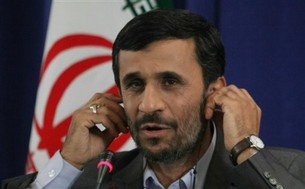
(Credit: AP Photos)