



An Arabic version can be found here.
Note from the Writers and Researchers:
This investigative report is dedicated to the soul of our dear friend and colleague, Hisham al-Hashemi, a historian and researcher specializing in security, strategic affairs, and extremist groups. He was shot to death in front of his home in the Zayouna district of Baghdad on July 6, 2020, after he publicly criticized Kata’ib Hezbollah, a U.S.-designated, Iranian-backed terrorist militia operating in both Iraq and Syria. Hisham’s killer was acquitted — despite having confessed his guilt. From this injustice, we drew the inspiration for this investigation into the hidden depths of Iraq’s corrupt judicial network. For our protection and that of our families, we do not wish to be identified. May Hisham al-Hashemi’s death have not been in vain, and may a cleansed Iraq be returned to its honorable and patriotic people.
Rest in peace, Hisham
On a typical, yellow-tinged day in Baghdad along the heavily guarded main road leading into the Green Zone, orders were screamed out: Lift the concrete barriers! Stand aside! Make way for incoming convoy!
Instinctively stepping aside from where we were waiting to enter the Green Zone for an appointment with one of Iraq’s most powerful figures, a spear-shaped 35-vehicle convoy pushed its way forward, sealing off both lanes of what is called Baghdad Airport Road and tightening into a protective ring around the principal vehicle. On both sides of the road, we were treated to a sparkling light show caused by sunlight reflecting off rifle scope lenses as pre-positioned snipers scanned the area.
As the convoy drew nearer, jamming devices were activated, cutting off all communication for the duration of its passage. We instinctively stood at attention as the vehicles — all with identical license plates, armored bodies, and blacked-out windows — moved in a perfectly synchronized rhythm. The city that for more than 1,200 thousand years has inspired the sweetest verses of poetry appeared to hold its breath until the final vehicle passed, including one carrying an anti-aircraft weapon that Iraqi citizens jokingly call “the tail.” Only when the convoy crossed the final checkpoint into the Green Zone did we again approach the first checkpoint.
A soldier asked for our entry passes. We handed them over, asking who the convoy belonged to. He looked at us with a mix of disgust and irritation. Only after he checked that our passes were valid did he finally mutter before waving us through: “Leave it to Allah, brother. That’s the king of Iraq.”
Later, we asked our driver if he knew who the king of Iraq was. Without missing a beat, he answered: “Mr. Faiq, of course.” Our curiosity intensified. Who was this “Mr. Faiq”? What position did he hold, and how did he earn such a title?
The King of Iraq
In uncovering the scale of Faiq Zaidan’s power and corruption, we would soon find ourselves recording first-hand testimonies describing the guardian of the legacy of Qasem Soleimani and Abu Mahdi al-Muhandis, the Iranian Islamic Revolutionary Guard Corps (IRGC) commander and the commander of Iraq’s Popular Mobilization Forces (PMF) who were killed January 2020 on Baghdad Airport Road in a targeted U.S. drone strike.
It was they who created Zaidan — shaping him into the gatekeeper entrusted with protecting Iran’s influence and power in Iraq, the custodian of corrupt networks, the master extortionist who keeps a dossier on every notable official and businessman in Iraq, and the plunderer of his nation’s wealth for “sister Iran, ” as he likes to call the Islamic theocracy sharing a porous 994-mile border with Iraq.
Iran long ago recognized that infiltrating Iraq’s judiciary was the surest path to capturing the state from within. Over two decades, Soleimani and al-Muhandis engineered Zaidan’s rise as the overlord of the entire judiciary system in Iraq.
After graduating from the Judicial Institute in 1999, Zaidan served as a judge in civil and criminal courts in Baghdad until 2005, when he became head of the Central Investigative Court (widely referred to as the Terrorism Court) responsible for combating terrorism and major crimes. This position, which he held until 2012, became his gateway to glory, riches, and power.
During his tenure, Zaidan and another judge, Majed Al-Araji, became known as the “execution judges,” issuing death sentences against hundreds of thousands of Sunnis, Shias, and others — often without proper trials or solid evidence. This earned him the trust of Iran, Soleimani, and al-Muhandis, whom Zaidan would later describe as “the brother my mother never gave birth to.” Likewise, he described Soleimani on Iraq’s Al-Sharqiya TV as “a brother from another mother.”
In 2012, he was elevated to the Court of Cassation, which is responsible for reviewing and supervising decisions from lower courts, and exercising significant authority over all federal and regional courts. In 2014, he became its vice president and, two years later, its president. Yet even that authority wasn’t enough. Only one year later, in 2017, a legal amendment made him both the head of the Court of Cassation and the Supreme Judicial Council, effectively placing the entire judiciary under his authority. Thus, in five short years, with the backing of Soleimani and al-Muhandis, Zaidan ascended to the highest judicial position in the country and, most would argue, the very top of the state’s power structure, which is why he is widely known as “the king of Iraq.”
His iron grip on the judiciary strips Iraq’s elections of their meaning and drains its democratic process of all substance. Under Zaidan, no candidate can run for office without first obtaining approval from both the Electoral Commission and the judiciary. If candidates are deemed undesirable for any reason — even if there is no legal basis to block them — the court simply issues a decision rejecting their candidacy. And if candidates appeal the ruling, they find themselves trapped in a maze of judicial procedures with no end or exit.
Likewise, if the prime minister appoints a director-general and that appointment is not acceptable to the judiciary or Iran-backed factions, an immediate decision is issued suspending the appointee from work. Even if a governor Zaidan disapproves of should win an election, he can be quickly removed through a judicial ruling. And in parliament, the judiciary can overturn any decision it makes by simply issuing a ruling against it.
Equally important, Iraq is the financial lung through which Iran breathes despite U.S. and international sanctions — and it is Zaidan who secures the detours around them. Not even the Central Bank can object to his orders to turn a blind eye to companies that legally appear Iraqi-owned but are, in fact, Iranian. A high-level source at the Central Bank admitted, “We have become worthless employees. Orders come to us from Faiq, and if we don’t comply, a court ruling arrives from some junior judge ordering us to execute immediately. The situation has reached an unprecedented level.”
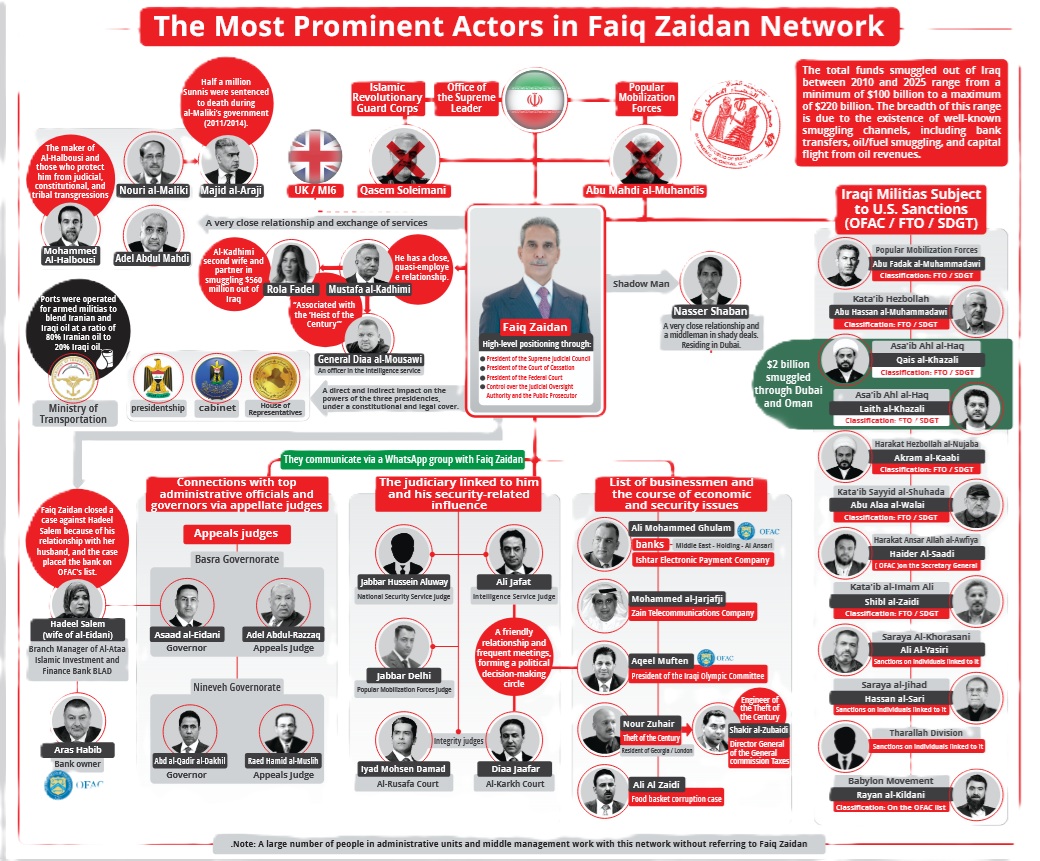
Based on estimates calculated by our research team using a normative-assessment model that incorporated variables such as the exchange rate of the U.S. dollar, foreign transfers, and oil prices, the value of funds smuggled out of Iraq between 2010 and 2024 ranged from $100 billion to at least $220 billion, if not more. This wide gap reflects the diversity of smuggling channels — from bank transfers and oil and fuel smuggling to the flight of capital derived from oil revenues.
Colombian drug lord Pablo Escabar built his empire on a strategy strikingly similar to the one employed by Faiq Zaidan. Escobar coined the phrase “silver or lead” to describe the two choices for anyone who stood in his way: accept the bribe (silver coins) or face death (lead bullets). This method fused temptation and fear into a single tool of domination.
Iraq’s own Escobar employs this strategy in building his intricate network of judges, state officials, ministers, and the country’s security, political, and economic decision-makers. He deploys influence and twists the law to secure their obedience, allegiance, and silence. He protects corrupt officials while crushing dissenters and honest businessmen who are left with only two options: acquiescence or a slow death spent in courts, bankruptcy, frozen assets, exile, or prison.
The Intelligence Officer/The General
Our first source, an intelligence officer who works in a government security agency, keeps a low profile, receiving foreign journalists and academics under the pretext of helping those interested in modern Iraqi history. That is his public role. But as a patriotic Iraqi, he was willing to provide whatever facts he can regarding the danger gripping Iraq’s political and security landscape — and the judiciary’s domination over both.
The truth is, he had grown utterly exhausted by the ugly reality that things were moving from bad to worse. Although discouraged, he spoke with courage and conviction. After greeting us, he launched forward without any pleasantries: “You realize that once you write this report, no one will be able to protect you in Iraq. And you will never enter Iraq again. Everyone you know here will turn on you and deny you. I hope you understand that beforehand.”
When we assured him that we did, he smiled, instructed his secretary not to disturb him, turned off his cell phone, and began speaking with complete candor.
“Since 2003, Americans have only ever looked at Iraq from one angle: the armed militias. That has been their greatest mistake for 25 years. The militias are not the real threat. We saw how Hamas and Hezbollah collapsed within days, crumbling like the building that buried [Hezbollah leader Hassan] Nasrallah [in a September 2024 Israeli airstrike].
“Iraq’s problem,” he continued, “is the deep state, a network woven by Iran through Soleimani and al-Muhandis. We must admit, they reached a clever insight. Instead of relying solely on what are commonly referred to as Iraq’s ‘three presidencies’ — prime minister, president, and speaker of parliament — they realized a fourth presidency must be created. One with legal and constitutional cover so powerful that the other three could not oppose it. A single position where all powers converge in the hands of one man they can trust, who trusts them, and who becomes the real ruler of Iraq. No one would dare challenge him; and if they tried, he could stop them using either the law itself or the protective network surrounding him at every level: government, military, security, legislature, and the armed militias.
“The Americans think the network Soleimani and al-Muhandis built over the past 30 years vanished when they killed them,” he said with a bitter laugh. “But this network continues to control Iraq’s governance, politics, economy, security, and foreign relations through Faiq Zaidan. What Soleimani and al-Muhandis did was genius. If the Americans want to dismantle Iranian influence in Iraq by even 70%, they must neutralize Faiq Zaidan and his entire network of judges, security officials, government and political figures, military commanders, and businessmen. If this country is to be saved, this is the duty of real national intelligence: to hold these individuals accountable and prosecute them for the crimes they have committed.”
Our host leaned back and took a deep breath, exhaling it into a bitter laugh, “And through all of this, the Americans are still trying to figure out why Iraq keeps collapsing. Anyone who looks at Iraq today can see that this network is expanding, gripping every nerve stem controlling Iraq’s governance, politics, economy, security, and foreign relations. All because of one man: Faiq Zaidan! I’ll say it again: what Soleimani and al-Muhandis did was genius — criminal genius, but genius nevertheless.”
Pausing for another deep breath, he continued, “This realization isn’t new. But it doesn’t change the direction we’re heading in. How do the Americans not understand that Iranian influence goes far deeper than creating or arming militias? The Iranians have always worked through soft infiltration — embedding themselves across every administrative, security, economic, social, and military unit, appointing those loyal to them and sidelining anyone who dares say no.”
A Terrorist Only Trusts Other Terrorists
The general casually asked, “Did you see his convoy on your way here? Your timing overlapped.”
We froze in surprise. Yes, we told him, a massive convoy had passed just as we had arrived.
Surprised by our surprise, he laughed. “Of course! Why are you shocked? How can a man who rules the country arrive from the airport in an ordinary motorcade? Do you know that his closest personal security, his first protective ring, is made up of armed militiamen? Why such loyalty to him? These men are considered terrorists under Iraq’s counterterrorism law, yet to him they are his personal shield. Terrorists guarding a terrorist wearing a suit worth five times his monthly salary and more than twice their annual salary.”
We asked him to explain.
“Faiq wears a specific luxury brand. His Italian tailor lives in Dubai. Each suit costs around $20,000. And his official state salary — given all his positions — doesn’t exceed $4,000 a month. You tell me, how is that possible?”
Faiq Zaidan Khalaf Sheikh Farhan Al-Aboudi was born March 9, 1967, in Baghdad. He did not inherit any vast wealth from his family that could have made him what he is today: one of Iraq’s richest men. So, can 25 years of government service in Iraq make you a billionaire? Of course not. But our host had a different answer.
“Yes,” he insisted, “you can become a billionaire if you are obedient, smart, and carry out the agenda of a state that, up until October 7, 2023, wielded fear and power across the Middle East and produced 4.6 million barrels of oil a day. Through Zaidan, Iran controls every Iraqi businessman, takes a cut from every strategic Iraqi project, and manipulates Iraqi government positions however it wants.
“Yes!” he declared, striking the table. “A thousand times yes! And America is still searching for Iranian influence. Let me tell you, America doesn’t want to hear these truths. It doesn’t want to admit that it knows there are 80 members of the Iraqi parliament today who belong to armed terrorist militias — groups that are not even legally allowed to participate in elections. Yet Zaidan grants them permission and legitimacy to serve the Coordination Framework, which receives its instructions directly from Iran via WhatsApp.
“Unless President Trump orders his team to listen to the Iraqis — really listen. Maybe Trump will say, ‘Let’s hear what the Iraqi people have been saying for years. What do they want?’ Send us a special envoy. Mark Savaya. Maybe this time he is willing to listen.”
Certainly no one in America seemed to listen when on June 27, 2024 — coincidentally, the exact date 43 years earlier that Iran’s Ayatollah Ali Khamenei narrowly escaped an assassination attempt when a bomb concealed in a tape recorder exploded on the desk in front of him — Mike Waltz, then a Florida congressman with four Bronze Stars earned while serving in the Special Forces during combat tours in Afghanistan, the Middle East, and Africa, posted a warning to the world on X (Twitter): “Faiq Zaidan, the head of Iraq’s Supreme Judicial Council, is at the center of Iran’s plot to turn Iraq into a client state. The first step to dismantling the Ayatollah’s network of control is to clearly name who is doing his bidding.”
In response, the Iraqi Foreign Ministry and every political force aligned with the Iran-backed militias rushed to Zaidan’s defense, damning Waltz’s warning as an assault on Iraq’s sovereignty and the judiciary. In retrospect, the backlash only served to reveal just how important Zaidan is for Tehran’s balance of power inside Iraq — even if he is not, at least publicly, a completely obedient instrument.
On second thought, perhaps Trump was listening. He chose Waltz to serve as his National Security advisor when he began his second term in office. Unfortunately for the 47.5 million people in Iraq who treasure their democratic institutions, only 101 days later Waltz left that position to serve as the U.S. ambassador to the United Nations. It was unfortunate because Waltz was one of the few people in Washington who recognized that the head of Iraq’s entire judicial system is basically an agent for Iran.
We then asked the general why he thought Iran focused specifically on Iraq’s judiciary.
“You know that America, the West, and the Arab states cannot easily object to any judicial process or democratic procedure because they believe the judiciary is an independent authority that must be respected,” he replied, “and that the ballot box expresses the will of an entire people. This means that any attempt to criticize court rulings or election results embarrasses Washington and others — even if the elected MP or official is a leader of a militia that has committed murder and severe violations of the law. And that is exactly what happens.
“Look at the rulings of the Terrorism Court,” he urged. “Not a single Western country objected to them, even though most were sham trials that unjustly targeted many Sunnis and others. Then look at the Iraqi Constitution [Article 9], which prohibits any party with an armed wing from running in elections. And yet all the armed factions participate, win the biggest share of the ‘cake,’ and form governments without anyone in the world daring to object. Through this soft power, the Iranians crossed every red line without America or anyone else being able to stop them. They now rule the entire country through the judiciary and its rulings.”
We asked how this works in practice. “If a real external audit were conducted,” he explained, “it would find thousands of rulings that bar a citizen from running for office, or cancel a commercial or investment contract, or overturn a decision by a minister or a governor. And these rulings are issued within days when they are needed. But if you, as an ordinary citizen, file a case that doesn’t serve their interests, it can drag on for years. That is why everyone today, whether militias or others, tries to get close to Faiq and his men: to protect themselves from the judiciary or to push past any governmental measure. Isn’t Iran, in this sense, extraordinarily cunning?”
As an aside, we were genuinely enjoying ourselves. How often does a journalist or researcher get the chance to sit with an Iraqi intelligence officer who wants to talk? So, to seize the moment, we asked, “What else do you want to surprise us with?”
“I have a lot,” he responded modestly. “But can you guarantee this will ever be published, that it will reach American or Arab public opinion?”
“Of course,” we assured him. “That’s the entire purpose of this interview and of speaking with other sources as well.”
He suggested we take a short break to enjoy our cardamom tea. Then the general leaned forward to ask, “Didn’t I tell you that a terrorist trusts only other terrorists?”
He answered with another question: “Can you tell me who Qais al-Khazali is?”
“He is the leader of Asa’ib Ahl al-Haq [AAH], an Iran-backed Iraqi Shia militant group that the U.S. State Department designated as a Foreign Terrorist Organization in January 2020.”
“Well,” our host continued, “Zaidan has built a strong relationship with Qais al-Khazali. It’s a relationship marked by coordination and mutual understanding, especially on files with sensitive political or judicial dimensions. This closeness has given Zaidan a channel of influence inside al-Khazali’s movement and the Coordination Framework — and it has given the movement a crucial gateway into the judiciary.”
Then he asked, almost as an aside, “So, can Zaidan protect AAH and its leader from the United States of America?” Continuing his explanation, he added, “Qais al-Khazali is just the political front. But his brother, Laith al-Khazali, is a dealer in oil, weapons, drugs, medicine, and anything else you can imagine. He is the logistical backbone of AAH operations. In just the past few years, they transferred more than $2 billion between Oman and Dubai. We are not talking about millions but billions leaving Iraq under judicial protection and with official paperwork. Who can stop that?”
Taking advantage of how comfortable he had become, we asked if there are other terrorist militias Zaidan is connected to.
“Of course!” he replied without hesitation. “And here’s a different story, one I’m sure the Americans don’t know. There is a complementary, well-structured relationship with those who call themselves the ‘resistance factions,’ groups like Kata’ib Hezbollah [an Iranian-backed militia that largely comprises Iraq’s Popular Mobilization Forces] and Kata’ib al-Imam Ali [an Iraqi Shiite paramilitary organization often referred to as KIA]. There are reports and audio recordings confirming ongoing channels of communication and coordination between the two groups.
“Zaidan,” he continued, “has a particularly strong relationship with Shibl al-Zaidi, the secretary-general of Kata’ib al-Imam Ali, which, I’m sure you know, the U.S. government designated a terrorist organization this year. It also imposed sanctions on al-Zaidi himself, describing him as someone who acts on behalf of the Iranian Quds Force, facilitating funding and armed activities targeting American interests in Iraq, Syria, Lebanon, and Iraq.
“Anyway, the lines of investigation lead us to a connection between these militias and the ‘heist of the century’ network through Shaker al-Zubaidi, the former director-general of the Tax Authority [Iraqi General Commission of Taxes] and the financial architect of the heist who has significant influence over Zaidan, as well as Nasser Shaban, currently residing in Dubai, and, of course, Noor Zuhair is at the top of the list.”
Zaidan and the State of Law Coalition
He explained that Zaidan’s relationship with these groups took on a reciprocal, transactional nature built on quiet coordination and indirect de-escalation, especially in cases with security or judicial dimensions. Then he leaned back and shifted to a broader perspective. “If you’re analyzing how dangerous Zaidan is to Iraq — its present and its future — you must understand his relationship with Nouri al-Maliki, the leader of the State of Law Coalition. Zaidan and al-Maliki share a very close, well-established connection that allows their interests to align on major issues, whether related to state management or power balances within the Coordination Framework.”
Pausing for emphasis, he continued, “And I can almost guarantee that after the deaths of Soleimani and al-Muhandis, this bond was one of the key factors that enabled Zaidan to maintain his position inside the power structure through wave after wave of political change.
“This relationship began when Zaidan was still a judge at the Terrorism Court, and it deepened under the sponsorship of al-Muhandis, who encouraged al-Maliki to exploit the rulings of that court — rulings often issued without serious investigations and resulting in the execution of tens of thousands, if not hundreds of thousands, of Iraqis. At the same time, the court provided judicial cover that protected al-Maliki, Zaidan, Shibl al-Zaidi of the KIA, and AAH leader Qais al-Khazali from the consequences of the corruption they were involved in.
“Today,” he noted, “these men have become among the richest of the rich — wealthier than many major business owners and leaders in the region, and perhaps richer than some rulers who are held up as examples of vast wealth. So do not be surprised.”
The general then looked at us with calm determination. “I am convinced I’m fulfilling my duty to my country and its future. So, I’ll give you one last story, one more piece of the mosaic, so you can continue your journey with the other patriots you’ll meet. I know very well that I am not your only source.
“I know you are well-acquainted with Hisham al-Hashimi, the counterterrorism researcher who was shot dead in front of his house in July 2020 by gunmen on a motorcycle. I was kept aware of the investigation’s developments through my own private sources and not by virtue of my position because Zaidan had closed all avenues for accessing information. But in the end, the killer was exposed and arrest warrants were issued in 2021.
“The killer belongs to the Iraqi Kata’ib Hezbollah and is named Ahmed Hamdawi al-Kinani. He was sentenced to death in May 2023, only for the Court of Cassation to overturn the ruling in August 2023 — signed by Judge Faiq Zaidan. Thus, the case concluded with the defendant’s acquittal and release in March 2024 — also signed by Zaidan —in a decision issued by the Court of Cassation citing insufficient evidence.
“Despite all the efforts in the investigations,” he continued, “the volumes information gathered, the killer’s confession, and the death sentence for assassinating an Iraqi figure who criticized the armed militias — nothing was strong enough to stand up against the Iranian influence that turned a death sentence into an acquittal. What counterterrorism, you may ask, are the Americans talking about? Could something like this happen in any country other than Iraq?
“What I want to leave you with is this: Iraq has been hijacked by a state that placed one man in a strategic position, an ambitious man who then built a network that now grips Iraq by the throat. And this network, you will learn far more about it from a colleague of mine in military intelligence, recently retired and now living outside Iraq. Contact him. He will give you everything you need about the network run by the guardian of Iran’s legacy — the self-declared brother of Soleimani and al-Muhandis.”
As he walked us to the door, his aides had kept a respectful distance. Only after motioning for their commander to step back did he lean in and whisper to us that Zaidan had erected a statue of al-Muhandis at the entrance of his home. With a hearty laughed, he noted, “And by Iranian instruction in January 2021, Zaidan had the Iraqi judiciary issue an arrest warrant for U.S. President Donald Trump over the killing of Soleimani and al-Muhandis.”
Zaidan personally announcing that arrest warrant in relation to Soleimani and al-Muhandis aligns perfectly with Iran’s reaction to their assassination. It also reinforces the fact that Zaidan was indeed shaped by those two men and that he serves their legacy. His actions amount to a symbolic legal stance against Washington, the kind of gesture that further solidifies Zaidan political credit in Iran, its security trust in him, and his elevated credibility within Iran’s axis.
The Corporate Executive/“Investor X”
We met Investor X the next morning in his office in central Baghdad. What convinced him to speak was both the guarantee from a trusted intermediary that his identity would never be revealed and that he himself was one of Zaidan’s victims through a business partner. Although our source had been a silent partner, the massive loss — estimated at $15 million — dragged him into the catastrophe as well.
Iraqis are remarkably direct once they feel comfortable with you. After the greetings and the generous breakfast that he insisted we share with him, we laid out a sheet of notes filled with questions, observations, theories, and requests to verify certain information.
He pushed aside the notes, declaring, “I’ll speak in my own way. Take what you want and delete what you want. Faiq Zaidan is too smart to let himself be exposed. Yes, he’s obsessed with elegance and projects himself as the strong man — but he’s too much of a coward to operate openly. Some people call that intelligence. I call it cowardice. Let me prove it with something you can check yourself”
Zaidan and the “Heist of the Century”
“Faiq Zaidan has a strong relationship with an investor and businessman named Nasser Shaban,” began Investor X. “According to my information, Shaban manages Zaidan’s private financial affairs, quietly, away from the spotlight. He is the one who visits the families of detained businessmen, drug traffickers, arms smugglers, and militia commanders — and names the price they must pay for their cases to be permanently shelved or closed for ‘lack of evidence.’
“Though Shaban was indeed Zaidan’s trusted middleman,” he noted, “nothing stays the same forever. Someone close to both men had told me that a serious dispute recently erupted between them after allegations that Shaban had seized several properties rumored to have been given as bribes to Iraq’s ‘guardian of justice.’ These properties were linked to the Noor case, the infamous ‘heist of the century’ involving the theft of $2.5 billion from Iraqi state funds in 2022.”
Indeed, our team researched several sources and individuals close to both sides and discovered that there really was a dispute between the two men, stirred by al-Zubaidi, the head of the Tax Authority and a close associate of Zuhair. Al-Zubaidi had passed sensitive information to Zaidan about Shaban’s activities, including his acquisition of several properties — far more than what had originally been reported to Zaidan.
The escalating tensions among these actors are part of an unresolved struggle for financial and political influence. What is clear, however, is that Zaidan is likely to settle it in his own favor, given his ability to strike like a snake when the moment requires. However, it appears that Shaban has shifted to become an intermediary and a new black box for another businessman. Investor X told us that Zaidan will not allow this transition to happen — or Shaban will find himself facing a pile of legal cases filed against him and countless doors slammed shut.
When we suggested to Investor X that many Iraqi officials were implicated in the “heist of the century,” and perhaps Zaidan didn’t want all of them brought before the judiciary, he replied, “I don’t agree with you. He monopolized all the information along with one major political figure.”
“Who?”
Mustafa al-Kadhimi, he responded, explaining how the former prime minister also played a major role in the case. Zaidan, he said, never allowed any entity to obtain accurate information. He leaked only what served his interests and his agenda. “Some of the names circulated in the media,” he added, “had nothing to do with the case. They were thrown in only to neutralize them.”
To identify patterns and complete the picture of the pattern that was beginning to form, we asked Investor X, “Are there other cases Zaidan personally supervised that resemble this one?”
The Brown File
“Brother,” he began with a sigh, “there isn’t a major case in Iraq that doesn’t end up on Faiq Zaidan’s desk. Take, for example, the series of cases involving Ali Mohammed Ghulam and his three banks: [Iraqi] Middle East [Investment Bank], Al-Qabidh [Islamic Bank], and Al-Ansari [Islamic Bank]. In 2022, the U.S. Treasury Department had already placed all three on the sanctions list, freezing their access to dollars. In October 2025, it went further and added Ghulam himself, known as the “Dollar King,” to its sanctions list. In its official explanation, the U.S. Treasury made it clear that Ghulam had, and I quote, ‘avoided justice in Iraq by bribing judicial authorities.’ ”
He leaned forward and added sarcastically: “Who do you think they mean he bribed? You think some small judge can take a bribe? They know exactly where the file sits — with Zaidan.”
Investor X then brought out a brown accordion-like file containing an enormous stack of documents and declared, “Zaidan isn’t the only one who keeps private files. We have our papers too. If you want to read and take notes, go ahead — just no photos. Among other documents, inside that file are official reports submitted by the Central Bank and the independent Anti–Money Laundering [and Countering Financing of Terrorism] Office to the Iraqi judiciary that detail a complex scheme to purchase U.S. dollars and cycle the money into laundering operations run through Ghulam’s banks to finance Iran’s Islamic Revolutionary Guards Corps and its network of militant groups. The scheme was lucrative enough to allow Ghulam to pay cash for his $42 million mansion in London. The case has been sitting in the Karkh Court assigned to Judge Diaa Jaafar for almost three years without any action taken. It remains frozen under direct instructions from Zaidan.
“There were also letters of credit — for goods that never entered Iraq — worth $1 billion. This case, too, is in the Karkh Court before Judge Jaafar and has been pending for more than a year without any serious legal movement.
“The total amount involved is approximately 321 billion Iraqi dinars, equivalent to about $246 million. The Iraqi judiciary, through the Rusafa Central Investigative Court, closed these cases without investigation — again under the directives of Faiq Zaidan, which we have verified.
“Adding to all of this,” he continued, “is the court case of the Ishtar Gateway Company for Systems and Electronic Payment Services [Ishtar Gate], owned by Ghulam. The Iraqi judiciary fined Rafidain Bank, Iraq’s oldest and largest state-owned bank, an astonishing $600 million after the bank terminated its contract with Ishtar Gate, a judgment widely viewed as an attempt to pressure the bank into reinstating the contract. Had it not been for public pressure and media outrage, the matter would never have been closed.”
We asked, “Why all this protection for someone like Ghulam, who is involved in so many corruption cases and is under U.S. sanctions?”
His answer, he said, came straight from other documents in the brown file. “Ali Ghulam has a hidden friendship with Judge Zaidan. According to the information we have, he purchased a property in London either for Zaidan himself or for someone close to him to obscure the connection. Their relationship goes back to the judiciary’s role in helping Ghulam seize the Middle East Investment Bank from a Sunni family called al-Hafez, originally from Mosul. The judiciary facilitated Ghulam’s takeover, assisted by militias that stormed the bank and expelled the al-Hafez family.”
Zaidan and Al-Kadhimi
According to documents in the brown file, al-Kadhimi (or, as some Iraqis call him, al-Kathibi, “The Liar”) did not fall into Zaidan’s trap — but only because he was part of his network from the very beginning. Needing to conceal his relationship with Zaidan to protect his standing with Arab and Western leaders, his previous position as intelligence chief provided him with the legal cover for sensitive meetings and communications with Zaidan.
“Why did Faiq Zaidan save al-Kadhimi from the legal consequences of the ‘heist of the century’?” Investor X asked. “Because they were partners from the start.”
He cited a confession from Zuhair that he had delivered $560 million to al-Kadhimi and his inner circle, along with testimony from Dhia Al-Musawi — an intelligence officer and one of al-Kadhimi’s closest associates — that revealed details of the theft and how it was claimed that the money was transferred through al-Kadhimi’s second wife, Rola Fadel, a Lebanese national, as well as through the purchase of apartments and villas registered in their names in Lebanon. Today, Investor X noted, al-Kadhimi owns villas in Beirut, Istanbul, Amman, Iraq, and Dubai.
The irony is that Judge Jaafar, who is entirely aligned with Zaidan, said in a television interview, “I was the one who released Noor Zuhair based on the information I had. The government had nothing to do with it; issuing arrest warrants, release orders, or freezing assets is the exclusive authority of the judiciary. The government merely executes the orders.” He did this despite the existence of conclusive evidence against the Zuhair — and despite Jaafar himself admitting that pressure had been exerted on him to keep Zuhair in the media spotlight to divert attention away from the names of the politicians involved.
In essence, a plundered Iraq allows those who loot its wealth to remain safe and live in comfort — so long as they have someone like Zaidan closing the files behind them, counting only the “commission” owed to him. Two corroborating sources indicate that Noor Zuhair moves freely between Turkey and Iraq, enters Iraq through a private airport, and is protected by an armed militia that does not allow the state to arrest him. He is also said to control a fortune estimated at $22 billion.
Mustafa al-Kadhimi became prime minister in May 2020, succeeding Adel Abdul-Mahdi, one of the pillars of corruption and a central architect of Iran’s political structure in Iraq. He was thrown out of office after the deadly 2019 Tishreen protests that, according to Amnesty International, killed 600 and injured 20,000 of protestors. (Of the 2,700 criminal cases filed on behalf of the dead and injured, only a handful went to trial, and most of those sentences were later overturned.)
Al-Kadhimi learned nothing from Abdul-Mahdi’s mistakes.
Yes, he promoted himself as the standard-bearer of the change that demonstrators demanded and, yes, he ordered the release of detained protesters, reinstated Abdul-Wahab al-Saadi as head of the Counter-Terrorism Service after his dismissal had fueled public anger shortly before the protests erupted, and pledged to open investigations to hold those responsible for killing protesters accountable and to compensate the families of victims and the injured.
However, after carefully reviewing al-Kadhimi’s tenure, the following becomes clear:
- Most of his practical decisions were vague, indecisive, and largely symbolic, producing no tangible results.
- He was the first prime minister to approve the purchase of Chinese voiceprint recognition systems that were used to spy on officials and political activists.
- The committee he formed to investigate those responsible for shooting protesters in November 2021 did not lead to real accountability nor were any deterrent measures implemented.
- Despite the filing of no fewer than 2,700 criminal cases related to the protest events, only a small number of defendants ever stood before the courts, many rulings were overturned, and virtually no meaningful justice was achieved.
We had strong doubts about al-Kadhimi’s duplicity. But to be certain, we went back to the general to ask him about al-Kadhimi. “When al-Kadhimi first arrived, I was internally split,” the general admitted. “A large part of me believed the man might be a patriot who would expose this corrupt network and inform the United States and our Arab partners — especially since I knew al-Kadhimi had good relations with the leaders of the moderate Arab states. But the small sliver of doubt that I kept trying to push away is what ultimately prevailed.
“It became clear that al-Kadhimi is a first-class liar, chameleon-like and ever-changing, someone who tells each person exactly what they want to hear,” he said. “He knew from the very beginning when he took over Iraqi intelligence, and even before that, that Faiq Zaidan was Iran’s sole agent, the replacement for al-Muhandis. And he also knew that everything would fall into his hands in the event of al-Muhandis’s absence — because he was being prepared for that openly. So, he allowed himself to become part of the network, and it is that network that has protected him from the moment he assumed his premiership, throughout his government, and up until today.
“I tried,” he continued, “to learn or uncover any information regarding his actions in Iraq, his relationship with Zaidan, and his relationship with the Arab partners. But, to my knowledge, he never informed Washington or the Arabs about the movements of this network or its ability to corrupt Iraq in Iran’s favor. This led me and many others to consider him an insincere and dangerous partner — so much so that we weren’t surprised to discover that the assassination attempt against him in November 2021 was an Iranian theatrical production coordinated with him.
“He knows very well that his real value lies with Zaidan, the agent of the Iranian line in the end,” he said, adding that all the big names you hear — “al-Zaidi, al-Khazali, U.S.-designated terrorist Abu Fadak, [former Iraqi Prime Minister] Adel Abdul-Mahdi, [former Speaker of Parliament Mohammed] al-Halbousi, and al-Kadhimi” — are nothing but “vagabonds and puppets” in the hands of Faiq Zaidan.
Indeed, our research underscored how, during al-Kadhimi’s tenure from May 7, 2020, to October 27, 2022, the issue of renewing telecommunications licenses exposed the extent of influence exercised by certain actors over judicial decisions. This was evident in conflicting rulings — one court affirmed there was no legal obstacle to renewal, while other rulings moved toward invalidating the procedures due to suspected contractual violations. Multiple sources confirmed a link between Zaidan, in his role as president of the Supreme Judicial Council, and influential figures in the telecommunications sector, including Mohammed al-Jarjafji, the chairman of both the Credit Bank of Iraq and Zain Iraq Telecom who regularly hosts Zaidan in his London home.
To Investor X’s rhetorical question of how Zaidan built his network, we responded, “The one being asked does not necessarily know more than the one asking. Though, in truth, the man holding that overflowing brown file packed with documents, case records, minutes, and rulings bearing Zaidan’s signature ...”
An impatient Investor X interrupted us, “Let me give you a simple example before I explain how his judicial network works. Zaidan — who constantly praises Iraqi justice and boasts about the independence of the judiciary — is closely connected to a man named Aqeel Muften, the president of the Iraqi Olympic Committee. Muften was placed on the U.S. Treasury’s Office of Foreign Assets Control (OFAC) sanctions list in October 2025.”
Amid the controversy surrounding Muften’s inclusion on the OFAC sanctions list, many questions had been raised about the kind of influence that enabled him to secure the presidency of the Iraqi Olympic Committee — despite having no meaningful athletic background whatsoever. But Investor X revealed the heart of the matter with striking simplicity: “Faiq Zaidan played a decisive role in securing his position.” He explained that Muften’s farm in Jadriyah, an affluent Baghdad neighborhood along the Tigris River, serves as one of the private meeting locations for Zaidan and his inner-circle judges, such as Jaafar and Ali Jafat.
Some observers argue that Zaidan’s relationship with Muften should be formally investigated. The truth, Investor X insists, is obvious: “It’s a place where you get secrecy, privacy, loyalty, and everything needed for late-night deals. That’s all you need to know.”
Explaining how Zaidan engineered an entire network of influence throughout the country’s institutions, Investor X grew increasingly earnest, drawing us deeper into the complex, layered reality of Iraq’s deep state. Only later — through extensive independent research and verification — did we confirm what we had been consistently told by various and disparate sources: Zaidan has, over the past years, succeeded in building a deep and far-reaching network of influence inside the legal, political, administrative, and security circles controlling Iraq.
Any important nomination for a position — governor, minister, deputy minister, head of an independent commission, adviser, or director-general — almost automatically passes through Zaidan’s radiating circle of influence. This dynamic has created a situation in which Zaidan is viewed not just as a judicial figure, but as the gateway to entering the state itself, a perception that has further expanded his influence within Iraq’s political and administrative structures.
Through this approach, Zaidan has managed to plant a significant number of his loyalists in critical positions, including:
- Several provincial governors in key governorates such as Mosul, Basra, and Kut.
- Certain ministers and deputy ministers, including Defense Minister Thabit al-Abbasi.
- Heads of independent commissions, such as Omar al-Waeli, head of the Border Ports Authority.
- Advisers in highly sensitive offices, such as Mustafa Ghalib Mukhif, adviser to the president of the Republic and former head of the Central Bank of Iraq.
- Director-generals across ministries, economic institutions, and security agencies.
This network has effectively created a shadow structure that allows Zaidan to influence governmental decisions from outside official channels. He plays this game with calculated precision — executing what he wants while minimizing his appearance in the public eye.
The Judge
We asked Investor X to arrange a meeting with the judge he had mentioned. We wanted a wider view of how judges are recruited and positioned within this network, a depth Investor X said he did not fully grasp. He hesitated, saying he would give us an answer within 24 hours. If approved, the meeting would take place at Investor X’s home in complete secrecy.
Three days later, the judge agreed to meet under two conditions: We would never know or reveal his identity, and we would never identify his specific sector of work. The judge was eager, to say the least, to discuss the injustice inflicted on the state and its security, political, and military decision-making, as well as anti-corruption efforts.
He began with the “heist of the century.”
“Zaidan’s private judicial apparatus,” he said, “repeatedly released the main defendant, Noor Zuhair, for extended periods under the pretext of a funds-recovery settlement.” This, the judge explained, created a foggy and suspicious picture for the public regarding the seriousness of the judiciary’s pursuit of the case, thus allowing the media and the opposition to connect the entire process to political bargains and pressure from powerful actors.
“At that point,” he continued, “the judiciary became part of the settlement machinery — not an entirely independent arm. And this suits the interests of influential forces, some of which are tied to Iran. The evidence is in the cases of dollar smuggling and black-market transfers that never enter the banking or financial system. Smuggling the dollar out of the country was even given a legal fatwa [a ruling on a point of Islamic law given by a recognized authority].
“The fact that the investigation information was withheld from the government, parliament, and security agencies,” he explained, “and kept only with Zaidan’s group clearly means that the judiciary is promoting the idea that, despite the economic harm of the case, it is impossible to prove all its aspects — so it may end with no one held responsible due to insufficient evidence. This means Iran is taking whatever dollars it needs to fund its treasury, thanks to Zaidan and his gang.
“Why doesn’t the Iraqi state take the initiative to activate cooperation with international law-enforcement agencies, especially with the United States? Well,” the judge pointed out, “the defendant, Noor Zuhair, moves between Georgia in America and London, and if he were seriously arrested, we would have in our hands Iran’s ‘black box’ — the one related to money smuggling, currency speculation, and the black transfers that fund armed militias in Iraq and Lebanon, all the way to Hamas and certain extremist groups in Syria.
“However, advancing this case requires a high-level judicial will, something that lies solely in the hands of Faiq Zaidan, who has the authority to initiate or block the path of international prosecution. And since both his interests and Tehran’s interests require protecting Zuhair — or eliminating him at a time of their choosing — he prefers to leave the matter hostage to time and shifting circumstances, or to wait for a direct signal from Tehran. This,” he adds, “is something any judge familiar with the inner workings fully understands.”
The judge then turned to Investor X and asked, “Do you trust that everything I’m saying is safe in the presence of your guests?”
X reassured him, replying, “Speak freely and don’t worry. These people will eventually leave the stage, and what we say today is for the benefit of Iraq tomorrow.”
The judge let out a deep sigh. “The disaster in Iraq is that we are drowning in an ocean of information and reports, but none of it matters as long as Zaidan’s network remains active and embedded in every branch of the state.”
He then mentioned an article by Fawzi al-Zubaidi, an expert on Middle Eastern affairs and national security, published in the Washington Institute’s Fikra Forum on July 14, 2023, that provided an update to a nine-month investigation by Washington Post reporters Louisa Loveluck and Mustafa Salim published December 21, 2022. Based on research and interviews with roughly 20 detainees, The Post investigation revealed that an official committee (widely known as the Abu Ragheef Committee or the Anti-Corruption Committee) formed by then-Prime Minister al-Kadhimi under the pretext of combating corruption and organized crime, had carried out solitary detentions, torture, suffocation with plastic bags, and sexual violence to extract confessions from senior government officials and businessmen, many of which the committee had written in advance of the detainee’s imprisonment.
The judge affirmed that the anti-corruption committee effectively became a tool for legitimizing corruption, stripping uncooperative businessmen of their assets and transferring them to businesses aligned with Zaidan’s network. To verify this, we reviewed several cases handled by the Abu Ragheef Committee, including one against Bahaa Abdul Hadi, founder and manager of the smart card company Qi Card. Arrested on charges of corruption by the committee on September 17, 2020, and sentenced to one year and nine months in prison. Hadi’s trial lacked even the most basic guarantees of fair process. Worse, there is confirmed evidence that he was brutally tortured during his secret and arbitrary detention in Baghdad’s Rusafa Prison 2.
Meanwhile, Jamal al-Karbouli, owner of Al-Baghdadia and Dijlah TV, and the brother of an Iraqi Sunni politician who heads the al-Hal (Solution) political party, was arrested in 2021 on charges that his music TV channel aired “insults” against religious symbols — and wasn’t released until his family paid the committee “large sums of money.”
Our judicial source corrected a widely circulated media narrative that claims the Abu Ragheef Committee acted on its own. The judge insisted that the truth is entirely different. “Every action taken by the committee was carried out under judicial supervision. The investigative methods, information-gathering, and the so-called ‘enhanced techniques’ were all conducted with Faiq Zaidan’s personal knowledge. The most alarming part is that the list of individuals targeted by the committee came directly from Zaidan himself — people he considered disobedient or unwilling to pay the required kickbacks.”
The Judges’ Coup Inside the Federal Supreme Court
The judge pointed out the dispute this summer between Zaidan and Jassem al-Amiri, then chief justice of the Federal Supreme Court, as an example of how Zaidan manages power and settles his scores. Their conflict marked a major turning point in the relationship between the judiciary and the Sunni political establishment.
According to a unanimous Sunni political narrative, the clash erupted in July 2025 after al-Amiri issued a ruling that removed Muhammad al-Halbousi from the legislature on charges related to document forgery. Zaidan viewed the ruling as a direct attack on a close political ally — that was, perhaps more egregiously, carried out without coordination with Zaidan. This infuriated him.
However, Zaidan did not forget this blow and allowed Al-Halbousi to return to the political arena through the gateway of the 2025 elections, despite the fact that he had previously been convicted and Iraqi law does not permit a person convicted in a forgery case or a felony involving moral turpitude to return to political activity — let alone assume the head of the country’s legislative authority. This constitutes additional evidence of Zaidan’s ability to control the Iraqi political stage through the gate of a corrupt judiciary that he manages as he sees fit.
Zaidan did not rest until Chief Justice al-Amiri was pushed out of his position through what the media described as “the judges’ coup inside the Federal Supreme Court.” The coup ended with Court of Cassation Deputy President Munther Ibrahim Hussein, close to and loyal to Zaidan, being appointed chief justice of the Supreme Court. Our sources believe that although the events were never officially acknowledged as a political power struggle, they have since become a central part of the political narrative surrounding the nature of the relationship between Zaidan and al-Halbousi.
Separate interviews conducted by our research team with al-Halbousi’s rivals made one conclusion unmistakably clear: the relationship between al-Halbousi and Zaidan granted al-Halbousi an unprecedented judicial weight within the Sunni political sphere — a weight he did not inherently deserve.
This alliance significantly weakened the ability of other Sunni leaders to compete and solidified the judiciary’s role as an instrument of pressure or protection within Sunni politics. It laid the foundations for a political–judicial alliance that helped al-Halbousi survive major crises that would have brought down any other leader. For al-Halbousi, the relationship served as a powerful pillar, enabling him to expand his influence, contain his opponents in Sunni regions, and neutralize competitors.
Another incident — whose details we verified — illustrates how Zaidan’s influence has penetrated to the point of controlling the political representation of an entire community. Younis Shaghati, the brother of Haitham Shaghati, a businessman and a close friend of both al-Halbousi and Zaidan, decided to run for parliament without consulting Zaidan or obtaining his blessing. Zaidan’s response was swift: he issued a directive to the Independent High Electoral Commission instructing them not to approve Shaghati’s candidacy and to remove his name from the lists. Shaghati was then forced to go personally to Zaidan, and it is said that he kissed his hand in apology. But Zaidan coldly responded: “I will neither be pleased with you nor accept your apology because you ran without my permission.”
A source confirmed that the real reason for excluding Shaghati was to ensure the arrival of the Kata’ib Hezbollah MP, Saud al-Saadi, who is known for his extreme radicalism. This incident, the judge noted, reveals the extent to which the judiciary is being used as a tool to control the Sunni political bloc — a community between 13 and 16 million people, representing roughly 29–34% of Iraq’s population according to the CIA’s The World Factbook — in favor of a narrow circle of politicians aligned with Zaidan, foremost among them al-Halbousi.
While preparing the final review of this article, our editorial team was surprised to learn that the Iraqi Electoral Judiciary decided on December 7, 2025, to disqualify former Nineveh Governor Najm al-Jubouri and annul his result despite winning in the recent elections with 39,000 votes on the grounds that he was a “former division member in the Ba’ath Party.” A document issued by the Independent High Electoral Commission stated that the decision came after a comprehensive review of the appeals and files related to subjecting al-Jubouri to de-Ba’athification procedures — even though the Electoral Commission had previously approved the candidate lists before the elections and deemed him not subject to de-Ba’athification.
The real reason, however, for excluding al-Jubouri is that he is a Sunni figure with genuine popular acceptance in Mosul. Not only is he one of the Sunni officers who fought valiantly against ISIS, but he did not submit to al-Halbousi. Consequently, Zaidan moved to act before the strong, patriotic Sunni figure could rise and compete with the “king of Iraq’s” subordinate, al-Halbousi.
In another incident that is also an indication of Zaidan’s control over election results and their engineering according to Iranian interests, the Electoral Judiciary ruled to exclude candidate Jamal al-Karbouli from the elections and rejected the appeal against the decision to disqualify him from running in the 2025 parliamentary elections simply because al-Karbouli is a strong candidate and a competitor to al-Halbousi, who is aligned with Zaidan.
Zaidan’s policy toward the Sunni community has become clear: sidelining strong Sunni figures from the political scene and supporting weak and corrupt ones who can be easily controlled and directed to serve Iranian interests.
After examining the circumstances of the recent Iraqi elections, the research team found that most electoral blocs were making pilgrimages to seek Zaidan’s blessing, fearing the exclusion of their candidates or the deletion of their electoral results. Some blocs close to the armed militias were even threatening other blocs through their relationship with him. He subjugates candidates and winning MPs with a ready-made set of flimsy pretexts, such as “good conduct,” “behavior,” and the “Accountability and Justice Act.” Everyone in Iraq knows this and speaks of it only in whispers, justifiably fearful of the consequences. This applies to the entire judicial system in Iraq.
In the end, everyone submits to “the king” by virtue of judicial decisions engineered in advance to support Iranian interests, keeping Iraq hostage to a group of entrenched names approved by Zaidan to be in parliament and increasing the weight of figures such as al-Khazali, al-Halbousi, and others. Accordingly, the “king of Iraq” fully controls the outcomes of the electoral process through the judges of the Iraqi Electoral Judiciary, the strike force whose decisions no one can challenge since it is widely known that they come by order of Zaidan. The essence of this power and its purpose is corruption, extortion, and the protection of Iran’s interests, ensuring that Iraq remains captive to Tehran and its Revolutionary Guard.
As a research team, we have concluded that it is necessary to reconsider the judicial decisions imposed by the deep state, which should be deemed void until proper retrial is conducted.
Zaidan and the Deep State He Built Beyond the Borders of His Judicial Role
According to the judge who agreed to speak with us, Zaidan carefully selected key judges overseeing the Iraqi Intelligence Service, the National Security Service, the PMF, and the Integrity Commission. Through these appointments, he secured control over the core arteries of the state.
He appointed Judge Ali Jafat as the head of Iraq’s National Center for International Judicial Cooperation, one of the most powerful nodes in Zaidan’s network. Information indicates that Jafat’s authority often exceeds that of the intelligence chief himself. Jafat has become the primary reference for directing investigations, managing sensitive files, shaping security assessments, and at times interfering in personnel-related administrative procedures.
This level of penetration gave Zaidan a critical key to the most sovereign institution in the country.
For the National Security Service, Zaidan appointed Judge Jabbar Hussein Aluway, who now holds sweeping influence over the agency’s operations and decisions, including arrests, security file evaluations, intervention in internal corruption complaints, and reshaping investigations in ways that serve Zaidan’s sphere of influence.
Meanwhile, PMF Judge Jabbar Delli plays an equally important role inside the PMF and is considered one of Zaidan’s most effective tools.
Legal sources, whose identities we withhold, revealed that an informal communication mechanism connects these judges directly to Zaidan via a closed WhatsApp group. Through this group, signals are exchanged regarding the direction of investigations, decisions on arrests and releases, extensions of detention, scheduling of case referrals, and the overall steering of verdicts in major files, whether economic or security related.
According to the same judicial sources, the scope extends far beyond disputes between business owners and the state. It includes:
- major financial cases involving banks, tax evasion, letters of credit, and government tenders;
- sensitive security cases related to internal conflicts, armed groups, money-laundering networks, and external links to foreign intelligence agencies, armed factions, or Iranian security commanders; and,
- hybrid cases combining economic and security dimensions, where legal procedures are used as tools for pressure or for the redistribution of power.
The judge, speaking with visible fear and hesitation, described the severe collapse of integrity among the Integrity Court judges, particularly Judge Jaafar (Karkh Court) and Judge Iyad Mohsen Damad (Rusafa Court). Each controls a wide sphere of influence within Iraq’s Federal Commission of Integrity (COI) through networks reaching numerous investigators and key administrative staff.
He recalled the public dispute between the former head of the Integrity Commission, Judge Haider Hanoun — one of the most honorable judges to have headed the COI — and Judge Jaafar. The dispute ended with Hanoun’s removal after the judiciary threatened to prosecute him for “overstepping judicial authority” following a press conference he held in September 2024. This incident stands as a clear example of the ability of Zaidan’s system to reshape leadership within oversight and accountability institutions.
Why the Sunni Areas Fell into ISIS’s Hands at Lightning Speed
The judge posed a rhetorical question: “Why did the Sunni regions collapse so quickly in the face of ISIS?”
He took us back to the era of Nouri al-Maliki’s premiership, December 2010–September 2014, during which Zaidan and another judge, Majid al-Aaraji, were given free rein against the Sunni community. Documents and testimonies we reviewed indicate that during those four years the two judges issued rulings that led to the execution of several hundred thousand Sunni citizens, many decided without proper trials or adherence to recognized judicial procedures.
Because of what our source, the judge, described as a sectarian and discriminatory approach in handling these cases, Iraqi intelligence — at the moment Mosul and other areas fell to ISIS in 2014 — sent urgent telegrams to Baghdad warning that the wave of harsh sentences, especially death penalties, had become a driving force pushing large segments of the Sunni population to view ISIS as a refuge of revenge against the central government and what the Sunni’s perceived as a politicized, sectarian judiciary.
The judge warned that this cycle could repeat itself at any moment if the root causes are not addressed, noting that early signs of this danger are already visible. But he stressed that if ISIS were to return today, it would not be in the same form we saw ten years ago. Instead, it could emerge in the form of chemical, biological, or even limited tactical nuclear attacks.
As a specialized research team, we reached three critical conclusions regarding Zaidan’s power that run counter to Iraq’s institutional integrity.
- Control of senior appointments; assuming high-level positions requires Zaidan’s personal approval
- Deep penetration of security agencies — intelligence, national security, and the PMF — through Zaidan-approved judges whose influence surpasses that of the agencies’ own leadership.
- Dominance over anti-corruption bodies, through Zaidan-approved judges capable of steering case files, protecting certain figures, or bringing others down as needed.
Controlling Basra and Nineveh Through the Appeals Judges
Since we are discussing Zaidan’s grip over the key decision-making centers of the Iraqi state, it is essential to highlight his ability to control major provinces through Appeals Court judges who have become anchor points for steering governorate administration, influencing governors, and managing delicate local power balances. Although this pattern extends to several other Iraqi provinces, Basra and Nineveh represent the clearest and most consequential examples.
Basra is Iraq’s primary economic hub, the province where the state’s essential resources are concentrated: oil fields, ports, and major corporations. For that reason, gaining influence in Basra became a major objective for the judicial system aligned with Zaidan. Basra’s Appeals Court judges, particularly Judge Adel Abdul-Razzaq, have effectively gained the ability to directly influence through:
- entering into economic ventures with Basra Governor Asaad al-Eidani and other businessmen;
- the directors of the strategic departments of oil, ports, customs, and electricity;
- the referral of cases to the judiciary that then blocks them, or exerting pressure by opening or freezing files; and,
- the calibration of local political dynamics.
We finished the meeting with the judge, which had been filled with fear, hesitation, and stammering. His anxiety was contagious; we found ourselves growing tense because he had every right to be afraid — for his position and for his family. He asked us not to leave until 30 minutes after he had departed.
We dutifully stayed behind and chatted with Investor X, who, during the meeting, had arranged another meeting for us the following night with two other investors — one Iraqi, the other Arab — who had been pulled into Zaidan’s web and forced to pay their “share” before their project was approved. We thanked him, and after midnight the driver took us back to the hotel through the quiet streets of Baghdad, past brightly lit cafés and colorful stalls selling grilled meat with pita. The city was beautiful, but it was also hostage to a criminal network run by Iraq’s own Escobar, dressed in a judge’s robe rather than Pablo’s infamous white Reebok sneakers.
The Arab Investor and the Iraqi Investor
The driver took us to Dijlah Village, an area filled with upscale restaurants and international luxury shops. The complex had been built during Mohammed Shia’ al-Sudani premiership, which has been running in caretaker mode since October 2022. By the time we arrived at the restaurant, we had been lulled into a quiet happiness that Baghdad still breathes and pulses with a vibrant lifeblood. Investor X welcomed us and introduced us to his other two guests. But the moment we sat down, a heated and blunt conversation erupted, the kind of discussion that leaves no room for ambiguity.
The Arab investor began: “Had I known that this devil Zaidan had wielded this much power, I would never have come here, never even come close. Imagine, I was about to pour half my wealth into Baghdad, and God saved me at the very last moment. Yes, I lost money, and, yes, I paid the heavy ‘tribute’ — as we Arabs call it — to a man who can only be described as a thief in a judge’s robe.”
His partner, the Iraqi investor, responded: “My friend, we paid that tribute just so he could fly to London, spend a few days, and expand his palace.” He added bitterly, “Thank God we’re only paying with our money. Others paid with years of their lives in prison simply because they said no. Some were killed — and you might find the killer sitting right next to us in this restaurant — while others who did nothing are rotting in prison on a ‘Terrorism Article 4’ charge.” (A charge under Article 4 of Iraq’s Anti-Terrorism Law can result in the death penalty.)
The Petroleum Engineer
It is important to document the testimony of an American petroleum engineer of Iraqi origin who worked in Iraq and Basra for more than ten years in the energy and oil sector, and in planning the construction of oil pipelines. We are withholding his identity because the information he provided falls under non-disclosable information.
“When President Trump imposed strict sanctions on Iranian oil in 2018 during his first term,” he told us, “orders were sent to the directors of oil companies and everyone working in the oil sector to assist Iran by exporting its oil with Iraqi certificates of origin. As a result, the oil leaving Iraq was 80% Iranian oil mixed with 20% Iraqi oil.”
He added that the Iraq government at the time was informed that this issue could be easily exposed internationally. Yet when Zaidan’s network was notified, the judge reportedly told them not to worry: “We will find a legal and constitutional loophole for it under Iran’s debt payments from Iraq.” Thus, Zaidan is considered one of the architects of smuggling Iranian oil to the world. He is also involved in the process of smuggling dollars to Iran so it can meet its needs as much as possible. This is what appeared in the “heist of the century” case, which we’ve already discussed extensively, as well as in the way Noor Zuhair, the main suspect in the case and the director of al-Kadhimi’s office, was dealt with.
How does all of this happen under a legal cover? Consistent sources clarify that the Iraqi Ministry of Transport leases certain seaports to armed militias with the approval of the relevant governor and the appellate judges in those provinces — all of whom fall within the orbit of appointments blessed by Faiq Zaidan.
Within this system, Iranian oil is mixed with Iraqi oil or with other materials, then re-exported using official Iraqi documentation and through routes that appear entirely legal, based on government approvals that pass through the governorates, ministries, and the required judicial signatures. As a result, governors in Basra — including the current one, Asaad al-Eidani — have been compelled to maintain constant coordination with appellate judges loyal to Zaidan to ensure the province’s political and legal stability and secure networks of mutual interests and reciprocal services.
As for Nineveh, it is the most complex province due to its diverse communities and the overlapping layers of influence within it. After 2017, Zaidan’s network succeeded in establishing a strong control inside the Nineveh Appeals Court through Judge Raed Hameed al-Muslih. This allowed the judges there to wield broad influence over the governor and the province’s vital departments, especially in reconstruction files, government contracts, land-related cases, the return of displaced families, and security matters.
This level of influence made successive governors feel that their survival in office depended on the rhythm set by the court, particularly in cases with political, economic, or national security implications. This model has been replicated in other provinces to varying degrees, including Najaf, Anbar, Salah al-Din, and Kut. And it has turned Appeals Court judges into shadow governors who manage core balances of payoffs behind the scenes while remaining tied to the central network of influence in Baghdad headed by Zaidan.
To verify the observations and claims made by the judge, we asked him for concrete evidence of Zaidan’s ability to control provinces or related cases. He replied: “Yes, there is a well-known case involving the wife of Basra Governor Asaad al-Eidani, a woman named Hadeel Abdul-Salem.”
As mentioned earlier, al-Eidani maintains close ties with Zaidan. Hadeel had previously served as the branch manager of Al-Ataa Islamic Bank for Investment & Finance (formerly BLAD) — owned by Aras Habib Kareem, who was placed on the U.S. sanctions list for allegedly financing Hezbollah through the bank. The judge explained the case as straightforward. The bank filed a lawsuit against Hadeel after she issued 3,000 letters of guarantee without the knowledge of the bank’s administration, without obtaining official approvals, and without entering the associated commissions into the system — commissions totaling 120 billion dinars, approximately $91.6 million.
In response, the Basra judiciary requested the formation of a joint investigative committee between the Federal Board of Supreme Audit and the Central Bank of Iraq, tasked with submitting a report to the judiciary. However — due to the relationship between Zaidan and al-Eidani, Hadeel’s husband — the judiciary reversed its decision and canceled the committee just ten days after establishing it. The reason: both the Audit Board and the Central Bank are highly professional institutions whose findings would have been decisive and embarrassing.
We found that much of the documentation related to the case had already been published in the media, and that parliament had also followed the issue closely. All documents are currently held at the Central Bank of Iraq.
In March 2021, the Parliamentary Integrity Committee estimated that Iraqi funds smuggled by corrupt actors under the political system in place since 2003 amounted to roughly $350 billion — equivalent to 32% of Iraq’s total revenues over 17 years. In contrast, Iraq’s per capita GDP in 2025 is estimated at around $6,030 per year, placing the country in a low global ranking: approximately 107th worldwide and eighth in the Arab world. Was this the promised “liberation project” and democracy?
The Business of Business with Zaidan
Today, because of Zaidan, an investor in Iraq is treated like a government employee begging for a position. A wise investor will first visit his office to pledge loyalty, receive his blessing, and negotiate Zaidan’s share of the project. Should the investor refuse, he may be allowed to begin the project — but a torrent of complaints, bureaucratic obstacles, asset freezes, and lawsuits will descend from every direction, forcing him to abandon his investment to Zaidan and flee for his own sanity and safety.
All available indicators circulating within economic and judicial circles show that the relationship between Judge Faiq Zaidan and Iraqi business owners has, in recent years, taken on a highly personal and intimate character, becoming part of the ecosystem through which major economic interests are managed. For Zaidan, the personal relationship is everything. If he approves of you — which will only happen after you first obsequiously show your approval of him — you may become part of his inner circle. If you do, private meetings, exclusive gatherings, and closed social occasions will regularly fill your calendar and eventually your bank account — despite judicial principles and professional ethics that explicitly prohibit judges from mixing socially with those who have any business before any court in the land.
As a result, a noticeable trend has emerged among high-level Iraqi businessmen, especially those involved in major projects or operating in economically significant provinces: building a personal relationship with Zaidan as a means of protecting their interests; safeguarding against sudden judicial actions that could target their companies; securing a pathway to an operational space in infrastructure projects or government contracts; and preventing government authority from intervening.
Be it threats from armed militias or targeting by any influential figure in Iraq, Zaidan’s all-protective shield provides safety and insurance to those accepted within his group or willing to pay tribute to him. This trend is particularly evident among Shiite businessmen, who hold substantial influence in the local market. It is widely said that most of them have established such relationships and have paid what is expected of them, whether in the form of gifts, offerings, or other mutually beneficial exchanges.
This reality has become somewhat openly acknowledged within commercial and investment circles — and even among criminal networks. A widespread belief has taken hold that major private-sector projects cannot operate securely without a direct link to the top of the judicial hierarchy, and that major criminals or individuals wanted by the courts are effectively (and literally) on a holiday from prosecution, shielded from accountability thanks to their relationship with and payments to Zaidan.
Zaidan’s Profile in the Foreign Press
We are not the only ones who have attempted to write about Faiq Zaidan’s suspicious and growing influence, but we are the first to address the subject with this level of first-hand testimony, names rather than aliases, and documented incidents. Several reports from different sources have highlighted Zaidan’s questionable influence, though none have confronted it as directly.
For example, the London School of Economics published an academic paper titled “The Shifting Landscape of Iraq’s Judiciary” in February 2025 that examines institutional transformations within Iraq’s judicial system. The paper provides a methodological context for how individuals and institutions in Iraq accumulated disproportionate influence. While the authors insist the paper is not a personal indictment, it nonetheless cites Zaidan’s deep involvement in politicized networks of corruption and pay-to-pay rulings.
We also heard criticism from Kurdish voices, both inside and outside Iraq, who argued that the practices of the Judicial Council have strengthened centralization and restricted the powers of the Kurdistan Region and other components. These concerns have been raised informally on the sidelines of the Middle East Peace and Security Forum hosted by the American University of Kurdistan in Duhok that was attended by international experts, policymakers, and academics.
Additionally, the Washington Institute for Near East Policy published a series of security analyses addressing the reactions of armed groups and political factions to judicial decisions. These studies describe how various militias and political actors either defend judicial institutions or attack them politically, illustrating the extreme sensitivity of the judicial environment in Iraq.
Furthermore, the British think tank Chatham House published an extensive policy paper titled “Tackling Iraq’s Unaccountable State: A Networked Approach to Mobilizing Reformers.” The December 2023 report, updated in May 2024, states that under Zaidan, the judiciary has become highly centralized, with Zaidan himself exercising control over appointments and accountability mechanisms within the judicial system. This concentration of authority, the paper argues, has effectively transformed the judicial chief into a political actor rather than a merely administrative judge.
In a highly publicized open letter to President Trump in April 2025, international legal experts and attorneys linked judicial administrative changes — including the removal of independent judicial leaders — to what they described as a recentralization of judicial power under Zaidan’s leadership. Describing it as a “judicial coup,” Robert Amsterdam, founding partner of the Washington–London law firm Amsterdam & Partners, declared, “The future of Iraq cannot exist in the absence of the rule of law.”
Interview with the “King of Iraq”
The Supreme Judicial Council — home to the office of Iraq’s self-styled “guardian of justice” — is in the beautiful Al-Harithiya district in central Baghdad. On the way there, one feels as if one is approaching a presidential palace; the road leading to the council has become one of the most luxurious streets in Iraq. Zaidan’s house, notably, is only five minutes away from the council headquarters.
The building, presided over by Zaidan, is treated like a heavily fortified security compound. No one enters without a prior appointment. And even with an appointment, you are escorted from the gate to the elevator by one guard, then handed off to another who walks you through the corridor leading to his office, where the secretary’s room sits.
If you are deemed important, he will rise to greet you. If not, he will remain seated. For us, he remained seated. After all, why would the “king of Iraq” bother to stand for writers interested in “documenting the history of the judiciary”? Out of concern for the safety of those who assisted us, we will not mention the date of the meeting or who arranged it.
His office is luxurious, marked by an exaggerated sense of style that did not match his personality. It is doubtful he chose a single item in it. Two large wall panels depicted elements of Iraqi heritage, and one wonders if he has any knowledge or interest about their history. Zaidan clearly suffers from what psychologists call the superego complex — an inflated higher self that breeds arrogance and an exaggerated sense of importance. We found him to be superficial, lacking depth when confronted with questions that required critical or complex thought. Within legal circles he is not regarded as an exceptional legal mind.
When asked about the relationship between Iraq’s “three presidencies” and judicial independence, he suddenly became aggressive, proclaiming, “No one in Iraq can move a stone without coming back to me.”
“Why?” we asked, seizing the moment. “What power do you possess?”
“They are all puppets with no real authority," he responded sneeringly. “They’re corrupt, and they know I can destroy anyone politically within hours — imprison them or issue a travel ban if I wish.”
“Is that in Iraq’s best interest?” we asked.
Suddenly aware he had spoken too freely, he instantly calmed down and tried to regain his poise. “Yes, all of it is for the good of the country and its people.”
Zaidan then shifted back to a prepared sheet of talking points about judicial independence. Before leaving, we surprised him with a question about the assassination of American citizen Stephen Troell on November 7, 2022, in Baghdad, a crime classified as a clear act of terrorism by the American government. Although Troell was not involved in any intelligence activity, his method of execution — highly professional and carried out in a heavily secured area — indicates that the operation was anything but random.
Despite the sensitivity of the case, the Iraqi government investigation made no real progress, reinforcing the belief among many that actors within the state, or their allies, were either directly involved or providing political and security cover for the perpetrators. Two days after the murder, an armed militia calling itself Ashab al-Kahf claimed responsibility for the murder.
We asked Zaidan for his opinion on the case. He ignored our question and declared the interview over.
We went back to the general once again. He agreed that Zaidan handled the case in a suspicious manner, downgrading it from an international terrorism case linked to armed militias to a regular criminal case. This was done, he explained, under Iranian instructions. The man who orchestrated the murder as an act of revenge for Soleimani’s death in 2020, according to available information, was a captain in Iran’s Islamic Revolutionary Guard Corps and Tehran did not want the door opened for demands to hand him over under international judicial agreements.
Iraq: Epicenter of the Cold War in the Middle East
Before leaving Baghdad, the general invited us to lunch. We recounted everything that had happened, sharing with him not the names but the general details of the testimonies and the conclusions we had reached from them. He confirmed their accuracy.
“In one week,” he noted, “you managed to gather all this documented information and first-hand testimony, and you reached the conclusion that Iran has a single agent who controls the state and effectively paralyzes all three presidencies: prime minister, president, and speaker of parliament. And you want me to believe that the United States doesn’t know this? Either they know and allow it, treating him as a security channel they coordinate through ...”
The general suddenly paused, fell silent for a moment, and then quietly spoke as if to himself: “They can’t possibly coordinate with someone like Zaidan. Maybe they simply want Iraq to stay exactly as it is, unchanged. Zaidan is part of the broader picture that keeps the country stuck. But I’m optimistic about President Trump and his ability to reshape things. I was going to introduce you to an important Kurdish figure, but he’s slippery; you’d never get anything useful out of him.”
Later, as the plane carried us away from Baghdad, we began reviewing our notes. By the time we landed, we had reached the conclusion that Iraq has become the epicenter of a second Cold War in the sizzling-hot cauldron of the Middle East. Iran and its regional proxies have turned our land into a ticking timebomb. Meanwhile, it is an understatement to say that the Iraq state that Faiq Zaidan engineered for himself and his network under a legal and constitutional cover is now and will continue to be extremely difficult to change or circumvent.
Yet there is hope. As U.S. Special Envoy Mark Savaya noted in a recent post on his X account: “Today, the world views Iraq as a country capable of playing a larger and more influential role in the region, provided that the issue of weapons outside state control is fully resolved and the prestige of official institutions is protected. No economy can grow, and no international partnership can succeed, in an environment where politics is intertwined with unofficial power. Iraq now has a historic opportunity to close this chapter and reinforce its image as a state built on the rule of law, not the power of weapons.
“Equally important,” the post continued, “is establishing the principle of the separation of powers, respecting constitutional frameworks, and preventing interference that could disrupt political decision-making or weaken the state’s independence. Strong nations are built when the executive, legislative, and judicial branches operate within their defined boundaries and are held accountable through clear legal mechanisms, not through pressure or influence centers.
“Iraq stands at a critical crossroads,” he warned. “It can move toward independent institutions capable of enforcing the law and attracting investment or fall back into the cycle of complexity that has burdened everyone.”
Final Messages
Once the cover is lifted from this system, Iran’s structure inside Iraq will begin to fracture. Not with the ease or speed some might hope for, but sufficiently enough to open a path forward. This may overly optimistic, but why can’t our narrative be used to undermine Iranian influence in Iraq as it has been weakened in Lebanon and Syria — but without firing a single bullet?
To the Iraqi people: You are not alone —we are part of you. This research project can — if the will exists — become the nucleus of an institution dedicated to returning Iraq to its rightful owners, the people, and rescuing it from the grip of systemic corruption. One question remains: Do you — along with the Arab and Western states that truly care about Baghdad — possess the will and courage to dismantle Faiq Zaidan’s network and restore the state? This is the goal we shall pursue until Iraq is liberated.
Finally, we implore President Trump to fulfill his vision of a new Middle East. Previous U.S. presidents may have failed to free Iraq from the grip of Iranian domination, but Trump succeeded in delivering a decisive blow when he eliminated two of the most dangerous men in the region, Soleimani and al-Muhandis. He can achieve far more than any of his predecessors if he imposes strict sanctions on the “king of Iraq” and his network of judges, militias, businessmen, officials, and the up to 80 members of the Iraqi parliament who entered parliament illegitimately to represent armed factions.
These institutional criminal organizations, deeply embedded within Iraqi state structures and protected by a corrupt legal cover, only understand enforceable commands. This is precisely what Trump, a strong and decisive president, does best.
While Western and Arab leaders spent decades focused on the threat of rogue weapons and militias, Tehran consolidated its control over Iraq until the state became organically linked to the Office of the Supreme Leader and the IRGC in Tehran. Yet once Zaidan and his network are removed, state institutions can return to performing their proper functions, weapons can be confined to the authority of the state, the influence of the militias can be reduced to the ash heap of history, and the channels through which Iran benefits from the Iraqi economy can be severed.
