




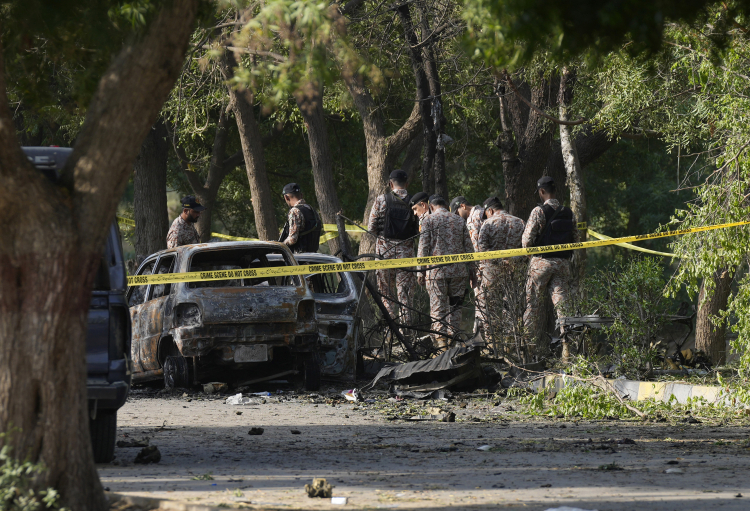
For decades, the Baloch Liberation Army (BLA) has been miscast as a “separatist insurgent group,” a label that is now outdated and misleading. What began as a movement propelled by political grievances and Cold War intrigue has been hijacked by something far more dangerous. Today, the group operates according to the methods of modern terrorism. It deliberately targets civilians and infrastructure, as illustrated once again by the coordinated attacks in Balochistan on 31 January that killed dozens of civilians and security personnel. Cut off from the aspirations of ordinary Baloch citizens and far removed from any genuine liberation struggle, the BLA now functions as a force of destabilization, systematically undermining peace, development, and regional connectivity. In doing so, it has become a force-multiplier for hostile external agendas seeking to cripple Pakistan and derail major strategic projects.
This exploitation of legitimate Baloch demands—for greater political inclusion, decentralized governance, and meaningful participation in national power structures—by terrorists claiming to speak in the name of separation becomes clear when measured against the actual priorities of ordinary Baloch citizens. Surveys and independent political assessments consistently show that public frustration in Balochistan has little to do with aspirations for secession and is overwhelmingly linked to unemployment, governance failures, corruption, poor public services, and chronic insecurity. Polling by Gallup Pakistan ranks jobs, governance and law and order as the province’s top concerns, while calls for secession barely register. The Pakistan Institute of Legislative Development and Transparency (PILDAT) reaches similar conclusions, citing political exclusion, uneven resource allocation, and weak representation as the core drivers of unrest. These findings align with Pew Research Center data showing that most people in Balochistan identify as Pakistani rather than by ethnic affiliation. Mainstream Baloch leaders across ideological lines advocate constitutional engagement and economic reform, exposing a growing gap between public aspirations and the BLA’s escalating campaign of violence.
“Those who wish to talk to us will find our doors open,” said Balochistan Chief Minister Sarfraz Bugti in August 2025, urging all political parties “to stand against terrorism and to acknowledge the state’s sacrifices in countering it.”
This disconnect is most visible in how the BLA now fights. In its early phase in the late 1990s and early 2000s, the group operated mainly as a guerrilla outfit, focusing its attacks on military and security targets. Over the past decade, however, suicide bombings, coordinated assaults across multiple cities, train hijackings and systematic infrastructure sabotage have replaced selective engagements. This turn toward mass casualty violence and psychological shock was exemplified by the 2025 hijacking of the Jaffar Express and the coordinated HEROF I and II operations. Civilian spaces, including buses, schools and public institutions, have increasingly become targets, putting teachers, journalists, students, and daily commuters directly at risk. The rise of semi-autonomous units such as the Majeed Brigade and Fateh Squad has further enabled decentralized, high-impact attacks, a model far more consistent with modern terrorist organizations than with traditional ethno-nationalist insurgencies.
This tactical evolution has gone hand in hand with a fundamental restructuring of the organization itself, blurring the lines between militancy, organized crime, and proxy warfare. Today, the BLA finances its operations through extortion, kidnappings for ransom, smuggling and trafficking, according to the Soufan Center, the Jamestown Foundation, and numerous regional security assessments. At the same time, it has shown a propensity to collaborate with ideologically different militant groups, including Tehrik-e-Taliban Pakistan (TTP), driven less by shared beliefs than by short-term aims. This pragmatic transactional approach reflects a reliance on violence as a tool of expediency and not for political expression. The result is a campaign fundamentally divorced from Baloch political grievances and directed purely toward economic disruption, infrastructure damage and regional destabilization.
The BLA’s rhetoric—and the claims of its apologists that its campaign reflects unaddressed political grievances—can make it difficult to dismiss the group as merely a mercenary force, or a proxy for Pakistan’s arch-rival India. Yet a closer examination of its evolving tactics and funding streams reveals a strategic reorientation that has drawn the organization deeper into regional power rivalries. In recent years, attacks have increasingly targeted Chinese nationals, port facilities, transport routes, and major development projects linked to the China-Pakistan Economic Corridor, signalling a calculated focus on high-value economic and diplomatic assets. Cross-border safe havens, post-2021 weapons flows, and documented instances of foreign intelligence support demonstrate how outside actors now influence the conflict landscape. This trajectory suggests geopolitical interference rather than a genuine nationalist struggle. In effect, the BLA has become a strategic spoiler, operating within a broader struggle for influence, where violence serves external interests more than indigenous political goals.
At stake in how the BLA is described is more than semantic accuracy. Language frames legitimacy, shapes public perception, and influences policy responses. Portraying the organization as a separatist movement confers an undeserved political rationale on acts that are fundamentally coercive, indiscriminate, and terroristic. The grievances of the underdeveloped sections of the Baloch population are genuine and warrant serious political engagement. But the BLA’s campaign of violence has nothing to do with these demands. On the contrary, its actions corrode the civic space necessary for addressing them. An honest assessment therefore requires calling the organization what it has become: a terrorist network that instrumentalizes political narratives to legitimize systematic brutality.
Joe Buccino is a retired U.S. Army Colonel who last served as Communications Director for U.S. Central Command. He is now the CEO of Joe Buccino Consulting
