




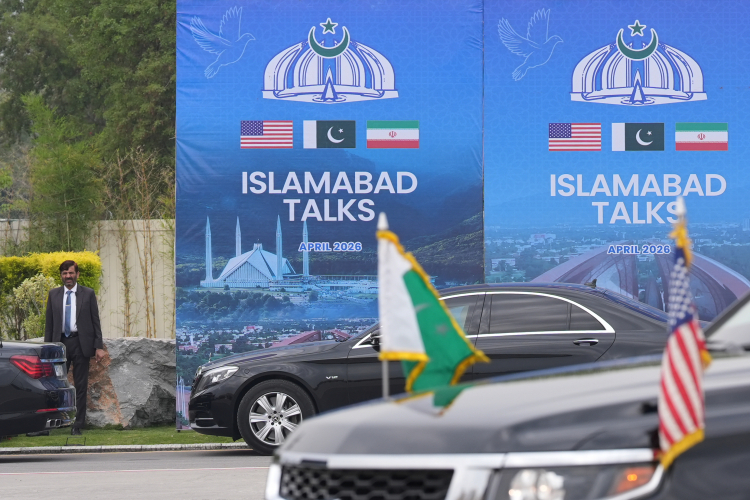
The phrase “military diplomacy” has long sat uneasily in Western policy circles, conjuring images of coups, shadow governments, and the erosion of civilian authority. While that discomfort has not entirely disappeared, it has been softened by Pakistan’s role in negotiations between the DC and Tehran. When Pakistan’s military brokered a two-week ceasefire between the United States and Iran in April 2026 and then hosted the first direct high-level talks between Washington and Tehran since the 1979 Islamic Revolution, something shifted. Across think tanks and international news reports, Pakistan’s military is now described not only as a dominant force at home but as a major diplomatic player abroad.
Concerns over the concentration of power in military hands have not receded. Asim Munir, Pakistan’s Chief of Defense Forces and Army Chief, who was elevated to Field Marshal in May 2025 following Pakistan’s four-day conflict with India dominates a weak and compliant civilian government inside Pakistan and concerns about his domestic power are real. But they now sit alongside a recognition of the military’s practical advantages in critical moments in the Middle East. Unlike civilian governments that turn over with electoral cycles, the Pakistani army offers continuity, institutional memory, and long-standing security channels with Washington, Tehran, and the Gulf capitals. What Pakistan’s current moment illustrates is not that those concerns are wrong, but that they are insufficient as a complete account.
Pakistan’s credibility as a mediator rests on several concrete foundations. Its long record of UN peacekeeping contributions, spanning 48 missions across 29 countries and more than 235,000 personnel deployed since 1960, has built an institutional reputation for sustaining ceasefires in difficult environments. Equally important is Pakistan’s unique structural position: since Washington and Tehran severed diplomatic ties in 1979, Pakistan’s embassy in Washington has permanently housed Iran’s Interests Section, giving Islamabad a formal channel to Tehran that most would-be mediators simply lack. Pakistan is home to the world’s second-largest Shia Muslim population, creating cultural and religious ties with Iran that lend additional legitimacy to its role.
Munir now holds power both internally and globally. His role in the Iran–US process has been critical in ending the American bombing campaign and driving toward a resolution to the war. He is regular contact with the key players on both sides: U.S, Vice President JD Vance, Special Envoy Steve Witkoff, and Iranian Foreign Minister Abbas Araghchi. Trump announced Munir was critical to the April 8 breakthrough ceasefire.
The personal dimension matters enormously. Trump has publicly called Munir his “favorite field marshal”, describing him as "a great fighter," "a very important guy," and "an exceptional human being." That rapport was not accidental. It was built through sustained engagement: Islamabad’s cooperation in arresting the suspect behind the 2021 Kabul airport bombing, Pakistan’s role in the India–Pakistan ceasefire in May 2025, and its early membership of Trump’s new Board of Peace initiative. Munir's relationship with Tehran is similarly cultivated: he travelled to Iran in April 2026 to facilitate a second round of negotiations, meeting directly with Iranian parliamentary and military officials.
The debate over Pakistan’s precise role — passive conduit versus active architect — matters because it speaks to agency, not just access. Available evidence increasingly supports the latter characterization. Pakistani officials delivered a 15-point US proposal to Tehran in March and drafted a ceasefire framework of their own when that was rejected. After the first round of talks concluded without a deal, Pakistan began formally referring to the process as the “Islamabad Process,” a deliberate piece of branding designed to establish a permanent mediating role, not a one-off event.
None of this is without risk for Pakistan. Should negotiations collapse, Islamabad will absorb at least a portion of the blame. Further, the sidelining of Pakistan’s elected civilian foreign ministry from the substance of negotiations is a democratic deficit that global observers will not overlook. While Prime Minister Sharif and Foreign Minister Dar sat at the table in Islamabad, they were largely sidelined by the Trump administration, which preferred working directly with Munir.
While the United States remains institutionally uncomfortable with military leaders as primary diplomatic interlocutors, that discomfort has not stopped it from operating that way, at least at this critical moment. Pakistan's brand of military diplomacy works, and that is precisely what should give us pause. While the Islamabad Talks may not have produced a final deal, they may have offered something more durable: a new diplomatic geometry in a region where the old coordinates no longer hold. Pakistan is not alone in this. Across the Middle East, it is generals and security chiefs, not foreign ministers, who hold the relationships that move events. The question this raises is not whether military diplomacy is effective. It demonstrably is. The question is what gets traded away when legitimacy and accountability are the price of admission to the table and who, in the end, is setting the terms.
Joe Buccino is a retired U.S. Army Colonel who served as communications director for U.S. Central Command from 2022 to 2024. He is the author of the book, “When Every Word Counts: How to Earn Trust, Command Attention, and Communicate Clearly in Any Situation.”
