




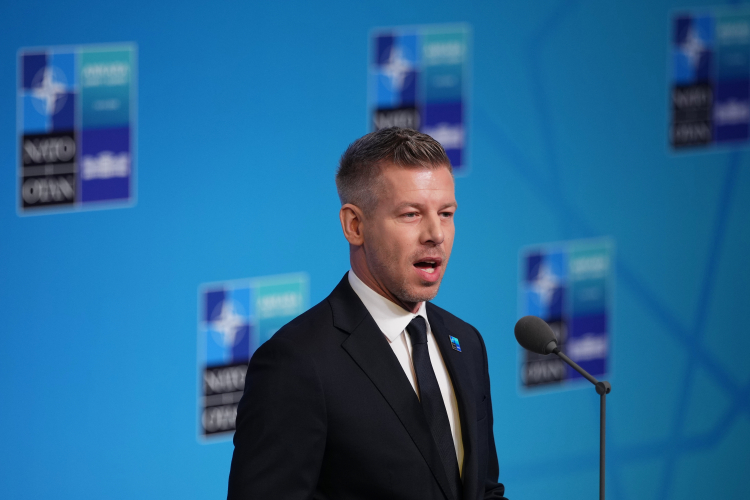
“Ladies and Gentlemen, Hungary is back.” This declaration by Romulusz Ruszin-Szendi, the Central European nation’s new Defense Minister, quickly became the running motto last week at the Equilibrium Institute’s Budapest Energy and Security Talks (BEST), at which this author was in attendance. It was a sentiment defense policymakers from both sides of the Atlantic have longed to hear.
At the forefront of the newly elected Prime Minister Peter Magyar’s administration is the message that it will bring Hungary’s foreign policy into alignment with the rest of Europe. The BEST forum functioned as a presentation of the new government’s security policies to the rest of the world. Geopolitical experts, military officers, business leaders, and policymakers from across Europe and the U.S. debated and discussed issues concerning energy strategy, AI development, and state infrastructural cybersecurity. Discourse centered on building a common outlook to be shared by Washington, Budapest, and their common allies. What was clear throughout the various panels was the new administration’s intention to firmly reassert Hungary as a member of the pro-NATO camp. Realization of his vision is contingent upon Magyar’s successful cultivation of Budapest’s relationship with Washington.
The liaison between Hungary and NATO has been complex for several years. Hungarians never stopped their contribution to the alliance nor hesitated to provide aid to Ukraine’s fleeing people when they were able. From leading the aerial defense of the Baltics, to providing aid and shelter, often in their own homes, to the millions of Ukrainian war refugees, the Hungarian people and armed forces more than did their part. The nation has kept to its commitment to spend over two percent of its GDP towards NATO, according to the Atlantic Council. The war played a noticeable role in Hungarians’ voting decisions as well, with many seeing parallels to the Soviet invasion of 1956.
Politically however, tensions boiled. Examples include Orban delaying Sweden and Finland’s accession to NATO and having constant spats with Kyiv over allegations of maltreatment of Ukraine’s Hungarian minority community. Russian oil exports were a constant specter with Kyiv seeking to halt their facilitation to bleed Putin’s war chest. Meanwhile, Orban accused Ukrainian President Zelenskyy of endangering Hungarian energy stability. Chinese Belt and Road investments in telecommunications development, manufacturing and logistics, and AI research and development agreements are firmly entrenched and even accompanied by security agreements between Beijing and Budapest. Stranger episodes entail Hungarian authorities detaining Ukrainian money trucks and claims of Ukrainian threats against Orban’s family. The chaotic portfolio of the nation’s foreign affairs, along with the endemic accusations of corruption and nepotism, were notable factors in Hungarians’ election decisions.
The biggest loser of this election is Putin. The last major impediment to European unity on providing support to NATO and Ukraine has ended. At the same time, President Trump has signaled a shift of sympathy from Putin towards Kyiv due to its recent battlefield progress, most notably with permission to build Patriot Missile systems. Putin faces a united Europe; one with an appetite to develop military capabilities and industrial production.
Orban’s departure does not signal that the West’s previous issues are resolved. One of the first actions of the new Prime Minister was to meet President Zelenskyy over the issue of protecting minority Hungarians in Ukraine’s Transcarpathia region. Hungary also remains heavily reliant on direct Russian energy sources, as does the rest of Europe through a loophole of facilitating it through Türkiye. Magyar acknowledges the potential dangers of relations with China and seeks limits, but does not call for Beijing’s departure, if he can even do so. The extent of the danger in Orban’s dealings with Beijing is still being investigated. Facing such daunting challenges, Hungary and its allies need each other more than ever.
To its credit, Magyar’s cabinet did demonstrate at the conference a clear command of the issues Budapest needs to address in order to secure its position with NATO. The joint development of regional defense industrial capacity, strengthening collective cybersecurity and AI development, and pursing energy autonomy are all critical. On these issues they find common ground with President Trump and his demands that Europe take more responsibility for its own self-defense. At the summit however, a focus on “European sovereignty” was occasionally pondered, in which Europe would have the capacity to operate without acting in concert with the U.S. Such thoughts are not without cause. President Trump’s criticisms of European defense shortcomings, contentions with Ukraine, and previous statements of affinity with Putin have raised European questions about the need for greater autonomy. Any distance the Prime Minister has with Washington at the moment should not come as a surprise given Trump’s affinity with Magyar’s political rival. Vice President J.D. Vance even campaigned for Orban during Hungary’s election season. On fair balance, “keeping America engaged with Europe” was another common line at the summit. A notable proponent was Turkish Deputy Foreign Minister Levent Gümrükçü, who acknowledged the history of unequal burden sharing upon the United States concerning Europe’s defense. His comments come after Trump stated his intent to lift sanctions against Türkiye’s acquisition of F-35 jets stemming from the purchase of the Russian S-400 air defense system at the NATO Summit in Ankara earlier this month.
The underlying tension that continues to appear amidst these events is the issue of lingering mistrust between western nations. This proves that NATO’s political alignment challenges did not end with the Orban administration’s departure. The overwhelming consensus of the Budapest conference’s attendees was that “the West is stronger together.” Left unaddressed however, the vestiges of division could grow and overtake them.
While Europe must develop domestic capacities to avoid the past mistake of being completely reliant on the Americans, total autonomy is neither feasible nor even desirable. For one, European love of regulation has long hampered its ability to innovate in terms of defense capability. The willingness to relax standards was a hotly debated topic at the conference, signaling a continued need for complementary American ingenuity both in cyber and industrial developments. While Ukraine’s heroic defense of its homeland from Russia has resulted in cosmic leaps of drone capability, it alone is not enough to meet Europe’s needs. American defense industrial manufacturing remains a dominant force in global military affairs. It’s utilization in Europe’s rearmament is critical from a strategic disposition, specifically to offer NATO’s member militaries common operating platforms. U.S. maintenance of European relations is needed to maintain its agency on the continent. As the lack of progress in the Iran conflict demonstrates, little of lasting worth is accomplished without cooperation among allies.
If Prime Minister Magyar intends to prove that “Hungary is back” politically in NATO, he’ll need to ensure that he does not repeat a mistake that his predecessor made: driving away allies, both domestic and international. The European Union and the U.S. made numerous errors in the manner of their engagements with the Orban administration, which arguably encouraged closer relations with Moscow and Beijing. Meanwhile, Orban’s folly was bringing his nation too close to the eastern powers. This created political isolation at home and abroad, widening the trust gap between Budapest and its strategic defense allies.
Beyond these contentions, the bigger security issues the U.S. and Europe need to address are too great for any to face alone. For both Hungary and Europe, true independence is contingent on a strong defense pact with America. For the U.S., continued global agency relies on strong allies. Despite the presence of some disputes, the dominant message of the Budapest conference was for Europe and the U.S. to stand together firmly in NATO. That sentiment must guide policymaking on both sides of the alliance’s namesake ocean.
Logan C. West is a doctoral student of statecraft and strategy at the Institute of World Politics in Washington D.C. and an alumnus of the Hungary Foundation’s Budapest Fellowship Program.
