


« The Woman Who Wants Us Out, Ctd. | Blog Home Page
December 04, 2009The Future of Israel's Labor Party (Pt. 2)
By Thomas G. Mitchell
Click here for part one.
Labor is now on the verge of a split. Former faction leader Daniel Ben-Simon has given his party two-three months to reform or he will join four rebel MKs to form a new faction. This faction can either join with Meretz, with Kadima, or remain independent. If Labor does split, expect to see meetings between Kadima, Meretz, and the new faction and perhaps the remainder of Labor as well over a reorganization of the Center-Left in Israel. Whatever new Center-Left combination emerges will first have to destroy Labor and consolidate its hold over the Ashkenazi moderates before it can compete with the Likud. We could see a Big Bang II or a rumble between the rebels, Kadima, and Labor for control of the peace camp. It will be interesting to see what happens next.
Labor received 19 seats in both the 2003 and 2006 elections. In late 2008—early 2009 Labor was polling only eight seats before the Gaza War helped to boost it to thirteen seats in the February 2009 election. It suffered from Israel’s poor performance in the Second Lebanon War in the summer of 2006 against Hezbollah. Amir Peretz was replaced as Labor leader in 2007 by former prime minister and chief of staff Ehud Barak. Barak wanted to serve as defense minister until Labor was sufficiently recovered that he could be elected prime minister. So when given the choice of serving in opposition second to Kadima or joining the Likud coalition under Benyamin Netanyahu in 2009 as defense minister, Barak quickly opted for the latter.
From 1984 to 1990 and again from 2001 to 2006, Labor spent most of its time as an equal or junior partner in governments of national unity dominated by the Likud. This has led to a blurring of the borders between the two dominant Israeli parties. This was partly the result of the influence of the “military politicians” or former generals in Labor. These generals, in whichever party, tend to look upon a ministry as another command similar to a theater or branch command in the IDF. Temperamentally most of these generals are incapable of sitting in the opposition for long periods of time as ideologically motivated civilian politicians are. If they don’t get a ministry they will leave politics and make money in the private sector.
Israel’s Center-Left sector has two other parties: Meretz and Kadima. Meretz was formed as an alliance of three smaller liberal or socialist parties in 1992 who had earlier cooperated in municipal elections in 1989. Two of these parties, Ratz and Mapam, were splinters from the ruling Labor Alignment, which existed from 1969 to 1984. The third, Shinui, is a splinter from the Democratic Movement for Change, which began as a protest movement in 1974. In 1997 the three parties merged into a united party. Meretz is, unlike Labor, an ideological party with two main concerns: opposing religious coercion and the peace process. Meretz varied between nine and twelve seats during the 1990s and then went to half that number during the following decade as it lost voters trying to shore up Labor. It has since its inception been the most dovish Zionist party in Israel. In late 2009 Meretz relaunched itself as the New Movement by integrating a number of prominent intellectuals into the party. The move backfired, largely because of divergent views about the Gaza War and the party ended up with only three seats.
Kadima was created four years ago in November 2005 when Prime Minister Ariel Sharon split his followers from the Likud. He did this in order to win more freedom of action than the Likud was prepared to give him. Two months later he suffered a massive stroke and has been in a coma ever since. Kadima’s leadership devolved to former Jerusalem Mayor Ehud Olmert, a longtime Likud party worker. In March 2006 Kadima won 29 seats its first time out and emerged as Israel’s largest party. After the Second Lebanon War Olmert’s poll ratings were in the low single digits and then in late 2008 he was indicted for corruption.
Tzipi Livni won a Kadima leadership contest by a narrow one-percent margin but failed to forge a coalition government in the fall of 2008 leading to new elections. Kadima again emerged from the election as Israel’s largest party with 28 seats. On the face of it this would seem as if it has a stable electorate. But the Likud also recovered from an all-time low of twelve seats in 2006 to emerge with 27 seats in 2009. From where did it get those seats? Labor lost six seats and Meretz lost two seats in the 2009 election. Those voters probably all went to Kadima in an attempt to shore it up so it would emerge as the largest party. Thus Kadima probably lost nine seats to the Likud: eight seats from its original 2006 voters who were replaced by voters from the Left and the one seat it dropped. The remaining six seats the Likud gained from religious parties and parties of the Right.
Israeli political scientists have for some time been writing about the “dealignment” of Israeli politics as a result of the lost dominance of Labor and the temporary change of the voting system. Labor went from the largest party to the second largest over a twenty-nine year period. It then remained as second largest for thirty-two years. It then jumped from second largest to fourth largest in 2009. This was due both to the recovery of the Likud, and the expansion of the Russian-immigrant Israel Beitenu (Israel, Our Home) party led by Avigdor Lieberman.
When Barak joined the coalition he was faced with an internal opposition by Labor MKs that wanted to remain with Kadima in opposition to Netanyahu. Barak could be left with a small rump that would then join the Likud. If this seems unlikely, consider that in 1965 former Prime Minister David Ben-Gurion bolted from Mapai and formed his own list, Rafi, which received ten seats in the Knesset. Three years later Rafi united with Mapai and another socialist party to form the Israel Labor Party. Ben-Gurion and a rump following stayed separate and received four seats in 1969 as the State List. In 1973 it was one of the two small parties that joined with the Gahal bloc to form the Likud.
Kadima has largely taken Labor’s place as the largest party in Israel. But it lacks natural partners to allow it to form a governing coalition. Its natural partners are Labor and Meretz. But together these two will be able to offer less than the number of seats that Labor alone brought to the coalition in 2006. This means that Kadima, like Labor in the 1980s, will be faced with the choice of opposition or sharing power in a government of national unity with the Likud. This will rule out the type of concessions that would be necessary to make peace viable on the Palestinian track. Incidentally, Fatah on the Palestinian side is in the same position. This will mean that peace talks will be limited to the Syrian track with Bashar al-Assad’s Ba’athist party dictatorship. So the crucial question then becomes what will Assad be able to offer to Israel to persuade it to give up the Golan for peace? That is the subject for another column.
-------
Thomas G. Mitchell, PhD is an independent researcher who was educated in Israel and the United States and specializes in research in settler societies.
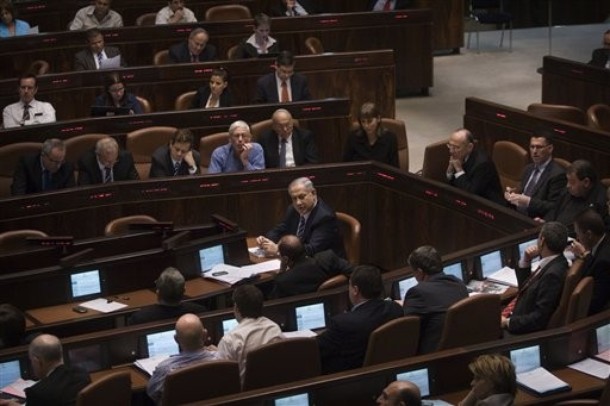
(AP Photos)