Main

March 14, 2010

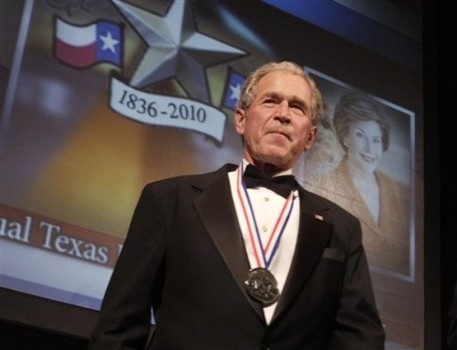
George Bush FTW?

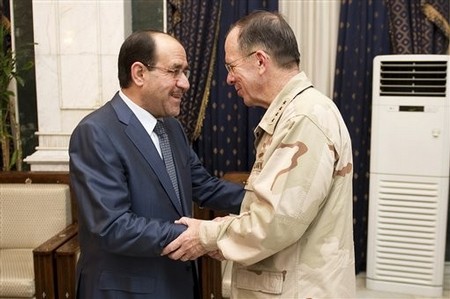
rsz_bush031410.jpg

Is it time for George W. Bush's victory lap? Not so fast, writes Carlos Lozada:

So, is it time to declare victory and start putting Iraq behind us? Not quite, says Dominic Tierney, the author of "Failing to Win: Perceptions of Victory and Defeat in International Politics." In Iraq, victory won't become evident with a surrender document, a key battle or a symbolic moment, like an election, but through a series of "incremental gains," much like a war on poverty, said Tierney, a Swarthmore political scientist. "It would take years of Iraq as a stable ally in the Middle East before we can look back and say it was all worth it," he said.

Today's triumphalism could easily dissipate, Tierney fears, if U.S. casualties jump or violence rises as Iraq puts together a new government. But as the United States struggles with wars abroad and political gridlock at home, even temporary public indifference to Iraq may feel like a strange sort of victory.

I think this is basically right, however the public indifference mentioned by Lozada is really the most troubling aspect of the current Iraq debate. A very small and insulated bubble of think tankery and media continues to debate 'victory' in Iraq; meanwhile, the American people have essentially moved on to bigger issues. And while one could argue that indifference is one of the many products of victory, I'd argue that the 2008 election suggests otherwise; the last candidate standing, after all, was the one who could legitimately wash his hands of the Iraq War vote.

But there's a far bigger problem in judging Iraq 'victory' or 'defeat' by the fluctuation of violence or the frequency of peaceful and orderly elections. Joshua Keating explains:

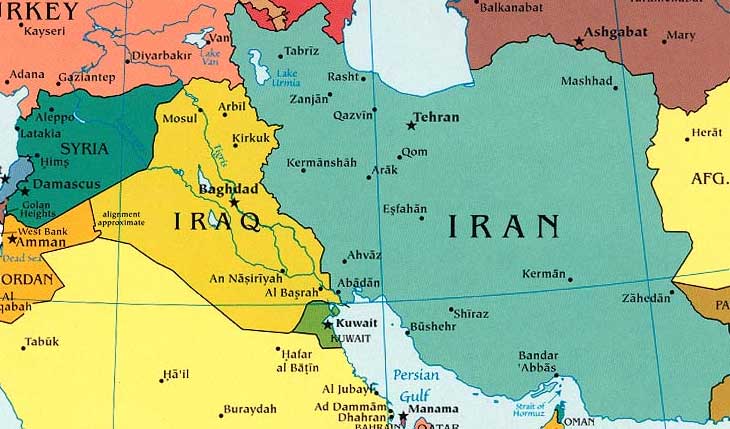
While few are shedding tears for Saddam Hussein, there's not much evidence to suggest that his removal made the world safer -- or that ousting him in this manner was worth the exorbitant cost in blood and treasure. The other two charter members of the axis of evil -- Iran and North Korea -- are still ruled by anti-American autocrats with fast-developing nuclear programs, and Iran, if anything, has been strengthened by the replacement of its archenemy with a reasonably friendly Shiite-dominated government.
The bottom line is that thousands of American lives and trillions of dollars were spent to turn one admittedly barbaric dictatorship into a semidemocracy addled by sectarianism and extremist violence. Doesn't seem worth it.

Moreover, the metric is all wrong, and it's imperative that we continue to evaluate and judge the Iraq War not by the success of the so-called Surge or this month's elections, but by the decision to go to war in the first place. Americans might want to revisit that decision with care, because Iraq is now the great project of a generation. It is the Moon landing of the oughts; America's global contribution. You don't, as I've argued, get multiple Iraqs. Rarely is a state handed the global capital to unilaterally re-engineer an entire society based on dubious intelligence and assertions.

In other words - to tweak the Pottery Barn rule - we shouldn't judge success or failure in Iraq by how well we glued the vase back together, but why it was broken to begin with.

(AP Photo)

March 12, 2010

Democracy, WMD, Iraq

Peter Feaver has an important acknowledgment on the subject:

There were good reasons to promote regime change in Iraq and good reasons to oppose it. But the strongest case for the urgency of dealing decisively with Iraq in 2002 hinged on Iraq's WMD arsenal and its pursuit of capabilities to expand that arsenal. Had the true condition of that arsenal (limited) and the true status of the pursuit (ongoing but slower than suspected and put on a somewhat slower track deliberately pending the final collapse of the sanctions regime) been known by the Bush administration, the president's national security team would have pursued other more urgent priorities in the war on terror. And had it been known more widely in Congress, there would not have been such strong bipartisan support for the use of force resolution; all of the major Democratic senators in 2002 with ambitions for the 2004 presidential run supported the use of force resolution because they agreed with the consensus view that Iraq had a formidable WMD arsenal and was seeking to expand it still further. And had it been known more widely in the international community, the argument with our allies would have been over the existence of an Iraqi threat rather than over the best strategy for dealing with it.

I think Feaver's acknowledgment is important because it also casts the post-hoc rationalizing and exculpating that has accompanied Iraq's current stability in the proper light. None of the national security objectives of the invasion were realized, minus the "regime change" so prized by the war's most fervent supporters.

But there's a problem with Feaver's argument as well, and that is the notion that the existence of WMD would have justified a war. Here, obviously, opinions differ widely, but a large part of the WMD argument didn't simply hinge on the mere existence of weapons, but on what Saddam would do with them. We were led to believe, principally by neoconservatives analysts who didn't have much to say about al Qaeda before 9/11, that Saddam would take the unprecedented step of transferring weapons to al Qaeda for use against the U.S.

In other words, we were led into the war on the basis of a hypothetical. World War I and II, Korea, Vietnam, the first Gulf War, Afghanistan - these were military actions taken in response to concrete events. The second Iraq war was not. Many people were not troubled by this use of military power at the time - indeed, they pushed for war precisely because it would be a demonstration of America's willingness to use force outside of traditional norms. And I think this view informs a lot of the cries of "victory" surrounding Iraq - it's not just a rear-guard effort to rehabilitate careers and legacies. It's an effort to resuscitate the idea that military power can and should be used in this fashion.

March 11, 2010

Worst.Year.Ever.

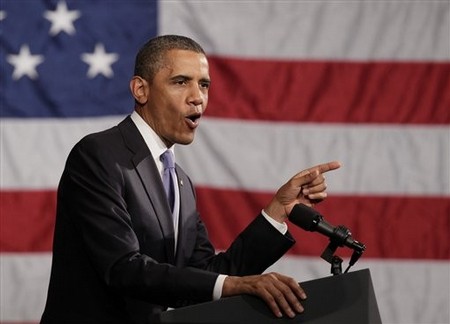
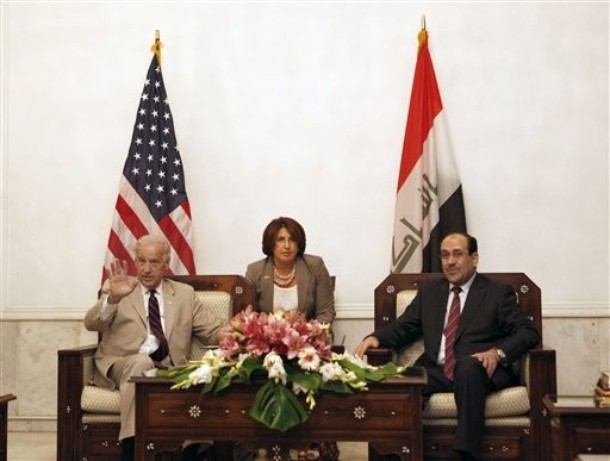
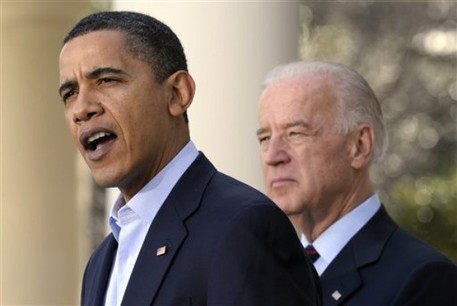
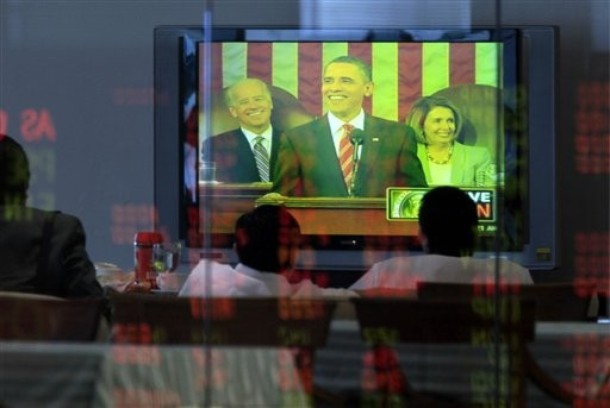
rsz_obamabiden031110.jpg

Danielle Pletka laments the end of American civilization as we know it:

Consider that the president’s own staff can’t gin up a single special relationship with a foreign leader and that the once “special relationship” with the United Kingdom is in tatters (note the latest contretemps over Secretary of State Hillary Clinton’s bizarre intervention on the Falkland Islands); that neither China nor Russia will back the United States’s push for sanctions against Iran; that Iran, it seems, doesn’t want to “sit down” with the Obama administration and chat; that the “peace process” the president was determined to revive is limping pathetically, in no small amount due to missteps by the United States; that one of the key new relationships of the 21st century (advanced by the hated George W. Bush)—with India—is a total mess; that the hope kindled in the Arab world after Obama’s famous Cairo speech has dimmed; that hostility to America’s AfPak special envoy Richard Holbrooke is the only point of agreement between Delhi, Islamabad, and Kabul; that there isn’t a foreign ministry in Europe with a good word to say about working with the Obama White House; that there is a narrative afoot that began with the Obama apologia tour last year and will not go away: America is in decline.

Too many of these problems can be sourced back to the arrogance of the president and his top advisers. Many of Obama’s foreign policy soldiers are serious, keen, and experienced, but even they are afraid to speak to foreigners, to meet with Congress, or to trespass on the policy making politburo in the White House’s West Wing. Our allies are afraid of American retreat and our enemies are encouraged by that fear. George Bush was excoriated for suggesting that the nations of the world are either with us or against us. But there is something worse than that Manichean simplicity. Barack Obama doesn’t care whether they’re with us or against us.

And that's in just one year! Imagine how much he'll have ruined by 2012!

Needless to say, I find all of this to be a bit exaggerated, and even a bit disingenuous. Keep in mind that many once thought it cute or tough to alienate and insult allies; designating them as 'old' and 'new' Europe, for instance. When the Bush administration ruffled feathers it was decisive leadership; when Obama does it it's the collapse of Western society as we know it. Pick your hyperbole, I suppose.

After eight years in office, did President Bush actually leave us with a clear policy on ever-emerging China? How about the so-called road map for peace? How'd that work out? Did President Bush manage to halt Iranian nuclear enrichment, or did he simply leave Iran in a stronger geopolitical position vis-à-vis Iraq and Afghanistan?

Pletka attributes many of these perceived failings to "arrogance." But it has been well documented that the previous administration was also stubborn, resistant to consultation and set in its ways. How then, if Ms. Pletka is indeed correct, has this changed with administrations?

Pletka scoffs at the president's insistence that policy is "really hard," but he's right - as was George W. Bush when he said it. Perhaps, just perhaps, the problem isn't what our presidents have failed to do, but what we expect them to do in an increasingly multipolar, or even nonpolar world?

(AP Photo)

March 10, 2010

What Next for Iraq?

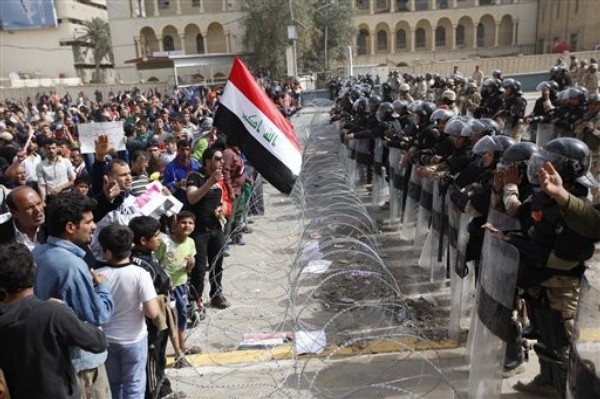
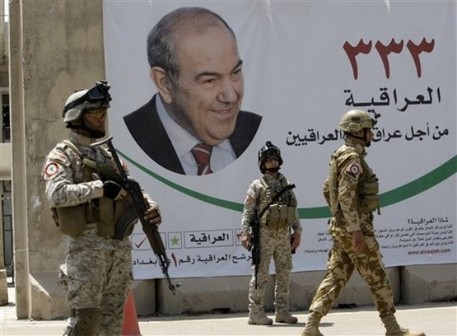
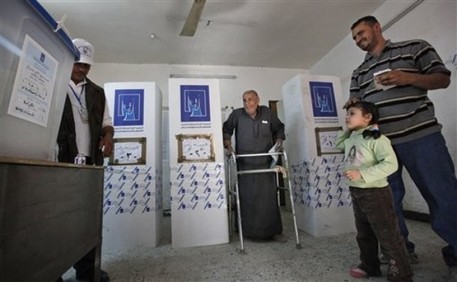
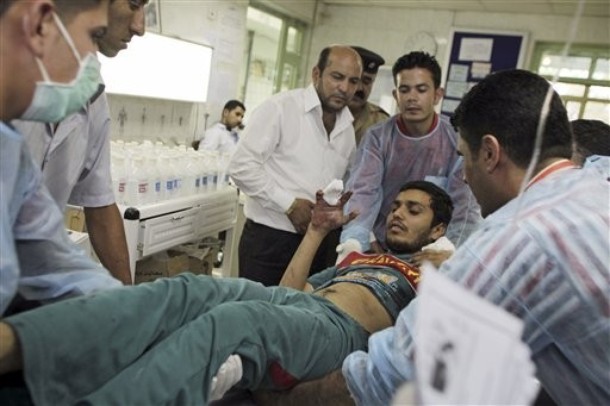
rsz_iraqvote.jpg

By Kirk H. Sowell

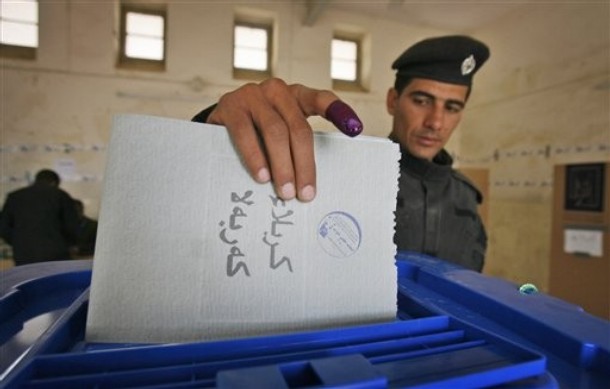
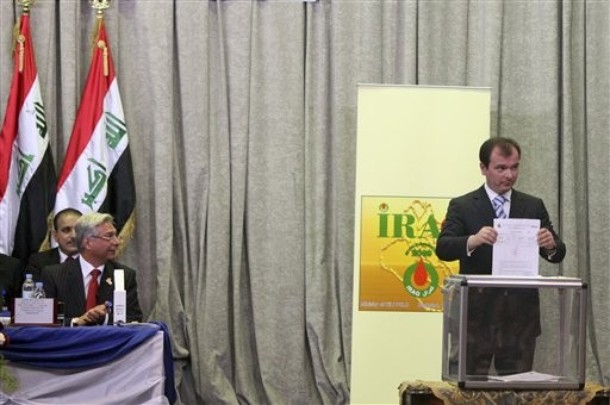
Now that Iraq has made it through another round of parliamentary elections, what next? The Iraqi High Electoral Commission (IHEC) has announced that it will release vote counts in thirds, will all votes to be officially certified by March 18, although such deadlines have been delayed in the past. Originally, the first announcement was set for this Thursday, March 11, but IHEC officials are now saying that they will try to release the first round of results tomorrow. The accelerated schedule no doubt has been influenced by the rampant leaking of partial and sometimes contradictory vote results by Iraqi websites linked to the parties. Credible reports indicate that Prime Minister Nuri al-Maliki has won a plurality, although by how much is not yet clear.

Once IHEC has certified the results, President Jalal Talabani will have 15 days to call the new parliament into session. It then has 30 days to elect parliamentary leaders and a new president. Once the new president is sworn in, he will have 15 days to designate the candidate of the largest bloc as the prime minister-designate, and the PM-designate will have 30 days to form a government. If he cannot, then he may ask for an extension, or the president may designate another bloc leader, and the second bloc chosen does not have to be the largest. For a more detailed explanation of the process, see a recent paper by the Washington Institute for Near East Policy. You may also want to check out IHEC’s website (although they don’t usually keep the English version updated very well).

Bear in mind that the parties which make up the electoral blocs are not required to vote with the leadership of their bloc. While party discipline in the last parliament was pretty strong it was quite common for parties to take positions against the blocs through which they were elected, or leave them entirely. Once the parties are seated, I expect them to realign into five groups which do not necessarily correspond to their blocs.

The first will be Maliki’s State of Law Coalition. Maliki’s bloc is the most internally cohesive, and it would be surprising of any of the parties running on it were to abandon him.

The second will be the Kurds and the most Iranian-aligned parties of the Iranian-backed Iraqi National Alliance (INA). The success of the opposition Kurdish Gorran Party will likely make them more fragmented than before, but the Kurds’ ties to the INA’s leading party, the Islamic Supreme Council of Iraq (ISCI), are longstanding and welded together by a common opposition to Maliki’s centralizing drive and the Sunni Arabs and secular Shia who make up the current opposition. While this Kurd-ISCI tandem would like to replace Maliki, I don’t expect them to have the seats to do so, and they will probably negotiate a government with him.

The third will be the Sadrist parties of the INA, the Sadr Current led by Muqtada al-Sadr, and the smaller Fadhila Party of the Ayatollah Muhammad al-Yaqubi. They joined ISCI in the INA only to check Maliki, and given their long mutual enmity it would be surprising if they stayed together. Like ISCI, both Sadr and Fadhila have had past conflict with Maliki. The difference between the Sadrists and ISCI is that the Sadrists have made genuine efforts to form coalitions with Sunni Arabs. I know the Sadrists would love to exclude their Shia Islamist rivals from power, but I doubt there will be enough seats for that. They will probably end up negotiating a deal with Maliki.

The fourth group is made up of Sunni Arabs and secular Shia parties, and seem certain to be dominated by Iyad Allawi’s Iraqi National Movement. I view recent media coverage of Allawi’s success as overblown, however. Allawi’s bloc has done well in the Sunni provinces, akin to an American presidential candidate running up votes in a state his party always wins anyway. Credible estimates I’ve seen from multiple sources in the Iraqi press give Allawi only somewhat better results in Shia areas than in the past, which is not enough. They will likely end up in the opposition.

A possible fifth group might form from Sunni Arab and secular Shia groups outside of Allawi’s bloc who could end up being a kind of swing vote in parliament. The most prominent is that of Ahmad Abu Risha, whose Anbar-based party played a key role in fighting al-Qaeda during the so-called Surge. This group could also include Sunni and secular Shia elements of the INA which aren’t satisfied with whatever deal seals the new government.

Kirk H. Sowell is an independent consultant based in the Washington D.C. area.

(AP Photo)

March 9, 2010

Can Democracy Take Hold in Iraq?

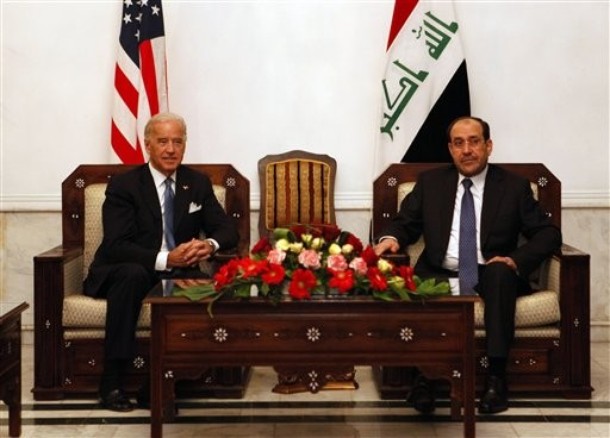
biden%20iraq.jpg

Daniel Larison takes note of Iraq's one million men under arms and writes:

...one of the last things fledgling democracies in countries with a history of authoritarianism need is a massively oversized military and security apparatus. It is often the case in developing countries that the military can serve as an institution that unites and integrates the nation. This will tend to make it the one institution most of the population trusts and respects. However, with greater prestige and respect comes a willingness to intervene in politics when the elected civilians prove themselves to be incapable of governing effectively and/or relatively honestly. When experiments in liberalism, democratization and privatization go awry or are associated with extremely negative economic conditions, public confidence in these things disappears. If democratization is followed by dysfunction, corruption, misrule and lack of basic services, military or authoritarian government becomes very attractive. Given the extent of the sectarian politicization of Iraq’s military and police that already exists, and considering the harsh and arbitrary practices of security forces right now, the differences between an authoritarian and a democratic Iraq are not nearly as great as they are supposed to be.

This is true but here's the tricky part: we need to set the bar for Iraq low because it's unrealistic and unreasonable to expect the emergence of a truly liberal, westernized market democracy to spring forth from the ruins of Saddam's bloody tyranny so quickly (with time, hopefully). As galling as a lot of the crowing about "victory" is, it is, to my mind, a good thing that Washington is going to content itself with "good enough" in Iraq.

Pointing out that Iraq is at present not very democratic, that Freedom House presently ranks it as unfree or that Transparency International ranked Iraq as the fourth most corrupt country in the world - these things could easily be turned on their head as a reason to stay in the country for an even longer stretch until we've brought it up to our standard. I think James Dobbins is right when he said the standard of any state-building exercise must be a relative one. A countries progress must be pegged to the status of its neighbors, not some absolute standard of perfection. That this nuance will be lost amidst the crowing is unfortunate, but it's the price we have to pay to reset our strategic position following the war.

(AP Photo)

March 8, 2010

Iraq Coverage

Just a reminder, in addition to the blog coverage we're offering on the Iraq elections, be sure to check out our Iraq hub page for a roundup of all the latest commentary, headlines and video on this week's vote.

Discipline of the Sword as Foreign Policy

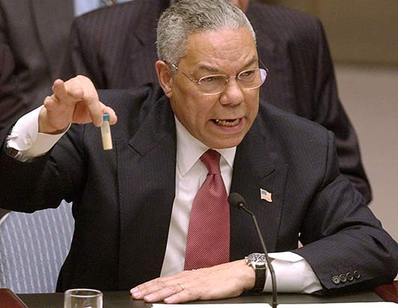
rsz_colin_powell_030810.jpg

There isn't a whole lot I can add to Greg's excellent critique of Jonah Goldberg's latest NRO piece on the current situation in Iraq. I concur with just about everything he had to say, although I'd take said criticism a tad further and ask what I believe to be a fundamental - and often neglected - question in American foreign policy: what do we expect of government when it adventures abroad?

Aside from, as Greg already noted, the many lives lost and the trillions likely to be spent when all is said and done, there is an overarching question about the responsibility of government to do as it says it will do, and no more, while exerting American power abroad. Were this a matter of domestic spending I suspect Goldberg would agree, yet as soon as the United States leaves its own shores these principles seem to become null and void. After all, it's certainly noble to suggest that politics end at the water's edge, but should American principles as well?

I don't intend for this to be an anti-Republican, anti-Bush or even an anti-Jonah Goldberg screed. I actually read Jonah's book, Liberal Fascism, and while I disagree with several of his conclusions, I enjoyed the read overall. I especially liked the chapter on President Wilson and the Progressives, in which he writes:

Today we unreflectively associate fascism with militarism. But it should be remembered that fascism was militaristic because militarism was "progressive" at the beginning of the twentieth century.
The idea that war was the source of moral values had been pioneered by German intellectuals in the late nineteenth and early twentieth centuries, and the influence of these intellectuals on the American mind was enormous. When America entered the war in 1917, progressive intellectuals, versed in the same doctrines and philosophies popular on the European continent, leaped at the opportunity to remake society through the discipline of the sword.

Now, I'm in no way suggesting that Jonah Goldberg is using the Iraq War to reengineer American society, nor am I calling him a conservative fascist. I am, however, concerned that this messaging whitewash we're now witnessing only serves to further confuse the purpose of American military might.

That Iraq could possibly grow into a freer, more pluralistic and even prosperous Mideast democracy is a wonderful prospect. But it is not the reason the United States invaded Iraq, and if we don't keep that in mind every time someone such as Goldberg decides to see silver linings in the policy clouds we will only make similar mistakes over, and over and over again.

And if the purpose of American foreign policy is to liberate the oppressed peoples of the world, I would then ask, at what cost? Freedom isn't free; indeed, it apparently, as Greg noted, costs tens of thousands of lives and trillions of dollars.

Is this sustainable? I would think not. U.S. military supremacy can either be a single tier in American foreign policy, or it can be the entirety of that foreign policy. I fear that both political parties often confuse the latter, be it deliberately or not, in order to score cheap points against the sitting president. They do this because it apparently works. Goldberg writes that the mad dash for Iraq credit "shows that America’s victories aren’t Republican or Democratic victories, but American victories. The same goes for its losses." This would be true, if ever a loss or failure abroad were admitted in Washington. But to be that introspective would equal political suicide, and thus, the victory parade must go on.

That's all well and good for legacy building and the campaigns to come, but is such a lack in retrospective criticism healthy for the country as a whole?

Analyzing the South

rsz_iraqpoll030810.jpg

By Kirk H. Sowell

Earlier today I posted a brief guide to understanding Iraq's election results along with links to a couple of Arabic websites publishing partial results, the Iraqi equivalent of exit polls. Right now the Iraqi National Alliance (INA) is publishing partial results as they come in, and while the source is partisan, the numbers seem credible and by and large indicate that they are losing to Iraqi Prime Minister Nuri al-Maliki. If you read Arabic, this is the page in which they are publishing rolling updates: Iraqi Citizens. Note that mainstream Iraqi and pan-Arab sources have only published very broad predictions, if at all, and are not publishing specific numbers yet, as the votes are counted.

This is a basic summary of the reports they are giving, last updated at 5:50 p.m. Iraq time. These provinces are all Shia provinces in southern Iraq, where the swing vote is located:

Karbala: Maliki wins seven of ten seats, the INA three.

Basra: Maliki with a huge early lead over the INA, 6,001 to 2,603, with Allawi's bloc a distant third. A later update did not give numbers, but confirmed that Maliki was ahead with the INA second.

Najaf: Maliki with "small lead" over INA. No specific numbers.

Wasit: The INA is publishing specific numbers for its own candidates by name, saying they are doing well, but says that overall results are "about equivalent" for Maliki and themselves, without giving numbers for Maliki.

Dhi Qar: The INA is publishing some specific numbers by district, but none overall for the province. The numbers cited give the INA a slight edge over Maliki, but probably within the margin of error.

The results in the ten Shia-majority provinces is key because they constitute the only real "swing voters" in Iraqi politics. The Kurds vote for Kurdish parties, the Sunni Arabs for Sunni Arab parties, but the Shia might vote for one of the competing Shia Islamist blocs or the secular Shia such as Iyad Allawi, who are running on joint slates with the Sunni Arabs. The election will thus be determined there. Not counting Baghdad, which is mixed but now predominately Shia, these five provinces account for a clear majority of the Shia seats.

Kirk H. Sowell is an independent consultant based in the Washington D.C. area.

(AP Photo)

Understanding Iraq's Poll Results

rsz_iraq030810.jpg

By Kirk H. Sowell

While partial results of Iraq's parliamentary election are now trickling out into Arabic media, they are not of sufficient reliability to make seat projections, but I have provided links to these “exit polls” below.

Iraq’s new parliament will have 325 members. Bearing in mind the ethno-sectarian breakdown of parliamentary seats is necessary to understand the country’s balance of power:

Shia: 175-180
Sunni Arab: 75-80
Kurdish: 60
Minorities (Christians, etc.): 8

I derive these figures from the provincial seat allocations set by Iraq’s electoral commission. For mixed provinces, I derived a total by using the results of the January 2009 provincial elections as a baseline. In Baghdad, for example, Shia parties won 44 of 57 seats in 2009. With 68 seats for the parliamentary elections, my estimate of Shia seats up for grabs includes about 54 from Baghdad.

Below are the major blocs and political parties. Iraq’s electoral system requires parties to have a certain threshold in order to receive any seats - depending on the number of seats in the province - but allows parties to form blocs which add up their votes in order to ensure that they meet the threshold, and then divide the seats according to party agreement. Under the “open list” system, voters are allowed to vote for individual candidates in addition to a list, but otherwise a bloc’s seats are divided according to that agreement.

State of Law Coalition (Prime Minister Nuri al-Maliki)
Maliki is a Shia Islamist and his coalition is dominated by his Islamic Dawa Party, although it contains some Sunni Arab participation. Although State of Law contains about 40 parties, and has a number of prominent individuals running on it – including Oil Minister Hussein al-Shahristani – it is dominated by Maliki as an individual. Maliki’s political platform emphasizes Iraqi nationalism; a strong, centralized state with Shia Islamist ideology played down.

Iraq National Alliance (INA)
The INA, the formation of which was openly negotiated by Iran in 2009, is Shia Islamist and Maliki’s primary Shia rival. It is much less cohesive, with a number of important parties. The two most important are long-time rivals: the Islamic Supreme Council of Iraq (ISCI), and the Sadrist faction of Muqtada al-Sadr. ISCI was created by Iran and retains close ties to its progenitor, while the Sadrists have more nationalist roots but have accepted support from Iran in their fight against the United States. The nominal chairman of the INA is former prime minister Ibrahim al-Jaafari, who split from the Dawa Party after an unsuccessful party coup attempt against Maliki in 2007. He appears to have decided to throw his lot with Iran in a bid to get back into power.

Kurds
The Kurds are irrelevant in the contest between the Shia Islamists and Sunni Arabs and secular Shia during the election itself; Arabs vote for Arabs, Kurds for Kurds. But their approximately 60 seats will be important in forming a new government. The Kurds are closest to ISCI and thus the INA, and have had problems with Maliki, but their primary conflict is with Sunni Arabs.

Arab Opposition
What we may broadly refer to as the “Arab Opposition” contains an array of political blocs which contain almost all Sunni Arabs plus several secular Shia parties. As the ethno-sectarian breakdown described above makes clear, Sunnis cannot play a meaningful role in Iraq’s national government without allies who can win seats in Shia provinces. The most important of these blocs is the Iraqi National Movement led by former prime minister Iyad Allawi. While Allawi is secular Shia, his bloc is largely Sunni.

One obstacle Allawi faces is that while the Shia Islamists are divided into just two blocs, the opposition Shia parties are spread across four (including his). If Allawi fails to achieve the breakthrough in the Shia provinces he needs, this will be one of the reasons. And the Sunni Arab-Kurd conflict means that he needs to do quite well in Shia areas in order to form a government or even force Shia Islamists into a power-sharing agreement.

I will publish seat projections as data from independent sources becomes available. Reports currently published in Arab media suggest that Maliki is ahead overall and that Allawi’s bloc dominated in the Sunni provinces, but provide contradictory results from the Shia provinces. Arabic-proficient readers who want to read the partial results as they are published by partisan sources may refer to this Maliki website or ISCI’s Buratha News. I emphasize that independent sources have not yet published such precise results.

Kirk H. Sowell is an independent consultant based in the Washington D.C. area.

(AP Photo)

March 7, 2010

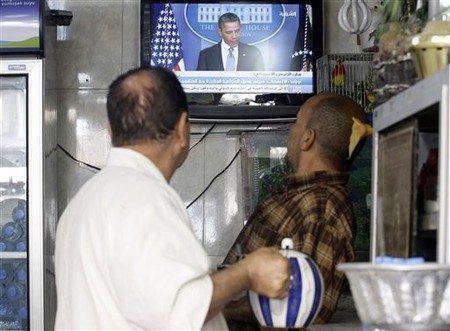
President Obama's Statement on Iraq Elections

Speaking in the Rose Garden, President Obama offered up a note of praise for the Iraqi elections:

Continue reading "President Obama's Statement on Iraq Elections" »

Iraq Debate: Ricks vs. Sullivan

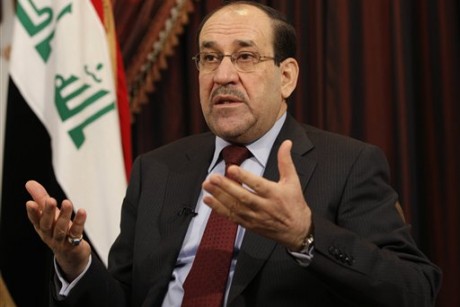
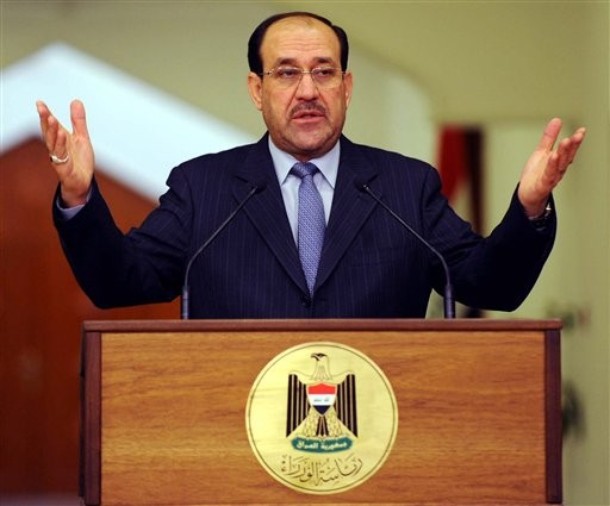
maliki.jpg

Thomas Ricks and Andrew Sullivan have gone back-and-forth over the issue of retaining additional troops inside Iraq to keep the peace following the 2011 withdrawal date established by the Status of Forces Agreement. Ricks believes such forces are essential to maintain stability in the country and asks: "What could be more imperialistic than invading a country pre-emptively on false premises and then leaving many years later in a selfish, callous and clumsy manner?"

Sullivan counters: "Staying forever, while your own country goes bankrupt."

I ultimately believe that Ricks' argument is going to win the day, not because it's terribly persuasive on the merits, but because it operates within the conventional wisdom about how the U.S. should interface in the Middle East. As I wrote during the campaign:


To believe that Obama is serious about ending America's commitment to Iraq is to assume either that the progress Iraq has made to date is irreversible (which almost no one believes) or that he has placed the removal of U.S. troops from Iraq ahead of other regional interests. After all, it is impossible to maintain America's traditional sense of responsibility over events in the Middle East and simultaneously remove large numbers of troops from Iraq, come what may. The only way to convincingly argue on behalf of ending the war is to mount an argument in favor of fundamentally redefining America's interests in the region. Short of that, any proposal for withdrawal will be hostage to the persistent specter of regional instability.

And so it goes.

The trouble with Ricks' argument, and the course Washington appears to be on, is that it is predicated on best-case scenarios. It is, fundamentally, a gamble that nothing major will go wrong inside Iraq that 50,000 U.S. troops cannot contain. If we bet wrong, there is absolutely no rationale for not sending in even more American troops. A commitment of 50,000 troops is essentially a commitment of 150,000, to be stationed in the country indefinitely.

This argument is also predicated on what I view to be a fairly hubristic reading of Washington's capacity to micro-manage events inside Iraq to our liking. As I've said before, if we had such skills, why did we not employ them in the years 2003-2007? That the surge succeed in quelling violence is no guarantee that Washington can hit the next curve ball Iraq throws at us.

(AP Photo)

March 5, 2010

Taking Credit for Iraq

Jonah Goldberg observes that America's view, or at least the elite view, of the Iraq war is changing:

Indeed, that’s what’s so interesting about the strange turn in the zeitgeist. Many of the war’s most ardent opponents claimed that Americans didn’t like the war for the same reasons the hard Left didn’t. But all that talk about “imperialism,” “neoconservatism,” “Cheney-Halliburton blood for oil,” and the rest was not at the core of the war’s unpopularity. What most Americans didn’t like was that we were losing militarily and costing the precious lives of our troops.

I think this is half-right. Reading this, you'd think the only objections to invading Iraq concerned the leftist critique about Halliburton, etc. And sure, there was plenty of that. But the most powerful objection, made by Scowcroft and others, was the one that centered on necessity. This argument did not win the day at the time, but as the war dragged on and the costs became clearer, Americans began to reassess the fundamental question of necessity. Yes, Goldberg is right, Americans want short and victorious wars. Who doesn't? But why wasn't the Iraq war short? After all, we deposed Saddam in a matter of weeks. Why didn't the Bush administration begin a rapid draw-down of American troops after "Mission Accomplished?" Why, ultimately, did concerns for the stability of post-war Iraq keep the U.S. mired in the place for years after the initial victory over Saddam was achieved?

Part of it was clearly an egregious lack in post-war planning. But perhaps a more important issue was the war's lack of legitimacy (i.e. its lack of necessity). The failure to find WMD knocked the legs out of the national security rationale for the invasion. If the administration had nevertheless packed up and left quickly, leaving Iraq in a shambles, it would have been damned twice. So the only possible redemption for the effort lay in an attempt to rebuild the country into a pro-Western democracy.

Goldberg, in his own way, acknowledges this:

First and foremost, it’s a sign that the war in Iraq, while costly and deservedly controversial, was not for nothing. Putting Iraq on a path to democracy and decency is a noble accomplishment of which Americans — of all parties — should be proud. Even if you think the war wasn’t worth it or that it was unjustified, only the truly blinkered or black-hearted can be vexed by the fact that Saddam Hussein’s regime is gone and the country is on the path to better days.

Should this occur, it is indeed a noble accomplishment, but what of the road to get there? The path from Saddam to self-government is piled high with Iraqi dead. The rough estimates for the numbers of Iraqis killed since the invasion reaches into the tens of thousands, and possibly over 100,000.

Obviously we don't know what might have been in Iraq. Maybe Saddam and his brutal minions would have killed an equal number of Iraqis before they gave way to a new government - which may have been even worse. Maybe the country would have come apart after Saddam's death and led to an equal number killed. Maybe all possible roads that diverged from America's decision to invade involved considerably more dead Iraqis than the one we took. All of that is very plausible. But you can't ignore the fact that the road we took resulted in the death of tens of thousands of Iraqis. If Goldberg and other war supporters want to make the omelet/egg argument about their lives and the creation of a new democracy, fine. But I think it's difficult to try to take credit for the emergence of a democratic government in Iraq without simultaneously taking "credit" (or rather, responsibility) for the tens of thousands of Iraqis killed to get there.

March 4, 2010

What Matters in Iraq?

iraqvotes.jpg


Peter Wehner has an interesting perspective on events in Iraq. He writes:

With the passage of time, President Bush’s decision to champion a new counterinsurgency strategy, including sending 30,000 additional troops to Iraq when most Americans were bone-weary of the war, will be seen as one of the most impressive and important acts of political courage in our lifetime. And those who fiercely opposed the so-called surge were not only wrong in their judgment; in some instances their actions were shameful.

To reframe Wehner's argument: President Bush was unhappy with his house. He had some legitimate questions about how secure the structure was and whether it was in need of some improvements. So he decided to set it on fire. He watched it burn almost to the ground (killing tens of thousands of innocent people in the process) and then decided to grab a hose and douse the flames. Despite the hosing, there are still embers everywhere that could potentially reignite. And in the process of burning down his home, his more aggressive and more powerful neighbor now has a better chance of taking over the entire block.

Wehner would have us believe not only that there are no embers (because if they reignite it's Obama's fault now) but that we should pay no mind to the fact that the "most impressive and important political acts of our lifetime" was occasioned by a much larger strategic failure that made such an act of courage necessary in the first place. Don't worry that he burned the place down, just celebrate the fact that President Bush had the wisdom to eventually decide to grab a hose.

This is an extraordinary act of revisionism. But Wehner goes further:

What America has done for Iraq, which had been brutalized for so long, may not be the noblest act in our history. But it ranks quite high. The Iraq war was, in fact, a war of liberation. And the liberation appears to be working. Nothing is guaranteed; “Everything in Iraq is hard,” Ambassador Crocker once said. But regardless of where one stood on the war and the surge, what we see unfolding in Iraq today is something to be grateful for, and to take pride in.

The emergence of a democratic government in Iraq is a good thing and indeed, we should be grateful that the Iraqis are out from under Saddam's yoke. But it's important to distinguish between things that are good, and things that are worth spending 3 trillion dollars and thousands of American lives on. The invasion and occupation of Iraq cannot be justified solely on the basis of our love for democracy. The costs must be justified by gains to the security of Americans.

I would be interested in hearing Wehner defend the proposition that elections in Iraq are moderating the Pakistani Taliban's desire to attack American troops or provide aid and comfort to al Qaeda. Or that Iraq's democracy is undermining the radicalization of Islamist militants worldwide. I would also be interested in hearing why Wehner believes that the regional empowerment of Iran and the placement of a government in Iraq that it is sympathetic (to put it mildly) to Tehran is a strategic boon to the United States. I would like to know why having tens of thousands of U.S. troops in Iraq as a hostage to the country's potential instability positions America well against the emergence of potential great power rivals.

Again, it's not that the surge wasn't successful in tamping down violence and giving America the chance to leave Iraq in a more stable condition. It's not that the democratic process unfolding in Iraq isn't a good thing for the Iraqis (although they had to endure tremendous suffering to get there thanks in large measure to extraordinarily poor post-war planning on the part of Wehner's administration). It's that these things in and of themselves are not the determinants of success or failure in Iraq. The metric is American security and whether the gains there (if any) are commensurate with the costs.

(AP Photo)

March 1, 2010

China's Mideast Security Detail

rsz_iraqchinaoil030110.jpg

Tom Barnett explains how China could reap the long-term benefits of the Iraq War:

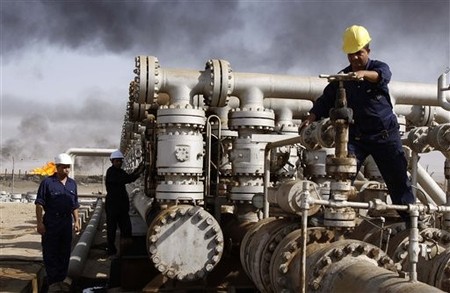
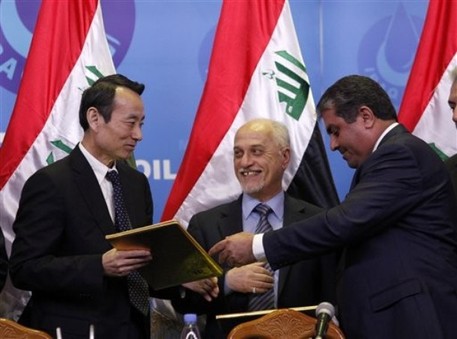
Will the Chinese begin to assume the same kind of security role that the U.S. has historically played in the region anytime soon? Hardly. And yet China's increasing presence throughout the region already alters the correlation of forces. China's national oil company, Sinopec, is the only foreign firm to date to win oil access in both Iraq's Kurdish region and the south. Given Baghdad's ambition and Beijing's unquenchable thirst, the two are a match made in Big Oil heaven -- with Washington's blessing.

And more importantly, with Washington's security. China gets another energy source, minus the nasty byproducts and backlash that come with regional hegemony. Meanwhile, we will have spent approximately $2 Trillion to give China more markets in which they will attempt to supplant the dollar.

(AP Photo)

Locker Room Antics

rsz_iraq030110.jpg

Michael Kamber critiques The Hurt Locker:

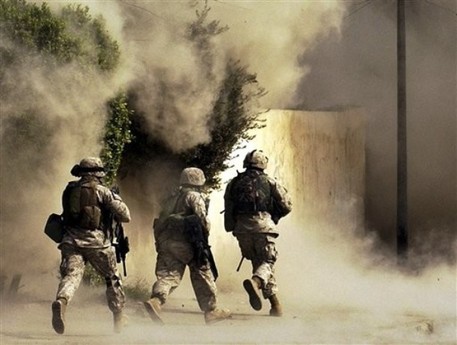
I’ve covered a number of conflicts and Iraq was the least romantic, the one that looked the least like the war movies I grew up on. Yet Ms. Bigelow pulls one out for Hollywood. While many have praised the movie as anti-war, I believe — in a counter-intuitive way — that it glamorizes war. The Steely-Nerved-Protagonist Who Has Seen Too Much kills the bad guys in an action-packed setting and eventually signs up for more. His hard-drinking, P.T.S.D.-ravaged character becomes that much more romantic for his flaws.

I understand the argument that Ms. Bigelow and her team should be applauded for tackling certain issues and bringing the war home to Americans. Yet with so many scenes and details untrue, the actual war in Iraq becomes merely a dramatic jumping off point for the filmmakers.

(AP Photo)

February 25, 2010

Ahmed Chalabi, Ctd

Max Boot semi-defends my imputation that Ahmed Chalabi played a significant role in luring neoconservatives into believing things about Iraq that turned out to be disastrously wrong but were nonetheless convenient in selling the Iraq war to the American people.

For the record, here is my post in its entirety:

Many neoconservatives are demanding that the U.S. throw its full weight behind the Iranians in their pursuit of freedom. On the surface, this is obviously a noble idea, but it’s worth remembering that the very people making confident predictions about the predilections of the Iranian people were duped by an Iranian stooge.

Then Boot writes:

But I also believe Greg Scoblete is wrong: First place, the Green movement in Iran is not a figment of some exile’s imagination. Second, simply because Chalabi is now an Iranian stooge does not mean he was one in 2003. My read is that he is an opportunist, out to grab power for himself, who will make use of whatever allies he finds helpful.

First, yes, obviously the Green Movement is real. Second, I don't know if Chalabi was on Tehran's payroll in 2002 but I do think Boot's take rings true. That does not change the basic premise of my post, which was admittedly not spelled out very clearly in those three sentences. To wit: there is a tendency, especially among those prone to foreign policy activism, to assume the best.

My interview with Robert Kagan was illustrative of this mindset I think. Kagan admitted he wasn't quite sure where we'd end up with Iran's Green Movement but that we should just "press all the buttons" with Iran and see what happens. The default assumption, as it was with Iraq in 2002, is that it is preferable to plunge ahead even when it is honestly acknowledged that we do not know what we're doing or where we're going because doing anything is better than doing nothing.

We see a protest movement in Iran demanding democracy and assume that should it take power, things would be better. This assertion is rife throughout Contentions. But what's the basis for this assumption? The only comprehensive study of Iranian attitudes, that I'm aware, shows that the Green Movement is a lot less influential than we'd like it to be. Nor is there any data, that I'm aware, that indicates that if the Green Movement or its representatives were to take power, that there would be a monumental shift in Iran's appetite for nuclear development, regional stature, or any systemic changes in its foreign policy interests. Maybe this is analysis is way off the mark, and if there's data that contradict it, I'd gladly post it and acknowledge it.

The broader point is that foreign policy activists spend inordinate amounts of time worrying about the hypothetical danger of inaction and almost no time contemplating the possible negative consequences of their proposed solutions. (See Heritage's James Phillips for Exhibit A). With Iraq, they pooh-poohed those who warned of the consequences of an invasion and drew erroneous conclusions about the capacity of Iraq's middle class to reconstitute itself and for oil wealth to pay the way during reconstruction, because such a theory helped sell a desired activism.

And so we turn to Iran's Green Movement, upon whose backs our hopes for regime change now rest. We hear endless calls for throwing the full weight of American support behind her based on assumptions that such a course can't do much harm and could possibly redound to our benefit. We're even told that they'd welcome a bombing campaign!

To my mind, the burden of proof should no longer be on those advising a "wait and see" attitude toward issues like Iran and on those who make grandiose claims on behalf of the potential of the Green Movement or America's ability to shape events in Iran to our liking. Especially after the manifold failures of prediction and analysis that marked the run-up to the Iraq war.

February 24, 2010

Douglas Feith Responds

In response to this post, Douglas Feith writes:

Like so much that has been written on the subject, your February 17 RealClearWorld blog post entitled "Paging Douglas Feith" was far off base.

Ahmad Chalabi's role in Bush administration Iraq policy is discussed extensively in my book, War and Decision: Inside the Pentagon at the Dawn of the War on Terrorism. Interested readers may want to read, in particular, pages 254-257, 242, and 383.

A mythology has developed about how administration officials, especially in the Pentagon, related to Chalabi and to the Iraqi National Congress, which he headed. Part of that mythology is an overblown notion of their importance as a source of intelligence about Saddam Hussein's Iraq.

Another part is the allegation that Pentagon officials aimed to favor or "anoint" Chalabi as the leader of Iraq after Saddam.

It is clear that that mythology was believed by many journalists and various officials within the Bush administration saw benefit in propagating it. But it is false.

Chalabi and the INC provided information to the U.S. government about Iraq before and after Saddam's overthrow. They were among numerous sources of such information. Like the other sources, they provided some information that was accurate and some that was not accurate. That is typical with intelligence sources. Readers interested in the details of Chalabi's role in providing intelligence to the U.S. government about Iraqi weapons of mass destruction (biological weapons, in particular) may want to read the Silberman-Robb Commission report (March 31, 2005), available at http://www.gpoaccess.gov/wmd/pdf/full_wmd_report.pdf.

There was no "anoint Chalabi" policy. As I said in my book, there is no memo, strategy briefing or other piece of paper that I know of that supports the "anoint Chalabi" charge. And the two people who would have had to implement the plan, if there were such a plan - General Jay Garner and Ambassador Jerry Bremer - have both clarified publicly that they were never asked to favor, let alone anoint or appoint, Chalabi as the leader of Iraq.

My book challenged anyone who had actual evidence that contradicts me to bring it forward. In the almost two years since my book was published, no one has produced any such evidence.

Facts matter, and I hope you'll run a correction. I would appreciate your helping to set the record straight.

And if Iraq Unravels?

IRaq.jpg

Thomas Ricks argues that prolonging America's stay in Iraq may be the best possible remedy to a return to civil war:

But I think leaders in both countries may come to recognize that the best way to deter a return to civil war is to find a way to keep 30,000 to 50,000 United States service members in Iraq for many years to come.

These troops’ missions would be far narrower than during the surge era; their primary goal would be to train and advise Iraqi security forces and to carry out counterterrorism missions. (It is actually hard to get below 30,000 and still have an effective force; many troops are needed for logistics, maintenance, medical, intelligence, communications and headquarters jobs, and additional infantry units are then needed to protect the people performing those tasks.)

Such a relatively small, tailored force would not be big enough to wage a war, but it might be enough to deter a new one from breaking out. An Iraqi civil war would likely be a three- or four-sided affair, with the Shiites breaking into pro- and anti-Iranian factions. It could also easily metastasize into a regional war. Neighboring powers like Turkey and Iran are already involved in Iraqi affairs, and the Sunni Arab states would be unlikely to stand by and watch a Shiite-dominated regime in Baghdad slaughter the Sunni minority. A regional war in the middle of the world’s oil patch could shake the global economy to its foundations and make the current recession look mild.

Ricks is perceptive critic of the Iraq war and knows much more about Iraq than I do, but I think he's suffering here from the same bit of hubris that swayed Washington before and in the immediate aftermath of the war - the idea that we can fine tune Iraq's development with a dollop of military power here, a dash of diplomacy there. Yes, maybe. Hopefully! But what if it doesn't work? What if the small force is not enough to "deter" a civil war from breaking out?

When the U.S. left forces behind in South Korea, they were a "down payment" on a much larger force which was to come to their aid in the event of a North Korean invasion. It was a signal of a much more significant American commitment - it was not the entirety of the commitment. So what are these 30,000-50,000 troops we're supposed to leave in Iraq? Ricks is a bit vague here but it's really the whole ball game - are these forces supposed to do what they can and not expect reinforcements if the situation in Iraq really gets bumpy again? Or do they signify an American commitment to send in even more troops should Iraq unravel?

If it's the later, than we are poised to seriously and in my view dangerously tie our hand to an unstable government.

In Ricks world - as in Obama's - if Iraq backslides, we're still on the hook. We're still living in Pottery Barn, red faced and guiltily holding the broken shards of Iraq for 60 or 70 more years. Resources which could be far more productively engaged elsewhere will be expended for the sake of policing a centuries long sectarian rivalry, settling tribal blood feuds and political squabbling.

The U.S. had close to 140,000 troops in the country and couldn't stop a civil war from breaking out. Why would 30,000 deter a civil war this time? It's true that Iraq's security forces are more developed, but if the war starts to pull ethnic and sectarian groups together, will the Iraqi forces not splinter as well?

The fact is we're dealing with too many variables to confidently predict Iraq's trajectory, as Ricks acknowledges, and in any event it's the wrong frame of reference. The question is what's in the best interest of the United States. America's policy in Korea worked because American forces deterred a rival state against a clearly delineated border. A similar trip wire inside Iraq seems much more likely to be tripped than not. Do we really want to tie ourselves to Iraq en-perpetuity?

(AP Photo)

February 23, 2010

The Reason for Foreign Policy Minimalism

biden%20iraq.jpg

It's an oft-recounted story but one that appears to need frequent retelling. In the immediate aftermath of the worst terrorist massacre in this country's history, U.S. forces swept into Afghanistan and quickly pushed the Taliban and al Qaeda into neighboring Pakistan. Having failed to kill the leader of either the Taliban or al Qaeda, and unsure about the relative strength of the group following initial combat, the Bush administration nonetheless shifted its focus, intelligence assets and diplomatic attention to launching a war against Saddam Hussein.

Throughout the years of that conflict, the Bush administration spent most of its energy and attention trying to fix the mess it had made in Baghdad, all the while the Taliban crept back into Afghanistan, ramping up its insurgency. It's not that the Bush administration wanted an insurgency in Afghanistan to rear its head - but it had a much more pressing problem (entirely of its own making) in Iraq.

Now the Obama administration faces the opposite problem. Iraq is relatively stable, Afghanistan is a mess. So naturally, the administration is focusing on Afghanistan. But it's not like things in Iraq are on a sure-fire path to success and we're hearing an increasing number of warnings that the Obama administration is "ignoring" Iraq. Some of this is just partisan positioning - so that if Iraq falls apart, the surge advocates who spent so much time trumpeting victory have an easy scapegoat when the wheels come off. But some of it, like Peter Feaver's post here, seems born of a genuine desire not to see a hard fought stability vanish in Iraq.

And it is a legitimate and important question: what should America's relationship be with Iraq? But implicit in many of the voices raising this question is the assumption that America must take an active role in shaping Iraq's political evolution.

Unfortunately, the government has only so many hands on deck and not many of them possess the unique skills and ability to micro-manage the political evolution of Iraq to our liking. If such a capacity was available in the United States, one wonders why it was not pressed into service in the years circa 2003 - 2008. But more importantly, this underscores a very important and what I took to be conservative maxim that the government should not endeavor to do too much.

(AP Photo)

February 18, 2010

Live Stream: Iraq's Elections & Iraq's Future

The Carnegie Endowment will be hosting Ad Melkert, the United Nations Secretary-General's Special Representative for Iraq, to discuss Iraq's upcoming elections and the outlook on the country's political future.

The event will run from 12:15-2:00 EST and will be live-streamed below.


This text will be replaced


February 17, 2010

Iraq in the Balance

With eyes turning to China and the potential for increased great power tensions in Asia, it's important to remember how weak the U.S. will be in such a circumstance if we can't disentangle ourselves from playing referee inside Iraq. To that end, Leila Fadel's report in the Washington Post is worrisome:

A senior U.S. military official who has spent years in Iraq said he fears that as the drawdown begins, American forces are leaving behind many of the same conditions that preceded the sectarian war.

"All we're doing is setting the clock back to 2005," said the official, who spoke on the condition of anonymity to offer a stark assessment. "The militias are fully armed, and al-Qaeda in Iraq is trying to move back from the west. These are the conditions now, and we're sitting back looking at PowerPoint slides and whitewashing."

If violence begins to ramp up, what will the Obama administration do?

February 10, 2010

Hanson vs. Bacevich

A few weeks ago Andrew Bacevich wrote a piece for the American Conservative arguing that the U.S. hasn't had a stellar track record when it comes to winning wars since 1945. Today in the National Review, Victor Davis Hanson argues that, to the contrary, the U.S. has succeeded in winning the same wars Bacevich dubbed defeats and is in fact winning the war on terrorism. You can read both and decide which is the more persuasive take, but I part company with Hanson as he edges toward drawing parallels with contemporary experience:

In other words, while particular wars in any age may not end in victory or defeat for either side, the concept of such finality is very much possible for either, given their shared human nature. In short, if a war is stalemated, it is usually because both sides, wisely or stupidly, come to believe victory is not worth the commensurate costs in blood and treasure — not because victory itself is an anachronism.

Hanson believes our goals are sufficiently modest that we can win in Iraq and Afghanistan:

In the latter two instances, we are fighting second wars in which victory is defined as ensuring the survival of successive consensual systems under the countries’ elected governments.

So far, we are winning both. Victory is definable: when these states are able to stay autonomous largely through their own efforts — with the understanding that Europe, for 65 years, and South Korea, for 60, have both required American military support to ensure their independence.


There are a few things wrong with this assertion. The first is that the goal of sustaining consensual governments is ancillary to the core purpose of both wars: which is to safeguard the U.S. from acts of Islamic terrorism. If we "won" by Hanson's definition in either country, but suffered further assaults from terrorists based elsewhere or saw no significant diminution of the terrorist threat worldwide, it would be difficult to justify the enormous expenditures in either theater. (Hanson later says as much.)

But notice what else is wrong here. In both the cases of South Korea and Europe, the U.S. role was to provide defense against external enemies, not internal ones. In both Afghanistan and Iraq, the U.S. is laboring to defend countries from mostly indigenous insurgencies, not external, nation state enemies. That transforms the role the U.S. is expected to play in both countries significantly. Given this difference, the lessons from past conventional wars don't offer much guidance. And you can see how it leads one astray:

That there was no visible German opposition to Hitler in 1939 and no visible support for him in April 1945 was due both to overwhelming Allied power and to the knowledge that a magnanimous reconstruction was possible. That we will be unmerciful to radical Islam and quite benevolent to those who reject it — that is the proper message.

The U.S. and its allies killed an estimated 6-to-8 million Germans (of which perhaps as many as 2 million were civilians) and completely, purposefully devastated entire cities in a campaign of total war to break the will of the German state. I would love to know why Hanson thinks this is a proper prescription for "radical Islam" which consists of scattered cells of terrorists throughout the globe, in possession of no country to speak of (except Iran, only we're not at war with Iran and not even those commentators who think we are at war with Iran wouldn't - I hope - advocate the wholesale slaughter of Iranian civilians to collapse the regime). We can indeed be "unmerciful" toward these terror cells, killing them wherever we find them, but that is only one element in a successful strategy.

Consider what has just occurred in Pakistan over the past few months. In August, the U.S. killed the leader of the Pakistani Taliban, Baitullah Mehsud. A few weeks ago, we killed his successor. Now the AP reports that there's a mad scramble among the Pakastani Taliban as people vie to take his place.

I don't know about you, but if my previous bosses kept getting whacked, angling for the job wouldn't be a top priority, and yet there is no apparently no shortage of people who want the job. (Ditto Hamas, which, while not as visible after Israeli assassinations still manages to fill its leadership ranks.) I think it's necessary to kill these people, but it's not sufficient, as insurgencies are fueled by a number of factors and overwhelming military force isn't enough to bring them to heel. And it would be positively insane and counter-productive to embrace a "total war" ethos with respect to an insurgency (especially a global one).

UPDATE: To see what metrics would be appropriate in judging a counter-insurgency see Tom Ricks and David Kilcullen.

February 9, 2010

U.S., UK Views on the Iraq War

As Britain's Chilcot Inquiry examines the country's participation in the Iraq war, Angus Reid surveyed opinion on both sides of the Atlantic on the conflict (full results here, pdf). Some of the key findings:

62% of Britons and 48% of Americans think the U.S. government made a mistake in launching military action against Iraq in 2003

55% of Britons and 69% of Americans think removing Saddam Hussein from power was the right thing to do, even if his regime did not possess weapons of mass destruction

One-in-four Britons (24%) believe that the world will look back on the war in Iraq in twenty years and brand it as a defeat for the U.S. and its allies, while 11 per cent claim it will be regarded as a victory. Americans are almost evenly divided in their assessment (18% defeat, 19% victory).

Another interesting finding is people's recollection of where they stood on the war when it began. Angus Reid asked if they supported the war at the time and found that on net, a majority of Americans now claim they were opposed to the war. That certainly doesn't jibe with how I recall public sentiment at the time.

The poll also found that while Americans claim that it was right to remove Saddam Hussein from power, 48 % of respondents told pollsters the war was a mistake vs. 35 % who thought it was not. That seems just a bit contradictory to me.

February 3, 2010

Influence in Iraq, But At What Price?

IRaq.jpg

Henry Kissinger's op-ed on Iraq argues that the U.S. must retain influence in Iraq even as it withdraws its troops. Sounds reasonable enough. Unfortunately, he doesn't quite say how, outside of a hinted suggestion regarding a special envoy, more high-level visits and the formulation of a strategic vision for Iraq. Nor does he say toward what end U.S. diplomacy and leverage in Iraq should be put to use, except for a vague reference to Iran's nuclear program.

I think it's clear that the U.S. is going to retain some leverage over Iraq for the next few years and there's no reason why the U.S. shouldn't work overtime to keep relations with Iraq friendly. But the situation inside Iraq is very fluid at the moment: the government has been preoccupied with domestic affairs and shoring up its own, very fragile, institutions. No clear picture has emerged yet on where the country sees itself geopolitically in the Middle East.

But Kissinger's piece is also a harbinger of Washington's worst tendencies. In its zeal to get Iraq onto the right side of the geopolitical scorecard, it could push the Obama administration into an even deeper role in Iraq's domestic politics with potentially disastrous results (ironically some of the same people who think the administration should govern Iraq have no faith in the administration's ability to govern America). Even before Kissinger's piece we have heard calls for the Obama administration to get more involved in micro-managing Iraq's political evolution - as if we have a long history of success in such matters, or even the wherewithal to produce an outcome to our liking, especially if we remain committed to a democratic Iraq.

Indeed, the administration's seemingly ad-hoc diplomacy toward the country may actually produce the best results. Proclaiming that we have a strategic blueprint for Iraq's development would likely set off groups inside Iraq that resent American influence and would put American-friendly leaders on the defensive politically.

(AP Photo)

January 30, 2010

Iraq the Irrelevant

Before the invasion of Iraq, we were told by Fouad Ajami and others that the Arab world suffered from certain pathologies that could only be cleansed by deposing a secular dictator who flouted our will and installing a democratic polity in his place. The net effect, we were promised, would "transform" the autocratic structures of the Middle East, giving its people more democratic channels for dissent and thus reducing the threat of jihadist terror directed at the United States.

So how's that going? Max Boot hails the progress thus far in Iraq:

A fragile but working democracy, an increase in foreign investment, a steep decline in attacks over the past several years—all these are signs that Iraq is hardly unraveling. That doesn’t mean that it is on a one-way flight to Nirvana. American vigilance and involvement remain essential. But an awful lot has gone right recently—more than I would have predicted back in 2007, when the surge was just beginning. Perhaps, just once in the Middle East, the pessimists will be proven wrong.

Here's hoping.

But notice what has not happened as a result of the progress to date in Iraq: a diminution of the al Qaeda threat. Instead, that threat is where it always was, tied to a Taliban insurgency in the Afghanistan-Pakistan border and creeping out into Yemen and Somalia.

The net result of the Iraq war from a counter-terrorism perspective has been to give Arab terrorists a first hand seminar in urban warfare, skills they are now delivering to the Taliban to sow death against U.S. and NATO forces. There is not much in the way of evidence that I'm aware of to suggest that progress in creating a democratic regime in Iraq is having any influence over the global terrorist movement. And at the end of the day, wasn't that the point of the endeavor?

January 29, 2010

Tony Blair's 9/11 Defense

TonyBalir.jpg


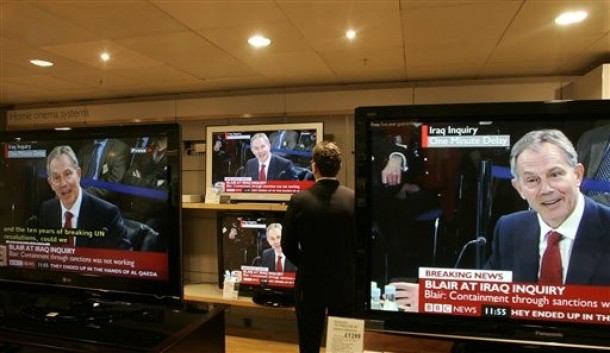
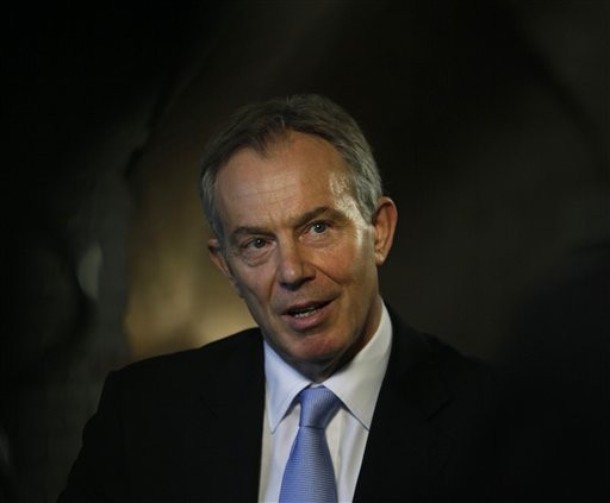
Appearing before the Chilcot Inquiry, former British Prime Minister Tony Blair defended his decision to join the U.S. invasion of Iraq:


Looking greyer than when he was in office, Blair told the inquiry that the British and American view changed "dramatically" after 9/11.

"Here's what changed for me: the whole calculus of risk," he said. "The point about this terrorist act was over 3,000 people had been killed, an absolutely horrific event. But if these people, inspired by this religious fanaticism, could have killed 30,000, they would have [done].

Blair went on to argue that Saddam's WMD program was an intolerable risk after 9/11. This is a fairly common line of argument regarding Iraq but it doesn't hold up logically. What 9/11 demonstrated was precisely the opposite - that no state would dare run the risk of attacking the United States directly, or providing aid to a terrorist group with the purpose of striking such a blow. The only government al Qaeda could count on for any official support was the Taliban and to call them a government is a fairly charitable description.

Al Qaeda proved to be such a lethal menace precisely because it had no state sponsor and no territorial vulnerability. The idea that 9/11 proved that deterrence was futile is erroneous, if anything, 9/11 confirmed that deterrence is still a viable concept, at least when dealing with states.

But there is also an element of the absurd in pointing to Iraq as a potential source of WMD for al Qaeda. Shortly after 9/11, we learned that Pakistani nuclear scientists had met with bin Laden. We learned further that Pakistan's chief nuclear engineer had created an extensive black market peddling nuclear material and blueprints for constructing nuclear weapons. We knew for a fact that Pakistan was a nuclear weapons state, while no one seriously believed that Saddam had a nascent, let alone functional, nuclear program.

If there was any state where one could make a plausible claim about the potential for WMD to be slipped to al Qaeda, it would have been Pakistan, not Iraq.

(AP Photo)

January 26, 2010

Video of the Day

Vice President Biden seems to think he knows something about Middle Eastern politics. Iraqi's apparently disagree:

Some will view this as another rejection of the Obama administration, but primarily it is a demonstration of the fierce independence that most Arabs and Iraqis have with regards to their own affairs. It is possible that this disagreement could devolve into violence, but there does not seem to be much that the U.S. could do to stop it. It's disingenuous however to represent the Iraqi government as currently divided with "pro-" and "anti-" U.S. branches. Clearly there are going to be factions within any democratic government, but since Iraq is a partial parliamentary system, the parliament chooses the president, and therefore minimizes the differences across branches.

For more video on Iraq check out the RCW Videos page.

January 18, 2010

Iraq: Another Mess on Obama's Plate

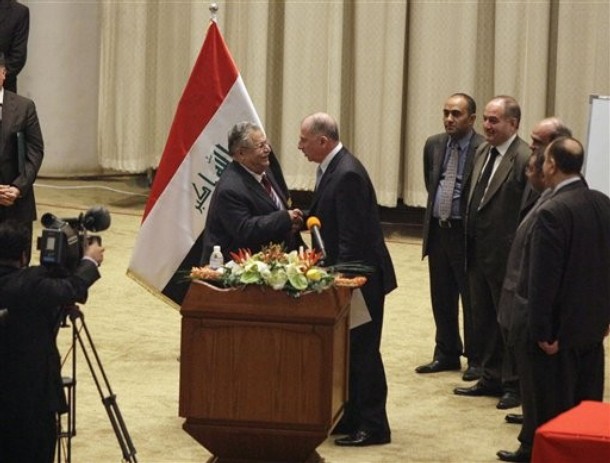
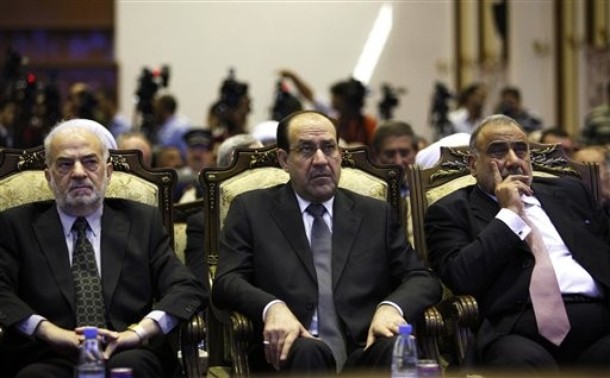
iraqleaders.jpg

It's been clear since the campaign that President Obama has tried to have it both ways with Iraq. He campaigned on a pledge to see the Bush-era Status of Forces Agreement through to a full U.S. withdrawal in 2011, but has also sprinkled enough caveats into his Iraq rhetoric as to leave open the possibility that the U.S. will stay behind in the event of an emergency. In other words, the decision to leave Iraq remains a hostage to events in Iraq.

It's too soon to tell if the election spat inside Iraq has the makings of such an emergency, but it's definitely unsettling:

More than a week after Iraq’s Accountability and Justice Commission first announced that it had disqualified at least 15 parties to run for Parliament, it remained unclear how many candidates out of more than 6,000 who have registered would be excluded — and which ones had been..

On Thursday, Iraq’s election commission announced that 499 were disqualified, but it postponed the publication of a list on Sunday, saying that still more names would be added Monday.

Far from dissipating, the political turmoil caused by the accountability commission — a little-known government agency headed by an official who until August was in an American prison on charges of orchestrating a 2008 bombing in Baghdad that killed two American embassy workers, two American soldiers and six Iraqis — only worsened over the weekend.

Maysoun al-Damlouji, a member of Parliament from Mr. Bolani’s bloc, compared the swirl of events to watching a Bollywood movie from India — in Hindi, without subtitles.

“We don’t know what’s going on,” Ms. Damlouji said.

The disqualification of so many candidates threatened to undermine a national election that has widely been cast as another test of Iraq’s nascent democracy. According to many lawmakers and experts, Iraq appears to be failing, raising fears of violence rather than political reconciliation as American troops steadily withdraw, nearly seven years after the American-led invasion that toppled Mr. Hussein.

Among those known to be disqualified is Saleh al-Mutlaq, a Sunni leader of a broad secular coalition that also includes a former Shiite prime minister, Ayad Allawi. The coalition, known in Arabic as Iraqiya, is widely seen as the most formidable challenger to Mr. Maliki’s bloc and a second, largely Shiite alliance.

Given the raft of international challenges facing the administration, the absolute last thing it needs is for Iraq to fall apart. Again.

Update: Marc Lynch offers his take:

How significant is all this? I don't think that it shows a military "unraveling" as chronicled in Tom Rick's eponymous never-ending series, but rather the political problems which the "surge" never really resolved. And those go deep, and should not be a surprise. Major political legislation intended to overcome sectarian and institutional complaints has been stalled or ineffective. Crucial Arab-Kurd issues remain unresolved. Tensions between centralizers and federalists remain unresolved. The Awakenings remain largely unintegrated into the state. Last year's provincial elections generated excitement at the time and some political fluidity but have had only a limited impact on the wider environment and many of the new councils have proven disappointing. The Iraqi refugees and internally displaced remain a persistent, gaping hole in the state. Now the upcoming elections, along with the occasional bursts of horrific violence and rumours of coup attempts and foiled plots of various kinds, has generated a feverish political environment and ramped up uncertainty about the future.... which this move only feeds.

That said, even if the ban on Mutlak and the others stands, I doubt it will lead to an across the board 2005-style Sunni boycott. Iraqi Sunni politics remain intensely fragmented and wracked by internal competition, as they have been for years. The same fragmentation and divisions which make it difficult for the Sunnis either to form a workable electoral coalition or to rekindle the insurgency will probably make it impossible for them to coordinate or enforce a "Sunni" boycott. Mutlak's list has plenty of ambitious Sunni rivals who will be only too happy to take advantage of its boycott to grab some extra power for themselves.

(AP Photos)

January 9, 2010

The Path to Tehran

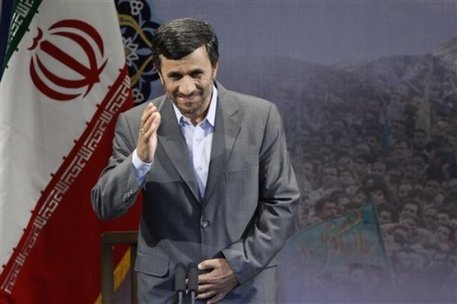
ahmadi_rsz_010910.jpg

I think Daniel Larison does a fine job of addressing one of Andrew Sullivan's readers regarding the Iranian Green Movement's future, so I would rather address some of the other points made by Sullivan in the same post. He writes:

It's a funny thing. Some neocons seem almost ambivalent about a revolution in Iran because it might lead to a nuclear-armed Iran not led by theo-fascists - which would complicate Israel's diplomatic and military position in the region. And many realists don't see a revolution because they remain wedded to the idea of the Iranian red staters rallying to their fundies the way Southerners rally to Cheney and Palin. Or perhaps because there's some kind of realist super-frisson in negotiating with the likes of Khamenei. I don't know. Skepticism is totally valid; but the measure of assurance that nothing has changed strikes me as off-base.

Dictionary.com tells me that frisson means "a sudden, passing sensation of excitement." I don't know that this is how I would describe the cold reality of negotiating with a regime's obvious leader -- much as we do with every other undemocratic or outright oppressive regime -- but how others get their kicks is really none of my business.

Moreover, is it a "realist super-frisson" when the United States does business with and/or engages China, Egypt, Russia, Jordan, Kuwait, Libya, Georgia and so on?

And who exactly are these neoconservatives doubting the spirit and efficacy of the Green Movement? Name names, please. As far as I can tell, most if not all of the leading neoconservative intellectuals and opinion makers have at the very least listed the unrest in Iran as one of several reasons for not engaging the Iranian regime. Their rhetoric sounds very similar to Andrew's, only we know what the former's intentions are: Regime change, be it through the support of revolution or outright attack.

But what does Sullivan hope to see in Iran? He goes on:

For what it's worth,I believe that a democratic revolution in Iran is both possible and would be the single most transformative event in global politics since the end of the Cold War. Especially for the US. I sure don't believe we should take it for granted; but I also see what is in front of us.

I happen to agree, but unlike Sullivan, I don't believe American policy toward Iran should be dramatically affected by the ebbs and flows of Iranian unrest. I've made the case before, so I'll keep it shorter here: if Iran gets the bomb I believe it will enable the regime to crackdown on dissidents with never before seen impunity. Thus, to accept a nuclear-armed Iran and hope for the best, as Andrew seems resigned to doing, strikes me as wrongheaded and harmful for everyone invested in a better Iran--both inside and outside of the country.

Meanwhile, we get a lot of pomp and punditry on Iran's pending Prague Spring, but few substantive policy suggestions for the United States. And I fear what we are seeing here is a repeat of the kind of rhetorical buildup that led to the 2003 invasion of Iraq. Many well-intentioned analysts and foreign policy wonks made strange bedfellows at the time with a longstanding neoconservative agenda to topple Saddam Hussein, thus providing cover for Democrats and otherwise skeptical officials to support the invasion.

I think what The Daily Dish has done to educate its many, many readers on Iran's rich history, culture and politics is an overall good thing (this, in part, is also why I believe it makes sense to engage him on the topic so often--if you care about Iran, Andrew Sullivan matters). My hope though is that they can temper some of that enthusiasm in 2010 with a more sober debate on American policy alternatives, and not, as Laura Rozen recently noted, enable a war policy concocted in part by those with the best of intentions.

(AP Photo)

December 29, 2009

The Good, the Bad and the Central

afgh_yemen.jpg

Max Boot discusses Yemen and its place in the greater War on Terror:

We cannot ignore the terrorist threat emanating from Yemen or other states but nor should we use this undoubted danger as an excuse to lose the war of the moment–the one NATO troops are fighting in Afghanistan. Winning the “war on terror” will require prevailing on multiple battlefields–Iraq, Afghanistan, Pakistan, Yemen, Somalia, the Philippines, and a host of other countries, including, for that matter, Western Europe and the United States. The methods and techniques we will use in each place have to be tailored to the individual circumstances. Few countries will require the kind of massive troop presence needed in Afghanistan or Iraq. In most places we will fight on a lesser scale, using Special Forces and security assistance programs. But because a lower-profile presence may work elsewhere doesn’t mean that it will work in Afghanistan–or would have worked in Iraq. We know this because the Bush administration already tried the small-footprint strategy in Afghanistan. It is this strategy that allowed the Taliban to recover so much ground lost after 9/11–territory that can only be retaken by an influx of additional Western troops. There is no reason why we can’t fight and prevail in Afghanistan even as we are fighting in different ways in different countries.[emphasis added]

The point on the Bush strategy in Afghanistan is simply inaccurate. What Boot calls a "small-footprint strategy" was in fact a rather ambitious, rhetoric-laden, albeit poorly resourced nation building agenda (we all remember the purple and blue fingers, right?). The goals didn't match the muscle, requiring a "reduction in objectives" by the Obama administration, as Richard Haass put it. In other words, President Bush spoke boisterously while carrying a tiny, tiny stick.

But Boot never explains why Afghanistan is such a vital front in the War on Terrorism, nor does he explain what Iraq has to do with that war at all. And why the Taliban--along with roughly 100 al-Qaeda operatives in the Af-Pak region--require a heavier troop presence than other threats (such as al-Shabaab in Somalia, for example) remains unclear to me.

I agree with Boot that the "good war, bad war" stuff is no good, and migrating the designation from one front to the next for political expedience is irresponsible. The real question--one I feel Boot never properly addresses--is why we even need a central front in order to conduct this war.

He writes that "one of the key advantages gained by our presence in Afghanistan is that it makes it easier to target terrorist lairs in Pakistan." But presence and escalation are clearly two different things, and targeting said "lairs" does not require the latter--as was demonstrated two weeks ago in Yemen.

(AP Photo)

December 22, 2009

Could We Lose Iraq?

maliki.jpg

Kenneth Pollack of the Brookings Institute is worried we might:

The mistake we are in danger of making in Iraq is that as our military steps back, our civilians are not always stepping up. Over the past six to nine months, our embassy has been inconsistent at best, and has panicked many Iraqis and many Iraqi leaders into believing that the Obama administration does not care about Iraq and is simply running for the exit as fast as they can. This isn’t true, and the President’s lieutenants have said so time and again, as has Vice President Biden, both in private and in public. But by failing to remain actively engaged with the Iraqi political process at all levels, by disdaining any further involvement in guiding Iraq’s domestic politics, and in abandoning aid programs willy-nilly, many embassy personnel have convinced a great many Iraqis of exactly the opposite. And therein lies the seeds of renewed civil war and a disaster for American interests.

I'm wondering why Pollack believes we can guide Iraq's domestic politics to a destination we find acceptable. If our bureaucrats possessed such a capability, wouldn't it have been in evidence in, say, the period between 2003-2007? That's not to say we should disengage willy-nilly, but I think the presumption here has to be that we really don't know what we're doing and that we should err on the side of minimizing U.S. exposure to Iraq's internal violence should the country implode again.

The other question that's not addressed here but is really central to Pollack's argument is the degree to which Iraq's politicians see their geopolitical interests as closely aligned with the United States. We know Iraqi society is riven with various ethnic and religious divisions which naturally pull at the country's geopolitical orientation, but is there a critical mass of Iraqis (and not just the political elite who depend upon the U.S. for their security) that sees Iraq's interests as largely overlapping America's?

And it's worth repeating again that the only reason Iraq matters to the U.S. at all is oil. If we used less oil, Iraq would matter less. (Pollack himself admits this in his book, A Path Out of the Desert.) Oil consumption is a technical problem, and America has proven time and again that it can solve technical problems (atomic bombs, moon launches, etc.). America has proven far less adept at long-distance nation building, especially in the Middle East. Why not play to our strengths?

(AP Photos)

December 21, 2009

Panama!

While ascribing some gushing praise to the foreign policy of George H.W. Bush in my most recent NY Daily News column, one word kept running over and over again through my head: Panama. More specifically, how does one reconcile this unilateral action with what I believe and argue was one of the more sensible and multilateral presidencies in American history?

Well apparently, according at least to Jordan Michael Smith over at Foreign Policy, Amb. Thomas Pickering has in retrospect expressed similar reservations over the precedent set by Panama:

Like Panama, Iraq was a war of choice. The light American footprint that had achieved results in the small Central American country convinced figures such as Defense Secretary Donald Rumsfeld that the same strategy would work in Iraq. Furthermore, the ability of the United States to depose Noriega and then swiftly withdraw from Panama contributed to the belief that nation-building was unnecessary in Iraq. "Iraq in 2003 was all of that shortsightedness in spades," concluded Pickering. "After all, the defense secretary said we didn't want anybody else's help, we didn't need anybody's help -- we were going to do it all ourselves."

That sounds just like the strategy that worked in Panama, 20 years ago.

I find this argument a tad bit unpersuasive. While Washington's relationship with Noriega was certainly less than angelic or innocent, one of the primary justifications for the Panama invasion was to uphold the Torrijos-Carter treaties and maintain the blueprint for an eventual handover.

In other words, a timetable for an end to America's presence in the country had already been agreed upon prior to any military action. We went to war over an agreement, rather than agreeing to a war with no clear direction or endgame in mind. I believe the two to be different.

And we did, by the way--much to the chagrin of Rep. Dana Rohrabacher--stick to that timetable, as President Clinton handed over control of the canal in 1999. Contrast that with the 2003 invasion of Iraq, where the very mention of a timetable for withdrawal was considered tantamount to surrender.

December 18, 2009

What's the Deal with Iraq's Oil?

iraqoil.jpg


Victor Davis Hanson speculates:

Perceptions of the war in Iraq have also changed in unforeseen ways.

"No blood for oil," for example, was once a common anti-war cry. But Iraq's auctioning of its oil leases has gone mostly to Europeans, Russians and Chinese - not Americans.

The U.S., it turned out, did not go to Iraq to steal its natural resources. Apparently, we instead ensured a fair auction by a constitutional government that preferred non-American companies to pump its oil. In the end, we were more idealistic - or naive -than conspiratorial.

I don't know if this really the right way to frame the issue. America's position in the Middle East was never to straight up expropriate oil but to keep oil moving into the world market, which is what these deals obviously facilitate. We use the lion's share of the world's oil, and so it's better if there's more of it washing around.
On the other hand, I wouldn't characterize American corporations losing out on an initial oil deal as being the result of naivete. Just the opposite, it would have been naive to think that we could have coerced Iraqi officials into awarding a U.S. firm a contract. The revelation of such a deal would likely have dealt our position in Iraq a pretty serious blow.

(AP Photos)

December 17, 2009

Box Cutters and SkyGrabbers

drone_pic.jpg

The WSJ has an embarrassing report today on how Iraqi insurgents have been hacking America's multi-million dollar Predator drones--and for under $26:

Militants in Iraq have used $26 off-the-shelf software to intercept live video feeds from U.S. Predator drones, potentially providing them with information they need to evade or monitor U.S. military operations.
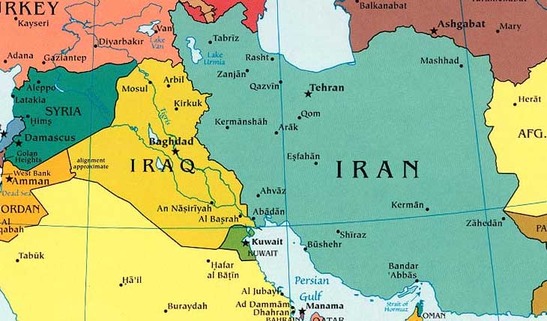
Senior defense and intelligence officials said Iranian-backed insurgents intercepted the video feeds by taking advantage of an unprotected communications link in some of the remotely flown planes' systems. Shiite fighters in Iraq used software programs such as SkyGrabber -- available for as little as $25.95 on the Internet -- to regularly capture drone video feeds, according to a person familiar with reports on the matter.
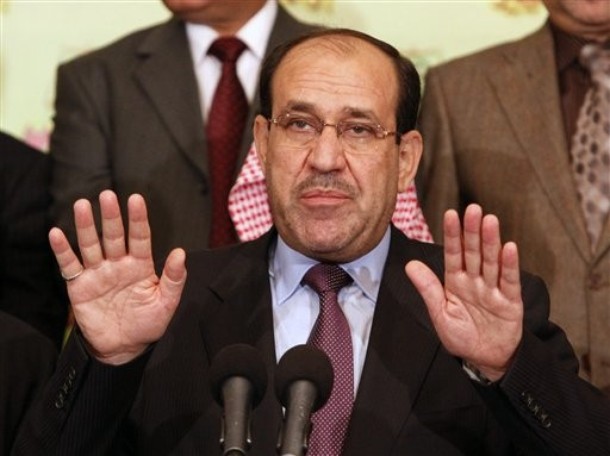
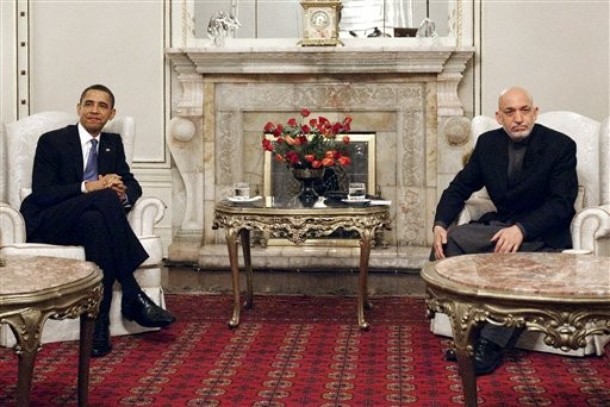
[...]

The militants use programs such as SkyGrabber, from Russian company SkySoftware. Andrew Solonikov, one of the software's developers, said he was unaware that his software could be used to intercept drone feeds. "It was developed to intercept music, photos, video, programs and other content that other users download from the Internet -- no military data or other commercial data, only free legal content," he said by email from Russia.

My sense is that this will get exaggerated and blown out of reasonable proportion by some, but setting aside the painfully foolish system security--no encryption???--this screw up reveals a more salient point, and brings to mind an old cliche: where there's a will there's a way.

Whether it's box cutters or file "intercepting" software, this, in my view, once again challenges the notion that a preponderance of troops and treasure exhausted in one part of the world is the right way to fight an allegedly global war on terrorism. There will always be fringe elements who hate the United States and wish us harm, but trying to pick them off continent-by-continent makes far less sense to me than diverting resources toward cyber-security, not to mention biological weapons security and regulation.

(AP Photos)

December 14, 2009

Tony Blair on Iraq War

tonyblair.jpg


British Prime Minister Tony Blair is defending his decision to join the American invasion of Iraq:

Former British Prime Minister Tony Blair has said he would have found a justification for invading Iraq even without the now-discredited evidence that Saddam Hussein was trying to produce weapons of mass destruction.

"I would still have thought it right to remove him. I mean, obviously you would have had to use and deploy different arguments about the nature of the threat," Blair told the BBC in an interview to be broadcast this morning.

This isn't all that shocking. Paul Wolfowitz admitted much the same thing to Vanity Fair, saying that WMD was the rationale that the bureaucracy could agree on. But it is worth noting that the conception of the Iraq threat had absolutely nothing to do with Iraq's actual capacity to harm America. Yes, there was a lot of talk about Saddam "possibly" transferring WMD to a terrorist group, but that was always dubious and never figured in the original case for war made during the 1990s.

Instead, Saddam was viewed as a "threat" because he had once made a play for Middle East hegemony. That he lost badly and was subsequently crippled as a result didn't seem to matter.

See also: Shadi Hamid has some interesting thoughts on the matter as well.

(AP Photos)

December 8, 2009

Winning Iraq

Iraq.jpg

The news from Iraq is both encouraging (an election law has been passed) and disturbing (118 people have been killed by a car bombing).

Many advocates of the Iraq surge have taken to calling the current outcome in Iraq a "victory." As far as victories go, this one is certainly not an unalloyed boon for the United States. We have invested a substantial amount of blood and treasure into Iraq and while it's true that the country is more permissive with its oil contracts than Saddam Hussein was, there have not been correspondingly high geopolitical returns. Maybe those are still to come. We'll see.

But the fact that many in Washington feel content to call Iraq a victory is a good thing in my mind. It means they're willing to define success down.

(AP Photos)

November 30, 2009

The British Iraq War Inquiry

afghanwarhelmet.jpg

The British are knee deep into their look-back on the Iraq war. The Guardian reports:

George Bush tried to make a connection between Iraq and al-Qaida in a conversation with Tony Blair three days after the 9/11 attacks, according to Blair's foreign policy adviser of the time.

Sir David Manning told the official inquiry into the war that Bush, speaking to Blair by phone on 14 September 2001, "said that he thought there might be evidence that there was some connection between Saddam Hussein and Osama bin Laden and al-Qaida."The prime minister's response to this was that the evidence would have to be very compelling indeed to justify taking any action against Iraq," Manning said.

Blair followed up the conversation with a letter stressing the need to focus on the situation in Afghanistan, where the attacks originated.

Outside of the administration, it was much the same story, as neoconservatives leaped immediately past Afghanistan toward Iraq. Here's a look at some neoconservative writings circa 2001. I don't see much in the way of prioritizing the rebuilding of Afghanistan.

Which brings us to the present debate. If you consider that neoconservatives were willing to essentially breeze past Afghanistan in September 2001, I find it a little difficult to countenance their arguments for why there is absolutely no other choice but to commit 100,000 troops to the pacification of the country in 2009.

(AP Photos)

November 23, 2009

Damaging the U.S.-British Relationship

US%20UK.jpg

Ever since President Obama removed the bust of Winston Churchill from the White House, commentators have worried about an erosion in the special relationship between the U.S. and Britain. But a British inquiry into the Iraq war is casting new light on those ties under the Bush administration:

The end of “major combat operations” in May 2003 set the stage for two different kinds of conflict. There was the nascent insurgency in US-controlled central Iraq – though not, initially, in the four southern provinces occupied by Britain. And, quite unknown at the time, there was the growing battle between the UK and America, whose relations appear to have been far worse than anyone suspected.

The entire piece is worth a read. The upshot seems to be the British favored a lighter hand in Iraq and the Americans didn't. The rest, as they say, is history.

(AP Photos)

October 28, 2009

Iraq: An Asset or Burden?

Iraq%20prize.jpg

Former aide to Vice President Cheney, John Hannah writes:

During his campaign, as well as during the first months of his administration, the president's default position was to talk Iraq down, and to leave the impression that America's only stake in the country was to wash our hands of it as soon as possible. That now seems to be changing, as the administration begins to realize that America's strategic interests could in fact be reasonably well served by having a potentially very prosperous, very powerful democratic friend in what historically has been one of the Arab/Muslim world's most influential countries. Moreover, this can be achieved through a relatively modest dedication of additional political, economic, and security resources -- even as U.S. forces continue to withdraw from Iraq and America's combat role dramatically diminishes.

It's very much an open question just how friendly Iraq is going to be, especially if they are increasingly capable of standing on their own two feet, without our "modest" (whatever that means) assistance. And what exactly do we expect from a friendly Iraq anyway? Help with Iran? Pressure on other Arab states to make peace with Israel? Preferential oil deals? Prolonged basing agreements? All of the above? Which "strategic interests" get served, and how?

And please, define "modest."

(AP Photos)

October 27, 2009

Putting Iraq in Context

iraqbomb.jpg
Max Boot says that we shouldn't be overly concerned that 155 Iraqis were killed earlier this week:


This reminds me of what I learned long ago in Iraq: acts of violence that occur a few blocks away might as well be a world away. Once again, I learned the details from CNN, just as observers back in the U.S. did. I did not feel the roar of the explosion, nor see the smoke. Nor, I should add, did the vast majority of Baghdadis, much less of Iraqis. That is not meant to minimize the horror of what happened or to downplay its significance. It is simply to place it in some context and urge readers not to lose sight of the big picture: Attacks are still down to their lowest level since 2003-2004. Life has returned to a semblance of normality in Baghdad and other areas. A few high-profile attacks — this one or the one in August — do not change the fundamental, day-to-day reality of life getting better.

Iraq's population is currently 29 million. A bombing that kills 155 Iraqis is the proportional equivalent of a bombing that kills 1,600 Americans. I wonder, in the wake of such an attack, if Boot would issue similar calls for context and urge us to recognize that America remains overwhelmingly safe and secure despite the occasional terrorist atrocity.

(AP Photos)

October 22, 2009

About that Iraq Troop Withdrawal

irAQ%20TROOP%20WITHDRAWAL.jpg

While surge Afghan advocates such as Max Boot take to op-ed pages urging an ever-larger influx of troops for Afghanistan, the draw down in Iraq seems slightly less assured:

U.S. commanders may have to slow the pace of the U.S. troop withdrawal from Iraq if Baghdad delays national elections scheduled for Jan. 16 or if other political instability develops, senior Pentagon officials said Wednesday.

A more protracted drawdown of the 120,000 troops now in Iraq would not prevent President Obama from boosting the number of U.S. troops in Afghanistan, but it could increase stress on American ground forces, Vice Adm. James A. Winnefeld Jr., director for strategic plans and policy for the Joint Chiefs of Staff, said during testimony before the House Armed Services Committee.

One rarely, if ever, hears mention of the very large American troop presence in Iraq when discussing Afghan strategy. But these troops will ultimately have to leave Iraq if we are to sustain a larger footprint in Afghanistan without putting massive strains on the Army.

(AP Photos)

October 13, 2009

Is Iraq a Natural U.S. Ally?

iraqmaliki.jpg

In the course of teeing off on Joe Klein's gloss on Charles Krauthammer's article on America's supposed decline, Peter Wehner ventures into some interesting territory regarding the foreign policy preferences of a sovereign Iraq. Klein took issue with Krauthammer's assertion that:


In Iraq, a determination to end the war according to rigid timetables, with almost no interest in garnering the fruits of a very costly and very bloody success--namely, using our Strategic Framework Agreement to turn the new Iraq into a strategic partner and anchor for U.S. influence in the most volatile area of the world. Iraq is a prize--we can debate endlessly whether it was worth the cost--of great strategic significance that the administration seems to have no intention of exploiting in its determination to execute a full and final exit.

Klein finds such a sentiment redolent with neo-colonial hubris:

A prize! Sounds sort of like Churchill in his most demented colonial moments: India, the jewel in the crown! (The fact that a duly elected Iraqi government wants us to leave is ignored.) Krauthammer’s sort of imperialism–a brutal and patronizing neo-colonialism–has never sat well with the American people.

Then along comes Wehner with this rather interesting argument:

What Krauthammer is championing is not some kind of imperial exploitation; rather, he is in favor of the elected government of Iraq cooperating with the United States in order to fight terrorism and counteract the disorders in the Middle East. (Only a simpleton would believe that withdrawing troops means an end to bilateral relations. Lots of nations work cooperatively with each other even when they do not have combat troops deployed in each-other’s territories.)

Now, unlike Wehner, I don't pretend to know what the geostrategic preferences of a truly sovereign and independent Iraq would be. There's an obvious incentive for Iraq to maintain friendly relations with the U.S., particularly while its governing institutions and security services are still weak. But there are also countervailing factors, such as its strong and friendly ties to Iran and whatever lingering hostility there is among the country's Sunnis toward the United States.

None of this is terribly difficult to understand - even for the simpletons of the world. Nor is it difficult to understand that Krauthammer is basing his "Iraq-as-strategic-prize" argument not simply on a free trade pact between the U.S. and Iraq but on the hope that the U.S. can maintain military installations in the country. And who knows, perhaps being a forward leaning regional ally of the United States is what a sovereign Iraq really desires. My reading of the Status of Forces Agreement signed by the Bush administration and the reports of how that agreement came to fruition, certainly do not lend credence to such an idea. But maybe Wehner knows something about Iraq's strategic thinking that I don't.

More likely, I suspect that Krauthammer means what Klein took him to mean - that the U.S. forge a "cooperative" Iraq by continuing to wade into Iraq's politics, make an end run around the SOFA and bolster factions which support America's regional ambitions and marginalize those that don't. That's not full blown, British Empire-style colonialism, but it isn't a business-as-usual bilateral relationship either (at least, not outside the Middle East).

(AP Photos)

August 17, 2009

Odierno's Troop Request

ODIERNO.jpg

General Odierno, commander of U.S. forces in Iraq, wants to send U.S. troops to Northern Iraq to shore up gaps in security created by the lack of cooperation between Kurdish and Iraqi army forces.

On the face of it, it seems like a sensible move. As the New York Times reports, these areas were not policed by either Kurdish or Iraqi forces and have thus been subject to a number of attacks by al Qaeda. Odierno positioned the use of American forces as a stop-gap that would allow the Kurds and Iraqi army to come to terms with one another:


“Once they get used to working with each other, it becomes very easy,” General Odierno said. He said the United States’ role would be one of oversight and encouraging the two sides to get along, rather than peacemaking. “I think there’s room to work this out.”

Hopefully, that will indeed be the case. But what if it's not? Stepping back, this development seems to underscore one of the key problems that the Obama administration is going to face in Iraq - what will they do if violence spikes? Max Boot seems concerned that the president will stay true to his campaign pledge and leave Iraq, then adds that the president been more "moderate" on Iraq than his campaign rhetoric so maybe the U.S. will indeed police the country forever.

It's going to be very difficult for the administration to make good on its promise to leave Iraq without formulating a very clear argument for why any resulting instability or violence is not America's problem. So far, the administration has tried to straddle a line that does not repudiate America's traditional custodial role for the region while promising to remove our forces. But what happens if push comes to shove?

(AP Photos)

August 12, 2009

The Shiites Restraint

Rod Nordland reports on the remarkable restraint shown by Iraqi's Shiite population as it suffers continued violence at the hands of Sunni terrorists.

Certainly an encouraging sign for the future stability of Iraq even if the persistence of anti-Shiite violence is disturbing.

July 30, 2009

Iraq Moves on MEK

iraqiarmy.jpg

The recent move by the Iraqi government to uproot the anti-Iranian terror group People’s Mujahedeen underscores one of the looming challenges with the Obama administration's nascent Iranian containment scheme, and that it is America's relations with Iraq.

By virtue of geography and history, Iran is going to exercise some degree of influence inside Iraq. To the extent that we are going to define our Middle East policy around the containment of Iran, it seems inevitable that tensions between Baghdad and Washington are going to flare.

---
Photo credit: AP Photos

July 27, 2009

Iraq as Korea

610x.jpg

Matthew Yglesias flags the Philippines analogy in this Ross Douthat column but I actually think the reference to the Korean war is more apt:

These twists and turns make Iraq look less like either Vietnam or World War II -- the analogies that politicians and pundits keep closest at hand -- and more like an amalgamation of the Korean War and America’s McKinley-era counterinsurgency in the Philippines. Like Iraq, those were murky, bloody conflicts that generated long-term benefits but enormous short-term costs. Like Iraq, they were wars that Americans were eager to forget about as soon as they were finished.

And like Iraq, the war in Korea never formally ended and the U.S. never left. To this day North Korea remains one of the most dangerous countries in the world despite a formidable American military presence in Japan and South Korea. Many decades after the end of the Korean War, it still falls mainly to the United States to take the lead in cajoling the North Koreans to stop acting crazy.

All of which is to say that even an ideal long term outcome will still be messy.

---------
The Demilitarized Zone between North and South Korea. Photo credit: AP Photos.

July 10, 2009

The Future of Iraq

So much of the public discussion of Iraq is backward-looking. Who was wrong about what, when. And since no one party to the Iraq debate has covered themselves with glory, there are ample opportunities for point scoring.

Unfortunately, while the U.S. begins to remove itself from the front line, there are still some vexing issues in the country which could lead to renewed violence and, potentially, renewed American involvement. Exhibit A, as the New York Times reports, is Kurdistan:

With little notice and almost no public debate, Iraq’s Kurdish leaders are pushing ahead with a new constitution for their semiautonomous region, a step that has alarmed Iraqi and American officials who fear that the move poses a new threat to the country’s unity.

The new constitution, approved by Kurdistan’s parliament two weeks ago and scheduled for a referendum this year, underscores the level of mistrust and bad faith between the region and the central government in Baghdad. And it raises the question of whether a peaceful resolution of disputes between the two is possible, despite intensive cajoling by the United States.

What is America's role in Iraq if this issue comes to a violent head?

July 3, 2009

The Iraq Blame Game

Even if Iraq falls back to the level of political mediocrity that surrounds it, the situation has changed from two years ago. If America had retreated then, it would have been a failure of our will and a failure of our military. But we did not fail. Our military adapted. Our leaders and country persevered. We have given the Iraqis what we owed them -- a decent chance at success, the only gift a liberator can give. Now, a failure would be sad and challenging -- but it would be their own. - Michael Gerson.

We'll see if this line really holds if security deteriorates and President Obama refuses to send in the cavalry.

July 1, 2009

The Cost of Iraq

iraq%20death.jpg

Over in Commentary, former Bush administration official Peter Wehner offers up an interesting piece of moral asymmetry:

The ultimate wisdom in initiating the Iraq war is still to be validated by contingent events still to unfold. What is happening today is a transition, not a final triumph....

Still, it is worth pointing out that those who wrote off the war as unwinnable and a miserable failure, who made confident, sweeping arguments that have been overturned by events, and who had grown so weary of the conflict that they were willing to consign Iraqis to mass slaughters and America to a historically consequential defeat -- they were thankfully, blessedly wrong.

I find this line of defense for the troop surge frankly bewildering. Wehner claims that those who wanted to wind down the war in 2006 and 2007 would have been responsible for "mass slaughters." I don't necessarily accept the logic that the U.S. is implicated in one Iraqi's decision to kill another. After all, many Iraqis were being killed by their fellow citizens long before the U.S. entered the picture.

That said, if Wehner wants to pin prospective "mass slaughters" on the conscience of those who wanted to wind down the war, it's fair to ask whether he feels any guilt about the actual mass slaughters that occurred as a consequence of the invasion. If withdrawal advocates were willing to consign Iraqis to their deaths, what can be said of the architects and champions of the Iraq war?

---
Photo credit: AP Photos

June 30, 2009

Iraq: Obama's First Test

610x.jpg

I'm skeptical of claims that anytime any event happens overseas it's a "test" of the president. That strikes as a rather Washington-centric view of the world. Nevertheless, there are "tests" and then there are tests. And the U.S. pullback from Iraqi cities today strikes me as the latter.

At issue is a basic question: is the U.S. military an Iraqi police force, or do we let the country go its own way, even it entails renewed bloodshed?

The American pullback will test both the durability of the surge/Awakening's security gains and the Obama administration's pledge to end the war. It could very well end up in a political win-win: the Obama administration can take credit for fulfilling its campaign pledge to end the war, and the Bush administration can take credit for preventing Iraq's slide into chaos. This is the ideal, and we should all be hoping it comes to pass.

But things could go awry. Today's car bombing hints at a future of renewed violence. In such an environment, there will be a fair number of analysts, pundits and politicians who will pressure the Obama administration to slow, or even reverse, the drawn down. Then, the administration will have to choose not just between the political question of keeping faith with its pledge, but between a basic strategic issue of whether it is in America's interest to police Iraq indefinitely or whether it's time for us to leave.

-----
Photo credit: AP Photos

June 14, 2009

More to Worry About

While the world is gripped by Iran's post-election chaos, Kori Schake reminds us that there's a little issue called Iraq:

According to the Brookings Institution’s Iraq Index, enemy initiated attacks are around 150 per month now, down ten-fold from 1,600 at their height. Iraqi casualties are still staggeringly high at 500 per month, but that is 3,500 fewer Iraqis losing their lives each month from when violence was at its height. By a substantial margin, those victims are Iraqi, civilian, and Shi’ia.

Politically, Iraq has made progress on about half the “benchmarks” demanded by Congress of the Bush administration. Worryingly, those Brookings grades as unmet are: the amnesty law, de-Baathification, federal funding to the provinces, the hydrocarbons law, resolving the status of Kirkuk, and the government absorbing Sons of Iraq into the security forces. To give a measure of the Maliki government’s resistance, of the 100,000 Sons of Iraq who helped break the back of the insurgency, only 5,200 have been integrated into the Iraqi Security Forces. Each of these issues could be flashpoints for violence as the United States disengages. And add to these troubles an Iraqi budget crunch that is slowing the pace of Iraq’s security force expansion.

But other than that, we've won.

May 19, 2009

Goldfarb's Google Gotcha on Richard Haass

Michael Goldfarb, on CFR President Richard N. Haass' "vociferous" opposition to the Iraq war:

It's amazing what Google turns up these days. Here is Haass on the Charlie Rose show in September 2003, two months after he left the administration to become president of the Council on Foreign Relations. Presumably free to speak his mind, and at a time when the war in Iraq was already going badly, Haass somehow does not take the opportunity to explain how he had opposed the war.

[...]

But ask him now and he'll tell you he "believed in diplomacy, I believe in multilateralism, I believe in institutions...I did not believe in the Iraq war." It's amazing what six years and a shift in elite opinion can do to a man's memory.

This strikes me as a somewhat peculiar gripe. Haass has never publicly claimed to have been a "vociferous" war critic, as Goldfarb argues. Haass has written - and repeated in recent interviews - that his war stance was a modest 60/40 opposition based off of logistical policy concerns. These policy concerns are a documented matter of record.

Continue reading "Goldfarb's Google Gotcha on Richard Haass" »