Main

February 8, 2012

Poll: Americans Endorse Drone Strikes Against Americans

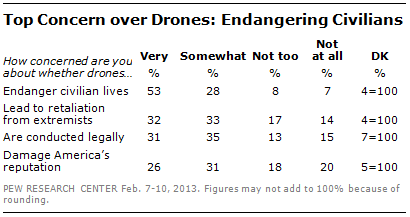
A new ABC News/Washington Post poll gives President Obama high marks in foreign policy:

Eighty-three percent of Americans in the latest ABC News/Washington Post poll approve of Obama’s use of unmanned drones against terrorist suspects, 78 percent back the drawdown of U.S. troops in Afghanistan and 70 percent favor keeping open the Guantanamo Bay detention center – the latter a reversal by Obama of his 2008 campaign position.

It also notes American comfort with targeting fellow citizens for death by drone:

Two-thirds in this poll, produced for ABC by Langer Research Associates, also favor the use of unmanned drones specifically against American citizens in other countries who are terrorist suspects – potentially touchier legal territory.
Interesting to note that the poll specifically describes those targeted by drones as "suspects" - so there appears to be ample support for killing Americans even if their guilt is not firmly established.

Whom Do Britons Dislike?

According to Angus Reid, the French and Greeks don't rank so highly in British esteem:

In the online survey of a representative sample of 2,011 British adults, about a third of respondents say they have an unfavourable opinion of France (35%) and Greece (32%).

The difference between the proportion of favourable and unfavourable opinions for both Greece and France is only ten points. Half of Britons (49%) have a favourable view of Germany, while one-in-four (25%) disagree.

At least half of respondents hold favourable opinions of all of the other nations included in this survey, such as Luxembourg (53%), Portugal (55%), Italy (57%) and Belgium (also 57%). The highest ranked EEC members are Spain (63%), Ireland (67%), Denmark (also 67%) and the Netherlands (69%).

February 7, 2012

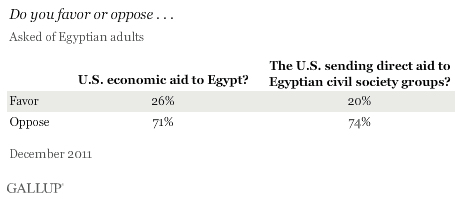
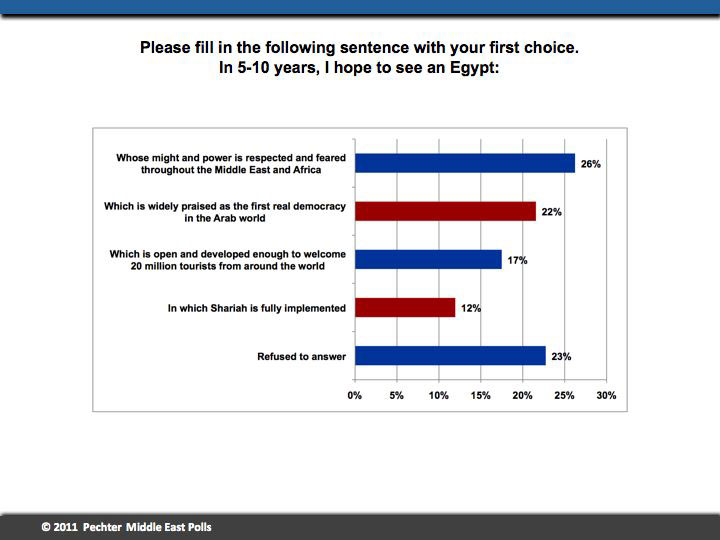
Egyptians Don't Want American Economic Aid

egytpaid.gif

A new survey from Gallup shows that a broad majority of Egyptians do not want American economic aid.

If this NGO crisis continues they may get their wish.

February 6, 2012

Poll: If Israel Attacks Iran, 48% of Americans Want U.S. to Help

That's the headline from the latest Rasmussen poll:

The latest Rasmussen Reports national telephone survey of Likely U.S. Voters shows that 83% believe it is at least somewhat likely Iran will develop a nuclear weapon in the near future, including 50% who say that is Very Likely to happen. Only 11% say it’s Not Very or Not At All Likely Iran will develop a nuclear weapon soon.

January 20, 2012

U.S. Views on a War With Iran

Emily Ekins gives us a look at some new findings from Rasmussen:

Yet despite the cheers the candidates received for taking hawkish foreign policy stances with Iran, a recent Rasmussen poll finds that only 35 percent of Americans favor using military force if sanctions fail to prevent Iran from developing their nuclear capabilities.

This finding is especially interesting given that 81 percent of Americans think it is either somewhat or very likely that Iran will develop a nuclear weapon in the near future, and that 63 percent of Americans do not believe it is very or at all likely that stiff economic sanctions will effectively force Iran to disband its nuclear program.

Although 76 percent of Americans believe that Iran is a serious national security threat to the United States, only 35 percent are ready to favor military intervention. This means that even though most Americans believe it's quite likely Iran will develop a nuclear weapon and that economic sanctions will fail to work, they aren’t willing for Americans to engage in another military intervention.

Too bad it doesn't matter what they think.

November 18, 2011

Poll: American Exceptionalism in Decline

This finding (pdf) from a large new Pew Research poll will no-doubt raise some eyebrows. In short, the idea of American exceptionalism is slowly falling out of favor:

However, the current polling shows the American public is coming closer to Europeans in not seeing their culture as superior to that of other nations. Today, only about half of Americans believe their culture is superior to others, compared with six-in-ten in 2002. And the polling finds younger Americans less apt than their elders to hold American exceptionalist attitudes.

Relatedly, Pew found that the further you go up the education scale, the less likely it is that you'd buy into exceptionalism:

In the four Western European countries and in the U.S., those who did not graduate from college are more likely than those who did to agree that their culture is superior, even if their people are not perfect. For example, Germans with less education are twice as likely as those with a college degree to believe their culture is superior (50% vs. 25%); double-digit differences are also present in France (20 percentage points), Spain (18 points) and Britain (11 points), while a less pronounced gap is evident in the U.S. (9 points).

October 18, 2011

New Polls on Trade, China Currency

The National Journal took the measure of U.S. sentiment of both the recently concluded free trade pacts with South Korea, Colombia and Panama, as well as Senate action on China's currency manipulation:

When asked if they supported or opposed the congressionally approved agreements with South Korea, Colombia, and Panama, voters were just about evenly divided, with 38 percent supporting the accords and 41 percent opposing them. A full 21 percent of voters didn’t know enough to answer or refused to say.

While the overall number of voters was divided fairly evenly, the differences among subgroups were stark. Men favored the agreements 46 percent to 38 percent; women opposed them 44 percent to 30 percent. Although Republicans are sometimes thought of as being more pro-trade, 41 percent of GOP rank-and-file voters polled opposed the agreements. The number was slightly higher for Democrats: 45 percent of them opposed the treaties. When it comes to education, 44 percent of college graduates supported the agreements and 31 percent opposed them. Among those with some college or less education, 45 percent opposed the trade pacts and 35 percent supported them—perhaps reflecting views on the loss of manufacturing jobs to foreign competition.

Voters were similarly divided about a proposed measure that would slap tariffs on Chinese goods if Beijing is found to be manipulating its currency. Overall, voters were evenly divided on the measure, with 44 percent supporting it and 41 percent opposing it. College graduates supported the sanctions measure, 57 percent to 30 percent. When party affiliation was factored in among college grads, Republicans were the most supportive of the measure: 62 percent of them backed the bill and only 24 percent opposed it despite the widespread opposition to higher taxes in the Republican Party. Among Democrats and independents, the support for the measure was a bit lower. There was less enthusiasm for the punitive sanctions among voters who were not college-educated, although Republicans once again led the way; 44 percent of GOP voters with no college degree backed the bill, compared with 37 percent for Democrats and 40 percent for independents.

Interesting partisan split on the China question.

October 5, 2011

U.S. Veterans Views on War

A new poll from Pew Research takes the pulse of U.S. veteran's views on war as compared to other Americans:

While Americans remain supportive of their all-volunteer military (only one half of 1% of the population has been on active duty service in the past decade), the length of the conflicts has reshaped attitudes toward war and sacrifice, the survey found.

Nine out of 10 expressed pride in the troops and three-quarters say they thanked someone in the military. But 45% said neither of the wars fought after the September 11, 2001, attacks has been worth the cost and only a quarter said they are following news of the wars closely. And half of the public say the wars have made little difference in their lives....

More than half of post-9/11 veterans also felt that too much reliance on military force to combat terrorism leads to more terrorism. On this topic, the public view was nearly identical -- 52% said too much force is not a recipe for success.

Post-9/11 veterans were keen supporters of nation-building with 59% supporting those roles for America's service members. But only 45% of the public and pre-9/11 veterans thought the military should be involved.

September 26, 2011

Religion in Egypt

A new survey takes the pulse:

A survey by the cabinet’s Information and Decision Support Center, published on Sunday, revealed that 58 percent of the sample said they would not vote for a president of a different religion than their own, while 36 percent said they would.

But the survey said that 60 percent said they would consider voting for candidates of a different religion in parliamentary elections, and 37 percent saying they would not.

It also said that 73 percent of Egyptians, Muslims and Christians, are religious and pray regularly.

September 13, 2011

U.S. Views on Winning Afghanistan

A new poll from Rasmussen:

Just 21% of Adults believe the original mission behind the war in Afghanistan has been accomplished. A new Rasmussen Reports national telephone survey finds that 60% think the mission has not been accomplished, with another 18% not sure.

Thirty-five percent (35%) of Republicans think the mission to end al Qaeda’s safe harbor has been accomplished, but that compares to just 10% of Democrats and 19% of adults not affiliated with either of the major parties. Most Democrats (75%) and most unaffiliated adults (59%) feel the mission has not been accomplished, and even a plurality (47%) of Republicans agrees.

Yet these findings come at a time when 59% of Likely Voters want all U.S. troops brought home from Afghanistan either immediately or within the next year. Just 22% believe the United States has a clearly defined mission in Afghanistan.

September 2, 2011

U.S. Fears of Terror Attack Fall

f1bdx0jca0quuy4seieb-q.gif
According to Gallup, Americans are less concerned about a potential terrorist attack on U.S. soil.

August 29, 2011

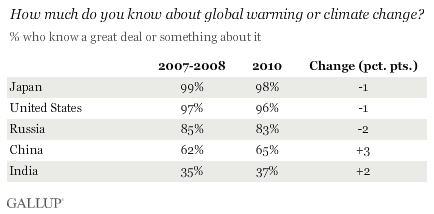
Clueless on Carbon

-eepjopsska9wioo2t_xow.gif

According to Gallup:

Residents in the top five greenhouse gas-emitting countries are no more aware of global warming or climate change than they were a few years ago. Majorities in all five countries Gallup surveyed in 2010 -- except India -- continue to say they know at least something about the issue.

August 24, 2011

Polling Libya

YouGov has a new poll out measuring UK attitudes on the war in Libya:

Public opinion on how well the West’s intervention in Libya and on whether it was right or wrong for the West to intervene have predictably flipped. Support for the West’s intervention had been standing at an August average of 33% thinking it right, 44% wrong – that has flipped to 41% right, 35% wrong. 25% of people had been thinking it was going well, 51% badly – that has flipped to 52% well, 26% badly. 47% of people now think that David Cameron has responded well to the situation in Libya, 33% badly.

If Gaddafi surrenders, 58% want to see him sent for trial at the International Criminal Court, 26% think Libya should try him. If he is found guilty 33% want to see him executed, 49% given life imprisonment. 39% would be happy if Gaddafi was killed in the conflict, 38% would rather he was captured alive so he can be put on trial. Finally on Libya, only 17% of people think we should send in British troops to keep order under the new regime. 38% would be happy to send police advisors, 42% would be happy for us to send emergency cash, food and medical aid.

Read the full results here. (pdf)

August 11, 2011

Indian Attitudes Toward Terrorism

india%20terror%20poll.jpg

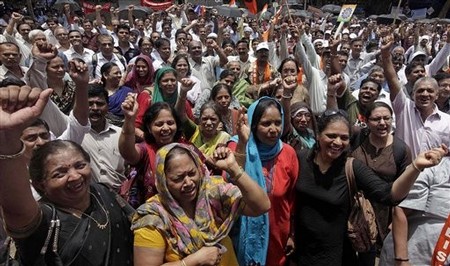
A new poll (pdf) takes the pulse of Indian attitudes toward terrorism. Among the findings, 37 percent of Indians believe the government needs to take "stronger action" against Pakistan. Fewer Indians are satisfied with their government's counter-terrorism policy, with just 38 percent claiming to be satisfied.

(AP Photo)

August 10, 2011

British Want to Use Live Ammo on Rioters

london%20riots%20ammo.jpg

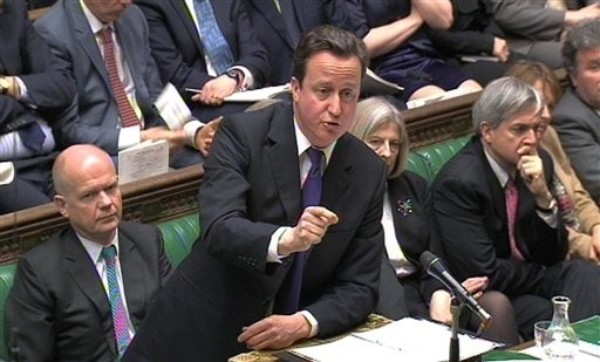
A new YouGov poll shows that the British aren't too thrilled with David Cameron's handling of the London riots but they do have want to get tough - really tough:

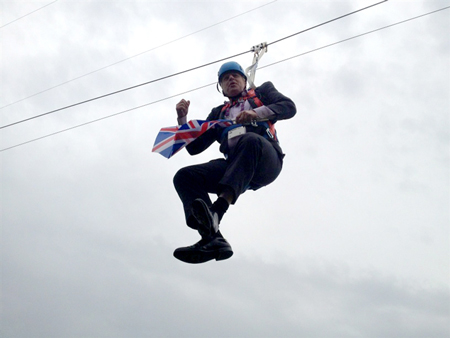
While 91% of people thought it was right that Cameron & Boris Johnson had returned from their holidays, they were generally seen as having handled the riots badly so far. Only 28% thought Cameron & May had handled them well, 24% thought Boris had handled it well (though of course, much of the fieldwork was done prior to Cameron & Johnson having done anything but get on a plane!). People were on balance positive about how the police had handled the riots- 52% thought they had handled them well, but a large minority (43%) thought they’d done badly.

Asked if the police should be able to use various tactics in response to riots provoked some pretty gung ho responses – 90% of people thought they should be able to use water cannon, 84% mounted police, 82% curfews, 78% tear gas, 72% tasers, 65% plastic bullets, 33% live ammunition, 77% thought that the army should be brought in. [Emphasis mine]

(AP Photo)

August 9, 2011

Americans Sour on Drug War

According to a new poll from Angus Reid:

Only nine per cent of respondents believe the “War on Drugs”—the efforts of the U.S. government to reduce the illegal drug trade—has been a success, while two thirds (67%) deem it a failure.
The poll also found that Americans are supportive of legalizing marijuana (55 percent) but very opposed to legalizing other drugs such as crystal meth or cocaine. You can read the full report here. (pdf)

July 28, 2011

Zimbabwe After Insane Inflation

zwpnqr1afuiclrqaq-fg9g.gif

Zimbabwe has long been synonymous with economic dysfunction. The country's inflation rate hit an amazing 231 million percent in 2008 and four out of every five adults in the country were unemployed. Today, Gallup notes that Zimbabweans are reporting improvements in their economic circumstances:

Zimbabweans appear to be benefiting from two consecutive years of economic growth and efforts to bring hyperinflation under control. Eighteen percent of Zimbabweans surveyed by Gallup in 2011 report "living comfortably" on their present household incomes -- double the 9% who said so in 2009. The 16% who reported they are "finding it very difficult" to get by is down significantly from 31% in 2009.

July 25, 2011

Japan's Views on Nuclear Power, Prime Minister

A new poll from Kyodo News measured Japanese sentiment on nuclear power and Prime Minister Kan:

A weekend telephone poll conducted by Kyodo News found 70.3 percent of respondents support Prime Minister Naoto Kan's call for a society that does not rely on nuclear power, but public support for his Cabinet sank to 17.1 percent, the lowest level since it was inaugurated just over a year ago, from 23.2 percent in the previous poll.

In the survey, 66.9 percent said they want Kan to quit by the end of August when the Diet session ends, while the disapproval rating for the Cabinet climbed to 70.6 percent from 61.2 percent in the last poll conducted June 28 and 29.

July 19, 2011

U.S. Views on Defense Cuts

Via Rasmussen:

Nearly one-half of Americans now think the United States can make major cuts in defense spending without putting the country in danger. They believe even more strongly that there’s no risk in cutting way back on what America spends to defend other countries.

A new Rasmussen Reports national telephone survey finds that 48% of Adults feel it is possible to significantly reduce military spending without putting the American people at risk. Thirty-seven percent (37%) disagree and do not believe major defense cuts come without risk. Fifteen percent (15%) are not sure.

Seventy-nine percent (79%) say the United States spends too much on defending other countries. Only four percent (4%) think America doesn’t spend enough protecting its friends. Thirteen percent (13%) feel these defense expenditures are about right.

July 18, 2011

Few Americans Think Afghanistan Will Improve

According to a new poll from Rasmussen:

The latest Rasmussen Reports national telephone survey of Likely Voters shows that just 22% now believe the situation in Afghanistan will get better in the next six months. Thirty-five percent (35%) expect the situation to get worse, while 30% predict it will remain about the same. Thirteen percent (13%) are undecided.

The number of voters expecting the situation to improve hovered around 20% for months until May when it jumped to 27% following bin Laden’s death. Last month, 26% expected the situation to get better.

July 13, 2011

British Views on the European Union

Not surprisingly, a new poll from Angus Reid shows deep British skepticism toward the European Union:

The level of animosity towards the European Union (EU) in Britain remains high, a new Angus Reid Public Opinion poll has found.

In the online survey of a representative national sample of 2,003 British adults, a majority of respondents (57%) believe that EU membership has been negative for the United Kingdom, while only one third (32%) think it has had a positive effect.

Respondents aged 18-to-34 are more likely to express positive feelings about the EU (45%) than those aged 35-to-54 (31%) and those over the age of 55 (22%).

Half of Britons (49%) say they would vote against the United Kingdom remaining a member of the EU if a referendum took place, while only one-in-four (25%) would vote to stay. Older respondents favour the idea of abandoning the EU by a 3-to-1 margin (68% to 19%).

Finally, Britons oppose the notion of the UK adopting the euro as its national currency by a 10-to-1 margin, with 81 per cent of respondents saying they would reject this course of action in a referendum.

Read the full results here. (pdf)

July 12, 2011

Support Falls for Libya War

According to a new poll from Rasmussen:

The latest Rasmussen Reports national telephone survey shows that just 24% of Likely U.S. Voters now believe the United States should continue its military action in Libya. Forty-four percent (44%) oppose further action there, while 32% are undecided.

A month ago, 26% favored continued U.S. military operations in Libya, while 42% were opposed.

Thirty-six percent (36%) of voters rate the Obama administration’s handling of the situation in Libya as good or excellent. That’s unchanged from last month. Twenty-seven percent (27%) view the administration’s performance as poor.

July 1, 2011

Korean Teens See Japan Threat

Interesting poll via Japan Security Watch on a recent survey of youth in South Korea:

Asked about enemies, 44.5% chose Japan, 22.1% chose North Korea, 19.9% chose the United States, 12.8% chose China and 0.6% chose Russia, showing that 44.5% of teenagers believe that Japan is an enemy.

June 29, 2011

Americans Support Obama's Afghan Pullout

public%20on%20afghan.gif

According to a new Gallup poll:

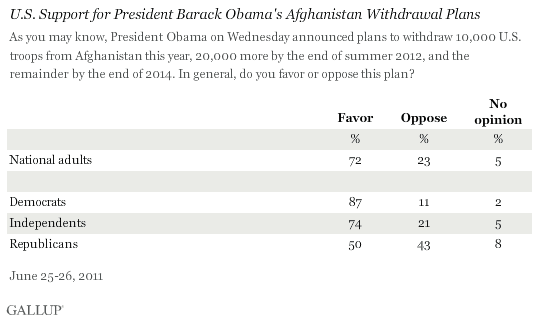
Americans broadly support President Barack Obama's plan to begin withdrawing U.S. forces in Afghanistan this year, with additional troops scheduled to leave by the end of next summer and the remainder by 2014. Nearly three-quarters, 72%, are in favor, while 23% are opposed.

The vast majority of Democrats and independents, as well as half of Republicans, favor the outlines of Obama's plan, according to the June 25-26 Gallup poll.

The same poll finds a more mixed reaction to the near-term goal of having 30,000 U.S. troops out of Afghanistan in 15 months. Forty-three percent of Americans consider this number about right, 29% call it too low, and 19% too high.ort President Barack Obama's plan to begin withdrawing U.S. forces in Afghanistan this year, with additional troops scheduled to leave by the end of next summer and the remainder by 2014. Nearly three-quarters, 72%, are in favor, while 23% are opposed.

Gulf Arabs Too Scared to Protest

According to a new poll:

Many Persian Gulf Arabs are frightened and pessimistic about the uprisings and revolutions that are sweeping the Middle East and are too afraid to speak out against their rulers.

According to a new opinion poll commissioned by the Qatar-based public forum The Doha Debates, that's the current mood among many gulf Arabs.

The online study, conducted by YouGov in June in which over 1,000 respondents were polled in 17 different Arab states, said an increasing number of gulf Arabs view the so-called Arab Spring with pessimism and fear.

And more than more half of those polled in countries in the Arabian Peninsula said they would be be "too scared" to go out in the streets and protest against their leaders.


The mood is far more optimistic in North Africa with 85 percent of respondents saying they thought Arab states would be democracies in five years, the poll found.

June 28, 2011

Nuclear Power: Globally Unpopular

nukes.jpg

According to a new poll from Ipsos MORI:

New research... shows that three in five global citizens (62%) oppose the use of nuclear energy – a quarter (26%) of those have been influenced by the recent nuclear disaster in Fukushima, Japan.

The latest Ipsos Global @dvisor survey shows that support for nuclear energy is far below that for solar power (97%), wind power (93%), hydroelectric power (91%) and natural gas (80%) as a source of electricity.

Just one in four (38%) adults across 24 countries support the use of nuclear energy. Support is highest in India (61%), Poland (57%) and the United States (52%).

(AP Photo)

June 27, 2011

Americans Believe al-Qaeda Is on the Ropes

According to a new Rasmussen poll:

Nearly one-half (48%) of Likely U.S. Voters think the al Qaeda terrorist organization is weaker today than it was before the September 11, 2001 attacks on America.

A new Rasmussen Reports national telephone survey finds that only 11% of voters think the terrorist group is stronger today, despite the killing last month of its leader Osama bin Laden. Thirty-two percent (32%) say al Qaeda’s strength is about the same now as it was prior to 9/11.

By comparison, in a survey last September, 36% thought al Qaeda was stronger than it was before the 9/11 attacks. Only 25% disagreed and felt the terrorist organization was weaker.

June 16, 2011

U.S. Views on NATO

Rasmussen polls likely voter sentiment on NATO:

A new Rasmussen Reports national telephone survey finds that 49% of Likely U.S. Voters believe America still should belong to the North Atlantic Treaty Organization, formed in 1949 to counter the Communist Soviet Union. Twenty-seven percent (27%) do not see a need for the United States to still belong to the alliance now that the Soviet Union is gone. Twenty-four percent (24%) are undecided.

Just 46% hold even a somewhat favorable view of NATO while 37% view the organization unfavorably. Overall attitudes are quite soft as just 7% hold a Very Favorable opinion of the group while 12% express a Very Unfavorable view. Nearly two-thirds (64%) fall somewhere in between.

Sixty-two percent (62%) of Democrats have a favorable view of NATO, while most Republicans (52%) view the alliance unfavorably. Voters not affiliated with either party are almost evenly divided in their assessments.

June 15, 2011

The Most Dangerous Countries for Women

A survey by the legal news service TrustLaw (pdf) has run down the five most dangerous states for women:


1) Afghanistan
2) Democratic Republic of Congo
3) Pakistan
4) India
5) Somali

India may be something of a surprise, surrounded as it is by mostly failed or failing states. But TrustLaw said that when it comes to human trafficking, India ranks the highest.

June 13, 2011

U.S. Views on Libya

A new Rasmussen poll shows little support for the war in Libya:

A plurality of voters now opposes further U.S. military action in Libya, and most say President Obama needs congressional approval to continue those operations.

A new Rasmussen Reports national telephone survey finds that just 26% of Likely U.S. Voters feel the United States should continue its military actions in Libya. Forty-two percent (42%) are opposed and 32% are undecided.

One thing that's become clear about the Libyan intervention is that the optimistic forecasts about American involvement ("days not weeks") turned out to be utterly wrong. Wars are inherently unpredictable. One would think this would counsel caution, but in Washington, not so much.

June 7, 2011

The View from Japan

pew%20poll%20japan.png

Pew Research conducted some polling on Japan, following up on the country's attitudes following the devastating earthquake and tsunami in March:

In the aftermath of the devastating March 11 earthquake and tsunami that struck the northeast coast of Japan, the Japanese public is resilient. Indeed, a majority believe that as a result of the disaster, Japan will become a stronger, rather than weaker nation. And while personal pessimism about the future has crept up slightly, on balance the public's overall sense of personal well-being appears little changed by the calamitous events of 2011.

What is clear, however, is that most Japanese foresee a rocky economic road ahead. A 52%-majority expect economic conditions to worsen over the next 12 months. In 2010, as the national economy showed signs of recovering from the global recession, only 33% of the Japanese public thought economic conditions would deteriorate in the coming year.


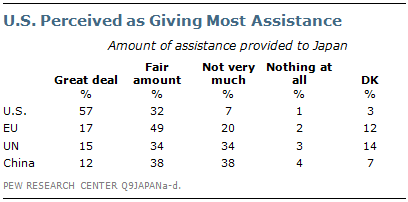
The U.S. image in Japan has been bolstered by post-quake aid. According to Pew:

A majority say the U.S. has done a great deal to help with relief efforts in Japan. Far fewer say the United Nations, European Union or China have done a great deal to assist Japan with the aftermath of the disaster. Thanks in part to American relief efforts, favorable opinion of the U.S. is at its highest point in nearly a decade, climbing to 85% positive this spring. The image of the United Nations has also improved in conjunction with earthquake assistance, and China's image has seen a modest uptick.

June 6, 2011

Polling Egypt's Revolution

The International Republican Institute has conducted some fresh polling in Egypt. The Washington Post got a sneak peak:

A majority of Egyptians who supported this year’s revolution did so mainly because of their poor economic situation, not because they yearned for democracy, according to a U.S. government-funded poll released Sunday.

The survey also underlines Egyptians’ sky-high expectations for their next government. Eight in 10 respondents said they anticipated their economic situation would be better in the coming year. That presents a daunting challenge for whomever takes office, with a recent drop in tourism and foreign investment exacerbating the country’s already severe economic problems....

Only 15 percent said they support the Muslim Brotherhood, which favors a government guided by Islamic sharia law. Less than 1 percent of respondents favor an Iran-style Islamic theocracy.

And only 15 percent said their political opinions were strongly influenced by religious figures, with many more citing family members and military leaders....

The poll found that two-thirds of respondents wanted Egypt to be closer to the United States than to Iran. But that result does not reflect the ambiguity many Egyptians feel about the U.S. government, which was a strong backer of Mubarak.


June 2, 2011

U.S. Views on Cyber Attacks

Following the news that the Pentagon was going to take a harder line on cyber attacks, Rasmussen has a poll gaging likely voter sentiment:

A new Rasmussen Reports national telephone survey finds that 82% of Likely U.S. Voters are at least somewhat concerned about the safety of the country’s computer infrastructure from cyberattack. Just 17% don’t share that concern. These findings include 35% who are Very Concerned but only three percent (3%) who are Not At All Concerned. (To see survey question wording, click here.)


The Pentagon is currently considering a new defense strategy that would classify a major computer sabotage attack from another country as an act of war justifying a forceful U.S. military response. Fifty-three percent (53%) of voters agree with this proposed new strategy and think a major cyberattack on the United States by another country should be viewed as an act of war. Twenty-two percent (22%) disagree, and another 25% are undecided.
A plurality (45%) of voters regards a cyberattack by another country as a greater economic threat to the United States than a traditional military attack. Twenty-two percent (22%) still see a traditional attack as a bigger threat. One-in-three voters (33%) are not sure which is the greater threat.
May 31, 2011

UK Views on Libya

Anthony Wells summarizes the latest YouGov poll of British views on Libya:

People were marginally in favour of the intervention in Libya (by 42% to 36%), but opposed further intervention to remove Gaddafi by 56% to 24%. Asked how long they though the West should continue to give military support to the rebels, 20% said it should stop immediately, 30% that it should continue for as long as necessary (6% said up to a month, 12% 3 months, 8% six months, 4% a year).

More generally YouGov asked if people though Britain should or should notbe prepared to take military action against leaders who posed a threat to their own people, but no direct threat to Britain – broadly whether people supported liberal interventionism or not. 32% thought Britain should intervene in such cases, 44% that she shouldn’t.

Why the Gulf Is (Relatively) Quiet

Gallup has a new poll out which sheds some light on why the states in the Persian Gulf have been relatively quiet during the Arab Spring:

gcc%20rating.gif

May 26, 2011

Bibi Boosted

According to a new poll, Israeli Prime Minister Benjamin Netanyahu has seen a surge of support following his trip to the United States:

The poll, conducted by the Dialog organization, under the supervision of Prof. Camil Fuchs of the Tel Aviv University Statistics Department, showed that 47 percent of the Israeli public believes the U.S. trip was a success, while only 10 percent viewed it as a failure.

Nearly half of the public felt "pride" at seeing Netanyahu address the joint session of Congress on Tuesday, while only 5 percent deemed it a "missed opportunity." The rest expressed no opinion, while 20 percent of those questioned said they hadn't watched the speech.

Israelis also don't believe that U.S.-Israel relations have been harmed by the visit despite its attendant problems, tensions and disputes.

Some 27 percent of those polled said they believe relations between the two countries will actually improve as a result of the visit, while only 13 percent thought relations would deteriorate. Nearly half of those questioned don't think there will be any change.

From the poll, it emerged that Netanyahu's trip not only put a brake on the drop in his popularity ratings, but actually reversed the trend.

May 19, 2011

Who's Leading in Libya?

No one's quite sure, according to a new Rasmussen poll:

A new Rasmussen Reports national telephone survey of Likely Voters shows that 38% believe the burden of the military operation in Libya is being handled primarily by U.S. allies like England and France. Thirty-two percent (32%) believe the United States is primarily handling the operation, while another 30% are not sure.

Democrats and voters not affiliated with either major political party lean more toward the view that our allies are the ones who are primarily handling the military operation, while Republicans are more evenly divided. A plurality of GOP voters (42%) says the United States is primarily handling the military operation in Libya.

Hopefully President Obama's speech today will provide some clarity as to the U.S. mission in Libya.

May 16, 2011

Peace, Well Being Linked

According to a new poll from Gallup:

The data are clear: Where there is high wellbeing, there is peace, and where wellbeing wanes, there is potential for conflict, for instability, and for violence, and peace is threatened.

Switzerland, Austria, Finland, Denmark, and Norway are among the high wellbeing countries that also have scores that indicate they are stable, peaceful countries according to the Failed States Index and World Bank dimension. These are undoubtedly among the most stable, peaceful countries on the planet.

On the other hand, Zimbabwe, Afghanistan, Burundi, Haiti, Iraq, the Democratic Republic of the Congo, and Ivory Coast are countries that have low wellbeing and low peace/stability scores.

Gallup observes a relationship between wellbeing and real-world situations. Most notably, wellbeing in Egypt and Tunisia declined in the years leading up to the recent revolutions there. Similar patterns are evident in other countries in the Middle East and North Africa, including Bahrain.

May 12, 2011

U.S. Views on Syria

Via Rasmussen:

A new Rasmussen Reports national telephone survey finds that just nine percent (9%) of Likely U.S. Voters think the United States should get more directly involved in the Syrian crisis. Sixty-five percent (65%) say America should leave the situation alone. But one-in-four voters (25%) aren’t sure.

These findings are comparable to the views voters held in the early stages of the protests in Egypt in late January and in Libya a month later.

Yet while the Obama administration has limited itself publicly to criticism of the Syrian government’s actions, just 28% of voters think the administration’s response has been good or excellent. Nearly as many (23%) rate the response as poor.

If Americans don't want to get involved in Syria's uprising, it's not clear to me why they're unhappy with the Obama administration. In any event, as Rasmussen noted, public opinion on these matters isn't all that important.

May 10, 2011

U.S. Views on Afghanistan

Rasmussen finds an increased willingness among likely voters to pull troops out of Afghanistan:

A new Rasmussen Reports nation telephone survey finds that 35% of Likely U.S. Voters now favor the immediate withdrawal of American troops from Afghanistan, the highest level of support to date. Twenty-one percent (21%) more support the establishment of a firm timetable to bring the troops home within a year.

The combined total of 56% is up four points from the beginning of March, up 13 points from 43% last September, and up 19 points from September 2009.

Thirty percent (30%) of voters still oppose the creation of any kind of timetable for withdrawal and 15% remain undecided.

May 9, 2011

Most Americans See Pakistani Complicity

According to a Friday poll from Rasmussen, a majority of Americans think Pakistan knew where bin Laden was:

A new Rasmussen Reports national telephone survey finds that 84% of American Adults think it’s at least somewhat likely that high-level officials in the Pakistani government knew where bin Laden was hiding. That includes 57% who say it is Very Likely they knew. Only nine percent (9%) believe it’s not likely that Pakistan knew.

Just 15% of Americans say the United States should continue military and financial aid to Pakistan. Sixty-three percent (63%) say that aid should not continue. Twenty-two percent (22%) are not sure.

May 4, 2011

Pew Poll: U.S. Still Divided on Afghanistan

According to a new Pew Research poll following the death of bin Laden:

While the public is more optimistic about success, there is little change in opinion about maintaining U.S. troops in Afghanistan. The public remains divided over whether the U.S. should keep troops in Afghanistan until the situation has stabilized (47%) or remove troops as soon as possible (48%), virtually unchanged from a month ago (44% keep troops, 50% remove troops).

April 27, 2011

Canadians: Cynical and Distrustful

segments.jpg

At least when it comes to their federal political parties:

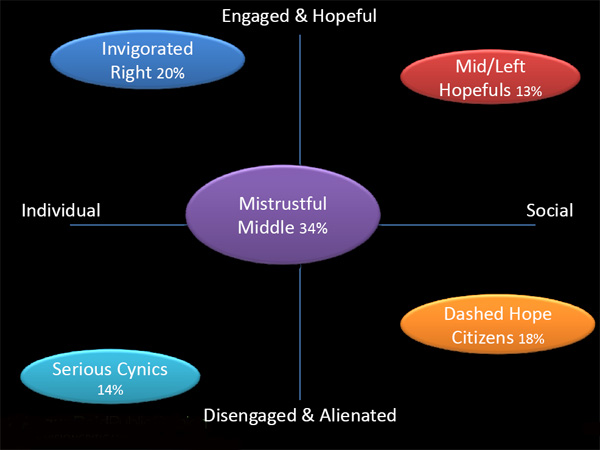
As Canadians prepare to cast their ballots in the fourth federal election held in the past eight years, a unique segmentation conducted by Angus Reid Public Opinion shows that only one third of Canadians are truly connecting with the main federal parties, while large proportions of respondents hold feelings of mistrust, skepticism and even cynicism towards politics.

According to Angus Reid, which conducted this analysis, the key group in this election is the Mistrustful Middle, "where respondents are currently being courted primarily by the Tories and NDP. This is the biggest of the five groups encountered, and the one where policy ideas are taking a more prevalent role than traditional support for existing parties."

You can read a full analysis here. (pdf)

April 22, 2011

A Royal Wedding? Yawn

royal%20wedding.jpg

Interest in the forthcoming nuptials of Prince William and Kate Middleton isn't running all that high:

According to a CBS News/New York Times poll, nearly 3 in 10 Americans (28 percent) say they're very or somewhat wrapped up in the pre-wedding news. Thirty percent say they're following it, but not very closely and 42 percent say they're not paying any attention at all.

Of those that are following the wedding, most say they plan to watch it next Friday. Among women paying attention, nearly 3 in 4 say they'll watch.

Interest among Britons slightly outpaces that of Americans. In a separate poll commissioned by CBS News and conducted by the British online polling firm YouGov, 29 percent said they are following the wedding very or somewhat closely. But nearly half say they're not paying close attention and 1 in 5 say they're paying no attention at all.

In related monarchy news, Queen Elizabeth turned 85 yesterday.

(AP Photo)

UK Sours on Nuclear Power

According to a new poll from Angus Reid:

In the online survey of a representative national sample of 2,023 British adults, 43 per cent of respondents support building more nuclear power stations in the UK, down eight points since July 2010 and 12 points since November 2009. Conversely, the level of opposition to this idea has risen to 37 per cent, up six points in less than a year.

Across Britain, 45 per cent of respondents believe the UK should avoid nuclear energy and focus on other carbon-free sources of energy, while 38 per cent would further pursue nuclear energy capabilities to reduce greenhouse gas emissions. The percentage of respondents who support either of these two statements has flipped since last year.

At least two thirds of Britons remain “very concerned” or “moderately concerned” about nuclear waste management (77%), health risks for communities that are close to a nuclear power station (69%), an accident at a nuclear power plant (69%), and nuclear technology falling into the hands of extremists (68%).

April 8, 2011

U.S. Views on Afghan War

Gallup finds the public mostly split:

gallup%20afghan%20new%20poll.gif

Frank Newport discusses the implications:

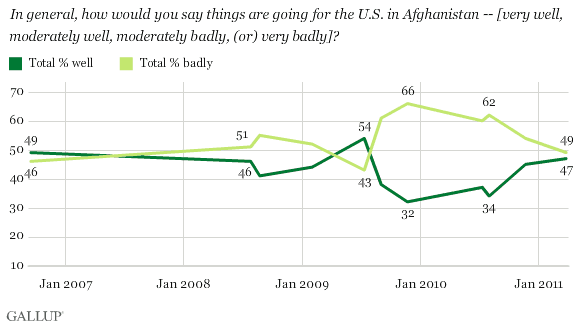
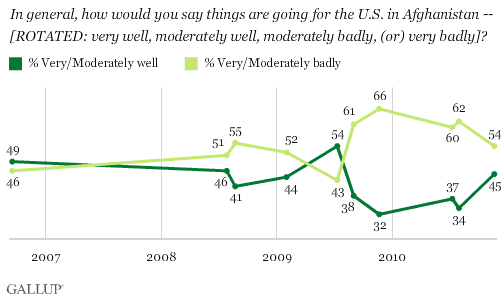
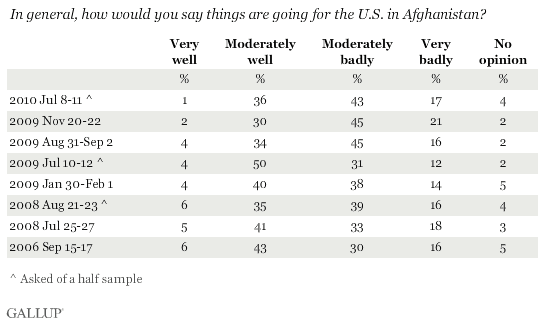
At this point, there does not appear to be a groundswell of opposition to U.S. involvement in that country. While the U.S. has been involved in Afghanistan for more than nine years, less than half of Americans say sending U.S. military forces there was a mistake. In contrast, it took less than a year and a half for a majority of Americans to say sending troops to Iraq was a mistake.

Americans also do not appear to be overly concerned about the way things are going in Afghanistan, with about as many saying the war is going well as say it is going badly. This is a more positive assessment than was the case throughout last year and for much of 2009 and 2008.


April 7, 2011

Which Countries Love Capitalism

globescan%20capitalism.gif

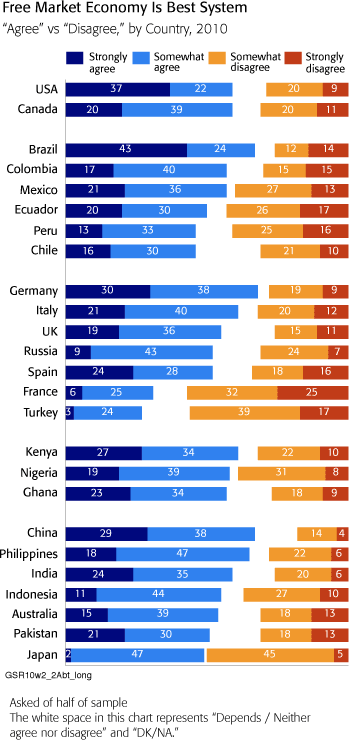
According to a new poll from GlobeScan, public support for a free market economy is lower in the U.S. than it is in... China.

April 6, 2011

U.S. Interests in the Middle East

One of the consequences of the various uprisings gripping the Middle East will be a forced reappraisal of what American interests are in the region. No one is quite sure what will replace the old order that is in the process of either being swept away or seriously rattled, but I think it's clear that what follows will entail a rethink of U.S. policy.

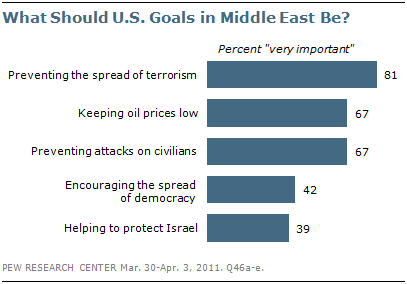
In that light, a new Pew Research poll asked Americans to rank their Middle Eastern priorities:

u%20mideast%20interests.png

That terrorism tops the list is interesting, because you could argue that the best thing the U.S. could do to blunt the spread of terrorism is to disentangle itself from the Middle East - something which may become a fait accompli if more democratic governments emerge in the Middle East. The flip side, however, is that chaos in the region (especially in Yemen) makes it more likely that terrorist cells can set up shop, making an attack against the U.S. more, not less, likely. Steps to reduce America's exposure to terror in the long run could produce a spike in short-term risk.

April 5, 2011

UK Libya Polling

A new poll (pdf) from YouGov asked Britains about Libya. Overall, 50 percent think Prime Minister David Cameron is doing well vs. 35 percent who believe he's doing badly. Views are more mixed about the wisdom of taking action against Libya: 41 percent thought it was the right idea vs. 40 percent who thought it was wrong. Of those polled, 49 percent thought military action is going well vs. 27 percent who thought it is going badly.

When it comes to taking more aggressive action against Libya, British public opinion turns negative. Only 28 percent would support arming the rebels vs. 46 percent who oppose such a move. A clear majority - 64 percent - do not want to send coalition ground forces into Libya to depose Gaddafi.

April 4, 2011

President Obama's National Security Polling

Not as good, according to a new poll from Rasmussen:

A new Rasmussen Reports national telephone survey of Likely Voters shows 37% give the president good or excellent ratings on his handling of national security issues. Slightly more voters (40%) say the president is doing a poor job when it comes to national security. (To see survey question wording, click here).

Last week, just after his decision to get involved in Libya, 43% gave the president positive marks for his handling of national security, while 34% rated his performance as poor.

Positive marks for the president on national security are now at their lowest level since he took office in January 2009. His poor rating is the highest measured since last August. One year ago, 45% gave the president positive ratings on national security, while 32% rated the job he was doing as poor.

March 31, 2011

Obama Not Moving U.S. Opinion on Libya

A Rasmussen poll finds that the public views Obama's handling of Libya favorably, although his speech on Monday didn't change many minds:

A new Rasmussen Reports national telephone survey finds that 43% of Likely U.S. Voters rate the Obama administration’s response to the Libya situation as good or excellent, marking little change from two previous surveys. Thirty percent (30%) give the administration poor marks, up from 21% earlier this month before the president committed U.S. forces to Libya.

Forty percent (40%) of voters felt at that time that the administration was doing a good or excellent job responding to the political crisis in Libya. Last week, with the U.S. military actively involved in Libya, 41% rated the Obama administration’s response as good or excellent, but 28% said it was doing a poor job.

The numbers also worsened slightly for the president from last week when voters are asked if Libya is vital to U.S. national security these days. Twenty-seven percent (27%) of voters say yes, while 48% say no, up six points from a week ago. Twenty-four percent (24%) remain undecided.

The latest survey was taken Monday and Tuesday nights, and the findings from the first night prior to the president’s speech and the second night after the speech show virtually no change on either question.

March 30, 2011

Support Falling for Libya War

According to a new poll:

A plurality of voters -- and a majority of independent voters -- thinks the U.S. military should not be involved in Libya right now, according to a new Quinnipiac University poll released Wednesday that also shows President Obama with his lowest-ever approval rating and re-elect score.

Just 41 percent of American voters say the U.S. is doing the right thing by using military force in Libya right now, while 47 percent believe that the U.S. should not be involved in the North African nation. Among independents, that support slips to 38 percent, with 51 percent saying the U.S. should not be involved.

The percentage of independents who say the U.S. is doing the right thing in Libya is lower than the percentage of Democrats (48 percent) or Republicans (40 percent) who approve of the use military force, echoing the results of two other surveys released over the last week that also showed support for the Libya mission lagging among independents.

March 29, 2011

Measuring Millenials' View of Foreign Policy

The Brookings Institution has polled (pdf) Millenials (those born between 1980 and 2005) for their views on foreign policy. The Millenials polled were student leaders and those engaged in policy internships so it reflects a rather stratified view of this age group. Here's what they found:

Isolationism, not globalism, is winning out. Fifty-eight percent of the young leaders think that America is "too involved" in global affairs and should instead focus more on issues at home. This level of isolationism, forged by growing up in the time of 9/11, Iraq and Hurricane Katrina, doubled the number recently seen in adult survey results. Indeed, contrary to the idea of young, globally minded Obamacrats vs. inward-looking Tea Partiers, young Democrats are actually more likely to hold isolationist attitudes than young Republicans.

-- China scares them. When asked to name any countries that they think will present the biggest problems for the U.S. over the next 10 to 20 years, China was listed the second most frequently, behind only Iran and ahead of nations such as North Korea, Iraq, Afghanistan and Russia. An almost even number -- 42% to 39% -- believe that China will be the most powerful country in the world in 2025, when these young people will probably start moving into power. Indeed, a majority of young Democrats and independents think China will be more powerful than the United States.

Among the top challenges for the future, Millenials identified terrorism at the top (31.6 percent) followed by climate change (12.8 percent), nuclear proliferation (11.5 percent) and global poverty (10.7 percent).

March 23, 2011

U.S. Support for Libya Strikes Climbing

A pair of new polls shows climbing support in the U.S. for the military mission in Libya, following a fresh poll from CNN that showed a jump in public support. First, Rasmussen:

34% of Likely U.S. Voters now think the United States should get more directly involved in the Libyan crisis, up 12 points from 22% two weeks ago. Forty-eight percent (48%) say the United States should leave the situation alone, down from 63% in the previous survey. Eighteen percent (18%) are not sure which course is best.

Forty-one percent (41%) of voters rate the Obama administration’s response to the situation in Libya as good or excellent, unchanged from earlier in the month. But 28% now say the administration is doing a poor job, up from 21%.

One likely explanation for the increased support for U.S. involvement in Libya is the United Nations’ approval of the use of multi-national air strikes to help rebels attempting to overthrow the government of longtime dictator Moammar Gadhafi. Forty-seven percent (47%) of voters say they are more supportive of American involvement in Libya now that the U.N. has approved the mission. Fifteen percent (15%) say the U.N. action has made them less supportive, while 32% say it has had no impact on their opinion.

Meanwhile, Gallup found that 47 percent of those polled approved of military action in Libya while 37 percent opposed. Additionally, Gallup noted that this approval rating "is lower than what Gallup has found when asking about approval of other U.S. military campaigns in the past four decades."

Across the pond, YouGov found (pdf) that the British public is equally supportive of military action in Libya with 45 percent thinking it's the right move vs. 36 percent who think it's the wrong move. Prime Minister Cameron gets higher marks for dealing with the conflict in the UK than does President Obama.

March 22, 2011

Public Supports Libya No-Fly Zone

t1larg.libya.poll.chart.01.jpg

A new CNN poll shows that support for a no-fly zone among the American public has edged up:

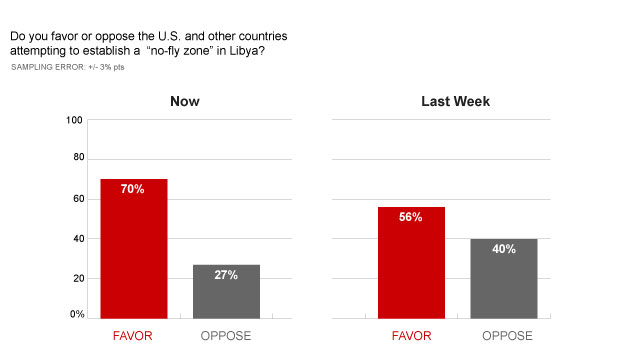
Seven in ten Americans support military action by the U.S. and other countries to establish a no-fly zone in Libya, a 14-point increase since last week, according to a new national poll.

But a CNN/Opinon Research Corporation survey also indicates there is less among the public for air strikes that directly target Libyan leader Moammar Gadhafi's troops who are fighting opposition forces, and only one in four want to send ground forces into the conflict....

According to the survey, 70 percent support the establishment of a no-fly zone by the U.S. and other countries, up from 56 percent a week ago. Twenty-seven percent oppose the move, down 13 points.

The poll indicates support drops to 54 percent for air strikes not directly related to the no-fly zone that instead target the troops fighting the rebels, with 43 percent opposed to that action.

March 16, 2011

U.S. Opposed to Afghan War

afghanwar%20poll.jpg

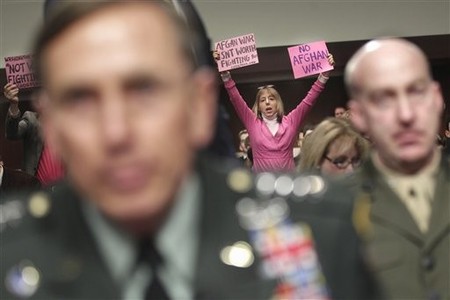
A new Washington Post/ABC News poll shows that two-thirds of the American public (64 percent) say that the war in Afghanistan is not worth fighting and almost 75 percent believe President Obama should pull "a substantial number" of combat troops out of Afghanistan this summer. On the other hand, 53 percent of those polled believe the president will not withdraw U.S. forces from Afghanistan this summer.

(AP Photo)

Still More Libya Polling

A new one from CNN shows 56 percent of the public supporting a no-fly zone with 40 percent opposed. It also finds support for arming the rebels (53 percent vs. 43 percent). However, the public does not favor the U.S. taking the lead to resolve the crisis - 74 percent said the U.S. should "leave it to others" - and an equally large majority do not support sending ground troops into Libya.

Jobs & Wellbeing

9mmjrh05jkunv790uwdmpq.gif

Gallup finds a connection:

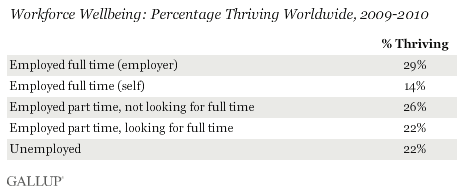
One of the most important factors contributing to an individual's wellbeing is his or her employment status. Globally, the difference in wellbeing between those who have good jobs and those who are self-employed is significant. In terms of one's wellbeing, the worst job in the world is to be self-employed in a developing country. At 12% thriving, the self-employed in the developing world have the lowest wellbeing of any group. Many of the world's poor are forced into growing or making things to sell on a street corner, working for themselves out of desperation. The picture is different in the developed world, where the self-employed are more likely to be entrepreneurs out of opportunity.

March 15, 2011

New Poll Shows U.S. Not in Favor of Libya Intervention

1927-6.png

A new poll from Pew Research confirms earlier polls from Rasmussen which showed that the American public doesn't support a military intervention in Libya:

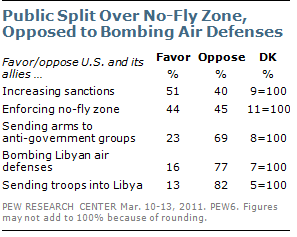
The public by a wide margin says the United States does not have a responsibility to do something about the fighting between government forces and anti-government groups in Libya. And while opinion is divided over enforcing a no-fly zone over Libya, this view is undercut by the fact that Americans overwhelmingly oppose bombing Libyan military air defenses.

The latest national survey by the Pew Research Center for the People & the Press, conducted March 10-13 among 1,001 adults, finds that 63% say the United States does not have a responsibility to act in Libya; fewer than half as many (27%) say the U.S. has this responsibility....

Reflecting the public's reluctance about U.S. involvement in Libya, barely half (51%) favor increasing economic and diplomatic sanctions against Libya. The public is divided over the possibility of enforcing a no-fly zone -- 44% favor this action while 45% are opposed. Yet just 16% favor bombing Libyan air defenses -- 77% oppose bombing the sites.

This is actually somewhat in line with yesterday's Washington Post/ABC news poll, which showed a slight majority in favor of a no-fly zone until they were asked about bombing Libyan air defenses, after which support for a no-fly zone drops. Pew also found that 69 percent of Americans have no interest in arming rebels and 82 percent do not want to send U.S. troops into Libya.

Meanwhile, Larison thinks we should follow Senator Lugar's advice and actually debate the merits of going to war with Libya in Congress:

As the vast majority of the public is against a Libyan war even in the form of a no-fly zone, it is hardly certain that Congress would authorize military action, much less take what is by now a very unusual step of formally declaring war. This is as it should be. War powers were reserved to Congress to prevent the executive from launching wars arbitrarily, and the failure of Congress to rein in presidential abuses in this area and the failure to insist on declarations of war before going to war have been at the heart of many of the most serious foreign policy blunders since WWII.

March 14, 2011

Polling Europe

The Guardian today reported on a new poll surveying members of

Europe's hope of a better future is faltering, as the financial crisis and spending cuts bite, according to a Guardian/ICM poll of five leading EU countries. It finds trust in government at rock bottom and widespread fear of further economic decline. Few people are convinced that the present signs of recovery can be sustained. The poll was carried out online using a representative sample of more than 5,000 people of working age in five leading EU states – Britain, France, Germany, Poland and Spain. It paints a picture of a continent confident in its liberal values and still mostly committed to EU institutions such as the euro and the free movement of people between states, but notably hostile to state spending and political leaders.

The poll also found deep economic pessimism in among Europeans:

Overall, 40% of those polled think their economy will get worse over the next 12 months, against 20% who think it will improve. Only in Germany are more people optimistic than pessimistic. Economic anxiety is greatest in France, where pessimists outnumber optimists by a net difference of 46 points. In Britain, the difference is 40 points and in Poland 30 points. Spain is more optimistic, with a net difference of 18 points – which could be explained by few people in the country thinking things can get worse than they already are.

U.S. Inclined Toward Libyan No-Fly Zone

A new Washington Post/ABC News poll shows less skepticism toward U.S. intervention in Libya than prior polls:

When it comes to Libya, 56 percent of those polled are supportive of the United States’ joining a new no-fly arrangement to prevent government air strikes on rebel groups. Support is slimmer (49 percent) for more independent U.S. action: using U.S. aircraft to create the no-fly zone.

They also asked the public to rate President Obama's performance on Libya:

Forty-five percent say they approve of President Obama’s handling of the situation in Libya, and 34 percent say they disapprove. A large 21 percent say they have no opinion on the matter. Those undecideds shift to disapproval when it comes to the president’s handling of the political unrest in the region more broadly. On that front, 45 percent approve, and 44 percent disapprove.

March 11, 2011

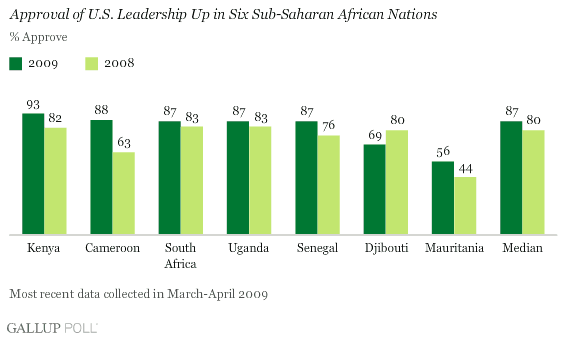
Honeymoon's End: Who's Less Sold on U.S. Leadership?

jxms6ezk8067bs8_gxytvq.gif

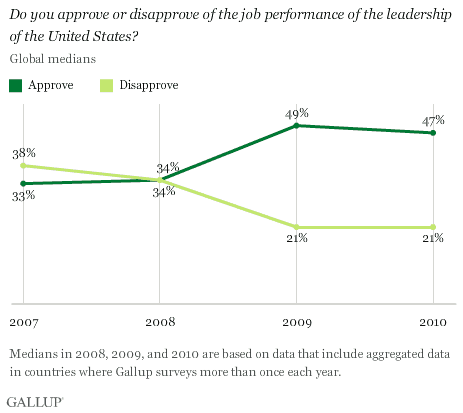
Gallup released a new survey canvasing approval for U.S. leadership. As part of our regular series of Global Top Fives produced with Gallup, we've dove in deeper to see where approval has dropped off the sharpest. Read it here.

March 10, 2011

New Poll Shows Little U.S. Support for Intervention in Libya

Following a Rasmussen poll which found that 63 percent of Americans wanted to leave Libya alone, a new poll (pdf) from Angus Reid confirms that there is little appetite for an entanglement with Gaddafi's crumbling country:

The prospect of a military intervention to topple the Libyan regime is endorsed at this time by fewer than one-in-ten Americans, a new Vision Critical / Angus Reid poll has found.

The online survey of a representative national sample of 1,006 American adults presented respondents with three policy options that the United States government could take to deal with Libya, where a popular uprising that began in February has led to violent confrontations between rebels and the long-standing regime of Muammar Gaddafi.

More than a third of respondents (36%) believe the U.S. should impose economic sanctions against Libya—the course of action originally outlined by President Barack Obama last month.

One-in-five Americans (22%) would do nothing, saying that the African country poses no threat to the U.S. Only eight per cent of respondents would authorize a full-scale invasion of Libya to remove the current government.

I think it would have been better to measure whether Americans would support a no-fly zone - the policy option currently being batted around. I don't think anyone has really put a full-blown land invasion on the table.

March 9, 2011

Democratic Passions Then and Now

Pew Research has gone back into the archives to compare enthusiasm for democracy among citizens of Eastern Europe following the collapse of the Soviet Union with their current attitudes. It provides something of a cautionary tale:

In 1991, majorities of Russians and Ukrainians clearly favored democracy, rather than a strong leader, as the best way to address their country's problems. By 2002 opinion had reversed, with two-thirds or more in each country saying they preferred a strong leader. In Poland and Bulgaria views were mixed on the issue, while publics in the Czech Republic and Slovakia continued to strongly support democracy.

Seven years on, doubts about democracy persisted. The fall 2009 Global Attitudes survey found Russians and Ukrainians still believing that a strong leader was the best means of solving their country's problems. Bulgarians now shared this view. In most countries half or more approved of the shift to a multi-party system. But the level of support declined between 1991 and 2009 in all but Poland, the Czech Republic and Slovakia. In Ukraine, a majority actually disapproved of the change to multiple parties.

These findings do not mean that East Europeans were inclined to abandon democracy. Publics across the region broadly endorsed the demise of communism. Rather these opinions point to the gap between what East Europeans hoped for and what they perceived in terms of political change.


March 8, 2011

U.S. Views on Libya Intervention

A majority of U.S. voters want a hands-off approach to Libya, according to a new poll from Rasmussen Reports:

Just 22% of Likely U.S. Voters think the United States should get more directly involved in the Libyan crisis. Sixty-three percent (63%) say America should leave the situation alone. Fifteen percent (15%) are not sure.

This is consistent with an earlier Rasmussen poll that found that 67 percent of voters said the U.S. should "stay out" of the unrest roiling the Arab world.

Rasmussen also asked voters about the performance of President Obama with respect to Libya:

Forty percent (40%) of voters rate the Obama administration’s response to the situation in Libya to date as good or excellent. Twenty-one percent (21%) say the administration is doing a poor job.

Britain and Libya

davidcameron%20revolution.jpg

As one wag (whose name escapes me) put it, David Cameron "is having a bad Arab revolution." A new YouGov poll confirms that:

Asked how David Cameron has respondened so far the public give a broadly negative reaction – 32% think he has done well, 48% badly.

There is strong support for applying economic sanctions – 69% would support them with only 16% opposed – and majority support for a no-fly zone (56% suport, 25% oppose). However, there is very little support for either direct military intervention by British troops, or indirect military intervention by arming the Libyan rebels (only 11% and 12% respectively would support). What support there is for limited military action against Libya is conditional upon UN approval – 52% of people would support limited military action (such as enforcing a no-fly zone) with UN approval, only 9% without.

March 7, 2011

Americans Want Afghan Pullout

According to a new poll from Rasmussen Reports:

A majority of voters, for the first time, support an immediate withdrawal of all U.S. troops from Afghanistan or the creation of a timetable to bring them all home within a year.

A new Rasmussen Reports national telephone survey finds that 31% of Likely U.S. Voters now say all troops should be brought home from Afghanistan immediately, while another 21% say a firm timetable should be established to bring all troops home within a year’s time. The combined total of 52% who want the troops home within a year is a nine-point jump from 43% last September. Just 37% felt that way in September 2009.

Only 34% of voters now think there should be no timetable for withdrawal. Fifteen percent (15%) are not sure.

The World's Favorite Country

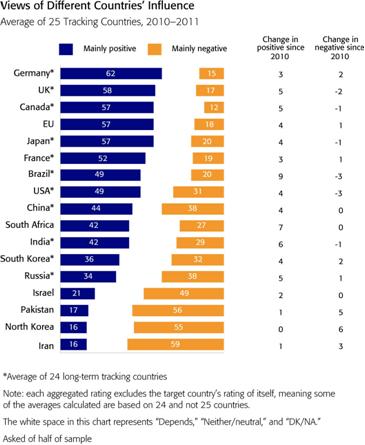
Digging a bit deeper into the BBC poll referenced below, we find that respondents in 27 countries gave Germany highest marks, followed by the United Kingdom and Canada:

pipa%20world%20poll.jpg


Brazil on the Rise

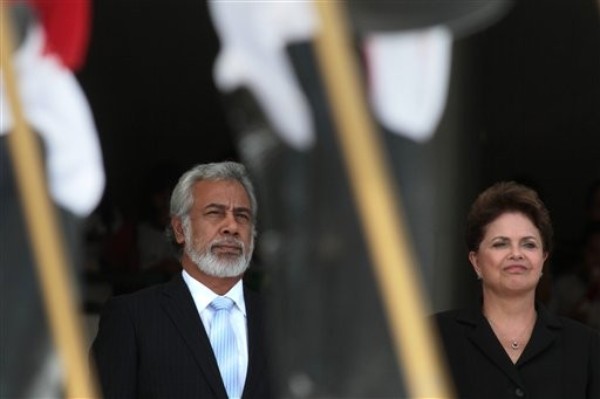
brazil.jpg

According to a new BBC poll, the world has a more positive view of Brazil and, in fact, an improved outlook toward a lot of countries:

Positive views of Brazil's influence jumped from 40 to 49 per cent on average over the previous year, with negative views dropping to just 20 per cent. Views of Brazil are now predominantly positive in all but two of the countries polled. The poll, conducted by GlobeScan/PIPA, asked a total of 28,619 people to rate the influence in the world of 16 major nations, plus the European Union.

In the year when South Africa hosted the World Cup, the proportion positively rating its influence in the world rose significantly, from 35 to 42 per cent. Germany was again the most positively viewed nation, with 62 per cent rating its influence as positive (up 3 points).

Overall, positive ratings increased of 13 of the 16 nations rated. These include the USA--positive views of American influence rose an average of four points to 49 per cent, with 31 per cent negative. The United Kingdom's positive ratings rose five points to 58 per cent, making it, for the first time, the second most positively rated country. This upwards movement for many countries counters a downward movement found in 2010, but also, in most cases, surpasses the levels found in earlier years.

In marked contrast, the three most negatively viewed countries saw their average ratings go from bad to worse, including Iran (59% negative, up 3 points since 2010), North Korea (55%, up 6 points), and Pakistan (56%, up 5 points). There was a significant increase in negative views of Iran in key Western countries including the United Kingdom (up 20 points), Canada (up 19 points), the USA (up 18 points), and Australia (up 15 points). However, Israel, for many years among the least positively viewed nations, bucked this trend, keeping its negative ratings at 49 per cent and showing a slight lift in positive ratings from 19 to 21 per cent.

(AP Photo)

March 3, 2011

Pessimission, UK Edition

According to a new Ipsos MORI poll, Britons have stayed downbeat despite a growing mood of economic optimism worldwide:

The general economic mood has greatly improved in many countries since the low point of 2008. Citizens of Sweden, Germany, China Australia and Canada are far happier now with the current state of their economy than they were two years ago. However, that large rise has not been seen among Britons where just eight per cent described the economy as good in April 2009 and 13% do so now. This places Great Britain around the same level as France and Italy in rating the economy as good (both 11%) but higher than Japan, Spain and Hungary (6%, 4% and 3% respectively).

However, economic optimism for the next six months is low among European and G8 countries. Of the G8 countries, Canada and Germany are the most positive about the future – although only one in three (31% and 30% respectively) expect the economy to improve in the next six months. The French are the most pessimistic with just five per cent expecting improvements. Just over one in seven (13%) Britons are optimistic about the future of the economy.

You can view the full survey here. (pdf)

U.S., UK & Canadian Views on Afghan War

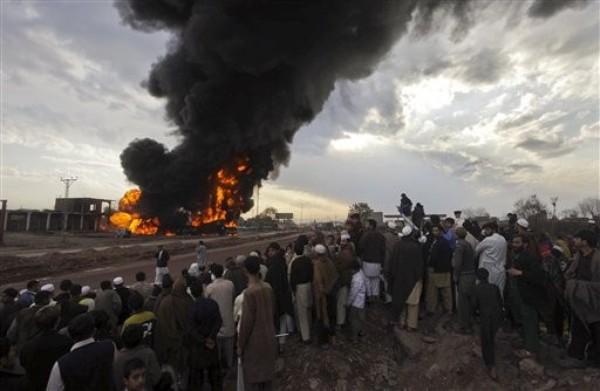
nato%20burning.jpg

According to a new poll from Angus Reid, more Canadians and Britons oppose the Afghan war than Americans do:

A year ago, a majority of Americans (58%) supported the mission in Afghanistan, while about two-in-five (38%) opposed it.

Now, in a trend that began late last year, respondents are evenly split, with 47 per cent backing the mission, and 46 per cent opposing it. The level of rejection to the Afghan mission is highest in the Northeast and West (both at 49%) and lowest in the South (44%).

For more than a year, a majority of Britons has expressed opposition to the mission in Afghanistan. This month, only 31 per cent of respondents are backing the military operation, while 60 per cent are against it.

This month’s result matches the high level of opposition to the mission, which was recorded in October 2010. Respondents in London (63%) and Scotland (62%) are more likely to reject the military operation.

For the first time since the war began, three-in-five Canadians (63%) voice opposition to the mission in Afghanistan. Support for the military effort has dropped to the lowest level recorded (32%).

This month’s numbers represent a drastic shift from a survey conducted a year ago, where 47 per cent of Canadians backed the war.

Full results here. (pdf)

(AP Photo)

March 2, 2011

U.S. Views on the Iraq War

Not so great, according to a new Rasmussen poll:

Looking back, a slight majority of Likely Voters believe the United States should never have gotten involved in Iraq in the first place. They also believe the mission there was more of a failure than a success.

The latest Rasmussen Reports national telephone survey of Likely Voters shows that just 36% believe the United States should have gotten involved in Iraq, while 51% disagree. Another 14% are undecided.

February 23, 2011

Americans Don't Want to Intervene in the Middle East

Walter Russell Mead doesn't think much of Rand & Ron Paul's non-interventionist foreign policy, arguing in the IHT that it won't garner favor in Washington:

The first is that the contest in the Tea Party between what might be called its Palinite and its Paulite wings will likely end in a victory for the Palinites. The Palinite wing of the Tea Party (after Sarah Palin) wants a vigorous, proactive approach to the problem of terrorism in the Middle East, one that rests on a close alliance between the United States and Israel. The Paulite wing (Rand Paul) would rather distance the United States from Israel as part of a general reduction of the United States’ profile in a part of the world from which little good can be expected.

The Paulites are likely to lose this contest because the commonsense reasoning of the American people now generally takes as axiomatic that security at home cannot be protected without substantial engagement overseas.

But on the issue of the growing tumult in the Middle East, the American people are with the "Paulites."

According to Rasmussen:

A new Rasmussen Reports national telephone survey finds that 29% of American Adults think a change of government in any of these Arab countries will be good for the United States, while slightly more (33%) feel such a change will be bad for America. Twelve percent (12%) say it will have no impact, but one-in-four (26%) aren’t sure what to expect.

However, as with the recent turmoil in Egypt, most Americans (67%) say the United States should leave the situation in the Arab countries alone. Just 17% say the United States should get more directly involved in the political situation there, but another 17% are not sure.

Americans are skeptical about the political changes that are likely to come from the growing - and, in Libya’s case, violent - protests. Thirty percent (30%) believe it is at least somewhat likely that most of these Arab countries will become free, democratic and peaceful over the next few years, but that includes just four percent (4%) who say it is Very Likely. Sixty-one percent (61%) view a democratic and peaceful outcome as unlikely, with 14% who say it is Not At All Likely.

If we're talking about common sense, not plunging the United States and NATO into an incipient civil war in a Middle Eastern country with strong tribal factions seems to qualify. Of course, this is not going to sit well with the coalition of liberals and conservatives urging the U.S. and NATO to the barricades.

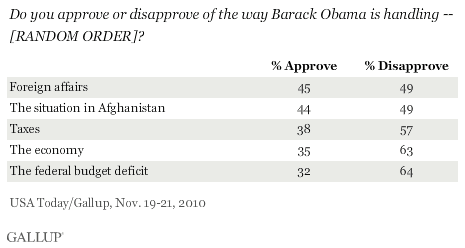
Obama's Handling of Foreign Policy

The American Enterprise Institute's Political Report rounds up some of the latest polling on President Obama's foreign policy:

How the public feels about Obama's handling of foreign policy:

Jan 2011: CNN/ORC – 57% approve; 40% disapprove
Jan 2011: CBS/NYT – 46% approve; 32% disapprove
Feb 2011: Gallup – 48% approve; 45% disapprove

How the public feels about Obama's handling of the situation in Afghanistan:

Jan 2011: CNN/ORC – 51% approve; 46% disapprove
Jan 2011: AP/GfK – 54% approve; 44% disapprove
Feb 2011: Gallup – 47% approve; 46% disapprove

How does the public feel about Obama's handling of the situation in Iraq:

Jan 2011: CNN/ORC – 56% approve; 42% disapprove
Jan 2011: AP-GfK – 57% approve; 41% disapprove

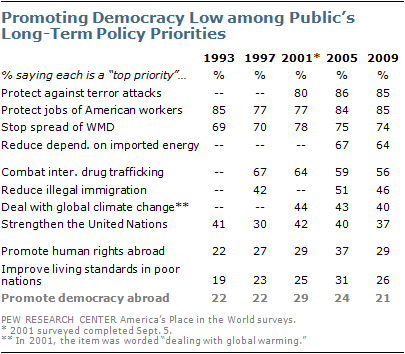
Polls show that Americans are not enthusiastic about actively promoting democracy abroad. In the latest overview Americans say this about "exporting democracy":

-55% thought that helping to bring a democratic form of government to other nations is "somewhat important"
-19% thought it "very important," and
-26% thought it "not important"

Read the whole thing here.

February 22, 2011

America's Role in the World

galup%20role%20in%20the%20world.gif

Gallup's latest World Poll figures show some decline in support for an active U.S. role in the world:

By a 2-to-1 margin, 66% to 32%, Americans would prefer that the United States be a major rather than a minor player on the world stage in trying to solve international problems. Support for the United States' having a leading or major role in this has diminished over the past two years, falling from 75% in 2009, while the percentage favoring a more isolationist stance has increased from 23%.

Dept. of Incoherence

cameronin%20mideast.jpg

While in the Middle East, British Prime Minister David Cameron said the West shared the blame for the Middle East's oppressive political environment:

"For decades, some have argued that stability required highly controlling regimes, and that reform and openness would put that stability at risk. So, the argument went, countries like Britain faced a choice between our interests and our values.

"And to be honest, we should acknowledge that sometimes we have made such calculations in the past. But I say that is a false choice.

"As recent events have confirmed, denying people their basic rights does not preserve stability, rather the reverse."

He said that Britain's economic and security interests would ultimately be advanced by a more democratic Middle East.

And just who did the prime minister bring with him on his trip through the Middle East to signify the harmony between Britain's values and interests? Representative from Britain's arms industry.

(AP Photo)

February 17, 2011

U.S. Sees Mubarak Ouster as Positive

mubarak%20zogby.jpg

According to a new poll from Zogby:

U.S. likely voters are more likely to say the ouster of Egyptian President Hosni Mubarak was positive rather than negative for the U.S., but 68% are either very or somewhat concerned that Islamic fundamentalists will have too much power in the new government.

The Feb. 14-16 Zogby Interactive poll also finds that 45% believe President Barack Obama's response to the situation in Egypt was "what it should have been." However, 21% say Obama should have been more supportive of "our ally" Mubarak and 15% say Obama should have been more supportive of the protestors.

Close to 50 percent of Americans thought Mubarak's ouster was a negative development for Israel vs. 28 percent who thought it was positive and 23 percent who weren't sure.

(AP Photo)

February 16, 2011

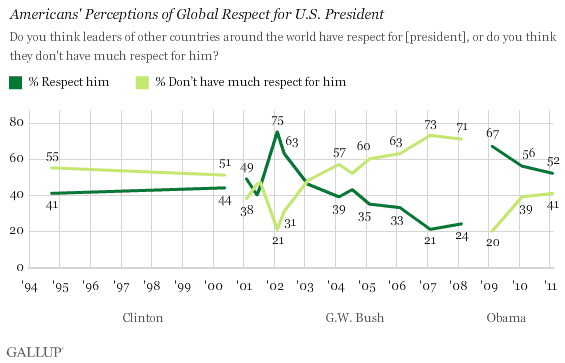
Does the World Respect President Obama?

Yes, but not as much as it used to, according to a new Gallup poll:

obama%20respect.gif

Gallup's Frank Newport offers some context:

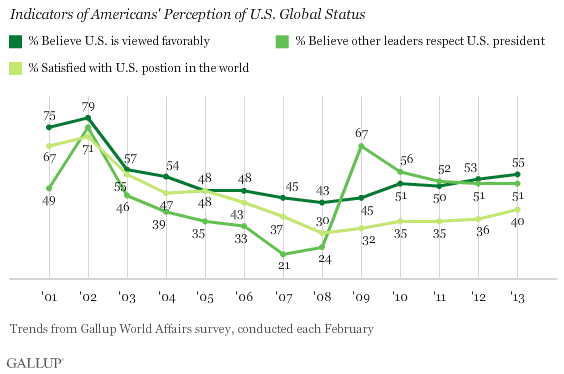
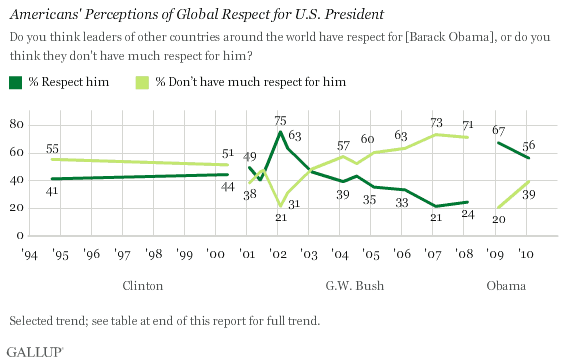
In February 2009, shortly after Obama's presidential inauguration, a soaring 67% of Americans perceived that the world's leaders respected him. That dropped to 56% last February, and is slightly lower (52%) in this year's Feb. 2-5 Gallup World Affairs survey.

Still, Obama's readings on this measure remain historically high.

A few months after 9/11, Bush received 75% and 63% readings on this respect question -- but all other readings during the Bush administration were below 50%. That includes the low point in February 2007, when 21% of Americans said world leaders respected Bush. Americans' views of world leaders' respect for Obama are also higher than two Gallup measures for Clinton, in 1994 (41%) and 2000 (44%).


February 15, 2011

U.S. Views on Clinton, Gates

clinton%20favorable.jpg

According to Rasmussen, Secretary Clinton is viewed favorably by likely voters:

A new Rasmussen Reports national telephone survey finds that 60% of Likely U.S. Voters hold at least a somewhat favorable opinion of Clinton, with 30% who view her Very Favorably. The ex-senator and former first lady is seen unfavorably by 35%. That’s down six points from January of last year and includes 18% with a Very Unfavorable view. (To see survey question wording, click here.)

Fifty-six percent (56%) had a favorable view of Clinton just before she assumed the secretaryship in January 2009.

Secretary Gates, who is less well known, gets a favorable rating from 44 percent of respondents and an unfavorable rating from 34 percent.

(AP Photo)

February 14, 2011

Voters Somewhat More Upbeat on Egypt

According to Rasmussen:

The latest Rasmussen Reports national telephone survey conducted the two nights following Mubarak’s announcement shows that 29% of Likely Voters believe the change in the government of Egypt will be good for the United States, up eight points from a week ago. (To see survey question wording, click here.) Two weeks ago, just five percent (5%) of all Adults thought it would be good for the United States if the government in Egypt was overthrown.

Twenty percent (20%) now say the change will have a negative impact on the United States, while another 16% say it will have no impact. But 35% aren’t sure what kind of impact, if any, the Egyptian change in government will have on the U.S.

Fifty-four percent (54%) of voters believe it is at least somewhat likely that Egypt will become a free, democratic and peaceful nation over the next few years. Thirty-one percent (31%) do not see this outcome as likely, while 15% are not sure. Those results include 16% who say it is Very Likely Egypt will reach this goal and eight percent (8%) who say that’s Not At All Likely to happen.

How's Obama Handling Egypt?

obama%20eygpt.jpg

Some recent polls on the president's handling of Egypt show the public mostly approves of how the administration has conducted itself. A Fox News poll showed 48 percent approval vs. 32 percent disapproval; Gallup had a 47 percent approval to 32 percent disapproval; Pew Research found that 57 percent of respondents said the administration was handling the protests "about right."

(AP Photo)

Americans Erroneous View of China's Economy

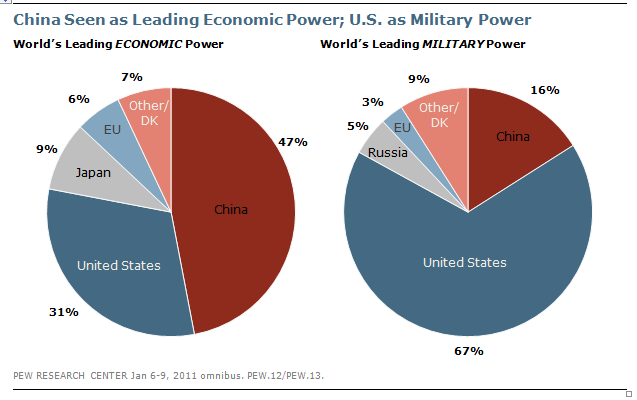
Today, the big news out of Asia is that China has overtaken Japan as the world's second largest economy. But polls have indicated that Americans have believed, erroneously, that China has been the world's largest economy for a while now.

The most recent figures come from Gallup:

china%20economy%20gallup.gif

Rasmussen found that 45 percent of Americans polled knew their country's economy was the biggest. In January, Pew Research reported that 47 percent of Americans thought China was the world's largest economy, while only 31 percent correctly noted that the U.S. was still the world's largest.

Needless to say, it's difficult for policymakers to address issues surrounding China if so many people don't understand the actual dynamics of the relationship.

February 13, 2011

America's Favorite (and Least Favorite) Countries

Gallup asked Americans to rate their favorite, and least favorite, nations:

gallup%20least%20favorite.gif

Gallup's Jeffrey Jones offers some perspective on the results:

The top- and bottom-rated countries have been fairly consistent in the 11-year history of Gallup's World Affairs poll. Canada has been the top ranked, or statistically tied for the top, in all but one year (2005, when Great Britain had the highest favorable rating). Iran has generally been the lowest-rated country each year since 2005, though it was tied with North Korea in two of those years. In 2004, North Korea was the lowest. From 2001-2003, prior to the beginning of the U.S. war in Iraq, Iraq was the lowest-rated country.

France has enjoyed a surge in popularity as well - they're back over 70 percent for the first time since 2002, according to Gallup. I guess we're over 'freedom fries' and other inanities.

February 11, 2011

Wasted Youth

egypt%20protests.jpg

According to Gallup, young people in several Arab countries feel their leadership is not taking advantage of the country's human capital. During the 2010 survey, Gallup found that Egypt's youth experienced the largest declines:

Fewer than 3 in 10 15- to 29-year-olds say Egypt's leadership maximizes youth potential, down from almost 4 in 10 in 2009.
Other countries notching declines: Jordan, Sudan and Iraq.

(AP Photo)

February 10, 2011

America's View of American Interests

Gallup ranks countries in order of what Americans say are there importance:

gallup%20rank%20list.gif

From Gallup:

Americans' views of Iraq's importance have shown the greatest change over the last four years, dropping to 52% "vitally important" today from 70% in 2007, when Iraq topped the list. At that time, President George W. Bush had just announced his "surge" strategy in Iraq in response to deteriorating conditions there, and his party had suffered significant losses in the 2006 midterm elections, partly as a result of the debate over Iraq. Now, with American combat troops withdrawn from that country and attention shifted to Afghanistan and other hot spots around the world, Iraq has slipped to fifth place.

Americans also are at least slightly less likely now than they were in 2007 to say what happens in Iran, North Korea, Russia, and Afghanistan is vitally important.

Personally, I'm surprised to find Canada ranking so low. On the scale of countries which impact the United States, its security, energy policy, economy, etc., it's not even close. Canada is considerably more important than any of the states ranked ahead of it.

Poll Shows Low Support for Brotherhood

egypt%20polling%20wash%20inst.jpg


The Washington Institute has released a poll (pdf) it conducted of Egyptians during the uprising. Some key findings:

This is not an Islamic uprising. The Muslim Brotherhood is approved by just 15 percent of Egyptians -- and its leaders get barely 1 percent of the vote in a presidential straw poll. Asked to pick national priorities, only 12 percent of Egyptians choose sharia (Islamic law) over Egypt's regional leadership, democracy, or economic development. And, when asked to explain the uprising, the issues of economic conditions, corruption, and unemployment (around 30 percent each) far outpace the concern that "the regime is not Islamic enough" (only 7 percent).

Surprisingly, when asked two different ways about the peace treaty with Israel, more support it (37 percent) than oppose it (27 percent) -- although around a third say they "don't know" or refuse to answer this question. Only 18 percent of Egyptians approve either Hamas or Iran. And a mere 5 percent say the uprising occurred because their government is "too pro-Israel."...

As for Egyptian views of America, a narrow plurality (36 percent vs. 27 percent) say Egypt should have good relations with the United States. And only a small minority (8 percent) say the current uprising is against a "too pro-American" regime. Nevertheless, half or more of the Egyptian public disapprove of how Washington has handled this crisis so far, saying that they do not trust the United States at all.

While the poll gives us reason to believe that a lot of the fear about "Tehran on the Nile" is likely overheated, there are foreign policy responses that are less encouraging (from Washington and Israel's perspective). When asked about Egyptian foreign policy, 19 said their first choice would be to maintain Egypt's relationship with the U.S. and 'moderate states' while 18 percent said Egypt should tear up its treaty with Israel and join the 'resistance front.' A further 16 percent said Egypt should distance itself from the U.S. and follow an independent line like Turkey, while 15 percent said better relations should be restored with Syria and Iran to help contribute to resistance against imperialism and colonialism.

February 9, 2011

Terrorism vs. Major War

Rasmussen finds that U.S. voters fear terrorism over a major war:

The latest Rasmussen Reports national telephone survey finds that just 12% of Likely U.S. Voters think traditional wars are a bigger threat to the United States than terrorists. Eighty percent (80%) disagree and see terrorists as the bigger threat.

However, voters have mixed feelings about refocusing the military toward fighting terrorism. Thirty percent (30%) feel America could improve its national security by reducing the number of soldiers in uniform and focusing more strategically on fighting terrorism, but 41% oppose such a strategic shift. Twenty-nine percent (29%) are not sure which is the best course.

February 7, 2011

Democracy Promotion a Low U.S. Priority

1883-1.png

According to Pew Research promoting democracy abroad is not afforded a high priority by the American public. Not a big surprise.

What is a bit surprising is the meme that's taken hold that somehow the protests in Egypt "prove" Bush was right about the importance of democracy promotion in the Middle East. It's surprising because, despite a few speeches, the Bush administration didn't do much to further democracy in the Middle East. (Did they condition aid to Egypt, Jordan, Saudi Arabia, etc. on that basis?) It's also strange because the Bush administration's true foreign policy legacy was the notion that the U.S. was justified in preemptively attacking countries on the basis of perceived threat, whether or not the threat had fully materialized. If the administration had a "big idea" with momentous consequences for its foreign policy, that was it.

Democracy as such only entered into the public discussion in a big way when the administration was casting about for a rational to continue nation-building in Iraq. It's true that, rhetorically, the administration did diagnose many of the ills that plagued the Middle East and occasionally took some blame upon itself for those ills. But giving a speech about the importance of democracy rather pales in comparison to invading a country on the basis of preemptive defense. If Bush administration officials are looking for vindication for their boss' foreign policy doctrine as it was practiced as opposed to how it was preached, it won't be found in Tahir Square but wherever those stockpiles of WMD went hiding.

U.S. Views on Forward Deployments

Rasmussen offers some grist for the coming austerity battle:

The latest Rasmussen Reports national telephone survey finds that 49% of Likely U.S. voters think we should remove troops from Western Europe and let the region defend itself. Forty-eight percent (48%) feel the same way about Japan. However, 60% say the United States should leave its troops in South Korea....

Earlier polling found that voters are fairly evenly divided as to whether the federal government spends too much or too little on national defense, but most also appear to dramatically underestimate how much is actually spent. Removing troops from Western Europe and Japan could reduce military spending by tens of billions of dollars annually.

February 3, 2011

U.S. Confident in War on Terror

According to Rasmussen:

There's little change in the number of U.S. voters who think the United States and its allies are winning the war on terror, but the number who feel the terrorists are winning has fallen to its lowest level in nearly two years.

The latest Rasmussen Reports national telephone survey finds that 39% of Likely Voters say the United States and its allies are winning the War on Terror, consistent with findings over the past couple months. Yet only 19% say the terrorists are winning that war, down 11 points from early January and the lowest level measured since July 2009. Thirty-two percent (32%) feel that neither side is winning, the highest that finding has been in several years of tracking.

February 2, 2011

U.S. Views on Obama's Egypt Policy

Not too bad, according to Rasmussen:


A new Rasmussen Reports national telephone survey finds that 41% of Likely U.S. Voters rate the way the Obama administration has responded to the situation in Egypt as good or excellent. Twenty-two percent (22%) view the administration’s response so far as poor. ...

Most Americans expect the unrest in Egypt to spread to other Middle Eastern countries and think that will be bad for the United States. But a sizable majority also believe the United States should stay out of Egypt’s current problems.

Polling Egypt

vx6i9ez4nuocpmm6i4qcbg.gif

Gallup offers up some of their research findings on Egypt and the Middle East:

Egyptians' approval of U.S. leadership fell 18 percentage points from 2009 to 2010, more than in other countries in the Middle East and North Africa.

Gallup's global employment tracking finds 21% of residents of the Middle East and North Africa were underemployed from 2009-2010 and 10% were unemployed.

They also tracked wellbeing in Tunisia and Egypt:


Wellbeing in Egypt and Tunisia decreased significantly over the past few years, even as GDP increased. In Egypt, where demonstrations have prompted President Hosni Mubarak to give up power after elections this fall, the percentage of people "thriving" fell by 18 percentage points since 2005. In Tunisia, where mass protests toppled the country's government last month, the percentage of people Gallup classifies as thriving fell 10 points since 2008.

February 1, 2011

How Do Egyptians Feel About Democracy?

egypt%20protests.jpg
In light of recent events, Pew Research reposted some of their April 2010 polling in Egypt and the Middle East:

A 59%-majority of Muslims in Egypt believed that democracy was preferable to any other kind of government. About one-in-five (22%), however, said that in some circumstances, a non-democratic government could be preferable, and another 16% said it did not matter what kind of government is in place for a person in their situation....

By wide margins, Muslims surveyed in the spring of 2010 believed that Islam's influence in politics was positive rather than negative. In Egypt, Islam's role in politics was seen favorably by an overwhelming 85%-to-2% margin among Muslims....

Asked whether there is a struggle in their nations between those who want to modernize their country and Islamic fundamentalists, a 61%-majority of Muslims in Egypt said they did not see a struggle. Just 31% of Egyptian Muslims saw a struggle between modernizers and fundamentalists in their country. Among the seven Muslim publics surveyed in 2010, only in Jordan (20%) did fewer say they saw such a struggle.

Among Egyptian Muslims who did see a struggle, a 59%-majority sided with the fundamentalists. Just 27% of those who saw such struggle sided with the modernizers.

Obviously, views may have shifted a bit!

(AP Photo)

January 31, 2011

Democracy in the Mideast: Iraq Edition

Some recent polling (pdf) from Greenberg Quinlan Rosner Research took the pulse of Iraqi attitudes regarding their government. The survey found that a majority of Iraqis (61 percent) believe that making Iraq more democratic will improve their quality of life but many Iraqis continue to view politics through a "sectarian lens."

The political picture appears most grim in Western Iraq and among the country's Sunnis - 70 percent of whom said job opportunities are getting worse. Few Sunnis think Iraq is a true democracy and a majority (52 percent) said they wouldn't vote in a future election. Kurds, not surprisingly, are more optimistic both about Iraq as a whole and Kurdistan in particular. You can view the full results here. (pdf)

January 26, 2011

Who Will Leave the Eurozone?

Bloomberg took the pulse of global investors about the future of the Eurozone:

Most global investors predict at least one nation will leave the euro-area within five years and that Greece and Ireland will default, sentiment that is intensifying pressure on policy makers to strengthen their response to the debt crisis.

As the World Economic Forum’s annual meeting gets underway, 59 percent of respondents in a Bloomberg Global Poll said one or more of the 17 euro nations will quit by 2016, including 11 percent who see an exit within 12 months. Respondents were divided over whether Portugal would default, while a majority expressed confidence in Spain.

January 25, 2011

Housing Optimism

sri-global-advisor-purchasing-real-estate.gif

Ipsos MORI has released findings on the global housing market, asking residents of 24 countries whether they think it would be a good time to buy real estate in the next thirty days:

More than two thirds (68 per cent) of people in the UK think that this is a bad time to buy real estate according to the latest findings by Ipsos MORI. Conversely, Indians are the most positive about their property market, with 64 per cent saying that this is a good time to purchase property.

Interestingly, as you can see from the chart above, the Chinese were even more bearish on real estate than the Brits.

January 21, 2011

U.S. Views on Obama & Allies

Rasmussen has a new survey out gaging people's perception of the Obama administration's approach to alliance management:

The latest Rasmussen Reports national telephone survey shows that a plurality of Likely Voters (41%) says Obama believes America’s allies should do what the United States wants most often. But 23% think Obama believes America should do what its allies want more often, while 27% think neither scenario applies.

By contrast, 55% of all U.S. voters say our allies should do what the United States wants more often, and just nine percent (9%) think America should do want its allies want instead. Thirty-one percent (31%) agree with neither course....

Republicans are more likely than Democrats and voters not affiliated with either major political party to believe Obama thinks the United States should do what its allies want most often. While most Republicans hold the opposite belief themselves, roughly half of Democrats agree. Unaffiliated voters are more prone to choose neither option.

One of the things that's somewhat interesting about this finding is how it relates to the just concluded summit with China's President Hu Jintao. Before and during the summit, there was a lot of talk about how important it was for President Obama to publicly excoriate and shame China about its poor human rights record. The basic idea, I guess, is that this scolding would produce better behavior from China.

But consider the Rasmussen finding above - many Americans aren't particularly interested in doing what their allies want them to do, much less a country that's a quasi-adversary. Now, put yourself in the place of the Chinese - not exactly fast-friends with the U.S. - and ask whether they're going to be moved to make reforms at the behest of hectoring from American politicians.

January 19, 2011

EU Residents Upbeat About the Future

Some findings from a recent Gallup poll point to a generally optimistic outlook in the EU:

Residents in most EU countries surveyed in 2010 expect their lives will be closer to ideal five years from now. On a 0-to-10 scale, with 10 being the best possible life, people in nearly all EU countries -- except Greece, Romania, Luxembourg, and Slovenia -- give their future lives higher average ratings than their present ones. Greeks and Romanians alone predict their lives will be worse in five years; Luxembourgers and Slovenians don't expect their lives to be any different.

As Gallup observes, optimism increases the younger you get:

Young people across most of Europe are more likely than older people to rate their future better than their present. Fifteen- to 29-year-olds are the most likely to expect to be better off in the future while those aged 65 and older are the least likely to predict improvement. In every country, the percentage of respondents who rate their own future better than their present decreases gradually with age.

January 17, 2011

U.S. Focused on Domestic Issues

According to a new Gallup poll, Americans rank terrorism as the 7th most important priority for the federal government, behind a host of domestic issues. The war in Afghanistan comes in at number 10. Iraq, a distant 14th.

galluppriorities.gif

Chinese Views of the U.S.

Last week, Pew Research published findings from a survey of U.S. attitudes on China. Now a poll conducted by Horizon Research and published in China Daily reports on Chinese attitudes about the United States:

The number of Chinese people who view Beijing's ties with Washington as "very important" has doubled in the past year, while most people believe relations will remain stable or improve despite recent turbulence, a survey reveals ahead of President Hu Jintao's upcoming visit to the United State...

Nearly seven in 10 (69.9%) believe that in commercial affairs the world's two largest economies are both competitors and partners.

Most people consider that China made a greater contribution than the US in handling the financial crisis and trying to combat climate change, the survey showed.

Asked to value Beijing's ties with Washington, more than half (54.3%) of respondents said they regard Sino-US ties as "very important", more than double the 26 percent in 2009.

An overwhelming nine in 10 (90.9%) viewed the relationship as "important".

However, more than half of the respondents believed that ties had deteriorated in 2010, and nearly four in 10 (the report did not give the specific number) said current relations are "in a bad situation".

Eighty percent said the US was to blame.

As to future ties, six in 10 (no specific figure available) said the relationship will generally remain stable, while about one quarter were more positive, saying it will get better.

People under 30 are more optimistic than those in other age groups.

[Hat tip: China Real Time]

January 13, 2011

Tea Party Views on Afghanistan

The Afghanistan Study Group has released a new survey of conservative and Tea Party sentiments of the war in Afghansitan.

When given a choice between three options, 66% believe we can either reduce the troop levels in Afghanistan, but continue to fight the war effectively (39%) or think we should leave Afghanistan all together, as soon as possible (27%). Just 24% of conservatives believe we should continue to provide the current level of troops to properly execute the war. 64% of Tea Party supporters think we should either reduce troop levels (37%) or leave Afghanistan (27%) while 28% support maintaining current troop levels. Among conservatives who don’t identify with the Tea Party movement, 70% want a reduction (43%) or elimination (27%) of troops while only 18% favoring continuation of the current level.

A majority of conservatives agree that the United States can dramatically lower the number of troops and money spent in Afghanistan without putting America at risk. 57% say they agree with that statement after hearing about the current number of troops in country and the funding needed to support them. Only a third (34%) do not agree with this statement. Among Tea Party supports 55% agree that we can reduce the number of troops without compromising security while 38% disagree. Among non Tea Party conservatives, 60% agree with this statement while 27% disagree.

Full results here. (pdf)

U.S. Views on China

1855-4.png

Pew Research has released a new survey on U.S. views of China that contains many interesting findings:

Nearly half (47%) say Asia is most important, compared with just 37% who say Europe, home to many of America's closest traditional allies....

The latest national survey by the Pew Research Center for the People & the Press, conducted January 5-9 among 1,503 adults finds that by two-to-one (60% to 27%) Americans see China's economic strength as a greater threat than its military strength. And as Obama goes into talks with the Chinese president, a 53% majority say it is very important for the U.S. to get tougher with China on trade and economic issues.

Yet while Americans may see China as a problem, relatively few describe it as an adversary, and a 58% majority say it is very important to build a stronger relationship between the U.S. and China. By comparison, promoting human rights and better environmental policies and practices are important, but lower priorities.

It's interesting to note the divergence between where the U.S. public expresses concern with China - along the economic dimension - and where most of the "strategic class" of analysts find alarm - China's military build-up.

January 12, 2011

Businesses Approve of UK Coalition

camerononturkey.jpg

According to a new Ipsos MORI poll, business leaders in the UK overwhelming approve of the coalition government's economic plans:

A massive 89 per cent of UK business leaders agree that the Government’s policies will improve the state of the British economy according to the 2010 Captains of Industry survey from Ipsos MORI. There is also strong support for the Coalition’s cuts programme, with 75 per cent saying that the deficit needs to be cut quickly, which increases to 85 per cent of FTSE 350 respondents.

This year the captains of British industry are the most positive since 2006 about their organisation. 60 per cent think business for their own company will improve in the next year, while only seven per cent believe it will get worse.

Full report here. (pdf)

January 6, 2011

U.S. Views on Afghan War

Americans have a pessimistic view of the course of the war in Afghanistan, according to a new poll:

The latest Rasmussen Reports national telephone survey shows that just 19% of Likely U.S. Voters think the situation in Afghanistan will get better in the next six months. Forty-one percent (41%) now expect the war in Afghanistan to get worse over the next six months while 28% predict it will stay about the same.
Rasmussen also noted that the war ranked ninth in voter importance, out of a list of ten issues.

January 4, 2011

Transatlantic Malaise

Gallup measures it:

Europeans' evaluations of their local job markets were universally grim last year and even more dismal than Americans' assessments; neither are positive signs heading into 2011. A median of 13% across the 25 EU countries Gallup surveyed in 2010 said it was a good time to find a job in their communities, compared with 24% of Americans.

January 3, 2011

China's Views About Power

According to a recent poll, only 12 percent of respondents in China said their country was a world superpower:


Looking at relations with Japan, over half of the participants said the ties were unlikely to deteriorate in 2011.

Over 80 % of the participants also expressed concerns about Western intentions to contain China's development, with about 40 % calling for countermeasures to be taken against threats to China.

Among the issues of greatest concern, US intentions to strategically contain China placed ahead of trade disputes as the most important bilateral issue in 2010.

Ties with Washington were deemed as the most significant bilateral relationship for China for the fifth consecutive year.

December 29, 2010

U.S. Dislikes Iran But Doesn't Want to Bomb

A new poll from Angus Reid (pdf) finds that over two thirds of Americans think Iran is pursuing a nuclear weapon but only a quarter of those polled believe military force is warranted to stop them. Not surprisingly, Iran ranks as Americans' "least favorite" country when given a choice of 12 other nations, including Axis of Evil counterpart North Korea. Among the poll's other findings:

Despite these strong negative feelings and suspicions, Americans are still not in favor of any type of military engagement or intervention with Iran. In fact, the most frequent option Americans recommend to deal with Iran is engaging in diplomatic negotiations (30%, up slightly from 26% in January 2010), followed by economic sanctions (20%). Only five per cent of respondents would do nothing, claiming that Iran poses no threat to the world.

Across the country, 16 per cent of Americans would consent to launching military strikes to destroy Iran’s nuclear facilities, and seven per cent would authorize a full-scale invasion of Iran and removing the current government.

There are some striking differences when party allegiance is taken into consideration. More than half of Democrats would rely on negotiations and sanctions to deal with Iran (56%), while two-in-five Republicans (40%) would prefer to launch strikes or authorize an invasion. Independents are more likely to choose diplomacy and sanctions (52%) than air strikes or an invasion (19%).

December 27, 2010

The State of the World: Not Bad

20092010Report_Fig1_1_AverageNumberInternationalConflicts.jpg

According to a new report from the Human Security Report Project, the number of deaths from armed conflicts around the world continues to fall, even while intercommunal wars have jumped and other conflicts have become increasingly difficult to bring to an end. What wars are fought are less lethal, too. "The average annual battle-death toll per conflict in the 1950s killed almost 10,000 people; in the new millennium the figure is less than 1,000," the report states.

Four of the world's five deadliest conflicts (Iraq, Afghanistan, Pakistan and Somalia) involve Islamists insurgents and, in some capacity, the United States. Although the report notes that: "The level of armed conflict in Muslim countries is far lower today than it was two decades ago, and support for al-Qaeda and other radical Islamist groups has declined substantially throughout the Muslim world."

So what's behind the move toward a more peaceful world? The authors take a stab at an explanation:

The demise of colonialism, the end of the Cold War, a dramatic increase in the number of democratic states, and a shift in elite attitudes towards warfare are among the key political changes that have reduced the incidence of international warfare since the end of World War II.

Equally important, argues Professor Mack, has been the dramatic long-term increase in levels of global economic interdependence. “Interdependence,” he says, “has increased the costs of war while reducing its benefits.”

The decline in civil wars has rather different causes. Since the end of the Cold War, the UN-led upsurge of international efforts to negotiate peace agreements in ongoing conflicts and to prevent wars that have ended from starting again has been associated with a significant decline in the number of wars fought within states.

December 23, 2010

Distrust of China

A new poll finds that a majority of Japanese and Americans do not trust China:

The Gallup poll published Wednesday by the Yomiuri Shimbun was conducted among 1022 Japanese and 1002 Americans and showed that 87 percent of Japanese and 65 percent of Americans do not trust China....

The poll found that Japanese people feel relations between Japan and the U.S. have been worsening due to the planned relocation of U.S. base in Okinawa. Some 40 percent of Japanese respondents said bilateral relations deteriorated, up from 26 percent last year. In contrast, the proportion of those who thought the two countries are on good terms fell from 48 percent last year to 33 percent this year.

Asked about the reasons, 79 percent of Japanese cited complications caused by the relocation plan.

Polling American Exceptionalism

Gallup has a new poll out gaging American attitudes toward exceptionalism:


exceptionalism.gif

There are some other interesting data points as well:

Three-quarters of those who believe the U.S. is exceptional (62% of all Americans) also believe the U.S. is currently at risk of losing its unique character.

The poll does not delve into possible reasons why Americans think the United States' stature is at risk....

One of the extensions of the belief in American exceptionalism is the notion that, because of its status, the United States has an obligation to be the leading nation in world affairs. Americans generally endorse this position, as 66% say the United States has "a special responsibility to be the leading nation in world affairs." Republicans, Democrats, and independents generally agree, with fairly modest differences among party supporters.

December 20, 2010

American Views of U.S.-Israeli Ties

Via Rasmussen:

A new Rasmussen Reports national telephone survey finds that just 13% of Likely U.S. Voters think America's relationship with Israel will be better in a year's time, the lowest level measure since July. Twenty-nine percent (29%) expect that relationship to get worse over the next year, while 49% say it will remain about the same.

In November, 27% expected U.S.-Israeli relations to get worse in the next year, while in August, 34% felt that way, a level of pessimism comparable to voters' views about America's relationship with the Muslim world.

Now, 37% say the U.S. relationship with the Muslim world will be worse in a year's time.


Japan Sours on China

According to a report in the Asahi Shimbum:

A record 77.8 percent of respondents to a government survey at the end of October, at the height of the fallout from the Senkaku Islands dispute, said they did not "feel close" to Japan's giant neighbor.

That marked a sharp 19.3 percentage points increase over a year earlier and was the worst figure since 1978, when the Cabinet Office survey began.

The number of Japanese who did not feel the bilateral relationship was good rose 33.4 points to 88.6 percent.

The survey results mark a new high in negative feelings toward China over the last two decades. Throughout most of the 1980s, about 70 percent of Japanese respondents to the survey said they felt close to China.


British on the Move

While Ireland and Greece have been in the spotlight thanks to their dire fiscal straights, Gallup finds that Britons are more likely to express a desire to permanently leave their country than anyone else in Europe save Romanians. However, they add that this sentiment can't be tied to Britain's shaky economy:

Britons' relatively high level of desire to migrate permanently cannot be attributed to the recent global economic crisis or the country's own recession. The 33% who say they would like to move is the same now, as the United Kingdom emerges from its longest recession on record, as when it entered recession in 2008. This trend is similar to what Gallup observes worldwide: With some exceptions, people's expressed desire to migrate did not decrease meaningfully in the downturn.

Among the places Britons would most like to migrate to: Australia, the U.S., Canada and Spain.

December 13, 2010

Canadians Oppose Prolonged Afghan Stay

Canada is supposed to shift to a "non-combat" role in Afghanistan in 2011, but according to Angus Reid, many Canadians are unhappy with the plan:

While just over a third of Canadians support the country’s military mission in Afghanistan, the decision to keep 950 soldiers in a strictly non-combat role after 2011 has split views across the country, a new Angus Reid Public Opinion poll has found.

In the online survey of a representative national sample of 2,023 Canadian adults, more than half of respondents (56%) oppose the military operation involving Canadian soldiers in Afghanistan, while just over a third (36%) support the mission. Strong opposition to the war remains highest in Quebec (48%) while Albertans (19%) and Atlantic Canadians (18%) are more likely to strongly support the mission.

Public Supports New START

According to Gallup:

If given the opportunity to vote on the matter, 51% of Americans would ratify the START nuclear arms agreement with Russia and 30% would vote against it, while 19% are undecided.
The partisan breakout is interesting because while Democrats are the leading proponents (56 would vote in favor vs. 28 voting against), Republicans weren't all that far behind: 49 percent would vote for ratification, 34 percent said they'd vote the treaty down.

The poll was conducted on December 3-6th.

December 10, 2010

Public Views on START

Pew Research released a survey on U.S. opinion of several hot-button foreign policy issues:

On another major pending issue before Congress, most Americans who have heard at least a little about the START treaty favor its ratification by the Senate: 54% favor ratification of the arms control treaty while 24% are opposed. Democrats and independents favor the treaty's ratification by wide margins, while Republicans are evenly split.

And by greater than two-to-one (59% to 23%), the public favors allowing gays and lesbians to serve openly in the military....

On foreign policy, the public has become less optimistic that the U.S. will succeed in achieving its goals in Afghanistan. Only about half (49%) say the U.S. will definitely or probably succeed while 39% say it will definitely or probably fail. In June, 59% said success in Afghanistan was at least probable.

Support for maintaining U.S. and NATO forces in Afghanistan also has slipped since June. Currently, 44% favor keeping troops in Afghanistan until the situation has stabilized while 47% want to remove troops as soon as possible. In July, opinion also was divided, but in June 53% favored keeping U.S. and NATO troops in Afghanistan while 40% wanted them removed as soon as possible.

Polling Iran

A new survey finds of Iranian opinion has a little something for everyone:

The majority of Iranians are in favor of their country having nuclear weapons, despite the fact that they are worried about international sanctions, according to a poll carried out by US-based Charney Research for the International Peace Institute.

The poll found that 71 percent of Iranians want the country to have atomic weapons, a number that stood on only 52 percent in 2007. Forty-seven percent of respondents believed international sanctions on the Islamic Republic were having a major impact.

Also:

The poll found that, by a three-to-one majority, Iranians want closer ties to the West, not reduced links. They also support Western criticism of Iranian human rights violations and aid to Iranian nongovernmental organizations.

There's something in the poll to confirm that even a democratic Iran might not give up its nuclear weapons ambition and evidence that Iranians would welcome some Western assistance (although not to overthrow the current regime).

December 9, 2010

Mixed Views of Wiki Disclosure

Angus Reid surveys public opinion in the U.S., Canada and Britain on WikiLeaks:

Half of Americans (51%) believe WikiLeaks as wrong to publish tens of thousands of classified U.S. diplomatic cables, while one-in-five (19%) agree with its actions.

The views of respondents in the other two countries are definitely more nuanced. In Canada, 36 per cent of respondents say WikiLeaks was wrong, while 30 per cent claim it was right. Britain posts very similar numbers, with 38 per cent of respondents stating that WikiLeaks was wrong, and 33 per cent saying it was right.

At least three-in-five respondents in the three countries believe the release of these documents will damage diplomatic relations between the U.S. and other countries (BRI 65%, CAN 61%, USA 60%) and majorities also state that the release of these documents will make it harder for the U.S. to advance its foreign policy goals (BRI 60%, USA 59%, CAN 57%). However, while three-in-five Americans (62%) fear that the WikiLeaks release will put people’s lives at risk, including U.S. diplomats and soldiers, this view is shared by about half of Britons (51%) and Canadians (48%).

A More Corrupt World

So says Transparency International in a new poll:

Corruption has increased over the last three years, say six out of 10 people around the world. One in four people report paying bribes in the last year. These are the findings of the 2010 Global Corruption Barometer.

Views on corruption were most negative in Western Europe and North America, where 73 per cent and 67 per cent of people respectively thought corruption had increased over the last three years.

You can view an interactive presentation of the results here.

December 7, 2010

American Views on Afghanistan

Via Angus Reid, a new survey on U.S. views on the Afghan war:

Americans remain divided on their country’s military deployment in Afghanistan, and almost half erroneously assume that more than 2,000 U.S. soldiers have lost their lives in the conflict, a new Angus Reid Public Opinion poll has found....

The proportion of people in the United States who think that engaging the military in Afghanistan was a mistake stands at 38 per cent, six points higher than in April and June. Two-in-five Americans (40%, +3) believe that that the U.S. did the right thing in sending soldiers to Afghanistan.

More than half of respondents (54%, +3) claim that they do not know what war in Afghanistan is all about, whereas 46 per cent (-3) say they do.

See the full results here.

December 6, 2010

Muslim Public's View of Hezbollah, Hamas, al-Qaeda

Pew Research highlights this surveys Muslim publics for their views on Hezbollah, Hamas and al-Qaeda:

1814-1.png

It's worth noting here that Turkey is the least receptive to these groups. In a later question from Pew, on the whether Islam in politics is a good or bad thing, Turks had the lowest percent of respondents (45 percent) suggesting it was a good thing.

Obama's Approval

Foreign affairs and his handling of Afghanistan remain his (relative) strong points, according to Gallup:

lae9_aymn0e21uczz53pvq.gif

December 2, 2010

Americans & Foreign Aid

According to a new survey from World Public Opinion, most Americans don't know how much of the federal budget goes to foreign aid:

Asked to estimate how much of the federal budget goes to foreign aid the median estimate is 25 percent. Asked how much they thought would be an "appropriate" percentage the median response is 10 percent.

In fact just 1 percent of the federal budget goes to foreign aid. Even if one only includes the discretionary part of the federal budget, foreign aid represents only 2.6 percent.

December 1, 2010

Afghanistan & Indian Leadership

Our latest Gallup/RCW top five list looks at the countries who most approve of India's leadership. While the top five countries are clustered in Africa, Afghanistan comes in at number 6 (not in our survey but in the full Gallup survey on India here). It's not surprising, given the nearly $1.2 billion in aid that India has provided to the country after the U.S. invasion, but it is a reminder of why Pakistan, despite being on the receiving end of even more American generosity, is consistently undermining U.S. goals in Afghanistan.

Americans Expect War in Korea

koreawar.jpg

According to a new poll from Angus Reid:

More than two thirds of Americans expect armed conflict to break out in the Korean Peninsula over the next year and more than half are in favor of allowing U.S. soldiers to provide assistance to South Korea, a new Angus Reid Public Opinion poll has found....

More than half of Americans (53%, +6 since August) would support American soldiers providing assistance to South Korea in the event of a war against North Korea, while three-in-ten (31%) disagree with this course of action. Republicans (71%) are more likely than Independents (54%) and Democrats (46%) to endorse this notion.

Respondents are almost evenly divided on whether the U.S. Government should authorize a military invasion of North Korea with the aim of removing the North Korean Government, if a war breaks out in the Korean Peninsula. While 38 per cent of respondents are in favor of an invasion, 41 per cent are opposed. More than half of Republicans (53%) are ready to endorse an incursion in this particular scenario, but only 37 per cent of Independents and 34 per cent of Democrats concur.

An earlier survey from Rasmussen found that 46 percent of Americans would support South Korea militarily in the event of a war, and 33 percent supported sending additional American troops to the peninsula in the event South Korea was attacked.

(AP Photo)

November 29, 2010

U.S. Less Pessimistic About Afghan War

gallup%20us%20afghan%20poll.gif

So says Gallup:

Forty-five percent say things are going well for the U.S. there, the highest percentage since July 2009, and one of the more positive evaluations in the last four years. Still, the majority of 54% believe things are going badly for the U.S....

More generally, 44% of Americans say they approve and 49% disapprove of the way Obama is handling the situation in Afghanistan. That is up from 36% approval in late July/early August, when support for the war dropped after there were leaks of classified military documents detailing some troubling accounts of the U.S. conduct of the war on an Internet site called WikiLeaks. But Obama's Afghanistan approval rating is down slightly from the 48% registered in February, the first measurement after Obama's new Afghanistan policy was announced.

November 24, 2010

U.S. Views on Aiding South Korea

defendingkorea.jpg

Rasmussen Reports has a new survey out on U.S. attitudes toward assisting South Korea:

Forty-six percent (46%) of voters believe the United States should provide military assistance to South Korea if it is attacked by North Korea. Twenty-nine percent (29%) disagree and say military assistance should not be provided, while another 25% are not sure....

The United States still has roughly 28,000 troops stationed in South Korea, but just 33% of voters think additional troops should be deployed there if South Korea is attacked by its neighbor to the north. Thirty-nine percent (39%) oppose the deployment of additional American soldiers to assist South Korea if it is attacked. Twenty-eight percent (28%) are undecided.

(AP Photo)

November 22, 2010

Economic Optimism, Indian Edition

According to Gallup, economic optimism is on the rise in India:


indian%20economic%20optimism.gif

Standard of living perceptions have also been boosted - 44 percent of Indians say their standard of living has improved vs. 32 percent in 2009.

Gallup and RCW surveyed the top five most economically optimistic countries here.

November 16, 2010

U.S. Views on Trade

According to Pew Research, Americans are taking a dimmer view of free trade:

Most Americans say that increased trade with Canada, Japan and European Union countries -- as well as India, Brazil and Mexico -- would be good for the United States. But reactions are mixed to increased trade with South Korea and China.

More generally, there is increased skepticism about the impact of trade agreements such as NAFTA and the policies of the World Trade Organization. Roughly a third (35%) say that free trade agreements have been good for the United States, while 44% say they have been bad for the U.S.

Support for free trade agreements is now at one of its lowest points in 13 years of Pew Research Center surveys.