Main

July 28, 2010

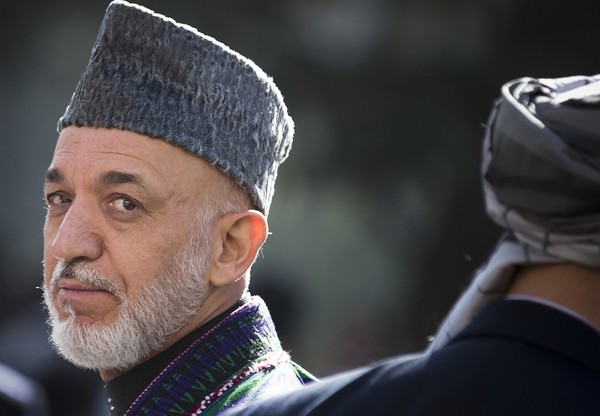
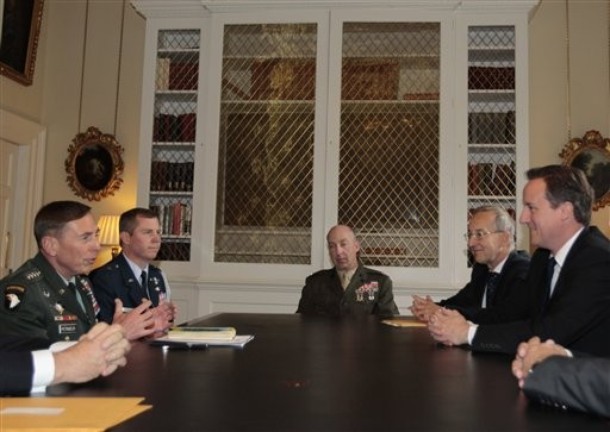
David Cameron on Pakistan

The British Prime Minister continues his making friends and influencing people tour:

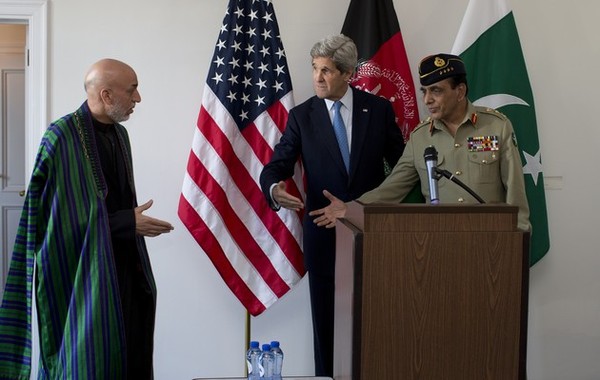
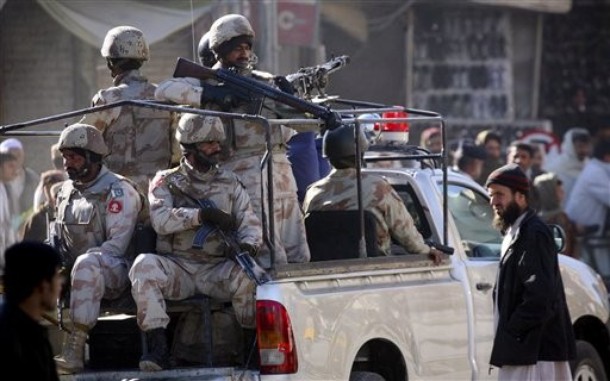
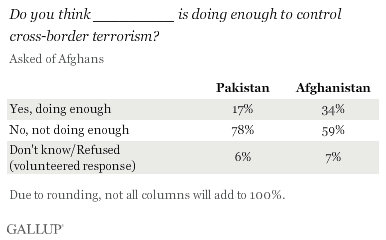
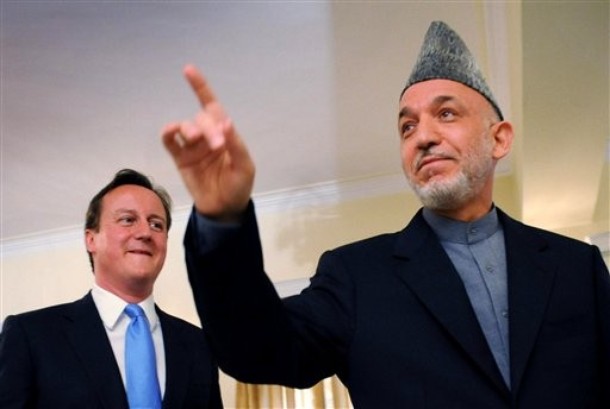
David Cameron today sparked a furious diplomatic row with Islamabad after accusing elements of the Pakistani state of promoting the export of terrorism.

In the strongest British criticism of Pakistan so far, the prime minister warned Islamabad it could no longer "look both ways" by tolerating terrorism while demanding respect as a democracy.

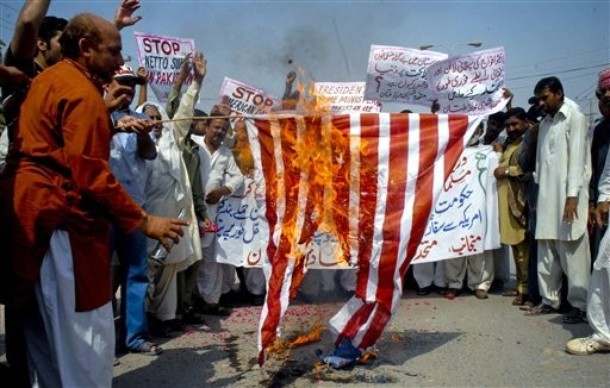
But in an angry response, Pakistan's high commissioner to Britain accused Cameron of damaging the prospects for regional peace, and criticised him for believing allegations in the Wikileaks documents published in the Guardian earlier this week.

I doubt publicly brow-beating Pakistan over their not-so-covert support for militant networks is going to work, but then again, will anything?

July 27, 2010

WikiLeaks and the COIN Consensus

Andrew Exum, writing in the pages of today's New York Times, shrugs at the WikiLeaks brouhaha:

ANYONE who has spent the past two days reading through the 92,000 military field reports and other documents made public by the whistle-blower site WikiLeaks may be forgiven for wondering what all the fuss is about. I’m a researcher who studies Afghanistan and have no regular access to classified information, yet I have seen nothing in the documents that has either surprised me or told me anything of significance. I suspect that’s the case even for someone who reads only a third of the articles on Afghanistan in his local newspaper. [Emphasis added - KS]

But is this really the case? "Move along, nothing to see here" certainly appears to be the consensus from the media and the policy community, but this is an incredibly small (albeit vocal) sample size of Americans. Broader survey data paints a slightly different picture of the American public's war understanding - one which is more confused, critical and mixed about the U.S. mission and prospects in Afghanistan.

I agree with Exum that much of the information revealed in the leaks was common knowledge to the commentariat and the think tankers, but I wonder if the same can be said so unequivocally of the greater public. Would support for the war radically change if, for instance, the American public better understood the Pakistani intelligence community's relationship with a co-conspirator in the 9/11 attacks? What about that aid package Washington just handed to Islamabad?

Exum would have us all believe that the WikiLeaks disclosures are both ho-hum and irresponsible journalism. Both may be true, but if there's been any kind of journalistic failure here it began not with WikiLeaks, but with the pundits and policy makers who have failed to enhance public understanding of the war. There was no need for such debate and education however, because a bipartisan consensus had already congealed around a counterinsurgency strategy.

Exum accuses WikiLeaks founder Julian Assange of being an activist with an agenda, which is no doubt true. But is Assange really the only one with an agenda here, or does his agenda simply not sit well will the COINdinistas?

July 26, 2010

WikiLeaks Observations

First the interesting, from Londonstani:

I think there is much more to this whole episode than whether or not you knew civilians were being killed in Afghanistan and former ISI officials were giving advice to insurgents in Afghanistan. This is about public opinion. Measuring what the public thinks and predicting how it might react to events is an imprecise science (much like the related fields of economics and sociology). But it's still very real. You might not know how it works but you can feel its effects when governments start clamping down on banks, launch military campaigns or pull troops out and come home.

And when it comes to public opinion, lots of vagaries start making a huge difference - like how you found out. When George Galloway suggested that British MPs were greedy, people rolled their eyes, nodded or smiled. The general thought was, "yeah. But they are politicians, what do you expect?" However, once the British MPs expenses scandal hit the headlines with details of taxpayers coughing up for duckhouses and flatscreen televisions, the result was a national political crisis.

We'll follow subsequent polling on U.S. sentiment toward Afghanistan, but I wonder: is this, as Andrew Bast wrote today, a "Pentagon Papers" moment? I lean towards "no," but we'll see.

Now the debatable, from Stephen Hayes:

Taken together, and added to what we know about support for al Qaeda and its affiliates from the regimes in Iraq, Iran, Syria, Yemen and elsewhere, these reports should deal a fatal blow to the stubborn claims that the jihadists at war with us operate without the backing of states. Unlikely.

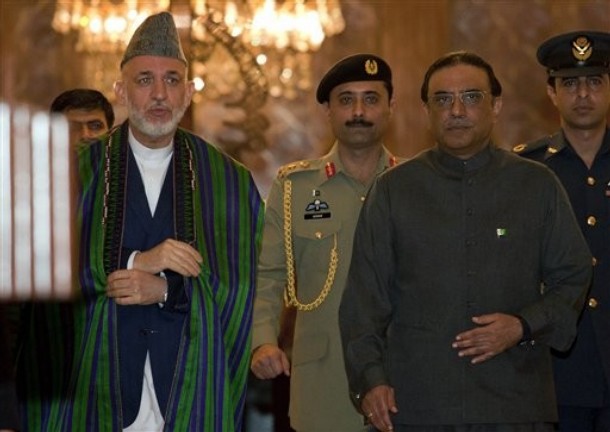
So, which state is supporting the Pakistani Taliban's efforts to overthrow the Zardari government?

That aside, I think this is a bit of red herring. There are terrorists organization that are state proxies (Hezbollah) and there are terrorist organizations that take aid and comfort where they can get it but don't exist for the purpose of perpetuating the policies of a single state (al Qaeda). This strikes me as an important distinction and not one we should casually discard.

WikiLeaks and 'Unrefined' Intel

With the release of what purports to be some several tens of thousands of intelligence documents from Afghanistan, the commentariat is atwitter with the possibility that people normally excluded from the intelligence process have been granted an all access pass to the inner sanctum. While I have not yet been able to read the reports due to a clogged WikiLeaks portal, most of these rules are precisely what was taught to me and what I taught to intelligence professionals throughout the military.

1) While 90K seems like a lot, it is only about 50 reports a day over a five year period. Many individual intel teams will generate that many reports on a busy day, and it only represents a very small fraction of the total intake of intel across Afghanistan. With so few reports it is possible that these reports were cherry picked, but even without deliberate selection bias, this is hardly an accurate picture.

2) Context is everything. There are literally dozens of things that a good analyst must take into consideration before giving credence to any report. Is the source honest? Is the source well informed? Are there other confirming reports? Does this really reveal anything? Human intelligence is notoriously easy to fake, and the more well known a person is the more likely you are to get reports on that person, usually false. Similarly, if people know that you suspect someone, they are often very willing to fabricate information to confirm your suspicion. Many times sources are just looking to get paid. For this reason single reports are basically useless. In fact, any source has to be evaluated over time, and against other intelligence. Without a lot of experience and access to broad spectrum information it is very difficult to evaluate intelligence.

3) Intelligence is perishable. Things change. If you tried to get a picture of someone based upon their Facebook page from the past five years, and assumed that it was all current across the entire time, you would likely be surprised by the number of twenty-somethings who were really into Britney Spears. Drawing conclusions in 2010 from links made across five years is hazardous at best.

4) People have agendas. Sources, WikiLeaks, the analysts (including me) all have things they are trying to accomplish. You do not and will not know their motives. But every level has filtered the information how they want. In the case of these leaked documents, the information has been filtered at least four times: the original source, the reporting officer, the leaking person and WikiLeaks. In at least two of those cases we know that part of the agenda is in opposition to the U.S. war effort, but we still have no idea how that filtered the information. More obviously, most readers will not read the actual documents, and will rely on people who claim to have read the documents and are writing for other media.

5) Just because something is secret does not mean it is important. The U.S. could probably declassify 90 percent of the things that are currently classified as 'secret' without hurting the mission one bit, because that information is either not true or unimportant. People keep secrets for all kinds of stupid and not stupid reasons, but that does not intrinsically mean it has any value.

If you want more information on the U.S. intelligence procedures as followed by the U.S. Military, refer to FM 2-0 (pdf).

David Benson has spent the last ten years in the intelligence community both in the U.S. and abroad, including seven years with the Army, and three years as a civilian contractor with a DoD Intelligence agency.

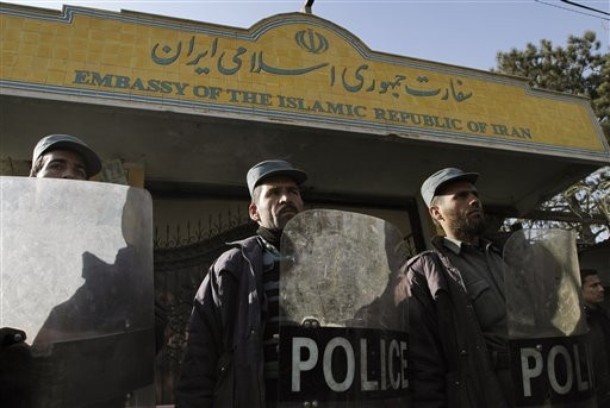
Pakistan, Iran and the Limits of American Power

limits%20of%20power.jpg

As Laura Rozen notes, there doesn't appear to be much in the WikiLeaks document dump that should surprise people who have been keeping up with the news on the Afghan war. Nevertheless, it serves to further confirm what the London School of Economics Study alleged earlier this year: that Pakistan is complicit in the Taliban insurgency and is actively undermining American goals in Afghanistan even while it receives billions of dollars in taxpayer money.

The revelations about Pakistan are interesting insofar as they highlight the contrast with U.S. policy on Iran. Both countries are supporting terrorist groups that have killed Americans. I would argue that Pakistan's support for terrorism is significantly more serious than Iran's because: 1. Pakistan's terror affiliates have the proven capacity and intention of striking the American homeland and killing American civilians; 2. Pakistan is facilitating the protection of the lead architects of 9/11. Nevertheless, Iran is no slouch when it comes to funding or arming terror groups.

Yet as the U.S. showers Pakistan with money and military hardware, it seeks to sanction and isolate Iran. And here's the rub: neither approach has been very effective. This is bad news for those who seek to engage Iran: the engagement with Pakistan has not convinced important constituencies in that country to cut ties with the Taliban or surrender their vision of Afghanistan as "strategic depth." It's also bad news for those who seek to get tough with Pakistan: getting tough with Iran hasn't changed Iranian behavior either.

I think a case can be made that engagement has moved Pakistan further toward U.S. goals than isolation, sanctions and belligerent threats have worked to move Iran toward U.S. goals. But the lack of progress on both fronts should serve as a reminder that there is a great distance to travel between being powerful and getting your way.

(AP Photo)

July 25, 2010

Where Is al-Qaeda Safest?

Describing Pakistan's lawless tribal belt near Afghanistan as the "global headquarters" of Al-Qaeda, top American military commander Mike Mullen has said the US believed that the terror network's chief Osama bin Laden and his deputy Aiman al-Zawahiri are in this country.

The presence of these terrorist leaders in the region is a reason why "a principal part of the overall Af-Pak strategy is focussed on elimination of safe havens" for them, Mullen told reporters in Islamabad last night.

His comments came days after US Secretary of State Hillary Clinton ruffled feathers in Islamabad by making a similar statement. - Hindustan Times

One recurring fear that advocates of a counter-insurgency in Afghanistan invoke to press their case is that if the U.S. changes its strategy, al Qaeda will pull up stakes from Pakistan and move into Afghanistan to reclaim their former safe haven. This doesn't make much sense on the face of it: Pakistan seems like a much safer place for al Qaeda's leadership to reside than Afghanistan. Could you imagine the top U.S. diplomat and military leader waxing so ineffectual if bin Laden was in a country we could attack with impunity?

July 23, 2010

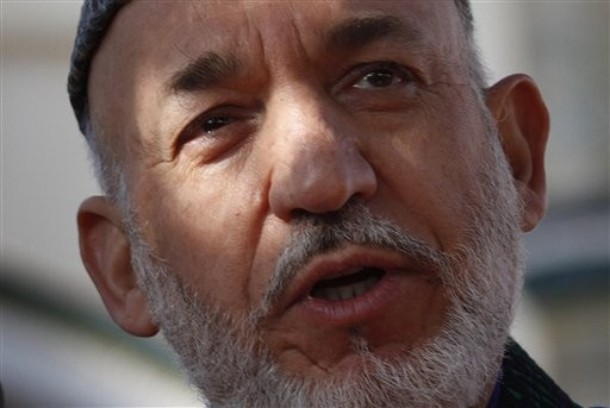
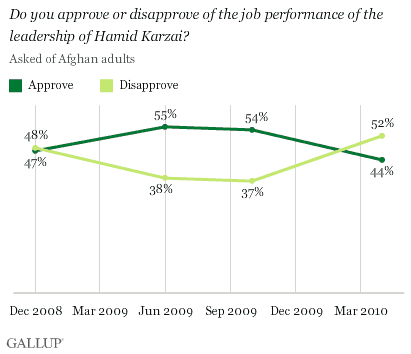
Karzai's Job Approval Sinking

karzai%20job%20approval.gif

According to Gallup, Hamid Karzai's approvals are slipping:

At 44%, more Afghans approve of Karzai's individual leadership than they do the nation's leadership in general. However, his approval is down from 2009, and a majority (52%) disapproves for the first time. Karzai enjoyed majority approval throughout 2009, despite the election controversy last fall. His fellow citizens are more divided now, as they were in late 2008.

Things aren't looking so good for the U.S. either:

Afghans' approval of their country's leadership fell to 33% in April -- the lowest measured since 2008. More Afghans now approve of the job performance of U.S. leadership (43%) than they do their own.

July 19, 2010

Afghan Poll: Mixed Picture

afghan%20poll%20results.jpg


A new poll from the International Council on Security and Development found some mixed results from the Afghan people:

ICOS field research reveals a relationship gap between NATO-ISAF and the Afghan communities they are intended to protect. For instance 75% of interviewees believe that foreigners disrespect their religion and traditions; 74% believe that working with foreign forces is wrong; and 68% believe that NATO-ISAF does not protect them. 55% of interviewees believe that the international community is in Afghanistan for its own benefit, to destroy or occupy the country, or to destroy Islam.

These results are troubling, and demonstrate the mistrust and resentment felt towards the international presence in Afghanistan. Of those interviewed, 70% believe that recent military actions in their area were bad for the Afghan people, whilst 59% opposed further operations in Kandahar. According to interviewees, the Afghan government is also responsible by failing to provide good governance. 70% of respondents believe that local officials make money from drug trafficking, and an astonishing 64% state that government administrators in their area were connected to the Taliban insurgency.


On the flip side, the survey also found that 55 percent of those interviewed thought that NATO was winning in Afghanistan. Also:

Despite the 2009 presidential elections, which were marked by fraud, 40% of Afghan respondents stated that democracy was important to them, and 72% would prefer their children to grow up under an elected government rather than the Taliban.

There is some progress in women‟s rights, with 57% of interviewees supporting girls education. The field research also reveals that respondents have strong social and economic aspirations – the most popular uses for $5000USD would be establishing or expanding a business, and marriage.

The interviews also indicate that negativity is not directed solely against the international coalition, but also to other outside parties. 62% of the interviewees believe Pakistan played a negative role in their country and 56% felt negative about Iran‟s influence in Afghanistan.

(AP Photo)

July 15, 2010

U.S. Views on Afghanistan

From a recent CBS News poll:

Today, the poll finds, 62 percent of Americans say the war is going badly, up from 49 percent in May. Just 31 percent say the war in Afghanistan is going well.

Nine years into the war, 33 percent of Americans say they do not want large numbers of U.S. troops in Afghanistan for another year. Twenty-three percent of Americans say they are willing to have troops stay there for one or two more years.

Just 35 percent are willing to have troops stay longer than two years.

Most Americans -- 54 percent -- think the U.S. should set a timetable for the withdrawal of U.S. troops from Afghanistan. Forty-one percent disagree.


July 13, 2010

U.S. Views on Afghan War

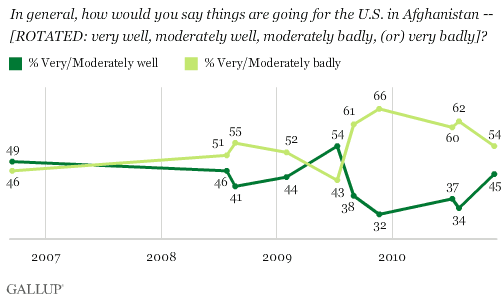
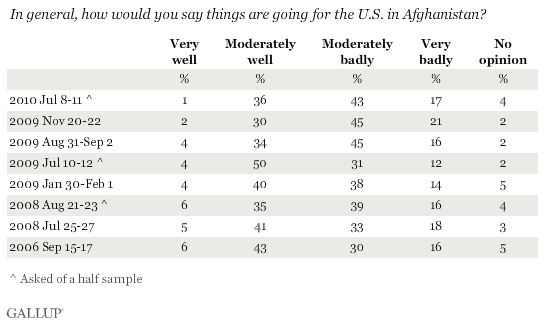
Gallup offers some new polling data on U.S. views of Afghanistan and of General Petraeus:

afgghanwarequestoins.gif


Frank Newport offers his analysis:

Gallup finds both good news and bad news for Gen. Petraeus in this July 8-11 poll. He takes his new job as commander of U.S. and allied forces in Afghanistan with a remarkably positive image among Americans who know who he is. At the same time, Petraeus now faces the additional challenge of commanding a mission that the majority of Americans say is going badly. Americans' views of the situation in Iraq improved during and after Petraeus' tenure as commander in that country. The degree to which Petraeus will be able to shift Americans' perceptions of the war in Afghanistan in similar fashion will have important consequences in many arenas, including the politics of the war in the U.S.

I think this last line is the key to understanding the surge, which is why I don't believe we can say definitively yet whether it has worked or not. The key metric is less what it does in Afghanistan, but the impression it leaves in Washington.

July 2, 2010

A Turning Point?

This week has brought two interesting revelations from the GOP in terms of foreign policy. The first was Representative Bachmann's claim that she didn't want to "bind the United States into a global economy." (Perhaps she's a secret devotee of Juche?)

The second, and more consequential, is this riff from Republican National Committee Chairman Michael Steele on the war in Afghanistan:

At a Republican Party fundraiser in Connecticut on Thursday, Steele declared that the war in Afghanistan "was a war of Obama's choosing" that America had not "actively prosecuted or wanted to engage in," in a response to an attendee's question about the resignation of Gen. Stanley McChrystal -- which Steele called "very comical."

"The McChrystal incident, to me, was very comical. And I think it's a reflection of the frustration that a lot of our military leaders have with this Administration and their prosecution of the war in Afghanistan," said Steele. "Keep in mind again, federal candidates, this was a war of Obama's choosing. This is not something the United States had actively prosecuted or wanted to engage in."

I highly doubt this presages a shift in the Republican attitude toward the war. But nevertheless, there is no intrinsically conservative/limited government argument for engaging in a multi-billion dollar social engineering scheme in the Hindu Kush. If the general public turns further south on the effort, will this line of argument gain greater traction among Republicans?.

July 1, 2010

U.S. Puts Number on Al Qaeda

The New York Times reports:

Michael E. Leiter, one of the country’s top counterterrorism officials, said Wednesday that American intelligence officials now estimated that there were somewhat “more than 300” Qaeda leaders and fighters hiding in Pakistan’s tribal areas, a rare public assessment of the strength of the terrorist group that is the central target of President Obama’s war strategy.

Taken together with the recent estimate by the C.I.A. director, Leon E. Panetta, that there are about 50 to 100 Qaeda operatives now in Afghanistan, American intelligence agencies believe that there are most likely fewer than 500 members of the group in a region where the United States has poured nearly 100,000 troops.

And it's not like these 100,000 troops are dedicated to finding and rooting out the 500 odd al Qaeda operatives in Pakistan. Instead, they're hunting down mid-level Pashtun Taliban commanders and attempting to extend the writ of the government in Kabul.

June 30, 2010

What Does Pakistan Want?

The Council on Foreign Relations has a good interview up with their Senior Fellow for India, Pakistan and South Asia, Daniel Markey. Here's Markey on Pakistan's goals inside Afghanistan:


The Pakistanis would want to see an Afghanistan run by a collection of individuals who are at least sympathetic to Pakistan and who are committed to not seeing much in the way of Indian influence in Afghanistan. You really do have to trace this back to Pakistani concerns about being confronted on both eastern and western borders by India. Some of that is a bit obsessive, but that's certainly the way the Pakistanis have perceived developments in Afghanistan. They have seen a rising amount of Indian influence and a potential that they would be squeezed by both sides. So they want to make sure that they have preponderant and certainly dominant interests and influence in Kabul into the future. They will probably not be satisfied with anything short of that.

As Markey notes, the way the Pakistanis see their interests protected is by nurturing militant groups that have sheltered international terrorists in the past and would presumably do so again in the future. There's not much our counter-insurgency can do about that, unless we can combine it with a diplomatic effort to change Pakistan's strategic outlook.

What's a Life Worth?

a%20life%20is%20worth.jpg

Both Matthew Yglesias and Ross Douthat raise an issue that's been under-discussed with respect to Afghanistan, and that's the issue of saving face. Yglesias writes that it was "churlish" of him to point out that the Iraq surge had failed based on the objectives laid out for it because it made Washington feel good about leaving the country. Similarly, Douthat claims that the objective of a counter-insurgency strategy in Afghanistan is to "make it easier for leading U.S. policymakers to embrace a real withdrawal" - irrespective of obtaining any strategic objectives in the country.

There have been countless incidents in war when military commanders and/or their civilian leaders have made decisions that they knew would cost lives but were nonetheless essential to victory. There are also countless incidents when rulers sent armies off on fatal missions simply to assuage their imperial or monarchical vanity.

The U.S. has to think long and hard about where the current Afghan counter-insurgency falls on this continuum. It's one thing to risk the lives of American and Western soldiers because there is absolutely no other choice to safeguard our security. It's quite another to do so to make Washington's political establishment feel good about itself.

(AP Photo)

Wars Cost Money

We see once again that there is no substitute for a clear-headed commander in chief. Petraeus was successful in Iraq because he had the right strategy and a president who supported him fully. Had Petraeus not been given Ambassador Crocker to work with and had he not been given a wholehearted and, yes, open-ended commitment from the commander in chief, he might very well have failed.

Petraeus could have said to Obama that he wouldn’t take the job given the timeline — and he still could resign if it remains firmly in place. But at least for now he has chosen to operate with the ball and chain around his ankle. - Jennifer Rubin, 6/30/2010

War is a horrid prospect, as is the potential for massive loss of life – but not as horrid as that of a nuclear-armed Iran. Obama’s willingness to leave Israel to fend for itself or, worse, interfere with its ability to do so is not merely a betrayal of our democratic ally; it is an abdication of American responsibility that will resonate for years to come, signaling that the U.S. is no longer the guarantor of the West’s security. - Jennifer Rubin, 6/29/2010

An open-ended commitment to do whatever it takes in Afghanistan irrespective of the costs and the initiation of a new war against Iran. And yet Rubin appears to be worried about American debt.

Australians Call for Afghan Exit

Via Angus Reid, more deterioration in Western support for the Afghan mission:

The proportion of people in Australia who want to end their country’s commitment in Afghanistan has risen considerably, according to a poll by Essential Media Communications. 61 per cent of respondents think Australia should withdraw its troops from Afghanistan, up 11 points since March 2009.

On the contrary, 24 per cent of respondents say the Australian troops should stay in Afghanistan.

Australia has roughly 1,500 troops inside Afghanistan.

June 29, 2010

Americans Favor Afghan Timetable

According to Gallup:

A majority of Americans (58%) favor President Barack Obama's timetable that calls for withdrawal of U.S. troops from Afghanistan beginning in July 2011. Most of the 38% of Americans who are opposed reject the idea of setting any timetable rather than setting one with an earlier or later date.

A further 7 percent want out sooner, while 1 percent think it should start later. As for President Obama's handling of the war:


The poll finds 50% saying Obama is doing a "very good" or "good" job, while 44% believe he is doing a "very poor" or "poor" job. Democrats give Obama high marks on Afghanistan, while Republicans mostly say he is doing a poor job.

A new Angus Reid poll also found support for President Obama's decision to junk General McChrystal: 53 percent supported the decision, 28 percent disapproved and 18 percent were unsure. Full results here. (pdf)

June 28, 2010

Over Invest?

The Bush administration made a decision back in 2002 not to over-invest in Afghanistan, to settle for very limited goals and to focus instead on Iraq. Candidate Obama fiercely opposed the Iraq war and called instead for a big new recommitment to Afghanistan.

Once elected president, Obama hesitated for months as he pondered whether to fulfill his pledges on Afghanistan. That delay suggests to me that the original commitment had been made for campaign purposes, and did not reflect a serious analysis of the costs and benefits of a big Afghan counterinsurgency.

Whatever Obama’s motives, the results of his long-pondered policy have been disappointing to everybody — and a sharp reminder of the reasons that president Bush opted against nation-building in Afghanistan. - David Frum, June 2010


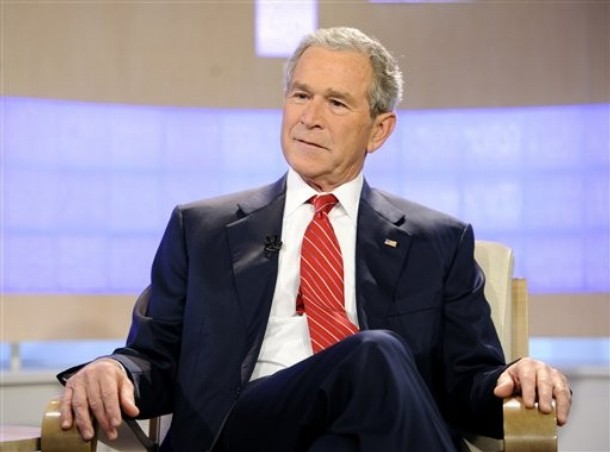
President Bush today embraced a major American role in rebuilding Afghanistan, calling for a plan he compared to the one Gen. George C. Marshall devised for Europe after World War II, and vowed to keep the United States engaged in Afghanistan "until the mission is done."

Speaking before cadets at the Virginia Military Institute, Mr. Bush warned that military force alone could not bring "true peace" to Afghanistan, and that stability would come only after the war-ravaged country reconstructed its roads, health care system, schools and businesses — just as Europe and Japan did after 1945. - James Dao, New York Times, April 2002.


Efficiency in the War on Terror


This seems rather inefficient:

A key tenet of this policy, as Obama has reiterated frequently, is to “disrupt, dismantle, and defeat al Qaeda.”

The U.S. has committed nearly 100,000 troops to the mission in Afghanistan. ABC This Week host Jake Tapper asked CIA Director Leon Panetta how big is the al Qaeda threat that the soldiers are combating:

TAPPER: How many Al Qaeda, do you think, are in Afghanistan?

PANETTA: I think the estimate on the number of Al Qaeda is actually relatively small. I think at most, we’re looking at 50 to 100, maybe less. It’s in that vicinity. There’s no question that the main location of Al Qaeda is in the tribal areas of Pakistan.

The 100,000 U.S. forces that have been tasked to dismantle the 100 or so al Qaeda members — a ratio of 1000:1 — is complicated by the fact that we are also engaged in operations going after the Taliban leadership.

If you broaden the definition of who constitutes a threat to the U.S. to include the Afghan and Pakistan Taliban, I think that ratio looks a lot less absurd. But it still doesn't change the fact that the locus of the terrorist threat to the United States is in Pakistan. And all we're doing in Afghanistan is abetting a massive theft of American (and international) taxpayer dollars.

June 25, 2010

Afghan Straw Men

Max Boot thinks Andrew Sullivan's whacking at a straw man by bemoaning the fact that surge boosters want us in Afghanistan forever. Writes Boot:

I hope Andrew is right — not because I or anyone else is in favor of perpetually occupying Afghanistan (talk about a straw man!) — but because the only way to prevail is to show the will to stay in the long run.

Then he conveniently declines to specify what the long run is. But why? If Boot thinks the way to leave Afghanistan is to never say we're going to leave could he at least proffer a guess as to when the U.S. will have achieved its goals in the country sufficient enough to stop transferring American wealth and risking American and NATO lives in the country?

I do understand Boot's frustration - President Obama's time line was a mistake, reflecting a muddle between trying to reassure Americans that they won't be handing over their wealth and soldiers to Afghanistan en-perpetuity, while nevertheless committing to a counter-insurgency strategy that requires patience, manpower and resources. It would behoove the administration to move decisively in one direction.

Paging Richard Armitage

pakistan.jpg

The New York Times has a devastating article detailing how Pakistan is seeking to integrate the al Qaeda-linked Haqqani network into a power-sharing deal with the Afghan government:

Though encouraged by Washington, the thaw heightens the risk that the United States will find itself cut out of what amounts to a separate peace between the Afghans and Pakistanis, and one that does not necessarily guarantee Washington’s prime objective in the war: denying Al Qaeda a haven.

It also provides another indication of how Pakistan, ostensibly an American ally, has worked many opposing sides in the war to safeguard its ultimate interest in having an Afghanistan that is pliable and free of the influence of its main strategic obsession, its more powerful neighbor, India.

The Haqqani network has long been Pakistan’s crucial anti-India asset and has remained virtually untouched by Pakistani forces in their redoubt inside Pakistan, in the tribal areas on the Afghan border, even as the Americans have pressed Pakistan for an offensive against it.

General Kayani has resisted the American pleas, saying his troops are too busy fighting the Pakistani Taliban in other parts of the tribal areas.

But there have long been suspicions among Afghan, American and other Western officials that the Pakistanis were holding the Haqqanis in reserve for just such a moment, as a lever to shape the outcome of the war in its favor.

Your tax dollars at work.

Pakistani officials cite the Obama administration's timetable as one of the reason's they're cutting their own deals, but seeing as they've been playing a double game with the U.S. since 2001, it's difficult to credit that. Short of making Afghanistan the 51st state or radically transforming India-Pakistan relations, there's little evidence that the U.S. could stay inside Afghanistan long enough to make Pakistan fundamentally reorient their strategic interests. It would take a blockbuster peace deal with India and years worth of mutual trust-building before Pakistan stopped viewing India as a threat and Afghanistan as an essential strategic bulwark.

That leads to the question of what other levers, if any, the U.S. can use to influence Pakistan behavior in the short term. One is tempted, after reading this news, to dust off the Richard Armitage playbook and explain to Pakistan that they will be held responsible for any future attacks by al Qaeda that originate inside any area of Afghanistan controlled by the Haqqani network.

June 23, 2010

Did Bush Fail in Afghanistan?

Following up on Kevin's post, one element that seems to be missing from the discussion about the surge in Afghanistan is the nature of Afghanistan before the U.S. intervention. Kevin highlights this quote from Foreign Policy's Blake Hounshell:

For years, the U.S. more or less tried Vice President Joe Biden's preferred approach of keeping a light footprint and limiting U.S. military operations to going after bad guys, while de-emphasizing nation building. That didn't work either. So I think it's worth giving COIN more time to succeed, whether or not McChrystal is the man implementing it.

I think it's worth asking what the metrics are here. Hounshell asserts that the Bush/Biden approach didn't work - so what didn't it do? Did al Qaeda establish training camps inside Afghanistan and use it as a launch pad for international terrorist attacks against the U.S. homeland? No. Did the Taliban capture Kabul, re-institute sharia across the country and lay out the welcome mat for bin Laden & company? No. Did it end the country's thirty year civil war, Pakistan's cultivation of militant networks inside Afghanistan or usher in liberal democracy? No. It didn't do that either.

There is plenty to fault with the Bush administration's approach to Afghanistan - especially the decision to shift intelligence assets out of the country in 2002 to focus on Iraq. As Kevin said, they struck an untenable straddle of "occupation lite" - pretending that we were going to patch the whole country up while devoting patently insufficient resources to the task. But that said, the entire purpose of the Afghan war was to drive al Qaeda out and make sure they didn't come back. And in that respect, Bush can rightly claim "mission accomplished."

Moreover, he did that while simultaneously drawing U.S. intelligence assets and high-level military, political and diplomatic attention away from Afghanistan. That suggests to me that if President Obama refrains from any further wars and occupations in the Middle East, he should be able to ensure that Afghanistan is not al Qaeda Central at a modest expense.

The over-arching problem, it seems to me, is that Washington cannot really publicly reconcile itself to the fact that it is going to leave Afghanistan much the way it found it: at war with itself. Even if the current COIN strategy succeeds, it will simply transfer the onus for fighting onto a better trained Afghan National Army. Either scenario - COIN or counter-terrorism - ends with an Afghanistan that is still rife with conflict.


McChrystal and the COINdinistas

rsz_mcchrystal062310.jpg

Analyzing the potential outcomes of Gen. Stanley McChrystal's termination, COINdinista extraordinaire Andrew Exum concludes that:

In the end, your opinion on whether or not Gen. McChrystal should be dismissed might come down to whether or not you think the current strategy is the correct one for the war in Afghanistan. My own prediction is that Gen. McChrystal will be retained. As much as critics of counterinsurgency like to blame Gen. McChrystal (and nefarious think-tankers, of course) for the current strategy, the reality is that the civilian decision-makers in the Obama Administration conducted two high-level reviews in 2009 and twice arrived at a national strategy focused on conducting counterinsurgency operations in Afghanistan. I suspect the president will not replace the man he has put in charge of executing that strategy with just 12 months to go before we begin a withdrawal.

I suspect Exum is probably correct, but I don't know that one's position on COIN must necessarily determine their verdict on the general. Frankly, I read the Rolling Stone piece, and I found most of the stuff - while no doubt in violation of some military etiquette regulations - to be somewhat benign; the kind of water cooler griping that goes on inside every organization. Of course McChrystal erred in his media judgment, and I'm agnostic really on his fate, but I don't know, as Exum notes, if firing him makes sense while the country is so invested in his strategy.

And that's really the problem here. As Spencer Ackerman rightly points out, there's a kind of irony to this whole hubbub: while there's plenty of debate to be had over McChrystal, we mustn't expect too much debate over McChrystal's strategy. The White House has already reiterated its commitment to COIN in Afghanistan, and that, to me, is the end of the story. Though I take more of a realisty position on the war there, I don't know that demanding my pound of flesh makes much of a difference here.

Exum mistakenly assumes that anti-COIN = anti-McChrystal, but I think any critic of COIN would expect these kinds of internal flareups and frustrations when one country attempts to occupy and subsequently engineer the society of another. Power struggles; civilian vs. military personnel; arguments with the host government; bruised egos and hurt feelings over leaked memos and misplaced quotes; etc. This stuff seems par for the course.

Were there an actual debate about options in Afghanistan, then maybe you'd see more of an analytical uprising from the anti-COIN camp, but that debate had already been settled by COIN advocates long ago. Take this argument from Blake Hounshell, for example:

The thing is, though, it's not as if there is a viable alternative strategy out there. For years, the U.S. more or less tried Vice President Joe Biden's preferred approach of keeping a light footprint and limiting U.S. military operations to going after bad guys, while de-emphasizing nation building. That didn't work either. So I think it's worth giving COIN more time to succeed, whether or not McChrystal is the man implementing it.

There are actually a multitude of options in Afghanistan, but none of them will ever appear viable so long as we cling to an amorphous definition of "victory" there. To my recollection, what the Bush administration did in Afghanistan was not at all "light footprint," but rather, under-resourced occupation. They wanted to keep troop casualties low, but they also wanted to pacify the country. They pushed for elections, but then provided no sustainable security arrangement to actually guarantee a democratic Kabul's legitimacy.

This policy - which even the Bush administration would later scrutinize - is not what Biden had proposed last fall. His suggestion was to contain Afghan radicalism, draw down forces and continue drone strikes on militant targets throughout the greater Af-Pak region. If you support such a strategy (as I do, albeit reluctantly), then you certainly aren't concerned about dressing Afghanistan up as a functional democracy, because it clearly isn't one.

But critics can't live in a counterfactual dream world where the White House actually engages the public in a serious debate over the War on Terror, because that moment has passed. While we all question the job security of one general, we should at least, in fairness, congratulate the COINdinistas for what appears to be a vise-like grip on U.S. foreign policy thinking.

(AP Photo)

Surges & Costs

Things are very fluid on the General McChrystal front at the moment but this suggestion from Bill Kristol strikes me as emblematic of much of what has gone wrong with the debate over Afghanistan:

If Gen. McChrystal does step down, there are undoubtedly many able general officers who could replace him. Here’s one unconventional suggestion, though: Ask Gen. David Petraeus to give up his CENTCOM post and take command of the war in Afghanistan. President Obama should also accept the resignations on the civilian side of special envoy Richard Holbrooke and ambassador Karl Eikenberry; he could then ask Ryan Crocker to come out of retirement to head up the currently dysfunctional civilian effort.

And what will happen? Will Afghanistan suddenly grow governing institutions where none currently existed (Iraq, however dysfunctional and tyrannical under Saddam, had institutions)? Will Pakistan suddenly decide to abandon the Taliban? Will spending hundreds of billions of dollars and committing U.S. soldiers to Afghanistan for another five-plus years make a significant dent in the global jihadist movement?

It seems to me the debate over Afghanistan has become fundamentally unmoored from any discussion of the global terrorist threat. Take all the money, manpower and focus that surge boosters propose to devote to Afghanistan for "however long it takes" until we "win" a very, very modest victory and ask yourself whether that effort and those resources couldn't have a more significant impact on the terror threat if used in a different manner.

June 22, 2010

Bribing Warlords

Dexter Filkins writes that the U.S. taxpayer is "inadvertently" funding warlords in Afghanistan:


At the heart of the problem, the investigation found, is that the American military pays trucking companies to move its supplies across Afghanistan — and leaves it up to the trucking companies to protect themselves. The trucking companies in turn pay warlords and commanders to provide security.

These subcontracts, the investigation found, are handed out without any oversight from the Department of Defense, despite clear instructions from Congress that the department provide such oversight. The report states that military officers in Kabul had little idea whom the trucking companies were paying to provide security or how much they spent for it, and had rarely if ever inspected a convoy to find out.

So we're bribing incentivizing warlords to let trucks navigate the country. Could we do the same to keep al Qaeda from setting up terrorist camps?

June 21, 2010

Victory in Afghanistan

Far too much commentary on Afghanistan proclaims a desire to "win" without saying what that actually means. The Center for a New American Security's John Nagl, however, lays out what a win for the U.S. looks like:


Success there - defined as an Afghanistan that does not provide a haven for terror or destabilize the region and is able to secure itself with minimal outside assistance - remains a vital national interest of the United States.

And although winning in Afghanistan would not by itself defeat Al Qaeda and associated terror movements, it would strike a hard blow against our enemies, while losing the war there would be cataclysmic: It would strengthen our enemies and lead to the loss of many more innocent lives around the globe.

Later in the piece, Nagl says that such a victory can be achieve in five years. Yet the article, and many like it, elides the crucial questions - how "hard" a blow against our enemies would such a victory in Afghanistan deliver? And would it be worth the cost?

Afghan Diplomacy

afghandiplomacy.jpg

Earlier last week, the London School of Economics released a report documenting Pakistan's extensive ties to the Taliban and related militant groups giving America grief in Afghanistan. The revelations - which weren't exactly news but were nonetheless significant - underscored the problematic nature of the American mission in Afghanistan. Despite years of cajoling, threatening, and bribing, the U.S. has been unable to stop Pakistan from nurturing Islamic militants in Afghanistan as a "hedge" against India. And so long as Pakistan keeps hedging, it will be impossible to keep the Taliban out of Afghanistan.

Peter Feaver, formerly of the Bush administration's national security council, offers his thoughts on a diplomatic gambit that could salvage Washington's position in Afghanistan:

But the thing Pakistan cares about almost as much as (and perhaps more than) a nuclear deal is the Indian file. For nine years we have tried to get Pakistan to see in Afghanistan what we see, a dangerous problem of safe-havens for militant Islamist terrorist networks. Instead, when Pakistan looks at Afghanistan, it sees India -- that is, a possible two-front conflict in which India conducts mischief in Pakistan's backyard. That is why so much of Pakistan's efforts in Afghanistan have been counterproductive. Maybe it is time to leverage that largely unfounded but deeply entrenched view. Maybe it is time to offer them some help on specific asks they have on their India file: say further restrictions on Indian activity in Afghanistan (even though it is benign), or perhaps reinvigorated efforts to deal with environmental and water resource issues related to the Kashmir, or perhaps reinvigorating regional confidence building measures with an expanded U.S.-sponsored Track II dialogue on conventional war doctrine.
Feaver goes on to suggest that the U.S. should be prepared to support an Indian seat on the UN Security Council, loosen technology transfers and offer "confidential assurances" regarding a rising China.

Considering past U.S. efforts with India and Pakistan, it's unlikely that such an approach could work (and Feaver acknowledges as much). Nevertheless, it may be worth trying - it's difficult to see the U.S. escaping from the morass of Afghanistan without attempting to reach a modus vivendi with India and Pakistan over an end-state in that country.

Relatedly, Michael Cohen passes along this piece in Orbis (pdf) detailing what a scaled down "counter-terrorism" approach to Afghanistan would look like in practice.

(AP Photo)

Canadian Support for Afghanistan Slips

canadaafghanistan.jpg

While U.S. support for the war in Afghanistan has held fairly steady since late 2009, Angus Reid found a fairly steep drop in Canadian support since February:


Fewer adults in Canada are supportive of the military mission in Afghanistan, according to a poll by Angus Reid Public Opinion. 59 per cent of respondents oppose the operation involving Canadian soldiers, up 10 points since February.

Angus Reid also found that the strongest opposition to the war was in Quebec, while Alberta was the most supportive area of the country. Additionally, 48 percent of Canadians thought the country made a mistake in committing troops to Afghanistan and 31 percent expressed confidence that the Obama administration will "finish the job."

Complete results here. (pdf)

June 18, 2010

U.S. Views on the Afghan War

afghanwarhelmet.jpg

While elite angst over Afghanistan is percolating, Angus Reid found that public opinion regarding the war remains relatively unchanged since December 2009: 50 percent of respondents in a survey supported the war, up from 49 percent in December 2009.

Some other findings:

* 50 percent of respondents said they have no clear idea what the war in Afghanistan is about

* 60 percent have no confidence in the Obama administration to finish the job

* 52 percent feel the government has provided too little information to the American people about the war.

Full results here. (pdf)

(AP Photo)

June 17, 2010

All it Would Take Is a Speech

rsz_obama061710.jpg

What would it take to find the "willpower" to win in Afghanistan? A good speech, says Max Boot:

All it would take would be a speech from the president saying something like this: ”I was wrong about trying to set a timeline for American withdrawal. I wanted to inject fresh vigor into our military and diplomatic efforts. But I now realize that my talk about starting to pull American troops out next summer has been misinterpreted; it has caused some in the region to doubt our resolve. So let me be clear. We will stay as long as necessary to defeat the cruel evil of the Taliban, al-Qaeda, and associated extremists. I now pledge that, to paraphrase another young Democratic president, we shall pay any price, bear any burden, meet any hardship, support any friend, oppose any foe, in order to assure the survival and the success of liberty in Afghanistan.”

Boom. With a few gutsy words like that, President Obama could instantly change assumptions about our willpower. That’s all it would take, because in all likelihood the Democratic Party would fall in behind him — or at least not challenge him too aggressively. Republicans, for their part, would enthusiastically support him as they have whenever he has increased our commitment to Afghanistan.

Michael Cohen scratches his head:

There is a great deal about Max Boot's analysis that makes me wonder - but his refusal to ever consider public opinion or the historical lack of political will among countless democracies to fight overseas conflicts is perhaps the most perplexing. Consistently we have seen that lack of popular support can undermine the support for long, drawn-out conflicts - as was the case in Vietnam, Algeria, Iraq and to a lesser extent Malaya, Kenya, South Lebanon to name a few examples. And even in countries that weren't democracies this has been the case. Even in one of the examples that Boot cites - the Iraq War - he ignores the fact that stubborn adherence to a failing war cost Republicans control of Congress and the White House.

Why Boot never factors in the role of political will and seems to believe - against all evidence to the contrary - that it can simply be manufactured by "resolute" leaders is beyond my meager ability to comprehend.

That makes two of us.

UPDATE: Although I did enjoy the "let me be clear" part in Boot's Obama speech.

June 16, 2010

Timelines Aren't the Problem

As more and more angst begins to surface about the trajectory of the U.S./NATO counter-insurgency effort in Afghanistan, there's a real danger in missing the point. The administration's stated time line for withdrawal is a problem, but it is not the problem. (It's also worth noting that the administration has repeatedly insisted that the draw down only begins in July 2011 and is "conditions-based.") The fundamental problem is the nature of the outcome the U.S. is trying to achieve in the country.

Surge boosters in particular are hiding behind the announced time line as a way to mask their own analytical failure to enunciate achievable goals at acceptable costs.

Anthony Cordesman offers a caveat-laced case for the war, and in doing so reveals the basic strategic problem facing the U.S.:


The fact is, the strategic case for staying in Afghanistan is uncertain and essentially too close to call. The main reason is instead tactical. We are already there. We have major capabilities in place. If we can demonstrate that the war can be won at reasonable additional cost in dollars and blood, it makes sense to persist. But, only if we can demonstrate we can win and show that the additional cost has reasonable limits. Containment and alternative uses of the same resources are very real options, and would probably be more attractive ones if we could somehow “zero base” history. The reality is, however, that nations rarely get to choose the ideal ground in making strategic decisions. They are prisoners of their past actions, and so are we. [Emphasis mine]

This is true for al Qaeda of course, but much less so. We are laboring in Afghanistan as much, if not more, for prestige than for any kind of major victory against al Qaeda, which has already demonstrated the ability to not only set up shop elsewhere, but to reach into the United States via the Internet for recruits.

Support for Afghan War in UK

cameronkarzai.jpg

Support for the Afghan war in the United Kingdom has seen a slight uptick in June, according to Angus Reid: 38 percent support the war, up from 32 percent in April. However 55 percent oppose the war.

While Britons may object to the war, a new poll from Ipsos Mori suggests the war is not high on the list of their concerns. When asked what they saw as the most important issue facing Britain, "defence/foreign affairs/international terrorism" placed 7th with just 3 percent. Full results here. (pdf)

(AP Photo)

June 15, 2010

How Long Should We Stay in Afghanistan?

staying%20in%20Iraq.jpg

When President Obama announced his Afghan strategy at West Point, many commentators argued that the July 2011 draw down date was a mistake. Peter Feaver cites it again in a recent post outlining the various mistakes the administration has made with respect to its Afghan strategy, all in the service of "slowing down the domestic clock" so the United States can stay in Afghan for an unspecified length of time sufficient to achieve an unspecified goal at an unspecified cost.

As I've said, I've come around to the view that announcing the withdrawal date was a mistake as it is ultimately undermining our position there. But the question needs to be asked of those who support a robust counter-insurgency: how long do you want to stay and how much do you want to spend? Is there any time duration and any amount of money (let alone American and NATO casualties) that you would consider excessive to the goal of preventing al Qaeda from using Afghanistan as a future base of operations?

The more the bloom comes off the Iraqi rose, I suspect these questions are going to be posed more persistently to supporters of the Afghan Surge.

(AP Photo)

June 14, 2010

Blood for Rocks?

Did someone say exit strategy? The New York Times is reporting that the U.S. has found massive deposits of untapped mineral wealth in Afghanistan valued at almost $1 trillion:

The previously unknown deposits — including huge veins of iron, copper, cobalt, gold and critical industrial metals like lithium — are so big and include so many minerals that are essential to modern industry that Afghanistan could eventually be transformed into one of the most important mining centers in the world, the United States officials believe.

An internal Pentagon memo, for example, states that Afghanistan could become the “Saudi Arabia of lithium,” a key raw material in the manufacture of batteries for laptops and BlackBerrys.

The vast scale of Afghanistan’s mineral wealth was discovered by a small team of Pentagon officials and American geologists. The Afghan government and President Hamid Karzai were recently briefed, American officials said.

While it could take many years to develop a mining industry, the potential is so great that officials and executives in the industry believe it could attract heavy investment even before mines are profitable, providing the possibility of jobs that could distract from generations of war.

Lisa Reisman at MetalMiner isn't impressed:

Undoubtedly, we’d probably all agree that we’d like to see Afghanistan move its economy away from its primary source of revenue (opium traffic), stabilize its government and turn itself back to a country without the Taliban. But call me a cynic I think the enthusiasm for these findings is grossly overdone. If we (America) as a country won’t deal with Bolivia for its lithium, how in the world do we expect to help create the physical infrastructure (roads, rails, etc) the political infrastructure – if a central structure is even possible in Afghanistan (e.g. security, a rule of law, quasi-non-corrupt leaders) and religious infrastructure (e.g. the removal of the Taliban) required to help Afghanistan transform its “drug resistant” (pun intended) ways to take advantage of these finds?

RCW contributor Daniel McGroarty has lots to say about the value of strategic and Rare Earth minerals.


UPDATE:
Michael Cohen thinks it's a joke:

But even if this is true, so what? How many years would it take to put in place an infrastructure to develop and mine these natural resources? And if you think Afghanistan is corrupt now (only Somalia is worse!) imagine how it will look after this? Congo has tons of natural resources; so does Angola. How's that working out for them?

There is nothing in this story that changes the fundamental incoherence of the current mission in Afghanistan. There is nothing here that will change the dynamics on the ground in Afghanistan and the reality of a corrupt, illegitimate Afghan government, an adaptable insurgent force and a June 2011 deadline for the commencement of US troop withdrawals.

The only thing this story shows is the desperation of the Pentagon in planting pie-in-the-sky news stories about Afghanistan and trying to salvage the lost cause that is our current mission there.

Blake Hounshell also smells something of a rat.

June 9, 2010

Nation Building in Kandahar

afghan%20pullout.jpg

Rod Nordland details American efforts to nation build in Kandahar, Afghanistan:

Minister of Defense Abdul Rahim Wardak said the new approach was adopted after officials considered the mistakes made in Marja and the much larger scale of Kandahar.

“We have learned lessons, also, which we will apply in the future,” he said in an interview this week. “About Kandahar, it is a different type operation, it is not like Marja, it is not going to be that kinetic.” (Kinetic is military jargon to describe fighting.)

Instead, the emphasis has been placed on strengthening provincial reconstruction teams, once run by Canadians, with American employees — from the embassy, the Agency for International Development and the Department of Agriculture — in six crucial districts around Kandahar.

The Kandahar civilian operation increased to 110 Americans from 8 last year, with 50 more on their way this summer, United States officials say. They are providing subsidized seeds and tools, carrying out cash-for-work programs and even hiring employees for Afghan government offices here....

A key to being able to do that is the steady increase of troops from the United States and other NATO nations for protection.

Until 2009, a Canadian battle group of 1,300 troops was responsible for all of Kandahar and could do little more than keep the Taliban from taking the city — while leaving the insurgents free to operate in the surrounding districts. Canadian civilians working on provincial reconstruction rarely left their base.

Since last year, the United States Army has brought in the Second Stryker Brigade, a battalion of the 82nd Airborne, parts of the Fourth Infantry Division and a cavalry squadron, for the crucial outlying districts, as well as a military police battalion in the city of Kandahar itself.

“The military presence bought us the political space and oxygen this fall to start putting projects in to remedy grievances in the districts and more recently in the city itself,” said an American official, speaking on the condition of anonymity in line with United States Embassy policy.


What is going to happen to this when the administration starts drawing down troops in 2011? At the time the Afghan strategy was announced, I was on the fence about the virtues of a withdrawal timeline, but it increasingly looks untenable. If you're going to commit to nation building and using tens of thousands of American troops to protect Afghan civilians while you jump-start reconstruction, then time-stamping an arbitrary withdrawal is counter-productive. It would be better, in my view, not to commit to nation building as a counter-terrorism strategy, but the administration seems to have fixed on the worst of both worlds: it won't effectively nation build but will nonetheless risk American and NATO lives and siphon American taxpayer dollars into an effort it has already disavowed.

(AP Photo)

June 7, 2010

Yemen as Terrorist Epicenter

yementerror.jpg

As the U.S. struggles to stabilize Afghanistan, the Times of London reports that counter-terrorism officials are increasingly worried about Yemen:

If there is one country that is giving US counter-terrorism officials the greatest concern in terms of its burgeoning al-Qaeda training camps and the number of new holy warriors intent on carrying out attacks on Western targets, it is Yemen.

The country has become the base for al-Qaeda in the Arabian Peninsula (AQAP). The organisation has set up training camps and appears intent on recruiting foreign nationals with the passports and visas necessary to board aircraft bound for the US and its allies. Inside the White House, the Pentagon and the US intelligence agencies the fear is that Yemen is more likely to produce a successful suicide mission within the US than perhaps any other country.

Even if the U.S. succeeds in stabilizing Afghanistan (and if you have hope on that score, do read Dexter Filkins' expose of Afghan corruption in the NY Times) al Qaeda and its affiliates are already taking root in other countries - just as many predicted. And what will the U.S. do? Will Yemen become another front in the Drone War?

(AP Photo)

June 5, 2010

CIA Voices Drone Doubts

Earlier in the week, the United Nations called on the U.S. to halt the CIA-led drone assault in Pakistan (but not the use of drones by the U.S. military, which they viewed as more accountable). Now comes a report that mid-level CIA officers are concerned about the drone program as well:


CIA officers "are very upset" with the drone strike policy, Addicott said. "They'll do what the boss says, but they view it as a harmful exercise. They say we're largely killing rank and file Pakistani Taliban, and they are the ones who are agitated by the campaign."

Because the drone strikes kill innocent civilians and bystanders along with leaders from far away, they "infuriate the Muslim male", said Addicott, thus making them more willing to join the movement. The men in Pakistan's tribal region "view Americans as cowards and weasels", he said....

The complaints by CIA operatives about the drone strikes' blowback effect reported by Addicott are identical to warnings by military and intelligence officials reported in April 2009 by Jonathan Landay of McClatchy newspapers. Landay quoted an intelligence official with deep involvement in both Afghanistan and Pakistan as saying al-Qaeda and the Taliban had used the strikes in propaganda to "portray Americans as cowards who are afraid to face their enemies and risk death".

The official called the operations "a major catalyst" for the jihadi movement in Pakistan.

The decision to expand the use of drones from "high level al Qaeda figures" to members of the Pakistani Taliban has been defended on the grounds that the two groups are too closely intertwined to make a clear distinction and as a favor to Pakistan, which views the Pakistani (but not Afghan) Taliban as a clear threat.

I tend to view drone strikes as the "least worst" option, especially when compared to a full blown counter-insurgency (which isn't an option in Pakistan anyway). But we may need to be more selective in our targeting. It will be a cold comfort to knock off senior al Qaeda leaders if we wind up destabilizing Pakistan as a result.

June 4, 2010

Our Own Worst Enemy

Thomas Barnett on the failures of the Obama administration's approach to Afghanistan:

Iraq was a governed space before we got there--a brutal regime no doubt, but a governed space, meaning the capacity was there.

The same simply wasn't true of Afghanistan.

We didn't do right by the country for seven years, and now we're trying to cram-course the entire place in a matter of months. Why? Oldest reason in the book: our leadership fears our public.

The damage we do to the "nation" of Afghanistan--along with the region--is one thing. The damage will do to ourselves globally is another.

It's clear that the Obama administration's Afghan surge is a face-saving effort - an attempt to restore enough security so that we can declare victory and "transition" to simply arming our favored thugs to ward off the nastier Taliban. Had we pursued such a strategy from the start, the U.S. would not be facing a huge loss of global credibility. But rather than set a very, very low bar in Afghanistan, we hailed it as the Marshal Plan 2.0.

May 28, 2010

A Losing Strategy

Counter-terrorism expert Bruce Hoffman has a real eye-opener on al Qaeda in the current issue of the National Interest. The piece really casts doubt on the wisdom of waging a huge counter-insurgency in Afghanistan. Hoffman notes how al Qaeda is getting increasingly better at reaching into the U.S. to find and radicalize individuals to carry out attacks. While we focus on one theater - first Iraq, then Afghanistan - al Qaeda retains resiliency by keeping a global footprint. The administration's touting of drone strikes is also misguided, Hoffman writes:

The operable assumption, like the infamous body counts that masqueraded as progress during the Vietnam War in the 1960s, is that we can kill our way to victory. Long ago, David Galula, a French army officer and arguably still today the world’s preeminent expert on counterinsurgency and counterterrorism, wrote about the fallacy of a strategy that relies primarily on decapitation. In Pacification in Algeria, 1956–1958, first published by the RAND Corporation in 1963, Galula explains how the capture in 1957 of the top-five leaders of the Algerian National Liberation Front, the terrorist-cum-guerrilla group that the French battled for eight long years before giving up in exhaustion, “had little effect on the direction of the rebellion, because the movement was too loosely organized to crumble under such a blow.” Half a century later, he could just as easily be talking about al-Qaeda...

The above examples are not meant to imply that killing and capturing terrorists should not be a top priority in any war on terrorism. Only that such measures—without accompanying or attendant efforts to stanch the flow of new recruits into a terrorist organization—amount to a tactical holding operation at best. That is not the genuinely game-changing strategic reversal that attrition of terrorist leaders in tandem with concerted counter-radicalization efforts to hamper recruitment can ultimately achieve.

Unfortunately, while Hoffman acknowledges the need to stem the supply of recruits, there aren't many specifics about how that should actually be done. What Hoffman does make clear is that reforming the Karzai kleptocracy is not going to impede al Qaeda to any great extent.

May 27, 2010

Poll: Kashmiri Attitudes

According to the UK think tank Chatham House, there has been no "systematic attempt" to judge the attitudes of Kashmiris on either side of the line of control between India and Pakistan. It's remarkable, when you think about it, given the international implications of the conflict post 9/11. Now, Kings College and Ipsos Mori, under the auspices of the Qadhafi Foundation for Charity Associations & Development have undertaken a comprehensive study of Kashmir opinion. Some of the findings:

Independence: In aggregate 44 percent in AJK and 43 percent in J&K said they would vote for independence. However, while this is the most popular option overall, not only does it fail to carry an overall majority, on the Indian side of the LoC it is heavily polarised. In the Kashmir Valley Division, commonly regarded as the core region of Kashmiri identity and of demands for its political recognition, support for independence runs at between 74 percent and 95 percent. In contrast, across Jammu Division it is under one percent. In Leh it is thirty percent and Kargil twenty percent.

Joining India: Twenty-one percent overall said they would vote to join India. However, only one percent on the Pakistani side of the Line of Control said they would vote for this, compared with 28 percent on the Indian side. In the Vale of Kashmir support for joining India was much lower, down to just two percent in Baramula. Only in Jammu and Ladakh Divisions was there majority support for joining India, rising to as high as eighty percent in Kargil.

Joining Pakistan: Fifteen percent overall said they would vote to join Pakistan. Fifty percent of the population on the Pakistani side of the LoC said they would choose to join Pakistan, compared with two percent in J&K, on the Indian side of the LoC. Badgam, in the Kashmir Valley Division, had the highest percentage vote for joining Pakistan at seven percent.

One conclusion is clear: a plebiscite along the lines envisaged in the UN resolutions of 1948-49 is extremely unlikely to offer a solution today.

You can read the whole report here.

May 24, 2010

Poll: American Views on the Afghan War

Via Rasmussen:

A new Rasmussen Reports national telephone survey finds that only 41% of Likely U.S. Voters now believe it is possible for the United States to win the nearly nine-year-old war in Afghanistan. Thirty-six percent (36%) disagree and say it is not possible for America to win the war. Another 23% are not sure.

Just before President Obama announced his new strategy for the war last December, only 39% thought a U.S. victory was possible, while 36% disagreed. But confidence that America can win jumped to 51% after the president’s highly-publicized strategy was declared. But support began to decline after that.

In fact, 48% now say ending the war in Afghanistan is a more important goal than winning it. Forty-two percent (42%) place more importance on winning the war. Voters have been almost evenly divided on this question for months.

May 17, 2010

Fighting the Afghan War, Soviet-Style

John Bolton is skeptical about nation building in Afghanistan. I think there's plenty of reason to be, but I can't quite understand the conclusion he draws:


But we cannot withdraw from the conflict just because the Afghans may not be meeting our standards. Leaving due to Afghan government failures, of which there are and will be many, would jeopardise our strategic objectives, frustrating the very reasons for intervening after 9/11 in the first place: preventing terrorists from re-establishing Afghanistan as a base, or using it to destabilise Pakistan and seize control of Islamabad’s nuclear weapons.

We must achieve these objectives — which means essentially destroying the Taleban — whether or not the Afghan government shapes up. That is the right metric, not nation building. This is a hard truth, but realistic unless you are prepared to risk a nuclear Taleban.

But how does one "destroy" the Taliban? Does Bolton know who they all are? Where they all are? And would bringing the necessary firepower to bear on the problem, while ignoring the depredations of the Karzai regime, make the Afghans more or less accommodating to foreign forces? As the U.S. wages a total war campaign against the Pashtuns, do fellow Pashtuns in Pakistan get more or less restive? Karzai has, on numerous occasions, blasted NATO for civilian casualties. Presumably under the Bolton doctrine, those casualties increase while our concern for what Karzai (or any Afghan) has to say decreases. Does that seem like a stable mix?

At least advocates of nation building have a coherent view: the Taliban can't be defeated in a conventional sense so the Afghan state has to be reconstructed to the degree that they can wage the insurgency on their own, while winning over an increasingly larger percentage of the population base. If you're skeptical that this approach is worth the costs, the answer isn't to go on a Soviet-style rampage in an ill-defined attempt to "defeat" an enemy deeply enmeshed in Afghan society. It's to leave and figure out a more cost-effective means of keeping al Qaeda (remember them?) from reconstituting in large numbers.

Winning in Afghanistan

afpak.jpg

John Nagl defends the war in Afghanistan:


While winning in Afghanistan would not by itself defeat al-Qaeda and associated terror movements, losing in Afghanistan would materially strengthen them at the cost of many more innocent lives around the globe. And there are encouraging signs indicating that the war in Afghanistan can be won—if the international community remains committed to the fight.

Here's how Nagl defines victory:

The development of an Afghan government that is able to provide a modicum of security and governance for its people is necessary to ensure that the international community's security interests will be preserved without a continued major international troop presence. To achieve this objective, the coalition and its Afghan partners must build a state that reconciles a degree of centralised governance with the traditional tribal and religious power structures that hold sway outside Kabul. Achieving these minimal goals will require continued support for an increasingly capable Afghan army and much more effort in building a police force that can earn the trust of the people, as well as a greater Afghan commitment to good governance and to providing for the needs of the people wherever they live.

All of that presumes a degree of human and government capital that simply may not exist. It also presumes that the international community can in fact create the right balance between a strong central government and one that gives the "traditional" power structures outside Kabul their due. Nagl calls these "minimal goals" but they sound rather difficult to me.

(AP Photo)

May 12, 2010

Times Square & Counterinsurgency

shahzad.jpg

Faisal Shahzad, the would-be car bomber of Times Square, is the poster child for why the massive counter-insurgency inside Afghanistan is a dubious counter-terrorism strategy. Shahzad was reportedly lured to radicalism by the preachings of Anwar al-Awlaki, which he consumed over the Internet. It's true that he traveled to Pakistan, where he was presumably taught how to build his crude car bomb. But does anyone believe that sufficiently motivated individuals (or groups) can't get up to speed with how to kill large numbers of people without traveling to Pakistan? Obviously, they can.

Even if Pakistan played a role in the radicalization of Shahzad, it's difficult to see how American strategy in Kabul can mitigate that. Indeed, under no conceivable scenario does a functioning government in Kabul stop Shahzad - or future Shahzads - from hatching and attempting to execute murderous schemes.

(AP Photo)

May 10, 2010

Plan B: Freedom?

rsz_iraq051010.jpg

Looking back on President Obama's Cairo speech, George Packer wonders if the so-called freedom agenda has become too cynically applied:

this Administration will devote its energy to repairing relations with foreign governments, and will not risk them for the sake of human rights. Where the stakes are low, as in the West African nation of Guinea, the Administration speaks out against atrocities, with positive effect; but where there’s a strategic interest, as in Ethiopia, which has jailed dozens of journalists and opposition politicians, the policy is mainly accommodation.
What if people around the world want more than a humble adjustment in America’s tone and behavior? What if American overtures to nasty regimes fail, because those regimes have a different view of their own survival? Then the President will have to devise a fallback strategy—preferably one that answers the desires of the people who applauded in Cairo, and doesn’t leave another generation cynical about American promises. [Emphasis added. - KS]

But isn't part of the problem that the so-called freedom agenda has become a de facto, as Packer puts it, "fallback strategy"? If the United States should learn anything from the previous administration, shouldn't it be that using the rhetoric of freedom as window dressing or, even worse, a "fallback" for policy failures only corrupts and sullies the very word itself?

For want of an actual freedom agenda, the American president is often asked to speak out against every petty despot and dictatorship around the world. But the United States cannot, I hope it goes without saying, invade and occupy every undemocratic country allegedly in need of liberation. Were it even effective - which, even in the cases of Iraq and Afghanistan, would be a rather untenable claim - it's simply not sustainable.

I believe a big part of the problem is the way in which we measure success and failure in American foreign policy. If, getting back to Packer, it's the American president's job to combat global cynicism, then we are in a lot of trouble. I think sequence matters, and if the United States wants to address freedom it should first start with basic human needs such as health. George W. Bush - for everything he got wrong about Iraq and Afghanistan - seemed to understand this in the case of Africa.

It might also be helpful to retain the moral high ground while discussing a sustainable freedom agenda. Which, for example, is more likely to engender global cynicism: the American president's failure to speak out against Ethiopia, or Americans publicly debating whether or not a U.S. citizen deserves his Miranda rights simply because he's a Muslim?

(AP Photo)

May 7, 2010

The Hawkish Divergence on Iran and Pakistan

Barely a day goes by without a prominent journalist, magazine, blogger or defense analyst warning - often in very stark tones - about the danger from Iran. And while Iran is obviously a national security issue, I'm struck by the huge disparity between the focus and intensity on Iran vs. Pakistan. By almost every measure, Pakistan is a more serious threat to the U.S. and to the lives of American citizens than Iran, yet receives a fraction of the attention. Nearly every claim made regarding Iran can be made with respect to Pakistan, in spades:

* Supports terrorism? Check. Only Pakistan's terrorists have the demonstrated intention, and reach, to hit the American homeland.

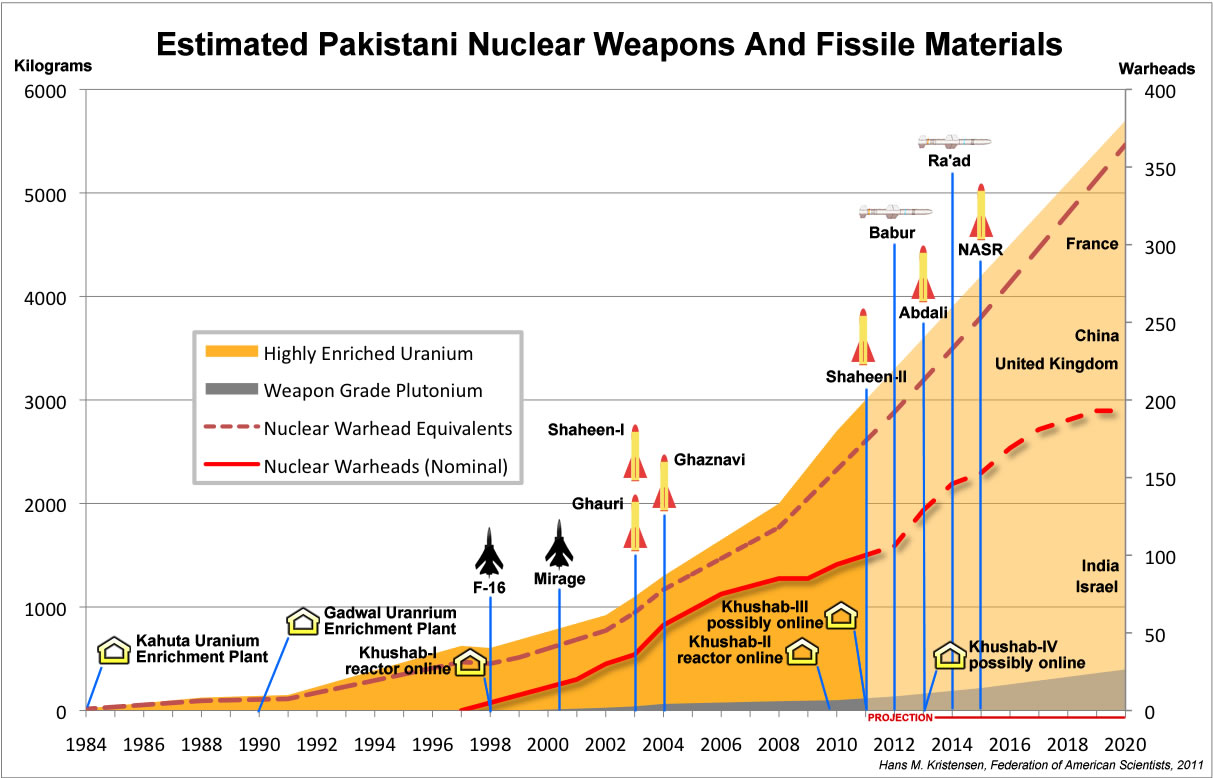
* Developed a nuclear weapon. Check. Something Iran has yet to do.

* Proliferated nuclear technology. Check. Again, Iran has a lot of catching up to do here.

* Trafficked nuclear know-how to terrorist groups. Check. For all the hysteria about Iran's potential to pass nuclear know-how to terrorists groups, Pakistani nuclear scientists have met with bin Laden, who is clearly more of a threat to the U.S. than Hezbollah or Hamas.

True, Pakistan is not run by "mullahs" but it has been a bona fide military dictatorship shot through with Islamist sympathizers, when not under the weak and often corrupt rule of civilians. Unlike Iran, Pakistan has repeatedly engaged in open, conventional war with its neighbor. Iran fought one major war - which it did not start.

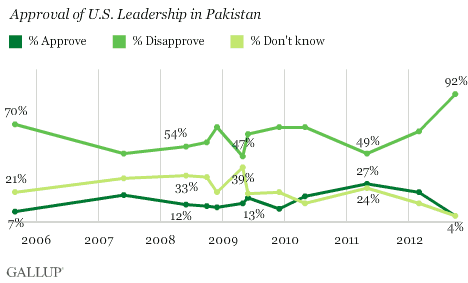
Iran's leaders may be openly hostile to the U.S., whereas Pakistan's are more than happy to pocket taxpayer dollars in return for uneven cooperation. But if opinion polls are to be trusted, Pakistanis have deeply unfavorable views of the U.S. Perhaps this explains why Pakistanis - not Iranians - are frequently implicated in anti-American terror plots.

If you had to wager which terrorist group was going to get its hand on a nuclear weapon (and from which country they'd procure it), I'd say the safe money, by far, would be a Sunni jihadist group based in Pakistan and not a Shiite terror group in Iran.

And yet, each day brings thunderous cries to bomb Iran or scathing blasts against the Obama administration for fecklessness regarding Iran's nuclear program. And very, very little about Pakistan. Why?

I can think of three reasons. One, Iran occupies a strategic location that Pakistan does not, so you could make the case that proximity to oil trumps a propensity to kill American civilians. Second, you could argue that because Iran-the-state is overtly hostile to the U.S. in a way that the Pakistani state is not that it merits an extra dose of hawkishness. Third, it requires less intellectual rigor and delivers greater partisan advantage to be an Iran hawk. It's easy to get to the administration's right on Iran and condense your option down to a sound-bite: "bomb Iran." Pakistan is infinitely more complex - both in terms of the policy and the politics. It's hard to get to the administration's right on Pakistan when they've stepped up drone attacks at a quicker pace than their predecessor. So it's better to just ignore it. (And I don't think even the most enthusiastic hawks would call for a wide ranging bombing campaign against Pakistan.)

During the 1990s, neoconservatives spent an awful lot of energy agitating for the overthrow of Saddam Hussein all while the real threat to the American homeland - al Qaeda - passed completely under their (and everyone's) radar. Now, all the intellectual energy is being devoted to Iran, when far more Americans are likely to be killed as a result of events in Pakistan. Of course, given the track record, I guess we should take comfort that they're not offering up suggestions for Pakistan. But still, this disparity is something to ponder.

April 26, 2010

Afghanistan: Searching for Political Agreement

Washington, DC readers should be sure to check out an event this Wednesday at the Carnegie Endowment for International Peace on political reconciliation in Afghanistan. Gilles Dorronsoro, a visiting scholar at the Endowment who just returned from the country, will be discussing his trip and the likelihood of a unity government in Kabul.

Interested readers may register to attend Wednesday's event here.

April 22, 2010

Poll: Americans Less Anxious About Foreign Policy

A new poll conducted by Public Agenda has found the American public less anxious about foreign policy than it's been in four years:

The Foreign Policy Anxiety Indicator stands at 122, a 10-point drop since 2008 and the lowest level since Public Agenda introduced this measure in 2006. The Confidence in Foreign Policy Index, produced by Public Agenda in collaboration with Foreign Affairs, uses a set of tracking questions to measure Americans' comfort level with the nation's foreign policy, much the same way the Consumer Confidence Index measures the public's satisfaction with the economy.

The Anxiety Indicator is measured on a 200-point scale, with 100 serving as a neutral midpoint, neither anxious nor confident. A score of 50 or below would indicate a period of complacency. Above the "redline" of 150 would be anxiety shading into real fear and a withdrawal of public confidence in U.S. policy.

Digging into the numbers, the survey found a partisan divide with Republicans evincing more anxiety about our foreign policy than either Democrats or Independents. Despite the overall mood of relative calm, Public Agenda found that most Americans still see the world as a dangerous place. "The number who say the world is becoming 'more dangerous for the United States and the American people' is virtually the same was it was two years ago: 72 percent, compared with 73 percent in 2008," the survey noted.

Despite America's improved image internationally, 50 percent of those surveyed by Public Agenda said U.S. relations with the rest of the world were on the "wrong track." Only 39 percent said they were on the right track.

Americans were also polled on Afghanistan. Forty eight percent said that our safety from terrorism did not depend on our success there vs. 40 percent who believed it did.

April 21, 2010

Poll: American Support for Afghan War

usmilitaryconvy.jpg

Angus Reid has a new poll out measuring American sentiment toward the war in Afghanistan:

This month, 51 per cent of respondents (down three points since February) say they support the military operation involving American soldiers in Afghanistan, while 39 per cent are opposed (up one point).

Two-in-five Americans (43%) believe the country did the right thing in sending military forces to Afghanistan, while three-in-ten (31%) think it made a mistake.

Overall, 52 per cent of respondents say they have a clear idea of what the war in Afghanistan is about.

When The War is Over

When asked about what they think will be the most likely outcome of the war in Afghanistan, the findings show little fluctuation since February. One-in-four Americans (25%,) expect a clear victory by U.S. and allied forces over the Taliban, and 26 per cent foresee a negotiated settlement from a position of U.S. and allied strength that gives the Taliban a small role in the Afghan government.

Significantly fewer respondents foresee either a negotiated settlement from a position of U.S. and allied weakness that gives the Taliban a significant role in the Afghan government (9%) or a military defeat of U.S. and allied forces by the Taliban (4%).

As for whether people have confidence in the administration, Angus Reid found greater skepticism:

Only 33 per cent of respondents (-2) are very or moderately confident that the Obama Administration will be able “finish the job” in Afghanistan, while a majority (53%, +1) are not too confident or not confident at all.

April 12, 2010

Could the Karzai-Obama Spat Pay Dividends?

karzai%20iran.jpg

To add to Kevin's post on the Karzai-Obama spat, it seems to me that there's a third interpretation of the recent feud that falls somewhere between "President Obama's being naive and irresponsible" and "President Karzai's an out of control drug addict." That is that the spat is good for all parties. It's good for the U.S., because it sends a warning to Afghan officials that American aid is not a given and that there must be some movement toward meeting Washington's expectations with respect to corruption and governance. I largely sympathize with the idea that these messages should mostly be conveyed behind closed doors, but there's another important constituency that needs to hear Obama's message: the American taxpayer.

It seems perverse for the U.S. to take the position that Afghanistan has an open-ended claim on American blood and treasure irrespective of how its leaders behave (it's perverse stance in good times, too). A public scolding at a minimum assures Americans that the president is mindful that resources are limited and not to be doled out lightly.

It's good for Karzai, too, because it establishes his nationalist bona fides and demonstrates to the Afghan people that he's not a Western stooge - a position that, perhaps more than corruption, would undermine his legitimacy in the eyes of the Afghan people.

This is obviously an optimistic reading of events and it could very well turn out that either Obama is being reckless in publicly spanking Karzai or that Karzai is out of control - or that both men are just groping their way blindly toward an unseen end-game.

(AP Photo)

Karzai, Blind Squirrels and Blithering Idiots

rsz_karzai041210.jpg

Responding to Sarah Palin's defense of Afghan President Hamid Karzai, Andrew Exum writes:

Oh, and by the way, if you think using leverage to affect the political choices made by the Afghan leadership is not a good thing right now, then you are a) Liz Cheney, b) Sarah Palin, c) a blithering idiot or d) some combination of the previous options.

Well, then I suppose I'll take "c) blithering idiot" for $1,000, Andrew.

However, keeping my blithering idiocy in mind, I wonder if Exum could perhaps clarify what he means by "using leverage." I don't think anyone - not even Governor Palin, for that matter - is arguing that Karzai should be exempt from any and all forms of diplomatic pressure. What she and other critics of the Obama administration's handling of Karzai seem to be taking exception to is the very public belittling of the man.

Larison suggests that Karzai's latter-day defenders are simply adding this to a continuum of mostly hollow attacks on Obama's foreign policy. I'm sympathetic to this argument, and he's probably right, but so what? Obviously, the president is going to make policy mistakes, and if your fallback position is to simply attack everything that he does, eventually, you're going to get one right! Blind squirrel ---> nut.

But if the United States is truly invested in securing and nurturing Afghanistan's fragile young democracy, what then is the point in publicly humiliating the democratically elected-ish leader of said investment? There's nothing wrong with pressuring Karzai behind closed doors; publicly equivocating when asked if Karzai is even a U.S. ally is another matter entirely.

If he is an ally, well then the answer should be simple. If he isn't, then what the hell are we doing in Afghanistan? As a critic of the Afghan surge, Karzai's legitimacy never really mattered as much to me as did eradicating al-Qaeda's presence in the region - and we're doing that. Exum, on the other hand, supports a prolonged military presence in Afghanistan, and yet, for some reason, also supports publicly undermining the democratically elected-ish leader of the country.

American legitimacy in Afghanistan is pegged to the legitimacy of Karzai and the Afghan government. Should it come as a surprise then when Karzai chooses to do photo ops with Ahmadinejad and, even more absurdly, threatens to join the Taliban after Washington publicly exposes him to be a contrivance or puppet of the West? Such marching orders place him in a rather untenable spot, no?

I don't know the answers to all of these questions, but I'm just a blithering idiot . . . or perhaps Liz Cheney. Is it too late to change my answer?

(AP Photo)

April 8, 2010

Karzai and the Afghan Muddle

karzaicorrupt.jpg

Wayne White offers his thoughts on Hamid Karzai:

What transpires in Kabul all too often is over-emphasized, with foreign actors frequently consumed by developments there that will have less bearing than one may think on what is happening throughout the countryside, where much that happens in Kabul is commonly little known or understood. More importantly, Karzai himself is falling into a related pattern of believing that the more he can control events affecting the ruling elite, the more he can guarantee ultimate triumph for himself in the overall equation. In fact, in doing so, he probably has damaged further his own ultimate prospects as well as those of the mission. This also was characteristic of Diem and Thieu.

Unfortunately, I doubt there are ways of redefining the mission or shifting our concentration of effort that can reduce significantly the negative impact of corrosive political behavior on the part of Karzai, his many cronies, as well as other Afghan politicians raised in a similar milieu. Our inevitable association with him one way or another--and his dominance over the Kabul political scene--will continue to cast a shadow upon the overall US, Allied and Afghan government effort to create a situation in which a withdrawal is possible that would leave behind a stable, positive political order--perhaps regardless of the withdrawal timelines chosen.

I think the constant harping on Karzai underscores the problematic nature of conflating a narrow mission of beating back al Qaeda - which has largely been driven out of the country anyway - with creating a stable Afghanistan. The administration insists you can't have one without the other, but at what point does stability in Afghanistan cease to be worth the price?

And that's why I think we ultimately will have to either "redefine the mission" or declare mission accomplished in 2011, irrespective of the political stability in Kabul. At the end of the day, do we really want Afghanistan to have an open claim on American resources?

(In that vein, Michael Cohen argues that it's all the fault of the mythology of the Iraq surge. Counter-insurgency has been seen to be a huge success there and so it's simply been exported to Afghanistan, when in fact it may be the wrong strategy for that country - and may not have been as decisive as we think in Iraq, either).

(AP Photo)

April 6, 2010

Karzai on a Bender?

Peter Galbraith (who is no disinterested observer) suggests rather casually that Afghan President Hamid Karzai is on drugs:

Visit msnbc.com for breaking news, world news, and news about the economy

Great!

April 3, 2010

Karzai & the Problem of Staying Forever

karzai%20iran.jpg

Charlie Rose had a fascinating interview with Michele Flournoy - the whole thing is worth watching in full but the talk about Pakistan was interesting. Rose noted the recent successes against the Taliban and the apparent turn in Pakistan towards cooperating more fully with the U.S. Flournoy chalked to it up to the U.S. successfully persuading Pakistan that the U.S. was in Af-Pak for the long haul.

This a theme her boss, Secretary Gates, has harped on frequently, citing his experience with Afghanistan in the 1980s. The thinking is simple enough: Pakistan will hedge its bets (i.e. support the Taliban) if it thinks the U.S. is going to bail on the region like it supposedly did after the Soviets withdrew from Afghanistan.

Flournoy noted that the administration had convinced Pakistan that even as the U.S. military role shifts and is ultimately reduced inside Afghanistan, it remains committed to the country for the long-term.

Which brings us to Mr. Hamid Karzai. On Thursday, Karzai unleashed a blistering tirade against the United States (he's later sought to clarify his remarks to his U.S. paymasters) but his little exegesis on U.S. imperialism is a good reminder that American commitments to stay "engaged" for the long haul are going to run up against Karzai and the local Afghan talent we're banking on to run the place.

None of this would be a problem if we were taking a very limited, cost-effective approach to keeping al Qaeda from reorganizing large-scale training camps in the country. But with tens of thousands of U.S. and NATO troops in the country committed to waging a "population-centric" counter-insurgency, we've set our sights a lot higher. That means Karzai and the quality of his governance is going to matter a lot more. And so far, it seems like that's going to be an increasingly serious problem for the administration's strategy.

(AP Photo)

March 31, 2010

Global Goods

At least someone's getting rich:

China has significant economic interests in Afghanistan, though its contribution to Afghan reconstruction has been well behind Western nations. The state-owned China Metallurgical Group intends to contribute US$3 billion towards the development of Afghanistan's Anyak copper mine, 30km South of Kabul.

If the mine contains the 11.3 million tonnes of copper expected by the Afghan Government, the site has the potential to deliver over US$80 billion to China based on current copper prices. The vast bulk of the military forces providing security in Logar province, where the Anyak mine is located, are American.

March 30, 2010

Palin for Pakistan?

Londonstani pokes fun at the governor.

March 29, 2010

Surge Wars: Obama vs. Bush

obmaafhgnawin.jpg

Stephen Walt hopes that Obama is going to follow Bush's Iraq surge script in Afghanistan:

First, announce an escalation of the U.S. effort (aka a "surge"), but set a rough deadline for it and quietly put new emphasis on "political reconciliation." (Done). Next, bombard the media with lots of evidence of progress, such as Taliban "strongholds" seized, al Qaeda leaders killed or captured, Taliban leaders arrested in Pakistan, etc., so that people think the surge is working. (Now underway). Third, arrange a diplomatic settlement that requires the phased withdrawal of U.S./ISAF troops, even if their departure is on a rather lengthy timetable. The Iraqi equivalent was the Status of Forces agreement negotiated by the Bush administration in the fall of 2008; in Afghanistan, it would probably entail some sort of negotiation between the Karzai government, the Taliban, and various other warlords (whether by a loya jirga) or some other device (Maybe underway too?). Finally, start removing the "surged" forces more-or-less on schedule-and ahead of the 2012 election cycle-so that you can claim to have avoided the quagmire that critics warned about back in 2009 (Remains to be seen).

I think this overlooks a critical component that distinguishes an Obama surge from Bush's Iraq surge. In the latter, there was an entire corps of pundits and former administration officials heavily invested in portraying the Iraq surge as a victory. Even before President Bush left office, they were proclaiming the early security gains of the Iraq surge as a historic victory. Since the gains have held, they've gone into overdrive.

In Afghanistan, there's no one to declare victory for Obama. Conservative supporters of the president's Afghan surge are on record opposing a 2011 draw-down. It's safe to assume that the country will remain violent and unstable enough in 2011 for them to renew and strengthen their opposition to any large-scale draw-down, especially since it will dovetail with the larger election-year critique of Obama as craven appeaser. And Obama doesn't have much, if any, support for an Afghan surge to his left. That leaves the administration to make the case that they've "won" in Afghanistan by their lonesome.

And 2012 works against Obama in another way. One reason I suspect that Iraq war supporters proclaimed victory with such reckless abandon was the calculation that any ensuing violence could be dumped in Obama's lap. The bigger the proclaimed victory, the harder the partisan hit Obama would take if Iraq's sectarian tensions once again erupted. At the next election cycle, the Obama administration has no one to "hand off" Afghanistan to but (it hopes) itself.

(AP Photo)

March 18, 2010

Iran Supplying the Taliban

talibanarms.jpg

U.S. officials occasionally claim that Iran is backing the Taliban (or elements within the Taliban) to bloody the U.S. in Afghanistan. Now it seems further proof is emerging:

Channel 4 News can reveal the Taliban insurgency against British and American forces is being supported by Iranian weapons smuggled over the border including mines, mortars and plastic explosives.

The exclusive images and documents show, for the first time, the full extent of Iranian support for the Taliban in the shape of tonnes of weapons of the type being used against UK troops in Helmand province.

That's via a somewhat skeptical Joshua Foust who observes:

So at least based on what they have posted online, it doesn’t seem like a slam-dunk case, to borrow a troubled phrase. It is a narrative that plays to American and British assumptions of Iranian perfidy, but despite the cache of weapons on display it doesn’t directly implicate the Iranian government in any of the smuggling—any more than the Taliban operating in Waziristan directly implicates the Pakistani government (that is to say: neither government is monolithic and certainly has factions that behave semi-autonomously). If, however, the Channel 4 documents actually involve official Iranian government in shipping arms to the Taliban as part of a deliberate strategy to “bog down” the U.S., then it would be the first time concrete evidence of their involvement has been shown. And if that actually happens, then we have a rather big deal on our hands.

I'm not sure how big a deal it because it doesn't appear to be anything new (at least from the perspective of U.S. commanders in the region, who have been suggesting as much for a while now). But I think it does raise an important question about the outlook of the Iranian regime (or the faction that's shipping arms to the Taliban). Specifically, Foust notes that supporting the Taliban cuts against a number of Iranian interests and undermines the substantial investment that Iran has made inside Afghanistan. If they are willing to undermine those interests to kill a few U.S. and NATO soldiers and preoccupy America, what does this tell us about their cost/benefit analysis?

Second, the revelation, if true, underscores the problematic nature of our position in Afghanistan. When the Soviet Union stationed large numbers of troops in the country, the U.S. had a very low cost way to inflict damage on them. By staying inside Afghanistan to wage a state-wide counter-insurgency, we are quite possibly affording Iran the same opportunity. If we can achieve our counter-terrorism objectives from a few remote airfields in Pakistan and some office buildings in Virginia, does it really serve our interests to be so directly exposed to this kind of proxy violence?

(AP Photo)

CIA: al Qaeda on the Ropes

%5Bpreadatordrone.jpg

CIA Director Leon Panetta gave an interview to the Washington Post claiming that the "secret war" of drone assaults in Pakistan is having a major impact on al Qaeda:

So profound is al-Qaeda's disarray that one of its lieutenants, in a recently intercepted message, pleaded with bin Laden to come to the group's rescue and provide some leadership, Panetta said. He credited improved coordination with Pakistan's government and what he called "the most aggressive operation that CIA has been involved in in our history," offering a near-acknowledgment of what is officially a secret war.

"Those operations are seriously disrupting al-Qaeda," Panetta said. "It's pretty clear from all the intelligence we are getting that they are having a very difficult time putting together any kind of command and control, that they are scrambling. And that we really do have them on the run."

Obviously the CIA has a vested interest in claiming success, but the headlines of late certainly seem to corroborate the program's effectiveness. Which again begs the question of why we're investing a considerable amount of blood and treasure trying to build a state from scratch in Afghanistan if our counter-terrorism objectives are being met more effectively over the border.

(AP Photo)

Pakistan, Afghan Views on Counter-Terrorism

Gallup reports that both Afghans and Pakistanis take a dim view of their governments' efforts to combat terrorism:

pakterrorviews.gif

Next door, the views are not much better:

afghanviewsofterrror.gif

March 16, 2010

Glassman and Pape at New America

There are two great events happening today at the New America Foundation, and we have 'em both live right here at RealClearWorld.

The first event, starting at 12:15 pm EST, will be a discussion with former Undersecretary of State James Glassman on "the role strategic communications can play in helping the United States in Iran."

The second event, set to kick off at 3:30 pm EST, will be a discussion with Professor Robert Pape on the rise of suicide terrorism in Afghanistan.

Steve Clemons will be moderating the day's events, and you can watch them both at either The Washington Note or right here on The Compass following the jump:

Continue reading "Glassman and Pape at New America" »

A Set Back for the Taliban, or Karzai?

afghanistanconference.jpg


The arrest of Taliban Number 2 Mullah Baradar was hailed in the U.S. as a major success in the war against the Taliban. But, according to this AP story, it looks like Hamid Karzai doesn't see it that way:

The detention of Mullah Abdul Ghani Baradar — second in the Taliban only to one-eyed Mullah Mohammed Omar — has raised new questions about whether the U.S. is willing to back peace discussions with leaders who harbored the terrorists behind the Sept. 11 attacks.

Karzai "was very angry" when he heard that the Pakistanis had picked up Baradar with an assist from U.S. intelligence, the adviser said. Besides the ongoing talks, he said Baradar had "given a green light" to participating in a three-day peace jirga that Karzai is hosting next month

.

This raises the question of whether Pakistan's increased willingness to move against the Afghan Taliban is really an effort to sandbag the Karzai government's reconciliation efforts. The report also notes that there's a divergence between the American and British position on reconciliation, with the British pushing it more aggressively.

One of the problems with nation building is that if you're disinclined to make the country a semi-permanent ward of the United States, local stakeholders are going to cut the deals they need to make to survive and those deals may work against American interests. So it really comes down to a question of whether it's better to stay in Afghanistan for a few more decades or accommodate ourselves to a less-than-ideal outcome with respect to integrating the Taliban back into the government (if they even can be, it's not a sure thing). So what's the return on investment if we stay in Afghanistan for thirty years?

(AP Photo)

March 12, 2010

Taliban Growing More Unpopular in Pakistan

A new Gallup poll offers some more glimmers of good news from Pakistan (despite today's horrific carnage):

talibanpakistan.gif

More intriguing:

The Taliban lost support in every region of Pakistan. But nowhere are they more unpopular than in the North West Frontier Province (NWFP), ground zero for a full-scale military offensive against the Taliban last May. In November-December 2009, 1% of NWFP residents said the Taliban have a positive influence, down from 11% in June. The percentage saying the Taliban's influence is positive in Baluchistan, which abuts South Waziristan, dropped from 26% to 5%.

March 11, 2010

Who's Bearing the Brunt of Afghan War Casualties?

Steve Coll crunches the numbers:

Using Afghan-war fatality figures from ICasualties.org and population estimates as of July, 2009 from the C.I.A. World Factbook, and rounding up numbers, I took out my calculator this morning and came up with the following ratios of deaths-per-population among coalition countries that have fought in the Afghan war, since 2001, starting with the most burdened:

Denmark, 1 per 177,000 (31 deaths)
Estonia, 1 per 186,000 (7 deaths)
United Kingdom, 1 per 224,000 (272 deaths)
Canada, 1 per 236,000 (140 deaths)
United States, 1 per 302,000 (1017 deaths)
Latvia, 1 per 733,000 (3 deaths)
Netherlands, 1 per 810,000 (21 deaths)

Worst.Year.Ever.

rsz_obamabiden031110.jpg

Danielle Pletka laments the end of American civilization as we know it:

Consider that the president’s own staff can’t gin up a single special relationship with a foreign leader and that the once “special relationship” with the United Kingdom is in tatters (note the latest contretemps over Secretary of State Hillary Clinton’s bizarre intervention on the Falkland Islands); that neither China nor Russia will back the United States’s push for sanctions against Iran; that Iran, it seems, doesn’t want to “sit down” with the Obama administration and chat; that the “peace process” the president was determined to revive is limping pathetically, in no small amount due to missteps by the United States; that one of the key new relationships of the 21st century (advanced by the hated George W. Bush)—with India—is a total mess; that the hope kindled in the Arab world after Obama’s famous Cairo speech has dimmed; that hostility to America’s AfPak special envoy Richard Holbrooke is the only point of agreement between Delhi, Islamabad, and Kabul; that there isn’t a foreign ministry in Europe with a good word to say about working with the Obama White House; that there is a narrative afoot that began with the Obama apologia tour last year and will not go away: America is in decline.

Too many of these problems can be sourced back to the arrogance of the president and his top advisers. Many of Obama’s foreign policy soldiers are serious, keen, and experienced, but even they are afraid to speak to foreigners, to meet with Congress, or to trespass on the policy making politburo in the White House’s West Wing. Our allies are afraid of American retreat and our enemies are encouraged by that fear. George Bush was excoriated for suggesting that the nations of the world are either with us or against us. But there is something worse than that Manichean simplicity. Barack Obama doesn’t care whether they’re with us or against us.

And that's in just one year! Imagine how much he'll have ruined by 2012!

Needless to say, I find all of this to be a bit exaggerated, and even a bit disingenuous. Keep in mind that many once thought it cute or tough to alienate and insult allies; designating them as 'old' and 'new' Europe, for instance. When the Bush administration ruffled feathers it was decisive leadership; when Obama does it it's the collapse of Western society as we know it. Pick your hyperbole, I suppose.

After eight years in office, did President Bush actually leave us with a clear policy on ever-emerging China? How about the so-called road map for peace? How'd that work out? Did President Bush manage to halt Iranian nuclear enrichment, or did he simply leave Iran in a stronger geopolitical position vis-à-vis Iraq and Afghanistan?

Pletka attributes many of these perceived failings to "arrogance." But it has been well documented that the previous administration was also stubborn, resistant to consultation and set in its ways. How then, if Ms. Pletka is indeed correct, has this changed with administrations?

Pletka scoffs at the president's insistence that policy is "really hard," but he's right - as was George W. Bush when he said it. Perhaps, just perhaps, the problem isn't what our presidents have failed to do, but what we expect them to do in an increasingly multipolar, or even nonpolar world?

(AP Photo)

March 1, 2010

A Victory over the Pakistani Taliban?

pakistanfightstaliban.jpg

The Times says that Pakistan has put the hurt on its home-grown Taliban menace in the tribal area:

Significant leaders of the Pakistani Taleban have been killed or captured in an onslaught of frontier ground and air attacks, a Pakistani general has told The Times.

“The militant command and control centres and their caches have been dismantled or captured,” said Major-General Tariq Khan, one of the country’s most experienced commanders in the frontier war with the Taleban. “The kind of hits the leadership has taken, the casualties they have taken, the TTP [Pakistani Taleban] is no longer significant,” he said. “It has ended as a cohesive force. It doesn’t exist any more as an umbrella organisation that can influence militancy anywhere.”

Given that the Pakistani Taliban are a huge menace to Pakistani society, it wouldn't make much sense for Khan to engage in empty boasting (whereas such claims made about the Afghan Taliban would have to be taken with huge grains of salt). But still, it seems a bit premature. Insurgent groups can remobilize under the radar, and how much infrastructure do the Pakistani Taliban need to carry off terrorist attacks in Pakistan's cities? Still, certainly encouraging news.

But what of al Qaeda, which is thought to be hiding in the tribal zone?

General Khan said: “There was some Arab influence in terms of resources and money. We haven’t found a dedicated al-Qaeda command-and- control centre. My commandant in Bajaur . . . says it’s like a pinch of flour in a bag of salt — you get the flavour but can’t catch the individuals.”

(AP Photo)

Can Great Powers Fix Afghanistan?

afghangreatpower.jpg

The Lowy Institute's Michael Wesley thinks they can:

But Central Asia's southern tier has benefited from no such clear thinking. Beijing's support for Pakistan has kept India strategically bottled up under the Himalayas for decades, while Indo-Pakistani hostility has led Islamabad to seek strategic depth in Afghanistan. India's response has been to try to deny that strategic depth, and China has every reason to try to block the recent countermove by New Delhi into Afghanistan. This is a complex and dangerous dynamic made chronically unstable by its cyclical structure.

To avoid the worst possible outcome, all three rivals must be engaged in the process of building a stable Afghanistan – and collectively guaranteeing it. The most realistic route is to actively involve the Shanghai Cooperation Organisation in the future of Afghanistan while broadening that organisation to include India and Pakistan. This solution ties the stability of the northern and southern tiers of Central Asia to each other, thereby broadening the stakes of those involved. The one hope and one fear that bind China and Russia together are also remarkably relevant to the SCO's proposed new members.

The attractive feature of this solution is that it puts the regional powers (i.e. the major stakeholders), and not the U.S., in the driver's seat. It's unrealistic to expect a permanent U.S. presence in Afghanistan or a permanent American subsidy for Pakistan (although Egypt has been enjoying theirs for quite a while). The notion that America doesn't have an "attention span" is an obnoxious way of saying that the treasury is not an infinite well upon which other nations have an open-ended claim.

A regional solution that ties the major powers into some kind of institutional framework for stabilizing Afghanistan seems like a good alternative, especially since none of the stakeholders save Pakistan have much interest in seeing a Taliban restoration. (Of course, whether such a gambit is workable is another matter.)

(AP Photo)

Not Your Father's Taliban

Meet the new Taliban: more virgins, less killing.

February 23, 2010

The Reason for Foreign Policy Minimalism

biden%20iraq.jpg

It's an oft-recounted story but one that appears to need frequent retelling. In the immediate aftermath of the worst terrorist massacre in this country's history, U.S. forces swept into Afghanistan and quickly pushed the Taliban and al Qaeda into neighboring Pakistan. Having failed to kill the leader of either the Taliban or al Qaeda, and unsure about the relative strength of the group following initial combat, the Bush administration nonetheless shifted its focus, intelligence assets and diplomatic attention to launching a war against Saddam Hussein.

Throughout the years of that conflict, the Bush administration spent most of its energy and attention trying to fix the mess it had made in Baghdad, all the while the Taliban crept back into Afghanistan, ramping up its insurgency. It's not that the Bush administration wanted an insurgency in Afghanistan to rear its head - but it had a much more pressing problem (entirely of its own making) in Iraq.

Now the Obama administration faces the opposite problem. Iraq is relatively stable, Afghanistan is a mess. So naturally, the administration is focusing on Afghanistan. But it's not like things in Iraq are on a sure-fire path to success and we're hearing an increasing number of warnings that the Obama administration is "ignoring" Iraq. Some of this is just partisan positioning - so that if Iraq falls apart, the surge advocates who spent so much time trumpeting victory have an easy scapegoat when the wheels come off. But some of it, like Peter Feaver's post here, seems born of a genuine desire not to see a hard fought stability vanish in Iraq.

And it is a legitimate and important question: what should America's relationship be with Iraq? But implicit in many of the voices raising this question is the assumption that America must take an active role in shaping Iraq's political evolution.

Unfortunately, the government has only so many hands on deck and not many of them possess the unique skills and ability to micro-manage the political evolution of Iraq to our liking. If such a capacity was available in the United States, one wonders why it was not pressed into service in the years circa 2003 - 2008. But more importantly, this underscores a very important and what I took to be conservative maxim that the government should not endeavor to do too much.

(AP Photo)

Conflicted U.S. Views on Afghanistan

afghantaliban.jpg

It has been a good few weeks in Afghanistan and Pakistan, with the arrests of major Taliban figures and the start of the Obama administration's troop surge. Angus Reid finds more Americans are optimistic about the mission:

More adults in the United States are now in favour of the ongoing military operation in Afghanistan, according to a poll by Angus Reid Public Opinion. 54 per cent of respondents support the mission involving American soldiers, up five points since December.

In addition, 52 per cent of respondents think the federal government has provided too little information about the war in Afghanistan.

Rassmussen has picked up a different vibe:


A new Rasmussen Reports national telephone survey finds that 47% of voters now believe it is possible for the United States to win the war in Afghanistan. That’s down from a high of 51% in early December following President Obama’s announcement of his new strategy for the war. Just prior to that speech, however, only 39% thought a U.S. victory was possible.

Thirty percent (30%) now say a victory is not possible and 23% are not sure.

Personally, I'm in the slightly more optimistic camp now that it appears that Pakistan is finally taking the fight to the Afghan Taliban. If Pakistan is genuinely cooperating in squelching the Afghan Taliban threat (instead of nurturing it), it means the U.S. could actually leave Afghanistan sooner rather than later.

(AP Photo)

February 22, 2010

Targets and Tactics

rsz_predator022210.jpg

Max Boot writes:

Funny how no one seriously objects when U.S. Predators carry out similar hits on al-Qaeda operatives but the whole world is in uproar when the Israelis target members of Hamas — an organization that is morally indistinguishable from al-Qaeda. The Dubai uproar only highlights once again the double standard to which Israel is constantly subjected. But Israel cannot and should not use that double standard as an excuse to avoid taking vital action in its self-defense. The leaders of terrorist organizations are legitimate military targets, and Israel should spare itself the agonizing and hand-wringing over this targeted killing.

Daniel Larison pounces:

As atrocious and appalling as their past and present conduct is, Hamas still retains in much of the non-American West some minimal legitimacy as a major faction in Palestinian politics. Hamas and Al Qaeda may be morally indistinguishable, but politically they have very different standings in the eyes of many other states. Israel’s major regional ally Turkey has a ruling party that is somewhat sympathetic to Hamas, while it is resolutely hostile to Al Qaeda and its affiliates. These are rather obvious political distinctions that Boot ought to understand, and the Israeli government must also understand these things. It is pointless to pretend that these distinctions don’t exist and to complain that the different reactions to drone strikes and the Dubai assassination prove a double standard. Whether or not there should be a double standard, Israel’s government has to take for granted that there is one. If Israel’s patron and the global superpower can get away with something, however misguided it may be, it does not always follow that it can act with the same impunity.

Well put, but let me take it a step further and dismiss the notion that any double standard exists at all in this case. It's a convenient rhetorical crutch I suppose to scream hypocrisy every time a critique is made of Israeli behavior, but this time around it just doesn't pass muster.

Since he doesn't say, I'm left to assume Mr. Boot means predator strikes in Pakistan, and not Afghanistan. These strikes are the product of U.S.-Pakistani coordination spanning two administrations and two regimes in both Washington and Islamabad, respectively. The predators are likely based inside Pakistan, and the strikes are carried out with approval - albeit quiet and reluctant - from Islamabad.

Larison disapproves of the drone strikes, and I certainly won't deny him that right. Personally, I consider them the least bad alternative to a bad policy of prolonged regional occupation. If we're going to maintain a military presence in the region, then we should be targeting specific al-Qaeda-Taliban operatives and taking them out with limited civilian casualties. The drones accomplish this, which is why Pakistani concerns have been less about the civilian casualties involved and more about who gets to pull the trigger.

And there certainly has been debate in the West over these attacks, both public and private ones within the administration itself. Moreover, I cannot think of one pro-drone argument in the last two years that didn't involve a kind of resigned acceptance of the program's relative effectiveness. Who are these predator pom-pom wavers Boot alludes to? Name names, please.

One could go on at length about the differences between drones and Dubai, but let me try to sum it up in one word: sovereignty. What actually makes the drones controversial is the political backlash they create for our allies in Pakistan. Our presence in the country is a shadowy one, and the cost/benefit balance is rather sensitive. Washington views Pakistan as an important ally in an important war, and thus can't do too much to create domestic tensions for said ally. But these are considerations made in conjunction with that government, just as the strikes are ultimately approved and enabled by that government. Just imagine how much harder it would be if Western operatives went into Pakistan, unapproved, and carried out such strikes. The backlash would be both tremendous and justified. Now imagine how the UAE must feel.

The targets in each case may be "morally indistinguishable," but the tactics are not, and that's why Israel - if responsible - is in the wrong here.

(AP Photo)

February 17, 2010

What the Mullah Baradar Arrest Means

Cato's Malou Innocent writes that while important, the arrest of Taliban second in command Mullah Baradar will only bear fruit if the U.S. can ease tensions between Pakistan and India. Steve Coll suggests that the Obama administration just might be having success there:

I would guess at a more subtle motivation, one that might suggest a favorable pattern now emerging in the Obama Administration’s and Central Command’s approach to Pakistan’s role in the Afghan conflict. Over the last few months, by multiple means, the United States and its allies have been seeking to persuade Pakistan that it can best achieve its legitimate security goals in Afghanistan through political negotiations, rather than through the promotion of endless (and futile) Taliban guerrilla violence—and that the United States will respect and accommodate Pakistan’s agenda in such talks. Pakistan’s support for the Afghan Taliban, especially in recent years, was always best understood as a military lever to promote political accommodations of Pakistan in Kabul. Baradar, however, has defiantly refused to participate in such political strategies, as he indicated in an e-mail interview he gave to Newsweek last year. The more the Taliban’s leaders enjoying sanctuary in Karachi or Quetta refuse to lash themselves to Pakistani political strategy, the more vulnerable they become to a knock on the door in the middle of the night.

I admit I was skeptical that the Obama administration's efforts to ease Pakistan and India tensions would work (at least if the U.S. tried to press hard on the Kashmir issue). And while it's still too soon to tell if it has, I'm hoping to be proved wrong.

UPDATE:
Dan Twining raises some less optimistic interpretations:

What if Washington has cut a quiet deal with Pakistan's military high command, granting them a disproportionate role in determining Afghanistan's future in return for help facilitating the withdrawal of Western forces? In return for Pakistani cooperation over the next 18 months -- including Pakistani military offensives against violent extremists in its tribal regions, joint intelligence operations like the one that netted Mullah Baradar, delivering elements of the Afghan Taliban for serious talks on reconciliation with the Afghan government, and continued Western use of Pakistani territory to supply Western forces fighting in Afghanistan -- one could imagine a private U.S. understanding with Pakistani armed forces commander General Kayani that, once Western forces withdraw from Afghanistan, Pakistan can enjoy a free hand to resume its special relationship with the country's post-Karzai leadership in its continued quest for strategic depth against India.

February 12, 2010

Charlie Wilson's Legacy

charliewilson.jpg

Charlie Wilson, the Texas Congressman who spurred the U.S. to step up aid to Afghan Mujahadeen during the Soviet invasion, has passed away. Many people are hailing his life and his supposed prescience that the U.S. should have stayed committed to Afghanistan after the Soviet defeat.

Joshua Foust wrestles with his legacy and wonders whether the U.S. would have been better off not getting involved in Afghanistan in the first place. It's an interesting argument. Clearly a lot hinges on the question of how decisive Afghanistan was to the fall of the Soviet Union. Very decisive, and I think the case for U.S. aid is strong. Not very decisive, and the case collapses. I'm not sure how big a role it played. So to you, wise readers, was Afghanistan instrumental in destroying the Evil Empire?

(AP Photo)

February 10, 2010

Hanson vs. Bacevich

A few weeks ago Andrew Bacevich wrote a piece for the American Conservative arguing that the U.S. hasn't had a stellar track record when it comes to winning wars since 1945. Today in the National Review, Victor Davis Hanson argues that, to the contrary, the U.S. has succeeded in winning the same wars Bacevich dubbed defeats and is in fact winning the war on terrorism. You can read both and decide which is the more persuasive take, but I part company with Hanson as he edges toward drawing parallels with contemporary experience:

In other words, while particular wars in any age may not end in victory or defeat for either side, the concept of such finality is very much possible for either, given their shared human nature. In short, if a war is stalemated, it is usually because both sides, wisely or stupidly, come to believe victory is not worth the commensurate costs in blood and treasure — not because victory itself is an anachronism.

Hanson believes our goals are sufficiently modest that we can win in Iraq and Afghanistan:

In the latter two instances, we are fighting second wars in which victory is defined as ensuring the survival of successive consensual systems under the countries’ elected governments.

So far, we are winning both. Victory is definable: when these states are able to stay autonomous largely through their own efforts — with the understanding that Europe, for 65 years, and South Korea, for 60, have both required American military support to ensure their independence.


There are a few things wrong with this assertion. The first is that the goal of sustaining consensual governments is ancillary to the core purpose of both wars: which is to safeguard the U.S. from acts of Islamic terrorism. If we "won" by Hanson's definition in either country, but suffered further assaults from terrorists based elsewhere or saw no significant diminution of the terrorist threat worldwide, it would be difficult to justify the enormous expenditures in either theater. (Hanson later says as much.)

But notice what else is wrong here. In both the cases of South Korea and Europe, the U.S. role was to provide defense against external enemies, not internal ones. In both Afghanistan and Iraq, the U.S. is laboring to defend countries from mostly indigenous insurgencies, not external, nation state enemies. That transforms the role the U.S. is expected to play in both countries significantly. Given this difference, the lessons from past conventional wars don't offer much guidance. And you can see how it leads one astray:

That there was no visible German opposition to Hitler in 1939 and no visible support for him in April 1945 was due both to overwhelming Allied power and to the knowledge that a magnanimous reconstruction was possible. That we will be unmerciful to radical Islam and quite benevolent to those who reject it — that is the proper message.

The U.S. and its allies killed an estimated 6-to-8 million Germans (of which perhaps as many as 2 million were civilians) and completely, purposefully devastated entire cities in a campaign of total war to break the will of the German state. I would love to know why Hanson thinks this is a proper prescription for "radical Islam" which consists of scattered cells of terrorists throughout the globe, in possession of no country to speak of (except Iran, only we're not at war with Iran and not even those commentators who think we are at war with Iran wouldn't - I hope - advocate the wholesale slaughter of Iranian civilians to collapse the regime). We can indeed be "unmerciful" toward these terror cells, killing them wherever we find them, but that is only one element in a successful strategy.

Consider what has just occurred in Pakistan over the past few months. In August, the U.S. killed the leader of the Pakistani Taliban, Baitullah Mehsud. A few weeks ago, we killed his successor. Now the AP reports that there's a mad scramble among the Pakastani Taliban as people vie to take his place.

I don't know about you, but if my previous bosses kept getting whacked, angling for the job wouldn't be a top priority, and yet there is no apparently no shortage of people who want the job. (Ditto Hamas, which, while not as visible after Israeli assassinations still manages to fill its leadership ranks.) I think it's necessary to kill these people, but it's not sufficient, as insurgencies are fueled by a number of factors and overwhelming military force isn't enough to bring them to heel. And it would be positively insane and counter-productive to embrace a "total war" ethos with respect to an insurgency (especially a global one).

UPDATE: To see what metrics would be appropriate in judging a counter-insurgency see Tom Ricks and David Kilcullen.

February 8, 2010

Video of the Day

It looks like Sherman was right:

It is apparent to me that Al Jazeera is attempting to paint the U.S. in a negative light with this video. While U.S. soldiers are in vehicles, who do you suppose delivered (and secured) those supplies? Nevertheless, this video highlights the Catch-22 that many Afghans feel they are in now.

For more videos on issues around the world, check out the Real Clear World Video page.

February 3, 2010

Afghan Views of the U.S.

With the U.S. and the UK poised to launch a major offensive against the Taliban, Gallup's Julie Ray and Rajesh Srinivasan have released some polling on Afghan's attitude toward the U.S. over 2009:

afghanskepticalus.gif

The authors conclude:


In the most recent survey, Afghans' opinions of the United States, as a nation, were the lowest Gallup has measured to date. Asked to rate the extent of their favorability on a 5-point scale, where 1 is very unfavorable and 5 is very favorable, a majority of Afghans (52%) rated the United States very (24%) or somewhat unfavorable (28%).

Keep in mind that these polls were taken at what we can only hope was the height of the Taliban insurgency. If coalition forces are able to suppress the insurgency, I would expect Afghan views of the U.S. to improve.

January 29, 2010

Video of the Day

The plan to 'reintegrate' the Taliban with money may seem like a new idea, but some are skeptical of its potential effectiveness:

The logic behind aid for current Taliban fighters is roughly the same as that behind foreign aid: we give you money to meet your needs, and you do not support our enemies. Underlying this is the assumption that these groups are actually somewhat autonomous and independent. If it works, 300 million is actually a fairly cheap price to make Afghanistan calmer.

For more videos, be sure to check the RCW video page.

Was Colin Powell Right About the Taliban?

mcchrystal.jpg

In Oct. 2001, Colin Powell floated the idea of negotiating with "moderate" elements in the Taliban to form a new Afghan government when Mullah Omar was run out of Kabul.

Conservatives hated the idea at the time. Far better to stay in Afghanistan for a decade and try to rebuild the country along Western-approved lines while transforming its people. And who knows, maybe that idea was completely untenable and wouldn't have facilitated a smoother American exit from Afghanistan than the nation building approach embraced by the Bush administration.

But now it turns out that an effort is underway to bring the Taliban on board, with the endorsement of both Secretary Gates and General McChrystal. The difference now, of course, is that we're in a dramatically weaker position now than we were in 2001. And the Taliban? Much stronger.

(AP Photo)

Tony Blair's 9/11 Defense

TonyBalir.jpg


Appearing before the Chilcot Inquiry, former British Prime Minister Tony Blair defended his decision to join the U.S. invasion of Iraq:


Looking greyer than when he was in office, Blair told the inquiry that the British and American view changed "dramatically" after 9/11.

"Here's what changed for me: the whole calculus of risk," he said. "The point about this terrorist act was over 3,000 people had been killed, an absolutely horrific event. But if these people, inspired by this religious fanaticism, could have killed 30,000, they would have [done].

Blair went on to argue that Saddam's WMD program was an intolerable risk after 9/11. This is a fairly common line of argument regarding Iraq but it doesn't hold up logically. What 9/11 demonstrated was precisely the opposite - that no state would dare run the risk of attacking the United States directly, or providing aid to a terrorist group with the purpose of striking such a blow. The only government al Qaeda could count on for any official support was the Taliban and to call them a government is a fairly charitable description.

Al Qaeda proved to be such a lethal menace precisely because it had no state sponsor and no territorial vulnerability. The idea that 9/11 proved that deterrence was futile is erroneous, if anything, 9/11 confirmed that deterrence is still a viable concept, at least when dealing with states.

But there is also an element of the absurd in pointing to Iraq as a potential source of WMD for al Qaeda. Shortly after 9/11, we learned that Pakistani nuclear scientists had met with bin Laden. We learned further that Pakistan's chief nuclear engineer had created an extensive black market peddling nuclear material and blueprints for constructing nuclear weapons. We knew for a fact that Pakistan was a nuclear weapons state, while no one seriously believed that Saddam had a nascent, let alone functional, nuclear program.

If there was any state where one could make a plausible claim about the potential for WMD to be slipped to al Qaeda, it would have been Pakistan, not Iraq.

(AP Photo)

January 28, 2010

Afghan Strategy in Focus

afghanistanconference.jpg

With world leaders meeting in London today to hash out a unified approach to Afghanistan, the Daily Telegraph's Con Coughlin thinks the strategy is doable:

Given that most of the support for the Taliban comes from Pashtun tribesmen, who previously dominated the country’s political institutions, the challenge it to persuade the more moderate Pashtun leaders to switch their support from the Taliban to the democratic process. One of the objectives of today’s conference is to raise the funds to pay “compensation” to those Taliban elders who can be persuaded to renounce the fight.
Dexter Filkins reports today that we have won over a major Pashtun tribe:
The leaders of one of the largest Pashtun tribes in a Taliban stronghold said Wednesday that they had agreed to support the American-backed government, battle insurgents and burn down the home of any Afghan who harbored Taliban guerrillas.

All it cost was $1 million in "development aid" routed directly to the tribe instead of the Afghan government.

(AP Photo)


January 27, 2010

Off Shore vs. Counter-Insurgency

Afghanistan.jpg


The Washington Post reports:


U.S. military teams and intelligence agencies are deeply involved in secret joint operations with Yemeni troops who in the past six weeks have killed scores of people, among them six of 15 top leaders of a regional al-Qaeda affiliate, according to senior administration officials.

The operations, approved by President Obama and begun six weeks ago, involve several dozen troops from the U.S. military's clandestine Joint Special Operations Command (JSOC), whose main mission is tracking and killing suspected terrorists. The American advisers do not take part in raids in Yemen, but help plan missions, develop tactics and provide weapons and munitions. Highly sensitive intelligence is being shared with the Yemeni forces, including electronic and video surveillance, as well as three-dimensional terrain maps and detailed analysis of the al-Qaeda network.

This is, in rough outline, what George Will, Robert Pape and others had advocated for Afghanistan as an alternative to nation building. I guess we're going to get a real life experiment in which is the most effective.

(AP Photo)

January 26, 2010

The Eikenberry Cables

eikenberry.jpg

The New York Times has gotten its hands on the cables that U.S. Amb. to Afghanistan Karl Eikenberry sent to the Obama administration warning them off a full scale counter-insurgency. You can read the cables here. He cites the weakness of President Karzai and the lack of an Afghan ruling class with a coherent national identity as reasons for skepticism, among others.

Will these things change dramatically between now and 2011?

(AP Photo)

January 23, 2010

Are We Pushing Pakistan Too Hard?

gatesinpakistan.jpg

On Dec. 30, an al Qaeda terrorist walked into a CIA base in the Afghan city of Khost and blew himself up, killing 7 CIA agents and a member of Jordan's intelligence service. Shortly thereafter, the perpetraitor of the attack was shown in a video with the leader of the Pakistani Taliban, Hakimullah Mehsud.

It looks like the CIA is pissed:

Since the suicide bombing that took the lives of seven Americans in Afghanistan on Dec. 30, the Central Intelligence Agency has struck back against militants in Pakistan with the most intensive series of missile strikes from drone aircraft since the covert program began.

Beginning the day after the attack on a C.I.A. base in Khost, Afghanistan, the agency has carried out 11 strikes that have killed about 90 people suspected of being militants, according to Pakistani news reports, which make almost no mention of civilian casualties. The assault has included strikes on a mud fortress in North Waziristan on Jan. 6 that killed 17 people and a volley of missiles on a compound in South Waziristan last Sunday that killed at least 20.

Personally, if you're going to wage a war on terrorism, drone attacks seem preferable to nation building. Even if we rebuilt Afghanistan, we've seen clearly al Qaeda's capacity to reconstitute itself in another country (Yemen) and actually launch a (thankfully failed) attack on the U.S. On the whole, a limited use of drone attacks against high-level al Qaeda targets seems a viable alternative to decades-long state building. Still, the drone strikes are not without risk, especially since they range a lot further than high-level al Qaeda terrorists:

If the United States expands the drone strikes beyond the lawless tribal areas to neighboring Baluchistan, as is under discussion, the backlash “might even spark a social revolution in Pakistan,” Mr. Arquilla said.

So far the reaction in Pakistan to the increased drone strikes has been muted. Last week, Prime Minister Yousaf Raza Gilani of Pakistan told Richard C. Holbrooke, the administration’s senior diplomat for Afghanistan and Pakistan, that the drones undermined the larger war effort. But the issue was not at the top of the agenda as it was a year ago.

Hasan Askari Rizvi, a military analyst in Lahore, said public opposition had been declining because the campaign was viewed as a success. Yet one Pakistani general, who supports the drone strikes as a tactic for keeping militants off balance, questioned the long-term impact.

“Has the situation stabilized in the past two years?” asked the general, speaking on condition of anonymity. “Are the tribal areas more stable?” Yes, he said, Baitullah Mehsud, founder of the Pakistani Taliban, was killed by a missile last August. “But he’s been replaced and the number of fighters is increasing,” the general said.

The number of terrorist attacks inside Pakistan have increased too, with the Taliban taking the fight into the heart of Pakistan. Drone strikes are intended to cripple al Qaeda, but if they cripple the Pakistani state along the way and precipitate some kind of collapse of the government, that could potentially be a far worse situation than a low level guerrilla war against the Karzia government in Afghanistan.

It doesn't appear to be the case the Zardari government is collapsing under the weight of drone strikes (corruption is another story). But it's clear they're unhappy, as this Times story recounting Secretary Gates' recent trip makes clear.

(AP Photo)

January 22, 2010

Power From Which Gun Barrel

pakistan%20armyu.jpg

According to the Washington Post, Karl Eikenberry, U.S. Ambassador in Afghanistan is pushing back against a plan from the military that would arm local Afghan militias:

Eikenberry's unease about the program as it was structured by the military also reflects a broader difference of opinion at the highest levels of the U.S. military and diplomatic headquarters in Kabul about new approaches to combating the Taliban insurgency. While military commanders are eager to experiment with decentralized grass-roots initiatives that work around the ponderous Afghan bureaucracy in Kabul, civilian officials think it is more important to wait until they have the central government's support, something they regard as essential to sustaining the programs.

Eikenberry's concerns are valid - if you look at the unease surrounding how a similar program has progressed in Iraq, there's a real concern that a failure to integrate armed groups into the central government ultimately lays the ground work for a civil war, or fragmentation (see here too). The Post pieces also notes that we don't really have good intelligence regarding the allegiances of these local groups. The U.S. could be sucked unwittingly into siding with unsavory characters in their local disputes.

But on the other hand, Eikenberry's objections are predicated on shoring up the central government, and there are plenty of people who think we need a more decentralized approach to the country. Arming friendly tribes may work to undermine Karzai, but if they can effectively keep the Taliban at bay, they may pave the way for a faster U.S. exit.

(AP Photo)

January 18, 2010

Taliban Attack Kabul

Reuters caught some extraordinary video here:


January 14, 2010

Afghan Optimism Improves

The BBC reports:

Most Afghans are increasingly optimistic about the state of their country, a poll commissioned by the BBC, ABC News and Germany's ARD shows.

Of more than 1,500 Afghans questioned, 70% said they believed Afghanistan was going in the right direction - a big jump from 40% a year ago.

Of those questioned, 68% now back the presence of US troops in Afghanistan, compared with 63% a year ago.

For Nato troops, including UK forces, support has risen from 59% to 62%.

Given that Western counter-insurgency efforts rise and fall on the outlook of the Afghan people, this is good news. Let's hope these positive trends continue.

January 12, 2010

How Does This End?

nigeria.jpg

The Cable's Josh Rogin passes along a report from the State Department that warns that Yemen, Somalia, Nigeria could be the next terrorist safe haven:

As the United States widens its understanding of the terrorism threat to include countries like Yemen and Somalia, its neighbor across the Gulf of Aden, the State Department inspector general's office is warning about another potential breeding ground for insurgents: Nigeria.

Of course, the underwear bomber Umar Farouk Abdulmutallab hailed from there, but his case is seen as an aberration because he grew up in the most advantageous of circumstances. But according to a new report made public Monday, Nigeria is at risk of becoming the same type of breeding ground for violent extremism that America is now battling in so many other places around the globe.

As many people have said repeatedly, you could break the back of al Qaeda in Af-Pak and still have a global terrorism problem on your hands.

Perhaps more importantly, as Matthew Yglesias intimates, we've now defined our national security interests in such a way that we cannot feel secure in the world so long as their are pockets of insecurity anywhere. That is not a rational view of defense but paranoia. Unfortunately, it's a view promoted as assiduously by progressives - including the Obama administration - as neoconservatives.

It's also worth asking just how much more expensive it would be to eschew global nation building and instead invest the money in developing an energy economy that does not rely overwhelmingly on petroleum.Having influence over the Middle East is great and all, but in a world where the U.S. economy wouldn't grind to a halt without oil, I don't see a lot of downsides to letting China enjoy the fun of wielding influence in the region.

(AP Photos)

January 11, 2010

Kabuli Conversations

The number of journalists at a typical Kabul dinner party is only surpassed by the number of story suggestions proffered to said journalists. Still being a newcomer, these pitches are most appreciated.

One such story idea was to delve into the world of Afghan conspiracy theories.

Conversations between Westerner and Afghan can quickly devolve into the foreigner refuting accusations that their home government, still clinging to imperial designs, are fighting the Taliban insurgency with one hand while supporting it with the other. Dig deeper and one learns that, despite horrendous losses in both blood and treasure, Western forces are, in fact, actively working against themselves to keep Afghanistan in a state of instability.

Unfortunately rumors of Western forces paying off the Taliban help to connect the conspiracy dots. And in some instances these allegations aren’t that far off. From this point of departure it isn’t difficult to follow how an illiterate society—where hearsay is the primary conduit of information— that (through its own painful experiences) has developed a understandable distrust of government can make the necessary leap in logic to conclude that the only reason that after eight years of war the American army of bunker busters and stealth fighters hasn’t bombed a bunch of Islamist hillbillies from their mountain redoubt is not simply because they’ve chosen against it but that they are actually arming and protecting Mr. Mullah Omar, commander of the Taliban faithful.

From here conversations veer towards motivations: what on earth does could justify such high economic, political and moral costs? The answer is usually: Realpolitik and serious cash. In the know Afghans will explain that an unstable Afghanistan—nestled tightly between Iran, Russia, China and Pakistan—provides the perfect pretext to station troops in a region of extreme strategic importance. Along with an opportunity for power projection, Afghanistan also offers mineral wealth. And when hard pressed, the perennial fallback of a war against Islam comes in handy.

At this point the speaker usually lets out a deep sigh before confiding "at least when the Soviets came to fight a war they weren't pretending to be our friends."

Alim Remtulla

Applying COIN to the Global War on Terrorism

mcchrystal.jpg

In an interview with Der Spiegel, General Stanley McChrystal lays out the general theme of counter-insurgency:

At the end of the day, a counter-insurgency is decided by people's perceptions and by how people feel. I think any war like this is not a battle between material. It's not about destroying the enemy's cities. It's not even about destroying their army, their fighters. You have to weaken the insurgency. But it's really about convincing the people that they want it to stop and they ultimately will. The most effective way for us to operate is to be really good and effective partners with our Afghan counterparts, because it's not a technical problem, it's a human problem.

I think McChrystal is correct here. But what's troubling is that Washington has not extrapolated this understanding to the global war on terrorism. After all, al Qaeda is reportedly in 60 countries. The failed Christmas Day bomber was a Nigerian, schooled in London and equipped in Yemen. The threat we face is global in nature and while we've embraced counter-insurgency doctrine in one theater, we seem to be indifferent to its precepts in others:


For now, however, the U.S. has chosen to meet the global threat of Islamic radicalism with what some would dub (in the Afghan context) a "narrow counter-terrorism" approach. We use intelligence to pick off al-Qaeda operatives on the battlefield, or police and investigative work to derail plots already set in motion, while mostly ignoring the psychological and political milieu from which radicalization occurs. To date, though, such an approach has been fairly effective. Terrorists have managed to kill scores in Europe (Madrid and London) but have yet to reprise a 9/11-scale atrocity inside the United States.

While al-Qaeda is infamously known for spacing its attacks out over several years, it has also been faced with unprecedented pressure since 9/11. U.S. and allied efforts may have permanently crippled al-Qaeda's ability to launch mass casualty attacks on American interests. (Of course, if that's true, it would severely undermine the counter-insurgent's case for a stepped up commitment to Afghanistan). On the other hand, we may simply be in a lull before the next massacre.

Unfortunately, we won't know until it's too late.

What we do know is that technology will only advance, allowing smaller groups of individuals to perpetrate ever more lethal attacks. The Internet ensures that even if physical safe havens such as Afghanistan become inhospitable, like-minded holy warriors can still find support and perhaps technical training in "virtual safe havens." We know too that while targeted military action and investigative work can yield tactical successes, America could well remain behind the strategic curve if broad swaths of the Middle East or pockets of Western Europe's Muslim community remains sympathetic to bin Laden's narrative.

Ironically - while there is a broad cross-section of elite opinion willing to countenance a truly massive investment in Afghanistan to win ordinary Afghans away from the Taliban - there is scant discussion, much less the political will, to embark on a strategic reorientation of America's Middle East policy and apply some basic precepts of counter-insurgency to that wellspring of jihadism.

(AP Photos)

January 1, 2010

A Virtual Safe Haven

yementerror.jpg

The New York Times' Eric Schmitt and Eric Lipton examine the role of charismatic Imams using the Internet to lure Muslims to the jihadist cause:


American military and law enforcement authorities said Thursday that the man accused in the bombing attempt, Umar Farouk Abdulmutallab, most likely had contacts with the cleric, Anwar al-Awlaki, whom investigators have also named as having exchanged e-mail messages with Maj. Nidal Malik Hasan, an American Army psychiatrist charged with killing 13 people in a shooting rampage in November at Fort Hood, Tex.

Speaking in eloquent, often colloquial, English, Mr. Awlaki and other Internet imams from the Middle East to Britain offer a televangelist’s persuasive message of faith, purpose and a way forward, for both the young and as yet uncommitted, as well as for the most devout worshipers ready to take the next step, to jihad, officials say.

“People across the spectrum of radicalism can gravitate to them, if they’re just dipping their toe in or they’re hard core,” said Jarret Brachman, author of “Global Jihadism: Theory and Practice” (Routledge, 2008) and a consultant to the United States government about terrorism. “The most important thing they do is take very complex ideological thoughts and make them simple, with clear guidelines on how to follow Islamic law.”


The events of the last two weeks - both the Christmas bomb plot and the emergence of Yemen as a terror safe haven (and a reminder of London's role in the radicalization process), have cast the argument that it's vital to state-build in Afghanistan to defend the U.S. from jihadist terrorism in a new, and unflattering, light. At a minimum, it puts the question of just how many of our counter-terrorism eggs we need to be putting in the AfPak basket vs. other theaters.

(AP Photos)

December 29, 2009

The Good, the Bad and the Central

afgh_yemen.jpg

Max Boot discusses Yemen and its place in the greater War on Terror:

We cannot ignore the terrorist threat emanating from Yemen or other states but nor should we use this undoubted danger as an excuse to lose the war of the moment–the one NATO troops are fighting in Afghanistan. Winning the “war on terror” will require prevailing on multiple battlefields–Iraq, Afghanistan, Pakistan, Yemen, Somalia, the Philippines, and a host of other countries, including, for that matter, Western Europe and the United States. The methods and techniques we will use in each place have to be tailored to the individual circumstances. Few countries will require the kind of massive troop presence needed in Afghanistan or Iraq. In most places we will fight on a lesser scale, using Special Forces and security assistance programs. But because a lower-profile presence may work elsewhere doesn’t mean that it will work in Afghanistan–or would have worked in Iraq. We know this because the Bush administration already tried the small-footprint strategy in Afghanistan. It is this strategy that allowed the Taliban to recover so much ground lost after 9/11–territory that can only be retaken by an influx of additional Western troops. There is no reason why we can’t fight and prevail in Afghanistan even as we are fighting in different ways in different countries.[emphasis added]

The point on the Bush strategy in Afghanistan is simply inaccurate. What Boot calls a "small-footprint strategy" was in fact a rather ambitious, rhetoric-laden, albeit poorly resourced nation building agenda (we all remember the purple and blue fingers, right?). The goals didn't match the muscle, requiring a "reduction in objectives" by the Obama administration, as Richard Haass put it. In other words, President Bush spoke boisterously while carrying a tiny, tiny stick.

But Boot never explains why Afghanistan is such a vital front in the War on Terrorism, nor does he explain what Iraq has to do with that war at all. And why the Taliban--along with roughly 100 al-Qaeda operatives in the Af-Pak region--require a heavier troop presence than other threats (such as al-Shabaab in Somalia, for example) remains unclear to me.

I agree with Boot that the "good war, bad war" stuff is no good, and migrating the designation from one front to the next for political expedience is irresponsible. The real question--one I feel Boot never properly addresses--is why we even need a central front in order to conduct this war.

He writes that "one of the key advantages gained by our presence in Afghanistan is that it makes it easier to target terrorist lairs in Pakistan." But presence and escalation are clearly two different things, and targeting said "lairs" does not require the latter--as was demonstrated two weeks ago in Yemen.

(AP Photo)

December 27, 2009

Is Yemen Tomorrow's War?

Very likely, says Sen. Joseph Lieberman. Spencer Ackerman pounces:


What are the local dynamics in Yemen that a military strike would impact? What would the goals of such strikes be? What are the underlying political effects that have allowed al-Qaeda to establish itself in Yemen? What measures short of war might be better targeted to addressing those conditions? These are just a few of the many prior questions that have to be answered before such a thing is considered. Instead, Lieberman just gets to go on Fox and monger away, unchallenged. Such is life.

Good questions all, but I think this war of tomorrow idea deserves some further unpacking. To me, targeted assaults on al-Qaeda operatives--alongside agreeable host governments--makes for a good counter-terrorism strategy. My question: if this is a sufficient tactic for dealing with one al-Qaeda safe haven, why then does another require costly occupation?

I hope Senator Lieberman will elaborate on what preemptive action would look like in Yemen. Favoring a reserved and targeted war there would seemingly undercut his support for escalation and occupation in Afghanistan, but no one ever accused U.S. senators of consistency.

December 22, 2009

Tora Bora, Ctd.

Afghan%20war%20scene.jpg

Peter Feaver makes a good point:

My problem with the Tora Bora critique -- both its generalized form and the particular form advanced by Glasser -- is that it conveniently forgets that the reason bin Laden was "trapped" in Tora Bora in the first place is that Secretary Rumsfeld and General Franks and CIA Director George Tenet defied both the conventional war plans and the conventional wisdom to mount the very light-footprint campaign that Glasser et al. are complaining about. If Rumsfeld and Franks and Tenet had used the conventional warplan that involved a heavy U.S. ground presence instead of the rapidly deployable light-footprint that Glasser denounces, the invasion of Afghanistan would have happened some time in 2002, if then. If Rumsfeld and Franks and Tenet had listened to the conventional wisdom during the early weeks when the light-footprint approach appeared to be faltering, they would have abandoned the Afghan effort long before the battle in Tora Bora.

I don't think this is a completely accurate rendering of the situation - the Senate Foreign Relations report says there were adequate troops inside Afghanistan to trap bin Laden but we simply choose not to send them into the mountains.

Still, Feaver's point strikes me as valid. We'd have never even gotten close to bin Laden if we didn't use the unconventional approach employed by Rumsfeld and Franks. And while we're playing hypotheticals, here's another one - what if we had listened to Rumsfeld even more closely and pulled our troops out of Afghanistan and Iraq shortly after invading both countries, instead of sticking around to nation build? How much worse off would we be, especially in Afghanistan?

(AP Photos)

December 21, 2009

Is the U.S. Repeating Cold War Mistakes?

yemen2.jpg


One of the most intense debates during the early years of the Cold War was the extent to which "indigenous" communist movements were really that, or whether the Kremlin was a global puppet master, manipulating everything. Many in the U.S. at the time tended see communism as a monolith and the Kremlin as the hidden hand, secretly directing events. The reality was more nuanced. The Kremlin did extend its influence into other states, but it couldn't control all of them (see Ukraine and China, for instance). Just because a country "went communist" did not ipso-facto mean that it would take its marching orders from Moscow.

One of the consequences of the U.S. viewing communism as a monolith was the tendency to plunge the U.S. into a series of damaging, even catastrophic, interventions that didn't really reduce Soviet power but did take a bite out of U.S. strength. When we viewed global communism through more sophisticated eyes, we were able to pry apart China and Russia and begin to shore up our position after Vietnam.

No historical analogy is perfect, but we seem to be in a similar dynamic with respect to al Qaeda and "Islamic terrorism" more generally. After 9/11, there was a lot of talk about a broad-based war on terrorism that would tackle not just al Qaeda but groups like Hamas and Hezbollah and states like Iran and Iraq which were seen to facilitate terrorism (but not, of course, the states actually responsible for whipping up the Sunni jihadist whirlwind - Saudi Arabia and Pakistan). It was an undifferentiated lump and we would vanquish it all.

Two wars later, we have an administration that appears eager to scale back the conceptual framework of the war on terrorism into something more bite-sized. But even if the Obama administration would like to pare back to the more discrete goal of defeating "al Qaeda," the job has been made more difficult by the emergence of "like-minded" terrorists with only a tenuous connection to the "core" group inside Pakistan.

This poses a particular problem, I think, for U.S. policy towards Somalia and Yemen. Both are war-torn countries dealing with some insurgent elements that have links to al Qaeda. Do these groups share al Qaeda's core goals of bloodying the U.S. so we'll withdraw support for Arab autocrats? Will these individuals facilitate attacks against American targets in North Africa and beyond? And - most importantly - is that a threat worth taking military action against when weighed against other risks?
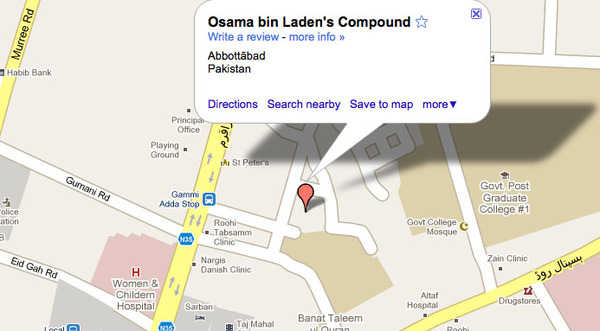
These seem like the kind of questions we need to be addressing before stuff like this:

The United States provided firepower, intelligence and other support to the government of Yemen as it carried out raids this week to strike at suspected hide-outs of Al Qaeda within its borders, according to officials familiar with the operations.

Those raids, the AFP reports, killed 49 civilians.

There are good reasons for using force against terrorist targets, and if the New York Times' report is to be believed, those targeted in the Yemen attack had fled Pakistan and so could plausibly be linked to the "core" al Qaeda threat which we are rightly concerned about. But the military is a blunt instrument and given the roiling instability in both Yemen and Somalia, it would be nice if the administration offered some kind of serious defense of its actions rather than just waving a hand and saying "al Qaeda," as if that's sufficient. Particularly because it seems intent on advertising its role in this attack.
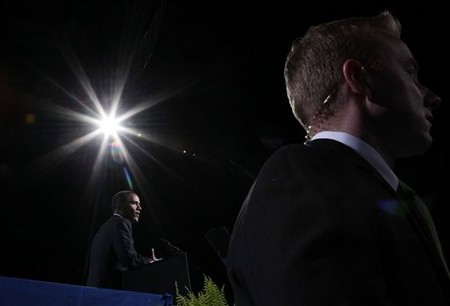
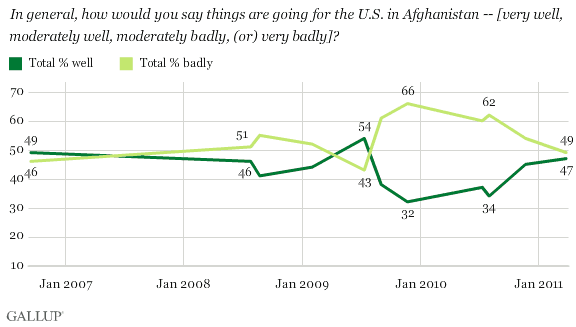
(AP Photos)

December 17, 2009

How Do Americans Really Feel About Afghanistan

Steve Kroft on 60 Minutes claimed that "most Americans" have soured on Afghanistan. Not so says Frank Newport:

Nothing like a good polling smack-down to get the heart racing.

Box Cutters and SkyGrabbers

drone_pic.jpg

The WSJ has an embarrassing report today on how Iraqi insurgents have been hacking America's multi-million dollar Predator drones--and for under $26:

Militants in Iraq have used $26 off-the-shelf software to intercept live video feeds from U.S. Predator drones, potentially providing them with information they need to evade or monitor U.S. military operations.
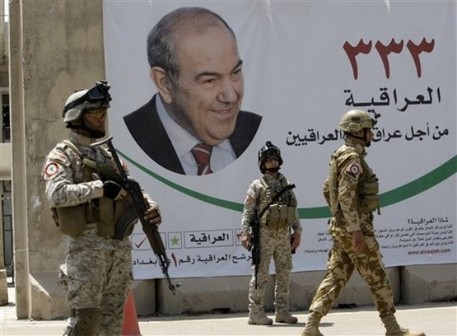
Senior defense and intelligence officials said Iranian-backed insurgents intercepted the video feeds by taking advantage of an unprotected communications link in some of the remotely flown planes' systems. Shiite fighters in Iraq used software programs such as SkyGrabber -- available for as little as $25.95 on the Internet -- to regularly capture drone video feeds, according to a person familiar with reports on the matter.
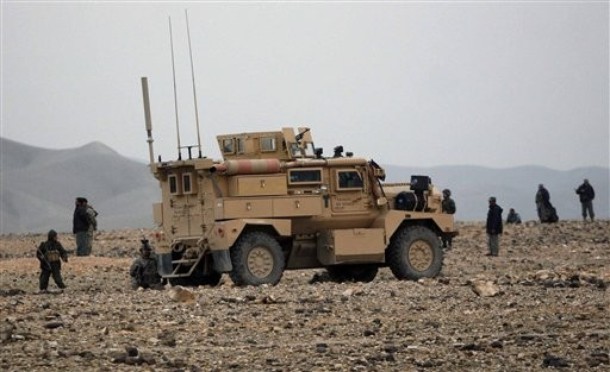
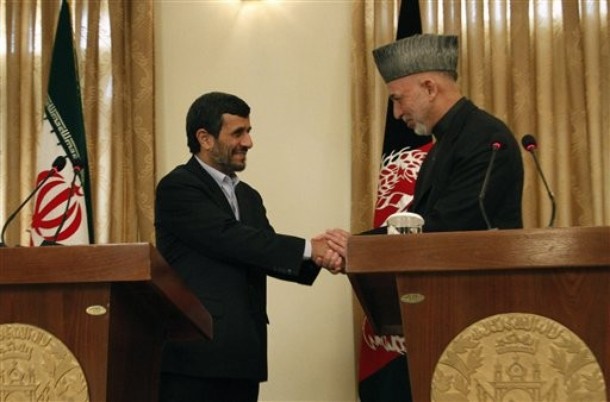
[...]

The militants use programs such as SkyGrabber, from Russian company SkySoftware. Andrew Solonikov, one of the software's developers, said he was unaware that his software could be used to intercept drone feeds. "It was developed to intercept music, photos, video, programs and other content that other users download from the Internet -- no military data or other commercial data, only free legal content," he said by email from Russia.

My sense is that this will get exaggerated and blown out of reasonable proportion by some, but setting aside the painfully foolish system security--no encryption???--this screw up reveals a more salient point, and brings to mind an old cliche: where there's a will there's a way.

Whether it's box cutters or file "intercepting" software, this, in my view, once again challenges the notion that a preponderance of troops and treasure exhausted in one part of the world is the right way to fight an allegedly global war on terrorism. There will always be fringe elements who hate the United States and wish us harm, but trying to pick them off continent-by-continent makes far less sense to me than diverting resources toward cyber-security, not to mention biological weapons security and regulation.

(AP Photos)

December 15, 2009

Obama's Afghan Timetable Doesn't Compute

Afghanistan.jpg


David Ignatius reports:

As one of the selling points of the plan to send an additional 30,000 troops into Afghanistan, rather than the full 40,000 troops Gen. Stanley McCrystal requested, the president's aides touted the idea that the extra forces would be sent in the next six months, rather than over the full year that McChrystal originally thought necessary.

But a top military planner says the actual timetable will be closer to what McChrystal proposed.

I asked Lt Gen. David Rodriquez, the No. 2 US commander here, in a briefing tonight how long the deployment of the extra 30,000 would take. He answered that "it will happen between nine and eleven months," starting in January 2010. Which means that some troops might not arrive until November 2010.

The next month after that, December 2010, is when Obama plans to assess how well the troops are doing -- so he can decide how many to pull out when the withdrawal begins in July 2011.

I am up in the air on the issue of whether timetables do more harm than good, but this is another matter. It strains credulity to believe that we can know whether the surge is working after one month.

The Blast Heard Around Kabul

Kabul awoke to yet another bomb blast this morning and, from the looks of it, it was a big one:

Arriving at the blast site roughly six hours after detonation, it was a scene of security officers corralling municipal workers, journalists and curious Afghan onlookers (I being continuously mistaken for the latter) amongst the wreckage, while they themselves tried to take in the enormity of the blast.

In the crowd, an old man announced that we were all "clinging to Bush's testicles" and that from our "fancy cars, only cared about this life and have no regard for the next," before a security official angrily chased him away.  Something could have been lost in the translation.

A steady exodus of foreigners from the Heetal hotel passed by car or on foot, rolling their suitcases through the debris.  A few stopped to pose for a parting shot in front of the collapsed buildings.

The blast crater, said to be a meter deep and two meters wide, had been filled with rubble (see second video).  The black SUV carrying the payload was reportedly hurled through the air by the explosion.  The soft-shelled SUVs in the vicinity were reduced to charred and twisted metal.   The armored variety remaining surprisingly intact:

Violence in Kabul has been steady since this summer's elections but there are concerning reports that while the Taliban were once knocking on the gates of Kabul, they are now banging on its very doors.

In striking one of Kabul's most affluent districts, their message is clear: anyone benefiting from the government's corrupt practices is fair game and cannot hide behind their check points and blast walls. Unfortunately, those actually caught in the blast were most likely guards and domestic staff.

President Karzai's former vice president, Ahmed Zia Massoud, whose house was damaged in the attack is thought to have been the intended target.  Fittingly, the president himself was convening a conference on fighting corruption at the time of the attack.

Tackling corruption will no doubt deflate the Taliban cause, but after eight years of war and borrowing best practices from confederate insurgents in Iraq, Pakistan and elsewhere, the tide will not turn on de-greased palms alone.

Alim Remtulla

Polling the Obama Doctrine

ObamaDoctrine.jpg

Rasmussen digs beneath the president's Nobel speech:

Fifty percent (50%) of U.S. voters agree with President Obama that Afghanistan is a "just" war.

A new Rasmussen Reports national telephone survey finds that only 24% disagree with the president’s declaration about Afghanistan in his speech accepting the Nobel Peace Prize last week. Another 27% are undecided.

Similarly, 52% think the president was right when he said, “The belief that peace is desirable is rarely enough to achieve it.” Twenty percent (20%) take issue with Obama’s remark, but 29% are not sure if he’s right or not.

Surprising how many people are undecided about the justness of the Afghan war. No matter where you sit on the questions of tactics, it seems obvious to me that war was and is justified, even if the strategy the administration settled on may not be the optimal one.

(AP Photos)

December 14, 2009

Why Are We in Afghanistan?

pakistanafghanistan.jpg

Joe Klein offers an answer:

Let's start with a fact: the Indian Embassy in Kabul has suffered major, lethal bomb attacks twice in the past two years. There is little question in the intelligence community that these attacks were staged by terrorist allies of the Pakistani Army. The Pakistanis are absolutely convinced that if the U.S. leaves Afghanistan, India will jump in, supporting the non-Pashtun elements in the country--indeed, India was a supporter of the Northern Alliance's guerrilla war against the Taliban in the 1990s (although, it must be said, the Pakistanis have a rather exaggerated sense of Indian involvement).

Why is this a problem we should care about? Because India and Pakistan both have nuclear weapons. Because tensions between the two countries would escalate dramatically if we were to abandon the region. And, most important, because our departure would empower the more radical elements of the Pakistani military and intelligence services--not merely in their support of the Taliban, but also, potentially, in their ability to stage an Islamist coup d'etat. This is the worst scenario imaginable: a nuclear Pakistan, with allies of Osama Bin Laden controlling the trigger.

I think it's obvious that along the spectrum of "bad to worse" we could still progress a lot further toward "worse" in Pakistan, as Klein argues. But there are several problems with this analysis. First, Pakistan and India have had nuclear weapons before the U.S. presence in Afghanistan. They have fought wars before the U.S. arrived and indeed, were on the brink of fighting another shortly after we invaded Afghanistan. There is nothing about our presence there that ensures peace and nothing about our departure that guarantees war. Moreover, Pakistan and India have been quietly working on a peace deal for years now, work that began, I believe, without American supervision or goading.

The second point, about an Islamist coup-d'etat is also dubious. Not that such an event couldn't occur, obviously it could. But I'm not sure why 100,000 troops inside Afghanistan is preventing that. They're not providing palace security for Zardari. If anything, constant U.S. drone attacks in the tribal zone and the incessant, public brow-beating of Pakistani officials by Americans to take the war to their own citizens could just as easily inspire a coup against a government seen as overly solicitous to America.

It's also worth stepping back and turning the problem around: if I understand Klein correctly, our strategic decisions are essentially hostage to what a few Islamist Pakistani military officers may or may not do with respect to the Afghan Taliban and their own government. Under that logic, we can never leave. And it's also worth noting that despite our massive presence in the region, Pakistan is not behaving itself:

Demands by the United States for Pakistan to crack down on the strongest Taliban warrior in Afghanistan, Siraj Haqqani, whose fighters pose the biggest threat to American forces, have been rebuffed by the Pakistani military, according to Pakistani military officials and diplomats.

The regional dynamics are clearly working against us. Where I part company with Klein is with the notion that we can fix them.

(AP Photos)


Al Qaeda Moves to Yemen

yemen.jpg

Terrorism experts frequently cite al Qaeda's long-standing home in Afghanistan as a key argument for why it's essential to conduct armed state building there. Peter Bergen wrote that:

Another common critique of the U.S. mission in Afghanistan is that there are numerous potential safe havens in the world; if Al Qaeda were facing defeat in Afghanistan, wouldn't it simply relocate to a more permissive venue? Those who raise this point are essentially talking about two things: on the one hand, the prospect of Al Qaeda moving somewhere far away like Somalia or Yemen; on the other hand, the reality that, no matter what we do to stabilize Afghanistan, its neighbor Pakistan will always be off-limits to American invasion and therefore available as a haven for Al Qaeda.

The point about Somalia and Yemen is unconvincing. Jihadists based there have shown no ability to hit targets anywhere but in their immediate neighborhoods. Many years after September 11, there is scant evidence that any senior Al Qaeda leaders have relocated to either place. For its part, Somalia is probably too anarchic, and possibly too African as well, for the largely middle-class Arab membership of Al Qaeda. In theory, of course, it's always possible that Al Qaeda could pick up and move elsewhere. But, with the exception of a few years in the 1990s, Al Qaeda has now been based in Afghanistan and Pakistan for a generation. This is the region where its leaders feel comfortable, where they have put down roots. If they didn't leave even after the United States conquered Afghanistan in late 2001, it seems unlikely that they will in the future.

But this doesn't seem to be holding up that well. The Boston Globe reports that al Qaeda is indeed moving to Yemen:

As the United States steps up the hunt for Al Qaeda in Afghanistan and Pakistan, some of the terrorist network’s veteran operatives are leaving the region and flocking to Yemen, where an escalating civil war is turning the nearly lawless Arab nation into an attractive alternative as a base of operations, according to US and foreign government officials.

Citing intelligence reports and intercepted communications, officials said they believe dozens of battle-hardened followers of Osama bin Laden have recently traveled to Saudi Arabia’s poor southern neighbor, joining other Al Qaeda sympathizers there who are attempting to make the remote mountainous province of Ma’rib, west of the capital of Sana, a new sanctuary.

A senior defense official said US military and intelligence officials, who have armed drones and special operations forces based in nearby Djibouti in the Horn of Africa, are devising new ways to combat the threat, but declined to provide details.

“There is, indeed, concern about the establishment of Al Qaeda elements in Yemen,’’ said the official, who is directly involved in counterterrorism operations in the Middle East.

Al Qaeda operatives in Yemen have been implicated in a series of recent bombings that killed tourists and damaged oil facilities, and are tightening their grip by assassinating local officials in key villages. Others have been captured in recent days trying to smuggle dozens of suicide vests from Yemen into Saudi Arabia, according to a Saudi government official who declined to be identified when discussing intelligence matters.

If counter-insurgency and armed state building is going to be the U.S. template for counter-terrorism, we're going to need a much, much bigger army.

(AP Photos)

December 11, 2009

Poll: Lack of Confidence in NATO

Rasmussen says the U.S. public isn't keen on the Atlantic alliance:


Just thirty-three percent (33%) of U.S. voters are at least somewhat confident that NATO will do all it can to help the United States win in Afghanistan, according to a new Rasmussen Reports national telephone survey. That figure includes five percent (5%) who are very confident.

Sixty-one percent (61%) of voters lack confidence in our NATO allies, with 45% who are not very confident and 16% who are not at all confident that they will help us win the war in Afghanistan.

NATO hasn't exactly covered itself in glory in Afghanistan, so these numbers don't strike me as that surprising.

December 10, 2009

President Obama's Impossible Troop Straddle

obamatroops.jpg

It was evident during his campaign that Barack Obama was going to be a fairly conventional figure when it came to U.S. foreign policy (despite the hysteria from some quarters). And so he has found himself in an uncomfortable straddle - professing a desire to bring troops home from Iraq and, in 2011, from Afghanistan in accordance with a sizable segment of popular opinion and the majority of his Democratic base. Yet the conventional wisdom of which his administration is firmly embedded views extended deployments in both countries as vital to securing American interests.

There's really only one way to square this circle, and that is to bring the costs of both missions down to where the U.S. presence is seen merely as stabilizing force, as it is in Korea. This really seems like what the administration is hoping will happen - that the U.S. will be able to transition its role while Iraq and Afghanistan emerge from their internal violence, while at the same time retaining a military toe-hold in each country to project power regionally.

The U.S. applied a similar strategy in the late 1940s as Western Europe and Asia were collectively attempting to pull themselves out of the ruins of World War. The only difference, of course, is that Western Europe and Asia were vital centers of industry and American commercial activity which fought wars against external, nation state aggressors. In Iraq and Afghanistan, neither of those conditions apply. We're going to be investing an awful lot of time and effort into nations and regions which, at the end of the day, just aren't that relevant.

(AP Photos)

December 7, 2009

The Woman Who Wants Us Out, Ctd.

A reader responds to a reader responding to me. Got it? Good. On Malalai Joya, this reader writes:

The fact that she decries US troops, despite the fact that it was US troops that put her into power in the first place, is merely a stronger version of Hamid Karazi's frequent condemnation of US bombings. To me, that suggests that she is a demagogue exploiting a salient issue, not at all a heroine.

[...]

Westerners are looking for anybody to latch onto, any hero that appears to validate their existence, so as to claim progress and victory. But that is a foolhardy endeavor, as we don't have to end up being governed by these "heroes" and "heroines" that we praise.

Third-world nations do not need strong personalities and famous leaders. It suffered from them for far too long. It instead needs good institution-building, to ensure its very survival. The United States should not throw money in the hopes of listening to soundbites from Afghani politicians and feeling "good" about themselves. The United States should throw money in the hopes that, in the future, Afghanistan still functions, so that the vast majority of AFGHANS, the ones we don't see in the news or blogs, live in peace.

December 6, 2009

On Not Leaving Afghanistan

As I and others pointed out after the president's speech, using the term "vital national interest" to describe Afghanistan didn't exactly jibe with the notion that we would be walking away from the country in 18 months. And lo and behold, we're not:


"We will have 100,000 forces, troops there,” Mr. Gates said on ABC’s “This Week,” “and they are not leaving in July of 2011. Some, handful, or some small number, or whatever the conditions permit, will begin to withdraw at that time.”

“I don’t consider this an exit strategy,” he continued, “This is a transition.” He said it would begin in less-contested parts of Afghanistan before expanding to the most obdurate Taliban strongholds, largely in the south and east.

The White House used appearances on the Sunday talk programs to convey that the deadline would mark the start, not the end, of troop withdrawal. “2011 is not a cliff, it’s a ramp,” Gen. James L. Jones, the national security adviser, said.

Wherever one stands on the issue of the efficacy of timelines, it's pretty clear that the administration is actively walking back the idea that responsibility for Afghanistan is going to be handed over to Afghans any time soon.

(AP Photos)

Eye on the Prize

battleships.jpg


Fareed Zakaria makes a key point:

It also means concentrating on the centers of global power, not the periphery. Throughout history great nations have lost their way by getting bogged down in imperial missions far from home that crippled their will, strength, and focus. (Even when they won: Britain prevailed in the Boer War, but it broke the back of the empire.) It's important to remember that in the coming century it will be America's dominant position in Asia—its role as the balancer in the Pacific—that will be pivotal to its role as a global superpower, not whatever happens in the mountains of Afghanistan.

This is very true, but as Iran proceeds toward nuclear weapons there will be numerous voices telling us how vital it is to focus on the Middle East, and use American power to contain a potentially hegemonic Iran. This would be a mistake - our 60 year history of trying to do this with the Saudis and later the Israelis have brought us a considerable amount of grief, particularly since the collapse of the Soviet Union and the rise of transnational terrorism. But with a fragile world economy coming out of a deep recession, any movement of oil prices is likely to figure front and center in the mind of politicians - long term considerations be damned.

(AP Photos)

December 4, 2009

The Woman Who Wants Us Out, Ctd.

A reader responds to my post on Malalai Joya:

I admire the guts of this young woman and believe it will eventually be the women of Islam who prove to be its salvation.

However, having left Afghanistan at 4 and not returning until she was 20, in 1998, it appears she spent the period of the Taliban's reign of terror in Iran and Pakistan. Ironically, the world would never have heard of Malalai Joya had the US not invaded Afghanistan and created an opportunity for her to even serve in its legislature.

The Afghan region has been in a state, in varying degrees, of perpetual tribal war for centuries and it is easy to understand its people know no other state of affairs. The reality, though, is Afghan existence is mostly defined by raw power from the barrel of a gun.

I don't have a great deal of confidence in American success there, but I am willing for us to make the effort to buy enough time to hopefully allow more Joyas to step forward and blossom. To reasonably compare any current statistical evidence on crime and security to the earlier Taliban era is preposterous. One would have to assume the Taliban actually kept those records and kept them accurately.

I fear Joya is making the Hobbesian choice of native, dictatorial power over a gamble for a better environment in the future, even if it is provided temporarily by a foreign power. If she believes the withdrawal of all coalition forces and an immediate return to local determination is the best solution, she is indeed living in a world of "bellum universale" and "jus non retinendum".

I wish her and her countrymen the best of all luck.

Al Qaeda Kills a Lot of Muslims

alqaedakills.jpg


Not exactly news, I know, but with Stephen Walt tallying up the number of Muslims felled by the U.S. over the past 30 years, it's also worth noting al Qaeda's body count:

Few would deny that Muslims too are victims of Islamist terror. But a new study by the Combating Terrorism Center in the US has shown that an overwhelming majority of al-Qaida victims are, in fact, co-religionists....

... Between 2004 and 2008, for example, al-Qaida claimed responsibility for 313 attacks, resulting in the deaths of 3,010 people. And even though these attacks include terrorist incidents in the West -- in Madrid in 2004 and in London in 2005 -- only 12 percent of those killed (371 deaths) were Westerners.

That's from a report from the Combating Terrorism Center at West Point. Read the whole thing here (pdf).

(AP Photos)

The 1% Consensus

cheney_rsz_01.jpg

I found Fareed Zakaria's interview this week with CNN on Afghanistan and President Obama's military escalation rather interesting. The entire interview is worth a read, but Zakaria made what I thought was an especially salient point on Pakistan:

CNN: Do you think the president was justified in raising the specter of nuclear disaster in connection with terrorism and Pakistan?

Zakaria: I used to believe that the Pakistani nuclear weapons were secure and the Pakistani army was strong enough to maintain control over them, but I have seen recent reports, including one from Bruce Riedel who is advising the president on this which cast doubt on the security of nuclear command and control, the security of the weapons themselves.

So yes, reluctantly I would have to say the president was right to raise the specter of some possible collapse of parts of the Pakistani state which could put the nuclear weapons in the wrong hands. I think it's remote, but ... you want to do what you can to minimize the chances of a remote but very bad outcome.

This reminds me of Vice President Cheney's now famous "1% chance" line on the possibility of al-Qaeda acquiring nuclear capability via Pakistan. "It's not about our analysis," said Cheney at the time, but "our response."

This was obviously the guiding doctrine for the Bush administration, but what's interesting is how the very same doctrine, if reluctantly, has found consensus within the Obama administration as well. Zakaria admits to a reluctant acceptance of this, and we heard much of that same reluctance in the President's speech this week.

It is fascinating however--all of the back and forth sniping notwithstanding--to see the same driving paranoia bind the previous and current administrations together. While data indicates that most Pakistanis, prompted in part by drone attacks inside their borders, view the United States as the problem--not the Taliban.

Yet a nuclear al-Qaeda/Taliban consumes our imaginations. To paraphrase the former Vice President, it's not the analysis of such a possibility that matters, but our preparedness to react to that possibility in preponderant fashion. In an age where asymmetric warfare meets nuclear know-how, paranoia may be the new norm. Whereas past enemies fighting with conventional means could be 'contained,' today's enemies must be assumed at their worst, and dealt with in apparently equal fashion.

(AP Photos)

December 3, 2009

The Woman Who Wants Us Out

rsz_sm_joya1.jpg

Afghan politician and women's rights activist Malalai Joya on Western forces in Afghanistan:

Torture, drug trafficking, the continued rule of warlords and fundamentalists–these are the only things that this war has brought Afghans. Today, our people are being victimized by two enemies: the occupation forces bombing us from the sky, and the warlords and their Taliban brothers-in-creed.

If the troops withdraw, it will be easier for Afghans to fight one enemy and to determine our own future. It is the duty of the Afghan people to work for freedom and democracy; these values can never be donated to us by the very foreign powers who–after nearly three decades of funding various fundamentalists are arming warlords and other criminals–are responsible for many of the problems Afghanistan faces today.

While I don't agree with everything Joya has to say, I think her words in this case are worth consideration; especially as we debate women's rights as a byproduct of war.

I understand the temptation to morph the Afghan war into a cause for liberalism and humanitarianism, and the likelihood will only increase now that a liberal president has assumed the role of caretaker over the conflict. And we've seen this before from previous progressive administrations, as Wilson's Latin America policy comes to mind. The temptation to be global evangelists of just about anything can sometimes be too attractive when you possess the means to act on that temptation.

But why we went to war and what we can do with war are two different things, and we should be mindful not to let the latter have too much influence over broader policy ambitions. Making Afghanistan the central front in women's liberation makes no more sense than making Afghanistan the central front in the War on Terrorism--both are in fact global struggles requiring global solutions.

(h/t Andrew Sullivan)

December 2, 2009

Next in Line at the Graveyard?

Max Boot asks for moratorium on the Soviet analogies:

The whole mindset of the Red Army veterans is highly conventional — employing helicopter assault forces and tanks. That works against a conventional army; it doesn’t work against guerrillas. McChrystal realizes that, which is why he’s trying a different strategy — the same one that has been vindicated in counterinsurgencies from Malaya to, more recently, Colombia and Iraq. Anyone who offers a mindless Soviet analogy to suggest that we are doomed to failure in the supposed “graveyard of empires” — and I have heard many such arguments in the past few days — should ponder the profound differences between the Soviets’ tactics and those of NATO. There is no comparison.

Pomp and Circumspect

Fred Barnes writes:

I had hoped Obama would declare that nothing will deter him, as commander-in-chief, from prevailing in Afghanistan. But it turns out a lot of things might deter him. He listed a few of them: the cost of the war, its length (if more than 18 months from January 2010), the failure of Afghans to step up to the task sufficiently. He hedged.

Americans and our allies were looking for more, I believe. To have rallied the country and the world, Obama needed to indicate he would lead a fight to win in Afghanistan, with the help of allies if possible, but with the armed forces of the U.S. alone if necessary. He didn’t say anything like that. He didn’t come close.

The heavy emphasis placed by some on lofty rhetoric never ceases to amaze me. President Obama's predecessor was fond of the stuff, but it never accounted for much on the battle field. As we've now come to learn, the rhetoric President Bush applied to Afghanistan rarely matched strategic application on the ground. And as for Iraq, well, we know what lofty rhetoric and pageantry got us there.

I may disagree somewhat with the President's escalation plan, but I can at least appreciate his coupling of that plan with some sober rhetoric and reality on the ground.

The American Order and Afghanistan

irAQ%20TROOP%20WITHDRAWAL.jpg

Andrew Sullivan thinks that President Obama is seeking to "unwind the American empire" with his new strategy in Afghanistan:

How best to unwind the empire? By giving McChrystal what he wants and giving him a couple of years to deliver tangible results.

While I think this is the narrow goal of the president's surge strategy, I think it's wrong to characterize this as some kind of broader repudiation of America's strategic posture. Quite the contrary. In his speech, President Obama explicitly situated the surge in Afghanistan as a piece with past American efforts to sustain international security:

Since the days of Franklin Roosevelt, and the service and sacrifice of our grandparents, our country has borne a special burden in global affairs. We have spilled American blood in many countries on multiple continents. We have spent our revenue to help others rebuild from rubble and develop their own economies. We have joined with others to develop an architecture of institutions - from the United Nations to NATO to the World Bank - that provide for the common security and prosperity of human beings.

We have not always been thanked for these efforts, and we have at times made mistakes. But more than any other nation, the United States of America has underwritten global security for over six decades - a time that, for all its problems, has seen walls come down, markets open, billions lifted from poverty, unparalleled scientific progress, and advancing frontiers of human liberty.

In other words, far from repudiating an "imperial" foreign policy, President Obama is positioning the surge within the continuum of America's post World War II role as global leader.

Only this time, instead of the economically and strategically vital areas of Europe and Asia, and instead of facing a superpower threat, we're going to attempt to micromanage a tribal dispute in the mountains of a country that has never been, and likely will never be, a pivotal international power.

And we do not simply because we face a legitimate security threat from international terrorism, but because we now have such an extravagant idea of what is necessary to keep America safe. President Obama:

What we have fought for - and what we continue to fight for - is a better future for our children and grandchildren, and we believe that their lives will be better if other peoples' children and grandchildren can live in freedom and access opportunity.

President Obama is not the first president to express such a universalist sentiment. And it's difficult to tell if this was included as a sop to his critics who accuse him of being a monster realist, or a genuine statement of strategic purpose. Either way, it doesn't seem to signal an unwinding of anything.

(AP Photos)

Betting on COIN

coin.jpg

Thinking a bit further about the strategy the president laid out in his speech last night, it seems to place a mighty heavy bet that the U.S. military can duplicate in Afghanistan the success it enjoyed in Iraq. The strategy strikes me as modest: calm things down so we can leave with the patina of victory. If the longer term trends in Afghanistan turn south, the fault will lay with the Afghans, who failed to take advantage of the opportunity afforded them by allied military forces.

This worked fairly well in Iraq. The politics inside Iraq are still a mess, and an appallingly high number of Iraqis are still being slaughtered, but we can plausibly and rightfully say that if Iraq can't get its act together now, no amount of American military power inside the country could right the ship.

Obama is gambling that a similar dynamic will take hold in Afghanistan. We'll do our best, and then it's up to them. This doesn't exactly jibe with the contention that Afghanistan is a "vital national interest" but given the circumstances, perhaps this was the only bet available. I sure hope it works.

(AP Photos)

December 1, 2009

Obama Speech Reaction

“As Commander-in-Chief, I have determined that it is in our vital national interest to send an additional 30,000 U.S. troops to Afghanistan. After 18 months, our troops will begin to come home. These are the resources that we need to seize the initiative, while building the Afghan capacity that can allow for a responsible transition of our forces out of Afghanistan.” - President Obama.

There is an elemental tension between having a short "time bound" surge - as one senior administration official put it in a conference call with bloggers after the speech - and the urgent requirement to pour in additional U.S. forces now.

The official went on to say that the administration explicitly rejected a "10 year nation building" strategy, in addition to leaving now or standing pat.

But if the situation is as urgent and portentous as the administration says it is today, and conditions aren't measurably improved in 18 months, I don't see how you could leave. If it would be irresponsible and wrong today to do anything other than surge, what could possibly change in 18 months? The administration may reject the "10 year nation building" strategy, but the rhetoric it has used to justify the current strategy sets them on a clear path towards such a commitment.

A Band-Aid on Bush's War

bush1111.jpg

I think there's something getting repeatedly lost in the hand-wringing and keyword-tallying going on in preparation for tonight's speech by President Obama. While I'm sure we'll hear a great deal this evening about "benchmarks," and victory and the Taliban, I suspect we'll hear very little about the War on Terrorism. There are some fundamental questions that have not been answered by escalation proponents, and I doubt we'll get those answers tonight when the President takes to the podium at West Point.

Specifically, how is allocating 100,000 troops to Afghanistan--at a roughly estimated cost of $1 million per troop per year, if not more--a justifiable strategy for isolating and killing an al-Qaeda leadership believed to be weak and on the wane in the region. How does escalation in Afghanistan defeat al-Qaeda in Yemen, or the Maghreb?

And in his failure to address broader questions about America's long war on terrorism, President Obama has simply opted for the politically safer option of applying bandages to President Bush's Afghan war strategy. This may assuage the President's critics, but it does little to address greater concerns about terrorism and American security.

Rather than a departing from the Bush doctrine, Obama has simply wed himself to it--or worse--clings to it for dear life.

I'll be 'tweeting' (yes, that's apparently a verb) the speech once it begins, please feel free to follow along.

(AP Photos)

Afghanisan & the Logic of Escalation

Afghanistan.jpg

I think Alex Massie has it right:


...I guess one ought to have an official "What I Think About Obama’s Escalation in Afghanistan post". And the truth is that I don't know. Don't know whether Obama's new strategy will work, don't know if it is wise or enough or too much or just about right. And I'm intensely suspicious of anyone who celebrates it and, most especially, those who immediately claim that it's insufficient, reckless, half-hearted or whatever. Because (almost) none of us have a clue, really, and pretending that we do does no-one any good.

What may be said, with all due caution, is that the administration is doing its best to make the best of a bad situation. It seems quite possible to me, even probable, that there is no solution to the matrix of problems we face in Afghanistan. If there were someone might have found it by now.


Well said. My biggest concern is that the logic of denying the Taliban and al Qaeda a propaganda win only increases after the president's commitment ofmore troops. If we discover that a population centric counter-insurgency with 100,000-plus allied troops does not do the trick, it will be that much harder to switch tactics and pursue an off-shore counter-terrorism approach. The logic of saving face after putting more of our blood and treasure on the line will only shift further in the direction of further escalation if sufficient progress can't be shown after 18 months.

(AP Photos)

Breaking Developments

This is it. President Obama will announce his new Afghan strategy tonight. Analysts and pundits will learn which of their thinking falls most closely inline with the president’s on such issues as troop deployment, a time line for withdrawal, the training of the Afghan army and police force, and how best to tackle corruption in the Karzai regime.

The President is also aware that force alone will not render Afghanistan more secure. Winning the necessary hearts and minds as part of a victorious counterinsurgency operation also requires a thoughtful development strategy to ensure that any success is both lasting and durable. How will President Obama weigh-in on the development issue?

In my brief few weeks here in Kabul I’ve somehow managed to ensconce myself within development community. While we haven’t yet had the opportunity to discuss what they’d hope to hear from President Obama’s new strategy, I have noticed a pall of frustration that follows their every move, not an uncommon phenomenon here in Kabul.

When their accomplishments are not overshadowed by the unrelenting news of IEDs, corruption and opium, they are undermined by bureaucratic ineptitude. Within a few hours of arriving I was forwarded an article by Rajiv Chandrasekaran--no stranger to good intentions gone awry from his time reporting in Baghdad’s greenzone with the Washington Post--that summed up the aggravations of development work here in Afghanistan.

Worse still, some of their early accomplishments have begun to unravel in the deteriorating security environment

Of the journalists I’ve spoken to, most would love to spend more time covering development success stories but with bureaus already stretched thin, finite column inches for foreign news and development projects that, in a 24 hour news cycle, progress at a glacial pace, it’s rare to find media outlets that are both willing and able.

I would be remiss, however, to not highlight the few positive development stories that did breakthrough: here, here and particularly here.

Like President Obama’s stimulus plan, where we’ll never know exactly how many jobs it saved or created and how much worse the recession would have been in its absence, it’s difficult to gauge how worse off things here in Afghanistan would be, despite all the missteps and backsliding, without the emphasis on development work to complement the security strategy. As the President lays out his grand Afghan plan, it will be worthwhile to see what, if any, mention will be made on development to ensure that a third comprehensive review will not be necessary.

Alim Remtulla

November 30, 2009

Advice for the President's Afghanistan Speech

obama%20war%20council.jpg

Tom Donnelly offers some:

The message he must communicate is beyond pure reason. The troop numbers, the strategic rationale and the policy direction matter more as indicators of temperament than as elements of an argument. The question of commitment was less pressing six months ago when Gen. Stanley McChrystal, trumpets across Washington blaring, was sent to take command in Afghanistan. But now it can no longer be avoided. The current moment is a test of the president’s “courage d’esprit,” of his determination.

The trouble is, the president is speaking to multiple audiences. There is a constituency - called the American people - who are as much interested in hearing how the war ends than in Churchill 2.0. There is Pakistan, which we are told wants to hear that we'll never leave, ever, so they'll stop backing the Afghan Taliban. There are the Afghans themselves - some of whom want a reassurance that the U.S. will not bug out on them and others who want a reassurance that the U.S. is not bent on permanently occupying them. You can signal resolve to one party and undermine your message to the other.

The broader problem is that this question of resolve is a red herring. What if Obama resolutely declares that American interests will be better served with an off-shore approach? I suspect Donnelly would not be pleased with such a display.

But more broadly, the president is one man. In a democratic society, there is going to be a loud, public clash of views on the subject of whether we need to stay in Afghanistan for decades or whether we should switch our strategy. By the very nature of our society, it is impossible to signal "resolve" when it comes to a mission that is as ambiguous as Afghanistan has become. There will always be powerful voices - in Washington, in the media, etc. - who can dissent and by dissenting, dilute a unified message. If the Taliban are paying attention, they'll surely pick up on that dissent no matter how resolute President Obama becomes. Unless you want to silence that dissent, there's no way a democratic debate cannot ultimately serve as fodder for enemy propaganda.

That's not to say it's impossible for a democratic society to convey an image of resolve. You could signal unity of purpose and seriousness about the war by instituting conscription and putting the economy into a war-footing, as we did during World War II (great stimulus prospects there as well). Both moves would certainly put the world on notice that America was serious about the business in Afghanistan.

(AP Photos)

Losing Bin Laden

Afghan%20war%20scene.jpg

The Senate Foreign Relations Committee has a new report out (pdf) on the failure to kill or capture Osama bin Laden at Tora Bora in December 2001. In it, the Committee notes:


There were enough U.S. troops in or near Afghanistan to execute the classic sweep-and-block maneuver required to attack bin Laden and try to prevent his escape. It would have been a dangerous fight across treacherous terrain, and the injection of more U.S. troops and the resulting casualties would have contradicted the risk-averse, ‘‘light footprint’’ model formulated by Rumsfeld and Franks. But commanders on the scene and elsewhere in Afghanistan argued that the risks were worth the reward.

This jibes with other accounts that suggested that a fear of casualties stayed the American hand at Tora Bora. Which is very strange, when you think about it. After all, Secretary Rumsfeld, President Bush et. al. countenanced a much, much riskier danger in invading Iraq. Why they wouldn't put a far lower number of American lives at risk to nab bin Laden escapes me.

(AP Photos)

November 28, 2009

Butchering Sacred Cows

It’s Eid in Kabul.The city has shut down. Locals head to mosque, then home to their families. American expats are celebrating Thanksgiving; the rest of us are simply enjoying a long weekend. When the two groups do cross paths, Afghan kids have been know to light firecrackers behind the feet of unsuspecting Westerners before running off giggling, leaving the foreigner, shocked and alarmed, to quickly search for cover from what can only be assumed to be incoming fire.

At the Indonesian embassy Rock 'n' Roll classics are butchered by way of karaoke. Outside, cows and goats are ritualistically slaughtered for the holiday.

Indonesia, home to the world's largest Muslim population, is one of the few countries that has maintained a diplomatic presence in Kabul throughout Afghanistan’s turbulent past.

Situated next to the embattled Indian embassy, the Indonesians don’t need to be reminded of the importance of upholding the appearance of neutrality in Afghanistan’s pugnacious politics. Picking up stray body parts off the embassy tennis courts leaves a powerful impression.

But like the Indians, the Indonesians know all too well the threat of Islamic terrorism and can ill-afford to remain completely impartial on the topic of Afghanistan. For the moment, however, there are painfully fresh kebabs and a harmonized "More Than Words" guitar sing-along to contend with.

Alim Remtulla

November 26, 2009

Kabul's Bristling Bureaucracy

My second week has been spent trying to navigate Kabul's bureaucracy. What I thought was a six month visa, purchased at the accordant price, now appears to be valid for only one. I have two weeks to exit the country.

Working strictly from hearsay, the only apparent source of information here in Kabul, I can now either fly to Dubai and brave the lines at the embassy, armed with a convincing yarn on why I am deserving of the scarce commodity that is the six month multiple entry visa. Alternatively, I can work towards finding a trusted Afghan fixer who can work the system and, for a modest fee, secure any visa.

Most firms here have dedicated staff to resolve such issues. As a freelancer I'm left to rely on the kindness of others or fend for myself. From what I've gathered a successful freelance journalist cannot be above the transparent calling-in of favors or even the forging of official documents.

On a recent mission to scour the streets of Kabul for a cheap iPhone, my companion, an Afghan of few words and gentle features, explained that Kafkaesque bureaucracy is nothing new to this country. Under the Taliban he was forced to wear a beard of at least eight centimeters. Erring on the side of caution he kept it at ten. Looking back at pictures as a bearded 29 year old, he thinks the facial hair added at least ten years. For the first two months the beard constantly itches but then you get used to it, he says. Sleeping was difficult though, the whiskers tickling at your face and neck. Now clean-shaven and baby-faced, he doesn’t plan to sport a beard until at least 50. Apparently a gray beard in Afghanistan is license to make your own rules.

Alim Remtulla

November 24, 2009

From AfPak to Somalia

FBI%20Somalia.jpg

This news today surely puts this news about the president's decision to pour 34,000 additional U.S. troops into Afghanistan into sharper relief:

Federal officials on Monday unsealed terrorism-related charges against men they say were key actors in a recruitment effort that led roughly 20 young Americans to join a violent insurgent group in Somalia with ties to Al Qaeda.

With eight new suspects charged Monday, the authorities have implicated 14 people in the case, one of the most extensive domestic terrorism investigations since the Sept. 11 attacks. Some of them have been arrested; others are at large, including several believed to be still fighting with the Somali group, Al Shabaab.

The case represents the largest group of American citizens suspected of joining an extremist movement affiliated with Al Qaeda, senior officials said. Many of the recruits had come to America as young refugees fleeing a brutal civil war, only to settle in a gang-ridden enclave of Minneapolis.

A fully resourced counter-insurgency in Afghanistan would do nothing to avert this kind of problem. It's not that we should ignore Afghanistan. But the idea that we need to put all our resources into a single basket in the name of counter-terrorism sure seems counter-productive.

(AP Photos)

November 23, 2009

Afghanistan and the Articles of Confederation

Greg noted recent efforts to arm local leaders to fight the Taliban and recently, George Gavrilis at Foreign Policy called for a less centralized state in Afghanistan along the Tajikistan model. Indeed, it is likely that the problem with Afghanistan is actually the government's structure.

Right now Afghanistan has something it never has had in the past: a strong central government. That means that the stakes are very high both internally and externally for those who control the government. However, by empowering and arming local leaders, we might be able to successfully create a system which is at least externally stable.

Put another way, the United States currently has a strong central government because the first system, the Articles of Confederation was viewed as too weak to prevent a takeover by the British or the French. However, in the case of Afghanistan, we are playing the role of the British and the French. It may well behoove us to encourage a more decentralized model wherein the Taliban do control some territory, but not enough that they are externally a threat. Western air power and special forces could intervene as needed if the balance ever tipped too far towards the Taliban, without requiring the troop commitment we have now.

Such a solution would not turn Afghanistan into the Colorado of the Himalayas that American politicians hope for, but it would probably be much more sustainable in the long term, and it may allow the U.S. to contain Salafist threats in the region.

Questions for FPI, Ctd.

Adding to Greg's excellent points from earlier regarding the Foreign Policy Initiative's recently published fact sheet on Afghanistan, I too noticed a couple of curiously absent items from their analysis: cost and scope.

On the first point, FPI make no mention of the financial costs entailed in the Afghan mission--estimated somewhere between $750,000 and $1 million per person based off the proposed surge total of 40K--or how an indefinite presence in Afghanistan will affect American spending options both at home and abroad.

This leads directly into mission scope. Absent any kind of endgame or "Mission Accomplished" benchmarks, this fact sheet merely outlines the indefinite occupation of one particular country. If the greater War on Terrorism can be fought and won on this front alone, then what does that say about known al-Qaeda havens such as Yemen and Somalia? Max Boot, who's cited in the brief, writes in the pages of Commentary Magazine that "pure" counterterrorism:

is the strategy that Israel has used against Hamas and Hezbollah. The result is that Hamas controls Gaza, and Hezbollah controls southern Lebanon. It is the strategy that the U.S. has employed in Somalia since our forces pulled out in 1994. The result is that the country is utterly chaotic and lawless, and an Islamic fundamentalist group called the Shabab, which has close links to al-Qaeda, is gaining strength. Most pertinently, it is also the strategy the U.S. has used for years in Afghanistan and Pakistan.

So if our strategy to defeat al-Qaeda is insufficient in Somalia, why aren't we planning indefinite counterinsurgency in that country as well? In the brief, FPI argues that the All Volunteer U.S. military is stronger than it has been in years, and any complaints about it being overburdened are "no truer now" than they were when voiced in reference to Iraq. Does this argument apply only to a War on Terrorism based in Afghanistan, or does it give the United States the flexibility to fight al-Qaeda as needed on other continents?

If, as FPI claims, 60,000 troops slated for redeployment from Iraq next summer will help plug in the holes of a revamped Afghan presence, where then would the troops come from to properly fight al-Qaeda elsewhere? If Fred Kagan--cited multiple times throughout this fact sheet-- is correct, and a "small-footprint counterterrorism strategy" can't work in Afghanistan, why is it acceptable in other terrorist hotbeds?

To believe this fact sheet is to believe that the so-called Global War on Terrorism isn't all that global after all--it in fact leapfrogs from mission to mission, conveniently enough, alongside American forces. Wherever we go, there's your war. Whereas Iraq was once the "central front" in the War on Terrorism, now--in accordance with an Iraq withdrawal I suspect most of the analysts listed in this brief likely opposed--it is imperative that we shift those resources toward Afghanistan. The so-called central front appears to be one step ahead of us.

For FPI's facts to add up, Afghanistan must now remain the one and only central front, and al-Qaeda must remain America's only serious enemy. Both notions strike me as terribly shortsighted.

Questions for FPI

Afghansitan.jpg

The Foreign Policy Initiative has circulated what it dubs the Case for a Fully Resourced Counter-Insurgency in Afghanistan, where they attempt to rebut assertions raised by skeptics of nation building there. Well worth a look.

There are, however, some rather important questions that are left untouched. They are:

* Would a fully resourced counter-insurgency prevent or seriously reduce terror attacks against the United States from Islamic radicals? If we "win" in Afghanistan, would the Fort Hood shooting not have occurred? Would radicals in London not have hatched a plot to bomb transatlantic airliners?

* If counter-insurgency is the American template for beating Islamic terrorism, will it be applied in Somalia, particularly if al Qaeda flees there?

* Why does Afghanistan warrant such an out-sized claim on American resources, given that al Qaeda's ability to launch mass-casualty terrorist attacks has been severely diminished? Are America's other foreign policy priorities - including relations with China, Russia and India - less significant than the battle against the Taliban in Afghanistan?

* How many terrorist attacks against the U.S. homeland have been thwarted by U.S. troops operating inside Afghanistan, and how many have been thwarted by intelligence operatives outside the country?

* And finally, why should we believe that Pakistan would be at risk if we were to withdraw from Afghanistan? Doesn't Pakistan, to this day, cultivate the Afghan Taliban for its own ends?

Inquiring minds want to know.

(AP Photos)

November 22, 2009

An Afghan Awakening?

tribes.jpg

Dexter Filkins reports on U.S. efforts to aid some Afghan tribes who have turned against the Taliban:

American and Afghan officials have begun helping a number of anti-Taliban militias that have independently taken up arms against insurgents in several parts of Afghanistan, prompting hopes of a large-scale tribal rebellion against the Taliban.

The emergence of the militias, which took some leaders in Kabul by surprise, has so encouraged the American and Afghan officials that they are planning to spur the growth of similar armed groups across the Taliban heartland in the southern and eastern parts of the country.

The American and Afghan officials say they are hoping the plan, called the Community Defense Initiative, will bring together thousands of gunmen to protect their neighborhoods from Taliban insurgents. Already there are hundreds of Afghans who are acting on their own against the Taliban, officials say.

I know several Afghan experts were wary about an "arm the tribes" strategy. But if the tribes, which Filkins says are already well armed, want to turn their guns on the Taliban, it seems smart to give them some ammo.

(AP Photos)

November 20, 2009

Back to the Stone Age?

Paksitan%20Police.jpg


In making the case for an extended American commitment in Afghanistan, the New Yorker's Steve Coll argued that the U.S. must prevent the restoration of the Taliban-led "Islamic Emirate of Afghanistan" which held sway over the country in the late 1990s. Unfortunately, as Eli Lake reports today, it seems that elements within Pakistan's intelligence service have another idea:


Mullah Mohammed Omar, the one-eyed leader of the Afghan Taliban, has fled a Pakistani city on the border with Afghanistan and found refuge from potential U.S. attacks in the teeming Pakistani port city of Karachi with the assistance of Pakistan's intelligence service, three current and former U.S. intelligence officials said.

If one steps outside the debate over how many troops to send into Afghanistan, there is a broader discussion of how to turn the regional dynamics around in such a way as to favor a successful outcome for the U.S. inside Afghanistan. The biggest question mark has always been how to ensure that Pakistan doesn't nurture Taliban elements in Afghanistan as a hedge against India and an American departure. Unfortunately, no one seems to have solved this particular puzzle.

First, we had the Bush administration's initial response after 9/11, which was to threaten a military reprisal against Pakistan if they didn't quickly reorient their position toward the Taliban. That was quickly followed up with generous financial support directed at the Pakistani military. Neither really worked. The Obama administration, together with Sens. Kerry and Lugar, have decided to spread the money further afield, to Pakistan's civilian government and civil society.

Maybe this tack will work, but it will do so over time. And it will take a major, decades-long commitment on the part of the U.S. inside Afghanistan - not simply to combat the insurgency but to convince Pakistan that we're never leaving and they won't need to cultivate Afghanistan for "strategic depth." We would, in effect, have to make Afghanistan a perpetual ward of the United States.

Needless to say, none of that is cheap. Nor is it going to keep us secure from Islamic radicalism, as the Fort Hood massacre demonstrates.

(AP Photos)

November 17, 2009

Losing Afghanistan

Afghanistan.jpg

Steve Coll ponders the implication of an American failure in Afghanistan:

As I’ve argued, in my view, a purpose of American policy in Afghanistan ought to be to prevent a second coercive Taliban revolution in that country, not only because it would bring misery to Afghans (and, not incidentally, Afghan women) but because it would jeopardize American interests, such as our security against Al Qaeda’s ambitions and our (understandable) desire to see nuclear-armed Pakistan free itself from the threat of revolutionary Islamist insurgents. So, then, a definition of failure would be a redux of Taliban revolution in Afghanistan—a revolution that took control of traditional Taliban strongholds such as Kandahar and Khost, and that perhaps succeeded in Kabul as well. Such an outcome is conceivable if the Obama Administration does not discover the will and intelligence to craft a successful political-military strategy to prevent the Afghan Taliban from achieving its announced goals, which essentially involve the restoration of the Afghan state they presided over during the nineteen-nineties, which was formally known as the Islamic Emirate of Afghanistan.

He then goes on to list a variety of potential outcomes, none of them cheery. But I want to focus for a minute on the definition of failure above. I think, as a baseline statement of American goals in Afghanistan, the prevention of this kind of restoration seems reasonable. But it's worth noting how - and how quickly - the original Islamic Emirate of Afghanistan collapsed. It took roughly 300 special forces, CIA paramilitary, U.S. airpower, and the Northern Alliance to run them out of town in a few weeks.

In other words, we didn't need 100,000 troops to shut down the Taliban in 2001 when they ran the place. I'm hard pressed to see why we'd need 100,000 to keep them away.

(AP Photos)

Kabuli Impressions

I'm approaching my first week here in Kabul. It's been filled with all the expected first impressions of a foreign conflict zone: the layers of military security and precautionary protocol; the motley crew of bacchanalian expats, myself among them; romantic notions of Afghanistan's storied past, rugged terrain, defiant people.

Coming from a nugget of truth, cliches serve as a shorthand and ought not be dismissed outright. But it's still worth being mindful not to slip into these the well-trodden pitfalls without at least of bit of resistance.

This week's evenings have been spent meeting dozens of aid workers, diplomats and journalists, and a few elusive security contractors. The days on learning how to navigate the city enough to feed myself and exerting mental energy on figuring out exactly how I'm supposed to make rent. It's going to take some time to understand exactly what's going on here, how things function, and who's who.

While still getting settled, events continue without me. A military convoy was bombed Friday morning (a friend said he heard his windows rattle), only a few days ahead of President Karzai's inauguration this week. I'm told most of the city will be even more locked down than usual for the event. Offices will be closed, roadblocks will choke the city, foreign staff's mobility will be restricted to a few secured locations and curfews are to be tightened.

Still without a press pass, I'll likely be doing the same.

Alim Remtulla

November 16, 2009

It's Not Like It's Important

Obama%20Afghan%20Debate.jpg

This line from David Broder on the Afghanistan debate sure caught my eye:

It is evident from the length of this deliberative process and from the flood of leaks that have emerged from Kabul and Washington that the perfect course of action does not exist. Given that reality, the urgent necessity is to make a decision -- whether or not it is right.

I don't think anyone's seriously holding out for "perfect" here and, obviously, the president can't postpone a decision forever. But there is no urgency here. The U.S. has "neglected" Afghanistan since Iraq war planning began - a few more weeks along the present course won't be decisive one way or another.

(AP Photos)

November 13, 2009

Do We Need Al-Qaeda?

13149_1_.jpg

Gustavo de Las Casas argues that the world is better off with an Al-Qaeda organization that is not dead, but instead just constantly held on life support. He writes:

It is tempting to draw up an organizational chart of al Qaeda and think that if the important nodes can be identified and destroyed, the rest of the network will follow. But if al Qaeda is shut down and its middle management decimated, eager fanatics around the globe would no longer gravitate toward a centralized base. Their alternative? To form their own no-name networks and band up with any other al Qaeda survivors. Killing off al Qaeda would do little to reduce Islamist terrorism. It would only make the world of terrorism more chaotic....we should take full advantage of the simple fact that the net which unites the worst Islamist terrorists also snares them.

Hopefully, this debate is happening in the upper echelons of the White House, because if Las Casas's logic is correct, then it's time for the U.S. and NATO