Main

September 16, 2013

Seeing the Mideast Through a Cold War Lens Will End Badly for America

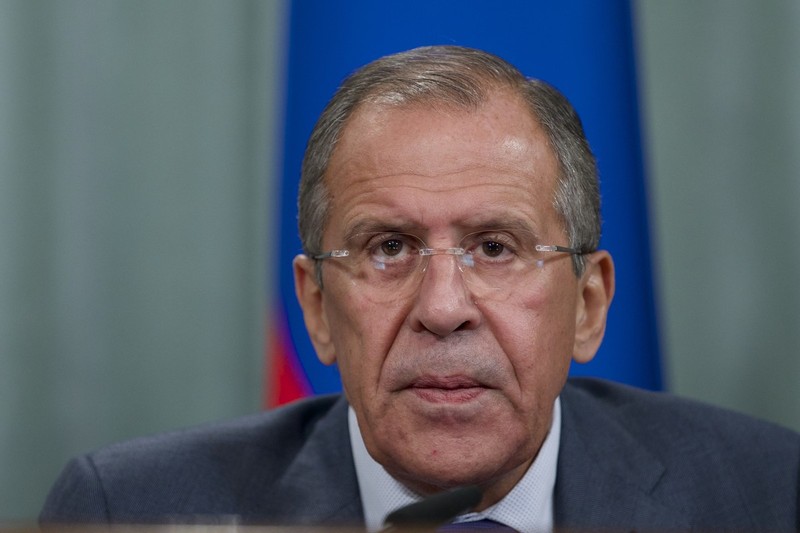
lavrov%20evil.jpg

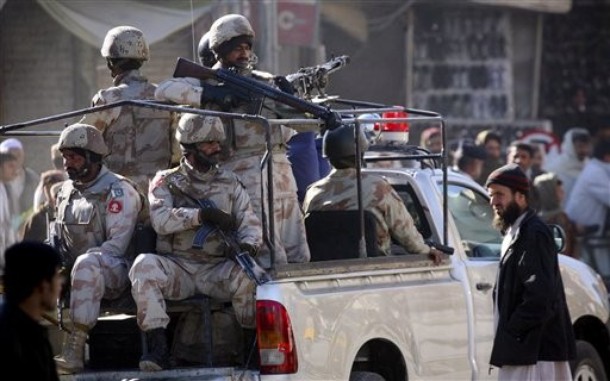
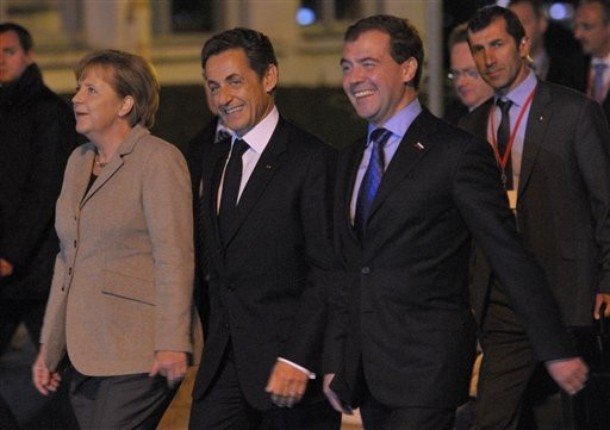
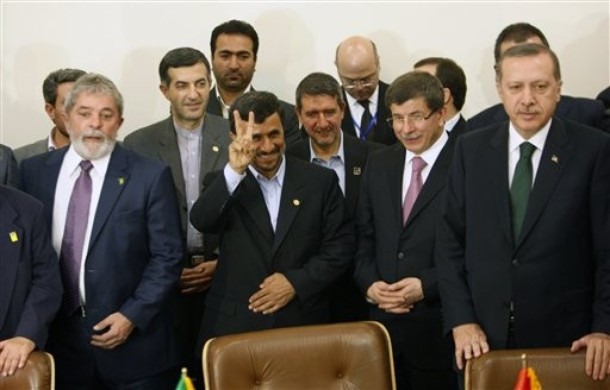
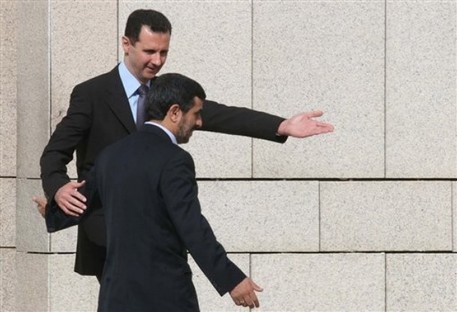
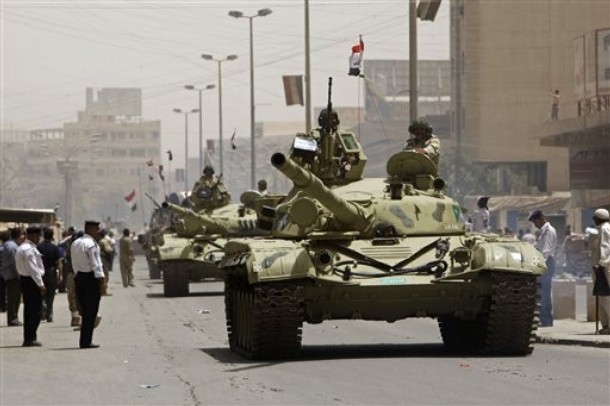
While I took issue with Andrew Sullivan's idea that Vladimir Putin now "owned" the mess in Syria, Commentary's Jonathan Tobin evidently took the idea to heart and is terrified at the prospect. According to Tobin, it's quite possible that Putin could end up "owning" the Middle East with damaging results for the U.S. around the world:

The guiding principle of Russian foreign policy is twofold: annoy, humiliate, and defeat the United States every chance they get and thereby help rebuild the lost Soviet empire whose fall Putin still mourns. Russian adventurism in Syria won’t stop there. It will extend into Asia and cause havoc and diminish American influence there and everywhere else.

I think Tobin is utterly wrong in his premise that a loss of influence in one area of the world will lead to a loss everywhere (an argument that should have been put to bed after it was thoroughly discredited during the Cold War), but just for the sake of argument, let's accept that his framing is correct. Does it therefore make sense to overthrow Assad? Not even close.

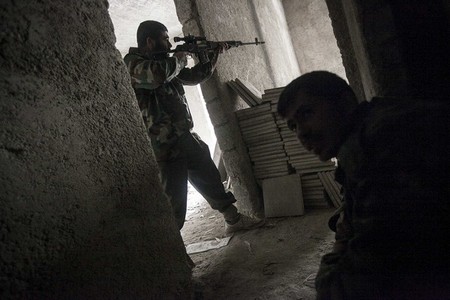
First, let's look at the lay of the land. Russia has one client -- a regime that is battered by a civil war and that looks to be battling a fierce insurgency for years. It has a second, tepid ally in Iran. The U.S., on the other hand, can count on all the other major countries in the region. It's a chessboard that looks distinctly favorable to the U.S. even if Assad stays in power.

Second, for all of Tobin's breathless talk about "Brezhnev-era" diplomacy and Putin's scheme to reconstitute the Soviet empire (!), there is no chance whatsoever that Russia can re-assemble anything remotely like the Soviet Union again. It will never reclaim Central or Eastern Europe. Central Asia is independent and is as likely to tilt toward China as it is toward Russia. Ukraine, Russia's best hope for a pliable neighboring client, is also balking at Russian overtures, despite the election of Viktor Yanukovych, who was widely seen as in Putin's pocket. As Anton Barbashin and Hannah Thoburn noted recently, Russia's entire geopolitcal strategy for its near abroad is collapsing. The idea that saving Assad's bacon is an important building block in restoring Russian power makes sense only if you ignore almost every other development in Russia's Putin-era foreign policy. (It also ignores the strong evidence that Russia is in pretty bad shape domestically, too.)

Then there's the history. The last time the U.S. aided rebel groups to blunt the advance of Russian power, in Afghanistan, it ended in a transnational jihadist movement that killed thousands of Americans. Back then, the U.S. had the benefit of not knowing the danger of Islamic radicalism. Back then, Russia was a legitimate national security threat that warranted such risk taking. Today, there is no such excuse. Russia is hardly a large enough "threat" to the U.S. to warrant stoking a jihadist whirlwind in Syria just to give them a black eye.

(AP Photo)

July 30, 2013

The Obama Administration Encircles China

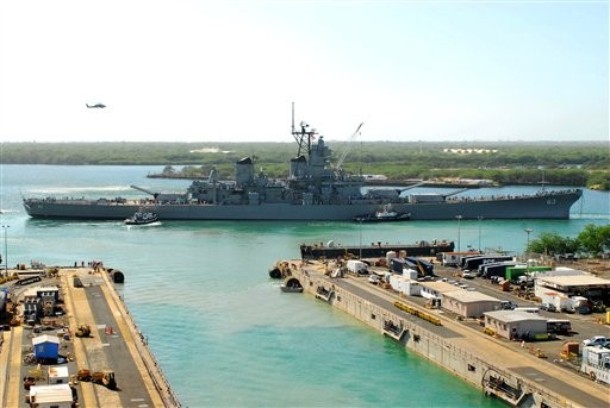
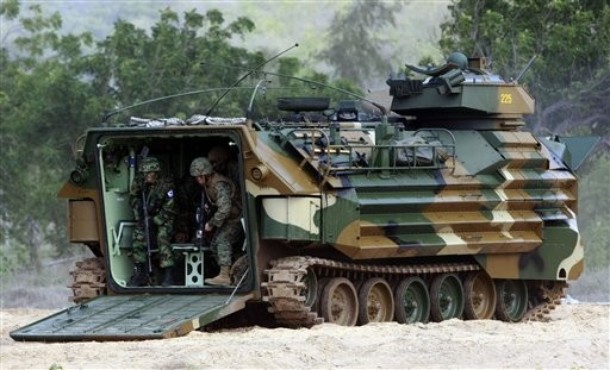
uscircleschina.jpg

President Obama's "pivot" to Asia has been overshadowed by events in the Middle East, but as John Reed reports, that hasn't stopped the administration from implementing a policy of military encirclement around China:

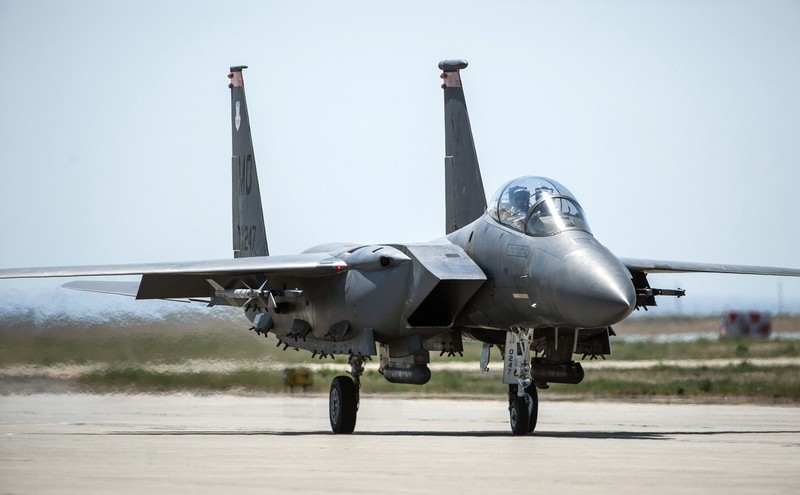
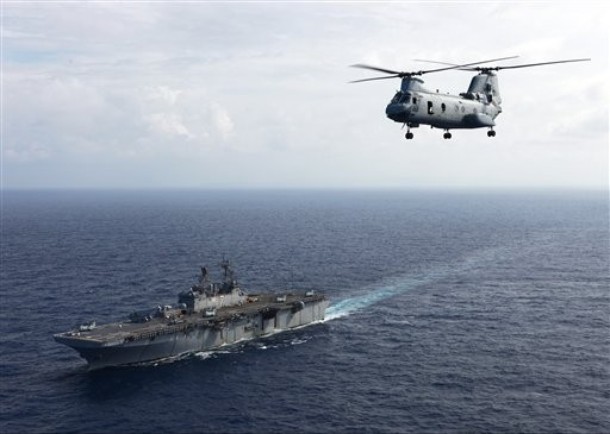
The United States Air Force will dramatically expand its military presence across the Pacific this year, sending jets to Thailand, India, Singapore, and Australia, according to the service's top general in the region.

For a major chunk of America's military community, the so-called "pivot to Asia" might seem like nothing more than an empty catchphrase, especially with the Middle East once again in flames. But for the Air Force at least, the shift is very real. And the idea behind its pivot is simple: ring China with U.S. and allied forces, just like the West did to the Soviet Union, back in the Cold War.


What kind of reaction will this encirclement provoke in China?

One way to answer this is to flip the question: If China began using bases in Central America to station offensive air power, would the U.S. sit idly by?

The administration seems to be banking on a deterrent effect -- that the Chinese will see the constellation of forces arrayed against them and relent on some of their territorial claims and acquiesce, however begrudgingly, to American military dominance in their backyard. This is a high-risk roll of the dice, to say the least.

(AP Photo)

May 6, 2013

The Great Foreign Policy Paradox: Terrorists Are Starfish

starfishrcw2.jpg

Motivational speakers are fond of telling a slightly corny, yet morally correct, story about a girl flinging starfish back into the ocean after a storm washed thousands of them onto a beach. The point of the story is that one person, while probably incapable of changing the world, can make a substantial difference in the lives of those whom they touch.

Unfortunately for motivational speakers, starfish may not be the most lovable example. To fishermen and marine biologists, starfish are an incredible nuisance. They eat oysters and clams, and they even destroy coral reef ecosystems, including the beloved Great Barrier Reef. To get rid of them, fishermen would chop them up and throw them back into the water.

The trouble with this strategy is that starfish can regenerate. A bisected starfish isn't a dead starfish: It's now two starfish. (And a starfish cut into five pieces turns into five starfish!)

In the world today, civilized societies are the fishermen, and terrorists are the starfish. If we leave the terrorists alone, they will destroy our global ecosystem; if we attack them, they multiply. This is the great paradox of foreign policy.

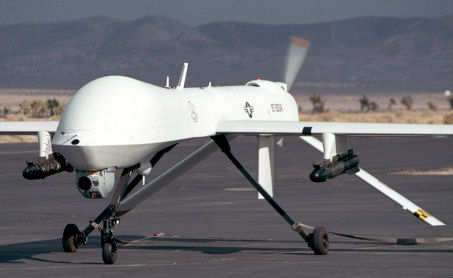
This paradox has received a lot of attention recently in regard to our drone campaign. Writing in The Atlantic, Hassan Abbas concludes that we simply don't know if drones are creating more terrorists than they kill.

Which is why the recent testimony of Yemeni writer Farea Al-Muslimi before the Senate is so troubling. He claims that drone strikes are terrifying his fellow countrymen and turning public opinion against the United States. Jihadists prey upon the poor, the angry and the fearful -- using their poisonous ideology to convert them into extremists.

This is largely what happened in Chechnya, the ancestral homeland of the Boston bombers. The Economist explains:

The nationalist cause that inspired Chechen fighters 20 years ago is now an Islamic one. Yet this mutation has as much do with Russia’s ruthless actions in the region as with the global spread of Islamist fundamentalism.

The article concludes that "suppression alone is unlikely to bring greater security to Russia."

Any marine biologist would have known that.

(Image: Starfish via TheMargue/Wikimedia Commons)

March 20, 2013

President Obama Claims U.S. Alliance to Israel Is "Eternal"

obamaisraeleternal.jpg

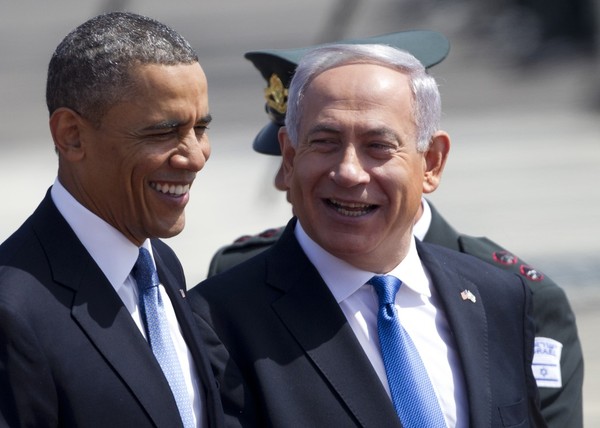
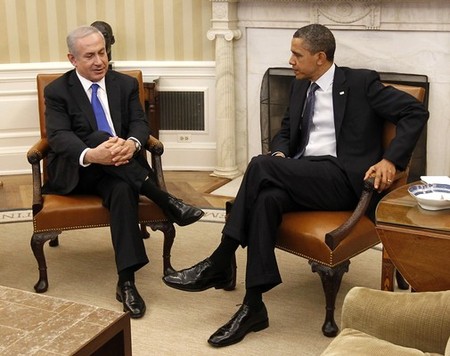
President Obama, speaking in Israel today:

“So as I begin this visit, let me say as clearly as I can –the United States of America stands with the State of Israel because it is in our fundamental national security interest to stand with Israel. It makes us both stronger. It makes us both more prosperous. And it makes the world a better place. That’s why the United States was the very first nation to recognize the State of Israel 65 years ago. That’s why the Star of David and the Stars and Stripes fly together today. And that is why I’m confident in declaring that our alliance is eternal, it is forever – lanetzach.”

While President Obama credits "strong national security interests" with the initial U.S. recognition of Israel, the reality was more complicated. In fact, President Truman's State Department and Defense Department, his key national security advisers, objected to the move. (Allis and Ronald Radosh have a nice background on Truman's recognition of Israel here.)

What's important about the president's remarks today, though, is less the strategic history than his assertion that the U.S. and Israel have an "eternal alliance."

I suspect we're going to see a lot of debate centered around that phrase in the coming days.

Andrew Sullivan, for instance, contrasts Obama's rhetoric with George Washington's famed warning to avoid entangling alliances:

The concept of an “eternal”, and “unbreakable” alliance with any other single country is a statement George Washington would have regarded as deeply corrosive of foreign policy and domestic governance. To declare it in the language of the foreign country has even deeper resonance. It is now the governing principle of both political parties – and the primary reason we may once again be headed to war with unforeseeable consequences in the Middle East.

Rick Moran, meanwhile, doubts Obama's sincerity:

If Iran gives him half a chance, he will sell out Netanyahu and the Jewish state.

Uri Friedman sees more subtle language at work:

See what he did there? Change "your" to "our" and a host of furious no-stronger-allies would be knocking on Washington's door. But, as Obama's speechwriters are well aware, it's probably fair to say that Israel received a visit from its closest partner today.

(AP Photo)

March 19, 2013

What Pundits and Politicans Mean When They Say "Neo-Isolationism"

usarmyisolation.jpg

Michael Hirsh says that there's a new monster stalking the nation's capital: neo-isolationism. Here's his evidence:

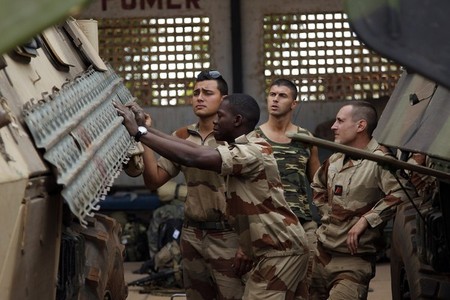
Perhaps nothing more vividly illustrates this dramatic transformation in U.S. foreign policy than the reversal of roles on the world stage of the United States and France. A decade ago, in the months before the Iraq invasion, the French played the role of chief challengers to the Bush administration and were derided as “cheese-eating surrender monkeys,” in the colorful tabloid phrase of the time. Today, it is France that is taking the lead in intervention, prodding the U.S. forward in Libya, Syria and Mali.

To a degree that the American public may not even be aware of, the U.S. military is now playing a supporting role to the French, with logistical aid and airlift in Mali, much as it did in Libya. In addition, Washington is only slowly coming around to the hawkish French view of Syria's stalemate: Autocrat Bashar al-Assad won’t be moved to negotiate unless the rebels can change the military balance with Western arms. A senior Western diplomat says America’s reluctance to intervene today, even in a humanitarian crisis as bloody as Syria’s, is not unlike where Washington was at the beginning of the Bosnia crisis of the early 1990s, when then-President Clinton was criticized for his hesitation (he eventually came around to supporting NATO strikes and empowered an aggressive U.S. diplomat, the late Richard Holbrooke, to take the lead from the Europeans in negotiations).

So ... the evidence that America has turned isolationist is that it has intervened in two countries (in the past several months) but on a more limited basis and not as fast as some people would like.

With all due respect to Hirsh, this is rather thin beer.

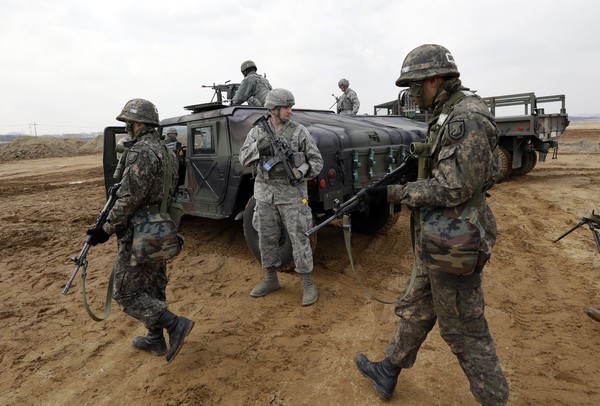
In fact, the "neo-isolationist" meme would be farcical and embarrassing if it wasn't so pernicious. As Daniel Larison notes, there are no isolationists in any meaningful sense of that term operating in American politics today. Even the more ardent non-interventionists still endorse trade and diplomacy. Many realists support the U.S. maintaining some international power projection capabilities as well.

So the term "isolationist" is really a short-hand for someone who opposes a particular war or intervention. It would be helpful if Hirsh and others chronicling Washington's foreign policy debate would be more specific here: There may indeed be a greater scrutiny with respect to the costs and benefits of putting U.S. boots on the ground in various parts of the world, but that's a far cry from "isolationism." Conflating it as such plays into the hands of demagogues.

(AP Photo)

March 12, 2013

U.S. Think Tank Concerned That No One Thinks America Is Great Anymore

liebermanisolationist.jpg

Senator Leiberman is going to the American Enterprise Institute to do battle with the dark (and non-existent) forces of neo-isolationism. In making the announcement, AEI's President Arthur Brooks made the following observation:

"Senator Joseph Lieberman's knowledge, deep commitment and vision for American greatness is all too rare in Washington."[Emphasis mine.]

The idea of American greatness is "rare" in Washington? What Washington is Brooks referring to? The notion of American exceptionalism is one of the most rigid orthodoxies around. Kishore Mahbubani addressed this point at a recent Asia Society event with a telling anecdote: as he moderated a panel on American power with U.S. politicians and policy-makers, he discovered that "no senior American figure can have words coming out of his or her mouth" acknowledging even the possibility that America could be number two in the world.

Needless to say, the idea that America in general and Washington's political class in particular is suffering from an insufficient dose of self-flattery doesn't pass the laugh test.

(AP Photo)

March 6, 2013

Kerry's Magic Words Will Keep Arms from Falling into Jihadist Hands

kerrymagic.jpg

Secretary of State John Kerry has a plan to stop Gulf state weapons from ending up in jihadist's hands in Syria:

Secretary of State John Kerry said Tuesday that the Obama administration supported efforts by Middle Eastern nations to send arms to the opposition in Syria, and had had discussions with foreign officials to emphasize that those arms should go to moderate forces rather than to extremists.

“We had a discussion about the types of weapons that are being transferred and by whom,” Mr. Kerry said after a meeting with the prime minister of Qatar, which has been involved in arming the Syrian opposition. “We did discuss the question of the ability to try to guarantee that it’s going to the right people and to the moderate Syrian opposition coalition.”

Mr. Kerry’s comments were the most direct public affirmation to date that the Obama administration was supporting efforts to arm the Syrian resistance, provided that the arms are sent by other nations and that care is taken to direct them to factions the United States supports. [Emphasis mine.]

It's been discussed and emphasized. Is anyone else reassured by that?

(AP Photo)

March 5, 2013

Americans Are Ignorant About Their Military Might

naymight.jpg

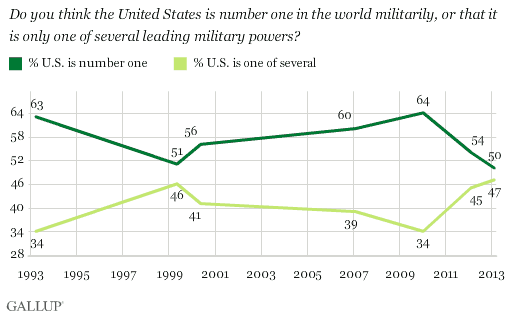
America has not faced a military equal for decades now. The U.S. routinely outspends all of its potential rivals combined and while it doesn't boast the largest nuclear arsenal in the world in numeric terms, it's generally considered qualitatively superior to Russia's nuclear stockpile.

Yet a surprisingly large number of Americans don't seem to grasp their country's military superiority.

According to Gallup, fully 47 percent of Americans think that the U.S. is merely one of several leading military powers. The 50 percent who answered correctly that the U.S. is the leading military power represents an all-time low for the figure:

whzhcxq6c0onb_u2bndkrq.gif

Daniel Larison takes a stab at explaining why so many people don't understand America's relative military standing:

When the U.S. fights major foreign wars, the well-publicized exercise of U.S. military power–no matter how unnecessary or self-defeating–drives the public perception that the “U.S. is number one” up and drives the other result down. When the U.S. concludes these wars or is perceived to be in the process of bringing them to a conclusion, we seem to see the reverse. A related explanation is that concluding wars, withdrawing forces from other countries, and considering the possibility of reduced military spending provoke hawkish warnings of American “decline.” That leads to a different sort of alarmism about the dangers to the world that could result from this so-called “decline.”

Robert Golan-Vilella adds more:

One reason is the habitual tendency of U.S. policy makers to exaggerate threats and dangers around the world, as Micah Zenko and Michael Cohen chronicled in their Foreign Affairs essay “Clear and Present Safety” last year. With leaders constantly stressing how dangerous and threatening the world is, it’s no wonder that the U.S. public believes a number of mistaken things about global affairs—and that many of them involve either overstating threats or understating Washington’s own power. For example, a 2010 CNN poll found that 71 percent of Americans believe that Iran currently has nuclear weapons. A separate CNN poll in 2012 indicated that Americans believe that the threat from Iran is on par with the danger presented by the Soviet Union in the mid-1980s. These latest results from Gallup appear to be part of the same story.

(AP Photo)

February 26, 2013

Top House Democrat Wants to Arm Syrian Rebels

Rep. Eliot Engel (D-NY) thinks it's a good idea to dump weapons into Syria. Engel evidently believes the U.S. has a "choice" between brokering a peace deal with Russia and Assad, or precipitating the Assad regime's violent collapse.

Engel does not offer any evidence to support the proposition that arming the rebels will produce an outcome amenable to American interests -- this is now apparently simply assumed on faith.

In other Syrian news, the Saudis are reportedly funneling infantry weapons from Croatia into Syria. Not to worry though: they're only giving those weapons to "secular" and "nationalists" groups -- and not jihadists. According to an unnamed CIA official, the rebellion against Assad remains "fragmented" and "operationally incoherent."

Maybe someone should tell Rep. Engel.

February 25, 2013

Americans Think the World Thinks Better of Them

obamaintheworld.jpg

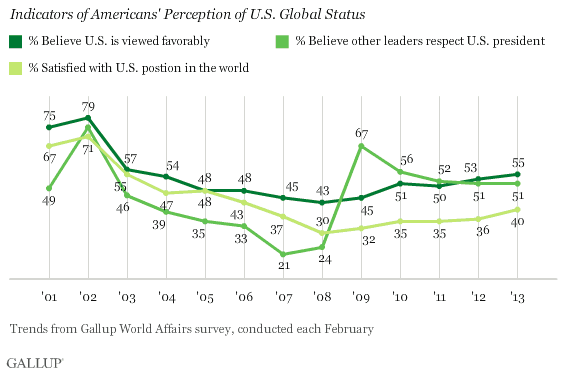
Americans are increasingly satisfied with how their country is viewed in the world, according to Gallup's U.S. Global Status Index.

The country's satisfaction with its global status is the highest it's been since 2006, but the index itself (which is based on three questions pertaining to America's global status) shows key variations. While Americans are happier with their country's perception in the world, they have consistently lost faith in the proposition that other leaders respect President Obama -- although the current president still rates significantly higher on this score than his predecessor during the depths of the Iraq war.

Americans on the whole are also still largely unsatisfied with their position in the world. What's a superpower to do?

ulv1mhff_0ekdfmikly6ua.gif

(AP Photo)

February 22, 2013

Can the U.S. Bring Order to an Unruly World?

obamagrandst.jpg

Patrick Doherty is worried about the current trajectory of global politics:

Abroad, Washington's post-Cold War pattern of episodic adventurism and incremental crisis management only creates further uncertainty, and rising powers will not lead. Other major economies have little appetite for altering the global order and hence are doubling down on the old system, exacerbating trade imbalances and driving record resource extraction. As commodity prices rise, global powers are hedging ever more aggressively -- stockpiling resources and increasingly becoming entangled in conflicts in resource-rich areas. As the global economy falters, unrest rises and the great unresolved conflicts of the 20th century -- the Middle East, South Asia, North Korea, Taiwan -- grow increasingly enmeshed in the power dynamics of this new era.

Simply put, the current U.S. and international order is unsustainable, and myriad disruptions signal that it is now in a process of collapse. Until the United States implements a new grand strategy, the country will face even more rapid degradation of domestic and global conditions.


Doherty goes on to outline his view of what a workable U.S. strategy should be and I encourage you to read it in full. But here I just want to put in a kind word for "incremental crisis management."

It's very popular in foreign policy punditry circles to call for a grand strategy, or complain that a given administration lacks one (or lacks a good one). I've done it myself. But there is also something to be said for "incremental crisis management," particularly when the alternative is untenable, as I suspect Doherty's might be.

Any global strategy advanced by Washington is going to encounter hundreds, if not thousands, of variables that cannot be predicted or adequately controlled for. A year before 9/11, almost no serious "grand strategist" would have argued for the complete realignment of the U.S. national security bureaucracy to chase some guys in a cave in Afghanistan. (The Bush administration spurned the poor guy who proposed a more vigorous effort against al-Qaeda in the pre-9/11 months.)

In other words, efforts at concocting a very elaborate grand strategy are one unexpected crisis away from being rendered laughably obsolete.

But incremental crisis management has something going for it, particularly in the world that Doherty describes. Translated from bureaucratic speak, it simply means responding to events as they occur in a manner that may not "solve" a problem, but does enough to mitigate the worst harm to the United States. In other words, it's about being flexible and not having a rigid template. In a world that is being beset by a series of challenges -- some envisioned, others not -- with the global distribution of power and influence in flux, it's not a bad idea. In such an instance, a new global order will emerge on an ad-hoc basis -- which it is likely to do anyway, no matter what strategy Washington pursues.

(AP Photo)

February 20, 2013

Americans Don't Want Their Government Spreading Democracy (But Do Want it Fighting Terrorism)

obamaontheplane.jpg

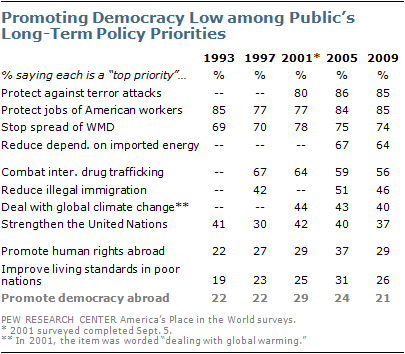
What do Americans want their government to be doing abroad? According to a new survey from Gallup, the answer is resoundingly "preventing future acts of international terrorism." What ranked as the least important priority (from the choices given)? "Helping other countries build democracies."

Here's the full list:

6fppssciik2vvuidwfeyma.gif

Gallup has polled these priorities five times since 2001 and found only a slight variation in Americans' stated preferences. The issue of securing of energy supplies has shifted steadily up the priority scale since 2003.

(AP Photo)

February 19, 2013

Why Hagel Is Generating Such Sound and Fury

hagel%20battle.jpg

Josh Marshall and Andrew Sullivan make the case that one reason Hagel's nomination has become such a hot potato is because he symbolizes the Obama administration's pivot away from the Middle East. Here's how Marshall puts it:

Let’s start with what we might incompletely call the Bush/neoconservative approach. It is a belligerent unilateralism, a vision based on an abundantly powerful and yet deeply endangered America, and — very significantly — one that sees almost all the big issues and future security of the country emanating out of the zone of conflict stretching from North Africa into Pakistan. In other words, it’s about oil, Islam, the Middle East and Israel.

The people around Obama have a different take on goals, threats and tactics. It’s not just that we can’t continue — either in security or fiscal terms — with open-ended occupations of Middle Eastern countries or hapless efforts to ‘transform the region’. It’s that the Middle East is fundamentally more yesterday’s news than tomorrow’s and that we need to be in the business of making it more yesterday rather than less.

There are multiple lines of attack against Hagel, so I don't know if there's really one meta answer for why his nomination has generated such controversy. Still, Marshall makes an interesting point.

(AP Photo)

February 18, 2013

Five Things Americans Fear the Most

nkoreatopthreat.jpg

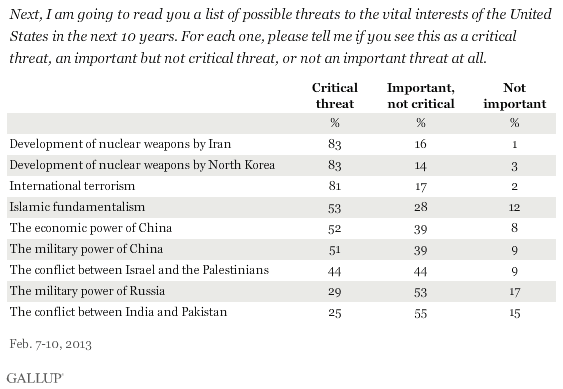
What do Americans fear most? When it comes to America's international security interests, the North Korean and Iranian nuclear programs are deemed most threatening, according to a new survey from Gallup. Americans were giving a list of nine developments and asked to rank them from more to less critical. Here are the top five threats Americans say are most critical:

1. The nuclear programs of Iran and North Korea (tied for first)
2. International terrorism
3. Islamic fundamentalism
4. The economic power of China
5. The military power of China

The poll was conducted before North Korea's most recent nuclear test.

Other issues that had previously ranked higher -- such as the Israeli-Palestinian conflict and tensions between India-Pakistan -- have declined.

Here's a look at the full list of Gallup's results:

gallupthreats.gif

(AP Photo)

February 14, 2013

Has Obama Lost Pakistan?

gallup021413.gif

In his State of the Union address earlier this week, President Barack Obama had this to say about U.S. counterterrorism efforts in the (mostly) Muslim world:

Today, the organization that attacked us on 9/11 is a shadow of its former self. Different al Qaeda affiliates and extremist groups have emerged – from the Arabian Peninsula to Africa. The threat these groups pose is evolving. But to meet this threat, we don’t need to send tens of thousands of our sons and daughters abroad, or occupy other nations. Instead, we will need to help countries like Yemen, Libya, and Somalia provide for their own security, and help allies who take the fight to terrorists, as we have in Mali. And, where necessary, through a range of capabilities, we will continue to take direct action against those terrorists who pose the gravest threat to Americans.

As we do, we must enlist our values in the fight. That is why my Administration has worked tirelessly to forge a durable legal and policy framework to guide our counterterrorism operations. Throughout, we have kept Congress fully informed of our efforts. I recognize that in our democracy, no one should just take my word that we’re doing things the right way. So, in the months ahead, I will continue to engage with Congress to ensure not only that our targeting, detention, and prosecution of terrorists remains consistent with our laws and system of checks and balances, but that our efforts are even more transparent to the American people and to the world.

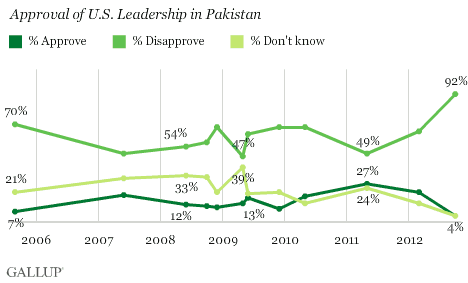
One place left unmentioned in the president's address was Pakistan, where a recent Gallup poll indicates that disapproval of U.S. leadership is at an all-time high:

With President Barack Obama's first term characterized by strained relations between Pakistan and the U.S., more than nine in 10 Pakistanis (92%) disapprove of U.S. leadership and 4% approve, the lowest approval rating Pakistanis have ever given.
Pakistanis now more than at any other time in the past three years feel threatened by interaction with the West, according to a May 12-June 6, 2012, survey. A majority (55%) say interaction between Muslim and Western societies is "more of a threat," up significantly from 39% in 2011. This sharp increase is observed at a time of heightened Pakistani concerns regarding U.S. encroachment on Pakistani sovereignty, including an intensified number of U.S. drone strikes in Pakistan, as well as the aforementioned May 2011 killing of bin Laden by the United States military.

Enlisting "values" in the fight against terrorism is all well and good, but values projection isn't a direct marketing campaign. American values are understood abroad not through rhetoric, but through policy. While drones are certainly a more cost efficient, and less invasive, form of interventionism, they are a form of intervention nonetheless. The president came into office hoping for a reset with the Muslim world, but the "Muslim world" isn't a place; it's a concept comprised of many different sects, regions, languages, nationalities and interests. As it turns out, matters of sovereignty, national identity, regional supremacy and patriotism matter to Muslims, too. (Shocking, I know!)

Over 10 percent of the world's Muslim population resides in restive, nuclear-armed Pakistan. There's certainly no panacea for fighting fringe organizations like al-Qaeda, but if President Obama is so concerned about Muslim extremism, then he might want to stop alienating the places where most of the world's Muslims happen to live.

February 13, 2013

Restrainers vs. Shapers in U.S. Foreign Policy

restrainandshape.jpg

Thomas Wright argues that the "new debate" among Democrats in foreign policy is a divide between "shapers" who want America to play an activist role abroad and "restrainers" who don't. Wright sees a short-term win for the restrainers, with a caveat:

Restraint is an idea that seems to fit the moment. Americans are tired of war and feel more constrained after the worst financial crisis since the Great Depression. However, over time, the realization will set in that staying out also shapes the world -- and probably in a way that is detrimental to America's interests. It creates a vacuum filled by others. It fuels uncertainty. And it exacerbates crises.

Larison isn't buying it:

Armed foreign intervention, providing military supplies to one side in a conflict, and imposing sanctions on another country create their own kinds of uncertainty and exacerbate the crises they are meant to address, and they do so in ways that directly involve the U.S. and impose longer-term obligations on it. Toppling regimes creates vacuums that are filled by others, and that has been true even when the U.S. has had over a hundred thousand soldiers occupying another country. The reason that restraint often makes more sense than interference is that it is quite unusual to find cases where interfering would benefit the U.S. and the country in question more than it costs both. The impulse to “shape” events in other countries is misguided in principle and frequently destructive in practice. Put bluntly, the “shapers” in both parties have had their turn for the last twelve years, and they aren’t likely to get another one for a while.

The frustrating thing about Wright's overview of the debate is that it's focused solely on military questions, as if that is the only way in which the United States can or should exercise "influence" in the world. I think it's true that there is a constituency, in both parties, that wants to see the U.S. less militarily engaged around the world, but that is manifestly not the same thing as being "restrained" when it comes to economic engagement or traditional diplomacy.

(AP Photo)

February 8, 2013

"Everyone Is Happy with the Status Quo on Iran"

iranhappy.jpg

After committing himself to Iran blogging autopilot, Drezner argues that the status quo will endure because most of the major players, with the exception of Israel, are happy with it:

The U.S. is delighted to keep Iran contained. The Iranian leadership is content to blame the U.S. for all of its woes and possess a nuclear breakout capacity, without actually having nuclear weapons. Iran's economic elites are delighted to engage in sanctions-busting -- more profit for them. And Iran's neighbors are happy to see Iran contained and not actually develop a nuclear weapon. I think even Israel would be copacetic with the current arrangement if they knew that the Iranian regime had no intention of crafting an actual weapon unless it felt an existential threat.

I don't think this status quo is sustainable at all and the U.S. may not be all that happy with it if they thought through the implications. Put simply, the U.S. is on a similar course with Iran as it was with Iraq in the 1990s. That containment regime took a brutal toll on innocent Iraqis and helped fuel terrorism against the United States. It then culminated in a costly war because many people became convinced that the status quo was intolerably threatening.

Iran is on the same trajectory, only it may not take a decade to crumble, given Israel's repeated warnings about taking preemptive action. U.S. sanctions may or may not dissuade the ruling elite to permanently forswear nuclear weapons, but it will eventually devastate life for ordinary Iranians. Worse, the U.S. is empowering Sunni Gulf allies who are in turn helping to "contain" Iran by whipping up Sunni jihadist forces around the region. These forces pose a much more direct threat than Iran since, by their very nature, they cannot be contained and have a proven capacity to do large scale damage inside America. They are instruments of instability and they're already at work in Syria, right next door to Iran.

I think in the short-term, the rinse/repeat quality of the Iranian containment regime justifies autopilot, but I think it's likely to unravel much sooner than we think.

(AP Photo)

Why Neoconservatives Get Their Way (On Many Things)

randpaul.jpg

Daniel Larison thinks Robert Kagan is wrong to suggest that Senator Rand Paul is not a "true" foreign policy dissenter because then he "would have the temerity to declare that a nuclear Iran, although unfortunate, is nevertheless tolerable and that the military option ought not to be on the table." According to Larison, that's not the way politics works:

Kagan knows very well why Sen. Paul doesn’t take a more unconventional line on Iran policy. We have seen it on display for the last seven weeks in the panic over Hagel’s nomination and we have seen it over the last six years as Sen. Paul’s father has been written off as a “fringe” figure because he takes exactly the position on Iran that Kagan describes. Obviously, Kagan isn’t interested in having a “true dissenter” in the debate, and he hates them when they appear.

While I think Larison is right about the practical results, I wonder if Kagan doesn't have a point. It all goes back to the Overton window. For the uninitiated, here's the theory:

The Overton window is a means of visualizing which ideas define that range of acceptance by where they fall in it. Proponents of policies outside the window seek to persuade or educate the public so that the window either “moves” or expands to encompass them. Opponents of current policies, or similar ones currently within the window, likewise seek to convince people that these should be considered unacceptable.

Kagan and his fellow advocates both within government and in think tanks and journalistic institutions have had a fair degree of success in moving this window in their direction. Whenever a civil war breaks out in countries within or adjacent to regional interests of the United States, there is an implicit expectation that Washington "do something." By defining America's sphere of interest so broadly (Kagan, remember, believes the U.S. should exercise hegemony over the very Earth itself) they have succeeded in moving the policy debate onto grounds that are already favorable, even if they don't get every war or intervention they desire.

The problem is that the Overton window does not move back in a direction of less intervention through nuanced critiques of the most extreme position. Believe me, I wish it did. Instead, it needs to move using the same kind of stridency and demagoguery that pushed it in its original direction. So while I personally wouldn't agree with categorically ruling out the use of force against Iran no matter what, opponents of preventative war are going to have to make some politically risky declarations if they expect the consensus to start to move in their direction.

(AP Photo)

February 6, 2013

Rand Paul Foreign Policy Speech

U.S. Senator Rand Paul is scheduled to outline a "constitutionally conservative" foreign policy in a speech at the Heritage Foundation this morning. For a preview of the speech, be sure to check out Daniel Larison's recent interview with the senator.

You can watch the speech here, below the jump, at 11 a.m. ET.

Continue reading "Rand Paul Foreign Policy Speech" »

February 4, 2013

The Case for Maintaining U.S. Aid to Egypt

egyptrunrest.jpg

Ken Sofer argues that cutting U.S. aid to Egypt now would be too harsh:

While Egypt’s progress under President Muhammad Morsi towards an open, democratic state has been frustrating and often ineptly managed, the United States needs to remain engaged in efforts to influence the political and economic transition in Egypt, as well as bolster security in one of our most important allies. Both actions will require continued support for a full range of U.S. policy tools — including the annual security and economic assistance the U.S. has delivered since 1979 — and a more robust diplomatic engagement with the multiple centers of power that have emerged in Egypt during the past two years.

U.S. assistance and support for Egypt must be reformed in the long run to reflect new realities, but ending aid to Egypt is a blunt tool that should be reserved for red lines in the relationship, such as a coup d’état, a sharp authoritarian turn, or Egypt reneging on its treaty obligations with Israel. As incoming Secretary of State John Kerry recently stressed, now is not the time to rashly cut off support to Egypt. Clearly, Egypt’s people and leaders will determine its trajectory, but the United States can play a positive role in shaping outcomes.

Can the U.S. really play a positive role? Presumably Sofer means that we can continue to identify and work with liberal factions inside Egypt to bolster their capacity to peacefully organize while exerting pressure on the Brotherhood to adhere to the peace treaty with Israel and govern according to Egypt's constitution. None of these things are necessarily bad ideas, but are they sufficient? And if they fail, what will the U.S. have gained? Having meddled in Egypt's political transition and failed to secure our preferred outcome, we will simply have made more enemies, wasted billions of dollars and provided significant weaponry to a hostile force.

Events across the entire are very fluid right now. I think the notion that Washington can harness these turbulent forces to "shape outcomes" to its liking is, at best, optimistic.

(AP Photo)

Hagel's Retreat Exposes Myth of "Bipartisan Consensus" on U.S. Foreign Policy

The one criticism that seems to have stuck on Chuck Hagel is the charge that his views were outside the "mainstream" consensus arrived at by that bastion of foreign policy understanding, the U.S. Congress.

This consensus is treated as if it simply reflects a self-evident reality about U.S. interests, or portrayed as the result of careful, bipartisan deliberation. The Hagel hearings exploded that myth.

Instead, we saw first hand that the bipartisan consensus is sustained because policymakers with career ambitions can't really afford to deviate from it without risk to their career. It's an incentive structure that selects for conformity. Hagel's "safe" approach to the hearing, where he choose to mostly elide (or bumble) tough questions rather than address his critics head on, will only entrench this dynamic. Even if he survives the confirmation process, any current or future foreign policy wonk with high career ambitions who watched the Hagel hearings must have absorbed the message: much better to play it safe.

Update: Larison adds more:

One thing I would add to this is that the conformity that is being demanded of politicians and officials doesn’t have much of anything to do with an informed understanding of the relevant issues. As Scott pointed out in his post last week, adhering to the consensus view seems to require flat-out rejection of weighing different policy options. It doesn’t seem to matter whether a person has reached the “right” conclusion at the end of his deliberation. Evidently, the process of reaching that conclusion must not involve entertaining or considering anything besides the “right” answer, and if it has that becomes grounds for suspicion. It’s not just that the consensus view isn’t the product of careful deliberation, but that careful deliberation itself is taken as a sign of possibly unacceptable deviationism.

January 31, 2013

Why Is the U.S. "Leading from Behind?"

leadingfrombehind1.jpg

Victor Davis Hanson offers up every possible explanation but the right one:

After the collapse of the Soviet Union, both Democratic and Republican administrations ensured the free commerce, travel, and communications essential for the globalization boom.

Such peacekeeping assumed that there would always pop up a Manuel Noriega, Slobodan Milosevic, Saddam Hussein, or Osama bin Laden who would threaten the regional or international order. In response, the United States — often clumsily, with mixed results, and to international criticism — would either contain or eliminate the threat. Names changed, but evil remained — and as a result of U.S. vigilance the world largely prospered.

This bipartisan activist policy is coming to a close with the new “lead from behind” policy of the Obama administration. Perhaps America now believes that the United Nations has a better record of preventing or stopping wars — or that the history of the United States suggests we have more often caused rather than solved problems, or that with pressing social needs at home we can no longer afford an activist profile abroad at a time of near financial insolvency.

How about a more plausible explanation: that the U.S. is slowly coming around to the idea that it has to set priorities about when and where it intervenes and that regional powers are more than capable of handling these policing duties? (And, to the extent they're not, it's because life under the U.S. defense umbrella has hollowed out their military capacity -- a dynamic that can only be reversed if it's clear the U.S. taxpayer won't be continually on the hook for their defense.)

And isn't it ironic that at a time of "near fiscal insolvency" the supposedly "conservative" position is to retain an "activist profile abroad" at all costs? Slash big government at home to sustain big government abroad. No cognitive dissonance there!

(AP Photo)

January 28, 2013

Obama's Promise: A "Surgical Strike" Against Iran

In an interview with the Daily Beast, Israel's outgoing defense minister Ehud Barak said the Obama administration presented Israel with "quite sophisticated" plans for a "surgical" operation against Iran's nuclear program.

One question that arises is whether the Obama administration went through this exercise as a means of mollifying Netanyahu to delay a strike, without any real intention of following through, or whether the administration made more concrete assurances to buy more time for sanctions and negotiations. Either way, as Barak states at the end of the interview, the U.S. has put its credibility on the line with the Iranian nuclear program.

Still, the idea that any strike against Iran would be "surgical" is a misnomer, one designed to soften the public's expectations for what a military campaign against Iran would entail. Such a mission may be conceived of as a limited and targeted strike, but if Iran were to retaliate, all bets would be off and things could get messy very quickly.

January 24, 2013

Rand Paul Is Not a Conspiracy Theorist

Hayes Brown thinks Senator Rand Paul is indulging in conspiracy theory mongering because he asked Secretary Clinton about the possibility that the U.S. used its consulate in Libya to funnel weapons into Turkey and eventually Syria:

Paul’s inquiry about Turkey seems less odd if you’re familiar with Glenn Beck-inspired conspiracy theories that have been circulating among right-wing websites since the attacks in Libya.

The theory goes that Ambassador Chris Stevens — who was killed during the attack — was deeply involved in the CIA project of gathering loose arms in Libya in the aftermath of Moammar Qaddafi’s downfall. Stevens then facilitated the movement of those arms from Libya to Turkey, where they then went on to Syria. The secrecy involved in moving those weapons under the table is part of why the Obama administration covered up the truth of the attack, according to the theory, which even Fox News has helped spread.

The Obama administration has repeatedly said that it will not be providing arms to the rebels in Syria, which this theory claims to counter. While the CIA was involved with helping round up the loose arms that were rampant in Libya, there is no evidence that Stevens or the State Department was involved in the operation, nor that the arms were then shipped to Syria.

Look, I do not traffic in "Glenn Beck-inspired conspiracy theories" but this dismissal is just a wee bit threadbare. Is it a self-evidently crackpot idea that the U.S. government would secretly funnel weapons to insurgents in other parts of the world? Um, no. It was a fairly standard American practice throughout the Cold War. In fact, the Obama administration is arming multiple "allies" in both Africa and the Middle East as we speak. It is "coordinating" with Gulf state allies to provide arms to Syria's rebels in their quest to overthrow the Assad regime. Is it really that much of a stretch to think that the U.S. is quietly getting arms to the Syrian rebels directly as well?

The only evidence Hayes musters to dispute the theory is that the Obama administration said it isn't. And we all know that no U.S. administration would lie about this kind of thing.

Seriously, I have no idea what happened in Benghazi any more than Hayes does. I'm not very interested in what the administration's talking points were, or should have been. But if the U.S. was using Libya to smuggle weapons into Syria, it's something the American people should know about.

January 21, 2013

Neoconservatism as a Communist Show Trial

Daniel Larison catches Jennifer Rubin demanding re-education for Chuck Hagel:

The language of inquisitors crops up throughout the post. Rubin describes recent reports about Hagel’s views in terms of his supposed “serial recantation,” she insists that he must “renounce” his past views, and later implies that he must express remorse for them. Hagel is supposed to prove the sincerity of his “conversion,” and he must prove that he has “the emotional commitment to these views” that the hard-liners require. At one point, she states that this is necessary because “we expect the defendant to recognize and accept full responsibility for his misdeeds.” In this case, Hagel’s “misdeeds” amount to questioning hard-line policies and nothing more. Applying such absolutist, religious terms to policy differences is twisted, and it is proof of the fanaticism of Hagel’s critics.

It is not enough if Hagel ceases to support a policy that Rubin considers mistaken, and it is certainly not enough that Hagel correct the distortions of his record that his critics have circulated. According to this fanatical view, he is obliged to confess his wrongdoing and beg mercy of the people hounding him.

Do Mali Terrorists Intend to Attack the United States?

mali.jpg

The Obama administration has been slow to hop on the Mali intervention bandwagon and some reporting from the Los Angeles Times indicates why:

Militants in Mali, "if left unaddressed, ... will obtain capability to match their intent — that being to extend their reach and control and to attack American interests," Army Gen. Carter Ham, head of the U.S. Africa Command, said in an interview.

But many of Obama's top aides say it is unclear whether the Mali insurgents, who include members of the group Al Qaeda in the Islamic Maghreb, or AQIM, threaten the U.S.

Those aides also worry about being drawn into a messy and possibly long-running conflict against an elusive enemy in Mali, a vast landlocked country abutting the Sahara desert, just as U.S. forces are withdrawing from Afghanistan.

"No one here is questioning the threat that AQIM poses regionally," said an administration official who spoke on condition of anonymity when discussing internal deliberations. "The question we all need to ask is, what threat do they pose to the U.S. homeland? The answer so far has been none."

It's hard to know just what kind of aims and "intent" AQIM has, since different leaders may have a different conception of their mission. According to the Combating Terrorism Center at West Point, AQIM is more of a regional outfit and to the extent that it wants to target foreign countries, France and Spain top the list. Although as this CFR backgrounder makes clear, that picture may be changing with possible links between AQIM and the attack on the U.S. consulate in Benghazi, Libya.

Still, the Pentagon risks setting up a self-fulfilling prophecy if it ends up quickly diving into a war in Mali. AQIM will have regional aims up until the minute U.S. bombs start falling on their heads. At that moment, they will no doubt broaden their sights.

(AP Photo)

January 18, 2013

What the Hagel Debate Is Really About: The Wisdom of Preventative War

hagel11.jpg

Robert Satloff identifies a real, substantive issue in the Hagel debate amid the tawdry smear campaign:

Even supporters of Hagel’s nomination must admit that it is nearly impossible to find any support in his record for the idea of “prevention” that undergirds the strategy toward Iran. This concept, which has been publicly embraced by Obama, means that the United States should deter Iran not from using a bomb but, rather, from acquiring one — preventing Tehran peacefully, if possible; through military means, if necessary.

While Hagel has not specifically repudiated prevention, he has criticized key elements of the policy. He has expressed skepticismthat the United States should threaten Iran militarily; he has suggested that U.S. muscle-flexing in the Persian Gulf sours the possibility for a negotiated settlement with Iran; and he has been critical of the military option to delay or destroy the Iranian nuclear program.

In this context, the looming fight over Hagel’s confirmation has obscured the strategic repercussion of the nomination.

As Satloff notes, it's odd for an administration that has publicly embraced the idea of the preventative war to nominate a defense secretary who has been skeptical of the idea. That is, unless President Obama isn't committed to a preventative war or Hagel is willing to swallow his reservations and salute when/if the time comes.

Unfortunately, what's not going to happen during the Hagel confirmation hearings is an actual debate about the wisdom of preventative wars and specifically the wisdom of a preventative war against Iran. Hagel will have to toe the administration's line, which is that a preventative war is fully on the table if Iran doesn't knuckle under, and whatever misgivings everyone thinks he has will have to be sacrificed on the altar of expediency.

(AP Photo)

January 15, 2013

Mali Makes the Case for Non-Interventionists

maliwar.jpg

There's been a lot of nonsense talk of late about a potential American "retreat" from the world -- a return to the dreaded "isolationism" of the 1930s. In reality, most of those making the case for a more restrained foreign policy don't want a worldwide "retreat" but simply less meddling in countries whose dynamics the West doesn't understand and can't direct.

Fortunately (or rather, unfortunately) the Western war in Mali is serving as Exhibit A for the non-interventionist case. First, the New York Times' Adam Nossiter explains how the Mali rebellion benefited from the fall of the Gaddafi regime in Libya:

Well, when Gadhafi fell, his extensive arsenals in the south of Libya were left totally unguarded, unprotected by the Western forces that brought him down. Gadhafi had fighting for him a number of ethnic nomad fighters from Mali, the Tuaregs. And so when Gadhafi fell, these Tuaregs returned to Mali, where their group had been conducting a rebellion for almost 60 years against the Malian state.

They took with them a lot of the weapons that were in Gadhafi's arsenal. So for the first time in their long history of rebellion against Mali, they were properly armed and equipped thanks to Moammar Gadhafi. And it was those weapons that allowed these nomadic rebels to crush the Malian army in January, February and March of 2012.

Al-Qaida was already installed in the desert and they made a sort of tactical alliance with these nomadic rebels. But the al-Qaida forces, being tougher, took the upper hand, and so now they're the ones in control.

Now, the rebellion in Mali had raged long before the Western intervention in Libya and even without Western help, the forces battling Gaddafi may have prevailed -- or may have provoked enough disorder and lawlessness that these weapons could have slipped from Libya into Mali. Still, the Western intervention clearly accelerated the disintegration of the Gaddafi regime and poured jet-fuel on the fires simmering in Mali. And that has now led to... another intervention.

And it gets worse:

But as insurgents swept through the desert last year, commanders of this nation’s elite army units, the fruit of years of careful American training, defected when they were needed most — taking troops, guns, trucks and their newfound skills to the enemy in the heat of battle, according to senior Malian military officials.

“It was a disaster,” said one of several senior Malian officers to confirm the defections.

Then an American-trained officer overthrew Mali’s elected government, setting the stage for more than half of the country to fall into the hands of Islamic extremists. American spy planes and surveillance drones have tried to make sense of the mess, but American officials and their allies are still scrambling even to get a detailed picture of who they are up against. [Emphasis added.]

It bears repeating that Mali's rebels would be fighting with or without American interference and the rebellion against Gaddafi may have resulted in the eventual collapse of his regime and a southern flood of weapons. But what is unmistakably clear is that American (and Western) efforts have not only failed to improve things, they've likely made the situation considerably worse. Will Congress question the Obama administration over this?

(AP Photo)

January 11, 2013

Come Home America ... to Cliches

Fred Hiatt is worried that the U.S. is poised to "retreat" from the world:

Those who argue for a more vigorous international role are sometimes caricatured as war-loving and unilateralist when, in fact, an activist stance has been favored by Democrats from Harry Truman to Madeleine Albright and Republicans from Richard Nixon to Colin Powell. It would be no fairer to label them all bellicose neocons than to call Obama a pure isolationist.

So if this more "vigorous" international role isn't a constant reach for military force, what is it? Hiatt explains, kind of:

But there are risks to withdrawal as well as to engagement. Only a few years after the United States turned its back on Rwanda, our leaders felt compelled to apologize and ask themselves how they could have let genocide happen. When America last turned its back on Afghanistan, two decades ago, civil war followed, with al-Qaeda close behind. Clinton responded with cruise missile attacks, the 1990s’ equivalent of drone strikes. America learned on 9/11 how inadequate that response had been.

These are two examples (the only ones he cites) where a "vigorous" response is clearly a militarized one. So this is, in fact, exactly what critics of this style of "internationalism" are objecting too. (They should also object to self-styled "internationalists" whose preferred interaction with the world focuses almost exclusively on bombing parts of it.)

Kevin Drum also brings up a vital point: the kinds of interventions that the Hiatt's of the world are urging on the U.S. are the kind that we do badly -- not because Washington is somehow uniquely incompetent but because nation building is extremely hard and resource-intensive. Yet this never seems to figure into Hiatt's calculus.

For the record, I don't see the nomination of either Chuck Hagel or John Kerry as tipping a massive U.S. retreat from the world. I'd venture a guess that almost all U.S. military bases abroad not currently slated for closure or consolidation will still be in operation when they leave. The U.S. will still retain a wide network of ambassadors, will still participate and lead most international organizations, will continue to engage in trade negotiations and will still use lethal force against al-Qaeda in places such as Afghanistan, Pakistan and Yemen. There may be a stronger reluctance to start large scale wars with countries absent a clear casus beli, but that's not a "retreat" in any meaningful sense of the word.

January 4, 2013

"Stirring the Pot" and American Exceptionalism

Daniel Larison highlights this passage from Danielle Pletka's overview of the GOP's foreign policy post 2012:

But there’s a deeper difference here as well. Republicans are more willing to upset the global status quo. Not always, to be sure. [bold mine-DL] President Dwight Eisenhower stood by with only murmurs of protest as the people of Hungary were trampled in 1956; President George H.W. Bush did the same decades later after the 1989 Tiananmen Square massacre. But Reagan stirred the pot and worked with like-minded allies to oust communist dictators. Republicans today, I have little doubt, will be more supportive in the event of an Israeli military strike on Iran, more willing to heed the counsel of military commanders in Afghanistan about the timeline for victory and withdrawal, and less willing to show flexibility in the face of Russia’s slide back to authoritarianism.

In the simplest terms, values are what divide us from them and them from us. There are those who believe that American values form a moral imperative for U.S. power in the world -- that because U.S. democracy is among the world's most durable and just, the United States has an obligation (not merely the occasional inclination) to help others attain the benefits of a free society. That is what Republicans have stood for abroad and the distinction they must now again draw with their Democratic counterparts.

There are plenty, many on the left, who oppose the idea of American moral leadership. This is not because they are unpatriotic, self-hating commies (to coin a phrase). Rather, it is because they believe in neither the uniqueness of the American experience nor the superiority of the American system.

One could, I think, quite easily believe the reverse: that America's experience is unique and therefore trying to replicate it throughout the globe by force and coercion is a fool's errand. Believing that America is an exceptional country is not a mandate for a global revolution, even if the most vocal proponents of the idea believe it is.

Then there's the question of whether America's ostensibly conservative political party should endorse "stirring the pot" as a positive foreign policy objective. This kind of attitude -- a revolutionary self-confidence that Washington can work wonders beyond its shores (while, incidentally, abjectly failing at home) -- seems more reactionary than conservative. What's needed is a political party with the wisdom to discern which pots need to be stirred when.

January 3, 2013

A War in Asia Is Worse than Islamic Terrorism

Clifford May argues that Stratfor's Robert Kaplan is wrong to worry about Asia's brewing nationalism:

Similarly, in Asia, Kaplan sees China, Japan, and other nations “rediscovering nationalism,” undermining the notion that “we live in a post-national age.” He adds: “The disputes in Asia are not about ideology or any uplifting moral philosophy; they are about who gets to control space on the map.” True, but is the revival of such nationalistic sentiment really a crisis or even a major problem? Meanwhile, much more significant, Islamists are offering an alternative to both the old nationalist and the newer post-nationalist models.

It seems self-evident to me that Asia's disputes are considerably more worrisome. Islamists may be offering alternative models to discredited pan-Arab movements, but it doesn't mean the countries they lead (or could lead, if they take power) have much in the way of power or influence on a global scale. We know that when militant Islamist groups take power, the country in question tends to fail (see Afghanistan, Iran, etc.). Egypt's Brotherhood may offer an alternative to Taliban-style militancy, but then it will be stripped of the elements that make it dangerous to Western interests. Islamist governments of the kind May fears produce dysfunction, not global power.

The principle threat Islamism poses to the West is sporadic terrorism. There are some worst-case scenarios which could see sweeping upheaval across the Mideast that deposes the Saudi monarchy and plunges the global energy market into a major crisis. There's also the possibility that terror networks in Syria and Iraq could disrupt regional energy resources. That's clearly a danger, but one that carries the seeds of its own solution -- i.e., the more terrorism disrupts Middle East energy supplies, the faster the globe will transition away from Middle East energy. (A smart political class would be trying to head this off now, by reducing the use of oil -- not just producing more of it domestically -- but that's an argument for another day.)

Switching to Asia, the dynamics are just as combustible but the players far more important. It touches on two U.S. treaty allies, South Korea and Japan. It implicates three of the largest economies in the world (China, Japan, and the United States) as well as major maritime trade routes. The potential for conflict is rife, since unlike the Middle East where every country knows who owns what oil field (for the most part), Asia's untapped resources lie in contested waters. There's just as much history and bad blood among the major players in Asia as there is among the Mideast's various rivals (if not more), but unlike the Mideast, Asian states have advanced militaries.

So I think Kaplan has it right: we should be more concerned with Asia's brewing conflicts than Islamism.

December 31, 2012

Why Hagel Should Not Tell Obama to Go to Hell

Terry Michael thinks that Chuck Hagel should prefer a pose of ideological purity to becoming secretary of defense:

Assuming his nomination isn't proactively yanked by the president, here's the question that Hagel first needs to answer: Should he allow himself to be used as a pawn in Barack Obama’s continuing deflection of presidential responsibility?

Tempting as it may be to get inside the tent, Hagel should decline. Given Obama's uninspiring track record, he won't have a major impact on policy. Far more likely, he'll serve as a prop for a president who asserts the right to kill even American citizens without judicial oversight and to send manned and unmanned planes anywhere he chooses.

This doesn't sound very persuasive. Ultimately, if people sympathetic to Hagel's views on various matters want their arguments to prevail, they're going to need to wield positions of authority. That will naturally entail some compromises and deviations from time to time, but that's inevitable. An ideological purity that never translates into policy outcomes isn't worth much.

Update: Larison adds more:

What makes Terry Michael’s argument even less persuasive than Scoblete allows is that Hagel would have virtually no influence as an outside critic demanding that Obama “bring the troops home now.” There is no guarantee that a Secretary Hagel would move the administration in the right direction on many things, but he will likely be a brake on military spending and future military action instead of a goad to both. The chances are good that he would be an advocate for withdrawing U.S. forces from Afghanistan as quickly and completely as possible, and he stands a much better chance of making that happen if he is inside the administration than if he remains outside it.

December 21, 2012

Character Assassination Isn't an Argument

One of the striking things about the argument over Mr Hagel, who was a Republican senator for Nebraska for 12 years, is the nastiness of the arguments over foreign policy within the Republican Party. The disputes within the party over taxes and immigration are so prominent that it is easy to lose sight of the fierce disagreements between its realist and neo-conservative wings. The same sort of personal animus was evident when the Romney campaign announced that Bob Zoellick, the former World Bank boss and realist standard-bearer, would be in charge of foreign policy personnel in the event of an election victory, prompting howls of disapproval from neo-conservatives. If Mr Romney had won the election, the infighting would have been fierce. -- Geoff Dyer

I think we need to distinguish between "howls of disapproval" and "nasty smears." It's perfectly fine for neocons to argue (even howl) that Hagel is unfit to be defense secretary because he's soft on Iran or whatnot, but to call him an anti-Semite is character assassination.

December 18, 2012

The Real Hagel Debate

Ever since former Senator Chuck Hagel's name has been floated as a possible nominee for Secretary of Defense, critics have been attacking his supposed lack of support (even "animus") for Israel. Bill Kristol went so far as to say a Hagel nomination would be a referendum on "who has Israel's back."

More relevant, I think, are the issues Josh Rogin zeroes in on:

Former Nebraska Sen. Chuck Hagel, rumored to be in contention for the job of defense secretary, has a long record of opposing sanctions on countries including Iran, North Korea, Syria, Libya, and Cuba.

Hagel, who serves as co-chair of President Barack Obama's intelligence advisory board, throughout his career has publicly supported the idea of engaging with rogue regimes and focusing on diplomacy before punitive measures. While in Congress, he voted against several sanctions measures and argued vociferously against their effectiveness.

Hagel's stance on sanctions puts him outside of the current consensus of his Senate colleagues -- even outside the public position of the Obama administration, which has touted its harsh sanctions against Iran and has mostly maintained the panoply of economic shackles on Cuba, North Korea and Syria. His preference for engagement over confrontation is also at odds with President Obama's pledge to deny Iran a nuclear weapon no matter what.

The trouble for Hagel's critics is that the sanctions regimes against all of these countries have failed to produce the desired outcome. Iran and North Korea continue to advance their nuclear programs and missile programs, respectively. The Castros still rule Cuba. Assad remains in power in Syria and if he falls (or when he falls) no one will believe it was because the U.S. slapped sanctions on the ruling regime.

But that doesn't mean Hagel's supporters are going to have an easy time of it. In none of the above cases is it clear that engagement would work miracles (and to be fair, Hagel has said as much). The problem with most proponents of engagement is that it's difficult to claim on one hand that the U.S. has "vital" interests in a region or particular outcome and then whirl around and say the only way you'll pursue those interests is through dialogue. As I wrote in 2008:

By conceding the premise of American security interests, it’s easy to see why Democrats keep losing the politics. If America is to be the world’s policeman, who is the more credible figure: the state trooper ready to club the bad guys, or the security guard at the mall, brandishing a walk-talkie?

The politics have clearly shifted a bit since I wrote this, but there is still an environment of irrationality and demagoguery that hangs over these issues that makes it difficult to make the case for engagement unless you're willing to concede that the U.S. really doesn't have a vital stake in the outcome -- something Hagel (or any high office holder) is unlikely to do.

Hagel's position on sanctions also cuts directly against Washington's self-professed identity as moral arbiter of the globe. As Michael Rubin unwittingly demonstrates in his attack on Hagel, sanctions serve, in part, as a kind of moral affirmation for those in the U.S. foreign policy community who believe the purpose of U.S. power is the uplift of the human soul. In this view, you are morally suspect if you are unwilling to endorse collective punishment and subject literally millions of people to economic misery and hardship in the attempt to coerce a handful of people in a regime to change course.

It's also important to remember that Hagel's views on engagement and sanctions are just one question that needs to be resolved to everyone's satisfaction. Equally, if not more important, are his views on the kind of military the U.S. should field in the future and America's global defense posture. Where does he believe future defense dollars should be allocated? What kind of military would he want to build?

December 10, 2012

The Obama Administration's 'Benign Neglect' of Israel

obamapeacepro.jpg

Peter Beinert outlines his view of the Obama administration's second term approach to Israel:

So instead of confronting Netanyahu directly, Team Obama has hit upon a different strategy: stand back and let the rest of the world do the confronting. Once America stops trying to save Israel from the consequences of its actions, the logic goes, and once Israel feels the full brunt of its mounting international isolation, its leaders will be scared into changing course. “The tide of global opinion is moving [against Israel],” notes one senior administration official. And in that environment, America’s “standing back” is actually “doing something.”

Administration officials are quick to note that this new approach does not mean America won’t help protect Israel militarily through anti-missile defense systems like the much-heralded Iron Dome. And they add that the U.S. will strongly resist any Palestinian effort to use its newfound U.N. status to bring lawsuits against Israel at the International Criminal Court. America will also try to prevent further spasms of violence: by maintaining the funding that keeps Mahmoud Abbas afloat in the West Bank and by working with Egypt to restrain Hamas.

What America won’t do, however, unless events on the ground dramatically change, is appoint a big-name envoy (some have suggested Bill Clinton) to relaunch direct negotiations between Israel and the Palestinians. The reason: such negotiations would let Netanyahu off the hook. Senior administration officials believe the Israeli leader has no interest in the wrenching compromises necessary to birth a viable Palestinian state. Instead, they believe, he wants the façade of a peace process because it insulates him from international pressure. By refusing to make that charade possible, Obama officials believe, they are forcing Netanyahu to own his rejectionism, and letting an angry world take it from there.

I wouldn't interpret it this way at all.

Consider what the Obama administration is doing: it is still offering Israel the full panoply of material and military aid and support, it is still going to orient its regional diplomacy around making the Mideast safer for Israel and it is going to impede any Palestinian attempts to leverage international bodies to Israel's disadvantage. In exchange for this, the administration is not going to push Netanyahu to do anything. Instead, it's simply going to refrain from defending Israel rhetorically from European criticisms.

If you were Netanyahu, wouldn't you take that deal?

Moreover, the "facade of the peace process" was never for the benefit of Netanyahu -- or Israel, for that matter. It was a means for the United States to offset the negative regional response to U.S. aid to Israel. Dropping this facade isn't going to materially harm Israel, and I doubt it will do any damage to the U.S., either. It has long been understood in the region that U.S. aid to Israel is unconditional, so the new administration policy isn't a sharp break with the past. Indeed, it seems like the Obama administration is resetting U.S. policy to what it was under the first term of the Bush administration: there will be a stated desire for a negotiated settlement ending in "two states for two peoples" but little U.S. effort to push the process along.

(AP Photo)

What's the Deal with Qatar?

syriaqatar.jpg

There's one thing the revolt against Libya's Gaddafi and the revolt against Syria's Assad have in common: weapons have been provisioned to Islamic extremists and al-Qaeda syndicates by the government of Qatar.

It's difficult to tell whether it's due to incompetence (one person quoted by the Times describes weapons being handed out "like candy" without regard for who's getting one) or whether the government is deliberating seeking out Islamists to empower as a means of expanding its regional influence. But either way, Qatar's actions are bolstering people who may present a direct threat to the United States as failed states emerge in both Libya and Syria.

The U.S. is no passive observer: it has an air base in Qatar, is building a missile defense radar installation there and is ostensibly close to the government. While it probably couldn't stop Qatar outright, it seems odd that the Obama administration is doing nothing besides registering token complaints.

Or maybe not so odd: after all, Qatar is a plank in a regional strategy designed to contain Iran. It is, in fact, a perfect example of how such a strategy is going to end up fueling forces far more hostile to the U.S. and its interests -- and far less deterrable -- than Iran.

(AP Photo)

December 4, 2012

Vogue Editor as UK Ambassador?

Anyone who has paid a few minutes of attention to the news over the past, say, three years, should appreciate that Europe is undergoing monumental upheaval - its most significant since the collapse of the Soviet Union. So, naturally, the U.S. is looking to staff its embassies with top-flight talent:

President Barack Obama is considering nominating Anna Wintour, editor-in-chief of Vogue, as his next ambassador to either the U.K. or France as he looks to reward his biggest fundraisers with embassies never out of fashion, according to two people familiar with the matter.

It's a time-honored tradition to dole out ambassadorial positions to donors and Wintour is no less qualified than the other under-qualified people who have held these positions through the years.

Still, it's a nice reminder of how Washington's "meritocracy" works.

November 26, 2012

The Flattering of the Hegemon

Robert Kagan thinks the world wants America:

The recurrent theme at the Sir Bani Yas Forum, hosted by the United Arab Emirates and Chatham House here last weekend, was, Where is the United States? ... It was impressive to see how much desire there is for a more active U.S. role in the Middle East. There was little talk here of America’s decline as the world’s preeminent power. No one is preparing for a Chinese, Indian or Turkish ascendancy. Not even the Europeans claim that the European Union has the will or capacity to take on a bigger role in the region. The United States remains by far the most important player.

What has people concerned and despairing is not American decline but America’s declining interest — the sense that the Obama administration, and the American people, have about washed their hands of the Middle East.

This isn't surprising: it's much like the concept of moral hazard in economics. If the world is always expecting a U.S. bailout, they'll never take it upon themselves to address their own issues.

November 19, 2012

Has Obama's "Light Footprint" Strategy in the Middle East Really Failed?

obamamideastfoot.jpg

David Sanger's piece in the New York Times highlights a lot of what I think is wrong about how foreign policy is discussed in Washington. The piece is anchored around the observation that a lot of things are bad in the Middle East right now (Syria, Iran's nuclear program, a war between Israel and Gaza militants) and that Obama has taken a "light footprint" approach to the region, ergo the light footprint is to blame.

This is dubious on a number of levels.

First, the "light footprint" simply isn't true relative to the baseline of America's presence in the Middle East circa the late 1970s. It is only "light" relative to the occupation of Iraq during the years 2003-2008. The U.S. still retains military bases in Kuwait and Bahrain, conducts regular military exercises in the region and has positioned additional naval power in the Gulf to contain Iran.

So the notion that President Obama has employed a "light footprint" makes almost no sense, unless we're talking about sustaining an occupation force in the region of over 100,000 U.S. troops -- and even then, Sanger's argument is untenable. There were more civilians killed in the Middle East when the U.S. had a "heavy footprint" than under Obama's light one.

Second, it's anchored in an assumption that the Middle East's problems are America's to solve - and that simply putting more effort into it (enlarging our "footprint") will yield the results we desire. This is an assumption that is belied by the history of outside powers- particularly Western powers -- in the Middle East. From the disastrous map-drawing of the victors of World War I to the disastrous intervention in Iraq, foreign powers have always struggled to forge a Mideast more to their liking.

The idea that President Obama's policies are failing presupposes a coherent alternative approach that Sanger doesn't mention (probably because it doesn't exist).

This is not to carry water for President Obama's Middle East policy - it has certainly failed, or disappointed, on a number of fronts. But it is to suggest that the reluctance to get the U.S. deeply involved in the region (any more than it already is) is based on an appreciation that U.S. interests in the region are changing and that the ability to effect positive change is extremely limited.

(AP Photo)

November 16, 2012

Cost of a War with Iran: $3 Trillion

According to a report from the Federation of American Scientists, a U.S. war against Iran could cost the global economy as much as $3 trillion.

The group based its estimates on a series of escalating steps, from sanctions to a blockade to targeted air strikes to a more comprehensive aerial bombing campaign culminating in a ground invasion to destroy Iran's nuclear facilities and military bases. Each step gets its own estimated price tag: additional sanctions are expected to cost the world $64 billion while a blockade would cost an estimated $325 billion. More aggressive steps cost into the trillions.

Will these costs stay the hands of policy makers in the U.S. and Israel and Europe?

November 15, 2012

Is Australia Free-riding on the U.S.?

aussiefreerode.jpg

First Japan announces a reduction in defense spending, and now Australia has announced plans to trim its own defense bill.

This at a time when the U.S. has just bolstered its military commitment to Australia.

Funny how that works.

The Pentagon believes its defense commitments offer "reassurance" to Asian allies living under the shadow of an increasingly powerful China. Yet as we've seen in Europe, such "reassurance" can eventually degenerate into free-riding where allied defense budgets shrink, confident that Uncle Sam is on hand if the going gets rough.

The U.S. can ill afford more debt. If additional U.S. allies decide they'll trim their own defense tabs too as the U.S. "pivots" into the region, the administration may need a rethink.

(AP Photo)

Will Obama's Pivot to Asia "Score Points" with the Chinese?

Lewis Simons writes in praise of President Obama's "pivot" to Asia:

Mr. Obama, by accepting a friendly invitation to visit Southeast Asia, is choosing instead to deal with China as an equal on neutral turf, rather than seek direct confrontation. No threats. Just a show of smart power.

While his gradualist approach certainly will not be cheered by American conservatives, it is a style that is likely to score points among Chinese and other Asians who see a freshly reminted American president approaching them not with a clenched fist but with an open hand. He proposes refurbishing a long-faded American presence on the Asian mainland, competing again for its raw materials, investments and markets. [Emphasis mine]

While some Asian states have clearly welcomed the administration's "pivot," China hasn't been among them (see also here and this study of Chinese reactions to the pivot here).

President Obama isn't approaching China with as clenched a fist as the U.S. could possibly make, but the signs of a containment regime are unmistakable. It appears to be the case that Chinese officials preferred to deal with Obama than with Romney, but that does not mean their minds will be put at ease with respect to U.S. strategy.

That's not a bad thing, per se. The U.S. does need an approach to China that balances the defense of vital security interests with the need to avoid thoughtless provocation. Still, we shouldn't kid ourselves about what's going on. Certainly, the Chinese understand that the "pivot" is aimed at them and not in a manner designed "to score points."

November 12, 2012

America: The Next Energy Superpower?

According to the International Energy Agency's World Energy Outlook report, the U.S. will be the leading energy producer in the world by 2020:

Energy developments in the United States are profound and their effect will be felt well beyond North America – and the energy sector. The recent rebound in US oil and gas production, driven by upstream technologies that are unlocking light tight oil and shale gas resources, is spurring economic activity – with less expensive gas and electricity prices giving industry a competitive edge – and steadily changing the role of North America in global energy trade. By around 2020, the United States is projected to become the largest global oil producer (overtaking Saudi Arabia until the mid-2020s) and starts to see the impact of new fuel-efficiency measures in transport. The result is a continued fall in US oil imports, to the extent that North America becomes a net oil exporter around 2030.
If true, the geopolitical consequences of this development are profound. Put simply: it will mean the death of the Carter Doctrine or the idea that the U.S. has to police the Persian Gulf for the sake of its own security. "Energy independence" is a chimera, but the increasing diversification of supply means that no single region can hold the world economy hostage like it used to. U.S. policy should be focused on magnifying this trend - through increased domestic production, greater efficiency and the development of alternative energy technologies.

Not everyone is convinced that the future is so rosy, like Stuart Staniford:

I am less persuaded myself that using a thousand oil rigs to generate an extra one million barrels per day of oil is necessarily a sign of a large and long-term sustainable increase in US oil production (as opposed to, say, frenzied scraping of the bottom of the barrel). But, still, I'm not certain beyond a reasonable doubt just how deep this particular barrel can be scraped.
The greater challenge will be thinking long term: if the IEA is to be believed, Saudi Arabia will soon lose its "swing producer" status. Are they ready for that? And will the U.S. be similarly prepared when it own supplies eventually draw down?

November 8, 2012

Video: Debating Democracy Promotion

RT's CrossTalk hosted an interesting discussion with several U.S. analysts on the topic of U.S. democracy promotion.

November 1, 2012

Does the U.S. Have No Choice But to Go Broke Policing the World?

It would be nice to ignore problems in faraway lands, but in the age of al-Qaeda America simply does not have that option as often as we might wish. Organized and armed terror groups can exploit chaos or even take power themselves; the United States for its own protection cannot allow global jihadis to establish safe havens or to take over national governments.

Obama’s splendid little war in Libya has created serious long term strategic problems for the United States and saddled us with commitments and responsibilities we do not want, do not need but cannot shirk. Every day the news brings more evidence that, like it or not, we’ve got more work to do in the Middle East, and it is exactly the kind of expensive, frustrating and dangerous grunt work that President Obama took office promising to end. - Walter Russell Mead

Here's the problem with this: if Mead's first paragraph is correct (and I don't think it is) then his second paragraph is incorrect. As noted early, Libya's armed uprising against Gaddafi began before Obama's splendid war and even if Gaddafi crushed it, it was likely that pockets of destabilizing resistance would remain in the country - just the kind of pockets al-Qaeda thrives in. (It's also odd for Mead to complain about this, since he wants to duplicate precisely this kind of dynamic in Syria.) Is Mead suggesting that Obama's failure was involving the U.S. in Libya in the first place, or not sending in 300,000 U.S. troops to provide post-war security?

The broader question is: "in the age of al-Qaeda" can the U.S. not afford to look away at problems like Libya and Mali? And by "not look away" I'm assuming Mead means, not send in drones, the CIA and the State Department to wage a covert and/or proxy war against Islamist forces.

Perhaps Washington can, in fact, look away. Not turn a blind eye, but not plunge in guns blazing until there's a clear indication of threat.

Most Islamists movements are piggy-backing on local insurgencies and unrest. They may hate the West, but how many of them share the bin Laden vision of attacking the U.S. homeland? How many of them could attack the U.S. homeland, even if they wanted to? These are tricky questions to answer, but they should be answered before plunging in. The default assumption that every Islamist group is ipso-facto plotting the next 9/11 on U.S. soil is a recipe for expensive over-reach.

The minute the U.S. begins training local proxies, dropping bombs on houses and generally butting into a local fight, it makes enemies and, as Mead notes, takes on a series of expensive and potentially deadly commitments. Sometimes, this can work to our advantage: the campaign in Somalia, where a U.S.-trained African Union force has made substantial gains against al-Shabaab, seems to be a model in this respect. The "blowback" - thus far - has been minimal and militant forces have been on the run.

But just because Islamists have taken up in some deserted corner of the world shouldn't mean the U.S. runs in frantically. The world is filled with chaotic spaces. It is literally impossible for the U.S. to police them all, or to send enough cash and guns to local forces to do the policing for us - even there are even willing locals ready to assist us. The U.S. would go broke faster than stability would return to these areas sufficient to stop a major terrorist attack - which is almost impossible to stop anyway, given how few people are required.

October 16, 2012

How the Sausage of U.S. Foreign Policy Is Made

The State Department has just published 1,000 pages worth of documents relating to the 1970s energy crisis. In it you'll find transcripts of meetings with key principles in the Nixon, Ford and Carter administrations. If nothing else, it provides a good insight into the role energy plays in U.S. foreign policy - particularly at a time of soaring energy prices (in other words, it might be a good primer for current and future policymakers).

CFR's Micah Zenko rounds up some of the choice quotes, including Henry Kissinger calling future National Security Adviser Zbigniew Brzezinski a "total whore" and Alan Greenspan an "amateur."

Ironically, over the weekend I listened to Andrew Scott Cooper discuss his book The Oil Kings, which deals with the same subject matter. It's fascinating stuff - it sheds light not just on the challenges the Nixon, Ford and Carter administrations faced in the oil realm, but how much back-biting and internal squabbling hindered the U.S. response. Cooper also details how the U.S. completely missed how Iran's troubled economy could force a challenge to the Shah's rule from the clerical establishment.

October 2, 2012

Making America's Job Tougher

Stephen Walt has a good piece on U.S. power and relative decline that's well worth reading, but I wanted to highlight this contention:

If all we were trying to do was defend Americans against major threats and foster continued economic advancement, running U.S. foreign policy would in fact be relatively easy. The main reason American foreign policy looks difficult is because Washington keeps taking on really difficult objectives, like occupying Iraq, trying to turn Afghanistan into a modern, Western-style state, attempting to coerce Iran into giving up all nuclear enrichment in exchange for precisely nothing from us. And that's just for starters. No matter how strong you are, you can make your job more difficult if you consistently try to do things that are both very, very hard and not necessarily all that important.

I don't know how "relatively easy" running America's foreign policy would be - it seems like a tough job under the best of circumstances (even bloggers, omnipotent as they are, have their limitations). Still, Walt's point is one that really needs to be internalized when listening to presidential candidates (and presidents) talk about foreign policy. There is an expectation that U.S. foreign policy is mostly about "solving" problems when in fact it's usually more about managing them. There are some times when "kicking the can down the road" can be irresponsible, but there are other problems (say, like North Korea) where ending your administration without a major catastrophe is something to be content with.

September 24, 2012

The Use and Abuse of the "Terrorist" Designation

When the Bush administration sought to tie the regime of Saddam Hussein to terrorism, it pointed to the sheltering of the cult/terrorist group Mujahedin-e-Khalq Organization (MEK) as one of its transgressions. Last week, the Obama administration decided to pull the group from the State Department's list of Foreign Terrorist Organizations, despite concerns that they're still in the terrorism business. The ostensible reason the group was removed was because they complied with a U.S. request to depart Iraq, but Paul Pillar notes that it sends an unmistakable signal to Iran:

No good will come out of this subversion of the terrorist-group list with regard to conditions in Iran, the behavior or standing of the Iranian regime, the values with which the United States is associated or anything else. The regime in Tehran will tacitly welcome this move (while publicly denouncing it) because it helps to discredit the political opposition in Iran—a fact not lost on members of the Green Movement, who want nothing to do with the MEK. The MEK certainly is not a credible vehicle for regime change in Iran because it has almost no public support there. Meanwhile, the Iranian regime will read the move as another indication that the United States intends only to use subversion and violence against it rather than reaching any deals with it.

Although the list of foreign terrorist organizations unfortunately has come to be regarded as a kind of general-purpose way of bestowing condemnation or acceptance on a group, we should remember that delisting changes nothing about the character of the MEK. It is still a cult. It still has near-zero popular support in Iran. It still has a despicably violent history.


All nations are entitled to double-standards and hypocrisies - in fact, it would be largely impossible to operate in the world without them - but it's odd that an establishment that prides itself on global norm setting would be so cavalier about advertising their own.

September 20, 2012

The Collapse of Washington's Cherished Orthodoxies

Every foreign policy dogma suffers from its own conceits. For neoconservatives, it's the idea that military force and demonstrations of "will" can routinely produce favorable policy outcomes around the world. For the Democratic foreign policy establishment, one guiding conceit is arguably the notion that a more globally popular America will allow a largely identical series of policies to be accepted much more happily. These are generalizations, of course, but I think they largely fit the bill.

Just as the Iraq war exposed the limits of the neoconservative doctrine, the riots engulfing the Middle East have surely revealed the fallacy of the global popularity doctrine. Because, as Richard Wike explains, it's difficult to improve America's image without actually changing American policies:

Why hasn't America's image improved? In part, many Muslims around the world continue to voice the same criticisms of U.S. foreign policy that were common in the Bush years. U.S. anti-terrorism efforts are still widely unpopular. America is still seen as ignoring the interests of other countries. Few think Obama has been even-handed in dealing with the Israelis and the Palestinians. And the current administration's increased reliance on drone strikes to target extremists is overwhelmingly unpopular -- more than 80 percent of Jordanians, Egyptians, and Turks oppose the drone campaign.

The opposition to drone strikes points to a broader issue: a widespread distrust of American power. This is especially true when the United States employs hard power, whether it's the wars in Afghanistan and Iraq or the drone attacks in Pakistan, Somalia, and Yemen. But it is true even for elements of American soft power. Predominantly Muslim nations are generally among the least likely to embrace U.S. popular culture or the spread of American ideas and customs. Only 36 percent of Egyptians like American music, movies, and television, and just 11 percent believe it is good that U.S. ideas and customs are spreading to their country.


September 19, 2012

Is it Time for the U.S. to Turn Away from the Middle East?

antiamerican.jpg

The ongoing protests over the anti-Islamic film "Innocence of Muslims" has naturally led to finger pointing and partisan sniping in the United States.

On the left, we have the absurd (and evidently untrue) suggestion from the Obama administration that it was all just outrage over "Innocence." Just a misunderstanding that can be soothed over with more pious homilies. Conservatives have responded by retreating to the usual trope that "strength" will be respected and that it was simply Obama's weakness that initiated the ferocious unrest.

The truth is, the U.S. has a very immature relationship with the Middle East. The left and neoconservative right tend to treat the region as child-like, in need of careful nurturing so that they can flower into their full democratic potential (and be ever grateful as a result). The right, when not indulging in the same democratic do-gooderism, tends to believe that the region is similarly child-like but needs to be cowed with displays of power, the better to "respect" us (translation: submit to policies they find offensive or oppressive). Both sides routinely express shock and outrage when the Mideast responds with displays of anti-Americanism.

Moreover, despite some topical changes, U.S. policy toward the region has been incredibly stable since President Carter: the U.S. takes a deep and abiding interest in keeping Israel secure, anti-American powers down, and corrupt and dictatorial allies in power. All three policies are deeply resented in the region. To a subset of the region, American values aren't that popular either (even a wholesale change in U.S. policy wouldn't stop Salafist rabble rousers from burning flags and marching on embassies at this or that perceived outrage, nor is it likely to stop dedicated jihadists whose radicalism can't be wound down all that quickly).

So the likely U.S. response to Middle Eastern protest, in the short term at least, is going to be more of the same. Conservatives will make vague but insistent demands for "strength" while liberals will talk up the merits of outreach and democratic reforms. Foreign policy experts will double down on the orthodoxy that the Mideast is just too important to be left to chart its own destiny.

I'd prefer to see these events as yet another reminder that the U.S. should be pursuing a policy of gradual disengagement and benign neglect. Over time, if fracking and alternative energy sources ultimately do disperse the concentration of strategic energy wealth around the world, the value of the Middle East to U.S. economic security will plummet (indeed, it was arguably overblown to begin with). That will knock the legs out of the rationale for supporting what dictators and monarchs are able to pull through the Arab Spring. It will also weaken the rationale for attacking countries like Iran, whose principle threat to the U.S. revolves around an ability to spike global oil prices. Washington's ability to secure Israel will suffer a bit with fewer dictators to bribe, but Israel's defensive capabilities can still be sustained offshore - through arms sales and intelligence sharing.

(AP Photo)

September 7, 2012

Is the Arctic the Next South China Sea?

Irvin Studin thinks so:

A similar dynamic to that in the South China Sea may well develop before long in the Arctic, where at least five countries – the US, Russia, Canada, Norway and Denmark – are scrambling for position as the polar ice melts at ever-accelerating rates. China, while not yet a first-order Arctic player, is very much alive to this situation. It and other big players, including India and the EU, will want in. The ambitions of the actors in this theatre may soon be at odds with the prevailing “Pax Arctica” doctrine that claims, at least publicly, that the international rule of law, prudence and co-operation will govern the judgment and behaviour of all players for the foreseeable future.

In the coming decade or two, once the polar ice has melted, use of the Northwest Passage will reduce travel distances between Asia and Europe by up to 7,000km. The aggregate hydrocarbon potential for countries in the Arctic will be significant – far larger than in the South China Sea. A July 2008 study by the US Geological Survey estimated that total undiscovered, conventional oil and gas resources in the Arctic would include 90bn barrels of oil, 1,669tn cubic feet of natural gas and 44bn barrels of natural gas liquids – all largely offshore.

Control over a number of islands and bodies of water – from the Northwest Passage (claimed by Canada as internal waters) to the Northern Sea Route (claimed by Russia as internal waters), the Beaufort Sea (disputed by Canada and the US), Hans Island (disputed by Denmark and Canada) and the Lomonosov Ridge (disputed by Russia, Denmark and Canada) – is still being negotiated under the aegis of the UN Convention on the Law of the Sea, which includes the UN Commission on the Limits of the Continental Shelf.

At a minimum, it looks like the early 21st century will be an era when naval power comes back to the fore.

August 7, 2012

What the Arab World Thinks It Knows About America

Mohammed Dajani did a deep dive into the Arab world's understanding of the United States:

In total, just over 1,000 books were collected. This shockingly low number alone says a lot about the poverty of Arab knowledge about America. Of the total, about 25 percent covered U.S. foreign policy, reflecting three dominant themes:

* the United States as policeman of the world, directing global politics to benefit U.S. interests;

* the Israeli lobby as the major force behind U.S. decisionmaking;

* and the United States as waging a war against Islam.

Typically, the authors of these books have never traveled to or studied in the United States, but that has no impact on their immense credibility and wide readership.

Dajani contends that the three major points above represent biased information about the United States. And indeed, the beliefs about the power of the "Israel lobby" or there being a "war on Islam" are spurious. But the first contention - that the United States acts as policeman of the world, directing global politics to benefit U.S. interests - seems pretty straightforward and unobjectionable, not the product of misinformation. Obviously the U.S. doesn't always succeed in directing global politics toward the benefit of its interests, but that's clearly America's grand strategy.

July 12, 2012

U.S. Lifts Sanctions on Burma

The Obama administration formally eased some sanctions on Burma yesterday. Freedom House's Rhonda Mays and Robert Herman argue that the administration needs to go slow:

The waiver will permit business dealings with highly corrupt and opaque companies like the Myanmar Oil and Gas Enterprise (MOGE), whose profits have bankrolled a succession of brutal military governments. The measure will leave untouched the actual laws underlying the sanctions, essentially granting U.S. businesses exemptions that, in theory, could be revoked should Burma's government stall or backslide in the reform process. However, trying to shut the flood gates after investment has begun to pour into the country would be next to impossible, especially given the influence that the business lobby seems to have exerted over the Obama administration's Burma outlook in recent months.

July 11, 2012

Ronald Reagan: Liberal Interventionist?

Gulliver digs up a quote from a 1985 book titled Intervention and the Reagan Doctrine and an old Kenneth Waltz essay (pay walled) that described the administration's view on the budding concept of humanitarian intervention:

Senior officials in the Reagan administration elevated the right to intervene to the level of general principle. As one of them said, we "debated whether we had the right to dictate the form of another country's government. The bottom line was yes, that some rights are more fundamental than the right of nations to nonintervention, like the rights of individual people... [W]e don't have the right to subvert a democratic government but we do have the right against an undemocratic one."

Notes Gulliver:

But still we're left with the inescapable reality that decisions about intervention or nonintervention are made in national capitals on the basis of national interests; thus ever was it so.

Indeed. This is why the U.S. should be wary about making sweeping moral claims when it acts on behalf of its interests.

June 19, 2012

The U.S. Isn't Handing Off the Mideast to China

Niall Ferguson, long a proponent of an imperial role for the U.S., makes this rather shocking (for him) suggestion:

In terms of geopolitics, China today is the world’s supreme free rider. China’s oil consumption has doubled in the past 10 years, while America’s has actually declined. As economist Zhang Jian pointed out in a paper for the Brookings Institution last year, China relies on foreign imports for more than 50 percent of the oil it consumes, and half of this imported oil is from the Middle East. (China’s own reserves account for just 1.2 percent of the global total.)

Moreover, China’s dependence on Middle Eastern oil is set to increase. The International Energy Authority estimates that by 2015 foreign imports will account for between 60 and 70 percent of its total consumption. Most of that imported energy comes through a handful of vital marine bottlenecks: principally, the straits of Hormuz and Malacca and the Suez Canal.

Yet China contributes almost nothing to stability in the oil-producing heartland of the Arabian deserts and barely anything to the free movement of goods through the world’s strategic sea lanes.

Imagine, for a moment, if the Chinese said they would be building naval bases in the Persian Gulf to help stabilize the region and protect their vital sea lanes. Would the U.S. reaction be to celebrate the burden-sharing and use the move as an opportunity to downsize its own commitments? Or would Washington have a collective freak-out about Chinese "assertiveness" and the dangers of being locked out of the Middle East forever?

I'm going with the second option.

Indeed, the reason the U.S. is "pivoting" to Asia is partly because China is beginning to shore up its own sea lane defenses in its immediate neighborhood. The U.S. response hasn't been to celebrate China's assumption of greater responsibility but to complain that China is "destabilizing" the region with its arms buildup and "assertive" foreign policy. If China can't take steps to protect what it views as vital interests in its own neighborhood without provoking howls of protest from the U.S., why do we think they'd be welcome in the Middle East?

If anything, the arguments for a redoubled U.S. commitment to the Middle East are going to grow in direct proportion to China's strategic rise. If China is dependent on Mideast oil and the U.S. is holding the most leverage in the Middle East, we are de-facto arbiters of China's energy security. That's not a position the U.S. is likely to relinquish if a Cold War-style standoff with China starts to take shape.

The flip side to this, and the argument I'm more sympathetic too, is that fobbing off the troublesome region on China (or anyone) would be a very good idea. It's just interesting that Ferguson, of all people, would be advancing it.

May 30, 2012

Measuring Nations in Kardashian Units

Ethan Zuckerman, who runs the Center for Civic Media at MIT, developed a rather ingenius unit of media measurement - the "Kardashian" - which, as Zuckerman explains, is "the amount of global attention Kim Kardashian commands across all media over the space of a day," and approximated by using Google Insight to measure how many people are searching for her.

So, with a hat-tip to Kevin Mack, I thought we could apply this measurement to see how some newsworthy countries stack up against Ms. Kardashian. The results are below.

Continue reading "Measuring Nations in Kardashian Units" »

May 3, 2012

The 'Core' of Realism Is Betrayal?

Michael Rubin claims that the 'core' of realism is the betrayal of dissidents:

But the betrayal of dissidents is simply the bread-and-butter both of realists and the UN’s breed of internationalists, both philosophies to which Obama aspires... Realists will always find an excuse to ignore dissidents and dismiss their fight for freedom and liberty. Unfortunately, what these realists see as sophistication not only is amoral, but actively undercuts long-term U.S. security.

It's true that realists are reluctant to take up the cause of dissidents in other countries and that this does not always redound to American glory. But this is because realists recognize that the world is not an ideal place and that the concerns of dissidents, however legitimate, always have to be weighed against U.S. interests and America's capability to actually effect the change these dissidents want to see. If all that was required to change China's human rights record was more U.S. hectoring and lecturing, it would have happened already.

Do realists always strike the right balance? Of course not. But Rubin's formulation elevates the unfortunate trade-off that can result from a realist approach as somehow the central, animating principle. In fact, it would be like saying that mass civilian death, torture and population displacements are the "core" of neoconservatism since that is what their policy produced in Iraq and would likely produce if U.S. "leadership" were exercised in places like Syria. But I wouldn't argue that such maladies are neoconservatism's "core" - since I don't believe neoconservatives are bloodthirsty sadists. Though, if I were a neoconservative, I certainly would be careful about throwing charges of "amorality" around.

April 26, 2012

Did Marco Rubio Give a Serious Foreign Policy Speech?

I listened to Marco Rubio's speech yesterday and while I thought it was an effective recitation of the neoconservative worldview, I didn't think there was much else to it. Then I see Time's Michael Crowley describe it as "learned and substantive" and it got me thinking if we actually listened to the same speech. It's not a matter of ideological disagreements or even a matter of policy disagreements but the fact that in key areas the speech lacked substance. Take Syria, which I think provides the best example.

Here's Rubio:

The goal of preventing a dominant Iran is so important that every regional policy we adopt should be crafted with that overriding goal in mind. The current situation in Syria is an example of such an approach. The fall of Assad would be a significant blow to Iran’s ambitions. On those grounds alone, we should be seeking to help the people of Syria bring him down.

But on the Foreign Relations committee, I have noticed that some members are so concerned about the challenges of a post-Assad Syria that they have lost sight of the advantages of it.

First, Iran would lose its ally and see its influence and ability to cause trouble in the region correspondingly reduced. But Hezbollah would lose its most important ally too, along with its weapons supplier. And the prospects for a more stable, peaceful and freer Lebanon would improve.

Second, the security of our ally, the strongest and most enduring democracy in the region, Israel, with whom we are bound by the strongest ties of mutual interest and shared values and affection would improve as well. And so would the prospects for peace between Israel and its Arab neighbors improve.

Finally, the nations in the region see Syria as a test of our continued willingness to lead in the Middle East. If we prove unwilling to provide leadership, they will conclude that we are no longer a reliable security partner, and will decide to take matters into their own hands. And that means a regional arms race, the constant threat of armed conflict, and crippling fuel prices here at home due to instability. The most powerful and influential nation in the world cannot ask smaller, more vulnerable nations to take risks while we stand on the sidelines. We have to lead because the rewards for effective leadership are so great.

Forming and leading a coalition with Turkey and the Arab League nations to assist the opposition, by creating a safe haven and equipping the opposition with food, medicine, communications tools and potentially weapons, will not only weaken Iran, it will ultimately increase our ability to influence the political environment of a post-Assad Syria.

Crowley thinks this is a "reasoned argument" but it's literally the opposite. There are simply no reasons given for why anyone should believe that any of the positive outcomes Rubio lists would actually occur if the U.S. followed his advice. Rubio treats as self-evident assertions that actually need to be supported with evidence and argument. For instance: what about the balance of forces inside Syria gives him hope that a post-Assad regime would be friendly to U.S. and Israeli interests? Why does he believe the opposition would listen to the U.S. following Assad's overthrow - or that it would be even possible to stand up a government rather than have the country collapse into a civil war? Why, in short, does Rubio believe what he believes about U.S. involvement in Syria's uprising?

There is literally no "reason" given for us to believe that any of the beneficial outcomes listed by Rubio would actually occur. Doesn't the U.S. deserve more?

April 12, 2012

Does NATO Still Serve American Interests?

Stanley Sloan makes the case:

Most would agree that the most vital American interest is defense of the homeland and protection of its citizens. An active alliance with America’s leading partners would seem to address that vital interest, even if the United States does not currently face threats of a truly existential nature. Having allies dedicated to considering an attack on one as an attack on all, as provided in the North Atlantic Treaty’s Article 5, is not a bad insurance policy – one on which the United States collected after 9/11....

The main strategic value of America’s European allies, however, is in the capabilities that the Europeans bring to the table, as they did in the case of Libya. Granted, European military resources have shrunk over the years, and the Libya “model” may or may not work for some other contingency. But as European allies reallocate resources as part of their withdrawal from Afghanistan, it is in the interest of the United States that they do so in ways that enhance their ability to assist the United States in dealing with future security challenges. NATO consultations can facilitate such an outcome.

I think Sloan was closer to the mark in the first graf: While it's difficult to see the U.S. entering into any conflict where it is the weaker power and thus actually in need of European help, a defensive alliance with mostly like-minded countries does provide something of an "insurance policy." In fact, as powers like China and Brazil pull more weight globally, having an alliance such as NATO ensures that the Euro-Atlantic region is firmly defended. It also makes economic sense for indebted Europe (and America) to leverage the alliance to achieve cost-savings in defense.

But this really isn't the case for NATO today, as Sloan makes clear. Rather, it's to have a set of allies to provide the U.S. with some additional capabilities (and legitimacy) for its international adventurism.

The insurance policy metaphor is apt. We would typically describe a person as insane if they deliberately hurt themselves just to luxuriate in the fact that they have medical insurance. By using the utterly unnecessary Libyan intervention as an example of NATO's worth, supporters of the alliance are chopping off their fingers, rushing to the ER and then waving the bandaged stumps around as proof of how important good medical coverage is.

To my mind, the case for NATO is actually closer to auto insurance - something that is important to have but that you try never to draw on unless something serious happens.

March 30, 2012

Domestic Political Bias in International Relations

Sometimes coincidences surprise me. Today two blog posts crossed my desk that spoke to each other and the wider world. At the Monkey Cage they are publicizing a new book by Clifford Bob on transnational advocacy networks. The description that the Monkey Cage quotes from Bob describes the work in these fairly neutral terms:

International activism is no longer the preserve of the left, if it ever was. More specifically, the book focuses on conflicts over gay rights and gun rights at the UN and in Brazil, Sweden, and Romania...

I have not read the book yet, but if the above quote is accurate this is a very interesting take on a popular topic. Almost all investigation from Keck and Sikkink to Charli Carpenter have focused almost exclusively on the uses by left, or left-leaning transnational actors. Logic dictates that there should be conservative transnational actors as well, and a study of them would be illustrative.

However, if you click through to the description that the University Press gives of the book, it includes this line:

He investigates the 'Baptist-burqa' network of conservative believers attacking gay rights, and the global gun coalition blasting efforts to control firearms.

This description makes the book seem less like an evenhanded evaluation of competing interests' uses of trans-national advocacy networks and more like a pathologization of alternate viewpoints, or perhaps an evaluation of enemy tactics. As if to verify this concern, over on Science Blog there was this gem:

Over the last several decades, there’s been an effort among those who define themselves as conservatives to clearly identify what it means to be a conservative,” Gauchat said. “For whatever reason, this appears to involve opposing science and universities and what is perceived as the ‘liberal culture.’ So, self-identified conservatives seem to lump these groups together and rally around the notion that what makes ‘us’ conservatives is that we don’t agree with ‘them.’

"For whatever reason" that he cannot possibly imagine. All kidding aside, unnecessary partisanship in scholarship only serves to hurt our understanding of the world we live in. Pathologizing opposition makes us leap to false conclusions, ignore important areas of study, and alienate people who might otherwise be interested in the areas studied. This is most critical in international relations where there are so many factors to take into account that a failure to do so can egregiously alter our world view.

Based upon his own description, it doesn't sound like Bob is trying to be a partisan and instead come at a serious question from a new direction. If that is the case he needs to get on the phone and get the official description changed to reflect the reality of his work.

March 28, 2012

Who Is America's #1 Geopolitical Foe?

We know Mitt Romney thinks it's Russia and now the White House is on record giving al-Qaeda the dubious honor, but neither of these answers seems all that satisfying. Romney's answer, redolent of the Cold War, at least has the benefit of anointing a bona-fide geopolitical heavyweight. The White House's response has the benefit of identifying a group that is actually implacably hostile to the U.S., even if its power is negligible.

So who should get the top spot? China, like Russia, has geopolitical clout but isn't hostile to the U.S. across the board in the manner of an al-Qaeda. Beyond China, countries like Iran or North Korea (or even Pakistan) could earn a nod for their hostility to U.S. regional aims, but again, not for their power or geopolitical weight.

Even conducting this thought experiment usefully illustrates the fact that the U.S. is actually in a pretty nice geopolitical position in 2012: it has very few implacable enemies and none that are very powerful. There are very powerful states that, on certain issues, play a spoiler role, but the era of straight-up great power antagonism is gone. As James Joyner pointed out, the entire notion of the U.S. having a "number one geopolitical foe" is an "outmoded concept."

At least for now.

March 20, 2012

Glenn Greenwald, Meet Robert Pape

I promise I'm not starting a series ... but this from Glenn Greenwald caught my eye:

Here’s a summary of the Western media discussion of what motivated U.S. Staff Sgt. Robert Bales to allegedly kill 16 Afghans, including 9 children: he was drunk, he was experiencing financial stress, he was passed over for a promotion, he had a traumatic brain injury, he had marital problems, he suffered from the stresses of four tours of duty, he “saw his buddy’s leg blown off the day before the massacre,” etc.

Here’s a summary of the Western media discussion of what motivates Muslims to kill Americans: they are primitive, fanatically religious, hateful Terrorists.

Even when Muslims who engage in such acts toward Americans clearly and repeatedly explain that they did it in response to American acts of domination, aggression, violence and civilian-killing in their countries, and even when the violence is confined to soldiers who are part of a foreign army that has invaded and occupied their country, the only cognizable motive is one of primitive, hateful evil. It is an act of Evil Terrorism, and that is all there is to say about it.

I'm not sure which Western media outlets Greenwald reads, but I think this is just a wee bit overstated. First, there's Greenwald's own prodigious output, which routinely contextualizes most acts of violence directed against the United States as being something other than evil. Second, there is the aforementioned Robert Pape, whose work rather directly refutes Greenwald's premise that we never read about other motives for terrorism besides irrational, hateful evil (he's even got a book - and a database!).

But wait, there's more.

There is a Republican presidential nominee who has staked a large portion of his foreign policy platform on the notion that U.S. military action in the Muslim world is inciting terrorism. There's former head of the bin Laden unit, Michael Scheuer, writing in the obscure journal the Washington Post, on how the true motivations for al-Qaeda include U.S. support for Arab dictatorships. A few weeks after 9/11, Fareed Zakaria had a cover story in Newsweek offering a very nuanced take on the root causes of Islamic terrorism.

At this point, I'd say any casual reader with an interest in foreign or defense policy, or any viewer who tuned into one of the GOP debates on foreign policy, has at least been exposed to the notion that "primitive, hateful evil" is not the sole, or even decisive, motivation behind acts of terrorism.

March 1, 2012

Saudi Arabia and 9/11

For more than a decade, questions have lingered about the possible role of the Saudi government in the attacks on Sept. 11, 2001, even as the royal kingdom has made itself a crucial counterterrorism partner in the eyes of American diplomats.

Now, in sworn statements that seem likely to reignite the debate, two former senators who were privy to top secret information on the Saudis’ activities say they believe that the Saudi government might have played a direct role in the terrorist attacks. - New York Times

Here's a prediction: it won't reignite any debate. People may get hung up on the fact that large numbers of Americans were killed on 9/11 but the prevailing attitude in Washington is that that matters less than geopolitical orientation. Iraq played no role in 9/11 and had an infinitely smaller role in fomenting the kind of jihadism that bin Laden embraced than Saudi Arabia. But the aftermath of 9/11 did not see a diligent search for Saudi linkages. What it did see was an effort to rope Saddam Hussein into the equation, because he, not Saudi Arabia, was the geopolitical problem child. And it worked.

Today, that problem child is Iran and I suspect no amount of Saudi complicity in 9/11 (if there was any at all) short of green-lighting the attack itself would change Washington's Middle East calculus at this point.

February 23, 2012

Bibi & Obama: Beyond Personality

David Makovsky explains how President Obama and Prime Minister Netanyahu can improve their relationship:

How can Obama and Netanyahu win each other's trust? The two sides should come to a more precise understanding of U.S. thresholds for the Iranian nuclear program and American responses should they be breached, as well as an agreement on a timetable for giving up on sanctions so their Iran clocks are synchronized. In other words, the two sides need to agree on red lines that might trigger action. Israel will probably seek some guarantees from the United States before agreeing to forgo a pre-emptive strike that might not succeed.

It may turn out that such guarantees are impossible, given the mistrust between the two parties and the ever-changing regional circumstances. Whatever the mechanism, there is no doubt that the U.S.-Israel relationship could benefit greatly from a common approach toward the Iran nuclear program at this tumultuous time.

I don't think such guarentees would break down over issues of trust but over issues of threat perception. Ultimately, it's impossible to form a "common approach" when the strategic interests are divergent - as they are in this case. Up to a point, both the U.S. and Israel want Iran to abandon their pursuit of nuclear weapons capability but it's clear that the Israelis feel this way because they believe Iran would pose an existential threat to their security, while the U.S. feels this way because it wants to prevent a regional arms race and blunt any Iranian bid for hegemony. If what senior military and intelligence officials in the U.S. say about Iran is true, then it's clear there's a limit to how far we're willing to go with Iran. Israel, I suspect, has no real limit because it feels the stakes are higher.

Ultimately, the U.S. and Israel can't synchronize their positions because they're different positions - not because Netanyahu and Obama can't get along.

February 7, 2012

Preemption and International Law

Mario Loyola wants international law to enshrine a doctrine of preventative war:

The right of early preemption against threats like Iran’s nuclear program must become an international norm of general acceptance if preemptive threats are to have any deterrent value. Current norms — and the diplomatic strategies derived from them — have only incentivized Iran to sprint toward nuclear weapons. The strategy of increasingly onerous sanctions may be painful for Iran, but it implies that military strikes are off the table as long as further sanctions are in prospect. Thus, starting with the first Security Council sanctions in 2006, Iran knew that it had several risk-free years ahead of it to develop WMD.

The only principle that can justify early preemption against a WMD threat is one that calls on dangerous regimes to be transparent in their dispositions. What you could call “regime transparency” is the key. This is the cardinal principle that was all along missing in the Bush administration’s justification for war against Iraq. The burden of proof should have been on Saddam to demonstrate the non-threatening nature of his weapons programs. In the long run, such a burden could be met only by a regime that was itself essentially transparent, in which the business of government was conducted in an orderly and law-abiding way.

I don't see how this is a practical or desirable standard. Enshrining the doctrine of preventative war around inherently subjective and conditional terms such as "dangerous" or "non-transparent regimes" seems to open the door to all kinds of questions: dangerous to whom? How dangerous? What constitutes a lack of transparency? And so on. What, in other words, stops Russia from claiming the right to attack Georgia preemptively if it purchases U.S. military equipment? What is the normative case against China attacking Taiwan or Iran attacking Saudi Arabia if these states increase their lethality through U.S. arms purchases?

Obviously, you can embrace a policy that states that only the United States has the prerogative to attack other countries on a preemptive basis, but I highly doubt many countries would be interested in enshrining that as "international" law.

Loyola bases his argument on the existence of nuclear weapons:

The “general principle” for preemptive self-defense is that you can preempt an “imminent attack” but nothing more. That rule is ridiculous, and will sooner or later prove suicidal. Because of the instantly deliverable nature of nuclear weapons, waiting for firm intelligence of an imminent threat is a reckless game of chicken in which the claimed right of preemption is triggered only when it is almost too late to make any difference.

But what's new here? Nuclear weapons have been "instantly deliverable" for many decades now. The U.S. has been able to deal with this unfortunate reality rather well, as the record of nuclear wars and nuclear attacks since 1946 seems to suggest.

December 27, 2011

Keeping NATO Relevant

Via Larison, Kori Schake's piece on why NATO is worth saving serves up an interesting meditation on how an alliance ostensibly formed for defensive purposes is being warped to serve the needs of intervention:

The big risk is not whether the alliance can win whatever wars it chooses to fight. It can. The risk is that NATO will choose not to fight, that its members will withdraw into their own narrowly defined interests, close to home.

But notice how this concern stands in contrast to NATO's original intention, as described by Schake:

NATO’s membership has more than doubled to 28 countries since its inception in 1949, but its basic principle remains the same: “The Parties agree that an armed attack against one or more of them in Europe or North America shall be considered an attack against them all.”

Many Washington policymakers want to keep NATO in business to provide some kind of multilateral imprimatur on their various international adventures, but European defense budgets point pretty clearly to another reality - Europe itself is not facing any serious military threats and many European countries are scaling back their defense budgets (a trend accelerated by the Eurozone crisis). The great irony is that NATO could remain relevant in this era or austerity by actually serving as a conduit to collective defense - allowing member states to enjoy cost-savings by eliminating duplicate capacities. But instead it's being torn apart by those who insist it fight wars of choice - not wars of self-defense.


December 22, 2011

Maintaining Leverage Over Egypt

Andrew Exum argues that American leverage in the Middle East shouldn't be traded away so lightly:

The principle problem is one that has been in my head watching more violent crackdowns in Bahrain and Egypt: the very source of U.S. leverage against the regimes in Bahrain and Egypt is that which links the United States to the abuses of the regime in the first place. So if you want to take a "moral" stand against the abuses of the regime in Bahrain and remove the Fifth Fleet, congratulations! You can feel good about yourself for about 24 hours -- or until the time you realize that you have just lost the ability to schedule a same-day meeting with the Crown Prince to press him on the behavior of Bahrain's security forces. Your leverage, such as it was, has just evaporated. The same is true in Egypt. It would feel good, amidst these violent clashes between the Army and protesters, to cut aid to the Egyptian Army. But in doing so, you also reduce your own leverage over the behavior of the Army itself.

But all of this begs an important question - leverage for what? The idea is that the U.S. invests in places like Bahrain and Egypt because it needs or wants something in return. During the Cold War, it was keeping these states out of the Soviet orbit. In the 1990s and beyond, it was ensuring these states remained friendly with Israel and accommodative to U.S. military power in the region. Today, what? What is it that U.S. policy requires from Egypt and Bahrain that necessitates supporting these regimes during these brutal crack downs?

December 13, 2011

Is COIN Dead?

Trefor Moss agrees with a growing number of analysts that counter-insurgency is on the way out:

These are probably very good reasons for reorienting NATO and the U.S. military away from COIN – but not, it seems to me, the best or most obvious one. COIN should be abandoned because it’s time to accept that it simply hasn’t worked.

Counterinsurgency was always a paradoxical idea that involved the simultaneous waging of war and peace on the same country: you shoot the bad guys and build schools for the good guys. Afghanistan, though, was always resistant to these neat distinctions. The bad guys didn’t always seem so bad, and we were never quite sure if the good guys were really on our side.

Even so, politicians, military commanders and think tankers often maintained that the problem in Afghanistan wasn’t COIN itself, but rather the inadequacy of the doctrine’s implementation. In theory, yes, counterinsurgency could have delivered in Afghanistan – if there’d been a million more troops and a trillion more dollars. Or if the terrain hadn’t been so impenetrable, or the tribal politics so inscrutable. Or if Karzai hadn’t been Karzai, and Pakistan hadn’t been Pakistan...

COIN was wreathed in so much hype that for a long time there was a general, uncritical acceptance that it was the right and only way. But in the end, Afghanistan left counterinsurgency looking like intellectual naivete: a smart idea on paper that was utterly unworkable in real world conditions.

Another important aspect of the counter-insurgency debate is not whether or not it worked or "could work" if adequately-resourced, but whether the U.S. should really put itself into a position where it needs to suppress an insurgency in the first place.

Put another way, if the U.S. had to do Afghanistan over again, would it have been better to apply the approach used at the early outset of the war (special forces and air power) without any commitment to reconstruction, nation building or political reform?

Libya is a bit instructive in this regard. Post war Libya is quite unstable - with armed militia groups holding out against what is nominally the governing authority in the country. It may yet collapse into a full-blown civil or tribal war. But the U.S. accomplished the goal of killing Gaddafi and running his family out of power and won't be stuck with large numbers of troops in the country and billions of dollars on the line should things get ugly.

The entire recourse to counter-insurgency, then, was indicative of a larger and more important failure in American strategy - the imposition of goals for Afghanistan that were far too broad and ambitious given the nature of the conflict the U.S. found itself in after 9/11. COIN is very much like asking whether we can clean up a mess after we've made one - a good question, but better to figure out how not to make the mess in the first place.

December 12, 2011

On Practicing What One Preaches

Imagine if the US government, with no notice or warning, raided a small but popular magazine's offices over a Thanksgiving weekend, seized the company's printing presses, and told the world that the magazine was a criminal enterprise with a giant banner on their building. Then imagine that it never arrested anyone, never let a trial happen, and filed everything about the case under seal, not even letting the magazine's lawyers talk to the judge presiding over the case. And it continued to deny any due process at all for over a year, before finally just handing everything back to the magazine and pretending nothing happened. I expect most people would be outraged. I expect that nearly all of you would say that's a classic case of prior restraint, a massive First Amendment violation, and exactly the kind of thing that does not, or should not, happen in the United States.

But, in a story that's been in the making for over a year, and which we're exposing to the public for the first time now, this is exactly the scenario that has played out over the past year -- with the only difference being that, rather than "a printing press" and a "magazine," the story involved "a domain" and a "blog." - Mike Masnick

Secretary of State Hillary Clinton urged countries not to restrict Internet freedom in a speech in The Hague, The Netherlands, on Thursday.

"After all, the right to express one’s views, practice one’s faith, peacefully assemble with others to pursue political or social change — these are all rights to which all human beings are entitled, whether they choose to exercise them in a city square or an Internet chat room," Clinton said. "And just as we have worked together since the last century to secure these rights in the material world, we must work together in this century to secure them in cyberspace." - The Hill

Indeed.

November 29, 2011

Why the Secret War Stays Secret

Roger Cohen is concerned about President Obama's proclivity for covert war:

So why am I uneasy? Because these legally borderline, undercover options — cyberwar, drone killings, executions and strange explosions at military bases — invite repayment in kind, undermine the American commitment to the rule of law, and make allies uneasy.

Obama could have done more in the realm of explanation. Of course he does not want to say much about secret operations. Still, as the U.S. military prepares to depart from Iraq (leaving a handful of embassy guards), and the war in Afghanistan enters its last act, he owes the American people, U.S. allies and the world a speech that sets out why America will not again embark on this kind of inconclusive war and has instead adopted a new doctrine that has replaced fighting terror with killing terrorists. (He might also explain why Guantánamo is still open.)

But it's clear why Obama does not do this. Consider Cohen's obvious assertion - that covert war invites repayment in kind. Washington has, to a remarkable degree, ring-fenced this idea from polite discussion. (Exhibit A - this Bob Schieffer interview with Ron Paul.) Common sense dictates that a sustained bombing campaign in places like Pakistan, Yemen or Somalia - or a sustained campaign of assassination and sabotage in places like Iran - will provoke a response. Even if the policy is justified on the grounds of an imminent threat (and in some discrete cases I think it is), it's obvious that people not associated with al-Qaeda or Iran's nuclear program will resent, perhaps violently, having their country bombed or assaulted from afar.

Staying silent about these activities not only preserves operational secrecy but inhibits a real debate about the costs and benefits of covert war so that the next time a terrorist does manage to do something awful his (or her) justifications can be reduced to banalities like a "hatred of freedom." Consider the curious assertion from the administration's counter-terrorism adviser John Brennan that absolutely no civilians have been killed by American drone strikes since Obama took office. It is a dubious claim, to put it mildly, but sustaining this illusion is critical to shielding Washington from any culpability for its action.

November 22, 2011

GOP National Security Debate Live Blog

RealClearWorld will be cosponsoring a live blog with the American Enterprise Institute during this evening's Republican national security debate.

Be sure to join us tonight as foreign policy experts analyze the debate and answer your questions.

Scheduled participants include:

Carl Cannon, Washington Editor, RealClearPolitics
Daniel Larison, Contributing Editor, The American Conservative
Greg Scoblete, Editor, RealClearWorld
Jeremy Lott, Editor, RealClearBooks
James Joyner, Managing Editor, Atlantic Council
Jonathan Schanzer, Vice President of Research, Foundation for Defense of Democracies
Justin Logan, Director of Foreign Policy Studies, Cato Institute
Richard Cleary, Research Assistant, American Enterprise Institute
Sally McNamara, Senior Policy Analyst for European Affairs, Heritage Foundation

October 28, 2011

Can Exceptionalism Guide U.S. Foreign Policy?

Writing in National Review, Marion Smith takes issue with Stephen Walt's take-down of America's exceptionalism. In it, Smith offers proof of why the U.S. is uniquely virtuous among nations:

How about the American commitment to end European imperialism in North America, leading to the Monroe Doctrine? Secretary of State John Quincy Adams worked so that neither Spain nor France reclaimed their revolting colonies in Latin America. At the same time, America rebuffed British attempts to secure an imperial foothold in North America through an Anglo-American military alliance. Despite America’s military weakness, Adams — the principal author of the Monroe Doctrine — believed it would be “more candid, as well as more dignified, to avow our principles explicitly” and reject an alliance, rather than appear to “come in as a cockboat in the wake of the British man-of-war.” By championing the cause of the newly independent Latin American republics in Europe, and being the first established nation to recognize the new nations, a young U.S. advanced its principles abroad, promoting a new system of “justice” for one-third of the globe.

Of all the places to defend morality in American foreign policy, Latin America (!) following the Monroe Doctrine would be about the last place I'd start. That aside, Smith offers some forward-looking guidance:

Rejecting the source of our goodness — our true principles — will dash any hopes for future greatness. As Alexis de Tocqueville noted, “America is great because she is good, and if America ever ceases to be good, she will cease to be great.” In the 21st century, Americans need to learn from the examples of our earlier statesmen who prudently applied our exceptional principles to the constantly changing circumstances of international affairs.

So what would this mean in the case of, say, Bahrain, where the government has murdered its own citizens and jailed doctors who cared for wounded protesters? The Obama administration had signaled it would go ahead and sell them U.S. weapons anyway, but has now held that up pending a State Department review on human rights. Is forgoing that sale the exceptional thing to do?

October 3, 2011

Interventionism

Alexander Downes has a good piece studying the history of regime change and whether it works. You really should read in full but I'll pull out this:

Regime change is nothing new to the United States. Since the defeat of Napoleon in 1815, the United States has been the world’s foremost practitioner. Of the roughly one hundred cases of externally imposed regime change in that period, the United States has been responsible for more than twenty. These are only the “successful” attempts.

Talk about exceptionalism! And you would think with all this practice we'd have gotten it down by now...

September 29, 2011

U.S. at Cross-Purposes in the Middle East

Hillel Fradkin and Lewis Libby have a long essay on America's fading position in the new Middle East:

Taken together, these trends have called into question a number of strategic concepts on which American diplomacy in the Middle East has rested for decades:

• that a prosperous and democratic Turkey, anchored in the West, would, by example, draw other Muslim countries westward;

• that the failures of fascism, communism, and Shia theocracy, coupled with the enticements and pressures of a global economy, would in time lead the region, with Western help, to realign toward a liberal future in the broader community of nations;

• that the peace Israel reached with Egypt and Jordan would in time radiate outward into peace with other Arab states, and thus minimize the prospects of a major regional war;

• that the world community would prevent states in the region from getting nuclear weapons; and

• that regional divisions and American strength would prevent forces hostile to the US from dominating the region.

I think what's evident from the above checklist of regional priorities is that they had failure baked in. The U.S. has had a mixed track record when it comes to preventing a major regional war - there was one almost every decade since 1970 - and two of them involved the United States. Nor is it clear why Washington expected that the Middle East would, with "Western help," realign to a "liberal future" as it simultaneously stopped hostile states from dominating the region and prevented them from acquiring nuclear weapons. "Western help" was (and is) directed toward illiberal states in the region as a bulwark against "forces hostile to the United States." The process of doing one thing undermines the other.

Put in more concrete terms: is there anyone who sincerely believes that you can support the Saudi monarchy to check Iran while simultaneously "helping" that same monarchy dissolve itself in the name of Western liberalism? It's sounds like a self-evidently absurd position and yet, it's being held up as something Obama has failed to do...

September 22, 2011

NATO in the Old Age Home?

Elizabeth Pond:

NATO won't be dismantled. Instead, it will move to an old people's home. Sure, member-state officials will drop by Brussels now and then to pat auntie on the head, but they won't expect her to do any heavy lifting.

This pungent metaphor was coined by veteran U.S. diplomat Robert Blackwill at the conference that kicks off the transatlanticists' high season each fall. Surprisingly, virtually everyone at the Geneva palaver of the International Institute for Strategic Studies last weekend agreed.

Americans across the political spectrum blame the decay of history's longest alliance on the free-riding Europeans' slashing their defense budgets after the fall of the Berlin Wall. Reciprocally, Europeans blame the decay on American hyperpower hubris in starting the Iraq war and failing to end the Afghan expedition before the quagmire—thus overextending the West, incubating America's present war fatigue, and giving the last laugh to Iran in the Mideast and China around the globe.

The truth is that the existential threat to Europe is located in the balance sheets of their national banks and the southern states of the Eurozone. And that is something that the U.S. and NATO, for all their military might, are unable to save them from.

September 21, 2011

The Strategic Case for Israel

Rick Perry did indeed give a more strategic argument on behalf of Israel during his speech yesterday, saying "Israel’s security is critical to America’s security."

Daniel Larison says it ain't so:

If we went through all of the allies deemed “critical” to our security, we would find that a large number of them could be fairly described as “a very small country that simply isn’t very important.” Indeed, many of our allies have become our allies because they hope to enhance their security at U.S. expense, and oddly enough many Americans have convinced themselves that it is imperative that we cooperate. These alliances and patron-client relationships often make sense for the other party, but very few of them make sense for the U.S. any longer.
I think the key phrase here is "any longer." It made sense to stack up a series of dependencies in the Cold War, when there was a reasonable chance of an all-out war with the Soviet Union. In today's world, the odds of a major great power war have diminished and where there is a heightened chance, it's in Asia, not the Middle East. Of course, the Middle East would be important in such an instance, since its natural resources would fuel the belligerents, but that doesn't mean a Cold War-era template should do the heavy lifting of protecting America's interests.

See also Andrew Exum.

September 15, 2011

Don't Play Ahmadinejad's UN Game

rsz_iran91511.jpg

The 66th session of the United Nations General Assembly convened this week in New York City.

Libya’s ousted Brotherly Leader and Guide of the Revolution Muammar Gaddafi dare not show his face due to an International Criminal Court arrest warrant upon his head for crimes against humanity. Venezuela’s President Hugo Chavez cannot attend either because of ongoing chemotherapy. But Iran’s President Mahmoud Ahmadinejad intends to be there.

We will no longer be entertained and infuriated by scenes of Chavez sarcastically speaking about satanic sulfur in 2006 or Gaddafi disdainfully chucking the UN charter over his shoulder in 2009. Nonetheless, Ahmadinejad plans on yanking the West’s chain yet again. He will distribute a book on alleged atrocities committed against Iran and Iranians by American, British and Soviet forces during World War II, the semi-official Mehr News Agency reports:

Ahmadinejad will go to New York late this week, taking 1000 English copies of Documents on the Occupation of Iran during World War II. Iran’s occupation by the Allies during World War II is an international issue. This book contains many documents referring to the abuses inflicted by the Allies against the Iranian people.

The five-volume work is to be presented as evidence at the UN General Assembly, a parallel story in the Tehran Times notes:

to demand compensation from the Allies for violation of Iran’s neutrality during that world conflict.

So even though his comrades from the Mad Hatter’s Tea Party cannot be there, Iran’s chief executive will do his best to incite American, British and Russian emotions – and he is well accomplished at provoking negative responses. But unlike Alice, officials in Washington, London and Moscow should not respond in anger. Paying no attention to his theatrics will deny Iran’s president the pleasure he seeks.

Let’s not give Ahmadinejad a tale to spin for Chavez when he flys to Caracas after the New York visit.

(AP Photo)

September 6, 2011

Here's the Obama Doctrine

Obama's Libya policy may not amount to a doctrine, but it did establish two principles. Last March, Obama explained that we must intervene when there's a risk of massacres or genocide, but we can never do so alone unless Americans are directly at risk.

At face value, I find this borderline repugnant. America shouldn't be the world's policeman, but neither should we make it a matter of principle to say we won't stop genocide when and where we can simply because no one will join our posse. - Jonah Goldberg

I doubt that the Libyan war established the principles that Goldberg claims here. But I do think the war established a principle, and a very important one at that: the U.S. will no longer be an occupying power.

The Libyan war, combined with the Obama administration's lethal expansion of special forces and drone attacks in Somalia and Yemen, drive this point home. The U.S. will continue to wage what can only be called a "war" on terror, but one that is far more asymmetrical and under the radar. This is almost certainly for the good. While drone campaigns will undoubtedly radicalize some (especially if they're used hyper-aggressively), they're far less radicalizing than a large scale troop presence in a foreign country.

August 29, 2011

Neoconservatism RIP?

Peter Beinart pens an obituary for neoconservatism:

Post-9/11, neoconservatism posited that jihadist terrorism was the greatest foreign-policy threat of our age, a threat on par with Nazi Germany and the Soviet Union. And it insisted that the only way to defeat that threat was to remake the Middle East through military force.

Today, by contrast, it is increasingly obvious that the real successor to German fascism and Soviet communism is not Al Qaeda, whose mud-hut totalitarianism repels the vast majority of Muslims. It is China’s authoritarian capitalism, the first nondemocratic ideology since the 1930s to challenge the idea that democracy is the political system best able to promote shared prosperity. And not only is Al Qaeda sliding into irrelevance, its demise is being hastened by exactly the narrowly targeted policies that neoconservatives derided.

I think this is something of a misreading. Before 9/11, and almost immediately thereafter, neoconservatives identified Iraq as a major threat. During the 1990s, they were also actively stumping for a more confrontational approach to China - something that has resumed as the war against al-Qaeda has moved further to the margins. And let's not forget Iran. In other words, neoconservatism doesn't rise or fall on a particular set of enemies, it's a way of thinking of the world and America's role in it (which, incidentally, has an endless capacity to identify enemies abroad). Agree or disagree with it, it's not going anywhere.

I do think Beinart is correct when he writes that: "Post-9/11 neoconservatism was a doctrine that rejected limits. Now that limits are becoming, painfully, the centerpiece of American political debate, it’s no longer a plausible vision of America’s relationship to the world."

August 19, 2011

Why America Is Losing

Stephen Walt declares the wars in Afghanistan and Iraq "lost" and offers a rationale:

More broadly, these wars were lost because there is an enormous difference between defeating a third-rate conventional army (which is what Saddam had) and governing a restive, deeply-divided, and well-armed population with a long-standing aversion to all forms of foreign interference. There was no way to "win" either war without creating effective local institutions that could actually run the place (so that we could leave), but that was the one thing we did not know how to do. Not only did we not know who to put in charge, but once we backed anybody, their legitimacy automatically declined. And so did our leverage over them, as people like President Karzai understood that our prestige was now on the line and we could not afford to let him fail.

This is very true, but it also underscores a point I have tried to make repeatedly since these wars began. Namely, that Washington defined the terms of victory, and those terms were inflated and untenable. There was no reason for the U.S. to "lose" the war in Afghanistan after toppling the Taliban and routing al-Qaeda, but by staying and constantly moving the goal-posts in the direction Walt describes above, a "loss" became baked-in.

But it also reflects where and how wars are fought today. The U.S. was able to "create" or rather, rebuild, institutions in Japan and Germany because both were functioning, coherent states before they were defeated. They also suffered unimaginable devastation. The U.S. was (thankfully) not going to fire bomb Iraqi cities or drop atomic bombs on Kandahar. Nor was it "at war" with Afghanistan or Iraq before invading and occupying either country. At best, it was at "war" with regimes that only partially represented their countries or sub-national movements that had taken root in those countries.

What's more troubling about both the Iraq and Afghanistan wars is not that the U.S. was defeated in its over-reaching ambitions but that large segments of its foreign policy making class choose to paper over this (because they were complicit) or are in a mad-rush to find the next arena for their adventurism.

August 10, 2011

Government Activism

Jennifer Rubin wants some:

Deeply regrettable.

That’s actually one way to describe the peculiar mix of indifference and incompetence that characterizes President Obama’s foreign policy. Why didn’t we call for Assad’s ouster months ago? Why didn’t we take charge in Libya, short-circuiting Moammar Gaddafi’s reign of terror? Why were we mute during the 2009 Green Revolution? When Russian operatives set off bombs in Georgia? When China arrested more high-profile dissidents? It is a long and ignominious record of indifference and appeasement, mixed with pompous pronouncements of our good intentions.

So we'd replace pompous pronouncements of our good intentions with pompous pronouncements of our outrage. Where would that get us?

August 8, 2011

Decline of the American Empire?

china%20modern.jpg

Stephen Walt wonders when it was the U.S. empire started to decline. His answer: the first Gulf War. Here's the rationale:

Unfortunately, the smashing victory in the first Gulf War also set in train an unfortunate series of subsequent events. For starters, Saddam Hussein was now firmly identified as the World's Worst Human Being, even though the United States had been happy to back him during the Iran-Iraq War in the 1980s. More importantly, the war left the United States committed to enforcing "no-fly zones" in northern and southern Iraq.

But even worse, the Clinton administration entered office in 1993 and proceeded to adopt a strategy of "dual containment." Until that moment, the United States had acted as an "offshore balancer" in the Persian Gulf, and we had carefully refrained from deploying large air or ground force units there on a permanent basis.

I think if we're going to pin the blame for a deepening U.S. role in the Middle East on anything it wouldn't be the Gulf War but the Carter Doctrine - that was what put the U.S. on the path toward an interventionist posture in the region. The Gulf War and the dual containment that followed were in many ways the logical heir to that doctrine.

But I'm not convinced that the Gulf War is really responsible, per se, for U.S. decline, mostly because "decline" is more of a relative phenomena (although we certainly haven't helped ourselves of late). That being the case, I'd argue that Deng Xiaoping's market-oriented reforms in China, which kicked off three decades of economic growth, have probably played a much more significant role in the narrowing of the power gap than America's post-Gulf War blunders.

(AP Photo)

August 1, 2011

Whither Exceptionalism

exceptionalism%20america.jpg

It's taken as a given in many quarters of Washington's foreign policy establishment that one critical role the U.S. should play internationally is patiently mentoring the world in the ways of government and freedom. Now that we have edged within a hair's breath of a self-imposed default, I wonder - will the enthusiasm for American exceptionalism wane among America's foreign policy commentariat? Even if - as looks likely as of this writing - a deal is hammered out, the U.S. has not covered itself or its political institutions in glory...

(AP Photo)

July 20, 2011

Containing Pakistan

David Rothkopf thinks the U.S. should form an alliance with India to contain Pakistan:

Pakistan is America's ally, of course. We say it all the time. Unfortunately, Pakistan also harbors our enemies, supports our enemies, tolerates the intolerable by our enemies, and is therefore also our enemy. Not all of Pakistan, of course. Just some of the most influential of its elites and institutions as well as substantial cross-sections of its population.

Pakistan therefore has no one to blame for the steady deepening of the security ties between the United States and India than itself. As containing the problems within Pakistan through cooperation with the Pakistanis looks increasingly difficult, it is only natural that the United States should simultaneously develop a Plan B approach. That approach is containment and it necessarily must involve a partnership with India.

I think a tighter partnership with India is very much in America's interests, but not because it's going to somehow squeeze Pakistan into abandoning its support for militant groups. In fact, if the U.S. is frustrated with Pakistan's behavior now, it beggars belief that we'll somehow get more cooperation out of them by teaming up with an arch-enemy. Nor is it clear how this will "contain" Pakistan since the use of militant proxies is almost impossible to stop.

What would potentially solve, or at least mitigate, Pakistan's support for militant groups would be a change in the dynamic between itself and India, and to the extent that greater U.S. ties to India could encourage a rapprochement there it's all for the better. But that's unlikely to happen, given how India views outside interference on the Kashmir issue.

July 14, 2011

The Arab Spring and U.S. Interests

Aaron David Miller reflects on the impact the "Arab Spring" will have on U.S. interests in the Middle East:

Democracy, or whatever strange hybrid of popular government, weak institutions, and elite control replaces the autocrats, will be a double-edged sword. And American policies, already marked by contradiction and challenge, won’t escape its cutting edge. The gaps separating American values, interests, and policies could actually grow, and the space available to the United States to pursue its policies—from Iran to Gaza to the Arab-Israeli peace process—could contract. The growing influence of Arab public opinion on the actions of Arab governments and the absence of strong leaders will make it much tougher for the United States to pursue its traditional policies. For America, the Arab Spring may well prove to be more an Arab Winter.

I used to agree with this sentiment, but now I'm not so sure. Consider what American policies in the region currently are:

1. Supporting Israel's military superiority: This can and will continue no matter who is in charge of the various states currently in tumult. Indeed, if democratic governments do take hold in the region and shift away from a "cold peace" with Israel, U.S. commitments would only strengthen. Certain facets of U.S. policy toward sustaining Israel's preeminence - such as bribing Egypt - might be constrained, but certainly not derailed (and let's not forget that Egypt is badly in need of money).

2. Ensuring the "free flow" of oil: U.S. forces stationed in the region ostensibly for this purpose are in countries where either the "Arab Spring" has been crushed (Bahrain) or never flowered in the first place (Kuwait and Qatar). Newly empowered democracies in Egypt and Tunisia might protest this basing, but could they really end it?

3. Containing Iran: This is as much a Saudi interest as an American one, and as long as the Saudis swing their sizable checkbook behind the effort it's sure to have a few takers.

4. Striking al-Qaeda: This is perhaps the most vulnerable of America's interests, since weaker governments and reformed intelligence services might have qualms about torturing people on America's behalf or simply be overwhelmed with other responsibilities to cater to Washington's requests. Still, if the U.S. can keep tight with Jordan and Saudi intelligence the impact could be manageable.

In other words, the major American policies in the region that inflame regional public opinion are also fairly well insulated from that opinion. They may be altered at the margins, but probably won't be completely derailed.

July 12, 2011

A Realist Turn

Daniel Trombly thinks that realism's current vogue is a false spring:

To be blunt, anybody hoping for realism and restraint in American foreign policy is setting themselves up for failure if they put their trust in the inherent wisdom of the mass public to provide a sound guide for foreign policy. It is true that after serious disasters in American foreign policy or prolonged wars, the public does tend to tack a seemingly “realist” course in foreign policy matters. However, a “realist’ inclination that only evinces itself in a politically meaningful way after enough time has passed for thousands of lives have been lost or billions of dollars spent is not a very useful constraint on the interventionist tendencies of the US government.

I'm not sure how much of this supposed realist turn is driven by public opinion or by politicians angling to differentiate themselves.

July 5, 2011

No, We Don't Need Nation Building

It's somewhat disingenuous of Max Boot to equate a desire not to engage in nation building with "isolationism" but I'd prefer to focus on this part of his recent op-ed:

Since the U.S. left Somalia, tail between our legs, it has become a haven for terrorists and pirates. Now an Islamist movement modeled on the Taliban, known as the Shabab, threatens to take over the country. If this were to happen, it would replicate the disaster that struck Afghanistan in the 1990s — another example of what happens when the U.S. refuses to help build a viable state in a country desperately in need of one.

If you want yet another example of how costly our aversion to nation-building has been, look no further than Iraq. The Bush administration associated nation-building with the hated policies of the Clinton administration and refused to prepare for it. The result was that Iraq fell apart after U.S. troops had toppled its existing regime.

What's fascinating about Boot's argument is where it begins - after the U.S. has intervened in Somalia and Iraq. What these two interventions have in common is not simply that the U.S. failed in its efforts at nation building but that neither were necessary at all. Understanding why the U.S. fails at nation building misses the point - it's like complaining that you're not good at plumbing after you've dismantled your sprinkler system and left hoses spewing water everywhere. If you know you don't know what you're doing - and what you're trying to "fix" isn't all that vital - don't do it! Why is this so hard to understand?

UPDATE: Larison pounces as well.

June 24, 2011

The Tea Party Divide Grows

rsz_bachmann62411.jpg

For my part in our brief interview with House Armed Services Chairman Buck McKeon (R-CA) today, I asked whether the era of the Republican hawk is over, or just on hiatus till after the next election. He had an interesting response.

"Conservative Republicans have a three legged stool: defense, fiscal responsibility and social issues. Right now the stool is a little out of balance because fiscal matters are dominating everything, because of the economic shape we're in," McKeon said. "And when the Chairman of Joint Chiefs comes and tells us our most important defense need is our economic stability, that gets a lot of people thinking that's all we should be talking about, to the point where some of them are saying 'Defense should be on the table, Defense should be cut.'"

This fits, of course, into larger concerns Republicans have about the increasing divide between the Washington foreign policy elite and the base of the party - not just the Tea Party, but other fiscal and social conservatives as well. While several Tea Party favorites maintain a generally hawkish stance on Afghanistan and other fronts, their attitude toward Libya has been frustration and disagreement from day one. A recent letter signed by a roster of former George W. Bush appointees and neoconservatives on the issue contains little in the way of anyone who seems to have a firm connection with the right's base. (A chat with an average member of the Tea Party does not typically reveal a high approval rating for William Kristol and Karl Rove, in case anyone was curious.)

When it came time to vote today, McKeon was with the majority of Republicans, but on the opposite side from 89 of his members who successfully blocked an attempt to approve limited funding for NATO/U.S. efforts in Libya. Included in opposition are several darlings of the Tea Party, such as Michele Bachmann, Allen West and several other freshmen.

The question is whether this divide between the neoconservative foreign policy elites and the more conventionally conservative voting base on the right will grow to affect other areas of national security policy as well, beyond just things branded as "Obama's war." Without respected and serious go-betweens who don't have prior bad blood with the base, it's hard to see how McKeon's stool will be rebalanced.

(AP Photo)

June 16, 2011

The American Interest

Glenn Greenwald claims to be shocked that the Obama administration would priviledge American companies over those from other countries:

Earlier this month, Hillary Clinton hosted a meeting of top executives from a wide array of corporations -- Goldman Sachs, JPMorgan, Halliburton, GE, Chevron, Lockheed Martin, Citigroup, Occidental Petroleum, etc. etc. -- to plot how to exploit "economic opportunities in the new Iraq." And one WikiLeaks "diplomatic" cable after the next reveals constant government efforts to promote the interests of Western corporations in the developing world. Nonetheless, the very notion that the U.S. wages wars not for humanitarian or freedom-spreading purposes, but rather to exploit the resources of other nations for its own large corporations, is deeply "irresponsible" and unSerious. As usual, the ideas stigmatized with the most potent taboos are the ones that are the most obviously true.

Really? I think it's just the opposite. There's no real stigma around the idea that the U.S. seeks to maximize its economic advantage or energy security through foreign policy. What else is it supposed to be doing?

It's true, as Greenwald notes, that there is often a taboo around discussing this so blatantly and crassly at the political level. Presidents are expected to engage in ritualistic paeans to universal human rights and paint the U.S. in the best light possible. But outside of some soaring presidential rhetoric, is the idea that the U.S. would seek to advantage its commercial interests when dealing overseas a "taboo?"

Hardly.

Remember Secretary of State James Baker's rationale for the first Gulf War? "Jobs, jobs, jobs."

It was obvious from the start that one of the primary reasons the West took such an active interest in Libya's humanitarian crisis was because of its oil. There has been no shortage of articles dealing with Libya's oil, its impact on the war or the role it has played in motivating countries like Great Britain to intervene in Libya's civil war. This is hardly hush-hush.

(Mind you, I don't think it was wise for the U.S. to intervene in Libya - no matter how much oil the country has - nor do I think the military should be used to tee-up preferential resource contracts for U.S. corporations.)

June 15, 2011

Is There a GOP Shift on Foreign Policy?

The hawkish consensus on national security that has dominated Republican foreign policy for the last decade is giving way to a more nuanced view, with some presidential candidates expressing a desire to withdraw from Afghanistan as quickly as possible and suggesting that the United States has overreached in Libya.

The shift, while incremental so far, appears to mark a separation from a post-Sept. 11 posture in which Republicans were largely united in supporting an aggressive use of American power around the world. A new debate over the costs and benefits of deploying the military reflects the length of the conflicts in Afghanistan and Iraq, the difficulty of building functional governments and the financial burden at home in a time of extreme fiscal pressure.

The evolution also highlights a renewed streak of isolationism among Republicans, which has been influenced by the rise of the Tea Party movement and a growing sense that the United States can no longer afford to intervene in clashes everywhere. - Jeff Zeleny

I very much doubt there's any kind of shift occurring. First, vague declarations on the campaign trail have no meaningful relation to how a candidate would govern if he or she were elected. Second, we've seen this movie before. In 2000, then-candidate Bush promised a "humble" foreign policy that would eschew nation building. We all know how that turned out.

The fact of the matter is that any significant "shift" in GOP foreign policy won't happen at the level of presidential hopefuls angling for the limelight. It will occur when the bureaucrats and policy-makers that would staff a future Republican administration turn meaningfully from the doctrines and orthodoxies that have shaped "Republican" foreign policy in the past. Is there evidence that such a shift is occurring? I don't see it ... do you?

Religion and Foreign Policy

romney%20fp.jpg

When one writes an article on foreign policy and religion one should be prepared to demonstrate more than a passing knowledge of either. Furthermore, one might wish to avoid using a sexual reference as a title. This piece by Molly Worthen fails on all accounts.

First, Worthen fails, as many scholars do, to distinguish between Mormonism generally and any given church. For the record, Mormonism includes varying cultural and religious traditions across the United States and world that accepts the Book of Mormon as scripture. There are many religious organizations, the Church of Jesus Christ of Latter-Day Saints being by far the largest, and the one to which Mitt Romney and John Huntsman belong. However, Mormon culture and traditions may have significantly different policy recommendations than the organization of the LDS Church.

Secondly, Worthen does not go beyond a very cursory examination of any Mormon doctrine, or culture which may impact foreign policy. Does she intend to imply that Romney might be pro-France because he was a missionary there, or that Huntsman might somehow favor Taiwan? Furthermore, Mormon scriptures have a great deal of political content, and not one is cited throughout the article (for example the extensive discussion of war in Alma 43-62).

Third, Worthen does not address foreign policy at all within her article. Indeed, it reads like a term paper on Mormon’s adapted for a foreign policy audience. The brief discussion of the Mormon version of American Exceptionalism is interesting, but American Exceptionalism is an assumption, not a policy, and has informed everyone from JFK to George W. Bush. Her sense that Mormons tend to be pragmatic even appears to me to be correct, but pragmatism is also an approach rather than a policy.

Finally, Worthen introduces extremely spurious information. She informs us that “Rumor has it that the CIA and FBI treat the Mormon faith as a de facto background check and recruit more heavily on the campus of Brigham Young University than almost anywhere else” - an assertion preposterous on the face of it. Moreover, apparently, "today's most famous Mormon guru [is] Glenn Beck,” as if a talk show host has sway either within the church or the foreign policy community.

Presidential elections and foreign policy are far too important to treat so lightly. While some may argue that it is unimportant what a person’s religion is, I believe that this is a topic worthy of discussion, if for no other reason than people do have concerns about it. Nevertheless, one must approach this topic carefully and responsibly.

It is not as though there is not abundant information on the topic readily available to the public. Speaking on the LDS Church, it has made all of its scriptures, statements and nearly all of its publications available online. Additionally, many scholars study LDS and Mormon culture in a political context including Harold Bloom and Armand Mauss. Furthermore, the LDS Church operates a university with a respected political science department, which includes Valerie Hudson who has written on both LDS religion and foreign policy! Finally, there are a variety of public figures in the recent past who could be looked to for inspiration including, but certainly not limited to Mo Udall, Ezra Taft Benson, J. Reuben Clark, and of course Brent Scowcroft.

(AP Photo)

June 8, 2011

U.S. Interests After the Arab Spring

After America’s withdrawals from Iraq and Afghanistan and the constraint to our strategic reach produced by the revolution in Egypt, a new definition of American leadership and America’s national interest is inescapable. - Henry Kissinger

One would think this would be the case, but is it? Few of the leading Republican candidates at the moment have engaged seriously with this question, content to recycle bromides defending the existing orthodoxy. The Obama administration has blithely set about digging another hole for the U.S. in Libya. Any attempt to argue for a narrower set of American interests in the Greater Middle East are met with cries of "isolationism." This is not an environment conducive to a sober reappraisal of U.S. interest in the Middle East.

June 6, 2011

A New Russian-U.S. Arms Race?

Richard Lourie argues that the U.S. and Russia may be heading towards a new arms race:

On May 20, Russia’s top generals made what Time magazine called “a startling admission of weakness.” In their opinion, by 2015 the NATO missile defense system would neutralize both Russia’s ICBMs and its submarine-based ballistic missiles. That could be devastating for Russia because, as defense analyst Ruslan Pukhov points out, for “relatively little expense, Russia’s nuclear forces support the country’s status as a great power, provide a military deterrent to other major powers and enable it to maintain moderately sized conventional forces.”

But Pukhov also demonstrates that the generals are wrong about the 2015 date — or were just making noises as part of the bargaining process. Russia’s nuclear arsenal will not be significantly stymied by the system NATO wants to put in place. But once in place, that system could provide an excellent base for a more elaborate system that could indeed neutralize Russia as a nuclear power. Since Russia has no leverage over the United States and NATO, its only choice would be to upgrade its own heavy, ground-based multistage missiles. In other words, Russia and the United States, without in the least meaning to, may be backing into a new arms race.

June 3, 2011

Paul Ryan's Imagination

paul%20ryan%20exceptional.jpg

Representative Paul Ryan offers what the Weekly Standard's Michael Warren calls an "embrace of American Exceptionalism" during a foreign policy speech. It includes this rather odd warning:

A world without U.S. leadership will be a more chaotic place, a place where we have less influence, and a place where our citizens face more dangers and fewer opportunities. Take a moment and imagine a world led by China or by Russia.

While we're at it, we can imagine a world led by elves and wizards because that's just about as likely to happen as a world "led" by China or Russia.

Neither China nor Russia is interested - let alone capable - of "leading" the world. Russia can barely tame the very weak and often thoroughly corrupt countries directly on its border. At the height of Soviet power (and, more importantly, at the height of Communism's ideological appeal), it couldn't rule the world.

Similarly, China has not shown any inclination that it wishes to dominate the global system the way the United States does. Not even the more alarmist projections about its military capabilities claim it is seeking global power projection as a prelude to global dominance. Besides, China has made a tidy profit lending the United States money while we burnish our global leadership in places like Iraq and Afghanistan. Places where, incidentally, the U.S. sacrifices blood and treasure and China gets mineral and oil rights. Talk about exceptionalism!

Global leadership is not a prize that other countries are aspiring to. At worst, nations are looking to beef up their capacity to exert regional influence or raise the cost of American interference. We should argue about when and where that posses a threat to the United States - not about fantasy stories of Chinese or Russian global domination.

(AP Photo)

May 26, 2011

It's Not the 1930s

Victor Davis Hanson is concerned:

But if America abrogates the preeminent leadership position it has held for the last 65 years, wouldn’t the world look a lot like it did in the pre-American days of the 1930s? Then, a Depression-era United States was just one of many powers, and was reluctant to assert leadership abroad.

In other words, the post-American world could look a lot like the rather terrifying pre-American version of seven decades past. Why in the world would we wish to return to it?


The trouble with these kinds of formulations is that they're hopelessly vague - what, in specific terms, does it mean to "abrogate the preeminent leadership position" and why is this something we're concerned with at the moment? Then there's this:
The so-called international community cared as much in the 1930s about rising, aggressive totalitarian states in Germany, Italy, Japan, and Russia as it does today about ascendant China or Iran.
This essentially refutes Hanson's premise about a "terrifying" post-American world right there. It is absurd to compare Iran to any of those rising powers in the 1930s and while China has the potential to shake things up globally, the idea that their rise is going unnoticed, or unchecked, is simply erroneous. In the 1930s, the U.S. had no military presence in Europe to contain Germany. In 2011, the U.S. has defense treaties with two of China's immediate neighbors and has military bases surrounding the country.

Obviously, things can go very badly abroad without having to rise to the level of Nazi Germany or the Soviet Union, but it behooves us to keep some perspective.

May 25, 2011

Staying in Iraq

Frederick Kagan has a new report (pdf) out making the case for an extended U.S. presence in Iraq beyond 2012. Here's what's in it for the United States:

A long-term strategic military partnership also benefits the United States. It would deter serious Iranian adventurism in Iraq and help Baghdad resist Iranian pressure to conform to Tehran's policies aimed at excluding the United States and its allies from a region of vital interest to the West.

In other words we must stay in Iraq to ensure that we can stay in Iraq.

While Kagan devotes the majority of the report to arguing why U.S. forces should stay within Iraq, he doesn't devote any space to arguing how the U.S. should go about convincing the Iraqi government. And indeed, Kagan admits that the Maliki government is "of two minds" about letting the U.S. retain a military presence in his country after the Status of Forces Agreement expires. One theme Kagan does stress is that Iraq should allow U.S. troops to stay in the country to keep Iraq free of foreign interference. This, for instance, was apparently written without irony:

If Maliki allows the United States to leave Iraq, he is effectively declaring his intent to fall in line with Tehran’s wishes, to subordinate Iraq’s foreign policy to the Persians, and, possibly, to consolidate his own power as a sort of modern Persian satrap in Baghdad. If Iraq’s leaders allow themselves to be daunted by fear of Maliki or Iran, they will be betraying their people, who have shed so much blood to establish a safe, independent, multiethnic, multisectarian, unitary Iraqi state with representative institutions of government. Maliki and Iraq’s other leaders contemplating such a course should beware the persistent dangers of the Arab Spring to would-be autocrats and those who appear to place control of their countries in the hands of foreigners.

Replace "Persian" with "American" and you can make the exact same argument from the standpoint of Iraqi nationalism. Kagan's entire argument is that Iraq's value to the United States hinges, in great measure, on how it can be used to defenestrate Iran. In other words, both the Americans and the Iranians are attempting to use Iraq in much the same way - as a springboard to enhance their power.

May 17, 2011

Why Is American Foreign Policy Militarized?

James Joyner had a good piece in the Atlantic last week asking why perpetual war became an American ideology:

The passionate zeal of the liberal interventionists and neoconservatives satisfies an emotional hunger that has been a part of our political system since the emotion-laden days of the Cold War, when the public first came to view U.S. foreign policy as a tool of good to be deployed against evil. Both ideologies use the language of morality and appeal to our shared humanity. People want to do something about tragedy and it's easy to persuade them that doing the right thing will be worthwhile. Realists may often be right, but they are rarely convincing.

I think that's right, but something's missing. I don't think we can explain the post-Cold War interventionist streak in U.S. foreign policy in just ideological terms, although I think the notion of "American leadership" has played an important role in pushing the U.S. in this direction. As Joyner notes, the disappearance of the Soviet Union left the U.S. without a competitor to push back against various foreign adventures, but I think there's more to it. When it comes to national security policy, Washington has engaged in the same kind of corporate book-cooking that would make Goldman Sachs proud. In other words, America has done a lot of "off balance sheet" accounting in the national security realm, all in an effort to shield the voter and tax payer from the true costs of various policy pursuits.

First, there is the sidelining of Congress in decisions of war and peace (a sidelining which they have all too enthusiastically consented to). Rather than a serious debate, the executive branch positions interventions as a fait accompli. No one takes seriously the idea that Congress should "declare war" before troops are dispersed. Second, there's a refusal to pay for wars by raising taxes. During the Bush years, we ran a guns and butter economy, with generous social spending and tax cuts, all while prosecuting two major ground wars. Third, there has been a refusal to resource counter-insurgency efforts by expanding the Army through conscription. There are good arguments against a draft, but surely one reason Washington has assiduously avoided the subject, despite the strain on manpower, is that it would make an interventionist foreign policy much harder to sustain.

May 14, 2011

Rumsfeld on WikiLeaks

rsz_rummy51411.jpg

Stepping aside from the ongoing back and forth blasts between Sen. John McCain and former Attorney General Michael Mukasey on waterboarding, it's time for another Bush-era official to offer his take on the policies of the time. So Donald Rumsfeld talks WikiLeaks with vindicated verve in today's Washington Post. An excerpt:

The documents should also disprove some myths that have dogged Guantanamo and the reputations of those who honorably serve there. The classified record, for example, confirms that three detainees who died in 2006 were suicides — not, as some have irresponsibly alleged, victims of brutal interrogations. The documents chronicle the lengths to which military guards accommodated Muslim religious sensibilities: sounding a call to prayer five times a day, providing halal meals and touching Korans only with gloves — not flushing them down toilets, as was falsely alleged by one U.S. magazine. There was no policy of mistreatment, much less torture.

The release of this classified information has compromised intelligence sources and methods, risking lives. The documents indicate, for example, that some al-Qaeda members turned and revealed large quantities of information about their colleagues. The cooperation of one Yemeni informant — since released — who fingered dozens of fellow detainees as members of al-Qaeda is now public, making him vulnerable to retribution.

Rumsfeld, one of the original co-sponsors of the Freedom of Information Act, has to smile at the results. In my recent interview with him - full transcript to come - Rumsfeld emphasized that with the release of his detailed documentation tied to his book project, he was interested not in revisionist history, but in putting out the truth about what happened for future historians to study and consider. Rumsfeld again:

Julian Assange hoped that his latest gamble with the lives of intelligence professionals, military personnel and terrorist informants would embarrass the U.S. government and inhibit its ability to strike our enemies. But the WikiLeaks documents, coupled with what we know about how bin Laden’s hiding place was discovered, may be among the clearest vindications yet of the Bush administration’s policies in the struggle to protect America and the free world from more terrorist attacks. They may prove the strongest arguments for keeping open the invaluable asset that is Guantanamo Bay.

(AP Photo)

May 12, 2011

Oil and Terror

When I first joined the Navy, our military footprint in the Middle East consisted of a one-star admiral and three ships. We now have multiple three- and four-star generals, and 150,000 men and women of the armed forces are deployed at great expense to our blood and treasure.

It is no coincidence that as our nation’s reliance on oil has grown, so has our military presence in this area, which is rich in oil and ripe with volatility.

Reforming our energy policy will take time and political will, but the stakes to our national security are too high not to act. It took nearly a decade to find bin Laden. Let’s start our next attack on Al Qaeda right now — working to end our oil dependence. - Dennis Blair

Transforming America's energy economy in the way Blair states is the work of decades. It will do nothing about al-Qaeda or radical recruitment in the short and medium-term. Indeed, this energy independence argument has little to do with U.S. national security - oil wealth will flow to terrorists so long as their are people who need oil and terrorists who need money. American dollars can easily be substituted with Chinese yuan in this regard.

This is actually an argument about whether or not the U.S. should sustain a large military footprint in the Middle East. I'd agree that such a large military footprint in the Mideast is counter-productive and should be reduced, but we don't need to go on a crash course to reduce oil consumption to do that - it could be done in relatively short order for far less money than transforming America's energy economy.

May 11, 2011

Can the U.S. Senate Do Foreign Policy?

Jennifer Rubin thinks she's found a "forceful, clear and unequivocal support for a robust American presence in the world" in the words of U.S. Senator Marco Rubio. So what did Rubio say? This:

I think we’ve taken too long. I think the fact that the administration continues to hold out hope that somehow Assad is going to be a reformer is not the right way to go. I intend, along with a couple of my colleagues this week, to introduce a resolution here in the Senate to act on this issue. And my hope is that this policy will move quickly on voicing support for those on the ground there in Syria who are trying, in a peaceful way, to bring about change to their country. And I think the world has to be so disappointed, I think, that this administration has not been more forceful in speaking out on behalf of freedom and democracy throughout the region, including places like Bahrain.”

Voice support. I hope Assad has braced himself for that.

Meanwhile, Jeffrey Goldberg reports on two other GOP foreign policy poobahs:

Senators John McCain and Joseph Lieberman had passed through a few weeks earlier, to see King Abdullah II. Their visit, I quickly learned, was simultaneously a source of bemusement and irritation for the Jordanian government. The two senators, of course, advocate an assertive foreign policy, and both are associated with neoconservative striving for robust and quick democratization of the Middle East. “They came in and said that Jordan should open up its political space for more parties, and be more aggressive about democratization within the parameters of a constitutional monarchy,” a senior Jordanian official told me. “And then they said, ‘But whatever you do, don’t allow the Muslim Brotherhood to gain more power.’ So they want us to be open and closed at the same time.”

So on the one hand we have a foreign policy of empty declarations. On the other, an incoherent and contradictory set of recommendations. Still, foreign policy is usually an executive branch endeavor anyway. So how is the Senate doing exercising its core, constitutional functions? Josh Rogin reports:

In just over a week, 60 days will have passed since the war in Libya began. But Congress has no plans to exercise its rights under the War Powers Act to either approve or stop the administration’s use of U.S. military forces to fight the army of Col. Muammar al-Qaddafi.

The War Powers Resolution of 1973 allows the president to commit U.S. forces for 60 days without the explicit authorization of Congress, with another 30 days allowed for the withdrawal of those forces.

“The constitutional powers of the President as Commander-in-Chief to introduce United States Armed Forces into hostilities, or into situations where imminent involvement in hostilities is clearly indicated by the circumstances, are exercised only pursuant to a declaration of war, a specific statutory authorization, or a national emergency created by attack upon the United States, its territories or possessions, or its armed forces,” the law states.

But the administration won’t be immediately pressed to follow the law if nobody in Congress intends to enforce it.

I suppose things were worse when American politicians shot each other, but it's discouraging nonetheless.

[Hat tip: Larison]

May 9, 2011

In Isolation

Jennifer Rubin strikes out at "isolationists" in the Republican party:

In sum, there are substantive and political reasons for Republicans to resist the temptation to abandon modern conservatism’s foreign policy (one that is grounded in moral values as well as a canny assessment of the danger of inaction). Whether they will do so depends in large part on the quality of the candidates and the strength of their arguments. If the internationalists are not forceful and effective in debunking the isolationists, as well as successful at the primary ballot boxes, the country and the party will suffer.

As Larison notes, there are no isolationists among Republican presidential contenders, so the charge that the party is trending "isolationist" is silly. What Rubin is really concerned about is that a future Republican nominee might say that he or she is less inclined to intervene in other countries and might seek to recoup some budgetary savings from the defense department. But there's no reason to believe they'd be sincere in this regard. It's useful to remember that, on the intervention side at least, this was how President George W. Bush presented himself to voters in 2000.

May 4, 2011

Should Obama Have Captured bin Laden?

bin%20laden%20capture.jpg

This morning, both John Yoo and Michael Barone hit on the same points I hit on Sunday in more thorough detail. Barone essentially outlines the framework of a political attack on Obama for moving away from his prior promises, but I think, as Barone seems to, that such an attack would be blunted by the fact that Obama ended up closer to the country's center. Only the leftward side of his base dislikes these moves with any intensity, and it's doubtful they'd cast a vote for anyone other than him in 2012.

Besides making the same point, Yoo makes the interesting argument that one side-effect of Obama's embrace of the Bush-era policies he once opposed is a greater willingness to kill terrorists as opposed to capturing and interrogating them. He outlines an argument for why Obama should've considered a capture instead of a kill:

Mr. Obama's policies now differ from their Bush counterparts mainly on the issue of interrogation. As Sunday's operation put so vividly on display, Mr. Obama would rather kill al Qaeda leaders—whether by drones or special ops teams—than wade through the difficult questions raised by their detention. This may have dissuaded Mr. Obama from sending a more robust force to attempt a capture.

Early reports are conflicted, but it appears that bin Laden was not armed. He did not have a large retinue of bodyguards—only three other people, the two couriers and bin Laden's adult son, were killed. Special forces units using nonlethal weaponry might have taken bin Laden alive, as with other senior al Qaeda leaders before him.

If true, one of the most valuable intelligence opportunities since the beginning of the war has slipped through our hands. Some claim that bin Laden had become a symbol, or that al Qaeda had devolved into a decentralized terrorist network with more active franchises in Yemen or Somalia. Nevertheless, bin Laden was still issuing instructions and funds to a broad terrorist network and would have known where and how to find other key al Qaeda players. His capture, like Saddam Hussein's in December 2003, would have provided invaluable intelligence and been an even greater example of U.S. military prowess than his death.

White House counterterrorism adviser John Brennan said Monday that the SEAL team had orders to take bin Laden alive, "if he didn't present any threat," though he correctly dismissed this possibility as "remote." This is hard to take seriously. No one could have expected bin Laden to surrender without a fight. And capturing him alive would have required the administration to hold and interrogate bin Laden at Guantanamo Bay, something that has given this president allergic reactions bordering on a seizure.

Mr. Obama deserves credit for ordering the mission that killed bin Laden. But he should also recognize that he succeeded despite his urge to disavow Bush administration policies. Perhaps one day he will acknowledge his predecessor's role in making this week's dramatic success possible. More importantly, he should end the criminal investigation of CIA agents and restart the interrogation program that helped lead us to bin Laden.

Yoo's argument is probably the best that can be made, philosophically, on this point. But there's little question in my mind that Obama made the right decision. Osama bin Laden is more valuable to the future interests of the United States - and as a statement about our approach to enemies - not as a captured target, legal controversy and living symbol, but as a corpse in the bottom of the sea.

(AP Photo)

Palin on Foreign Policy

palin%20policy.jpg

I've criticized the Republican 2012 field on numerous occasions for their lack of foreign policy heft and a profound unwillingness to weigh in on difficult decisions they would have to make as Commander in Chief. It's only fair, then, to share one potential candidate's attempt to frame a coherent approach to foreign policy in the public square - in this case, Sarah Palin in a speech in Colorado this week. Here's the relevant portion:

There’s a lesson here then for the effective use of force, as opposed to sending our troops on missions that are ill-defined. And it can be argued that our involvement elsewhere, say in Libya, is an example of a lack of clarity. See, these are deadly serious questions that we must ask ourselves when we contemplate sending Americans into harm’s way. Our men and women in uniform deserve a clear understanding of U.S. positions on such a crucial decision. I believe our criteria before we send our young men and women—America’s finest—into harm’s way should be spelled out clearly when it comes to the use of our military force. I can tell you what I believe that criteria should be in five points. First, we should only commit our forces when clear and vital American interests are at stake. Period.

Second, if we have to fight, we fight to win. To do that, we use overwhelming force. We only send our troops into war with the objective to defeat the enemy as quickly as possible. We do not stretch out our military with open-ended and ill-defined missions. Nation building is a nice idea in theory, but it is not the main purpose of our armed forces. We use our military to win wars.

And third, we must have clearly defined goals and objectives before sending troops into harm’s way. If you can’t explain the mission to the American people clearly and concisely, then our sons and daughters should not be sent into battle. Period.

Fourth, American soldiers must never be put under foreign command. We will fight side by side with our allies, but American soldiers must remain under the care and the command of American officers.

Fifth, sending in our armed forces should be the last resort. We don’t go looking for dragons to slay. However, we will encourage the forces of freedom around the world who are sincerely fighting for the empowerment of the individual. When it makes sense, when it’s appropriate, we will provide them with material support to help them win their own freedom.

We are not indifferent to the cause of human rights or the desire for freedom. We are always on the side of both. But we can’t fight every war. We can’t undo every injustice around the world. But with strength and clarity in those five points, we’ll make for a safer, more prosperous, more peaceful world because as the U.S. leads by example, as we support freedom across the globe, we’re going to prove that free and healthy countries don’t wage war on other free and healthy countries. The stronger we are, the stronger and more peaceful the world will be under our example.

Some of these principles may sound familiar. A few of them were first expressed back in 1984 in President Reagan’s cabinet. They were designed to help us sharply define when and how we should use force, and they served us well in the Reagan years. Times are much different now, but I believe that by updating these time-tested principles to address the unique and changing circumstances and threats that we face today, they will serve us well now and into the future. Remember, Reagan liked to keep it simple, yet profound. Remember what he would say to the enemy? He’d say, “we win, you lose.”

It's not sophisticated, and it's more passion than policy, closer to campaign rhetoric than thorough commentary. But this expression of a framework from Palin is a vast improvement over the stated remarks from other candidates thus far. It is unacceptable, a year and a half before election day, for serious individuals to still mark foreign policy as "TBD."

A side note: the mission that killed bin Laden ended up hinging on an area where Palin explicitly parted ways with John McCain during the 2008 campaign, siding with Obama on the question of sending a unilateral mission into Pakistan. Obama's major vindication on this is also a minor vindication of Palin on the point, who was slammed internally by McCain campaign staff at the time for expressing this view.

(AP Photo)

May 2, 2011

After bin Laden

rsz_china5211.jpg

In an effort to organize my own thoughts on the killing of Osama bin Laden, I find myself returning over and over again to Peter Beinart's take on the terror mastermind's demise:

President Obama now has his best chance since taking office to acknowledge some simple, long-overdue truths. Terrorism does not represent the greatest threat to American security; debt does, and our anti-terror efforts are exacerbating the problem. We do not face, as we did in the 1930s, a totalitarian foe with global ideological appeal. We face competitors who, in varying ways, have imported aspects of our democratic capitalist ideology, and are beating us at our own game.

Bin Laden was a monster and a distraction. It is good that he is dead, partly because the bereaved deserve justice, but also because his shadow kept us from seeing clearly the larger challenges we face. The war on terror is over; Al Qaeda lost. Now for the really hard stuff; let’s hope we haven’t deferred it too long.

The competitor Beinart alludes to, I'm assuming, is China, and I can't help but wonder if bin Laden's death marks the end of an epoch in American foreign policy. Terrorism obviously isn't going anywhere; it existed prior to 9/11, and it will continue to exist long after. The so-called Global War on Terrorism was less a global understanding than a kind of framework for How The World Works According to Washington. The American military has been and will for the foreseeable future remain the preeminent power on earth, but to justify and rationalize that hegemony there must be rules; a kind of flowchart or S.O.P. to help the Beltway make sense of American power.

The War on Terrorism provided Washington's pundits and policymakers with a handy paradigm, much as the Cold War did throughout the latter half of the 20th Century. Will this change? Will a symbolic death lead to a more substantive reappraisal of American policy? Keep in mind that bin Laden's arguably symbolic termination precedes an actual drawdown of American troops from Afghanistan later this year. So while the generals - and the bloggers, and the pundits, and the pols and the wonks - continue to fight and feud over the last war - will we employ 'COIN' or 'Offshore Balancing' in our next indefinite military campaign? - I can't help but think that the American public has already moved on.

And who can possibly blame them? My own gripe with the War on Terrorism, specifically the Afghan mission, was the apparent indefiniteness of the mission. In a decade full of 'surges' and small accomplishments, rarely has there been as decisive and certain an action as bin Laden's killing. This man attacked us, and now he's dead. Seems simple enough.

That's why I can understand last night's displays of revelry and pure emotion in Washington, New York and elsewhere. After nearly ten years of color codes, TSA molestations and frequent condescension from the intelligentsia, the American people finally got a cut and dry result - a mission truly accomplished.

But where to from here for American foreign policy? For all the shortcomings and confusion that came with the GWOT, it was, at the very least, a doctrine premised on national defense. But if, getting back to Beinart's point, the War on Terror is to be replaced by a doctrine of counter-declinism, deficit hawkishness and Chinese containment, then I fear we may be headed toward an even uglier foreign policy paradigm.

China has gradually crept onto the American radar screen, and Beijing, for its own part, has been a busy bee.

With bin Laden now dead, and U.S. withdrawal (kind of) underway in the Near East, is China the next in line to consume America's imagination and energy? And will Washington follow? What happens, in other words, when one distracted giant finally opens its eyes, only to find another right in front of it?

Update: Evan Osnos gives a rather appropriate take on Chinese reactions to bin Laden's killing.

(AP Photo)

April 20, 2011

Marco Rubio on U.S. Foreign Policy

“There is no replacement for America in the world,” Rubio says. “If America withdraws from the world stage, it will create a vacuum, and that vacuum will not be filled by someone better than us.” - Marco Rubio

I think this sentiment is worth unpacking a bit. First, it's simply not the case that any country could step in to whatever void it is Rubio thinks we'd be creating. There is no country even remotely close to possessing the kind of global force projection or influence that the United States wields. So even if the U.S. "withdrew" from the world stage there isn't even any state capable - much less interested - in filling that void on a global basis. Regionally, it's certainly possible you'd see unfriendly states wield more local influence, but in most regions of the world, the U.S. has very strong and capable allies that will also exert their influence.

And second, what does it even mean to "withdraw" from the world? Not trade with it? Not conduct diplomacy? Not pursue terrorist threats? Who is advocating these things?

April 14, 2011

The Libya Farce

It might be worth pointing out that the thing that has driven Libya to the point where it is in danger of becoming a failed state is the military intervention that did just enough to fracture the country into two parts. Where was all this concern about the Somalification of Libya a month ago when people were calling for turning it into another Somalia by attacking Libya? Escalating the Libyan war and toppling Gaddafi isn’t going to make the Somalification of Libya less likely, but will in all likelihood guarantee the disintegration of whatever political order remains. The U.S. and NATO are in their current predicament because too few people in charge of making decisions paid attention to unintended consequences and worst-case scenarios. Now would be a good time to fix that bad habit. - Daniel Larison

As further evidence of that lack of foresight, now Britain and France are whining that other NATO states haven't taken some of the burden of the Libyan air war off their shoulders now that a stalemate is clearly in the making. But as the U.S. found with its own boondoggle in Iraq, allies aren't keen on being dragged into wars not of their own making with little to no relevance to their own security or interests.

Meanwhile, the U.S. Congress can't quite clear the calendar to discuss Libya:

The Senate probably won't be debating the Libya war anytime soon. Top senators on both sides of the aisle are still negotiating over language for a resolution to express the Senate's view on the U.S. involvement in Libya, while the budget battle pushes the intervention to the back burner.

Congress was upset with President Barack Obama last month for committing U.S. forces to the international military intervention in Libya without seeking congressional consent or even really telling Congress about it in advance. But now, almost a month after the attack began, the appetite in the Senate for holding a full-fledged Libya debate on the floor, much less passing a resolution, just isn't there.

"I don't know if there will be time" to debate a resolution before senators leave town for a two-week recess next week, Senate Foreign Relations Committee Chairman John Kerry (D-MA) told The Cable in an interview on Tuesday.

Is it any surprise that the executive branch doesn't really take Congress seriously when it comes to matters of war and peace?

April 13, 2011

Tea Partiers, 2012 and Foreign Policy

Today I asked Steve Hayward of the American Enterprise Institute, a brilliant fellow and a Reagan scholar, about his thoughts on the potential 2012 field on the daily Coffee & Markets podcast (the question is around the 14th minute). Hayward gives an interesting answer:

Foreign policy was a more salient issue in the sixties and seventies and into the eighties - with the end of the Cold War it's much less so. We're back to almost a pre-World War II model in terms of the weight of foreign policy in electoral politics I think. Reagan, you remember, grew up with the Cold War, and he got a lot of his interest in politics right after World War II - and the Cold War and the communists in Hollywood and so forth. And then in the sixties, during the flashpoint over Vietnam, he was commenting a lot on the Vietnam War.

What's different today is that although we have the post-9/11 world of terrorism, and now three kinetic military actions overseas or whatever they call them now, and although that's going on - and I think this shows in the polls too - and people are concerned about terrorism, it doesn't fix the public's mind in the way the Cold War did, the way things were going in the end of the 1970s, with detente and arms control and the weakness of Jimmy Carter on foreign policy.

It's harder to have a clear view on this if you're an opposition candidate getting ready to run against a president whose foreign policy is opaque at best. That's an interesting question, but we live in different times, and it's harder to make out if you're a candidate right now.

I think Hayward's take is an accurate diagnosis of the politics of this issue, but it doesn't make me any more confident about the ability of the candidates involved thus far in the 2012 stakes, particularly when compared to the president they most admire.

April 8, 2011

Foreign Policy in 2012, Ctd.

Greg Scoblete has an interesting response to my criticism of Mitch Daniels and other Republicans. My basic point in my original post was that Newt Gingrich's opinion on Libya at least has the advantage of getting into specific policy details - while his fellow 2012 candidates are speaking either in neo-isolationist platitudes (Barbour), knee-jerk anti-Obamaisms (Bachmann), or dodging the question entirely (Romney).

I singled out Daniels for particular criticism because while he's clearly forming a niche as the 2012 cycle's wonkish candidate, with a significant base of intellectual support (not a proven winning strategy, but that's beside the point), he also seems loathe to allow for any expression of public thought on foreign policy issues, and has studiously avoided making comments on Egypt and Libya.

Greg, on the other hand, points out that Daniels is merely prioritizing the interests of his day job above the interests of the 2012 political cycle, and that it's better to engage in such activity than to share vacuous platitudes about the country's foreign policy challenges.

This is a perfectly valid response. It hearkens back to an older era of political engagement when politicians weren't expected to have opinions on everything under the sun, and I certainly think that era was healthier on a number of counts. "Better to remain silent and be thought a fool than to speak out and remove all doubt," as the saying goes.

But I would suggest that in this era, Daniels' lack of offerings on this topic are of greater concern. And contra Greg's post, Daniels actually has spoken out on other foreign policy issues in the recent past, albeit in small ways.

Continue reading "Foreign Policy in 2012, Ctd." »

Rothkopf on Ryan's Budget

paul%20ryan.jpg

David Rothkopf lays into House Budget Chairman Paul Ryan's budget plan for a number of reasons, but on one criticism in particular I found his argument both ill-informed and inaccurate:

As White House Budget Director Jack Lew has accurately observed, a "budget is not just a collection of numbers, but an expression of our values and aspirations." Thus, Ryan's budget -- which clearly has been vetted carefully by his fellow Republican leaders -- can be seen as a manifestation of Republican views on everything from how we should treat our parents to what America's role should be in the world. I'll leave it to others to continue the debate on health care. Instead, I would just like to point out that according to the summary of the budget in today's Washington Post, Ryan is proposing spending $27 billion less than the administration's figure of $63 billion on international affairs -- the portion of the budget covering diplomacy and U.S. foreign assistance programs. That 43 percent whack is by far the most draconian of all Ryan's cuts when measured in terms of the contrast between the White House's and Ryan's 2012 proposals.

While I can't blame Rothkopf for this mistake, the graphic he refers to is simply not an accurate picture of Ryan's budget. It compared numbers from the Office of Management and Budget (OMB) for Obama to the Congressional Budget Office (CBO) for Ryan - different methodologies, different evaluators - and that's just a completely unfair comparison. (The Post has since updated their graphic, which shows a smaller whack.) And while Rothkopf paints these numbers in severe terms in his lengthy post, the reality is that Ryan's proposal is really just a rewind to 2007. (pdf)

Keep in mind that spending on international affairs (categorized as Function 150) is up 65 percent in real terms over the last decade (staffing at places like USAID is up 76 percent over the same period), and Ryan's proposal meets the funding requests from President Obama for the State Department on anti-terrorism efforts (categorized as Function 970). A combination of these two functions under Ryan's proposal adds up to $41 billion for international affairs - that's just an 11 percent cut from the $46 billion in HR 1.

Keep in mind that much of the increased international affairs spending over the past decade was driven by President Bush's efforts on global health (PEPFAR, Global Fund), developing a new model for foreign assistance (Millennium Challenge Corporation), and the inevitable result of fighting two wars. We can debate what those numbers should be going forward, but in a time of economic belt-tightening, most Americans believe they shouldn't climb forever. As on many counts, Ryan's cuts are actually far more modest and pragmatic than those of his fellow conservatives - Tea Party hero Rand Paul's budget proposal involves cutting nearly all international affairs spending and all foreign aid.

In this context, a three year rewind is hardly the severe cut Rothkopf suggests. And the fact that Rothkopf gets these numbers wrong, then proceeds to frame Ryan's decision to take them back to 2007 levels with a scare-tactic title of "Death panels for diplomacy: Why does Paul Ryan hate American leadership?", indicates the level of seriousness, intelligence, and fairmindedness he brings to such debates.

(AP Photo)

April 7, 2011

In Praise of Rhetorical Restraint

In a post below, Ben Domenech argues that it is "profoundly disturbing" that Governor Mitch Daniels didn't offer an opinion on Libya, or a variety of other foreign policy matters over the past several months. Writes Domenech:

This is fine if one is interested in staying a provincial governor, but it is an unacceptable dodge from anyone interested in being Commander in Chief.

This has to concern anyone on the right who thinks the presidency demands an intelligent and sophisticated foreign policy approach if the mistakes of the Obama presidency are to be avoided.

I beg to differ. In fact, I'd argue it's closer to the opposite. The fact of the matter is that most Republican statements on any foreign policy issue at this stage of the game are vacuous platitudes and talking points crafted by advisers (this would go for the Democrats too were they in pre-primary mode). Many candidates never evolve positions that would rise above that level even during the campaign.

An "intelligent and sophisticated" person would not, in my view, formulate serious foreign policy positions in a matter of weeks in response to media demands that he or she say something profound. Given the gravity and magnitude and pace of change in the Middle East, I think it speaks rather poorly of a candidate to articulate sweeping policy doctrines or give definitive answers on matters of war and peace - particularly when they have a rather important day job that would, presumably, require much of their attention. I would think the people of Indiana might take some comfort in the fact that their governor is focusing on his job rather than a country he has no control over - a country that could also, incidentally, be in a completely difference place in six weeks, let alone six months.

Domenech rightly decries the vacuity of most of the potential 2012 presidential candidates positions on Libya, but this is symptomatic of a glib political culture (one that, again, is not a Republican phenomena but a bipartisan one). Standing aloof from that, at least at this stage, isn't a bad thing, in my view.

The 2012 Republicans and Libya

Scott Conroy's piece at RealClearPolitics on Newt Gingrich includes a reference to a video the former speaker claims justifies his position shifts on Libya. I've criticized Gingrich in the past for shifting on this, so it's only fair to include the counter-argument.

I'll admit I rarely watch the programs he's featured on in this video, so given a fuller context, I see how the shift is tied to Obama's remarks on March 3 - at least according to Gingrich's exploratory committee:

Gingrich said at that time that he could not support using the U.S military for a strictly humanitarian intervention. His message has been clear and consistent. Prior to March 3rd, he would not have intervened but used other means to defeat the dictator, but after the president’s March 3rd statement, he said that only reason to use our military force was to get rid of Qadaffi. He has maintained that position.

Regardless of what you think of Gingrich's shift - and there's no question there was a shift, it's just a question of whether it was a policy inconsistency, or a response to shifting facts on the ground and at the White House - it's worth noting that Gingrich is virtually alone in offering an intelligent commentary on the Libya situation among the potential Republican candidates for 2012. This may be one more example - there are many in the past on domestic politics - of Gingrich being penalized for being too much of a policy wonk, too specific in his arguments where others stick to pat generalities.

The statements from most of his potential foes are nearly all simple negatives: don't use ground troops, don't cater to the United Nations or the Arab League, don't do whatever it is Obama is doing. Tim Pawlenty did exactly this, though at least he has the excuse of doing it first. Mike Huckabee talked in vague terms about a need for an American presence, but does not specify how that will stop any of the killing of citizens he of course deplores. Haley Barbour embarked on what the Wall Street Journal tagged as a "glib trope to the isolationist left." Michele Bachmann gave a response which was just as isolationist, again without offering a solution. All of these individuals are actively engaging the national media - it's absurd that Mitt Romney, by all accounts the Republican frontrunner, thinks he can give a speech slamming Obama's foreign policy and then deliberately avoid reporters' questions on the most pressing foreign policy issue of the day.

Perhaps worst of all, it is profoundly disturbing that Mitch Daniels, a darling of the intellectual right, has as far as I can tell been completely silent on the matter - just as he has been nearly entirely silent on every foreign policy issue over the past several months. His comment in response to a question on Egypt in January was simply jaw-dropping: "I don't have a lot to say about it. I'm just a provincial governor out here." This is fine if one is interested in staying a provincial governor, but it is an unacceptable dodge from anyone interested in becoming Commander in Chief.

This has to concern anyone on the right who thinks the presidency demands an intelligent and sophisticated foreign policy approach if the mistakes of the Obama presidency are to be avoided. It's one of the reasons someone like John Bolton is likely to embark on a quixotic run, simply to ensure there's someone who understands the world outside our borders on stage in Iowa. Rather than just a litany of bullet points, perhaps Barbour, Daniels, Romney and others can just say "pass" and cede their time to candidates who are actually paying attention to the matter. Unfortunately, they won't be able to do this if they ever sit in the Oval Office.

March 29, 2011

Rolling Stone and "War Porn"

About a month ago, I shared some serious qualms I had about the veracity of a story by Michael Hastings in Rolling Stone on the PSYOP front. This month, RS is back again with more questionable coverage of the front, as Joshua Foust points out:

Reading the Rolling Stone piece, a reader walks away thinking that the killing of civilians is widespread and not at all limited to the troops associated with the “kill team.” The article paints the killings as the inevitable consequence of low morale and a rejection of counterinsurgency, and worse – it implies that murder is, in some way, a fact of being a soldier.

These sorts of implications, however, are difficult to square with the truth. Attention was first shed on the killings by fellow soldiers disgusted at the “kill team’s” alleged actions. Army rules — and U.S. law — considers such actions grievous crimes and stipulates immediate and harsh punishment for them. While the Army bureaucracy was slow to move — sadly, all too common regardless of the issue, whether an illegal killing, a problem with healthcare or even adapting to a rural insurgency in a war most people had forgotten about — that doesn’t automatically mean there is a cover up. Incompetence is a far more reasonable explanation than malice.

The point is, this is starting to turn into "war porn" - pairing shock video and images designed to create buzz. But the effect is to turn all combat deaths into murder (something that the RS author might believe, but most people don't), and murder exploited to sell magazines. Foust again:

There is a term for the sort of journalism Rolling Stone is engaging in here: war porn. In 2005, George Zornick wrote of the growing trend of many people both in and out of the military treating images of the war — weapons, death, combat and so on — in the same way one would treat pornography. The people posting these images, Zornick explained, “appear to regard the combat photos with sadistic glee, and pathological wisecracks follow almost every post.”

Continue reading "Rolling Stone and "War Porn"" »

March 24, 2011

Gingrich's Flip Flop on Libya

rsz_newt%21.jpg

Newt Gingrich is doing himself no favors with this flip flop on Libya, but it's an instructive moment for other Republicans on the problem with being reflexively anti-Obama. Here's the situation:

On March 7, the former Speaker of the House and likely 2012 presidential candidate told Fox News’ Greta Van Susteren that his response to Libya would be swift and unilateral. “Exercise a no-fly zone this evening,” he said.

“I mean, the idea that we’re confused about a man who has been an anti-American dictator since 1969 just tells you how inept this administration is,” he continued. “They were very quick to jump on Mubarak, who was their ally for 30 years, and they were confused about getting rid of Gaddafi. This is a moment to get rid of him. Do it. Get it over with.”

Now that Obama has taken that step and established a no-fly zone in conjunction with UN allies, Gingrich has changed tacks.

“I would not have intervened,” he told Matt Lauer on The Today Show Wednesday. “I think there are a lot of other ways to affect Gaddafi. I think there are a lot of other allies in the region that we could have worked with. I would not have used American and European forces.”

He criticized Obama for changing the designated purpose of the mission. “The president said on March 3, ‘Gaddafi has to go.’ Well they’re now saying this is a humanitarian intervention, which is nonsense. If this is not designed to get rid of Gaddafi, then this makes no sense at all.”

“This is about as badly run as any foreign operation we’ve seen in our lifetime,” he added.

Gingrich’s spokesperson Rick Tyler, explained that this was not the flip-flop that it might seem. Rather, he said, Gingrich’s response changed because Obama’s proposed mission had changed. “The Speaker has been consistent,” he told The Daily Caller. “The president has changed his mind.”

Gingrich explains his position further in a Facebook post, but I have a hard time seeing this as anything other than a flubbed situation. It's one thing to say "I support an NFZ right now, and not later, because later is too late," but that doesn't seem to be Gingrich's argument on the Today Show. Instead, the criticism seems to have shifted simply because "the president changed his mind."

I basically agree with Gingrich's latter position, as I understand it: Removing Gaddafi has to be the focus of any mission in Libya (with the U.S. in either an active or supporting role), and that a coalition-based "humanitarian involvement" is just another pointless, vague and demanding enterprise which has little promise of long term success. But if he only arrived at this position primarily because Obama shifted his own view, that's a rather dubious path to figuring out foreign policy.

(AP Photo)

March 19, 2011

Elliott Abrams on Foreign Policy and the Tea Party

My interview with Elliott Abrams a few months back is now available here. Here's an excerpt from the initial transcript concerning Abrams' thoughts on the Tea Party, Defense spending and the challenge of isolationism, which strikes me as particularly relevant given the current foreign policy debates on the right:

Domenech: America’s presence around the world is going to be something that is likely to be more of an issue within the new Congress. There seem to be so many members who are willing to put defense spending on the gradation of cuts. And I wondered what your thoughts area about that generally and about some of the different pushbacks that exist within both the conservative movements against this new view. Who do you think has the right of it and which direction should we go?

Abrams: It’s a very interesting question. I was very struck during the 2010 campaigns at the role that Sarah Palin played on this question. In many of her speeches, to Tea Party audiences, she said, "don’t cut the Defense budget, cut everything else, but we don’t want to cut the defense budget."

I have no doubt that there is fraud and waste in the Pentagon. It’s inconceivable that there shouldn’t be. It’s a government agency. There are going to be plenty of inefficiencies, but fundamentally, I think that it is a mistake at this juncture to be cutting the Defense budget, which is not so large, compared to various times in the past.

I think we missed one great opportunity and it was a terrible mistake. And that is, when the Obama administration started to spend its TARP money, the president was looking for shovel ready projects. It is now clear, at the end of two years of Obama, that he didn’t find too many. And I think the administration has acknowledged this. Well, there were a lot in the Pentagon. And the administration, for ideological reasons, did not want to spend the money on Defense related matters, and that was a huge mistake, both in terms of the economy because there were shovel ready projects that would have created employment and in terms of national defense.

This is going to be a very interesting debate within the Republican Party. I don’t see much isolationism, I have to say. I see one or two people, I mean, one associates this with Senator Rand Paul and that’s probably an unfair charge to make against him to say isolationist. You’d have to define the term and he’s not asking that we stop trading with foreign countries. I agree with the view that we do not have a revenue problem in the federal government, we have a spending problem and the solution to the problem is to stop the amazing amounts of red ink. We are likely to have an inflation problem soon enough.

But it seems to me that if you look at the world that we face, this would be a very inopportune moment to start doing what unfortunately the British have now had to do and dramatically cut back on their global role.

Continue reading "Elliott Abrams on Foreign Policy and the Tea Party" »

Fantasies

Perhaps the Obama administration has cleverly figured out a way to bring about the neoisolationist fantasy of the 1990s: making the rest of the world shoulder the load of global policeman. Many of the critiques of U.S. military intervention over the past twenty years have been critiques of U.S. involvement, not military intervention, per se. The cases in Somalia, Haiti, Bosnia, Kosovo, and so on were deemed not to be in our interest. Perhaps they required military intervention, but let someone else bear the costs.

The Bush 41 and Clinton administrations tried this, but were never able to get the rest of the world to handle matters satisfactorily. The United States was "indispensable," Clinton's Secretary of State Madeleine Albright concluded. If we did not lead and shoulder the leader's load it would not get done, whatever it was that needed doing (the East Timor exception that proved the rule notwithstanding). - Peter Feaver

Again, it's not clear if this is what the Obama administration is doing, but if so, rather than deride it as a "neoisolationist fantasy"* the president should get significant credit. The U.S. has no interests at stake in Libya's civil war, so it makes no sense to "bear the leader's load" in Feaver's words. But European and Middle Eastern countries do have a stake in the conflict. If going along with a UN Resolution and offering some intelligence and logistical support galvanizes these countries to take the lead and bear the majority of the costs ... that's a good thing! Military intervention may not be the best way for those countries to safeguard those interests, but they are in a better position to judge that than the U.S.

---
* I understand why Feaver uses the word fantasy here - it is something of a fantasy to expect others not to free ride on the U.S. when Washington has proven so profligate with its global leadership. But I don't quite understand what is "neoisolationist" about the proposition that nations with a larger stake in an outcome should bear a correspondingly larger share of the costs. It seems rather like common sense.

March 17, 2011

What's the UN Got To Do With It?

un%20susan%20rice.jpg

The Obama administration is evidently not willing to wage war against Libya without the imprimatur of the United Nations:

The administration, which remains deeply reluctant to be drawn into an armed conflict in yet another Muslim country, is nevertheless backing a resolution in the Security Council that would give countries a broad range of options for aiding the Libyan rebels, including military steps that go well beyond a no-flight zone.

Administration officials — who have been debating a no-flight zone for weeks — concluded that such a step now would be “too little, too late” for rebels who have been pushed back to Benghazi. That suggests more aggressive measures, which some military analysts have called a no-drive zone, to prevent Colonel Qaddafi from moving tanks and artillery into Benghazi.

The United States is insisting that any military action would have to be carried out by an international coalition, including Libya’s Arab neighbors.

This doesn't make much sense to me. If the administration believes that waging war against Gaddafi is in America's national interest, then it should do so irrespective of UN sanction. If the administration does not believe that waging war against Gaddafi is in America's interest, it should not do so anyway simply because the UN has authorized it. Having the UN Security Council authorize punitive measures against Gaddafi's regime doesn't suddenly transform the conflict from a peripheral interest to a central one.

(AP Photo)

March 9, 2011

An Iraq Syndrome?

Bloody wars beget caution. As after Korea, as after Vietnam, the wars in Afghanistan and Iraq have made Americans battle-averse. In 2005 John Mueller, a professor of political science at the Ohio State University, predicted in Foreign Affairs that an “Iraq syndrome” would eventually make America more sceptical of unilateral military action, especially in places that presented no direct threat to it, and less inclined to dismiss Europeans and other well-meaning foreigners as wimps. - Lexington

It has always puzzled me why much of the Washington foreign policy community saw the "Vietnam Syndrome" as a bad thing, as if the U.S. had curled up into a geopolitical fetal position, unwilling to use force even to protect vital interests (not true: when push came to shove we ejected Saddam from Kuwait). But to the extent that a "Vietnam Syndrome" prevented policymakers from blundering into an unnecessary conflict, so much the better, I would argue.

The trouble is, of course, that the definition of a "necessary" conflict is quite elastic. If the Iraq war has made at least some cross-section of elite opinion more wary about plunging American power into a Middle Eastern country about which it knows next to nothing, it should be regarded as a good thing.

March 4, 2011

Libya & the CNN Effect

obama%20reckless.jpg

Paul Miller makes a very important point:

The administration looks to me like it is being driven by the CNN effect. Libya is in the headlines, dramatic events are afoot, so the administration believes it must do something, it must act, probably to demonstrate resolve, or exercise leadership. It isn't leadership to let the media drive your foreign policy. If the exact same thing were happening right now in Equatorial Guinea, no one would care and we would not be contemplating a no-fly zone.

The administration is blundering into an unnecessary crisis, setting unrealistic expectations about our ability to drive events in Libya, and exposing itself to the dangers of unplanned escalation and mission creep. If we're to have a grand strategy centered on building the liberal democratic peace -- which is not a terrible idea -- it should start from more considered reflection, not lurching overreaction to a crisis over which we have little control.

It's worth pointing out that the administration is being goaded into this course of action by U.S. lawmakers too, not just journalists. But Miller is right: no core U.S. interests are at risk in Libya. The administration is going to be criticized no matter what it does, but far better to be assailed for inaction (or as I prefer to describe it, restraint), then to act recklessly.

(AP Photo)

March 3, 2011

Making Up Reasons

Diplomats say NATO won't act to stop Moammar Gaddafi from bombing his own citizens unless the U.N. Security Council passes an authorizing resolution -- and Russia and China will not allow that. Pentagon officials are meanwhile warning that any no-fly operation would require preemptive attacks on Libyan air defenses. At a Senate hearing Tuesday Gen. James Mattis, chief of U.S. Central Command, called the potential mission "challenging" and added, "it would be a military operation -- it wouldn't be just telling people not to fly airplanes."

Those comments exasperated Sen. John McCain (R-Ariz.) a former Navy pilot who, along with Sen. Joseph Lieberman (I-Conn.), just returned from a tour of the Middle East. "We spend $500 billion on defense, and we can't take down Libyan air defenses?" he asked incredulously in an interview he and Lieberman gave to me and The Post's Fred Hiatt. "You tell those Libyan pilots that there is a no-fly zone, and they are not going to fly."

"I think they [in the Obama administration] are making up reasons" not to act, McCain added. "You will always have people who will find out the reasons why you can't do it. But I don't recall Ronald Reagan asking anyone's permission to get Cuba out of Grenada, or responding to the killings of American soldiers.." - Jackson Diehl

This is a very odd way to describe what's happening. A top military official tells a Senate panel that bombing Libya is an act of war and not something to be entered into lightly (a message also conveyed by Secretary Gates to British Prime Minister David Cameron), and Senator McCain thinks this is the geopolitical equivalent of calling out of work sick with a "stomach bug."

I don't believe anyone in the Obama administration is arguing that establishing a no-fly zone is some kind of technical or logistical impossibility - they're saying, to borrow a phrase, that it wouldn't be prudent. Senator McCain's counter-argument consists of saying the words "Ronald Reagan" and making an unsubstantiated assertion of how Libya will behave after it gets bombed.

March 2, 2011

The U.S. and Terror

Following up on yesterday's post, Larison puts terror and U.S. foreign policy in context:

It isn’t that the threat is huge. The threat isn’t huge. What matters is that it is avoidable. When calculating the costs and benefits of U.S. policies, it becomes important then to consider whether these policies are doing enough to serve the national interest that they merit the risk of incurring regular attacks on Americans at home and around the world. Whether the threat is relatively large or small, there is no reason to expose the United States to needless dangers. The threat is nowhere near as dire as warmongers make it out to be, but it is much greater than it has to be, and the threat exists in no small part because the people demagoguing and exaggerating the threat frequently prevail in seting policy.

And apropos of this, via Yglesias, some new research on U.S. foreign policy and terrorism:

Applied to the US case, our theory predicts that more anti-American terrorism emanates from countries that receive more US military aid and arms transfers and in which more American military personnel are stationed, all relative to the country’s own military capacity. Estimations from a directed country dyad sample over the period 1978 to 2005 support the predictions of our theory for both terrorist incidents involving Americans and terrorist killings of Americans as dependent variables. These results are robust to a wide range of changes to the empirical research design.

America's Allies Want America's Nukes

By Elbridge Colby

The FT reports today that the White House has disavowed the reported statement by Gary Samore, NSC non-proliferation czar, that the United States would redeploy shorter-range nuclear weapons to South Korea if Seoul requested them. (Cold War-era U.S. tactical nuclear weapons were withdrawn from the Peninsula in 1991.) The story is interesting on a number of levels, not least because this is a fairly anemic denial: it states only that Washington “has no plans or intention” to redeploy them, has the effect of signaling to Pyongyang, Beijing, Tokyo and others that such a move is not beyond the pale. This is doubly so because it comes on top of earlier murmurs from Seoul seeking consideration of redeployment.

Just as interesting, though, is how the story reflects what has been a dormant but looks to be a reemerging dynamic: the push by U.S. allies to gain more visible and, to some, more credible manifestations of a U.S. nuclear commitment. Ultimately, a nuclear weapon is a nuclear weapon, whether it is on the ground in South Korea or somewhere thousands of miles away on a submarine or ICBM. But there has long been a perception that “forward-deployed” or “theater” weapons (including not only ground-based but also forward-deployed aerial and sea-based systems) have some value in demonstrating a specific commitment to the countries or areas in which they are deployed. So, back in the Cold War, NATO allies pushed for Washington to maintain nuclear weapons in Europe, weapons that were viewed as more credible for the defense of Europe and essential to linking European and U.S. security.

Today, U.S. allies in Northeast Asia worry about North Korea and the Chinese military build-up. In the Middle East they worry about Iran’s weapons program and regional ambitions. And in Eastern Europe there is concern about Russia’s continued truculence, as well as some reports that have unnerved capitals in the former Soviet Empire. Assuming these disturbing trends don’t all halt and reverse themselves, watch for allies to signal interest and maybe eventually push Washington to put some nuclear forces back to the front.
----
Elbridge Colby has served in several national security positions with the U.S. Government, most recently with the Department of Defense working on the follow-on to the START Treaty and as an expert adviser to the Congressional Strategic Posture Commission. The views expressed here are his own.

March 1, 2011

Terrorism: A Small - Or Huge - Threat?

Cato's Malou Innocent makes the case that U.S. policy is driving radical recruitment:

As a 2006 Government Accountability Office report noted, "U.S. foreign policy is the major root cause behind anti-American sentiments among Muslim populations." A 2004 Pentagon Defense Science Board report observed, "Muslims do not hate our freedom, but rather, they hate our policies."

At times it takes humor to shed light on such weighty and controversial issues. Writing about the motivation of Islamist radicals, American comedian Bill Maher once opined, "They hate us because we don't know why they hate us."

For far too long, politicians and pundits have danced around these uncomfortable truths. But it is well past time for American leaders to thoroughly explore the notion that U.S. policies contribute directly to radicalization. Reigning in the West's interventionist foreign policy will not eliminate the number of people and organizations that seek to commit terrorist attacks, but will certainly diminish it..

In this respect, terrorism can no longer be attributed to ignorance and poverty—conditions that exist in foreign conflict zones, but in and of themselves do not generate attacks against the West. Viewing poverty and underdevelopment as an underlying cause of extremism makes the mistake of stereotyping terrorists and their grievances. It also commits the error of ignoring the unintended consequences of past actions and very real dangers right within our borders.

I'm of the mind that, in general, a less interventionist foreign policy would serve American interests well in part because it would serve to reduce the terror threat. But sometimes I think that those advocating a less interventionist policy lean too heavily on that rationale. So in the spirit of subjecting our beliefs to scrutiny, it is worth asking if terrorism should cause a major rethink of where and when the U.S. intervenes in a foreign country. Sticking just with Cato analysts, Benjamin Friedman has argued that the threat from terrorism is in fact rather small and manageable (or as Stephen Walt, another non-interventionist, put it, more people are at mortal risk from nut allergies and bathtub drownings) and that hysteria over the threat is usually far more damaging than the threat itself:

It’s been six or seven years since people, including me, started pointing out that al Qaeda was wildly overrated. Back then, most people used to say that the reason al Qaeda hadn’t managed a major attack here since September 11 was because they were biding their time and wouldn’t settle for conventional bombings after that success. We are always explaining away our enemies’ failure.

The point here is not that all terrorists are incompetent — no one would call Mohammed Atta that — or that we have nothing to worry about. Even if all terrorists were amateurs like Shahzad, vulnerability to terrorism is inescapable. There are too many propane tanks, cars, and would-be terrorists to be perfectly safe from this sort of attack. The same goes for Fort Hood.

The point is that we are fortunate to have such weak enemies. We are told to expect nuclear weapons attacks, but we get faulty car bombs. We should acknowledge that our enemies, while vicious, are scattered and weak. If we paint them as the globe-trotting super-villains that they dream of being, we give them power to terrorize us that they otherwise lack. As I must have said a thousand times now, they are called terrorists for a reason. They kill as a means to frighten us into giving them something.

So is radicalization a major issue that warrants the U.S. to think twice before pursuing a preferred policy, or is it a small threat that doesn't warrant sweeping government changes? It seems to me you can't argue that on the one hand, the threat from terrorism is rather small and manageable, and on the other that it is so grave that we need to make major changes to American foreign policy.

February 28, 2011

China's Nuclear Ambitions

Philip Dorling reports that China has its eyes on bulking up its nuclear forces:

Top Chinese officials have declared that there can be no limit to the expansion of Beijing's nuclear arsenal amid growing regional fears that it will eventually equal that of the United States with profound consequences for the strategic balance in Asia.

Records of secret US-China defence consultations, leaked to WikiLeaks and provided to Asia Sentinel, have revealed that US diplomats have repeatedly failed to persuade the rising Asian superpower to be more transparent about its nuclear forces and Chinese officials have privately acknowledged a desire for military advantage underpins continuing secrecy.

The basic argument under-pinning the Obama administration's push to eliminate nuclear weapons is that unless the U.S. takes the lead in delegitimizing them by slashing its own arsenal, other states will naturally seek to build up their own forces. Well, the U.S. has committed to cut its nuclear arsenal and both China and Pakistan have recently indicated that their nuclear arsenals will expand.

That's not to say that the U.S. can't afford to trim its nuclear arsenal, it can. But the idea that doing so and showing "leadership" on this issue is having a demonstration effect on problem states seems unfounded. In fact, especially with respect to China's nuclear forces, the only way to prevent further nuclear weapons states from appearing is for the U.S. to reaffirm its commitment to use nuclear weapons to defend her allies in Asia.

Can America Shape the Middle East?

egyptshape.jpg

With the Middle East in flux, many commentators have started arguing that now is a propitious moment to begin remaking the region so that it conforms to Western universal values. The latest entry in the genre is Kenneth Pollack:

But how the Egyptian revolution defines the new Middle East is still an open question. A great many people will try to use it to impose their visions. It is a moment when the United States can and must enter the fray. It is vital that we take the lead in helping shape how Middle Easterners see the Egyptian revolution.

It is also an opportunity for the United States to overcome our past mistakes, to recognize the real grievances of the people of the region and to reexamine their conflicts and our role in them. The Egyptian revolution and the regional unrest that followed have made it abundantly clear that the vast majority of Muslim Middle Easterners want to live in modernizing, democratizing, developing nations. They want prosperity, they want pluralism and they want the better lives that we in the West enjoy.

The struggle in the new Middle East must be defined as one between nations that are moving in the right direction and nations that are not; between those that are embracing economic liberalization, educational reform, democracy, the rule of law and civil liberties, and those that are not. Viewed through this prism, the new Egypt, the new Iraq and the new Palestinian Authority are clearly in one camp. Iran and Syria — the region's two most authoritarian regimes and America's two greatest remaining adversaries there — are in the other.

It's interesting, when you think about it. The Mideast has long vexed the United States. We have been unable, and generally unwilling, to moderate its corrupt rulers, to solve its intractable conflicts and have been drawn into a "policing" role that has seen us wage wars and station military forces in the region - and with serious global consequences.

This current wave of unrest is an occasion to pause and reflect on U.S. policy and it has generally elicited two kinds of reactions. The first is Pollack's, and it's basically an argument for the status quo - but better! We'll keep meddling and interfering, but this time, we'll back the right player. The past failures can be swept away and the region can be made anew, just as Eastern Europe was brought into the fold following the collapse of the Soviet Union. This narrative, I suspect, is almost certainly going to the be one adopted by the Obama administration, as it continues to put the U.S. in the middle of the region's affairs and accords with the Iranian containment strategy the administration has put in place.

The second reaction, and one I'm obviously more sympathetic too, is Peter Beinert's argument that now is a good time to "get out" - that 400 million people aren't clay to be "shaped," and that those who can confidently declare what the "vast majority" of the Muslim Middle East desires don't really know anything of the sort.

(AP Photo)

February 25, 2011

Hastings, Caldwell and PSYOP Kerfuffle

Freelancer Michael Hastings, whose take-down of Gen. Stanley McChrystal garnered him a recent Polk award, has a piece in Rolling Stone this week that was tearing up certain portions of the blogosphere this week. It's headlined by a bold and attention grabbing claim: that a "runaway general" deployed "psy-ops" on U.S. Senators.

After a 10-story tall headline like that, the story itself is decidedly disappointing, and in some cases undercuts its case by making claims far beyond what the facts in evidence indicate.

(An aside: PSYOP is the proper abbreviation, as it is itself plural. Yet Hastings and a host of other journalists who reported on his story seem dedicated to the use of "psy-ops," a term that I've previously only heard from Hollywood. But this is Rolling Stone we're talking about.)

Hastings' target in this story is Lt. Gen. William Caldwell, who is the commander of NATO training for police and soldiers in Afghanistan. Caldwell has a reputation for being a superior commander and a smart, focused leader - he's widely credited for re-energizing the training side of the mission, and is viewed as an up-and-coming general. The case against him is leveled by Lt. Col. Michael Holmes, who claims he was assigned by Caldwell and his staff to "conduct an IO [information operations] campaign against" visiting U.S. senators on CODEL (Congressional Delegation) visits to garner more support for their efforts.

Continue reading "Hastings, Caldwell and PSYOP Kerfuffle" »

February 24, 2011

Should U.S. Pursue Primacy or an "Open Door"

Thomas Barnett ponders the difference:

The pursuit of primacy as a grand strategy is completely un-American in both its conception and execution. In fact, the Bush-Cheney neocons brought us far closer to an ideological coup d'état than any previous foreign policy scandals of note, including the secret wars of Nixon and Reagan. America's clear and succinct grand strategy, first enunciated by Presidents William McKinley and Theodore Roosevelt when the U.S. was coming of age as a great power, has been the "open door." Primacy was never its prize or its purpose.

Instead, the goal was to end Europe's corrupt colonialism through the extension of our model of multinationalism based on states united, economies integrated and security provided for collectively. In this model, no one state is allowed primacy over the union's other members. Conversely, no one state's economic success is viewed as a zero-sum loss by the others, for all find ultimate benefit in the shared economic connectivity....

If the "2.0 revolutions" of North Africa tell us anything, it's that America remains firmly on the side of the transformational future, unlike China and the rest of the authoritarian ranks. More to the point, America cannot be the world's most-consistent revisionist power and, at the same time, the keeper of any empire. Indeed, when it comes to the great empires of the 20th century, America played a profound role in dismantling all of them. On this score, Vladimir Lenin and Mao Zedong combined can't hold a candle to Franklin Roosevelt.

I think this is a point that very frequently gets over-looked in the debates about American military spending and role in the world: the post Cold War defense build-up and global posture was in response to the rise of the Soviet Union and collapse of power centers in Asia and Europe. That posture and the over-sized military that sustains it was never meant to be an end in itself.

February 23, 2011

Don't Just Do Something, Stand There

obama%20do%20someting.jpg

Bill Kristol wants President Obama to take action in the Middle East:

What exactly to do in each case is complicated; it depends on difficult judgments of facts on the ground. It might be that if more analysts and commentators spent more time trying to figure out what could be done, and less time thinking up clever analogies that allegedly show how things are destined to turn out, or finding ever more reasons any effort on our part is doomed to fail, we might learn that we have more ways to affect events than we now think.

But at such moments we can't depend on analysts and commentators. This is a time when one looks, necessarily, to the president. So far, one looks in vain. What has been strikingly lacking in the Obama administration's response is a sense of the possibility of the moment, a commitment to doing our best to bring that possibility to fruition, a realization that this may be an important inflection point in world history that should shake us out of business as usual.

It seems to me that if you're going to demand action but casually glide over the specifics of what you want done - it's complicated, you see - then you don't have much grounds to criticize. That's not to say there aren't grounds to criticize the administration's handling of the situation, but vague calls to "do something" aren't very convincing.

(AP Photo)

February 22, 2011

Senor and Martinez Respond

rsz_600x.jpg

Last week, I offered a critique of an Washington Post op-ed by Dan Senor and Roman Martinez in response to Donald Rumsfeld's book Known and Unknown. Senor and Martinez were kind enough to reach out on Friday to share their views, which are included in the following email. I encourage you to read their message in full, and then I'll share a few thoughts in response:

Continue reading "Senor and Martinez Respond" »

February 19, 2011

Debating American Power

For your weekend wonkery, an interesting discussion with Joseph Nye and Gideon Rachman on American power in the 21st century.

February 16, 2011

Are All Revolutions Good Revolutions?

As other dominoes teeter in the wake of Egypt's recent revolution, U.S. officials should be prepared to respond to a rather dangerous assumption that seems to be taking hold in the media: "all revolutions are now good revolutions."

One bit of knowledge that has emerged from the Egypt storyline is a greater awareness in the West when it comes to the Muslim Brotherhood as an active global force, one that is not limited in its influence to the boundaries of Arab nation states. While it's true that they're more active in places like Jordan, where the New York Times estimates they have the support of roughly 25 percent of the population (one reason why King Abdullah II met with them recently), and it's also true that the brotherhood in one nation is not necessarily as radical as it is elsewhere, the overall impact beyond the Middle East has to raise concerns.

The possibility that Brotherhood-backed political leaders will attempt to turn the Egyptian experience into a global rallying cry for revolution certainly bears watching. As we re-evaluate the Cairo Effect in light of Egypt's revolution, one question is whether the United States has devoted too much attention to our engagement with the Islamic world on the Middle East, creating a negative effect in other parts of that sphere. It's possible that President Obama's speech in Cairo had the effect of sending the message that the Arab world is the primary focus of our contacts with Muslims - a message that is unfortunate to say the least, considering that the effect here is hardly limited to the Arab world. Egypt creates an opportunity for opposition political leaders in other Muslim nations to grab hold of the revolutionary experience and deploy it as a talking point in their efforts; even if they inhabit a far more open, transparent, and democratic political system.

Speaking from New York last week, Malaysia's Anwar Ibrahim tried to do exactly this on CNN, following on his argument in the Wall Street Journal. This line sticks out to me as particularly notable on these lines - and it's consistent with the CNN interview:

The bogeyman of Islamism, the oft-cited scapegoat of Middle Eastern dictators to justify their tyranny, must therefore be reconsidered or junked altogether. The U.S., too, should learn a lesson about the myth that secular tyrants and dictators are its best bet against Islamists. Revolutions, be they secular or religious, are born of a universal desire for autonomy.

The WSJ piece is actually quite good on a number of points, but this line sticks in one's craw. It is particularly concerning to hear such rhetoric go without response - particularly given the possibility that Anwar speaks as someone who received financial support from the Muslim Brotherhood - as it tends to suggest that all political change must come in the form of take-to-the-streets revolt, not as peaceful and gradual reforms.

Continue reading "Are All Revolutions Good Revolutions?" »

Russia & Japan Tensions

Demis-kurils-russian_names.png

In the last few months, Russia and Japan have been trading barbs over the Kuril Islands. This follows heightened tension between Japan and China over the Senkaku Island chain. These territorial dust-ups leads J.E. Dyer to issue the following warning:

Keeping our foreign-policy thinking on autopilot leaves our spokesmen giving narrowly conceived, legalistic responses that are inadequate to a changing situation. America’s core ally in the Far East is under real territorial pressure from both Russia and China — and the reflexive assumption that any given situation will stabilize itself, with little or no inconvenience to the U.S., is increasingly outdated.

If we're speaking about 'reflexive assumptions,' lets discuss Dyer's. I'll state up front that my knowledge of both the Kuril and Senkaku disputes is pretty topical and I couldn't weigh in definitely on which country has the stronger claim (hit the links above for the Wiki-versions of both disputes). But Dyer isn't litigating the cases either, just simply assuming that the U.S. must stand with Japan. Clearly the U.S. is obligated to defend Japan, but that does not mean that the U.S. should defend Japanese claims that have no merit.

(Photo of Kuril Islands via Wikipedia Commons)

February 10, 2011

Reagan's Cold War Education

rsz_reagan.jpg

One of the most fascinating interviews I've ever seen Brian Lamb conduct - and there are many on C-SPAN's Booknotes - was with Kiron Skinner concerning her book, Reagan in His Own Hand. The entire interview is here, and it's well worth your time to watch it. Skinner, whose expertise as an academic is on the history of the Cold War, famously discovered an incredible archive of material written in Reagan's own hand of more than a thousand radio broadcasts, mostly delivered from 1975 to 1979, which were broadcas all around the country. Reagan would give brief three minute overviews and anecdotes, many of them very specific, with some real insight on world affairs, domestic policy and more.

Skinner's book led to a massive reconsideration of Reagan as a historical thinker when it was released - she describes him as a one man think tank, and the comparison seems apt. Yet this is not to suggest Reagan was right about everything - Skinner highlights mistakes that he made or inconsistencies with later policies, particularly toward the engagement of dictators in Africa and elsewhere.

Yet as you step back and take a measure of this time, what's intriguing about these broadcasts is that together they depict a candidate who uses his time in the wilderness - post governorship, rejected by his party in 1976, before the 1980 election and the change it brought - to better himself not just in learning about the country but also in learning about foreign policy, and in sharing what he learned with a rapt audience in unedited fashion.

The vast majority of these radio addresses focus on the world as a whole. Reagan talks not just about Communism but also about defense and intelligence policy, outreach to the Third World, treaties, diplomacy and human rights issues. He does a series on the B-52 bomber and Salt II, and hints at the policy that would later come to be known as the Strategic Defense Initiative in his criticism of the Carter administration's policies. He even devotes two commentaries to the intricacies of NSC-68, a report declassified in 1975 which sounded the alarm on the Soviet's military buildup to President Truman.

By 1976, Reagan had already succeeded as a sports broadcaster, actor, corporate spokesman, union leader and two-term governor. He had learned to adapt to the realities of the modern media, to dodge and parry in debate, to educate himself on key policy matters and to communicate them in winning fashion. Yet in the course of these radio broadcasts, you see Reagan clearly setting himself apart on matters of foreign policy, defense and the Cold War - casting off the Nixon/Kissinger approach and speaking with conviction of taking a different path.

(Quick aside: My favorite moment of the 1976 impromptu remarks Reagan gave after Ford was nominated is a shot of Kissinger in the audience, ignoring the speech entirely.)

There's a contrast here, of course - one you might have seen coming. The fans of the former Governor of Alaska, Sarah Palin, have made an art out of Reagan comparisons, particularly after a speech she gave last weekend at the Reagan Ranch. For my own part, by any measure other than name identification and a shared political party, this seems like so much thin ice. There is a key difference here, and nowhere do you see it more pronounced than on foreign policy. This difference has nothing to do with intelligence, in my view - it has to do with commitment and humility.

Continue reading "Reagan's Cold War Education" »

February 7, 2011

Democracy Promotion a Low U.S. Priority

1883-1.png

According to Pew Research promoting democracy abroad is not afforded a high priority by the American public. Not a big surprise.

What is a bit surprising is the meme that's taken hold that somehow the protests in Egypt "prove" Bush was right about the importance of democracy promotion in the Middle East. It's surprising because, despite a few speeches, the Bush administration didn't do much to further democracy in the Middle East. (Did they condition aid to Egypt, Jordan, Saudi Arabia, etc. on that basis?) It's also strange because the Bush administration's true foreign policy legacy was the notion that the U.S. was justified in preemptively attacking countries on the basis of perceived threat, whether or not the threat had fully materialized. If the administration had a "big idea" with momentous consequences for its foreign policy, that was it.

Democracy as such only entered into the public discussion in a big way when the administration was casting about for a rational to continue nation-building in Iraq. It's true that, rhetorically, the administration did diagnose many of the ills that plagued the Middle East and occasionally took some blame upon itself for those ills. But giving a speech about the importance of democracy rather pales in comparison to invading a country on the basis of preemptive defense. If Bush administration officials are looking for vindication for their boss' foreign policy doctrine as it was practiced as opposed to how it was preached, it won't be found in Tahir Square but wherever those stockpiles of WMD went hiding.

January 27, 2011

Is It All About U.S.?

rsz_egypt.jpg

Blake Hounshell believes that American vanity leads Americans to believe that U.S. policies regarding the Middle East have a great deal to do with the current movements in Egypt:

It's not about us. Indeed, what's been refreshing about the events in Tunisia and Egypt has been that very little of it has anything to do with the United States. For the most part, the demonstrators aren't chanting anti-American slogans; they're calling on their own corrupt, sclerotic rulers to stand aside. And that's a very healthy phenomenon.

This seems to be quite true of the populace at large, but I doubt it will be true of the success or failure of the overall movement. The key to success of the uprising in Tunisia was the defection of the police and army from Ben Ali. Whether or not the Army supports Mubarak or not could definitely hinge on what signals the United States sends. It is for this reason that the U.S. is playing it particularly cagey when in the Middle East.

In a very uncomfortable interview on Al Jazeera English, P.J. Crowley tried very hard to show tepid support for Mubarak, while at the same time looking supportive of democracy. I for one never thought I would see the day when Al Jazeera seemed like more of a champion of democracy than the U.S. State Department. Perhaps more telling is the report from STRATFOR that the Egyptian Chief of Staff is currently in Washington D.C. discussing the Army's position vis-a-vis Mubarak.

(AP Photo)

January 25, 2011

The True Declinists

Despite episodic outbreaks of anti-Americanism, the U.S. continues to be seen by most countries as relatively benign in its interactions with other powers. And despite the current economic downturn, the consensus view that free markets, open societies, and democratic institutions provide the surest path to peace and prosperity has remained extremely durable. This “transnational liberalism” inclines national elites to see a broad confluence of interests with the United States and reduces their tendency to try and counterbalance American power. As the guarantor of the international world economy and a provider of security and stability through its alliance system, the United States provides global public goods that others cannot. (This explains why Secretary of Defense Robert Gates has said that in his travels he has not found many anti-American governments.) Accepting the new conventional wisdom of the end of U.S. primacy could make this order dysfunctional. [emphasis mine]

But assertions of American decline can cut two ways. If seen as a fait accompli, they can predispose decisionmakers to pursue policies that actually accelerate decline; if seen as a challenge, they can spark leaders to pursue courses of action that renew American economic vitality. Declinism is what historian Marvin Meyers described years ago as a “persuasion”—a “matched set of attitudes, beliefs, projected actions: a half-formulated moral perspective involving emotional commitment.”....

If declinism has grown more aggressive, it has also touched off an equal and opposite reaction. Anti-declinism, too, can be broken down into different tendencies. Economic revivalists, for instance, believe that the U.S. economic travail is overstated and that declinists undervalue the historically demonstrated resilience of America’s economy. Soft power advocates see the attractiveness of the American political and economic model and its cultural influence as mitigating decline. Structural positionists tend to stress the advantages of America’s geopolitical location, its alliance relationships, and the resulting demands by others that the United States provide leadership in solving international problems. Benign hegemonists combine several of these elements by stressing the attractiveness of American ideology, the willingness of others to follow its lead, and the global leadership role of the United States as a moral imperative. - Eric Edelman

I think this is a somewhat odd way to look at the question. You can't discount psychological or ideological elements to this discussion of course, but it's fundamentally about policy outcomes. We had, for instance, in the previous administration what you would certainly call an "anti-declinist" world view - people who would vigorously dispute the idea that America was declining, or that it shouldn't be the preeminent power. And it was under their watch that the fundamentals of American power declined rather sharply. So, yes, we can identify and bemoan "psychological" declinism among various pundits or academics, but it's more important to identify politicians and policy-makers whose ideas, when put into practice, led to a material decline in America's power.

It's also not the case that non-interventionists uniformly want to see America "decline" in any meaningful sense of the word (do they want America's economy to implode or the country to be invaded or dominated by another power?). I suspect that non-interventionists (maybe a better term is "less-interventionists") believe the way the U.S. can sustain economic and military primacy is to exercise U.S. power more prudently and to be careful about writing checks the body politic can't cash.

Finally, and perhaps most importantly, is Edelmen's contention that changes in U.S. foreign policy would actually put the structure of the international order at risk. Obviously, that's a significant charge since that world order, for all its flaws, is still one that basically serves America's interests very well. But would this actually happen? It is, again, worth asking what would destroy that order if, say, the United States had decided not to invade and occupy Iraq or had continued consolidating and paring back forces from Western Europe. Is this the stuff of upending the international system?

January 24, 2011

China, America & the Middle East

Yiyi Chen, a professor at the Shanghai Jiaotong University and an adviser on Middle East affairs to the Beijing government, told The Media Line that Beijing in no hurry to significantly increase its role in the region. Right now, its focus is on studying the region and its problems carefully before deepening its involvement.

“The Western way isn’t the only way. The U.S. way has its value, but apparently it hasn’t solved the crises and conflicts of the region,” Chen said. “China has experienced the problem of foreign cultures and foreign value systems trying to impose their views on others ...We don’t have a view that we want to impose on the countries of the region.”

China’s growing economic and political clout hasn’t yet made itself felt in the Middle East, even as it has become the largest importer of the region’s oil, buying just over a tenth of the Gulf’s output and a quarter of Iran’s. But Beijing is starting to exercise unprecedented influence on critical issues, most notably by objecting efforts by the West to impose tougher sanctions on Iran. - David Rosenberg

From an American perspective, there's two ways to look at this. First, one can be enraged (or bemused) at how China is free-riding on America's provision of Persian Gulf security. While the American taxpayer and U.S. military bear the costs of keeping the region (relatively) stable, China bears none of those costs but enjoys all the benefits. The second way to view this is that the U.S. has China by the proverbial short hairs should relations deteriorate between the two great powers. With so much U.S. military power in the Gulf, it would be easy to disrupt energy shipments to China, but hard for China to inflict such a blow on the U.S.

What's interesting is Chinese thinking on the matter - insofar as Chen is a representative example. For the moment at least it looks like China is happy playing an "off-shore" role, which means the first interpretation mentioned above (free-rider) is perhaps a more accurate description of what's going on. Of course, China could very well want to play a more overt role in the region and simply lack the capacity or opportunity.

January 17, 2011

Tunisia, Iraq & U.S. Democracy Promotion

Via Larison, Jennifer Rubin asks:

One question that deserves further consideration: How much did the emergence of a democratic Iraq have to do with this popular revolt in Tunisia?

I think the provisional answer is nothing:

Ben Wedeman, probably the best TV reporter employed by an American channel (he works for CNN) when it comes to the Arab world, is in Tunis and had this to say about Ben Ali's stunning fall yesterday, the WikiLeaks theory, and the public fury that amounted to the first succesful Arab revolt in a long time: "No one I spoke to in Tunis today mentioned twitter, facebook or wikileaks. It's all about unemployment, corruption, oppression."

Of course, it's quite possible that individuals were inspired by Iraq, but from all the reporting I've read thus far the major catalysts for the "Jasmine Revolution" had little to do with Iraq and its example. Rubin, parodoxically, helps explains why Iraq and the Bush administration's freedom agenda had little impact:

What should the U.S. do? Schanzer said he is concerned that "this administration will let an opportunity slip through its fingers." We should, he said, be setting out our clear expectations that Tunisia should not "lapse back into authoritarianism" and must not embrace an government run by, or sympathetic to, Islamists. He said that during the Bush administration, officials on the ground and in Washington would be saying "we expect this" -- meaning democratization, free elections. Schanzer noted that we have quite a lot of leverage in Tunisia: "It is pro-West and a small country." And we don't put at risk any major asset in Tunisia by being firm in our expectations (e.g. Tunisia doesn't control the Suez Canal, as does Hosni Mubarak).

In other words, when the region heard "freedom agenda" what it meant was that the U.S. dictated terms.

Rubin does raise a significant question, however, regarding U.S. policy towards Tunisia. It could be, as her source suggests, that there exists a wellspring of knowledgeable people in the U.S. federal government who understand Tunisian society and have a keen grasp of how to ensure that the country's revolutionary tumult is channeled toward a stable, sustainable representative democracy (provided it's not too Islamist, of course). If that is the case, telling whatever government does emerge "what we expect" makes some sense, as it presumes we know what we're talking about.

If, however, we don't actually know what's best for Tunisian society going forward, outside of a general desire for it to have a representative and relatively liberal government, should we really be butting in?

UPDATE:
Dan Murphy at CS Monitor weighs in:

One question in Ms. Rubin's column does have a clear answer however. "How much did the emergence of a democratic Iraq have to do with this popular revolt in Tunisia?" she asks.

Having covered Iraq and Egypt full time between 2003-2008, and having explored the question of whether the US invasion of Iraq would spur regional political change at length with academics, politicians, and average folks in and out of the region over a period of years (and talked to people in touch with current events in Tunisia the past few days) the answer to her question is clear: "Little to nothing."

The sectarian bloodletting in Iraq, the insurgency, and the US role in combating it claimed tens of thousands of Iraqi lives, and Iraq remains unstable today. The regional view of the Iraq war was and is overwhelmingly negative, the model of Iraq something to be avoided at all costs. Before I read Rubin's piece earlier today, Simon Hawkins, an anthropology professor at Franklin and Marshall, was kind enough to chat with me about Tunisian politics and history.

Hawkins, whose dissertation was about Tunisia, has been coming and going from the country since the late 1980s. He recounted (unprompted) how the word "democracy" had been given a bad name among many of the Tunisian youth (the same sorts who led the uprising against Ben Ali) because of the Iraq experience, "That's democracy," a group of Tunisian youths said to him in 2006 of Iraq. "No thanks."

U.S. Focused on Domestic Issues

According to a new Gallup poll, Americans rank terrorism as the 7th most important priority for the federal government, behind a host of domestic issues. The war in Afghanistan comes in at number 10. Iraq, a distant 14th.

galluppriorities.gif

January 12, 2011

Q&A With Julian Assange

assange.jpg

Remember him? The New Statesman conducted an interview with the Wikileaks founder and has posted some excerpts:

The "technological enemy" of WikiLeaks is not the US - but China, according to Assange.

"China is the worst offender," when it comes to censorship, says the controversial whistleblower. "China has aggressive and sophisticated interception technology that places itself between every reader inside China and every information source outside China. We've been fighting a running battle to make sure we can get information through, and there are now all sorts of ways Chinese readers can get on to our site."

(AP Photo)

Playing the Middle East

erdogan.jpg

Stephen Kinzer imagines U.S. foreign policy doing a 180:

One could be a "power triangle" linking the US with Turkey and Iran. These two countries make intriguing partners for two reasons. First, their societies have long experience with democracy – although for reasons having to do in part with foreign intervention, Iran has not managed to produce a government worthy of its vibrant society. Second, these two countries share many security interests with the west. Projecting Turkey's example as a counter-balance to Islamic radicalism should be a vital priority. As for Iran, it has unique ability to stabilise Iraq, can also do much to help calm Afghanistan, and is a bitter enemy of radical Sunni movements like al-Qaida and the Taliban. Contrast this alignment of interests to the dubious logic of western partnerships with Saudi Arabia and Pakistan, so-called allies who also support some of the west's most violent enemies.

I think the point about close ties with Saudi Arabia and Pakistan is well taken. When you look at the trajectory of America's post 9-11 foreign policy, the regimes most directly implicated in that slaughter were (with the exception of the Taliban) embraced by Washington, while those with very little to do with international terrorism of the al-Qaeda variety (Iran and Iraq) were made the object of our ire.

That said, and leaving aside the rather dubious assertion that Iran could stabilize Iraq (aren't they just as likely to destabilize Iraq's Sunni minority?) I think Kinzer is making much the same mistake he's decrying. Trying to play one set of Middle Eastern regimes of another set is a mug's game.

(AP Photo)

January 11, 2011

Treating China Like Russia

china%20gates%20gedg.jpg

Richard Weitz argues in the Diplomat that the Obama administration's approach to China is much like the Clinton administration's approach to Russia:

Yet these policies should be seen less as an effort to contain China and more as a return to the kind of shaping and hedging policies that the Bill Clinton administration pursued on many security issues, especially relations with Russia. The principle behind this approach is that it will help shape the targeted actor’s choices so that it will pursue policies helpful to the United States and its allies. In the case of China, these policies would include not threatening to use force against other countries, moderating its trade and climate polices and generally embracing and supporting the existing international institutions and the global status quo. On the flip side, if these shaping policies fail, then the United States aims to be in a good position, thanks to its strategic hedging, to resist disruptive Chinese policies until China abandons them.

I don't think the two circumstances are really analogous. Clinton was able to "shape" Russia's choices regarding its immediate security environment because Russia was very weak and consumed with internal problems and the U.S. was not. And the end result of American policy toward Russia through the Clinton administration and into the Bush era was a sharp deterioration in relations between the two countries (a deterioration for which both nations share blame) and a war between Russia and her neighbor - not exactly an ideal we should be shooting for with China.

Furthermore, Weitz argues that the U.S. should try to shape China's choices to avoid a "destabilizing" arms race in Asia. But it's too late - arms purchases in Asia are on the rise and probably won't decline for some time. So has it destabilized Asia? Not yet and when you consider the environment, would Weitz prefer that all of China's neighbors were poorly armed and unable to defend themselves? It seems to me that that's an environment ripe for destabilization and Chinese adventurism. An Asia that's armed to the teeth is one in which China is not invading anyone.

(AP Photo)

January 10, 2011

Global Responsibilities vs. Bond Vigilantes

aircraft%20carrier%20daylife.jpg

James Joyner examines Secretary Gates' defense budget:

Again, this is hardly "austerity" in the sense the rest of the NATO Allies are experiencing. But that's a reflection of not only greater financial resources here but of the responsibilities that come with being a global superpower.

Further, let me again re-emphasize that Gates is not pretending that these are deep cuts. Or "cuts" at all. Rather, he's recognizing that the era of unlimited growth in the American defense budget are over, at least for a while, and acting accordingly.

I think this reality - taken together with an obvious unwillingness on the part of the political establishment to tackle entitlement spending - means that some form of bond market-provoked crash austerity program of the likes that is currently roiling Greece and Ireland has now become more likely for the U.S. over the medium term. But at least we'll have met our "global responsibilities."

(AP Photo)

December 28, 2010

The Jonathan Pollard Boomlet

PH2010092105071.jpg

Another presidency, another push for the release of spy Jonathan Pollard. Presidents Clinton, Bush and Obama have ignored the entreaties over the years, and I have a hard time seeing why this situation is any different. The current boomlet for Pollard is being advanced by a collection of respectable people - Jennifer Rubin at the Washington Post, former George W. Bush Attorney General Michael Mukasey and of course Prime Minister Benjamin Netanyahu - but it seems to have little basis in any actual changed information on Pollard's espionage activities in the service of Israel, South Africa and Pakistan.

Martin Peretz, who exists as a figure of permanent controversy (and loving every minute of it!), has come out solidly against the idea of release, writing that President Obama would be "encouraging the kind of ideological blackmail" that we have seen in Middle Eastern politics for decades. Peretz maintains that supporters of Pollard are unintentionally giving Obama an opportunity to offer a small victory to Israel's right wing in exchange for "squeez[ing] Israel on its real security interests which are to guarantee a peace with the Palestinians who do not really want peace."

This may or may not be true. But what is true is that Pollard handed over to Israel secrets which were traded to, or otherwise obtained by, the Soviet Union. As former FBI and Navy lawyer M.E. Bowman writes at the U.S. Intelligence Studies journal Intelligencer, in a piece anyone advocating for Pollard's release really ought to read, Pollard leaked "the daily report from the Navy’s Sixth Fleet Ocean Surveillance Information Facility (FOSIF) in Rota, Spain, a top-secret document filed every morning reporting all that had occurred in the Middle East during the previous twenty-four hours, as recorded by the NSA’s most sophisticated monitoring devices." He also handed over "the TOP SECRET NSA RAISIN manual which lists the physical parameters of every known signal, notes how we collect signals around the world, and lists all the known communications links then used by the Soviet Union."

Typically, this sort of verified espionage ends the conversation about clemency of any kind. So why does Pollard keep popping up as a candidate for such consideration? Bowman leads off his piece by addressing the question of why Pollard's defenders have received so little in terms of public push back:

There have been few rebuttals of this escalation of calls for Pollard’s release. Mainly because so few were cognizant of the scope of Pollard’s disclosures, or the misuses of those disclosures, and the damage they did to our own operations and sources; and even fewer, of the policy implications of these unauthorized releases to a foreign power. Finally, when a plea agreement was reached, it was no longer necessary to litigate issues that could have exposed the scope of Pollard’s treachery – and the exposure of classified systems.

This explanation makes sense. Of course, it will do little to stop the push by Pollard's supporters. Let's see if Obama will ignore them, as Bowman advises, or if he'll use the opportunity to his advantage, as Peretz fears.

(AP Photo)

What Dominates al-Qaeda Propaganda?

Thomas Joscelyn does a keyword search through 34 translated speeches:

To illustrate this point, consider the results of some basic keyword searches. Guantanamo is mentioned a mere 7 times in the 34 messages we reviewed. (Again, all 7 of those references appear in just 3 of the 34 messages.)

By way of comparison, all of the following keywords are mentioned far more frequently: Israel/Israeli/Israelis (98 mentions), Jew/Jews (129), Zionist(s) (94), Palestine/Palestinian (200), Gaza (131), and Crusader(s) (322). (Note: Zionist is often paired with Crusader in al Qaeda’s rhetoric.)

Naturally, al Qaeda’s leaders also focus on the wars in Afghanistan (333 mentions) and Iraq (157). Pakistan (331), which is home to the jihadist hydra, is featured prominently, too. Al Qaeda has designs on each of these three nations and implores willing recruits to fight America and her allies there. Keywords related to other jihadist hotspots also feature more prominently than Gitmo, including Somalia (67 mentions), Yemen (18) and Chechnya (15).

December 24, 2010

Balancing China

One argument made by proponents of the U.S. foreign policy status quo is that absent a strong American presence in key regions of the world, democratic allies will wilt under the oppressive influence of autocratic powers. But if we have learned anything in 2010 is that precisely the opposite happens, at least in Asia. China's "assertive" behavior hasn't precipitated a bout of regional appeasement but has instead catalyzed regional states to bulk up their defenses. As Barbara Demick reports:

Chinese behavior in the South China Sea has reversed the alliances of the Vietnam War, with Hanoi now edging toward the United States as it seeks protection. Vietnam is investing in submarines and long-range combat aircraft because of dozens of incidents over the last year in which Chinese vessels have harassed its fishing and oil ships. China's territorial claim to 1 million square miles of the sea has also unnerved Malaysia, Indonesia and Singapore, pushing them closer to the U.S.

Japan, too, recently announced that its new defense strategy will not entail becoming a satellite state of communist China but instead will be revamped to reflect China's emergence. Arms purchases in Asia are on the rise.

None of this is to suggest that the U.S. should "disengage" from Asia. But it is a telling reminder that if the U.S. were to disengage from, say, Europe, the result wouldn't be the collapse of Western Civilization.

December 23, 2010

Polling American Exceptionalism

Gallup has a new poll out gaging American attitudes toward exceptionalism:


exceptionalism.gif

There are some other interesting data points as well:

Three-quarters of those who believe the U.S. is exceptional (62% of all Americans) also believe the U.S. is currently at risk of losing its unique character.

The poll does not delve into possible reasons why Americans think the United States' stature is at risk....

One of the extensions of the belief in American exceptionalism is the notion that, because of its status, the United States has an obligation to be the leading nation in world affairs. Americans generally endorse this position, as 66% say the United States has "a special responsibility to be the leading nation in world affairs." Republicans, Democrats, and independents generally agree, with fairly modest differences among party supporters.

December 21, 2010

The Failure of Realism

Realists often hold a simplistic view of great-power relations, asserting that any humanitarian pressure on Russia or China will cause the whole edifice of global order to crumble. This precludes the possibility of a mature relationship with other nations in which America both stands for its values and pursues common interests. - Michael Gerson

The trouble with this advice is that the U.S. will only apply its values selectively. For all the neoconservative sanctimony on this subject, human rights and democracy, et. al. are really only issues if the country's geo-political orientation is disagreeable. If you're aligned with the U.S., you're free to treat women like chattel slaves and crucify people.

Now, you can argue that that's clever statecraft - to hold up a set of "values" as universal and argue that they must anchor American foreign policy when dealing with competitors, while shamelessly carving out exceptions for ruthless but properly behaved "allies." But is that a foreign policy that actually respects American values? I'd say not.

UPDATE: Stephen Walt has some good thoughts on the matter as well.

December 18, 2010

Protecting American Allies

In urging Senators to vote down the New START nuclear arms reduction treaty, Sarah Palin suggests the treaty would put U.S. allies at risk:

There are many other problems with the treaty, including the limitation on the U.S. ability to convert nuclear systems to conventional systems and the lack of restriction on Russian sea launched cruise missiles. In addition, the recent reports that Russia moved tactical nuclear weapons (which are not covered by New START) closer to our NATO allies, demonstrate that the Obama administration has failed to convince Russia to act in a manner that does not threaten our allies.

Presumably if the treaty left American allies exposed to Russian predations, we'd see a huge outcry from our European friends. But that hasn't happened. In fact, just the opposite: Europe's foreign ministers have all signed onto an op-ed urging ratification.

December 16, 2010

Is the U.S. Behind Iranian Terror?

Reza Aslan wonders if the U.S. isn't playing a role in terror attacks inside Iran:

In 2007, ABC News cited U.S. and Pakistani intelligence sources as saying American officials had been secretly advising and encouraging Jundullah militants to carry out attacks against targets inside Iran. The following year, in 2008, Seymour Hersh’s shocking New Yorker investigation revealed that the Bush administration had been funding covert operations inside Iran designed to destabilize the country’s leadership since 2005. According to Hersh, these covert activities included support for Baluchi groups such as Jundullah. That same year, Pakistan's former army chief, General Mirza Aslam Baig, claimed to have firsthand knowledge that the United States was providing training facilities to Jundullah militants in Pakistan and southeastern Iran, specifically to sow unrest between the two neighboring countries.
Obviously the U.S. is no stranger to this kind of stuff (see Afghanistan circa 1980) but two caveats are in order. First, the sources quoted above are the long and short of Aslan's evidence that the U.S. is behind these attacks. Second, I'd like to think - really, really would like to think - that American policy makers wouldn't be so short-sighted as to fund a Sunni militant group in Pakistan (!) simply to knock off a few Revolutionary Guardsmen.

Update: This 2007 Daily Telegraph article reports that it's not a well-kept secret that the U.S. is using the group to stir up trouble in Iran:

Funding for their separatist causes comes directly from the CIA's classified budget but is now "no great secret", according to one former high-ranking CIA official in Washington who spoke anonymously to The Sunday Telegraph.

His claims were backed by Fred Burton, a former US state department counter-terrorism agent, who said: "The latest attacks inside Iran fall in line with US efforts to supply and train Iran's ethnic minorities to destabilise the Iranian regime."

Again, skepticism is warranted, but still you'd have to marvel at the incredible absurdity of such a policy, should it exist.

(AP Photo)

Quadrennial Diplomacy & Development Review

The State Department has released its first ever Quadrennial Diplomacy & Development Review (pdf), patterned after similar reviews in the Pentagon. The idea behind the review is to push and reform America's "civilian power." Josh Rogin has a good overview of the plan and some of the challenges it faces.

December 15, 2010

Understanding Foreign Aid

Two weeks ago I linked to a survey that found that most Americans didn't know how much money the federal government spent on foreign aid. According to Xavier Marquez, the same cannot be said for Europeans, who knew (in 1999 at least) with an "uncanny" degree of accuracy how much their governments devoted to foreign aid.

[Hat tip: Monkey Cage]

December 13, 2010

Despair or Optimism in Afghanistan?

pakistan%20helpful.jpg

Max Boot says the president shouldn't listen to the "counsel of despair" coming from weak-willed elites. What I would like to know is how Boot and other proponents of staying the course in Afghanistan care to address this:

General Ashfaq Kiyani, Pakistan's army chief, has launched a diplomatic offensive to persuade the United States, Britain and President Karzai to back the deal which would offer government posts to Taliban leaders prepared to renounce al-Qaeda.

It amounts to a direct challenge to Nato's current strategy to intensify the war against the Taliban-led insurgency in the hope of persuading its "reconcilable elements" to negotiate a peace.

Under General Kiyani's plan however, the insurgency's most feared faction, the "Haqqani Network" could play a role in a new 'broad-based government'.

Boot suggests that the Taliban will be more amenable to peace talks if Petraeus is given more time to bloody them and stabilize Afghanistan. But if Pakistan is sheltering and in some sense directing the insurgency, how can that plan possibly work? Giving Petreaus "more time" isn't suddenly going to change the geopolitics of the dispute or Pakistan's motivations for using Afghanistan as strategic depth against India.

(AP Photo)

Can America Walk Away from the Middle East?

east%20jerusalem.jpg

Thomas Friedman says America should wash her hands of the peace process and cut aid to both the Israelis and Palestinians until they're ready to be serious about peace. Blake Hounshell says the U.S. can't just walk away:

But unfortunately, it's not so easy to just walk away. Not only has the United States given billions in military and economic aid to Israel over the last three decades -- and provided Israel diplomatic cover at the United Nations and other fora -- it has also propped up the Palestinian Authority while Arab leaders have broken promise after promise to help. U.S. bases dot the region, and U.S. troops are currently occupying two Muslim countries. American money goes to build settlements in the West Bank.

Seems like all the more reason to begin searching for another strategy. Hounshell argues that rather than pull back, the U.S. should double down and "propose" its own solution (and then what?) or do something really clever and unseat Netanyahu to put in the supposedly more pliable Livni. At which point, the Obama administration, Arab world, Palestinian Authority and Israel will make peace.

Sound plausible?

Of course it isn't. In fact, sustaining the peace process and America's broad and increasingly untenable definition of its interests in the Middle East is just as unrealistic as the notion that we can simply pull up stumps and leave tomorrow. I think even the most earnest proponent of "off-shore balancing" or non-interventionism understands that changes to American policy couldn't happen instantly. But there is a vital question of trajectory. For thirty years - since the Carter Doctrine - the U.S. has taken a path of deepening involvement in Middle Easttern affairs. It was a slow but steady accumulation of interests, military bases, commitments and a sense among Washington elites that concepts like "American prestige" had become inseparable from whether or not it could keep its arms wrapped around this unwieldy bundle.

In an era where the great power competition that compelled the Carter Doctrine is over and one in which America is menaced by a transnational radicalism, sustaining or even deepening our ownership of various Middle Eastern conflicts seems lethally counter-productive. That American commitments can't be unwound overnight is no argument against the proposition that we should at least get started.

(AP Photo)

December 9, 2010

A Realist Case for Israel, Ctd.

israel%20protests.jpg


In the past I've noted with some skepticism whether there was a 'realist' case for the U.S.-Israeli alliance in its current form. But Stephen Walt, unintentionally, I think, actually makes one:

It is increasingly likely that a genuine two-state solution isn't going to be reached, and as I've noted before, the United States will be in a very awkward position once mainstream writers and politicians begin to recognize that fact. Once it becomes clear that "two states for two people" just ain't gonna happen, the United States will have to choose between backing a one-state, binational democracy, embracing ethnic cleansing, or supporting permanent apartheid. Those are the only alternatives to a two-state solution, and no future president will relish having to choose between them. But once the two-state solution is off the table, that is precisely the choice a future President would face.

Leave aside whether this characterization is accurate and focus instead on why a realist - of all people - should care. The United States supports states with far more egregious human rights records than anything sketched above. A realist is supposed to give less weight to a state's internal flaws and focus instead on its geopolitical orientation, right?

Update: Larison demurs:

...I would say that a realist wouldn’t worry as much about Israel’s “internal flaws” if they were simply internal. We have other allies that still occupy territory seized during wartime decades ago, but the rest of them are not client states to the same degree that Israel is and the rest of them do not receive such generous aid. It is because of the extent of the relationship and the complications it creates for the U.S. with most other countries in the region that the realist cares about the implications for U.S. interests if the two-state solution is indeed beyond saving.

It is also the realist’s concern that much of the rest of the world claims to see the resolution of this conflict as a high priority, and it is the realist’s concern that much of the rest of the world focuses, fairly or not, on Israel’s conduct in the occupied territories more than it does on the worse internal repressions of numerous dictatorships. My preference would be to acknowledge that both the Israeli-Palestinian conflict and the U.S.-Israel relationship are vastly less strategically important than most people claim that they are, but a realist has to work with the world as it is rather than how one would like it to be.

(AP Photo)

December 6, 2010

The False Stability of Empire

Robert Kaplan pens an ode to what he sees as a fading American Imperium:

If the Cold War was an epoch of relative stability, guaranteed by a tacit understanding among empires, we now have one waning empire, that of the United States, trying to bring order amid a world of rising and sometimes hostile powers.

It's a useful conceit to pretend that the Cold War was an era of global stability, but unless we're defining 'stability' as the absence of a war between U.S. and Russia, the Cold War was anything but stable. China fought a war against India and had serious border skirmishes with Moscow. India fought several wars against Pakistan. Two civil wars - one in Korea and one in Vietnam - drew in the United States at the cost of 100,000 American lives and scores more wounded. Tens of millions of people died during Mao's reign of terror. Iran and Iraq fought a war which claimed about one million lives. Israel, too, fought several wars and Lebanon was ripped apart by a civil war (which also drew the U.S. in briefly, with disastrous results).

There is every reason to worry about instability and the potential for violence around the world today. But it has always been thus. America helped stabilize and secure Europe and portions of Asia because the societies it was protecting had been utterly shattered and broken and had no one else to turn to besides the Soviet Union - an unappealing option. But even in Europe there was terrorism, and around the world there was a pervasive worry about subversive Soviet efforts.

Today's international environment, as Kaplan eludes to, is quite different. American power is waning in large part because other powers are growing. That is a combustible mix, to be sure, and it might presage a more violent age than the one that past. But trying to sustain a Cold War sense of imperial mission is not going to fix that, and it would likely lead the U.S. into future costly conflicts that would only serve to hasten her relative decline. In fact, I suspect much of what lies behind this Cold War nostalgia is a pining for an intellectual coherence to American strategy that has been largely missing since the Soviet Union collapsed.

December 2, 2010

America's Foreign Policy 'Oblivion'

Pew Research's Andrew Kohut claims Americans are tuned out to foreign policy:

It is hard to recall a time when foreign policy issues played so diminished a role in the American public's thinking. Midterm election exit polls found only 8 percent of voters saying that a foreign policy issue was a voting consideration for them, and more generally, national polls show just 11 percent citing a foreign policy issue as the most important problem facing the nation. This is the lowest registration of international concerns since immediately before the 9/11 attacks.

November 30, 2010

Power & Expectations

obamaineurope.jpg

Politico's Ben Smith writes that American power ain't what it used to be:

"The impression is of the world's superpower roaming helpless in a world in which nobody behaves as bidden," wrote Sir Simon Jenkins in the left-leaning Guardian, one of the publications that were given the documents.

And while his assessment of the documents themselves may be too harsh, the massive leak drives home yet again the limits of any American ability to control events around the world.

I think the problem here is the view that the U.S. - or any country - can "control events around the world." Shape? Yes, to a degree. Influence? Sure. Control? Not really. That's a rather grandiose claim and one that, as David Shorr notes, infects too much popular discourse about foreign policy - leading to unrealistic expectations. Like this:

It is certainly true that Obama inherited many of his foreign policy challenges. Iran was pursuing nukes back when he was in the Illinois state Senate, and North Korea has been crazy since before he was born. But Obama insisted that his would be the better way. Engagement, dialogue, kumbaya would all win the day.

And yet they keep losing. A month after his inauguration, the North Koreans tested a ballistic missile. Since then, they've revealed yet another nuclear program and attacked South Korea just weeks after Obama's embarrassing failure to win a trade deal from Seoul during an official visit. Meanwhile, according to WikiLeaks and other sources, the North Koreans have been selling ballistic missiles to the Iranians.

One of the very early and obvious problems with Obama's foreign policy argument dating back to the campaign was that, rather than state the obvious - that some international problems are inherently difficult and "solutions" to them are often impossible to find - he tried to sell alternatives to Republican hawkishness as more effective. As I wrote two years ago:

Any debate about national security is rooted in a perception of American interests. Yet the Obama campaign has not focused much attention on defining what America’s fundamental security interests are – but on how best to manage them. On issues such as Iran and North Korea, the signature difference between the two parties is not over the extent to which these nations represent uniquely American problems (as opposed to regional ones), but the tools with which they propose to “solve” them....

By conceding the premise of American security interests, it’s easy to see why Democrats keep losing the politics. If America is to be the world’s policeman, who is the more credible figure: the state trooper ready to club the bad guys, or the security guard at the mall, brandishing a walk-talkie?

Thus, the baseline for judging the Obama administration remains unreasonable - he hasn't talked Kim Jong-Il out of booze and porn! - and more modest but respectable achievements (imposing sanctions on Iran, improving ties in South Asia) look paltry in comparison. That's not to say the administration has done everything right or that breakthroughs are impossible, just that the talk of American decline often rests on an unrealistic view of what America could achieve even at the apex of her power.

(AP Photo)

Does WikiLeaks Confirm Linkage?

There's many in U.S. foreign policy circles who believe that solving the Israeli-Palestinian dispute is the key to making America's life a lot easier - both in the Middle East and with the broader war on terror. Since the conflict is "linked" to the region's ills and to the broader threat of terrorism, it's imperative for the U.S. to try and solve it. Jennifer Rubin thinks the WikiLeak cables prove that "linkage" theory is bunk:

Recall that the Obama team over and over again has made the argument that progress on the Palestinian conflict was essential to obtaining the help of the Arab states in confronting Iran’s nuclear threat. We know that this is simply and completely false.

The documents show that the Arab states were hounding the administration to take action against Iran. The King of Bahrain urged Obama to rec0gnize that the danger of letting the Iranian nuclear program come to fruition was worse than the fallout from stopping it....

In short, there is zero evidence that the Palestinian non-peace talks were essential to obtaining the assistance of the Arab states on Iran.

Matt Duss argues that the case for linkage is more modest than Rubin claims, highlighting this quote from Dennis Ross as being the crux of the "real" linkage argument:

Pursuing peace is not a substitute for dealing with the other challenges… It is also not a panacea. But especially as it relates to resolving the Arab-Israeli conflict, if one could do that, it would deny state and non-state actors a tool they use to exploit anger and grievances.

He then notes several cables showing how Arab states, aside from asking for military action against Iran, were also privately urging on peace talks and arguing that a resolution to the conflict would help them and help stabilize the Middle East.

Much of this debate hinges on what you think the real linkage argument consists of - the more sweeping one that Rubin thinks is debunked by the cables, or the more modest one that Duss believes is bolstered by them.

But even accepting that the "modest" linkage argument is the real one, I'm not sure how this helps the administration. Bringing an end to the Israeli-Palestinian conflict seems like an awful lot of work for such a small payout.

November 27, 2010

The Next WikiLeak

Via Mike Allen:

ADMINISTRATION PREPARES FOR WIKIDUMP OF STATE DEPT. CABLES, possibly Sunday – Could be seven times the October release – Jim Miklaszewski, on “NBC Nightly News”: “U.S. officials tell NBC News that the upcoming document release from the website WikiLeaks contains top secret information so damaging it could threaten Senate ratification of the START nuclear arms control treaty with the Russians. According to the officials, the information contained in classified State Department cables reveals secrets behind the START negotiations and embarrassing claims against Russian leadership – information that could provide ammunition to Republican opponents of the treaty on Capitol Hill. …. There’s also serious concern that some of the leaks could threaten U.S. counterterrorism operations on two fronts, Afghanistan and Yemen. In Afghanistan, where President Hamid Karzai has already come under fire for Afghan corruption and questions about his mental stability, U.S. officials say the secret cables reveal new and even more embarrassing claims about his personality and private life. Perhaps more troublesome, the leaks reportedly include top secret information about U.S. military and intelligence operations against al Qaeda in Yemen and some critical dispatches about Yemen’s President Saleh.”

November 17, 2010

The Will to Power

What does it mean for global order when the world figures out that the U.S. president is someone who's willing to take no for an answer?

The answer is that the United States becomes Europe. Except on a handful of topics, like trade and foreign aid, the foreign policy of the European Union, and that of most of its constituent states, amounts to a kind of diplomatic air guitar: furious motion, considerable imagination, but neither sound nor effect. When a European leader issues a stern demarche toward, say, Burma or Russia, nobody notices. And nobody cares.

If the U.S. were to become another Europe—not out of diminished power, but out of a diminished will to assert its power—there would surely never be another Iraq war. That prospect would probably delight some readers of this column. It would also probably mean more fondness for the U.S. in some quarters where it is now often suspected. Vancouver, say, or the Parisian left bank. And that would gladden hearts from the Upper West Side to the Lower East Side. - Bret Stephens

There's a few points to make here. The first, and most obvious is that it is because of Iraq that U.S. power (let alone "will") has taken the kind of hit that Stephens finds so objectionable. Champions of that war - far more than the Obama administration - are responsible for any declines in American power. I can't speak for the Parisian left bank, but for someone who wishes to see the U.S. retain its power long into the future, avoiding peripheral wars of choice that degenerate into trillion dollar boondoggles seems to be a prerequisite.

But what of Stephens' core charge - that Obama has embraced "multipolarity" as the organizing principle of the world and is thus ceding the globe to disorder and insecurity as the U.S. pursues a "European" foreign policy? First, it rests on fantasied rendering of American power and second, a caricature of the current administration.

Stephens would have us forget the years 2004-08, but none of the Bush administration's various diktats were met with sharp salutes and dutiful obedience from international miscreants like Iran and North Korea. The U.S. took "no" for an answer from all the same corners that the Obama administration is taking "no" from - not because of incompetence or lack of will, but because their objectives were difficult and because they had dug themselves a deep hole in Iraq.

As for the Obama administration, it's not clear that they've become "European" in their foreign policy outlook - if by European Stephens means dovish. They've escalated both the wars in Afghanistan and the aerial war inside Pakistan and they are extending America's counter-terrorism campaign inside Yemen. This may be insufficiently robust for Stephens but any honest reading of the record wouldn't confuse this with "European" passivity (incidentally that charge is somewhat slanderous in its own right considering how many Europeans are dying alongside Americans inside Afghanistan).

November 9, 2010

China and the U.S. Navy

usnavychina.jpg

Alvin Felzenberg and Alexander Gray make the case for bolstering the U.S. Navy to contain China:

Actions such as these suggest that the people formulating current U.S. military posture may have forgotten a vital lesson of the Cold War: that perception can often be just as important as reality. It was America’s unprecedented investments in rebuilding and protecting Western Europe through the Marshall Plan and deterring an outside threat against it through NATO that demonstrated to the Soviet Union America’s commitment to defending the West against aggression. But for the perception that the U.S. was willing to go to war to protect democratic countries on that continent, the history of the last half-century would have been the story of either the loss of freedom through accommodation to Soviet aggression, or war.

The trouble with this version of Cold War history is that it leaves out a rather important fact: the U.S. fought two massive wars - at a cost of over 100,000 lives - to sustain the "perception" that we were willing to stand up to Soviet Communism. Are the authors suggesting that the U.S. embark on similar endeavors to impress upon the Chinese leadership our seriousness?

They continue:

Absent an overwhelming superiority in naval strength to back up trade and other negotiated agreements, President Obama’s efforts to re-engage in Asia will be worthless. China respects power and will adjust its foreign policy to the realization that the interests of America and its allies are both immutable and capable of being defended. That is the true path to an enduring peace.

I think it's correct for the U.S. to sustain a good deal of military power in Asia, of which the Navy plays a huge role. But this kind of advice really, really falls apart without a clear definition as to the American interests that are supposed to be "immutable." It's particularly important to spell out which of our allies' interests we are expected to treat as immutable and worthy of dying for.

(AP Photo)

American Leadership

David Schorr thinks that, contrary to my assertion, American leadership really does stand between a civilized world order and Hobbesian chaos:

Check my logic here:

1. The biggest items on the agenda -- disequilibrium in the global economy, climate change, and nuclear proliferation -- are on a negative trend line, stemming directly for a shortfall in international cooperation.

2. These items are high on the agenda because the stakes are high and the consequences dire.

3. Diplomatic and political impetus from the United States is a critical factor in spurring a more serious collective international response. We don't have all the answers, but we're taking the questions seriously; if America pulls back, things will continue along their downward slide.

Chaos? Economic imbalances will eventually go completely out of balance. Ten nuclear-armed nations becomes 12, 15, 20... Violent political predators from Sudan to Zimbabwe go unchecked. Oh, and remind me what happens when the global average temperature reaches four plus degrees over pre-industrial levels? I don't think chaos overstates the case.

The real point is that the United States cannot by itself ward off this Hobbesian future. This is an appeal to other governments to join Washington as global leaders who step up to their responsibilities to deal with these challenges.


Jacksonians & Afghanistan

Michael Gerson sees "Jacksonian" Republicans making trouble for President Obama's foreign policy:

Even without a developed tea party foreign policy, the center of gravity on Capitol Hill is likely to shift in a Jacksonian direction. Historian Walter Russell Mead describes this potent, populist foreign policy tradition as "an instinct rather than an ideology." Today's Jacksonians believe in a strong military, assertively employed to defend American interests. They are skeptical of international law and international institutions, which are viewed as threats to American sovereignty and freedom of action. Jacksonians are generally dismissive of idealistic global objectives, such as a world free from nuclear weapons. Instead, they are heavily armed realists, convinced that America operates in an irredeemably hostile world. In particular, according to Mead, Jacksonians believe in wars that end with the unconditional surrender of an enemy, instead of "multilateral, limited warfare or peacekeeping operations."

But then he writes:

But the largest test case will be Afghanistan. Here Obama faces a rare challenge. His base of support for the Afghan War lies mainly in the opposing party, making Republican attitudes toward the war decisive. As Obama's July 2011 deadline for beginning the withdrawal of American troops approaches, any hint of civilian-military divisions on strategy could dramatically erode Republican support. Jacksonians like to win wars. But if Obama appears reluctant, they could easily turn against a war the president does not seem determined to win.

This doesn't make sense. In the prior graf, Gerson insists Jacksonians don't like "multilateral, limited warfare or peacekeeping operations." That's precisely what we're doing in Afghanistan. If anything, a spike in Jacksonian sentiment would lead to an erosion in support for an open-ended commitment to nation-building in Afghanistan, which is what the conservative defense establishment believes is necessary to secure American interests.

Indeed, a Jacksonian turn in the GOP would probably horrify Gerson who, along with his former boss, President Bush, is a purveyor of "idealistic global objectives" such as ridding the world of tyranny.

November 8, 2010

American Exceptionalism

marcorubio.jpg

Andrew Ferguson argues that Republicans should cloth themselves - ala Marco Rubio - in the language of American exceptionalism. Daniel Larison isn't so sure:

If all that Americanists meant by American exceptionalism was that our political values and constitution are distinctively ours, I wouldn’t object. The trouble is that this is not all that they mean by it. They clearly mean to say that America is not simply unique and has distinctive political values, but that America is markedly superior to and significantly different from all other nations in terms of economic dynamism and political freedom. That is partly what Marco Rubio means by it, and from the praise he heaps on Rubio I assume this is what Ferguson thinks American exceptionalism means.

There was a time when this was true, or at least partly true, but over the last half century America and “the rest of the world” have changed enough that we cannot claim to be the most free or most economically dynamic country in the world. If all that Rubio wanted to say was that the U.S. ought to be the most free and most economically dynamic country, and that he believes that current policies are preventing that from happening, he could say that. Instead, he subscribes to the claim that America is the “greatest nation in all of human history.” Unless this is being measured in the crudest terms of global power, I’m not sure how one would substantiate such a claim, and even then I’m not sure that the claim would hold up.

We track a lot of global rankings and lists around here and it’s hard to identify many that place the U.S. at the top. It’s not the best place to start a business, not the most entrepreneurial, doesn’t have the best health outcomes, isn’t the least corrupt, isn’t the most prosperous, and on and on.

That's not to say America is unexceptional - it has the world's largest economy and the world's most potent military. It has helped create and lead a number of global institutions that have shaped the world's economic and security policy. It has played an undeniably unique role in world affairs since 1945. And, as Larison notes, it has a distinct and estimable constitution and set of political values.

But this is really kind of besides the point, I think. The purpose of the exceptionalist rhetoric is to serve as campaign agitprop. Indeed, Ferguson notes at the end of his piece, it "sounds like a campaign theme." The unstated but clearly intentional purpose of which is to cast opposing policies into the realm of the un-American, or even anti-American. The other purpose - one advanced more by intellectuals than politicians - is to safeguard the idea that because America is uniquely superior to the rest of mankind, its global role as guardian and protector of the world must be safe-guarded.

This view may actually collide with the politicians intent on restoring America's economic health by paring back some American military commitments and spending. But for now, the two seem to be co-existing just fine.

(AP Photo)

November 3, 2010

Will Congress Support America's Wars?

boehner.jpg

Kori Schake believes the Obama administration will find at least some support for its war policies in the newly empowered GOP:

But the president is not going to carry liberal Democrats on the wars whether or not he sticks to his politically-driven 2011 drawdown. "Ending combat operations" in Iraq has not been the improvement in security the president promised, as Tuesday's bombings sadly illustrate, and the president can ill afford such an outcome in "the good war." Liberal disaffection was less a problem for Democrats than the stampede of independents to the right; moderating his timeline to achieve the objectives of the war would likely appeal to them.

I'm not so sure that's the case. The war in Iraq has been deeply unpopular with a majority of Americans for years now, including independents. Support for the war in Afghanistan is similarly declining and there's no indication that independents would welcome a presidential commitment to never leave the country victory.

Indeed, while the conservative defense establishment remains enthusiastic about the prospect of transferring more American wealth to Hamid Karzai and his various hangers-on, any serious effort to repair the American balance sheet will have to take a cold, hard look at the scope of the commitments to Iraq and Afghanistan. Perhaps that's why the GOP's Pledge to America eschewed any high-sounding rhetoric about winning in Iraq and Afghanistan.

(AP Photo)

Foreign Policy and the Midterms

Daniel Larison and Marc Lynch have batted around some of the possible foreign policy implications of the GOP takeover of the house: the holding up of Ambassadors to Turkey and Egypt, spiking the New START arms control treaty and the possibility of an "Iranian Liberation Act." All plausible outcomes, but I think the most immediate and pressing foreign policy implication will stem from domestic politics:

As Republicans prepare to assert new authority in the U.S. Congress following the midterm elections Tuesday, the United States’ allies overseas are concerned that the political upheaval in Washington may pose fresh challenges to the global economy.

Despite pledges to curb government spending and the huge U.S. budget deficit, Republicans are expected to address anxiety over unemployment and flagging growth by pushing hardest for an extension of the income tax cuts for everyone, including the rich that were passed during the presidency of George W. Bush — a move that would add to the deficit and, by extension, further weaken the U.S. dollar.

Somehow I doubt that the GOP, including its supposedly fiscally conservative Tea Party candidates, will cut government spending in any meaningful sense. If Republicans didn't curb spending when they controlled all the levers of government (indeed, they increased it) it's rather a stretch to think they'll take an ax to the deficit this time around, particularly when at least some of those cuts will have to come from the Pentagon. This isn't inevitable - President Clinton and the Republican Congress were able to balance the budget and even produce a surplus. Will we have a repeat of that performance? I'm doubtful.

Which means that the persistent weakness of the U.S. economy and the U.S. dollar will continue to erode American strength internationally.

November 2, 2010

Can Obama "Go Small?"

obamasmall.jpg

If he's smart on this one (and I think he is), the president will keep his head, his rhetoric, and his ambitions small. He isn't going to find much solace and refuge in the world of Hamid Karzai, Mahmoud Ahmadinejad, or Hamas and Hezbollah. He can't (and won't) withdraw from this world, but he now also knows he can't remake it either. Gone are the transformational ambitions of nation-building, grand bargains, and comprehensive peace. What's left are more in the way of downsized transactions: managing, not resolving conflict; contracting, not expanding the U.S. role in them; and just plain getting by, or in the case of Afghanistan and Iraq, getting out. - Aaron David Miller

There's some indication that Miller is onto something. It can be found in an admission in this piece by C.M. Sennott from the State Department's Anne Marie Slaughter: "What's unique about this approach is that it starts with domestic strategy ... We have to rebuild our own foundation ... We believe passing health care legislation is as important as prosecuting the war in Afghanistan."

The administration has talked itself into rhetorical knots a bit - proclaiming at every turn that it is still devoted to the Cold War-era ideal of American global leadership while subsequently trying to define that leadership down. Unfortunately, the administration can't "go small" (in Miller's words) if it continues to endorse the idea that only America stands between an orderly world and Hobbesian chaos.

(AP Photo)

U.S. Policy in Asia-Pacific

As Secretary Clinton continues her swing through the Pacific Islands, it's worth checking out this testimony from Kurt Campbell, Assistant Secretary for East Asian and Pacific Affairs on U.S. policy toward the region:

The U.S. defense relationships in the Asia-Pacific, which form a north-south arc from Japan and South Korea to Australia, depends on our strong relationship with the FAS, which along with Hawaii, Guam, the Commonwealth of the Northern Mariana Islands, American Samoa and the smaller U.S. territories comprise an invaluable east-west strategic security zone that spans almost the entire width of the Pacific Ocean. The Freely Associated States contribute to U.S. defense through the U.S. Army base on Kwajalein Atoll in the Marshall Islands that houses the Ronald Reagan Ballistic Missile Defense test site, an important asset within the Department of Defense. Furthermore, the FAS’ proximity to Guam is important to US defense interests as the United States has a vital interest in maintaining the ability to deny any hostile forces access to sea lanes that protect our forward-presence in Guam and beyond. Our relationships with the FAS allow the United States to guard its long-term defense interests in the region.

Moreover, while the FAS do not maintain their own military forces, under the terms of our Compacts their citizens are eligible to serve in the U.S. Armed Forces. Micronesians, Marshallese and Palauans volunteer to serve in the U.S. military at a rate higher than in any individual U.S. state. We are grateful for their sacrifices and dedication to promoting peace and fighting terrorism.

November 1, 2010

Ileana Ros-Lehtinen: GOP Powerbroker?

rsz_ileana_ros-lehtinen.jpg

Last week, Josh Rogin of Foreign Policy published a top ten list of the new Republican powerbrokers in the wake of tomorrow's anticipated U.S. election. I could spend time quibbling with the list - many of the powerbrokers he lists are not new at all, and given that the U.S. Senate is unlikely to change hands, it is hard to see how Sens. Lugar, Kyl, or McCain have any different roles on Wednesday than they do today. But that's beside the point.

If there is one Republican on the list who stands out as someone who will actually, in Rogin's words, "stand between Obama and the world," it is Ileana Ros-Lehtinen of Florida. Ros-Lehtinen, who stands to take over the House Foreign Affairs Committee, was born in Havana, and her views on Cuba mark a significant departure from the administration's approach. The Miami Herald thinks her rise to the chairmanship effectively ends any talk of easing in relations with the current Cuban regime, and they're likely right:

Her ascendancy could also spell doom for Berman's bill on foreign-aid reform. She argues often for more vetting of foreign aid in the hope of finding cuts, and she has also introduced legislation to cut U.S. funding for the United Nations and the Palestinian Authority. She is also highly skeptical of the civilian nuclear agreements that the Obama administration is negotiating with Vietnam and Jordan. A vocal critic of what she sees as the Obama team's cool approach to Israeli Prime Minister Benjamin Netanyahu, Ros-Lehtinen could use the committee as a sounding board for those who want changes in the Obama administration's approach to Middle East peace.

Her actual voting and co-sponsorship record on a host of issues is quite moderate, even liberal by current Republican Party standards. But Ros-Lehtinen has already earned a reputation as a tough operator, and when it comes to clashes with the White House's views, I expect she'll prove to be the kind of politician who doesn't back away from public confrontation on the issues.

(AP Photo)

October 29, 2010

Normalizing History

turkey%20rising.jpg

Judah Grunstein argues that we're emerging from an anamolous historical period into what could be dubbed the "normalization" of history, saying this is particularly evident with Turkey and China:

With all the discussion these days about U.S. and Western primacy and relative decline, it's worth considering what a normalization of history represents to the rest of the planet. For Turkey, it means deep ties with both the U.S. and Europe on one hand, and with China -- as well as Iran and Syria -- on the other.

There are still a lot of caveats. China is operating under many constraints, including suspicions over its strategic and commercial intentions, but also the almost-universal fear among its trading partners of being overwhelmed by trade imbalances. But other South-South networks are emerging, with Turkey simply representing an early adapter in this process. That means that while the U.S. will continue to possess a disproportionate amount of power for the foreseeable future, we will find it increasingly difficult to wield that power effectively in order to translate it into influence.

The question is how American exceptionalism will adapt to the new normal that the rest of the world is busy preparing for. Recently we've done a good job of exploiting China's mistakes, particularly in Asia. But we should be putting more energy into exploring how to capitalize on Turkey's successes.

I think you can see the vague contours of this adaption in some of the Obama administration's policies: the fitful attempt to unwind America's entanglements in Iraq and Afghanistan, the effort to set relations with Russia on a more cooperative track, and the push to boost America's presence in Asia (with a corresponding "drift" away from Europe).

(AP Photo)

October 27, 2010

A Kissinger for Obama

Raoul Heinrichs hopes for one:

With his foreign policy foundering, Obama should have taken the time to find his Kissinger, an adviser with an intuitive understanding of American interests and priorities, a realistic appreciation for the scope and limits of power, and sensitivity to the consequences that actions might be expected to produce.

It's become a very American thing, especially in the post-Cold War era, to conceive of the world in terms of a succession of universal problems to which the US must offer a solution. Yet this approach hasn't worked. It's been costly, ineffectual and indiscriminate. By systematically overestimating the willingness of others to acquiesce to American solutions, it has also engendered in US foreign policy a debilitating level of incoherence.

October 26, 2010

Losing Europe to Russia?

russia%20germany.jpg

John Vinocur wonders if the U.S. is "losing" Europe to Russia. The framing of the question is a bit odd, because it presupposes that Russia is strong enough to "win" Europe away from the United States. What's really at issue is Europe's willingness to chart a slightly more independent course:

Rather, Germany and France, meeting with Russia in Deauville, northern France, last week, signaled that they planned to make such three-cornered get-togethers on international foreign policy and security matters routine, and even extend them to inviting other “partners” — pointing, according to diplomats from two countries, to Turkey becoming a future participant....

As for the Obama administration stamping its foot, what it came down to was a senior U.S. official saying: “Since when, I wonder, is European security no longer an issue of American concern, but something for Europe and Russia to resolve? After being at the center of European security for 70 years, it’s strange to hear that it’s no longer a matter of U.S. concern.”

Needless to say that Washington does not believe in "spheres of influence" or the ability of a great power to have a say in another country's foreign policy decisions. No sir.

(AP Photo)

October 21, 2010

Who Killed the Monroe Doctrine? America

chavez%20medvedev.jpg

Investors Business Daily is outraged that Russia is helping Venezuela develop nuclear technology, demanding that someone remind Russia of the Monroe Doctrine.

Unfortunately, the U.S. doesn't have any leg to stand on with respect to the Monroe Doctrine given how it's become a bi-partisan staple of foreign policy establishment dogma that the U.S. does not recognize "spheres of influence." It would be self-evidently absurd for the U.S. to protest Russia's dalliances in Venezuela (a little under 2,000 miles from the U.S. border) when the U.S. is pushing to admit countries that border Russia into NATO.

That said, should we be dusting off the concept of 'spheres of influence' in an era of emerging great powers? Ted Galen Carpenter argues that we should:

Russia needs to find a graceful way out of its increasingly cozy relationship with Chavez, and the United States needs to stop talking about deploying missile defenses or expanding NATO eastward. Washington and Moscow must acknowledge that the concept of spheres of influence is alive and well, and that gratuitous violations of that concept will negate any prospect for a reset in relations.

U.S. leaders must also comprehend that cordial relations with China require a willingness to accept that East Asia’s rapidly rising great power will seek to establish a sphere of influence in its neighborhood. Beijing’s expansive territorial claims in the South China Sea and the recent spat with Japan over disputed islets in another body of water are signs of that process. China’s growing power and assertiveness means that the United States will need to tread softly regarding such territorial disputes, as well as the even more sensitive Taiwan issue, if Washington wants to avoid nasty confrontations with Beijing.

While I think avoiding nasty confrontations should be a key goal, I'm not sure how affording China a 'sphere of influence' would work in practice. China's prospective 'sphere' encompasses major economic powerhouses like Japan, Taiwan and South Korea, and some weaker Southeast Asian states. Unlike, say, Russia, where the U.S. ties to countries like Georgia or even Ukraine were historically relatively weak and economically negligible, American ties to Japan and South Korea are anything but.

(AP Photo)

October 19, 2010

Britain's Defense Cuts

David Cameron's coalition announced plans to pare back defense spending as part of a wide-ranging effort to eliminate the country's deficit. The video above provides a good overview of both the strategic rationale behind Cameron's defense review and the possible pitfalls of how Britain is arraying her military forces.

The U.S. reaction to this is horror:

While Cameron pledges to safeguard funding for British forces in Afghanistan, the U.S. has already raised worries that cuts could leave its key ally unable to take on a major role in military missions in the future.

"This is not a time where you can forget about defense or you don't reinvest your savings as best you can in defense," said Jim Townsend, the U.S. deputy assistant secretary of defense for Europe and NATO. "This is not a time where you can slacken in the need to keep strong and to invest in your military."

Last week, U.S. Gen. David Petraeus visited London for talks and U.S. Secretary of State Hillary Clinton used a stop in Europe to emphasize that NATO members must be able to make "appropriate contributions," despite pressures on national budgets.

And if they don't? If I you were a NATO member looking at crippling debt loads and the urgent need to slash government expenditures and you knew you had the world's most powerful military obligated by treaty to ride to your rescue, where would you make cuts?

There's apparently some worry that the U.S. will "give up" on Britain now that she's proposed to build aircraft carriers without aircraft (seriously) but that strikes me as misunderstanding what the alliance was about.

October 18, 2010

The Great Game 2.0

I'm not going to pretend to be an expert on the foreign policy of Imperial Britain in the 19th and early 20th centuries, but what little I know of it makes me dubious of this argument from Thomas Barnett and, by extension, Robert Kaplan:

Where do Afghanistan and Pakistan fit into this "new Great Game," as Kaplan dubs it? They stand between, on the one hand, India and China and, on the other, all the energy that pair of rising behemoths needs to access in the Persian Gulf and Central Asia. So the current effort in Afghanistan is not a case of America imposing globalization's connectivity on places where it was never meant to go. Instead, it represents -- like in Iraq -- another situation where the U.S. is making dangerous places just safe enough for Asian powers to access much-needed energy and mineral resources.

As I understood it, Britain waged its "Great Game" against Russia for influence in Central Asia and the outskirts of the Ottaman Empire because Britain wanted to protect the trade routes it had between England and India. In other words, there was a clear strategic rationale for why Britain played the Great Game and the aim was to benefit Britain. Barnett argues that the U.S. should continue nation building in Afghanistan on behalf of India and China. But what's in it for the United States?

Barnett argues that we'd be a "stabilizer" between two rising powers, but one has to wonder how much of a role Western troops fighting and dying in Afghanistan should really play in that balancing effort.

The Benefits of Off-Shore Balancing

rsz_soldier101810.jpg

By Robert Pape

Robert A. Pape is Professor of Political Science at the University of Chicago specializing in international security affairs. He currently serves as Director of the Chicago Project on Security and Terrorism. This analysis first appeared on the CPOST blog.

Kori Schake, a valuable participant in our Capitol Hill conference on “Cutting the Fuse,” raises a number of important issues with the policy of off-shore balancing. I am delighted to respond and believe our exchange is an example of thoughtful thinking about how to move beyond the War on Terror.

Schake is right that U.S. policy makers are well-meaning; sending our ground troops overseas to advance our interests. But she overlooks how our ground forces often - and inadvertently - produce the opposite of what they intend: more anti-American terrorists than they kill. In 2000, before the occupations of Iraq and Afghanistan, there were 20 suicide attacks around the world and one (against the USS Cole) was anti-American. In the last 12 months, by comparison, 300 suicide attacks have occurred and over 270 were anti-American. We simply must face the reality - no matter how well-intentioned, our current war on terror is not serving American interests.

Schake is also right that, once we know that nearly all suicide terrorism occurs in response to military occupations by democracies, it is perfectly reasonable to ask "why some occupations and not others?" And, this has been a core element of my research, as readers will see in Chapter 1 of Cutting the Fuse and in my 2008 article in the American Political Science Review, among other publications.

In a nutshell, two factors matter.

The first is social distance between occupier and occupied, because the wider the social distance, the more the occupied community may fear losing its way of life. Although other differences may matter, research shows that occupations are especially likely to escalate to suicide terrorism when there is a difference between the predominant religion of the occupier and the predominant relation of the occupied.

Religious difference matters not because some religions are predisposed to suicide attack - indeed, there are religious differences even in purely secular suicide attack campaigns, such as the LTTE (Hindu) against the Sinhalese (Buddhists).

Rather, religious differences matter because it enables terrorist leaders to claim that the occupier is motivated by a religious agenda that can scare both secular and religious members of a local community – which is why bin Laden never misses an opportunity to describe U.S. occupiers as “Crusaders” – motivated by a Christian agenda to convert Muslims to Christianity, steal Muslim oil and resources, and change the local population’s way of life whether they liked it or not.

This first factor of religious difference explains why some occupations escalate to suicide terrorism, but not others – not only in recent times, but also in the past – such as why the Japanese started kamikaze attacks in October 1944 to defend their home islands from U.S. occupation, while the Germans did not.

The second factor is prior rebellion. Suicide terrorism is typically a strategy of last resort, often used by weak actors when other, non-suicide methods of resistance to occupation fail. This is why we see suicide attack campaigns so often evolve from ordinary terrorist or guerrilla campaigns, as in the cases of Israel and Palestine, the PKK in Turkey, the LTTE in Sri Lanka, etc. So, if the South Koreans ever began to resist American military presence in a serious way, this would be more worrisome than it may at first appear.

On the next issue she raises, Schake is simply wrong that “an offshore balancing approach means that we will not be engaged with military forces on the ground.” As readers will see in throughout my book, working with local allies is a core element of off-shore balancing. And, America has used the strategy of off-shore balancing to great benefit numerous times and often in concert with local allies - in the Persian Gulf in the 1970s and 1980s, in 1990 to kick Saddam out of Kuwait and in 2001 to topple the Taliban (it controlled 90 percent of Afghanistan and 50 U.S. troops, U.S. air and naval power, and U.S. economic and political support for the Northern Alliance kicked them and al-Qaeda out of the country!).

Finally, I agree that replacing mass boots with mass drones would be a mistake - since vast numbers of air strikes could inflict more than enough collateral damage to incite terrorism in response - which is exactly what Cutting the Fuse explains, and it's also why off-shore balancing means responding with stand-off military forces against significant size terrorist camps like Tarnak Farms (a military base larger than the Pentagon), and not every third ranking cadre in individual houses in Quetta, where more selective or even non-military means may well be more effective.

I hope Ms. Schake will have an opportunity to read Cutting the Fuse and to consider the research behind it. Governor Thomas Kean and Lee Hamilton - both heads of the 9/11 Commission - have, as did Thomas Schelling (Nobel laureate in Economics) and Adm. Gary Roughhead (the current Chief of Naval Operations). They too raised the issues Schake did (and more), and found convincing answers in the book.

(AP Photo)

October 15, 2010

The Limits of Denialism

Kori Schake isn't impressed with Robert Pape's research that shows that suicide terrorism is closely tied to the presence of foreign military forces:

To say that attacks occur where U.S. forces are deployed is to say no more than Willy Sutton, who robbed banks because "that's where the money is." Pape's approach ignores the context in which deployment and stationing of U.S. forces occurs. We send troops to advance our interests, protect our allies, and contest the political and geographic space that groups like al Qaeda and the Taliban are operating in. Of course the attacks will stop if we cede those political objectives. But the troops are not the point, the political objectives are the point.

Nowhere does this analysis grapple with the question of whether sending troops into places like Saudi Arabia was a good idea. Schake seems to operate under the assumption that if it's American policy, it must be right. But American policy can be wrong. Stationing troops in Saudi Arabia to contain Saddam Hussein was, I'd argue, a costly mistake. One that, as Pape's thesis demonstrates, provoked terrorism.

And indeed, America's political objectives in the Middle East are a part of our current problem: when you support autocratic governments and those that use their oil wealth to propagate a virulent strain of Islam you shouldn't be surprised when people resent your interference or fall under the sway of radical teachings. You can argue that these are the costs we have to endure to secure our interests and you can argue that this phenomena is exacerbated by religious fundamentalism that even U.S. policy changes couldn't completely mitigate, but you can't pretend this dynamic doesn't exist.

Schake continues:

The second important context Pape glosses over is that suicide attacks do not occur wherever in the world U.S. troops are deployed. Troops stationed in Germany, Japan, or South Korea are not at risk of suicide attacks from the people of those countries. This is not just about U.S. troops, but also about the societies we are operating in. It is about a radical and violent interpretation of Islam that we are using military force to contest.

Pape is not arguing that U.S. troops provoke suicide terrorist campaigns wherever they land, but that suicide terrorist campaigns cannot be explained without the presence of foreign (not simply American) military forces operating on territory the terrorists prize. Schake argues that the difference in treatment toward the U.S. from Japan and Korea on the one hand and the Middle East on the other is "about the societies we're operating in." And that's true: Different societies, with different histories, cultures and geopolitical contexts, react differently to the presence of foreign troops on their soil. But shouldn't American policy be alert to these differences and calibrated accordingly?

October 14, 2010

Friendship and International Affairs

Writing at The Public Discourse, Carson Holloway suggests we examine the softer side of international relationships among nation-states:

Modern individualism and egalitarianism both misunderstand the nature of solidarity or friendship among human beings and hence among nations. In their elevation of self-interest, both individualism and political realism tend to miss completely the role of friendship in human affairs. While it is true that self-interest is a powerful force, it is not the sole motive of human action. Men and nations sometimes do, and often should, act on the basis of friendship, or a sense of commitment to others that they view as “other selves,” to use a term Aristotle applied to friendship. Conversely, the cosmopolitanism of modern egalitarianism and idealism, while understanding the importance of human solidarity, mistakenly believes it can be extended to all human beings or nations indiscriminately. While it is true in some cosmic sense that all individuals and all nations are of equal value and dignity, it is not the case that that equal dignity is equally entrusted to all other men or nations.

I am skeptical of this approach. While Holloway attempts to articulate idealism and realism in terms of egalitarianism and individualism, there's an error here in applying the way things work within the domestic arena of politics. You can't simply assign the same rules to how "friendships" are conducted within societies with shared values and experiences and apply it to the international arena. By its very nature, the globe is anarchical and lacks common shared experiences or values across cultural and geographic boundaries -- while a society is possible in such a system, a "community" is not.

To think otherwise is to adopt a simplistic view of the interests of nation-states, one which applies too much knowledge from the domestic sphere to interactions at the higher level -- these are horses of a different color. One might as well apply lessons learned from Facebook interaction (which would suggest France is out shopping again, Germany is focused on the day's football match, and lord knows where Italy is, or with whom).

Nation-states cannot be "friends," at least in the ways Holloway defines such friendship. They can have common interests, shared goals, and traditional attachments, but friendship overrules none of these. The lesson we should take from the experience of Lord Palmerston and others is that it is difficult just for nation-states to have interests which approach permanence -- focusing on that is challenging enough.

Myths, Facts and Defense Spending

Today on Capitol Hill, representatives of the Heritage Foundation, the American Enterprise Institute and the Foreign Policy Initiative will gather to present a brief on the subject of Defending Defense: Setting the Record Straight on US Military Spending, which will reportedly "separate myth from fact in the current defense-spending debate."

As I've noted in the past, the push to make defense spending off limits is all about convincing the incoming wave of small government populists who are about to descend on Congress to leave defense pork off the cutting list. Cato President Ed Crane responded to the Wall Street Journal oped kicking off this project (authored on behalf of AEI's Arthur Brooks, Heritage's Ed Feulner, and FPI's Bill Kristol) with the point: "Rather than Congress constantly writing a blank check, the process of military budgeting should begin with a discussion about security necessities and their costs." But one doesn't need to be a libertarian or be opposed America's efforts in Iraq or Afghanistan to think that the massive waste and inefficiencies of the defense budget need to be curtailed.

When listening to Heritage's Mackenzie Eaglen, former advisor to Sen. Susan Collins, and John Noonan, a frequent contributor to the Weekly Standard, defend this viewpoint, I simply don't find their arguments convincing. I can't see the conservative justification for the view that defense spending needs to be placed off-limits for cutbacks, nor why the Tea Party movement should view this argument with anything but skepticism. In Noonan's interview here, he names a number of expanding and changing missions (soft power, cyber-security, two wars overseas), but then reverts to the standard two "big money" arguments: "the Air Force has old planes and we should make new ones", and "the Navy has the smallest fleet since World War I." Of course, neither of those things really impact the "new" missions for the United States military.

Deterrence is important. But just having more carriers and fighters isn't the answer. The United States already outnumbers the next 20 navies combined, most of which are our allies. The point is not the size of the fleet, but the capabilities. China and Russia have been achieving a good deal of technological success when it comes to anti-carrier low-flying missiles. The more such technology progresses, the less our ability to stick a carrier between China and Taiwan matters. Deterrence depends on spending money wisely, investing it with a mind toward proper priorities, and without a cap on the pocketbook, there's no incentive for making those decisions.

I have yet to hear one suggestion on expanding the defense budget from the groups involved in this effort that focuses on what the United States is doing right now. Next-war-itis has been a problem within the military acquisition process since the Cold War -- to the benefit of many suppliers -- and it's a "Myth of the Next" approach Sec. Gates rejected when he slashed the Army's Future Combat Systems while massively expanding the MRAPs budget.

Yet there's a more fundamental problem here: a question of conservative hypocrisy. Today, writing in Politico, Feulner and Sen. Jim DeMint hail the arrival of the Tea Parties as an enduring force in American politics. They note the disgust of these small government populists with the establishment forces of both parties. That frustration didn't come from nowhere, of course: it came from years of being ignored when it comes to matters of policy. It came from seeing the dilution of principle in favor of power. And it came from seeing their elected officials make small government promises and then defending bloated pork.

Those conservatives who claim that defense spending should be off-limits at Capitol Hill meetings of Washington, D.C. think tanks aren't going to find an eager audience with these new anti-establishment populists. And that, in my judgment, is a fact.

Suicide Terrorism & the U.S. Military

Robert Pape, a University of Chicago political science professor and former Air Force lecturer, will present findings on Capitol Hill on Tuesday that argue that the majority of suicide terrorism around the world since 1980 has had a common cause: military occupation.

Pape and his team of researchers draw on data produced by a six-year study of suicide terrorist attacks around the world that was partially funded by the Defense Department's Defense Threat Reduction Agency. They have compiled the terrorism statistics in a publicly available database comprising some 10,000 records on some 2,200 suicide terrorism attacks, dating back to the first suicide terrorism attack of modern times — the 1983 truck bombing of the U.S. Marine barracks in Beirut, Lebanon, which killed 241 U.S. Marines.

"We have lots of evidence now that when you put the foreign military presence in, it triggers suicide terrorism campaigns, ... and that when the foreign forces leave, it takes away almost 100 percent of the terrorist campaign," Pape said in an interview last week on his findings. - Laura Rozen

It's always struck me as a bit odd that the U.S. is willing to blithely assume huge costs in Afghanistan and elsewhere in the name of fighting terrorism while resolutely refusing to consider reducing our military footprint in the Middle East for fear of the costs. Perhaps Pape's research will help balance the ledger a bit.

October 12, 2010

Obama & Eisenhower

Will Inboden has an interesting post comparing the two:

While both presidents commissioned major strategic reviews upon taking office, Eisenhower's "Project Solarium" assessed the U.S. grand strategy for the entire global Cold War, in contrast to Obama's strategic review(s) of just one theater: Afghanistan-Pakistan. An accurate analogy would be if the Obama White House had done such a strategic review of the entire Global War on Terror (other than just giving it a new acronym). The Obama administration instead largely adopted wholesale the Bush administration's strategic framework for the war on jihadist terrorism: pre-emptive attacks, holding states accountable for terrorist actions, renditions, law-of-war detainees, support for reformist and peaceful Muslim leaders, and promoting governance and development as long-term antidotes to Islamist ideology.

I'm not sure if the Obama administration has embraced the "holding states accountable" paradigm (and in truth, President Bush didn't either, as such a standard would have plunged the U.S. into many more ground wars) but in general, the administration has indeed refrained from a wholesale overview of American strategy with respect to Islamic terrorism. But why?

October 11, 2010

Network Power

One thing I've always felt missing in a lot of the think pieces on the Obama administration's grand strategy (or lack thereof) is any attention to Anne Marie Slaughter - the former dean of the Woodrow Wilson School and now Director of Policy Planning at the State Department. Specifically, how Slaughter's view of America's "network power" relates to the administration's policies. Joseph Nye's Project Syndicate piece today does a good job at explaining what it's about:

Much of the work of global governance will rely on formal and informal networks. Network organizations (such as the G-20) are used for setting agendas, building consensus, coordinating policy, exchanging knowledge, and establishing norms. As Anne-Marie Slaughter, Director of Policy Planning in the US State Department, argues, “the power that flows from this type of connectivity is not the power to impose outcomes. Networks are not directed and controlled as much as they are managed and orchestrated. Multiple players are integrated into a whole that is greater than the sum of its parts.”

In other words, the network provides power to achieve preferred outcomes with other players rather than over them.

Slaughter herself detailed the idea more fully in a piece for Foreign Affairs (sadly behind a subscriber wall).

It's hard to tell in the day-to-day scrum of policymaking if this is in fact what the Obama administration is actually working towards. On some issues, like the peace process, the administration isn't harnessing any networks but is shouldering the burden alone. But I think you could make the case that "network power" is a decent explanatory framework for the administration's response to the international financial crisis (expanding the G-7 to the G-20) and some of its moves in Asia. And it's certainly a significant, if unstated, theme running through many of Secretary Clinton's major speeches on American foreign policy.

October 8, 2010

Wilson Rides Again

The Heritage Foundation is launching a new initiative to "apply America's first principles" to foreign affairs. Julia Shaw gives us a preview:

The principles articulated in the Declaration of Independence are the standards by which all governments (not just America’s government) should be instituted and are to be judged. America is the only nation explicitly founded upon the principles of human equality and natural rights, but these principles are applicable to all men and all times, as Lincoln said. What do these truths mean for our international relationships?

Well, let's see, it would mean the end of a lot of them for starters. It would also throw a rather large monkey-wrench into America's counter-terrorism policy, which entails an expansion of executive authority into things like assassinating American citizens on the basis of secret evidence, that I don't think the Founding Fathers would have been down with.

October 7, 2010

Should Britain Give Up Her Nukes?

Robert Farley makes the case:

The debate currently taking place in London matters for Washington, and U.S. defense officials have already expressed concern about the extent of British defense cuts. However, since taking office, President Barack Obama has made global nuclear abolition a central focus of his nonproliferation agenda, both rhetorically and in policy. A decision by the United Kingdom to forego the replacement of Trident and to eschew any other nuclear delivery system would advance this goal enormously. No major nuclear power has ever given up its weapons, despite the formal requirement of the Nuclear Non-Proliferation Treaty to work towards abolition. In the context of growing concern about nuclear proliferation, abolition of British nuclear weapons might provide an important symbol of commitment to Global Zero. However, there's no guarantee that a British policy shift would bring about a change in behavior in North Korea, Iran, or any other nuclear aspirant.

Just as important, however, is the money that would be saved from foregoing Trident replacement, which could be spent in other areas.

Yes, but what if Britain decides to eliminate its nuclear deterrent and a new U.S. president assumes office with a dimmer view toward such Utopian optimistic plans for "global zero?" Efforts to slash their arsenal to curry favor with the U.S. would then fall rather flat.

Defense Spending & American Interests

Amidst the useful back-and-forth over the issue of U.S. defense spending lies a more substantive issue: what America's role should be in the world. As Stephen Walt argues, it's hard to talk about the defense budget without situating the conservation in a discussion about American strategy:

Although it is mind-boggling to realize that five percent of the world's population (the United States) now spends more on defense than the other 95 percent put together, this situation is hard to avoid when you see threats emerging virtually everywhere and when you think all of them are best met by an ambitious and highly interventionst foreign policy. If Americans want to be able to go anywhere and do anything, then they are going to have keep spending lots of money...

October 6, 2010

Tea Parties vs. Defense Pork

John Noonan of The Weekly Standard and The Foreign Policy Initiative has responded to my piece on RealClearWorld from Monday which questioned whether Bill Kristol was a good messenger to the Tea Party movement. He also recorded a podcast today on the same subject.

Noonan writes:

Domenech nails it on message -a strong national defense is an inherently conservative principle- but whiffs on the messengers.

Though various conservative organizations occasionally swim against fiscal conservative currents, Heritage, AEI, and FPI remain trusted proponents of conservative principles. The focus, therefore, should not be on the messengers – but rather the messaging.

Three major think-tanks unifying behind a single rallying call, handled “Defending Defense,” should be eye-opening. Such an alliance should not be interpreted as old-school Washington establishmentarians manning the bulwarks against a new, popular conservative grassroots movement, but rather a plea for the Tea Party to acknowledge the dilapidated condition of the US military, which is facing unheard of budget cuts and historically low spending during a time of a tough, protracted war against Islamic extremism.

I think the inherent problem here is that Noonan doesn't really answer the question. I warned that Tea Partiers won't take what Kristol and others tell them all that seriously because they are viewed as a DC insiders, a concern that is in no way allayed by saying "Tea Partiers should take it seriously that three DC thinktanks all agree about this important thing." It's not like these organizations have some wellspring of goodwill built up within this populist movement.

I don't think Noonan's viewpoint is entirely off-base, but they need a better response than that -- otherwise, expect the kind of response he got from the comment section: Tea Party movement types sick of hearing lectures on what they ought to believe from the old guard and the establishment.

Yet there's no reason to think that Tea Partiers are extreme libertarians on Defense spending. These folks don't want to raze the Pentagon. What they're most angry about is waste -- what they consider to be waste of their hard-earned tax dollars on bailouts, stimulus packages, and more. And this is likely to be their view on Defense spending as well.

Any reasonable observer can look at the Defense budget priorities and see that there is plenty of waste, spread across the bloated projects that have been more about providing military pork barrel spending across the country than serving our national defense needs (witness, for example, the ludicrous continuation of C-17 purchasing). For years, companies have played the same game of scare tactics, pork promises, and flag-waving to pull in political support -- but consistent fiscal conservatives should be in favor of responsible spending, which drives the branches to be more efficient in how they spend, at least forcing them to choose between their pet projects.

No matter who the messenger is, Tea Partiers shouldn't listen to those who suggest it undercuts our troops to end bloated corporate welfare which has for too long disguised itself as military funding. In an era when entitlement spending will put even more pressure on other budget line-items, it's about time that Defense started spending smart.

October 3, 2010

The Tea Party and the Defense Budget

rsz_gates100310.jpg

Consider this weekend's op-ed in the Wall Street Journal by Bill Kristol, Ed Feulner and Arthur Brooks the latest entry in the continuing uncertainty among Washington insiders as to the foreign policy beliefs of the Tea Party movement. The trio write in defense of Defense spending, not just against the cuts currently planned under Secretary Gates, but against the perception on the part of deficit hawk Tea Party voters that the military is one big drag on the United States' debt picture:

Defense spending has increased at a much lower rate than domestic spending in recent years and is not the cause of soaring deficits. Even as the United States has fought two wars, the core defense budget has increased by approximately $220 billion since 2001, about a tenth as much as the government devotes each year to "mandatory" spending: Social Security, Medicare, Medicaid, lesser entitlements such as food stamps and cash assistance, and interest payments on the debt. These expenditures continue automatically, year after year, without congressional debate.

We should be vigilant against waste in every corner of the budget. But anyone seeking to restore our fiscal health should look at entitlements first, not across-the-board cuts aimed at our men and women in uniform.

In my view, Secretary Gates isn't seeking cuts aimed at men and women in uniform, but at technology which serves no purpose within a broken procurement process that is out of touch with the demands of the real world. But assume I am wrong, and that the Kristol et al. argument is an accurate critique: if that's the case, this has to be considered a case of right message, wrong messengers. While Brooks has no quarrel with the Tea Partiers, Feulner's organization endorsed TARP, and Kristol is perhaps the poster child of the kind of insider-ism which Tea Partiers are soundly rejecting.

A longtime critic of any cuts in Defense spending, Kristol's brand of "national greatness conservatism" (he and David Brooks unveiled the phrase in a 1997 piece in the WSJ) arguably ruled in the White House and in Republican circles for much of the past decade. Today, these "big government" views are anathema to the Tea Party, and Kristol's declarations of support and membership always appear to be paired with a trite tsk-tsk-ing at the people who make up this populist movement, with critiques often leveled at Tea Party darlings such as Rand Paul and Christine O'Donnell. Does it really make sense to trot out Kristol - a man whose opinion is politely disregarded at best by this populist upheaval on the right - on behalf of these views?

Of course, I doubt Kristol and others have anything to worry about. The best source for data on leaders within the Tea Party movement is the research provided by the Sam Adams Alliance, a Chicago-based group which found that Defense issues rate very high in importance among Tea Partiers. While Budget/Economy/Jobs categories are obviously the highest, Defense is high as well - and it's doubtful that indication of concern could in any way be interpreted as a call for cutbacks. But for those who are concerned that this populist movement will turn against the Defense budget after this election, I'd suggest they get to work on finding a better spokesperson than Bill Kristol to take this message to the Tea Parties.

(AP Photo)

September 30, 2010

Setting Priorities

Elbridge Colby joins the Pletka/Donnelly pile-on, offering his take on what a "conservative" foreign policy would look like:

Pletka and Donnelly have offered an ambitious vision of what the United States' purpose in the world should be. It is magnificent, perhaps, but it cannot be called conservative. In an age in which we must get our fiscal house in order, restore the sources of American prosperity, and face swiftly rising powers whose future courses are uncertain -- above all China -- a conservative foreign policy would focus relentlessly on investing our strategic effort, money, and time to serve our long-term vital interests most effectively. Distinguishing what is important from what is not and making the corresponding tough choices about commitments, spending, and our focus abroad is the heart of a conservative foreign policy. This is the essence of strategy. By contrast, confusing our own future with the fate of freedom in every corner of the world is an invitation to waste, disillusionment, and, quite possibly, disaster.

Well said.

September 27, 2010

Is Petraeus Making Blowback Respectable?

petraeus%20blowback.jpg

One of the arguments that runs through the Obama administration's Afghan strategy debate (as recounted by Bob Woodward) is the idea, advanced by the U.S. military, that killing Afghans in pursuit of al-Qaeda and the Taliban is counterproductive without a broader effort to assuage their grievances and improve their country :

At the Nov. 11 meeting in which Obama expressed his frustration, Petraeus cited the war game as evidence that the hybrid option would not work.

It would alienate the Afghan people whom U.S. forces should be protecting, he said. "You start going out tromping around, disrupting the enemy, and you're making a lot of enemies. . . . So what have you accomplished?"

This makes sense. If you're just dropping bombs and assassinating people in a country without regard for much else, they're going to be resentful and seek retaliation. But why is this understanding never advanced to the strategic level? The terrorist threat to the U.S. is global. If we're so solicitous of Afghan civilians that we're willing to risk over 100,000 U.S. and NATO troops and invest billions of dollars into the country to guard against blow back, shouldn't we be considering the ramifications of U.S. policies elsewhere?

(AP Photo)

Defending Freedom

Daniel Larison offers some further thoughts on the freedom and defense spending debate:

Not only did a host of other factors contribute to the end of the USSR, but in most important respects it was overwhelmingly the political action of the peoples of eastern Europe and the USSR that resulted in the collapse of the Soviet system. This isn’t meant to diminish the real successes of containment policy in western Europe and Asia, but we do need to acknowledge that policies that provided effective defense for our allies also effectively did very little to advance the freedom the hundreds of millions of people under Soviet control. That wasn’t the purpose of containment, and neither was it the main purpose of the military build-up in the ’80s.

Besides, to the extent that our military build-up showed leaders in the USSR that their economic and political model could not compete and thus contributed to the collapse, it is not something that can be readily repeated today and it is not something that needs to be repeated. Even if one wants to maintain that the build-up in the ’80s was imperative to “winning” the Cold War, there is no comparable competing state today, nor is there likely to be one for a long time. What Pletka and Donnelly are calling for is the ability to project power around the world in ways that have no connection with the advance of political freedom abroad. They are arguing for a “robust” American role in a post-Cold War world where it is not needed. Indeed, it is less necessary today than it was ten or twenty years ago, and it will become increasingly outdated and unnecessary as more regional powers begin assuming responsibility for their parts of the world.

September 24, 2010

Defense Spending and Freedom, Ctd.

Responding to my assertion that there's no correlation between U.S. defense spending and global freedom James Joyner (and Dave) called me out - arguing that the demise of the Soviet Union proves that indeed there is.

That's true, and I concede the point - up to a point. First, the U.S. defense build-up had an impact on the Soviet Union's ability to compete with the U.S. and helped hasten their end - but a host of other factors contributed to that end as well, as Joyner admits. If the Carter and Reagan administrations didn't initiate a defense build-up but the Soviet Union was still battered by falling oil prices and the Afghan insurgency (not to mention the accumulated rot of the Soviet system) would they still have fell? I'd argue that they would have, although, yes, it was useful to give them a push.

But to make the argument that global freedom hangs in the balance unless we transfer even more U.S. wealth to the Pentagon shouldn't the casual links be a bit tighter? And shouldn't there be more than one example?

Still, as I said, I'd certainly concede that the 1980s defense build-up did play a role in cracking the Soviet Union which in turn helped liberate Eastern Europe. I wonder, though, what relevance this has for 2010's strategic debates. Indeed it seems to put the Pletka/Donnelly argument in a worse light. The U.S. doesn't face a conventional military challenge on par with the Soviet Union and if you don't think spending billions of dollars in nation building and counter-insurgency is a sensible counter-terrorism policy, it's hard for me to see the point of declaring any and all defense cuts verboten, much less an intolerable threat to our very freedom, or the freedom of others.

Defense Spending and Freedom

aircraft%20carrier.jpg

If I'm reading this op-ed from Danielle Pletka and Thomas Donnelly correctly it sounds like they don't want the Republican party (or the Tea Party) to cut defense spending. Which is fine, so far as it goes. But they also seem to insist that the desire not to cut defense spending is somehow tied to protecting "freedom" at home and abroad.

Is there a correlation between U.S. defense spending and global freedom? There doesn't appear to be: in the period 1990-2000, as U.S. defense budgets fell, the number of countries ranked "free" by Freedom House grew slightly. Since 2000, as defense budgets grew, the number of countries ranked "free" stayed pretty much the same - the trend lines toward greater global freedom had actually turned negative during the years 2006-2009.

In other words, if you want to make an argument for why the U.S. should continue to devote plus or minus X amount of dollars to defense expenditures, I don't think "freedom" has much to do with the case one way or the other.

(AP Photo)

September 23, 2010

The GOP Pledge and Iran

rsz_GOPpledge.jpg

Picking up on Greg's post, it seems as though the GOP's "Pledge to America" is rather slim on foreign policy altogether. As an American voter, I actually find this appealing; domestic politics should be the focus of the 2010 elections, and kudos to the Republicans - if this leaked version of the party's 2010 electoral strategy is accurate - for making those issues their central focus.

That said, the foreign policy news junkie in me is somewhat disappointed in the dearth of red meat offered in this plan. It also begs a question: with all of the huffing and puffing we have heard - and indeed continue to hear - from conservatives about Obama's "appeasement" of Iran, are these same critics thus satisfied by a short and simple pledge to enforce "tough sanctions against Iran"?

I believe this demonstrates just how easy it is to be one of the two main political parties on the outs in the United States. Ideological rigidity, or, in the specific case of Iran, radical statements about preparing for a regime change, make for good soundbites and exchanges on the Sunday morning shows, but they don't resemble, as far as I can tell, the actual Republican plan for governance regarding the Islamic Republic - and that's a good thing.

All this could change, of course, in 2012 . . .

(AP Photo)

September 21, 2010

A Third Way?

There seems to be two emerging themes to America's post-recession national security debate. The first, typified by the Obama administration, is that the U.S. must continue to do everything globally but on a tighter budget and with help from allies. Secretary Clinton rebuffed advocates of restraint in her recent speech at the Council on Foreign Relations:

Which of our great challenges today can be placed on the back burner? Are we going to tell our grandchildren that we failed to stop climate change because our plate was just too full? Or nuclear proliferation? That we gave up on democracy and human rights? That is not what Americans do.

In other words, whatever the administration says about husbanding American resources and rebuilding on the home front, they're still committed, at least rhetorically, to over-stretch.

Then there is the conservative counter-thrust, which is to argue that America must continue to do everything (and more, like bombing Iran) but on a bigger budget - deficits and economic constraints be damned. Hence the continued outrage at Secretary Gates' efforts to redirect the growth of defense spending (which actually won't result in cuts to the defense budget, but in an internal shift in how resources are spent).

Reading this Seth Cropsey piece* on the U.S. Navy reinforced my view that there is a third way - that a constrained U.S. has to do better at picking its spots. This means focusing investment where it will yield the biggest returns and where the international system, and American interests, are most at risk.

Right now, the two poles in the debate oscillate around the worst of all possible worlds. The Obama administration evinces a kind of schizophrenic attitude - paying lip service to the idea that the U.S. needs to shore up its domestic position but insisting it can do so while sustaining America's post-Cold War posture as if nothing has changed (and spare us the talk of allies "doing more" - since when?). The administration's critics, meanwhile, are on red-alert for any hint of walking back any commitment, anywhere.

(*Cropsey himself doesn't appear to be in this third way camp, he insists that the U.S. has to be strong everywhere for the sake of "great power prestige" - I don't know about you, but it gives me a warm feeling to know my tax dollars go to making Washington bureaucrats feel prestigious. But Cropsey, whose piece makes the pitch for a strong navy, reinforces the point that the U.S. has become too focused on land wars and counter-insurgency. Neither will do much good to deter China, should the need arise.)

September 20, 2010

Linkage, Containment and the 'Shia Crescent'

rsz_bahrain.jpg

Linkage - the idea that there is a direct correlation between the Mideast peace process and the successful isolation of the Islamic Republic - has been the source of much debate in recent months in pundit and policy making circles, especially as Iran has eclipsed Israel's other security concerns in the Middle East.

Arab sheikdoms and autocrats, or so the argument goes, would naturally fall in line behind any U.S.-Israeli security regime in the region, as most of these actors - once pressed on the matter behind closed doors - would readily list Iran as their top regional concern, much as the Israelis already do. There's plenty of reason to believe that such a model for isolating Iran might emerge, evidenced more recently by the goody bags of weapons systems being doled out throughout the region.

But one of the pitfalls in creating such a regional dynamic, whereby the United States essentially guarantees the security and stability of the surrounding autocrats and monarchs, is what we're witnessing this week in Bahrain and Kuwait. When America's top diplomat calls Iran an emerging Junta, and the West repeatedly calls Tehran a regional threat, it gives the region's other not-democracies - you know, the friendly ones - carte blanche to suppress and discriminate against their Shia minorities and, in the case of Bahrain, majorities.

This certainly isn't breaking news, and Iran is by no means innocent of fanning the flames of sectarian division; and Secretary Clinton is, by the way, probably correct in her assessment of the Iranian leadership. But I question whether or not pandering to what are very old ethnic and religious differences is the best way to foster a 'cold' containment in the Middle East, or if it will only backfire and solidify Iran's place as champion of the global anti-American.

(AP Photo)

Bolton for President

I read recently that former UN Ambassador John Bolton was contemplating a presidential run, presumably on the theory that he could hammer President Obama over national security and foreign policy issues. And why not, it's a free country.

But there's some bad news in this Chicago Council on Global Affairs survey of U.S. attitudes toward foreign policy. Specifically, there's not much evidence that America supports the kind of militaristic, unilateralism espoused by Bolton. Nor, as Matt Duss points out, is there overwhelming support for military action against Iran.

September 14, 2010

Turkey and the Freedom Agenda

turkey%20referundum.jpg

There's been some interesting reactions to Turkey's recent constitutional referendum.

The first is Commentary's J.E. Dyer who laments the constitutional reforms, suggesting that any moves to weaken Turkey's secular military removes a useful "check" against Islamism, despite the fact that this "check" is often exercised via anti-democratic coups.

The second reaction is Thomas Barnett, whose piece in World Politics Review ran on the front page yesterday afternoon, arguing that Turkey is an ideal strategic partner for the U.S. in the Muslim world:

If America could be magically granted its ideal Muslim strategic partner, what would we ask for? Would we want a country that fell in line with every U.S. foreign policy stance? Not if the regime was to have any credibility with the Islamic world. No, ideally, the government would be just Islamist enough to be seen as preserving the nation's religious and cultural identity, even as it aggressively modernized its society and connected its economy to the larger world. It would have an activist foreign policy that emphasized diplomacy, multilateralism and regional stability, while also maintaining sufficient independence from America to demonstrate that it was not Washington's proxy, but rather a confident great power navigating the currents of history. In sum, it would serve as an example to its co-religionists of how a Muslim state can progressively improve itself amid globalization's deepening embrace -- while remaining a Muslim state.

I seem to recall during the Bush-era that "spreading freedom" in the Greater Middle East was supposed to be the great calling of our times. Yet many of the same proponents of the freedom agenda are now raising alarm bells about creeping Islamism in Turkey. So what was going to happen if the Bush administration's freedom agenda actually succeeded in places like Saudi Arabia, or Egypt? Would the Middle East have become secular, more hospitable to Israel and more reliably supportive of Washington's foreign policy goals?

(AP Photo)

September 9, 2010

A Second Great White Fleet

Christopher Albon and Craig Hooper write in favor of an application of naval soft power:

On August 31st, little noticed outside naval analyst circles, China’s first purpose-built hospital ship left port on her inaugural mission. The 10,000 ton vessel, called Peace Ark, and her crew of over 400 military and medical personnel will spend the next 87 days providing health care to foreign militaries in the Gulf of Aden and humanitarian assistance to civilians in Djibouti, Kenya, Tanzania, the Seychelles, and Bangladesh. More than that, Peace Ark’s deployment marks the start of a new phase of Chinese soft power: medical assistance to win hearts and minds.

U.S. Navy ships, including hospital ships, routinely conduct similar humanitarian assistance and disaster relief operations. The U.S.N.S. Mercy is currently returning from such a mission in the Pacific. However, in almost all cases these deployments are completed by one or two vessels, whose work often achieves only minor local media coverage. If we are serious about improving global perceptions of the U.S., we must think bigger.

One hundred and two years ago, sixteen United States Navy battleships steamed out of Hampton Roads, Virginia. For the next two years, this fleet circumnavigated the globe, making port calls on six continents. The armada, sporting freshly painted white hulls, became known as the “Great White Fleet,” and by doing everything but fight introduced a new and invigorated America to the world.

We need a second Great White Fleet.

One of the interesting questions under the current administration is whether there is a willingness to deploy soft power for use in situations that clash, even indirectly, with the interests of China. Much as I have agreed with the steps of Robert Gates as Secretary of Defense, his attitude toward the use of the Navy toward these kind of ends is perhaps a bit too negative. In any case, an interesting proposition.

Benjamin Domenech, a former speechwriter for Tommy Thompson and Sen. John Cornyn, is editor of The New Ledger and a research fellow with The Heartland Institute. He writes on defense and security issues for The Compass.

America in Retreat?

clinton%20in%20retreat.jpg

Danielle Pletka argues that Hillary Clinton's address yesterday marks a major retreat from world leadership:

Clinton declares, “For the United States, global leadership is both a responsibility and an unparalleled opportunity.” She then proceeds to describe what amounts to an abdication of American leadership—the international version of “honey, I love you so much and believe so much in our marriage that I want to work to help you be a better husband, teach you how to clean the house, and help you come to the understanding that you’re a deadbeat.” At home, this is called burden sharing, but usually it means “I want to do less.” And that is Clinton’s message to the world: America wants to do less.

Leave aside the question of whether this is what the Obama administration is in fact doing. What I want to know is why this is so terrible: why shouldn't other nations do more?

(AP Photo)

September 8, 2010

Owning Isolationism

Andrew Exum has some advice for Andrew Bacevich:

Bacevich suggests, by way of an alternative, that we should replace this trinity with another: "First, the purpose of the U.S. military is not to combat evil or remake the world, but to defend the United States and its most vital interests. ... Second, the primary duty station of the American soldier is in America. ... Third, consistent with Just War tradition, the United States should employ force only as a last resort and only in self-defense."

Bacevich complains loudly and frequently in Washington Rules that people who suggest things such as this are often denounced with the inevitably pejorative term "isolationist", but if I comb back through the political science literature on what some called "Middle Western Isolationism" or "Midwestern Isolationism" (Billington, 1945; Smuckler, 1953; Rieselbach and Russett, 1960), it's possible to see in Bacevich, a Midwesterner, an inheritor of this tradition -- at least in terms of his preferences for how big the U.S. military should be and where it should be based and employed. If I were him, I would just own the term "isolationist" and let the haters hate. Instead of preemptively denouncing those who would accuse him of isolationism, it might have born more fruit had Bacevich instead asked his readers, in light of what you have seen in Bosnia, Kosovo, Somalia, Iraq and Afghanistan ... why is isolationism so bad?

Bacevich can speak for himself, but I'd say the reason why one should resist just "owning" the term isolationism in this context is that it basically concedes too much. To me the term isolationism has always implied more than just a country's overseas military footprint and willingness to use military force. It encompasses trade, diplomatic engagement, and an openness to immigration, among other things. Just because you think using the military to try and foster a democracy in the Middle East or Central Asia is an improper use of American power doesn't mean you want to pull up the drawbridge and retreat into Fortress America.

August 31, 2010

Debating Tea Party Foreign Policy

rsz_glennbeck.jpg

Will the Tea Party movement redefine the right's foreign policy priorities in the same way it has redefined their domestic policy priorities? That seems to be the question Greg poses here, following on remarks by Gideon Rachman, in response to this weekend's festivities in Washington, D.C. (the rally was designed around Glenn Beck's views on faith and the need for an American spiritual revival, and therefore far more religious than political - something which won't be true at the Tea Party movement's 9/12 march.)

Others have raised similar questions. Beck is a canny entertainer, but his focus, at least as a television host, has almost entirely been on American domestic policy - when he's wandered into other areas, such as Puerto Rican statehood, he's latched onto storylines that don't quite fit. Instead of adopting neoconservative views, or more traditional Republican views, on foreign policy issues, Beck has wavered.

In this uncertainty, Beck is perfectly representative of the average member of the Tea Party movement. Keep in mind this is a political faction that hinges on a core set of economic issues, with a focus on fiscal and government reform, along the lines of the political upsurge that made Ross Perot a factor in the early 1990s. As such, they're quite dangerous and difficult for Republicans to control - being, as many of them are, fiscal conservatives and entrepreneurs who were as frustrated by George W. Bush's second term as they presently are with Barack Obama's first.

Research by the Chicago-based Sam Adams Alliance found that "in 2004, 96.9 percent of Tea Party activists surveyed said they voted for George W. Bush," however, "in late summer 2010, only 50.7 percent say they now affiliate themselves with the Republican Party," and fewer than half view Bush favorably today in line with the population as a whole. So I doubt you'd see the divided Tea Party embrace Bush's foreign policy wholesale, any more than they would his other policies.

Continue reading "Debating Tea Party Foreign Policy" »

August 30, 2010

Glenn Beck's Foreign Policy

beck.jpg

Gideon Rachman ponders what it would look like:

But I do think that the easy assumption that the Tea Party’s foreign policy would simply be George W.Bush on steroids may well be wrong.

As this interesting piece on the Foreign Policy web-site makes clear, there is a deep division on foreign policy within the Tea Party movement. On the one hand, Sarah Palin clearly has embraced the musucular militarism of the neo-cons. On the other hand Ron and Rand Paul, who are also idols of the movement, are basically old-fashioned isolationists, whose talk of an “American empire of more than 700 military bases in more than 120 countries” could easily come from Noam Chomsky or Chalmers Johnson.

That’s a pretty important division. And, interestingly, Glenn Beck seems to be moving gradually away from the neo-cons and towards the isolationists. In fact, he has called for American troops to move out of Korea, Japan and Germany.

I honestly don't know anything about Glenn Beck's preferred policies, foreign or domestic, so instead I'll pick a very inconsequential but still irksome nit with Rachman's argument: the equation of military footprint with international engagement. I mean, would we call China "isolationist" because it has not built a series of military bases across the globe? Obviously not. So why - all else being equal - would changing the number of U.S. forward deployments and overseas military bases immediately qualify as an "isolationist" foreign policy?

(AP Photo)

When Is "Realism" Bad?

James Kirchick thinks I'm missing the point by highlighting what I took to be his somewhat inconsistent views on when public opinion should be heeded and when it shouldn't:

But Scoblete is mixing unrelated points, akin to comparing watermelons (a staple of Kyrgyzstan) and pistachios (for which Iran is famous). In his view, you either follow the dictates of “global publics” — an approach to which Scoblete seems to subscribe — or ignore them in the pursuit of some wicked, unilateralist, neocon agenda.

A brief examination of the substantive issues being polled would be useful. With respect to Kyrgyzstan, the US policy of near limitless support for Bakiyev directly harmed American national interests. In the aftermath of his ouster, we are left with a country led by former opposition figures rightly wary of American intentions, because America did little as they were being persecuted by a kleptocratic regime. Never mind the immorality of propping up a loathsome autocrat; the five years of American support for Bakiyev will redound harshly against “hard” American interests like bashing rights.

As for Arab public opinion on the Iranian nuclear program, there is widespread consensus, across the political spectrum in America (and the rest of the free world), that Iran should not have one.

A few points. First, Kirchick is right that these issues should be examined and judged on their specific merits and not necessarily on the basis of any general principle. I'd also agree that on the issue of Iran's nuclear program, we shouldn't be overly solicitous of Arab views, but that's also because I suspect no one in the non-elite swath of the Arab world cares much about it one way or another and certainly not as much as their own lack of political liberty and economic opportunity at home.

But I wonder then why Kirchick insists (frequently) on criticizing "realism" (the word typically accompanied by derisive quotations) when it appears that he's comfortable with its various Faustian bargains when it comes to U.S. policy in the Arab world.

And I should clarify that I don't think U.S. policy should be crafted by the "dictates of global publics" but on the basis of national interest. And on those grounds, it's difficult to see why currying favor with the autocratic rulers of Kyrgyzstan to secure continued use of the Manas airbase constitutes a grave blow to U.S. interests (we haven't lost basing permission) while the practice of coddling Arab dictators and monarchs to maintain America's defense posture in the Middle East isn't. Maybe Kirchick believes that both practices are indefensible and should be scraped, although it's hard for me to see how you formulate any robust plan to deal with Iran's nuclear program that doesn't involve coddling Middle Eastern autocrats.

Either way, I'd say that until the disaffected citizens of Kyrgyzstan form a transnational terrorist organization dedicated to killing Americans on U.S. soil and driving them out of Kyrgyzstan, I'll maintain that the coddling of Arab dictators is doing more harm to American security interests than our (admittedly morally dubious) policy of coddling whatever autocrat currently lords over Bishkek.

August 25, 2010

They're Just Not That Into Us

rsz_iraq_sadr.jpg

One of the most frequently asked questions in popular media since the 9/11 attacks is some variant of "Why do they hate us?" It's a question I dislike, not just because it leads to trite and overly simplistic answers ("because of our freedom"), but because it ignores the real point of understanding the West's conflict with radical Islam: that it's not about hating us.

Lee Smith, the author of The Strong Horse: Power, Politics, and the Clash of Arab Civilizations, has an interesting passage in his book on this topic: "Maybe the question is not what went wrong with the Islam and the Arabs," he quotes a friend, "but what went right with the West."

To ask what’s wrong with the Arabs is to take the West as the historical norm, and imagine that its progress is a trajectory that all societies must inevitably follow, leading towards freedom, democracy and respect for the inherent dignity of the individual human being. But since we have been handed all of these things for free, it is easy to overlook the sacrifices many generations made in blood along the way. Likewise, to forget how we got here is to trivialize the efforts of others elsewhere who strive for the same ideals, but met with little or no success, like the Arab liberals.

As we seek better understanding of the true nature of the clash of civilizations, Smith advances the argument that the real clash we're seeing is not primarily between Islam and the West, but within Islam. And what's more, in studying history, we find that this clash is hardly new at all - though you probably knew as much - and that focused anger against America is merely the simplest and easiest way to unite warring factions and focus opponents away from their warlike, power-grabbing aims within Arab nation-states. As Smith writes in rejecting the oft-repeated line that 9/11 was born in the dungeons of Egypt:

The assumption behind this theory, and all theories purporting to explain the root causes of Islamic terror - for example, that it is the product of dire economic conditions, or is an expression of legitimate political grievances against the West - is that political violence in the modern Middle East is a deviation from the norm that requires a theory to explain it. The reality is very different. In the Middle East, political violence is not an anomaly. It is the normal state of affairs.

I spoke to Smith last week, and in the context of our discussion, I asked what he expects on the path ahead for the United States as we interact with the Muslim world. He believes that until we acknowledge the realities of conflict's essential role within Arab politics and government, the way forward is just going to be full of more disappointment. His view can hardly be called optimistic, but I think there's a great deal of merit to it. As Americans, we naturally view foreign policy through a U.S.-focused lens, and we're just not used to hearing "It's not about you." Maybe it's time we got used to that idea.

Benjamin Domenech, a former speechwriter for Tommy Thompson and Sen. John Cornyn, is editor of The New Ledger and a research fellow with The Heartland Institute. He writes on defense and security issues for The Compass.

(AP Photo)

Malaysia and the Allure of Bridge-building

In a post on The Compass last week, I mentioned Malaysia's Anwar Ibrahim as an example of a politician whose anti-Semitic views are all too quickly glossed over, when they actually deserve further attention. The aside provoked a few comments, so I think a followup is in order.

Ibrahim has a roster of politically significant defenders in America - particularly Al Gore and Paul Wolfowitz, who have lauded him on numerous occasions to the U.S. media - mostly stemming from what was fairly obviously a politically motivated series of legal attacks waged against him under the auspices of former Malaysian Prime Minister Mahathir Mohamad. Mahathir was, as commenters noted, both anti-American and anti-Semitic - and those weren't even his worst qualities. By comparison, Ibrahim is a charming fellow with a gift for gab, exactly the kind of personality the Western media adores.

Yet Ibrahim is also an example of the kind of political personality who displays magnificent ability to manipulate situations to his advantage, and to say one thing to one audience, and another to another. The game Ibrahim engages in is not new.

As Marco Vincenzino recently noted, Ibrahim is cut very much from the cloth of Ahmed Chalabi, whose name you might recognize as another would-be leader who wooed editorial writers and intelligence agencies with false promises and grand proclamations. As Vincenzino writes:

[Chalabi] also raised millions of dollars from American taxpayers for his Iraqi National Congress. Now back in his native-Iraq, this Machiavellian political survivor has re-invented himself as a staunch Shiite advocate and close ally of Iran. A sense of betrayal overwhelms many of his original supporters in Washington.

I recall seeing Chalabi circulating in the halls of Congress and courting powerful right-wingers months before the Iraq invasion - besides the fact that it was a policy decision I opposed at the time, I found him to be a slick and untrustworthy operator to a disturbing degree (though I am curious what his daughter's new book will reveal). Chalabi was fool's gold and, however you come down on his actions, American leaders were clearly wrong to embrace him as closely as they did.

Yet America's political leadership tends to repeat this mistake over and over again - they fall in love with the idea of bridge-building to the Muslim world, of finding moderates who maintain that they can act as go-betweens to factions many of our policymakers barely understand. This idea leads policymakers to sometimes embrace potentially disastrous figures who know how to manipulate these circumstances and desires - men like Ibrahim, who can intone about the vile influence of "the Jewish lobby" in their own countries and in their own language, but in English, charm former vice presidents and respected foreign policy leaders.

George Washington never actually warned Americans to "beware of foreign entanglements" in his often misquoted farewell address. But he did say that "excessive partiality for one foreign nation and excessive dislike of another cause those whom they actuate to see danger only on one side, and serve to veil and even second the arts of influence on the other." If you replace "nation" with "bridge-builder," you'll find it's still accurate in today's Washington.

Benjamin Domenech, a former speechwriter for Tommy Thompson and Sen. John Cornyn, is editor of The New Ledger and a research fellow with The Heartland Institute. He writes on defense and security issues for The Compass.

August 19, 2010

Americans Would Aid Israel in Iran Attack

According to Rasmussen:

Fifty-one percent (51%) of U.S. voters believe the United States should help Israel if it attacks Iran.

A new Rasmussen Reports national telephone survey finds that 35% say the United States should do nothing in the event of an Israeli attack on Iran, and two percent (2%) think America should help the Iranians.

Support for helping Israel is up nine points from two years ago when just 42% believed the United States should help the Jewish state if it launched an attack on Iran.

It's unclear, when looking at the question Rasmussen posed, what people take "help" to mean - is it intelligence cooperation, diplomatic cover or an actual joint military operation to strike Iran's nuclear facilities? I would assume it's the last one. A joint Israeli-U.S. military operation against Iran would certainly send many hearts aflutter in Washington, and enrage many in the Middle East. I'd have to think, absent an act of direct Iranian aggression against Israel (of the conventional military kind), such an outcome is all but impossible. It's more likely that the if the U.S. or Israel were to strike Iran, they will do so alone.

The Cliches of Civilizations

By Ben Domenech

Ayaan Hirsi Ali, the well-respected author and Dutch politician, had a widely-linked column in the Wall Street Journal this week on the late Samuel Huntington’s old whacking stick, the so-called Clash of Civilizations. She writes, in part:

“The greatest advantage of Huntington's civilizational model of international relations is that it reflects the world as it is—not as we wish it to be. It allows us to distinguish friends from enemies. And it helps us to identify the internal conflicts within civilizations, particularly the historic rivalries between Arabs, Turks and Persians for leadership of the Islamic world.”

We all tend to make mistakes in examining politics in this rapid-fire era, particularly when elections fade so quickly from memory; political tides change so rapidly, and technology has so many ramifications (who had the best YouTube campaign in 2004? Answer: no one, YouTube didn’t exist yet). One of the most common errors is the adoption of overboard collectivist terms when speaking about what are more properly understood as individual actors, or conflating the behavior of factions with that of nation-states.

Rarely does one individual symbolize the entire direction of state intentions (this mistake is made most frequently today regarding Iranian President Mahmoud Ahmadinejad), and rarer still does an organized faction behave according to the same restrictions and with the same calculating procedure as a nation-state.

In reality, of course, we can only make true predictions about the behavior of nation-states by looking at the longstanding factors informing state decision-making processes – alliances, financial concerns, internal weaknesses, external pressures and so on.

This brings us to Huntington, whose 50-point font phrase “the Clash of Civilizations” seems destined to be misapplied in perpetuity. Huntington’s view of the world was, of course, summarized in an article he published in 1993 where he predicted that culture, not interests or ideology, would account for the major conflicts of the future:

Continue reading "The Cliches of Civilizations" »

Arms for Sale

f35.jpg

The prospect of prolonged unemployment in the U.S. combined with slow economic growth and the continued expansion of the Chinese economy has thrown the costs of America's global foreign policy into sharp relief. Lawrence Korb and Loren Thomson argue that the U.S. can retrench from its over-extended posture by arming allies:

For example, the Pentagon needs to build weapons that are affordable and appropriate for its partners. Nobody can afford the new $3-billion destroyer the Navy has developed — Gates canceled the program — but many countries can afford the faster, more agile Littoral Combat Ship. Similarly, the $150-million price tag on the Air Force's twin-engine F-22 fighter is too high for allies, but if the single-engine F-35 can be fielded for less than half that cost, it will have major export potential.

The White House has already embarked on a series of initiatives to engage allies in more robust security roles while loosening the export restrictions that impeded arming them. These steps may have trade benefits for America, but their real significance is that America's eroding economic might makes unilateralism too costly to be feasible. Washington needs to help overseas friends play a bigger security role so it can concentrate on rebuilding its economy.

The trouble with this approach is that the U.S. can't catalyze greater allied burden sharing simply by selling weapons. First, it's not clear that America's European allies are all that eager to go on a military shopping spree. National budgets are under tremendous strain and the push for greater austerity will likely pinch defense spending still further. Second, for those allies in Asia that are likely to pay up for U.S. arms to offset a rising China, America is only redoubling its commitment to their security.

The U.S. can only achieve needed cost-savings in the national security arena if it selectively disgorges some of its defense commitments and redefines what it sees as core national interests that need to be protected with armed force. If Washington continues to insist that it's a global power with the world as its sphere of influence, than the U.S. is going to find itself perennially over-stretched no matter how many F-35s we sell.

(AP Photo)

August 17, 2010

A Hollow Military?

us%20military%20in%20action.jpg

Arthur Herman is worried that Secretary Gates is poised to "re-hollow" the U.S. military. The piece is anchored in a somewhat odd conceit:

In a world in which the use of conventional armed force is no longer the last resort but instead an almost unimaginable option (unless the law of inertia is involved, as it was in Obama’s decision to continue in Iraq and Afghanistan), it’s no wonder that the Pentagon’s fleets of warships, tanks, fighters, and bombers have come to seem an expensive luxury—not to mention this nation’s overwhelming nuclear arsenal. Obama foresees a steadily shrinking role for American military force, and Gates finds himself cast as the man to make it happen.

I'm not sure what world Herman is talking about, because in the real one the use of armed force by the United States is a common place. As John Mearsheimer noted in his lecture about the rise of China, "America has been at war for 14 of the 21 years since the Cold War ended. That is 2 out of every 3 years."

Far from a last resort, the military is a tool that has been used routinely since the fall of the Soviet Union. And this is what's troubling about the Gates' cuts - not that they'd leave the U.S. dangerously exposed (they won't) but that Washington will make cuts while simultaneously insisting on maintaining an activist foreign policy, with an unnecessarily sweeping view of what America's core interests are. That would indeed attenuate our strength at a time when we should be shepherding it.

(AP Photo)

August 12, 2010

When Does Public Opinion Count?

Writing on the recent unrest in Kyrgyzstan, James Kirchick ruminated on the dangers of over-looking the people in favor of the autocrats who lead them:

Nonetheless, the most important lesson to be learned from the events in Kyrgyzstan this past week is that supporting authoritarianism, no matter how valid the excuses, comes with a cost. This is something that everyone, especially "realists" who say that regime type should be irrelevant in the determination of foreign policy, ought to acknowledge. Soft-pedaling criticism of dictators who assist this or that American foreign policy objective, ­whether it be hosting a military base or supplying us with oil, may bring promised "stability," but it is always illusory. As the behavior of Kurmanbek Bakiyev demonstrated, authoritarians are by their nature irrational and unpredictable. Worse, when an authoritarian regime falls, the people who take over naturally feel resentment toward anyone who supported those who oppressed them.

Sounds reasonable to me. Only here's Kirchick on a Brookings Institution study of Arab public opinion concerning Iran's nuclear weapons program:


Last year, I wrote an essay for Commentary called “What Price Popularity,” which argued that the United States has and always will be reviled by many people around the world (particularly Muslims), that the reasons for this resentment are often quite complex and beyond our control, and that, rather than fret and complain about this phenomenon, policymakers would do well to pursue what they believe to be in the nation’s interest, regardless of what foreigners think. This latest poll simply underscores the irrationality, paranoia, and ignorance underlying Arab public opinion — and why we should stop obsessing over it, if not ignore it entirely.

Got it: we should worry about the trade off between authoritarian dictators and their put upon citizens unless those citizens happen to be Arabs, whose views are irrational, paranoid and ignorant and should thus be ignored.

August 10, 2010

Downsizing or Rightsizing?

Michael Mandelbaum sees a cash-strapped America as dangerous for the world:

Here the impact of the coming economic constraints on foreign policy will differ from the effects of the downsizing of the financial industry. Reducing the size of banks and other financial institutions will have benign consequences, reducing the risk of a major economic collapse, limiting economically unproductive speculation, and diverting talented people to other, more useful, work. By contrast, the contraction of the scope of American foreign policy will have the opposite effect because the American international role is vital for global peace and prosperity. The American military presence around the world helps to support the global economy. American military deployments in Europe and East Asia help to keep order in regions populated by countries that are economically important and militarily powerful. The armed forces of the United States are crucial in checking ambition of the radical government of Iran to dominate the oil-rich Middle East. For these reasons, the retreat of the United States risks making the world poorer and less secure, which means that the consequences of the economically-induced contraction of American foreign policy are all too likely to be anything but benign.

Mandelbaum skips over the context of those military deployments: the Cold War. But luckily for us, it's over. The consequences of an American military withdrawal from Europe is significantly less risky for the world in 2010 than it would have been during the Cold War. Second, in some regions of the world that are volatile, such as the Middle East, the U.S. military is arguably doing more harm than good. Large scale military deployments to keep the peace in the Persian Gulf after ousting Saddam from Kuwait only catalyzed a worldwide terrorist movement against the U.S. and ultimately drew the U.S. into a second, more costly, war in the region that did huge harm to the U.S. economy with no commensurate benefits. A similar gambit aimed at containing Iran may not end much better.

The exception to this dynamic, I would argue, would be Asia, where the U.S. does face a potential challenge in China - a country that could do serious harm to American economic interests (although shows no signs of doing so at the moment). But there's no reason to fear "down-sizing" in America's foreign policy if it's done in a manner that moves American forces from where they're no longer needed to ensure they can afford to stay where they are required.

The bigger danger is that policymakers will refuse to try to make considered cuts and adjustments. They will try to "do more with less" instead of "doing less with less."

July 29, 2010

Live Stream: Gingrich on U.S. Security at Risk

Free TV Show from Ustream

Former Speaker of the House Newt Gingrich will give a speech on U.S. national security at the American Enterprise Institute. It will be live-streamed here beginning at 2pm EST.

July 28, 2010

Nation Building & Interventionism

Many of my non-interventionist friends see the new Republican skepticism about nation-building as a bridge that can bring hawkish conservatives more towards our view, but what keeps worrying me is that the same people who now find nation-building wasteful and futile never seem to think that far ahead when it comes to starting wars that ruin whole nations. Instead of a recognition of limits on American power, impatience with nation-building (or even with the most minimal reconstruction efforts) seems just as often to be an unwillingness to take full responsibility for the decision to use force. While this reflects a desire to minimize costs to the U.S., which is a good start, this perversely makes the decision to use force easier and less politically risky, and that in turn tends to make interventions more frequent rather than less. Becoming more conscious of the costs of prolonged wars doesn’t necessarily mean that there will be more reluctance to use force next time. All that it does guarantee is that there will be less patience with any attempted reconstruction afterwards. - Daniel Larison

This is quite true. It makes little sense to oppose nation building without also restraining the use of military power. But while there's a constituency for the former, there doesn't seem to be much of one for the later.

July 27, 2010

WikiLeaks and the COIN Consensus

Andrew Exum, writing in the pages of today's New York Times, shrugs at the WikiLeaks brouhaha:

ANYONE who has spent the past two days reading through the 92,000 military field reports and other documents made public by the whistle-blower site WikiLeaks may be forgiven for wondering what all the fuss is about. I’m a researcher who studies Afghanistan and have no regular access to classified information, yet I have seen nothing in the documents that has either surprised me or told me anything of significance. I suspect that’s the case even for someone who reads only a third of the articles on Afghanistan in his local newspaper. [Emphasis added - KS]

But is this really the case? "Move along, nothing to see here" certainly appears to be the consensus from the media and the policy community, but this is an incredibly small (albeit vocal) sample size of Americans. Broader survey data paints a slightly different picture of the American public's war understanding - one which is more confused, critical and mixed about the U.S. mission and prospects in Afghanistan.

I agree with Exum that much of the information revealed in the leaks was common knowledge to the commentariat and the think tankers, but I wonder if the same can be said so unequivocally of the greater public. Would support for the war radically change if, for instance, the American public better understood the Pakistani intelligence community's relationship with a co-conspirator in the 9/11 attacks? What about that aid package Washington just handed to Islamabad?

Exum would have us all believe that the WikiLeaks disclosures are both ho-hum and irresponsible journalism. Both may be true, but if there's been any kind of journalistic failure here it began not with WikiLeaks, but with the pundits and policy makers who have failed to enhance public understanding of the war. There was no need for such debate and education however, because a bipartisan consensus had already congealed around a counterinsurgency strategy.

Exum accuses WikiLeaks founder Julian Assange of being an activist with an agenda, which is no doubt true. But is Assange really the only one with an agenda here, or does his agenda simply not sit well will the COINdinistas?

The Tea Party's Foreign Policy

It's taking shape. Josh Rogin reports:

Almost two dozen Tea Party-affiliated lawmakers cosponsored a new resolution late last week that expresses their support for Israel "to use all means necessary to confront and eliminate nuclear threats posed by the Islamic Republic of Iran, including the use of military force."

The lead sponsor of the resolution was Texas Republican Louie Gohmert, one of four congressmen to announce the formation of the 44-member Tea Party caucus at a press conference on July 21. The other three Tea Party Caucus leaders, Michele Bachmann, R-MN, Steve King, R-IA, and John Culberson, R-TX, are also sponsors of the resolution. In total, 21 Tea Party Caucus members have signed on, according to the latest list of caucus members put out by Bachmann's office....

Last week, a Tea Party-affiliated grassroots organization launched a nationwide campaign to build popular opposition to the administration's nuclear reductions treaty with Russia, called New START. The group is led by Supreme Court Justice Clarence Thomas's wife Ginny and it dovetails with similar efforts by former Massachusetts governor Mitt Romney.

The resolution also continues a theme among Tea Party leaders, such as Sarah Palin, who are seeking to separate the movement's domestic policies, which call for small government and fiscal restraint, from libertarian views on foreign policy, promoting instead an aggressive, unilateralist view of world affairs and unchecked military spending.

The cognitive dissonance of this view is staggering: you cannot have a small government at home if you insist on an interventionist, activist government abroad.

Of Realist Straw Men

Jamie Fly weighs in on the "whither the GOP statesmen" debate:

Just as Heilbrunn recasts the Republican establishment, he creates a neocon straw man. The neocons, like all conservatives supporting the president on Afghanistan, are the real internationalists of today's Republican Party. The fact is that those on the right and left questioning the current strategy in Afghanistan are the ones who would have us tread down the path toward isolationism.

Talk about straw men: unless you believe that Vice President Biden could be called an "isolationist" there is absolutely no truth to the claim that those advocating a counter-terrorist approach to Afghanistan would push the U.S. toward "isolationism."

July 26, 2010

WikiLeaks and 'Unrefined' Intel

With the release of what purports to be some several tens of thousands of intelligence documents from Afghanistan, the commentariat is atwitter with the possibility that people normally excluded from the intelligence process have been granted an all access pass to the inner sanctum. While I have not yet been able to read the reports due to a clogged WikiLeaks portal, most of these rules are precisely what was taught to me and what I taught to intelligence professionals throughout the military.

1) While 90K seems like a lot, it is only about 50 reports a day over a five year period. Many individual intel teams will generate that many reports on a busy day, and it only represents a very small fraction of the total intake of intel across Afghanistan. With so few reports it is possible that these reports were cherry picked, but even without deliberate selection bias, this is hardly an accurate picture.

2) Context is everything. There are literally dozens of things that a good analyst must take into consideration before giving credence to any report. Is the source honest? Is the source well informed? Are there other confirming reports? Does this really reveal anything? Human intelligence is notoriously easy to fake, and the more well known a person is the more likely you are to get reports on that person, usually false. Similarly, if people know that you suspect someone, they are often very willing to fabricate information to confirm your suspicion. Many times sources are just looking to get paid. For this reason single reports are basically useless. In fact, any source has to be evaluated over time, and against other intelligence. Without a lot of experience and access to broad spectrum information it is very difficult to evaluate intelligence.

3) Intelligence is perishable. Things change. If you tried to get a picture of someone based upon their Facebook page from the past five years, and assumed that it was all current across the entire time, you would likely be surprised by the number of twenty-somethings who were really into Britney Spears. Drawing conclusions in 2010 from links made across five years is hazardous at best.

4) People have agendas. Sources, WikiLeaks, the analysts (including me) all have things they are trying to accomplish. You do not and will not know their motives. But every level has filtered the information how they want. In the case of these leaked documents, the information has been filtered at least four times: the original source, the reporting officer, the leaking person and WikiLeaks. In at least two of those cases we know that part of the agenda is in opposition to the U.S. war effort, but we still have no idea how that filtered the information. More obviously, most readers will not read the actual documents, and will rely on people who claim to have read the documents and are writing for other media.

5) Just because something is secret does not mean it is important. The U.S. could probably declassify 90 percent of the things that are currently classified as 'secret' without hurting the mission one bit, because that information is either not true or unimportant. People keep secrets for all kinds of stupid and not stupid reasons, but that does not intrinsically mean it has any value.

If you want more information on the U.S. intelligence procedures as followed by the U.S. Military, refer to FM 2-0 (pdf).

David Benson has spent the last ten years in the intelligence community both in the U.S. and abroad, including seven years with the Army, and three years as a civilian contractor with a DoD Intelligence agency.

July 22, 2010

Debating New START

gop%20old%20guard.jpg

Jacob Heilbrunn's article in Foreign Policy on the decline and fall of the sensible, internationalist Republican old guard typified by Brent Scowcroft and George H.W. Bush has elicited some criticism from former Republican policymakers at the Shadow Government Blog (see here, here and here). The Shadow Government contributors argue that, contra Heilbrunn, there is no stifling Republican orthodoxy on foreign policy and that the internationalist mindset Heilbrunn mourns is still alive and well.

These are all valid and in some cases persuasive criticisms. I think Heilbrunn's piece sometimes conflates the un-nuanced views of popular conservatives (like Bill Kristol) with the conservatives and Republicans laboring away in think tanks who may not be as visible to the public but who are ultimately more responsible for shaping the direction that foreign policy would take under a Republican administration (in theory, at least). Read Shadow Government faithfully (as I do) and you will see that opinion is not necessarily monolithic on any subject.

But something's missing from this push-back. Heilbrunn's piece pivoted off of Mitt Romney's op-ed urging the Senate not to ratify the New START arms control treaty (calling it Obama's "worst foreign policy mistake"), despite the fact that these old guard GOP establishment types have endorsed it.

So it would be interesting to know where the once and likely future Republican policymakers contributing to Shadow Government feel about the specific question that kicked off this debate in the first place: should the Senate ratify the New START treaty? I know there's been some skepticism voiced in the past as to the merits of the treaty, but I don't recall anyone yet offering what their up or down vote would be. So, is Mitt Romney's take on New START where the rest of the current Republican foreign policy making establishment is?

(AP Photo)

July 20, 2010

Can the GOP Get Its Realist Mojo Back?

I ended a recent piece suggesting that Republicans would do well to "reclaim their realist roots." Daniel Larison isn't so sure:

If all that reclaiming “realist roots” accomplished was to persuade Republicans to turn against the war in Afghanistan entirely, or to settle for George Will’s preferred recipe for future blowback, what would have really been gained? It isn’t going to make them less hawkish on Iran policy, and it is hardly going to make them more skeptical about using force to solve international disputes. Indeed, rejecting a nation-building role in conflict zones will make the immediate costs and risks of military action lower than they would be otherwise. Far from making them less obsessed with the “threats” from Russia and China, it will allow them to reject the one policy where the cooperation or at least tolerance of both major powers is most obviously valuable, which will give them even greater incentives to stoke tensions with one or both.

In practice, if the GOP “reclaimed its realist roots” I wonder how much would change for the better. Republican realism sounds good by comparison with what we have had for the last decade, but most actual Republican realists, especially those in elected office, did little or nothing to challenge the endless hyping of foreign threats and the frequent recourse to military intervention abroad in the ’90s. Back in 1999, many of the defenders of the war against Yugoslavia were such Republican realists as Chuck Hagel and Richard Lugar. At the time, they supported yet another completely unnecessary war for the sake of the “credibility of NATO” and, of course, regional stability, which resulted in confirming the worst Russian fears about NATO expansion and significantly destabilizing the region with a massive refugee crisis and the spread of ethnic unrest into neighboring Macedonia. How many realists not affiliated with the Cato Institute expressed serious reservations about NATO expansion into Ukraine and Georgia before the August 2008 war?

A good point. Realism in defense of an extravagant view of U.S. interests is still dangerous and counter-productive. In practice, especially in the short-term, a revival of Republican "realism" would still be predicated on a fairly expansive view of what America's global interests are.

July 19, 2010

World Views

power%20and%20the%20people%20poll.jpg


Politico's "Power and the People" poll measures the views of "DC Elites" and the "general population." Here are some of the results when it comes to foreign policy:

* 49 percent of elites don't think we'll succeed in Afghanistan vs. 48 percent of the general population (GP)

* wars in Iraq and Afghanistan both merited "very important" consideration from 45 percent of both elites and GP

* GP was more concerned about nuclear proliferation than elites - 34 percent vs. 24 percent

You can see full results here. (pdf)

(AP Photo)

July 15, 2010

Big Government Abroad

I don't necessarily agree with its conclusions, but this post from Daniel Goure is worth reading:

The last time there was a major reduction in military forces was in the early 1990s at the end of the Cold War. Then the military was reduced by nearly 40 percent. Since that time, four administrations, Democrat and Republican, have found this posture the one they required and used. In the 1990s, even before September 11 and the wars in Iraq and Afghanistan, the utilization rate for the new force posture increased fourfold compared with what it was during the Cold War. The use rate has gone through the roof. This trend will, if anything, increase, given the Obama Administration’s new focus on building partnership capacity, Africa and assisting failing states.

Goure sees this as a good thing and a reason why the defense budget should not be cut. I don't, but you can certainly see how the U.S. set itself on a completely unsustainable course as it tried to cash in on the peace dividend of the Cold War's end, while simultaneously trying to take advantage of the strategic vacuum left by the Soviet collapse with a bout of mindless interventionism.

As it does with other big ticket items like entitlements, Washington has worked assiduously to hide the costs and trade-offs of the policies it has pursued, rather than address them squarely and responsibly. If you want an activist, Big Government posture abroad, then you should pay for it and be clear where taxpayer dollars are going and why. If you want to spend less, you need to do less.

July 14, 2010

America and the World

us%20satellite%20view.jpg


Stephen Walt points to what he sees as the five big questions confronting international politics. The fifth question concerns whether the era of American primacy is over. Walt thinks that the U.S. will remain the most powerful state internationally but that it will face new constraints from rising powers:

To succeed, therefore, U.S. diplomacy and grand strategy will have to be more nuanced, attentive, and flexible than it was in the earlier era of clear U.S. dominance (and a rigidly bipolar global order). We'll have to cut deals where we used to dictate, and be more attentive to other states' interests. The bad news is that nuance and flexibility are not exactly America's long suit. We like black-and-white, good vs. evil crusades, and our leaders love to tell the rest of the world what to do and how and when to do it. Even worse, our political system encourages xenophobic posturing, know-nothing demonizing, and relentless threat-inflation, all combined with a can-do attitude that assumes Americans can solve almost any problem and have to play the leading role in addressing almost anything that comes up. It is also a system that seems incapable of acknowledging mistakes and admitting that sometimes we really don't know best. Leaders like Bush and Obama sometimes talk about the need for humility and restraint, but they don't actually deliver it. So for me, a big question is whether the United States can learn how to deal with a slightly more even distribution of power, a somewhat larger set of consequential actors, and a rather messier global order. It's hard to be confident, but I'm open to being pleasantly surprised.

I wonder how unique this is to America's political system, but be that as it may I think Walt is right that the U.S. is going to have to do a few course-corrections as power shifts. Even if Obama's rhetoric has keyed in on the U.S.-China relationship, I still think Niall Ferguson is right that the U.S. is far too distracted with the Middle East. When I'm in a charitable mood, I think you could interpret the Obama administration's early foreign policy moves as efforts to get some of the nagging problems confronting the U.S. in the Middle East behind him, so he can focus on more important matters. Hence the continued draw down in Iraq, the surge in Afghanistan as a prelude to a draw down in 2011 and the frenzied (but failing) efforts to bring the Israel/Palestinian issue to some kind of settlement. But none of these efforts will really allow the U.S. to disengage from the region absent a kind of over-arching argument about why meddling around in the Middle East is fundamentally counter-productive to U.S. interests in a world where Asian powers are ascendant.

The other issue that hangs over U.S. grand strategy is more fundamental: what are we trying to accomplish? During the Cold War there was at least a baseline answer that most policymakers could agree with: contain the Soviet Union's global influence. There were numerous, heated debates about just how to do it, but multiple administrations signed onto the basic paradigm. But what's the plan now? Entrench American dominance? Spread democracy? Protect and expand America's access to economic markets? Combat global warming? Create a new world order? Contain China? Fix failed states? All of the above?

I don't think the current international environment calls for a crusading mission (nor would America's budget support it) and part of me thinks an ad-hoc approach might just be best. Washington, after all, could get the new paradigm wrong and in such an event, a determined push in a specific direction could be a disaster.

(AP Photo)

Parsing Obama's Rhetoric

obamaestpoint.jpg

Using a new search engine developed by the Washington Post, Steve Clemons analyzed Obama's speeches to divine which countries get regular mention:

From January 1, 2009 until July 12, 2010, Barack Obama mentioned Afghanistan in 70 major speeches and commentaries. Afghanistan leads among all nations in the FP failed state index.

China follows with 58 mentions. Then Iraq from the failed states line-up with 54. India beats Iran with 46 mentions to 43. North Korea scored just 19 even though it has nukes, sank a South Korean ship, and tests more ballistic missiles than virtually any other country.

Pakistan, which also has nukes and ranked No. 10 on the FP Failed States Index, got 17 mentions.

Interestingly, Israel and Palestine had nearly the same number of tags in key speeches and comments - 19 for Israel and 17 for Palestine.

Clemons adds:

This quick check of Obama statements shows a President and his team mostly focused on rising powers and key problematic powers.

Overall, there is still a systemic dearth of attention to the states that are doing the worst and sliding into failure.

The distraction of Afghanistan and Iraq is palpable - while the perceived need to manage US-China relations appears paramount.

Should we care about a "systemic dearth of attention" to failed states? I don't think so, for reasons elucidated well by Paul Staniland here. There's only so much an administration can do. Better to get China right.

(AP Photo)

July 7, 2010

The Dangers of Democracy Promotion

Daniel Larison runs down the dangers of democracy promotion:

Another danger is that this emphasis on democracy promotion conflates U.S. interests in a region with the aspirations of other peoples to govern themselves democratically when these two may not be complementary. Most enthusiasts for democracy promotion seem rarely to contemplate the possibility of such a conflict between the political goals of democrats in other countries and U.S. policies, and there usually seems to be a casual assumption that American interests and “values” advance in tandem. Much of the sympathy for the Green movement in the U.S. is predicated on two basically false beliefs that most Green movement members want to topple their government and want to adopt policies more amenable to the U.S. Many Western sympathizers with the Green movement would suddenly start singing a very different tune if they understood that neither of these things is true.

A related problem with the discussion of democracy promotion is that it's gotten increasingly wrapped up in partisan politics. We now hear commentators routinely damn the administration for failing to vigorously spread freedom - or at least, pay obsequious lip service to the idea that that's what the president should be doing. But as a partisan criteria, it's absurd. Even if you had an administration that was seriously committed to spreading democracy, it's not something that happens overnight. I think all but the most blinkered Wilsonian will acknowledge that building a true, durable democracy takes years, if not decades, of patient institution building. Moreover it's a cooperative effort: if the "host" nation isn't interested, it doesn't matter what the U.S. federal government does.

While I don't think the U.S. should play a role in armed democracy promotion (a view that very few people actually hold), or cynically retreat to the rhetoric of democracy promotion as a cover for advancing other interests (a view with a much larger constituency), I do think the U.S. can and should lay the groundwork for a more peaceful, liberalizing international order. But as Leslie Gelb argued in Power Rules, that will be accomplished via economic integration - something where the administration's critics do have legitimate grounds to criticize.

June 25, 2010

John McCain and Iran

There's so much wrong with Leon Wieseltier's op-ed in this morning's WaPo that it leaves me wondering how such a piece - which amounts to little more than a non-sequitur assault on Fareed Zakaria - even got published. I've already addressed the Zakaria article in question - which, incidentally, was rather spot-on - and I'll gladly leave Wieseltier's bizarre, straw man assault on Realism to those more invested in the school of thought than yours truly.

But this snippet regarding Sen. John McCain's position on regime change in Iran is rather telling:

Zakaria expressed alarm that an excessive American concern for the resistance in Iran will lead us to war. He said he has found proof of such danger in "The Iranian Resistance and Us," a piece by Sen. John McCain (R-Ariz.) that was published on the Web site of (we are so bad!) the New Republic this month. Zakaria said the article proves that as president McCain "would have tried to overthrow the government of Iran" because of his desire to "unleash America's full moral power" against the regime. This is outrageous. McCain's piece called on the United States "to support Iran's people in changing the character of their government -- peacefully, politically, on their own terms, in their own ways." Is even this a liberal heresy?

Mr. Wieseltier pretends as though Senator McCain had never taken a position on Iran prior to his TNR piece. But we of course already know that the very thought of attacking Iran was once so effortless, even comical to McCain, that he casually joked about the idea while campaigning for president back in 2007 (see video above). We also know McCain has, for years now, advocated keeping a military option against Iran's nuclear ambitions as a "last option," and that he would like President Obama to officially support regime change in Iran as U.S. policy. (How did that work as stated policy in the past, incidentally? Iraq Liberation Act, anyone?)

But how does one mobilize such change? Wieseltier never says (nor does McCain, for that matter). What should Obama actually do that isn't already being done? Do Wieseltier and McCain truly believe that the Green Movement is one shipment of digital video cards away from toppling the regime? I highly doubt it.

Three years ago, the very suggestion of bombing Iran was comical; now, the charge is apparently "outrageous." Critics such as Wieseltier - much like other cynical, latter day advocates of Iranian "freedom" - would have us believe that American "moral power" is suddenly their preferred weapon of choice.

I think we can probably excuse Mr. Zakaria for his incredulity.

June 23, 2010

McChrystal and the COINdinistas

rsz_mcchrystal062310.jpg

Analyzing the potential outcomes of Gen. Stanley McChrystal's termination, COINdinista extraordinaire Andrew Exum concludes that:

In the end, your opinion on whether or not Gen. McChrystal should be dismissed might come down to whether or not you think the current strategy is the correct one for the war in Afghanistan. My own prediction is that Gen. McChrystal will be retained. As much as critics of counterinsurgency like to blame Gen. McChrystal (and nefarious think-tankers, of course) for the current strategy, the reality is that the civilian decision-makers in the Obama Administration conducted two high-level reviews in 2009 and twice arrived at a national strategy focused on conducting counterinsurgency operations in Afghanistan. I suspect the president will not replace the man he has put in charge of executing that strategy with just 12 months to go before we begin a withdrawal.

I suspect Exum is probably correct, but I don't know that one's position on COIN must necessarily determine their verdict on the general. Frankly, I read the Rolling Stone piece, and I found most of the stuff - while no doubt in violation of some military etiquette regulations - to be somewhat benign; the kind of water cooler griping that goes on inside every organization. Of course McChrystal erred in his media judgment, and I'm agnostic really on his fate, but I don't know, as Exum notes, if firing him makes sense while the country is so invested in his strategy.

And that's really the problem here. As Spencer Ackerman rightly points out, there's a kind of irony to this whole hubbub: while there's plenty of debate to be had over McChrystal, we mustn't expect too much debate over McChrystal's strategy. The White House has already reiterated its commitment to COIN in Afghanistan, and that, to me, is the end of the story. Though I take more of a realisty position on the war there, I don't know that demanding my pound of flesh makes much of a difference here.

Exum mistakenly assumes that anti-COIN = anti-McChrystal, but I think any critic of COIN would expect these kinds of internal flareups and frustrations when one country attempts to occupy and subsequently engineer the society of another. Power struggles; civilian vs. military personnel; arguments with the host government; bruised egos and hurt feelings over leaked memos and misplaced quotes; etc. This stuff seems par for the course.

Were there an actual debate about options in Afghanistan, then maybe you'd see more of an analytical uprising from the anti-COIN camp, but that debate had already been settled by COIN advocates long ago. Take this argument from Blake Hounshell, for example:

The thing is, though, it's not as if there is a viable alternative strategy out there. For years, the U.S. more or less tried Vice President Joe Biden's preferred approach of keeping a light footprint and limiting U.S. military operations to going after bad guys, while de-emphasizing nation building. That didn't work either. So I think it's worth giving COIN more time to succeed, whether or not McChrystal is the man implementing it.

There are actually a multitude of options in Afghanistan, but none of them will ever appear viable so long as we cling to an amorphous definition of "victory" there. To my recollection, what the Bush administration did in Afghanistan was not at all "light footprint," but rather, under-resourced occupation. They wanted to keep troop casualties low, but they also wanted to pacify the country. They pushed for elections, but then provided no sustainable security arrangement to actually guarantee a democratic Kabul's legitimacy.

This policy - which even the Bush administration would later scrutinize - is not what Biden had proposed last fall. His suggestion was to contain Afghan radicalism, draw down forces and continue drone strikes on militant targets throughout the greater Af-Pak region. If you support such a strategy (as I do, albeit reluctantly), then you certainly aren't concerned about dressing Afghanistan up as a functional democracy, because it clearly isn't one.

But critics can't live in a counterfactual dream world where the White House actually engages the public in a serious debate over the War on Terror, because that moment has passed. While we all question the job security of one general, we should at least, in fairness, congratulate the COINdinistas for what appears to be a vise-like grip on U.S. foreign policy thinking.

(AP Photo)

June 21, 2010

Obama's Unpopular in the Middle East!

obamaburden.jpg

Heritage's Helle Dale looks at the recent Pew Survey on international attitudes of the U.S.:

The one exception to these glowing attitudes is the Middle East, the centerpiece of the Obama foreign policy thrust when the president came into office. In major foreign policy addresses, such as the Cairo and the Ghana speeches, Mr. Obama presented much “hope and change,” but has so far failed to produce any measurable results. As a result, publics of largely Muslim countries continue to look at the United States in negative light. In both Turkey and Pakistan, two U.S. allies, only 17 percent hold a positive opinion. In Egypt, America’s favorability rating dropped from 27 percent to 17 percent – the lowest percentage since 2006 when the surveys were first done.
I was under the impression that this was a mostly liberal line of criticism - that the Arab world remained unmoved by Obama's charm offensive because he hasn't actually changed much of what they dislike about American policy in the region. If Obama had undertaken policies that the Arab world broadly approved of, wouldn't Dale & company be outraged?

(AP Photo)

June 17, 2010

Obama and American Allies

There has never been much substance to the claims that Obama has been betraying allies in order to “appease” Russia, but then the people making this charge have never really understood what Obama has been trying to do in working with Russia, and many of them have been comically wrong in their assessment of Russian goals. Now that Kyrgyzstan is melting down, it is a good thing that Moscow and Washington have built up enough trust that both our governments can cooperate to limit the damage from the violence that erupted across the south of the country this week.

There are two cases of allied governments being hung out to dry, so to speak, and these are Japan and Turkey. - Daniel Larison

The strange thing about this particular line of criticism against Obama is not that his administration hasn't mishandled allies - they have. As Larison points out, they've fudged ties with Japan for sure and may be botching Turkey as well. The administration has taken some meaningless and thoughtless swipes at Britain, for instance, and the timing (though not the substance) of the announcement of missile defenses in Poland was insensitive.

No, the strange thing is that it's being voiced by many of the same people who positively gloried in the idea of unilateralism when it was a Republican president doing the spurning. They thrilled when Donald Rumsfeld derisively dismissed our core European allies as "old Europe" because they wouldn't toe the American line on Iraq. They exulted in the "Cowboy Diplomacy" of the Bush administration and wore America's alienation from the rest of the world as a sign that the country was doing something right.

Could it be that the champions of American unilateralism have had a change of heart?

June 5, 2010

Let the Eagle Choose

Looking back on the anniversary of President Obama's Cairo speech, Michael Rubin is troubled by the administration's freedom agenda - or lack thereof:

On this, the one-year anniversary of Obama’s Cairo speech, the silence of the Obama administration in the face of backsliding on rights, freedom, and liberty in Kurdistan, Turkey, and Arab states such as Egypt and Yemen, is deafening. In recent weeks, independent journalists in Kurdistan have begun to receive cell phone death threats (as Sardasht did before his murder). When they have gone to security to lodge complaints, the journalists are harassed. It is now only a matter of time until more journalists are whacked. The victims are not insurgents nor violent Islamists, but rather liberals and the best of the new generation. Obama’s inaction is dangerous because, when administration officials like assistant secretary of state Jeffrey Feltman or U.S. congressmen on a junket take their photos with Barzani, cynicism grows about perceived U.S. endorsement dictators; this in turn encourages anti-Americanism.

Many visitors describe their experiences in Iraqi Kurdistan as positive; my twenty-plus trips were. Certainly, Kurdistan shines compared to Baghdad if not, increasingly, Basra. The problem is that, on human rights, stability, and liberty, the trajectory in Iraqi Kurdistan is backwards. [Emphasis my own - KS]

To which Matt Duss retorts:

I don’t disagree with Michael here on the Obama administration’s lack of follow-through on the promise of the Cairo speech, which I’ve found deeply disappointing, or with his concern about the increasing oppression in Iraqi Kurdistan. Nor do I disagree that cuddling up to dictators encourages cynicism and anti-Americanism (though isn’t it interesting how conservatives can make such claims without being accused of “blaming America”?) As you can see from the photo at right (Bush shaking hands with Barzani), Bush himself knew quite a bit about cuddling up to dictators.

I do disagree, however, with his use of “backsliding” here, as if George W. Bush left the region on a pro-democracy trajectory, which he most certainly didn’t.

How about we cut both presidents some slack, and accept the fact that American officials are going to do the occasional photo-op with thugs, dictators and generally bad people? This strikes me as yet another example of American interests and rhetoric being in conflict. The potential to look foolish and hypocritical will always exist so long as the United States is in the business of everyone else's business.

The United States decided back in 2003 that the overall stability of Iraq was a long-term strategic interest in the War on Terrorism, and we've lost thousands of lives and billions of dollars in securing that supposed interest. Indeed, the very idea behind the strategic recalibration known as "The Surge" was to give all of Iraq the breathing room it required in order to become more like Kurdistan.

Can Washington rightfully turn around then and demand that Iraqi Kurdistan be freer-er? Is that consistent with the overall, long-term investment the United States has made in Iraq?

Even setting aside the freedom agenda, at what point must the United States decide that the business of global trade and commerce permits only a limited amount of rhetoric regarding freedom and democracy? Were all of the world's resources conveniently positioned under the world's democracies this wouldn't be so difficult. Sadly, this isn't the case. (Setting aside China's economic growth as compared to our more democratic allies in Europe.)

Take a step back and look at what, where and who the United States is in bed with around the globe, and then tell me that it's the American president's job to prevent journalists from receiving death threats in Iraqi Kurdistan. This is of course a terrible situation, but doesn't our executive have more pressing matters to attend to?

Dictatorships and otherwise isolated regimes have the luxury of rhetorical rigidity. America does not. Interests and rhetoric are colliding, and one may eventually have to give. So which will it be?

UPDATE: Evan Feigenbaum points out how China has its own problems in this area.

June 3, 2010

The Myth of Resurgent Isolationism

The University of Maryland's Steve Kull debunks the myth of rising American isolationism:

Asked what kind of role the US should play in the world only 11% said it should not play any leadership role. If the public was really going through an isolationist phase more would surely have endorsed this view.

On the other hand only 14% said the US should be the single world leader. This shows how low the support is for the US playing a hegemonic role.

The option that got the clear majority--endorsed by 70%--was for the US to play "a shared leadership role." Furthermore, this group was asked a follow on question about whether the US be the most active world leader or if it should be "about as active as other leading nations." Most chose the latter option. This has not changed significantly since it was last asked in 2005.

These responses also mirror a question that PIPA and the Chicago Council have asked for some years now. Asked most recently in 2006 what role the US should play in the world only small minorities endorse the isolationist position that that US should "withdraw from most efforts to solve international problems" (12%) or the hegemonic position that the US should "continue to be the preeminent world leader in solving international problems" (10%). A large majority (75%) instead sided with the multilateral position that the "US should do its share in efforts to solve international problems together with other countries."

A recurring theme is that American public tends to look to multilateral institutions, especially the UN as a means for the US to offset its dominant role in the world.

Coming back to the Pew poll there was also strong support for having a strong UN. Eighty-one percent gave "strengthening the United Nations" "top" (37%) or "some" priority (44%) as a foreign policy goal of the US.

June 1, 2010

More Barbarity Needed?

israelpower.jpg

Reflecting on the flotilla incident, Michel Rubin thinks it's time to junk the idea of proportionality:

Likewise, when terrorists seek to strike at the United States, why should we find ourselves constrained by an artificial notion of proportionality when responding to those terrorists or their state sponsors?

Ultimately, it may be time to recognize that, in the face of growing threats to Western liberalism, strength and disproportionality matter more to security and the protection of democracy than the approval of the chattering class of Europe or the U.N. secretary general, a man whose conciliatory policies as foreign minister of South Korea proved to be a strategic disaster.

I think the idea of "proportionality" is far too vague a standard to establish in war time. That said, I'm not so sure how Rubin's advice works in practice, when the principle enemies faced by the West are non-state actors. Take Afghanistan. The U.S. is applying force in a judicious manner not because it wants to earn the approval of the "chattering class of Europe" (whoever they are) but because of the belief that killing large numbers of Afghans indiscriminately is going to result in a much larger problem and deal Western security a much larger set-back. Why is that mistaken?

To take Israel's case specifically, it has, in almost every confrontation with terrorists group, enjoyed a disproportionate outcome - racking up higher body counts and more infrastructure damage than it has suffered. Has this "disproportionality" improved their fortunes vis-a-vis Hamas in Gaza or Hezbollah in Lebanon? It seems to me that these are groups that welcome a disproportionate response precisely for its radicalizing effects.

Waging a "disproportionate" campaign against non-state actors means deliberately widening the targets to include killing non-combatants and destroying civilian infrastructure, or taking no steps to minimize such "collateral damage." The West has embraced this ethos before, but during a world war. In the context of the lower intensity conflict against terrorist groups, such a strategy can only really succeed if you make a desert and call it peace.

(AP Photo)

What's So Super About Being a Superpower?

This isn't to deny the prevalence of anti-Americanism even in the Age of Obama. Nor is it to wish away the real threats to American power — from external challenges ( Iran, China, Islamist terrorists) to, more worrying, internal weaknesses (rising debt levels, decreasing military spending as a percentage of the federal budget, a shrinking Navy). But if my cross-global jaunt taught me anything, it is that those countries that dismiss the prospects for continuing American leadership do so at their peril. The U.S. still possesses unprecedented power projection capabilities, and, just as important, it is armed with the goodwill of countless countries that know the U.S. offers protection from local bullies. They may resent us, but they fear their neighbors, and that's the ultimate buttress of our status as the world's sole superpower. - Max Boot

What's interesting about Boot's argument is that he in no way ties this state of affairs to any benefits to the United States. Obviously, it's nice to feel wanted, but what is the actual strategic purpose of sustaining an expansive array of basing and security arrangements beyond "buttressing" our status as the world's sole superpower? Is American well-being and prosperity sustained by this posture? Boot refers to rising debt levels while lamenting falling military budgets, but isn't this a round-about way of suggesting that this isn't a sustainable strategy? And besides, it's a sleight of hand: military expenditures aren't falling and have in fact just finished a nearly unprecedentedly large run-up. Presumably you could slash other government expenditures for the sake of protecting Persian Gulf emirates, but I'm not clear on why that's such a good idea.

I do think Boot is correct on the basic dynamic: countries would rather have the U.S. taxpayer and U.S. soldier provide a share of their defense than to do it themselves, both because it's economically more attractive that way and because they fundamentally trust the U.S. more than any prospective security partner. I also think that in some limited cases, the U.S. can leverage that to our advantage. Where I differ from Boot, I guess, is that while he sees the need to establish this relationship everywhere, I'd rather be more selective. For instance, I don't believe it's wise (let alone moral) to defend Gulf monarchs. Nor do I think Europe is in much need of American defenses. A better case can be made for Japan and South Korea (and Asia more broadly), given the importance of the region in the coming century.

May 27, 2010

Coalitions of the Willing

hillarynationalsecurity.jpg

For all the sniping at the previous administration, the Obama team seems to have clearly borrowed at least one of its foreign policy doctrines - the "coalition of the willing."

Here's Secretary Clinton, speaking at the Brookings Institution, outlining the administration's thinking:

First, that no nation can meet the world's challenges alone. And second, that we face very real obstacles that stand in the way of turning commonality of interest into common action. Thus, leadership means overcoming those obstacles by building the coalitions that can produce results against those shared challenges.

Notice what she did not say: that these coalitions would be created under the auspices of established multilateral bodies like the United Nations. There has been a lot of talk of late about how the administration plans on revitalizing international institutions, which is a worthwhile goal so far as it goes, but in their search for greater effectiveness it certainly looks as if the Obama administration is trying to hedge its bets.

Unlike the idea of preventative war or the notion that democracy is an antidote to terrorism, this is a concept from the Bush-era that has some merit to it. It's not going to be possible for the U.S. to find broad consensus in the United Nations on anything. Instead it's going to be increasingly important to grab a sub-set of actors for any one issue.

(AP Photo)

Who Bears the Burden?

obamaburden.jpg

“The burdens of a young century cannot fall on American shoulders alone,” Mr. Obama writes in the introduction of the strategy being released on Thursday. “Indeed, our adversaries would like to see America sap our strength by overextending our power.” - New York Times
This is a pleasing sentiment, but one that I doubt will have any material impact on the conduct of U.S. policy. Matthew Yglesias puts his finger on the heart of the matter:
The issue is that the US national security establishment suffers from a bit of schizophrenia with regard to burden-sharing and you see it manifest itself in basically the same way with regard to both Europe and China. We want other major powers to “do more” to address major world problems, but at the same time we want them to just do exactly what we want whereas they want to look after their own interests. We don’t want the loss of control that would come from washing our hands of certain important situations, but we also don’t actually want to carry the load of dealing with everything ourselves.

This is the contradiction at the heart of Obama's pledge to reform international institutions to reflect the rise of other powers: to the extent that we assert the right to define our interests expansively, we cannot accommodate other powers unless they accommodate themselves to us. And why would they?

(AP Photo)

May 26, 2010

What Are Vital Interests?

irannuks.jpg

The deal struck by Iran, Brazil and Turkey is obviously inadequate to the goal of preventing Iran from acquiring a nuclear weapon, but one of the important subtexts of the deal is the emergence of new powers capable of tackling a pressing international issue. Indeed, some commentators have urged the administration to take the Turkey/Brazil deal precisely because it ratifies this emerging, multipolar diplomacy.

Regardless of how you feel about the merits of the Turkey/Brazil deal, I think their gambit affords the U.S. an opportunity to have a fundamental debate about which international issues and interests are truly vital (i.e. uncompromisable) and which are not.

In his recent speech at West Point, President Obama said that: "As influence extends to more countries and capitals, we also have to build new partnerships, and shape stronger international standards and institutions....This engagement is not an end in itself. The international order we seek is one that can resolve the challenges of our times... "

I think the opposite is likely to happen. As influence extends to more countries with different security and economic interests, it will be increasingly harder to find common ground and the efficacy of international institutions will likely lesson. President Obama thinks that reforming international institutions is the answer, but why do we think that giving other powers greater say will improve effectiveness, when what constitutes effectiveness is going to vary by country? One need only look at Copenhagen, or the details of the Turkey/Brazil fuel swap deal to understand that.

In such an environment, the U.S. is going to have to do a better job not simply playing well with others (which will be important) but also at defining which interests are truly vital - and not amenable to the kinds of lowest common denominator trade-offs inherent in international diplomacy. I doubt that will be easy. For years now, Washington has been downright promiscuous with the phrase "vital interest."

(AP Photo)

May 25, 2010

Change You Shouldn't Believe In

obamachange.jpg


Will Inboden has some worthwhile thoughts on President Obama's "change" mantra:

In short, through a combination of the burdens and responsibilities of office, prevailing geopolitical realities, the deep cultural currents of U.S. foreign policy, the bureaucratic systems that reinforce those cultural currents, and the crucible of learning that takes place every day in the toughest job in the world, the President Obama of today acts and sounds considerably different than the one elected in November 2008... This is not at all to say that his foreign policy is identical to that of his predecessors -- in important ways it does differ, and as I have written elsewhere, often not for the better -- but only to point out that truly profound structural changes in American foreign policy are very rare. And generally for good reason.

I wonder about this. First, I think it was clear during the general election campaign that Barack Obama was going to be a fairly conventional foreign policy candidate. He surrounded himself with establishment figures and recruited proteges of Brent Scowcroft into his foreign policy team. It's true that some people wanted to paint Obama as some kind of left-wing radical, but that was their dishonesty and partisan hackishness, not the result of any serious look at his policies or foreign policy advisers.

The other, more important point is to question whether we should be celebrating President Obama's embrace of foreign policy orthodoxy in the first place. It would be one thing if the United States were on a roll. But are we? We have just endured the worst economic downturn since the Great Depression - a downturn that has roiled global markets and is just now threatening to unravel the European Union. We are declining economically relative to emerging economies in Asia. We are involved in two wars which will grind their way down to less-than-optimal outcomes (and that's the best-case scenario), while steadily expanding our involvement in a third (Pakistan) with no clear strategy or open debate.

In short, there are plenty of reasons why we should be questioning the orthodoxy, not celebrating President Obama's embrace of it. I think we should be wary of sweeping, sudden and radical changes, but when it comes to U.S. foreign policy I'd suggest the bigger danger isn't that, it's complacency.

(AP Photo)

May 24, 2010

Rand Paul's Foreign Policy, Ctd.

Daniel Larison raises several good points in response to my initial post on the matter. Let me start by conceding Larison's point that Paul's "sovereignty" message is more politically potent than the anti-meddling one I had talked up in my first post. Larison also writes:

We can argue over how important it was that the U.S. take up those responsibilities at that time, but I think Paul would object to continued membership in these organizations because of the very activist and interventionist role the United States has played abroad in order to fulfill its obligations to them. He might also object to continued membership on the grounds that these institutions no longer need U.S. participation to function, and that whatever extraordinary role the United States may have had to fill after WWII and during the Cold War is now outdated. The non-interventionist appeal that Greg finds reasonable is closely tied to the general aversion to involvement in international institutions.

There's obviously something to this, and I think there's a longer discussion worth having about which institutions are worth reforming and which are worth scrapping. But there's also an issue of agency here that I think is being over-looked. It's true that the U.S. has justified some of its more ill-conceived actions as being consonant with its international commitments, but in many cases (especially our big ticket wars), it was the U.S. pushing these institutions in the direction of activism, not vice-versa. The U.S. "forum shopped" the war in Kosovo, settling on NATO only after it failed to win over the U.N. Security Council. The U.S. was not led off to battle under the authority (or persuasion) of an international body. Ditto the second Iraq war, where the U.S. sought legitimation for an action it had already decided upon. Indeed, the entire liberal internationalist argument in favor of global institutions is precisely their ability to lend international legitimacy to actions the U.S. seeks to take in its own interest.

There are cases, like Somalia in 1993, where you can say that American participation in international institutions led us astray, but on the major issues of war and peace, the U.S. is the one driving the bus. Withdrawing from the UN would not act as a check on interventionism. If anything, given how vociferously hawks like John Bolton denounce it, I suspect it would lead to much more.

UPDATE: Larison responds further here.

May 23, 2010

Strategic Logic

David Shorr touches upon a Compass favorite:

If the primary driver and focus of your foreign policy is the challenges and problems, maybe that's a strategically different lens than attending to your friendships. Maybe this approach treats relationships as overly instrumental rather than valuable in themselves. Of course any administration will say that it is working to keep relationships with allies strong, which is undeniably important. I just raise the question whether a hard-driving, problem solving-focused policy is bound to involve the trade-offs I'm describing. And is that really a wrong choice?

Indeed, and if the U.S. continues to find roadblocks where it once saw open highway, it may have to adjust and make the trade-off Shorr is describing.

'Go Back to Mexico'

The Washington Times has a suggestion for Mexican President Felipe Calderon, trusted ally:

America doesn't need self-righteous lectures from officials from the developing world. Mexico has its own problems, including pervasive violence, openly armed drug cartels, pollution, widespread institutional corruption and lack of economic opportunity. If Mexicans are flooding north over our border, it is for many very good reasons. Mr. Calderon should stick to trying to fix his own basket-case country, if he can.

Now, these may all be perfectly legitimate complaints, but I'm troubled that a major American newspaper's editorial board would so publicly scold and embarrass a longtime U.S. ally like Mexico - especially at such a critical moment in the War on Drugs.

Bob Kagan, Charles Krauthammer and Max Boot should be condemning the Times any minute now. . . .

[/sarcasm]

May 22, 2010

Rand Paul's Foreign Policy

randpaul.jpg

Daniel Larison has a nice write up on the subject.

I'd say the U.S. needs more politicians, especially Republican politicians, advocating for restraint abroad. That said, and with the caveat that I haven't followed the Paul campaign closely, is Paul the right vehicle for this message? On his Website he's called for the U.S. to pull out of the United Nations, the World Trade Organization and the IMF (but not Afghanistan). Imperfect institutions yes, but would this be any less radical and destabilizing than the interventionist policies pursued by previous administrations?

On his site Paul says he wants commercial engagement with the world - but the world, for better or worse, has built up a set of institutions to mediate commercial disputes and to conduct international economics along a rules-based system. You can, I suppose, junk it all and still trade with countries, but why is such a radical step needed? To protect U.S. sovereignty? Is it really threatened by the United Nations or WTO? Isn't the U.S. on surer footing when everyone acknowledges the rules of the road (even if they don't always play by them)?

It's one thing to make the case to the American public that U.S. foreign policy is too meddlesome in other states' business, too quick to reach for punitive sticks and too grandiose in scope and ambition. If that was Paul's message, I suspect it would find a lot of takers. But this is only a piece of what is a larger, more radical frontal assault against the post WWII institutions that, for better or for worse, the U.S. has worked to shape and lead to our general betterment. Some, like NATO, have arguably outlived their usefulness. Others, like the IMF and World Bank, likely need reforms. But a blanket rejection of U.S. participation in all of them just seems ill considered.

Having a voice of restraint in the Senate would certainly be a good thing and I'd be hard pressed to argue against anything Paul elucidates in the video below. But I would suggest that there's more to restraint than avoiding unnecessary wars - like not seeking a wholesale and radical revision of the international order.

(AP Photo)

May 21, 2010

(Not So) Deep Thought

As the anniversary of Iran's June 12 unrest rapidly approaches, I had a (not so) deep thought about this year's headlines as compared to last.

The top foreign policy story of 2009, I'd assume rather indisputably, was Iran. But barring some sort of cataclysmic event (knock on virtual-wood), the world news story of 2010 will likely be Greece and the greater Euro debt crisis.

So I ask: Which do you believe to be the more significant of the two? I think one's answer may reveal a lot about how they consider and approach foreign policy. (and yes, my answer is the Eurozone crisis.)

Please add your thoughts in the comments section and call me Neville Chamberlain.

It's All About Us

The real news is that already notorious photo: the president of Brazil, our largest ally in Latin America, and the prime minister of Turkey, for more than half a century the Muslim anchor of NATO, raising hands together with Mahmoud Ahmadinejad, the most virulently anti-American leader in the world.

That picture -- a defiant, triumphant take-that-Uncle-Sam -- is a crushing verdict on the Obama foreign policy. It demonstrates how rising powers, traditional American allies, having watched this administration in action, have decided that there's no cost in lining up with America's enemies and no profit in lining up with a U.S. president given to apologies and appeasement. - Charles Krauthammer.

Indeed. What he should have done is invade Iran and turn it into a democracy. That would show our rising power allies we mean business!

Peripheral Foreign Policy

rsz_iran052110.jpg

Roger Cohen is frustrated by the Obama administration's reaction to the Turkish-Brazilian nuclear fuel deal with Iran:

Brazil and Turkey represent the emergent post-Western world. It will continue to emerge; Secretary of State Hillary Clinton should therefore be less trigger-happy in killing with faint praise the “sincere efforts” of Brasilia and Ankara.

The West’s ability to impose solutions to global issues like Iran’s nuclear program has unraveled. America, engaged in two inconclusive wars in Muslim countries, cannot afford a third. The first decade of the 21st century has delineated the limits of U.S. power: It is great but no longer determinative.

Lots of Americans, including the Tea Party diehards busy baying at wolves, are angry about this. They will learn that facts are facts.

This strikes me as somewhat contradictory. Cohen laments the Obama administration's rejection of the fuel swap deal - which he concedes is an insufficient deal that fails to meet the Western demands put forth last year - because 1. You don't want to hurt feelings in Ankara and Brasilia, because they are emerging powers whom you might need down the road, and 2. this deal, while well short of the October arrangement, may have served as a "tenuous bridge between "mendacious" Iranians and “bullying” Americans."

First, the latter point: Spinning a deal for the sake of public perception and reaching a substantive deal are obviously two different things. Cohen asserts that this deal would've been a huge P.R. victory which, I suppose, it could have been. But if the administration is serious about nonproliferation it was necessary to knock this deal down right out the gate - which it apparently did.

And spin spins both ways. While Washington and the West certainly could have spun this deal to their advantage, so too could have the Iranians - as they already have. The whole point of this deal was not only to build trust between Tehran and Washington, but to assuage Western and regional concerns about Iranian enrichment. This week's trilateral deal fails to do that, and thus it fails to actually take time off the so-called Doomsday Clock.

In other words, accept this deal and you basically gave Iran seven months to set the terms of negotiation while rebuffing your own immediate concerns. Clenched fist, check.

As for Brazil and Turkey, what exactly was Obama to do? Accept the deal, and you accept the Turkish-Iranian argument that the deal represents the death knell of sanctions, which the U.S. never agreed to and never will. Cohen may view this deal as a beginning, but Tehran and Ankara are spinning it differently. And as Greg noted yesterday, China and Russia simply matter more than Brazil and Turkey do, especially on the matter of Iranian proliferation.

Will this hurt U.S. efforts down the road when, at some unforeseen moment, Washington needs Ankara or Brasilia? Perhaps. But that's the point: A multi-polar world doesn't guarantee a less divisive one where everyone gets along and hugs out their problems. Quite the contrary.

For much of the 20th century - and the first few years of the 21st - American power was rather easy: Either you're with us, or you're with the evildoer behind door #1. Make your choice. There was a kind of cold clarity in this arrangement, and in some ways the U.S. excelled at it. But as other powers emerge, they also come to the table with years - decades, even - of experience at playing a weaker hand inside global institutions like the UN. They know how to check the maneuverings and desires of other states, just as they too have been checked.

Washington isn't very good at this game, and it's going to take some time for the United States to rebuild capital and use its still preponderantly stronger military and economy to its advantage. This may require a more prudent, interests-based foreign policy designed to keep larger powers in your corner - which, in turn, will mean less peripheral meddling in said powers' backyards.

So will Ankara and Brasilia remember this? Probably. Welcome to the new world order.

UPDATE: Larison offers his thoughts on the matter.

(AP Photo)

May 20, 2010

China Continues Aiding Iran

Washington may hype having gained China’s support for a fourth round of United Nations Security Council sanctions on Iran, but Beijing’s leaders still seem to be working with their counterparts in Tehran to make existing and future attempts at tightening Iran’s access to global finances meaningless.

A report (in Persian) by the Fars News Agency confirms fears that China continues playing both sides of diplomatic and economic fences between the United States and Iran. While publicly appearing to go along with the much watered-down draft of sanctions, China has also agreed to "finance U.S. $1 billion for municipal and civic construction in the city of Tehran."

Essentially, the standoff between the West and Iran continues to play into Beijing’s hands. What if anything the United States and its allies can do remains unclear and possibly hopeless.

With friends like China, it is not surprising that Ahmadinejad and his cohorts dismiss the proposed set of sanctions as having "no legitimacy at all," even if adopted by the Security Council.

These developments highlight, yet again, that it is unrealistic to expect other nations to view multinational issues in the same light as the United States does. Attempts at resolving ongoing tensions with Iran in America’s favor, alas, continue demonstrating the escalating limits of Washington’s influence on a world stage where many nations are jousting for power.

May 19, 2010

The Ugly End of Exceptionalism?

rsz_obama051910.jpg

Richard Cohen writes:

American conservatives look at the defeats and disappointments, and they fulminate about Obama. They call him weak and inept -- and surely in some areas he has been both. But they are wrong in thinking that another person would make much of a difference. Times have changed. America's power is diminished -- relatively, for sure, but absolutely as well.

I think this is the important takeaway from this week's tripartite nuclear deal between Brazil, Turkey and Iran. While the nuclear alarmists are predictably ringing the bells of Armageddon, they do so, unbeknownst to themselves, from a position of increasing weakness. The Wall Street Journal leads the charge, insisting that President Obama do something, because, well, that's what the American president does. Absent, however, from their editorial panic attack is a feasible policy proposal for making Iran halt its enrichment, disclose all its nuclear wrongdoing and ultimately hug it out with the West.

They believe, as they so wrongly did back in 2002, that American military might alone is enough to compel global behavior and police the world's evildoers - and perhaps it was, during the Cold War. But the United States has yet to articulate a rationale for its role as global superpower in a world with multiple levers and venues for global governance, and the world's emerging powers simply aren't buying it any longer.

And this clearly flummoxes Iran hawks, who can only view American power through the lens of the presidency; they, like some of our allies in Israel, insist that the threat of a nuclear-armed Iran is the most pressing crisis facing the world, and should the American president but will it, he (or she) can give a compelling speech, pound his (or her) fist on a table or two, and the world - as it so often has in the past - will bend.

One problem: faith in American power is no longer unanimous. By pegging Iranian engagement to the nonproliferation regime, and in turn Israeli security, the Obama administration opened up a Pandora's box of nuclear populism. The plan, I'll admit, seemed a viable one at first: engage Tehran on the most commonly agreed upon and demonstrated dilemma - namely, its rogue nuclear program - and reach some kind of a deal on LEU in order to give the West breathing room for negotiation; alleviate Israeli concerns of an imminent nuclear arms race in the region; address the nuclear weapons program, and then move on to other longstanding issues in need of redress between Washington and the Islamic Republic.

But Iran has always insisted that the nonproliferation tactic was always a pretext - a multilateral cover - for compelling Iranian behavior and, perhaps, even changing the Iranian regime entirely. And normally, this complaint would fall on (mostly) deaf ears around the globe. But Iran, to its diplomatic credit, cleverly morphed a dispute between a handful of countries into a global debate between the nuclear haves and have-nots. What started as a reasonable discussion about Iranian intransigence became a debate over the legitimacy of the NPT.

The haves versus the have-nots; the emerging world versus the entrenched - this has played out exactly as Iran had hoped.

So what now? I think the best option remaining for the Obama administration is to table the nuclear question and go down the admittedly murky and unpleasant path of grand bargain engagement. Nonproliferation and the future of global nuclear enrichment is far too important to be left in the hands of the Iranians, and the only way the revolutionary regime will play serious ball on the nuclear question is if Washington is willing to address - and redress - Iran's laundry list of grievances and gripes.

Even Israel - which would no doubt protest such a sea change - has more pressing security concerns regarding the Iranians, as the potential threat of a Tehran-fueled arms buildup in the Levant makes confrontation between Israel and Hezbollah appear more and more likely. Setting the nuclear matter aside for the time being would behoove them as well.

But this is all rather unlikely. Iran, for its own part, has a long record of diplomatic gamesmanship and deception, and Obama simply doesn't have the political cover at home to make such a gesture (and the atmosphere may only worsen come November). Obama - after months of nuclear bell-ringing - will be held solely accountable at home for failing to slay the Iranian monster, and Washington will likely creep back into its comfort zone of exceptionalism and saber-rattling toward Tehran. Iran will embed itself even deeper into its own comfort zone of anti-Westernism and global defiance, as the U.S.-Iran status quo keeps trucking along.

How this ends, I'm not sure. Perhaps multilateral sanctions will hasten a breakthrough before the midterm elections, but that's doubtful. I don't believe we're witnessing the buildup to war, but I do believe Obama's window for engagement has likely closed.

(AP Photo)

May 10, 2010

The Dimmed Age, Ctd.

Michael Auslin has tackled some of the responses (including mine) to his Fox News piece about a potential American retrenchment abroad:

I have no idea exactly how Russia, India, or China would act in a world in which the United States was but one power, nearly equal to others. However, the balance of the current global system has been favorable for far more for far longer than any other in recent history. Watching it potentially degrade, therefore, should raise great caution in everyone’s eyes. If I had to hazard my own guess, a world without an imperfect America acting in a global manner as it has done would be closer to a post-Rome than a post-Britain scenario: bits of the current system slowly flaking off, numerous local conflicts threatening to impinge on the higher interests of bigger powers, a number of regional powers jockeying for influence, and the onset of decades of attempts to come to a new balance, one that may not necessarily privilege openness and freedom as its highest goods.

I think there's a lot to this. The coming decades will require the U.S. to be a lot more skillful in balancing various rising powers so that the international system continues to serve our interests. We may fail. This is, as Auslin suggests, new territory for a U.S. grown accustomed to thinking that the "unipolar moment" was going to simply last forever on the strength of our "exceptionalism." But I think there are two important caveats to keep in mind:

1. The U.S. is the victim of a lot of unforced errors, such as the Iraq war and the debt-financed guns-and-butter economy under the Bush II and Obama administrations, that have hastened a relative decline in power. There's no reason, on paper at least, why the U.S. can't right the fiscal ship and be more circumspect with the use of its military. We can't prevent a relative shift in the distribution of national power, but we can still maintain a relative advantage long into the future.

2. The biggest threat to the well being of Americans and the international system is not military in nature. The U.S. may leave small security vacuums in its wake that regional powers will jockey to fill, but none of that is a threat to the international system. It's on the financial and economic fronts that we face the most urgent threat. On Thursday of last week, $1 trillion in wealth vanished in five minutes (mercifully much of it was restored). One need only look at a retirement account or mutual fund statement from 2008 to understand that whatever may be occurring in Russia's near-abroad is a second-order concern to stabilizing and reforming the global financial system. Over the medium term, getting the U.S. and Europe back on a stronger growth track, and balancing their respective budgets, is going to be the order of the day. In light of that, some scaling back of America's military commitments isn't an impediment to the nation's power, but essential to sustaining it.

Plan B: Freedom?

rsz_iraq051010.jpg

Looking back on President Obama's Cairo speech, George Packer wonders if the so-called freedom agenda has become too cynically applied:

this Administration will devote its energy to repairing relations with foreign governments, and will not risk them for the sake of human rights. Where the stakes are low, as in the West African nation of Guinea, the Administration speaks out against atrocities, with positive effect; but where there’s a strategic interest, as in Ethiopia, which has jailed dozens of journalists and opposition politicians, the policy is mainly accommodation.
What if people around the world want more than a humble adjustment in America’s tone and behavior? What if American overtures to nasty regimes fail, because those regimes have a different view of their own survival? Then the President will have to devise a fallback strategy—preferably one that answers the desires of the people who applauded in Cairo, and doesn’t leave another generation cynical about American promises. [Emphasis added. - KS]

But isn't part of the problem that the so-called freedom agenda has become a de facto, as Packer puts it, "fallback strategy"? If the United States should learn anything from the previous administration, shouldn't it be that using the rhetoric of freedom as window dressing or, even worse, a "fallback" for policy failures only corrupts and sullies the very word itself?

For want of an actual freedom agenda, the American president is often asked to speak out against every petty despot and dictatorship around the world. But the United States cannot, I hope it goes without saying, invade and occupy every undemocratic country allegedly in need of liberation. Were it even effective - which, even in the cases of Iraq and Afghanistan, would be a rather untenable claim - it's simply not sustainable.

I believe a big part of the problem is the way in which we measure success and failure in American foreign policy. If, getting back to Packer, it's the American president's job to combat global cynicism, then we are in a lot of trouble. I think sequence matters, and if the United States wants to address freedom it should first start with basic human needs such as health. George W. Bush - for everything he got wrong about Iraq and Afghanistan - seemed to understand this in the case of Africa.

It might also be helpful to retain the moral high ground while discussing a sustainable freedom agenda. Which, for example, is more likely to engender global cynicism: the American president's failure to speak out against Ethiopia, or Americans publicly debating whether or not a U.S. citizen deserves his Miranda rights simply because he's a Muslim?

(AP Photo)

May 4, 2010

Nonproliferation as Team Sport

rsz_1rsz_11shah-nukeiran.jpg

No one worries about British or French or American nukes. Nor should anyone worry about Israeli nukes — as long as Israel doesn’t face annihilation, they will never be used.

That’s because countries like the U.S. and Israel have democratic systems with checks and safeguards against capricious use of the ultimate weapons. The problem with Iran is that it has no such safeguards. If it were to acquire nukes, its weapons would be in the hands of millenarian religious fanatics who jail or kill anyone who criticizes them. - Max Boot

If the administration wants to prevent proliferation and/or an arms race in the region, there is only one place on which it needs to focus its attention: Iran.

But since the administration refuses to turn up the heat on the regime, it has gotten nowhere in confronting the actual nuclear threat in the Middle East. So, instead, it is inventing a new threat and dealing with that one. In this case, we’re back to the laughable idea that the United States can extract good behavior from bad regimes by setting an inspiring example of self-abnegation, especially one in which we refuse to show any “favoritism” to our allies. - Noah Pollak

Once upon time, Washington's Iranian ally was an "island of stability," fully deserving of American nuclear know-how and material. The reason the Shah even signed the NPT in the first place was so that he could develop and expand his country's nuclear energy program. Fast forward 40 years, and that one little signature is essentially the spine of the international community's charge of nuclear malfeasance against Iran and its current regime. Without it, Tehran's behavior would legally be no different than India and Japan's, and in fact less "rogue" than Israel's. Without that little signature, we wouldn't even be having a debate over "targeted" multilateral sanctions vs. "crippling" sanctions. There'd be no hand-wringing over Chinese waivers and watered-down measures, because the case for punishing Iran's nuclear behavior would have zero international basis.

All of this is important, because it demonstrates how unbiased and fair global policy can serve a more static, long-term purpose. Alliances change and turn, which is why the case for democratic nuclear entitlement put forth here by Boot and Pollak makes little sense to me. I agree with Pollak that it's not entirely fair to target Israel and Israel alone for its nuclear program, but let's be fair - if Obama were to advocate a more consistent policy of "self-abnegation" and include, for example, India, then the choruses of Indo-American decline would only become louder and more profound.

And Boot seems to confuse democratic transparency for nuclear security. India is indeed a developing and promising democracy, but it's also a divisive and sectarian one; fraught with internal, regional conflicts. Can Boot really call India an island of stability just because it's a democracy in 2009? Is India immune from regime upheaval? Is any nation - much less one accounting for roughly one-sixth of the world's population - immune from such change?

Can he say unequivocally that Israel's undeclared and unmonitored nuclear weapons program will never produce the next A.Q. Khan?

5,113

That is the number of nuclear weapons the U.S. has in its stockpile. You can see a fact sheet of the U.S. nuclear stock pile here (pdf).


May 3, 2010

Building More Democracies

Apropos the discussion below on the best methods of spreading freedom (if it must be "spread" by the U.S.) Josh Rogin reports that the Obama administration is about to elevate development aid to a key pillar of national strategy. He's gotten his hands on the draft proposal:

The Cable has obtained a draft copy (pdf) of the review, which is titled "A New Way Forward on Global Development" and is known internally as the Presidential Study Directive on Global Development or PSD-7.

"The Obama Administration recognizes that the successful pursuit of development is essential to our security, prosperity, and values," the draft document reads. It promises a "new approach to global development that focuses our government on the critical task of helping to create a world with more prosperous and democratic states."

Obviously a lot of this depends on the implementation. But note what the Obama administration is insisting here - that helping to create a world with more "prosperous and democratic states" is a "critical task."

Freedom on the March

Ted Bromund didn't think highly of Mark Mazower's essay on "The Rise and Fall of Humanitarianism." Bromund writes:

The concept of legal norms is meaningless unless the norms are reciprocal: failure to uphold them must have consequences. Mazower traps himself into incoherence by accepting the fallacious belief that sovereignty is inherent in the state. Wrong: sovereignty is inherent in the people, who then establish the state as an expression of their sovereignty. The U.N. is deeply flawed precisely because it has admitted so many states that are not based on popular sovereignty.

It is, of course, quite fair to say that those states should not always – or even not often – be the target of armed intervention by the U.S. and its allies. Interventions are indeed not sustainable unless they are based on U.S. interests – yet as the U.S. is the only nation in the world consciously founded on an idea, it will always have an idealistic impulse in its foreign policy, and one of those interests is the advance of its ideas. There is no way to unravel this contradiction, except to acknowledge the need for balance. But there is one way to make the contradiction worse, and that is to assert that there are no policies between universal armed intervention and “stability.” As a matter of practice, there are many – ranging from verbal condemnations, to political pressure, to foreign aid policy, to withdrawal of diplomatic privileges, to economic sanctions, to all varieties of support for resistance groups. If the only alternative to constant armed interventions that are not directly in our interests are unenforced legal norms, the mindless pursuit of stability, and the U.N., we are in a very bad way. [emphasis mine]

There are, unquestionably, other policies the U.S. can engage in between armed intervention and "mindless" stability. But do they work? Sanctions haven't liberalized Cuba, Iran, North Korea, Burma, etc. All that and more didn't liberalize Iraq. The revocation of diplomatic privileges, political pressures or, gasp, verbal condemnation doesn't seemed to have moved the needle with Zimbabwe, Sudan, Congo, et. al. And which resistance groups does Bromund believe will usher in durable democratic change should we lend them our support?

What's missing from Bromund's litany is the one thing that could potentially improve humanity's lot - trade policy. Strengthening commercial ties between nations does not guarantee peace, harmony or the flowering of democratic governments. It certainly hasn't - yet - with China. But it does improve people's living standards and their material well-being and could, over time, lead to pressures for reform. Better still, strengthening trade does not require Washington bureaucrats and think tankers to anoint political winners and losers in countries whose cultures, customs and internal dynamics they simply do not understand. No need to drop-ship liberal institutions - they can grow, if they can grow, organically.

In this view, the best way to crack closed societies is not to subject them to toothless hectoring or sanctions - neither of which have proven terribly effective. But to end their isolation through commercial engagement. Again, it may not work, and certainly won't work in every case. But judged against the effectiveness of the other measures Bromund endorses, I have to think it stands a decent chance, provided we're patient.

(Daniel Larison has more here and here.)

April 28, 2010

Obama and North Korea

rsz_pyongyang.jpg

Danielle Pletka, writing - as usual - about freedomy stuff, bemoans the president's failure to take North Korea seriously . . . or something:

This is North Korea Freedom Week (being commemorated in Seoul, Republic of Korea), though it would be hard to tell in the capital of the freedom-loving world. North Korea appears to have slipped entirely off the radar of the Obama administration; neither the plight of its downtrodden citizens nor the proliferation of its nuclear weapons technology and missiles has stirred the interest of an administration purportedly obsessed with nonproliferation.
North Korea has long had its own people, as well as our allies in Japan and South Korea, in its gun sights. With Iran’s help, our allies in the Middle East and, with time, Europe and the United States, will join that unlucky group.

I really don't want to devote too much time to this, as we already know to take Ms. Pletka's web musings with a grain of salt. So I'll simply ask: What more should President Obama be doing about North Korean oppression and proliferation?

Last year, Pyongyang threatened to test a long-range missile in the direction of Hawaii and the administration quickly moved to fortify Hawaii. Of course, North Korea's track record for testing long-range missiles has been mixed at best, so just how serious these temper tantrums should be taken is debatable.

The ability to use these weapons of course matters, but, like in the case of Iran, such details are a tangential nuisance to Pletka and other neoconservative think tankers. Obama made the necessary maneuverings to defend the country, while quietly deferring to South Korean leadership on nuclear proliferation on the peninsula. South Korean President Lee Myung-bak has taken a hard line with the North, one President Obama agrees with. This policy makes sense, as it's in South Korea's more immediate interest - as well as the entire region's - to engage and, if necessary, contain the North.

Pyongyang uses America's presence in the region as justification for its nuclear adventurism; the louder and larger the role played in the region by the U.S., the smaller and less relevant the other actors become. The Obama administration, opting to break this pattern, has stepped back and handed the leadership reins to regional actors in an effort to change the Washington-Pyongyang dynamic. (Dear Leader has apparently taken notice of this shift, and may be rattling the saber a bit louder in order to draw Washington back in.)

So I ask again: With security measures in place, nuclear know-how controls underway and South Korea in the lead, what then should the Obama administration do about North Korea?

UPDATE:

Bruce Klinger of the Heritage Foundation makes a good point, and explains why South Korean leadership - and American compliance - is even more important now in light of the Cheonan sinking:

South Korea will contemplate both unilateral actions, including punitive economic and diplomatic measures, as well as taking the issue to the UN Security Council for multilateral response. In the latter case, Seoul would face stiff opposition from China and Russia, which have obstructed previous attempts to punish Pyongyang for violating UN resolutions.

If South Korea is reluctant to attack, it would be impossible for the US to be “more Korean than the Koreans” by advocating stronger measures. But the Obama administration should consult closely with the South Koreans and support whatever action they are comfortable taking. This should include pressing the Chinese and Russians to relent in favor of tougher international sanctions, and taking unilateral punitive action that complements the South Korean approach.

(AP Photo)

April 24, 2010

George W. Wilson

I have to say, I find the effort to rebrand George W. Bush as Woodrow Wilson II rather amusing. Here's Bari Weiss writing in the Wall Street Journal:

Mr. Bush is almost certainly aware that the freedom agenda, the centerpiece of his presidency, has become indelibly linked to the war in Iraq and to regime change by force. Too bad. The peaceful promotion of human rights and democracy—in part by supporting the individuals risking their lives for liberty—are consonant with America's most basic values. Standing up for them should not be a partisan issue.

Yet for now Mr. Bush is simply not the right poster boy: He can't successfully rebrand and depoliticize the freedom agenda. So perhaps he hopes that by sitting back he can let Americans who remain wary of publicly embracing this cause become comfortable with it again. For the sake of the courageous democrats in countries like Iran, Cuba, North Korea, Venezuela, Colombia, China and Russia, let's hope so.

For the sake of argument, let's grant Weiss' argument that promoting freedom was the "centerpiece" of President Bush's foreign policy agenda. How'd he do? Well, according to Freedom House, global freedom decreased in each of the last three years of his tenure, continuing through the first year of Obama's tenure.

I happen to think it's foolish to assign blame or credit for the ebb and flow of global freedom to the actions of a single politician or a single cohort of bureaucrats in Washington. But that's the terrain that Weiss has chosen to fight on, and by that measure, the freedom agenda was not successful (at least according to Freedom House's rankings).

April 22, 2010

Letting Them Play David

rsz_ahmadinejad042210.jpg

Ezzedine Choukri Fishere argues for full nuclear disclosure in the Middle East:

First, it would lay to rest the complaints about double standards in the nonproliferation community and relieve the US - and Israel - from the untenable claim that Israel's nuclear arsenal should somehow be treated as exceptional (a claim that nobody outside Washington and Tel Aviv gives serious consideration). The double-standard argument has been the most successful weapon against nonproliferation, especially in mobilizing public support for nuclear projects like those of Saddam's Iraq, Ghaddafi's Libya or Iran (and you will hear a lot about it in the coming weeks leading up to the NPT review). Second, such a dialogue would significantly decrease the pressure on Arab governments to start their own nuclear programs and abort what could be the beginning of a nuclear race in the region. Third, this dialogue would pave the way for the establishment of a Middle East security regime, which could be the vehicle for addressing a wide range of security hazards in this troubled and troubling region. Finally, such a dialogue might offer a framework for addressing Iran's problematic nuclear activities, especially if accompanied by a package of stabilizing confidence-building measures.

The problem here isn't the substance, but the messenger. As Colum Lynch recently pointed out, Washington's sudden insistence that the world disarm and turn back the nuclear doomsday clock rings rather hollow to weaker nations mulling the nuclear weapons route. Once again - much like with the global emissions debate - the United States, having already developed, proliferated and polluted, is telling the rest of the world what's best. There are obviously finer points and nuances to this perception but, generally speaking, it comes across as more unilateral lecturing from the West.

This of course complicates Obama's rapprochement strategy with Iran. Nonproliferation is important, perhaps too important to rest entirely on the unpredictable - and often erratic - actions of the Iranian regime. And thus far, the case against Iran has been an internationalist and legalistic one; filled with violated protocols, perfunctory deadlines and deliberative hectoring. The president intended to engage - instead he audits.

And I get the idea: Halt Iran's nuclear intransigence, buy time on the so-called doomsday clock and create the necessary breathing room to discuss the litany of other issues in need of resolving. But Obama has instead given the Iranians an opening to make this a global 'north' vs. 'south' argument, which hurts your case when you need countries like Brazil, China and Russia to support an engage/sanction Iran strategy. Rather than providing breathing room, the nuclear debate has instead sucked all the oxygen out of the room.

It's a strategy, to be fair, that I supported - and continue to, albeit tentatively. And perhaps there's still a chance for a fuel swap deal, but I remain skeptical.

(AP Photo)

Poll: Americans Less Anxious About Foreign Policy

A new poll conducted by Public Agenda has found the American public less anxious about foreign policy than it's been in four years:

The Foreign Policy Anxiety Indicator stands at 122, a 10-point drop since 2008 and the lowest level since Public Agenda introduced this measure in 2006. The Confidence in Foreign Policy Index, produced by Public Agenda in collaboration with Foreign Affairs, uses a set of tracking questions to measure Americans' comfort level with the nation's foreign policy, much the same way the Consumer Confidence Index measures the public's satisfaction with the economy.

The Anxiety Indicator is measured on a 200-point scale, with 100 serving as a neutral midpoint, neither anxious nor confident. A score of 50 or below would indicate a period of complacency. Above the "redline" of 150 would be anxiety shading into real fear and a withdrawal of public confidence in U.S. policy.

Digging into the numbers, the survey found a partisan divide with Republicans evincing more anxiety about our foreign policy than either Democrats or Independents. Despite the overall mood of relative calm, Public Agenda found that most Americans still see the world as a dangerous place. "The number who say the world is becoming 'more dangerous for the United States and the American people' is virtually the same was it was two years ago: 72 percent, compared with 73 percent in 2008," the survey noted.

Despite America's improved image internationally, 50 percent of those surveyed by Public Agenda said U.S. relations with the rest of the world were on the "wrong track." Only 39 percent said they were on the right track.

Americans were also polled on Afghanistan. Forty eight percent said that our safety from terrorism did not depend on our success there vs. 40 percent who believed it did.

April 21, 2010

Trade & American Military Power

Daniel Larison further analyzes Michael Auslin's contention that any reduction in American defense spending will cause a cascade of failures across the international system:

Auslin had warned that Chinese military build-up, Russian influence in post-Soviet space and an Iranian bomb would lead to a situation in which “global trade flows will be stressed, the free flow of capital will be constrained, and foreign governments will expand their regulatory and confiscatory powers against their domestic economies in order to fund their own military expansions.”

One of the reasons I didn’t originally address these concerns is that I don’t find these to be the likely consequences of China’s continued rise, Russian resurgence in its own neighborhood and Iranian membership in the nuclear club. Why will global trade flows be stressed? China is heavily dependent on its export trade to sustain economic growth at home. It has no incentive to disrupt or “stress” trade flows or to embark on policies abroad that would lead to this. At present we see increasing economic integration of Taiwan with the mainland, and the Hatoyama government has held out the possibility, however remote it is at the moment, of forming an East Asian economic community modeled on the European Union. China is investing in (and exploiting) markets all over the world in states where Western companies typically do not go or where they are not allowed to go. So why will the free flow of capital be constrained if China continues to increase its military power? Are we not instead seeing increased trade carried out by and among the BRIC nations? Aren’t emerging-market countries, including China, engaging in noticeable economic innovation?

In this vein it's worth reading Anthony Bubalo & Malcolm Cook's piece in the American Interest (sub required), documenting the rise in investment between China, Russia, and India and all across Asia and the Middle East. The reason Asia is growing in economic might is because of a growing trading network. They're participating in the global economy in ways that benefit them and trying to close it off to the U.S. or create an autarkic regional bloc doesn't appear to be the goal. And if it was, one way to breach it would be to get more trade deals through Congress and move to patch things up with India.

April 20, 2010

The Free Riders, Ctd.

Democracy in America pours some more cold water on the idea that other countries are "free riding" on American military power.

April 16, 2010

America: Still Number One

610x.jpg

Walter Russell Mead has some good observations on American power which are worth reading. His basic contention is that America is likely to remain what is was during the Cold War, the preeminent power. That doesn't mean we get our way, but it also means that no other country has the ability to set the international agenda like America does. Mead writes:

Although this is going to be tumultuous and challenging century, the outlook for America’s continuing world role is pretty bright (assuming we maintain the domestic sources of our wealth and strength). The rise of China is not, or does not have to be, the kind of challenge to American power that, for example, the rise of Germany posed to Britain one hundred years ago. China is rising — but so are India, Vietnam, Indonesia, Korea and Malaysia. China’s destiny is probably not to leverage its hegemonic power in Asia into a global challenge to the American system. Rather, it is more likely to concern itself with building a stable Asian state system which will rest in part on America’s continuing presence as an off shore balancing power and guarantor of the peace.

It is not the cleverness of American foreign policy that makes this outcome likely; it is the geography and economy of Asia. Britain’s unique role in the 19th century European balance of power worked much the same way. Many European countries had larger populations and bigger armies than Britain did, but Britain’s offshore position and sea power enabled it to play a unique and global role.

I think this is largely correct but I don't know how Mead can write a long post about the future prospects of American power without reference to either Iraq or Afghanistan. Both represent still open-ended conflicts which are consuming American resources and attention. Doesn't American power look quite different if a stable Iraq allows for a full U.S. withdrawal vs. an unstable Iraq precipitating Surge II?

I wouldn't worry about American policymakers suffering from a surplus of cleverness, but we should be on guard against foolishness and hubris. Both were evident in the decision to invade Iraq (to say nothing of the planning and execution of the war) and both could easily manifest themselves again. The U.S. is large and powerful enough to absorb multiple mistakes and own-goals without severe consequences, but there's a limit, isn't there?

(AP Photo)

April 15, 2010

-Ism Schism

Which IR box does Obama fit in? Is he Carter, Bush 41 or Bush 43? Dan Drezner wonders:

Moving from personalities to ideas, the realist/idealist divide, you still wind up with a muddle. Bob Kagan is right to say that Obama's desire for a nuclear-free world is about as idealistic as one can get. Similarly, Obama's affirmation of multilateralism doesn't seem terribly realist either. On the other hand, his policies towards great power rivals like Russia and China, and dependent allies like Israel and Afghanistan, seem pretty damn realist. Much like his Nobel Peace Prize address, the Obama administration's latest foray into the less shallow waters of international relations theory offers a sliver of support to all major IR approaches.

Which box you put him in, I suspect, depends on which policy dimension you think matters most. Human rights advocates will use the r-word; fans of nuclear deterrence will use the i-word. As someone concerned with the management of great power politics, I'd be comfortable calling Obama an realist, but I'm biased -- I speculated that this was the approach the post-Bush president would be forced to pursue.

I think much of this really depends on the issue itself, as well as the advisers in the president's ear on the matter. If, for example, nonproliferation makes one an IR idealist, then how do we classify Reagan? And I happen to agree with Drezner's final point; a president's hand is often forced by the times and circumstances.

I think this is a bigger rant for another time, but overall, you already know what I think.

April 14, 2010

Was Bush Right About the Middle East?

For all its singularly destructive actions, the Bush administration might very well be the only administration to have ever challenged the fundamental premises of US policy in the Middle East.

After the attacks of Sept. 11, liberals complained that Republicans failed to grasp the root causes of terror. But in their own way they did. Republicans offered an intuitive, if overdue, interpretation: Without democracy, Arab citizens lacked peaceful means to express their grievances and were therefore more likely to resort to violence. Thus, in order to rid the region of extremism and political violence, an ambitious, transformative vision of promoting democracy became not only necessary but urgent. - Shadi Hamid

There are a few points to make here. The first is to question the very premise that political structures in the Middle East are fomenting terrorism. How, then, to explain the existence of America citizens, born and raised in a democratic culture, turning to terrorism? Or any of the plots hatched in Europe by European citizens. They had ample opportunities to channel whatever grievances they held through democratic means, and yet they still choose terror. I think you could make a fair case that a democratic Middle East would help ease the terrorist threat, but would it be decisive?

The other point to make is to note the disconnect between the Bush/neoconservative push for democracy in the Middle East and their conception of America's interests in the region. The argument for Middle East democracy that Hamid sketches above sees political participation as a release-valve for Arab grievances. But what are those grievances? As they relate to the United States they are: the basing of U.S. combat forces in the region and support for Israel.

So the idea that democratic participation would actually give aggrieved citizens some relief seems to imply that a democratic government would actually have to address and ameliorate those grievances.

In such a context, it wouldn't be unreasonable to conclude that the advance of democracy in the Middle East could mean empowering governments that take a decidedly colder attitude toward America (and Israel). They might not go so far as to sever ties, but if you consider that a long-standing and democratic ally like Japan wants to reconfigure America's basing agreements, it wouldn't be a stretch to see newly empowered democratic states in the Middle East start pushing back against American military power in the region.

If you'd like to see fewer American troops and less American meddling in the Middle East, in other words, than you should indeed be pushing for greater democratic participation in the region. And yet that sits at cross-purposes with much of what I understand the contemporary Republican and conservative position to be - which is to entrench American military power and influence over the region.

I suspect this is why, for all the talk, President Bush never really leveraged American aid and influence in the Middle East in such a way as to truly endanger any incumbent autocrats. If Bush grasped at the kernel of a sound idea, he and his advisers were likely scared off by its implications, especially after the elections in the Palestinian territories.

UPDATE: Daniel Larison has some good observations on the issue here and here.

Understanding Limitations

rsz_obama041410.jpg

Assessing President Obama's recent Nuclear Posture Review, Tom Barnett writes:

Does this new doctrine make non-state actors any less likely to attack America with weapons of mass destruction? No. The NPR reiterates America's intense desire to hold accountable anybody who aids non-state actors in their acquisition of WMD, but it basically avoids any clear statement of how it will strategically respond to the successful use of WMD by terrorists against the United States. All that non-state actors can infer is that any non-nuclear WMD attack verifiably launched from an NPT-compliant state would not automatically trigger a U.S. nuclear retaliatory strike. Since al-Qaida and other extremists would probably welcome such a reflexive nuclear retaliation, they might judge this new doctrine a mild disappointment, but hardly a strengthened deterrent.

So we're left with this underwhelming effect: States not currently seeking nuclear weapons are assured that America won't mindlessly "go nuclear" on them if non-nuclear, but still-strategic attacks are launched from their soil. If such states actually harbored a huge and growing fear about this kind of scenario -- a fear so great that it was keeping them from cooperating with the West on stemming nuclear proliferation -- then I would say that Obama had accomplished something real with this change. But as no such dynamic is at work, I instead spot the latest example of Obama's occasional penchant for exquisite rhetoric masquerading as "change you can believe in."

I think what's really in conflict here is the politics of the presidency and the actual levers at the American president's disposal. We've become accustomed to expecting anything and everything from the executive, especially since the September 11 attacks. This, as I have argued, has resulted in a rather frenetic and, at times, reckless foreign policy.

The Iraq War, in many ways, represented the nadir of American unilateralism. It exhausted much of the capital gained by the 9/11 attacks and, to paraphrase Colin Powell, sucked all of the oxygen from the room. This, coupled with an increasingly multi-polar world order, has brought the foreign policy and domestic politics contradiction to to the forefront. Thus, President Obama must talk in grandiose, game-changing proses, while in truth applying a policy of what we might call a sane status quo at best. This creates the bizarre political environment we see today, where being the domestic political opposition is in truth the better place to be because it permits a kind of hyperbolic insincerity that may never be tested in any real policy realm. (Democrats certainly aren't exempt from this behavior; remember partitioning Iraq?)

The United States is still by far the most powerful and influential country in the world, but none of that will matter if Washington fails to ever reconcile actual ability with the unrealistic expectations of the presidency. Being the Leader of the Free World matters far less than being a reliable and honest partner in the multi-or-non-polar one.

(AP Photo)

April 13, 2010

Democracy Promotion vs. Deal Cutting

Max Boot flirts with realism:


I don’t have a problem with the fact that Obama isn’t doing much to promote democracy in states that are strategic allies. My problem is that he has missed — and is still missing — a golden opportunity to promote democracy in the country that happens to be our deadliest enemy at the moment. He has let the Green Revolution come and go in Iran while maintaining a hands-off attitude. There is surely a case to be made for attempting to reach a modus vivendi with the Nazarbayevs of the world — dictators who are concerned only with keeping power and are willing to accommodate our interests. There is no case to be made for accommodation with the Ahmadinejads and Khameinis of the world — dictators with grandiose ambitions that threaten ourselves and our allies and who have no interest at all in reaching any kind of entente with us.

I wonder if such a pose - democracy promotion when it aligns with our strategic interests - is really all that tenable. Isn't this a rather bald-faced hypocrisy? Why would anyone take the idea of political liberalism seriously if the U.S. - the supposed standard-bearer of the concept - holds it as nothing so much as a cynical cudgel to wield against regimes it disapproves of?

And I would disagree that there's "no case to be made for accommodation" with the "likes" of Iran's rulers: isn't Nixon-to-China a pretty good example of accommodating a regime we loathed (which had nukes and an orders of magnitude worse record on human rights) to achieve a larger strategic good? We accommodate Pakistan and you could make the case that the rap sheet on that country is at least as bad as Iran's, if not worse. They supported the Taliban during the 1990s, providing crucial support for a regime that enabled 9/11. They have done more to proliferate nuclear weapons than any country on Earth. They are rapidly building out their nuclear weapons capacity while waging a terror war against their democratic neighbor. They have a military and intelligence service which is reportedly riddled with Islamists and they continue to release Taliban fighters who turn around and kill Americans in Afghanistan.

There are differences between the two countries, obviously. Pakistan gets a few billion a year in U.S. development aid for their trouble and Iran gets sanctions, to take one significant one.

April 12, 2010

Karzai, Blind Squirrels and Blithering Idiots

rsz_karzai041210.jpg

Responding to Sarah Palin's defense of Afghan President Hamid Karzai, Andrew Exum writes:

Oh, and by the way, if you think using leverage to affect the political choices made by the Afghan leadership is not a good thing right now, then you are a) Liz Cheney, b) Sarah Palin, c) a blithering idiot or d) some combination of the previous options.

Well, then I suppose I'll take "c) blithering idiot" for $1,000, Andrew.

However, keeping my blithering idiocy in mind, I wonder if Exum could perhaps clarify what he means by "using leverage." I don't think anyone - not even Governor Palin, for that matter - is arguing that Karzai should be exempt from any and all forms of diplomatic pressure. What she and other critics of the Obama administration's handling of Karzai seem to be taking exception to is the very public belittling of the man.

Larison suggests that Karzai's latter-day defenders are simply adding this to a continuum of mostly hollow attacks on Obama's foreign policy. I'm sympathetic to this argument, and he's probably right, but so what? Obviously, the president is going to make policy mistakes, and if your fallback position is to simply attack everything that he does, eventually, you're going to get one right! Blind squirrel ---> nut.

But if the United States is truly invested in securing and nurturing Afghanistan's fragile young democracy, what then is the point in publicly humiliating the democratically elected-ish leader of said investment? There's nothing wrong with pressuring Karzai behind closed doors; publicly equivocating when asked if Karzai is even a U.S. ally is another matter entirely.

If he is an ally, well then the answer should be simple. If he isn't, then what the hell are we doing in Afghanistan? As a critic of the Afghan surge, Karzai's legitimacy never really mattered as much to me as did eradicating al-Qaeda's presence in the region - and we're doing that. Exum, on the other hand, supports a prolonged military presence in Afghanistan, and yet, for some reason, also supports publicly undermining the democratically elected-ish leader of the country.

American legitimacy in Afghanistan is pegged to the legitimacy of Karzai and the Afghan government. Should it come as a surprise then when Karzai chooses to do photo ops with Ahmadinejad and, even more absurdly, threatens to join the Taliban after Washington publicly exposes him to be a contrivance or puppet of the West? Such marching orders place him in a rather untenable spot, no?

I don't know the answers to all of these questions, but I'm just a blithering idiot . . . or perhaps Liz Cheney. Is it too late to change my answer?

(AP Photo)

Will an Economic Rebound Alter U.S. Foreign Policy?

Daniel Drezner wonders:

Afghanistan, Iraq, and the economic downturn have caused a lot of Americans to (understandably) grow weary of sustained engagement in other parts of the globe. If the economy turns around, a lot of attitudes about foreign affairs might become less sour.

Question(s) to readers: do you think the U.S. economy is primed for an supercharged recovery? If so, how will that affect attitudes towards American foreign policy?

I'd guess that at the elite level, certain kinds of criticisms of U.S. policy would be less persuasive in the context of a robust recovery (i.e. that the U.S. is over-extended). But overall, I'm not sure that GDP growth is the most salient factor when looking at American views of foreign policy. As Justin Logan has just highlighted, partisan affiliation seems to have a major, even decisive, impact.

April 11, 2010

Compass Q&A: Reza Kahlili

9781439189672.jpgReza Kahlili (a pseudonymous pen name) claims to have lived a double life. To his friends, family and colleagues in the Iranian Revolutionary Guards Corps, he was a regime loyalist working in the dutiful service of the Islamic Republic of Iran. But to the CIA, this young revolutionary was known as "Wally," and for over a decade this agency insider claims to have relayed sensitive information about Iran's most secretive military body to the U.S. intelligence community.

RCW recently spoke with Kahlili about his new book, A Time to Betray. This interview has been edited for length and clarity:

RealClearWorld: Why Did you join the Iranian Revolutionary Guard Corps (IRGC)?

Reza Kahlili: One of my close childhood friends had decided to join, and in the beginning, the Guards came from the poor sections of Iran. It was a tight fraternity; we even called each other "brother." It was built to secure the country, but it was also a way to build up the country's infrastructure and give back to the people.

RCW: You worked in the computer department, correct?

RK: Yes, it was late 1979, just a few months after the revolution, and I assisted in connecting bases around the country to assure communication and information throughout the corps.

RCW: Then, you became a spy for the U.S. Central Intelligence Agency. Why?

RK: The purpose of the revolution had changed. A radical minority was was now suppressing the majority. The Shah's officers - even those who surrendered willfully - were being executed, and plain-clothed Hezbollahi thugs were threatening people in the streets. Students were being tortured, and women were being raped in Evin prison.

RCW: And with this change the Guards also changed. The IRGC has been a hot topic since last year's election upheaval. What is the IRGC?

RK: There has been some misunderstanding about who is in charge in Iran, and many have falsely argued that the Revolutionary Guards are in charge; that Iran is really a military dictatorship. This is wrong. The IRGC will always be under the control of Iran's radical clerics. Its leaders can be, and have been, replaced. [Former IRGC chief commander Yahya Rahim] Safavi is just one example.

RCW: Who Are These "Radical Mullahs?"

RK: It all begins with Supreme Leader Khamenei, but you have other radical ayatollahs, such as [Ayatollah Mohammad Taghi Mesbah] Yazdi. He is an influential cleric in Qom, and also the spiritual adviser to Mahmoud Ahmadinejad. He helped Ahmadinejad get elected in last year's fraudulent presidential election.

Many of these clerics hold influential positions in government; especially in the intelligence units. Khamenei has representatives on every base and in every governmental department. The power structure begins with him.

IRGC111.jpg

RCW: So is the IRGC religious, secular or both?

RK: Most join the IRGC because they truly want to see the Islamic revolution spread around the world. But the organization's legitimacy, once again, begins with the clerics, so religion plays a huge role.

RCW: The Guards have also been compared to a corporation.

RK: Yes, what started as a small band of brothers became a security apparatus, a terrorist organization and then a ministry. Money was funneled to the IRGC, and it became heavily involved in black market commerce; buying and selling arms.

RCW: What do you think of President Obama's Iran policy?

RK: I had high hopes he'd study the attempts of previous administrations to negotiate with the Iranian regime. President Obama hoped he could put a new face on America abroad, and that would then bring Iran to the negotiating table. This was a misunderstanding, and a failure to learn from the efforts at negotiation made by his predecessors.

RCW: What about Obama's sanctions plan?

RK: Can you close the black market? Even during Reagan's embargo, NATO was selling items to Iran. The leadership doesn't care about the well being of the country, and sanctions will not faze them so long as they can get what they want on the black market. Sanctions are another illusion of the West.

The world must then understand the implications should Iran go nuclear. They will be untouchable. They'll move arms more freely, and they'll be able to threaten the world's energy markets. Mutual Assured Destruction (MAD) will not work on a suicidal state.

RCW: I'd like you to clarify that last point, because the activity you describe - moving arms, threatening energy outlets and acting with impunity - does not sound suicidal. What you describe is certainly troubling, but is it really suicidal?

RK: It is my opinion that they are suicidal. What if the Supreme Leader suddenly decided that the "Mahdi" was returning, and the end of days was near? It may all sound crazy to Westerners, but these people believe it deeply.

RCW: But Iran is believed to already possess chemical weapons. If they're indeed suicidal, why not use those?

RK: Can you wipe Israel off the map with chemical weapons? Can you kill millions? First impact is crucial, because no matter what Iran does, afterward, Iran will be no more. So in that case, would they rather fire ten missiles armed with chemical weapons to kill thousands, or fire nuclear-tipped missiles and shake the world?

RCW: So is containment out of the question?

RK: Iran doesn't hate the United State because of Iraq; it doesn't hate the United States because of Israel. They hate the United States because of the Qur'an. They believe Islam should conquer the world.

What would the consequences be for the world if Iran attacked the oil Gulf states, or Israel or Europe?

Why does a suicide bomber blow himself up? Answer that, and then tell me if containment will work.

*****

Kahlili claims his book first required approval from a U.S. intelligence body prior to publication. The opinions expressed in this interview are Kahlili's alone, and they do not necessarily reflect the editorial position of RealClearWorld.

UPDATE: David Ignatius reviews the book, and confirms that Mr. Kahlili had worked with the Central Intelligence Agency.

April 10, 2010

What's a Progressive Foreign Policy?

Matthew Yglesias takes a stab at defining one:


So my best cut at articulating the difference in a high-level way is that the right sees the world as zero-sum. Arrangements that advance the interests of others are inherently suspect because the mere fact that (say) the Russians think a deal is worth signing indicates that it must be bad for the United States. Progressives see a positive-sum world and believe in advancing American interests by means that including allowing others to advance their own interests. Progressives recognize the Hobbesian aspects of the international system that make positive-sum interactions difficult to obtain, but we see this as a challenge that can be overcome and seek means of overcoming it. Conservatives, meanwhile, are perpetually tempting fate—by sending the message to the world that America cares most about preserving its power relative to others, we indicate that the only way for others to advance their interests is by undermining our position.

First, I think Ygelsias is somewhat misrepresenting that dominant conservative position. I'd argue that conservatives seem to agree that some aspects of the world are indeed positive sum: the U.S. military as a global police force protects our interests but also lets allied states peacefully pursues theirs. They do not see the accumulation of U.S. power as a zero-sum affair because American power supports the positions and interests of a host of other nations.

While I'm skeptical of the idea of perpetual global hegemony, I'm not sure how much faith we can place in the progressive ideal sketched by Yglesias above. After all, what if other nations do view international affairs as a zero-sum conflict? We don't have the luxury of opting out of international competition just because we view the idea as anachronistic. It's one thing to take a magnanimous view of mutual interest when your country has the preponderance of power, but what if that changes?

Moreover there seems to be a glaring contradiction between a progressive foreign policy built around strengthening mutual interests and a progressive domestic policy that is deeply critical of international trade.

April 8, 2010

START of a New Silly Season

rsz_NewSTART040810.jpg

Dan McGroarty - a George H.W. Bush administration alum, and regular RCW contributor - analyzes President Obama's Nuclear Posture Review (NPR) and the New START treaty signed just today with Moscow:

In fact, the single largest line item in the 2011 Obama budget for the National Nuclear Security Administration is $2 billion for warhead modernization. The president's hairsplitting on whether a new warhead on an old missile makes it a new weapon is sure to demoralize the disarmament wing of his Democratic base - even as it invites a spirited discussion with Senate Republicans who stand between New START and its ratification.

For the cynically inclined - a group that likely includes North Korea's Dear Leader and Iran's ruling mullahs - it all adds up to a kind of nuclear collusion between the old Cold War superpowers to reduce the carrying costs of so many warheads, while keeping options open to improve the warheads each retains, and reserving the right to add more under the strategic bomber loophole.

So is the new treaty counter-productive to the point that the U.S. Senate should refuse ratification? No. The Senate can sign off not because New START does so much so well, but because it attempts so little. For that very reason, don't expect the Bulletin of Atomic Scientists to turn back the doomsday clock - and don't expect New START to shame the rogues of the world into abandoning their nuclear dreams.[emphasis my own - KS]

Please be sure to read all of Dan's piece, and cling to its sobriety and thoughtfulness like your childhood blanket, dear readers. His point is an important one: in truth, the ardent nonproliferationist has just as much to be irked about today as the nuclear weapons proponent - if not more. Nuclear status quo wins the day. But you wouldn't know that judging by recent commentary from otherwise thoughtful analysts such as Max Boot and Victor Davis Hanson, who have taken the NPR and New START as an opportunity to grab the weaker America meme and run with it; substance be damned.

In truth, the updated NPR changes little, and has virtually no impact on the United States' ability to reciprocate WMD with WMD if attacked. It's mostly business as usual for U.S. foreign policy.

But that doesn't sit well with a number of people, especially the president's political rivals. With it being a mid-cycle election year, the Republican Party must come up with a viable message at the state and district levels in order to strengthen its hand in Congress for the duration of Obama's term. Their dilemma, however, is that President Obama has indeed done very little to change substantive policy abroad, thus forcing them to concoct a variety of rows and crises in order to raise Obama's negatives. The criticisms have rarely borne out, but they needn't have to, so long as the GOP can come up with clever slogans and biting one-liners about American decline for its TV spots and direct mail packages.

As Michael Goldfarb - a gentleman who's certainly familiar with the rotating Washington door of politics, policy and media - put it just this week:

The treaty is a give-away to Moscow, but it isn’t a total capitulation -- the cuts are marginal and the effect will largely be to continue the status quo, i.e. a decaying U.S. nuclear deterrent and rampant proliferation. We already knew that reversing those trends isn’t a top priority for the Obama administration (excepting Secretary of Defense Robert Gates, who seems to have put up a real fight on this one).

Still, it’s an election year. How eager will Senate Republicans be to deliver their votes for a treaty that the administration will then turn around and hype as its signature (sole) foreign policy achievement?

Let the 2010 silly season begin.

(AP Photo)

April 7, 2010

What, Exactly?

Ambinder nails it on the NPR critics:

The NPR's reliance on the Nuclear Nonproliferation Treaty is predicated on strengthening the NPT's penalties for non-compliant states. Number three, it is actively pressing China and Russia to support sanctions against Iran and hasn't ruled out imposing tougher sanctions with Europe alone (whatever that would accomplish.) Number four, "directly confronting" means -- what, exactly? War? Say it aloud, senators, if that's what you intend. [emphasis my own]

But they won't, and they probably won't have to. This is about raising the president's negatives and creating contrast; it's not at all about legitimate policy concerns. As the critics all but admit, they can't allow Obama to have a political victory abroad. Not during the mid-cycle silly season.

April 6, 2010

Geostrategic Goalposts and Iran

I fear Andrew may have misunderstood my point on Iran-Iraq rapprochement. Perhaps Larison can clarify for me:

We could also draw another lesson from the growth of Iranian influence and power following the invasion of Iraq, and this is that policies that are supposed to increase and advance American power can be short-sighted and counterproductive. Indeed, these policies can ultimately produce the opposite result. More than that, we could conclude from this experience that the people most intent on securing and perpetuating U.S. hegemony are often the worst judges of how to do this.

Right, and as I argued yesterday, were Iranian influence in Iraq not marred by the ever-nebulous and changing concept of "American interests," we'd likely be cheering and gushing over such short order rapprochement between two bitter enemies.

And it should go without saying that there indeed are negative consequences for the United States should Iran exerts too much influence in Baghdad - especially if those interests are anything close to what we were told they'd be in 2003 and onward. Indeed, if keeping Iran isolated in its own neighborhood was imperative for American interests and security, then we basically acted in direct contradiction to that specific interest (there's a reason Iran rolled out the red carpet for the invasion of Afghanistan, after all).

And I believe the problem, as Larison notes, isn't just the policy, but the policymakers. The goalposts are constantly being moved on American interests in the Middle East, as wonks and writers jump from one bogeyman to the next. But this isn't strategy, it's just reaction; a bouncy ball of central front-ery.

Nuclear Madness

nuclearpeace.jpg

Jennifer Rubin has some questions about the Obama administration's nuclear posture review:

What possible rationale would there be for “revamping American nuclear strategy to substantially narrow the conditions under which the United States would use nuclear weapons, even in self-defense”? Why would we want to announce a new posture that ”eliminates much of the ambiguity that has deliberately existed in American nuclear policy since the opening days of the cold war”? [emphasis mine]

I'm going to take a wild guess and say that maybe it's because policy is 50 years old and the Cold War is over?

Rubin also writes:

It seems absurd to be “explicitly committing not to use nuclear weapons against nonnuclear states that are in compliance with the Nuclear Non-Proliferation Treaty, even if they attacked the United States with biological or chemical weapons or launched a crippling cyberattack.” All of this only reinforces the perception that Obama is dangerously obsessed with unilateral gestures and disarmament.

I do agree that unilateral American gestures are going to have zero impact on the nuclear designs of Iran and North Korea. That is the idea reportedly animating the administration's push for nuclear disarmament - we'll lead by example - and it's obviously very silly. But since we're never going to live in a world without nuclear weapons - and America will always have a nuclear arsenal sufficient to destroy every imaginable hostile nation we could face - I find much of the huffing and puffing about declaratory policy a bit tendentious.

Stephen Walt has more:

No matter what the U.S. government says about its nuclear strategy, no potential adversary can confidently assume that the U.S. would stick to its declared policy in the event of a crisis or war. If you were a world leader thinking about launching a major conventional attack on an important U.S. ally or interest, or contemplating the use of chemical or biological weapons in a situation where the United States was involved, would you conclude that it was safe to do so simply because Barack Obama said back in 2010 that the U.S. wasn't going to use nuclear weapons in that situation?

Of course you wouldn't, because there is absolutely nothing to stop the United States from changing its mind. You'd worry that the United States might conclude that the interests at stake were worth issuing a nuclear threat, and maybe even using a nuclear weapon, and that it really didn't matter what anyone had said in a posture review or an interview with a few journalists. And you'd also have to worry that the situation might escalate in unpredictable or unintended ways -- what Thomas Schelling famously termed the "threat that leaves something to chance -- and thereby ruin your whole day.

(AP Photo)

April 5, 2010

America's Global Retreat?

AEI's Michael Auslin had an article on Fox News arguing that Japan's unwillingness to host a marine base in Okinawa, Britain's skeptical take on the "special relationship" and the recently passed healthcare legislation spell trouble for global security:

The upshot of these three trends will likely be a series of decisions to slowly, but irrevocably reduce America's overseas global military presence and limit our capacity to uphold peace and intervene around the globe. And, as we hollow out our capabilities, China will be fielding ever more accurate anti-ship ballistic missiles, advanced fighter aircraft, and stealthy submarines; Russia will continue to expand its influence over its "near abroad" while modernizing its nuclear arsenal; and Iran will develop nuclear weapons, leading to an arms race or preemptive attacks in the Middle East.

Under such conditions, global trade flows will be stressed, the free flow of capital will be constrained, and foreign governments will expand their regulatory and confiscatory powers against their domestic economies in order to fund their own military expansions.

For the past six decades, global stability was assured in large part by an expensive US commitment to maintain credible forces abroad, forge tight alliances with key strategic countries, and devote a significant, though not onerous, part of national treasure to sustaining a military second to none. Rarely in history has a country shouldered such burdens for so long, but the succeeding decades of growth and avoidance of systemic war proved the wisdom of the course.

Are these three strikes the writing on the wall, the blueprint for how American power will decline in the world, with a whimper and an empty purse? The choice to reverse these trends will grow increasingly difficult in coming years, until we reach a point of no return, as did Great Britain and Rome.

The result, unhappily, will not be a replay of the 20th century, when Washington stepped up after London's decline. It will almost certainly be the inauguration of decades, if not centuries, of global instability, increased conflict, and depressed economic growth and innovation. Such is the result of short-sighted policies that reflect political expedience, moral weakness, and a romantic belief in global fraternity.


So who is guilty of moral weakness and short-sightedness: the Japanese, the British, or the Americans? All of the above?

It's one thing to worry if the U.S. was unilaterally unplugging itself from alliances over the objections of its partners, but at least in the cases Auslin cites, that's not the issue. The U.S. is harranging Japan to keep the base deal on track, while a democratically elected government, responding to the desire of its people, is objecting. In Britain, neither the current Labour government nor David Cameron's Tories are talking about seriously undermining strategic ties with the United States.

Auslin sites the success of a 60 year American strategy to keep the peace globally, but isn't this the fruits of such peace? Independent-yet-friendly democracies seeking a little more freedom of movement seems to me a far cry from countries seeking "non-aligned" status or worse, becoming clients of a competitive power.

Furthermore, I'm not sure why Auslin would suggest that "foreign governments will expand their regulatory and confiscatory powers against their domestic economies in order to fund their own military expansions." As Auslin notes, the U.S. is able to fund a globe-spanning military without undue burden, surely these other large economies can fund militaries sufficient to meet their (less grandiose) security needs.

I do agree with Auslin that we're looking at a potentially less stable international environment, but that's mostly due to the rise of China and more powerful states in Asia. And China is rising regardless of the percentage of GDP we allot to defense and entitlements. If defense analysts think this is going to overturn the peaceful workings of global trade, then it seems to me they should spend more of their time arguing against nation building in the hinterlands of land-locked Afghanistan than on health-care. The former pulls resources directly away from the mission of militarily containing China (unless providing security so that Chinese mining concerns in Afghanistan can reap billions in profit is a super-sophisticated form of stealth containment), while the later exterts a longer-term budget strain which may or may not impact defense outlays.

And while those who believe in "global fraternity" are surely romantics, I would argue that those who believe in a durable global hegemony are equally starry eyed.

March 30, 2010

Critics and Consistency

rsz_sarko033010.jpg

Responding to French President Nicolas Sarkozy's backhanded praise for American health care reform, Kevin Drum writes:

Sarkozy was something of a darling of the right when he was first elected, thanks to his support of laissez-faire economics and general embrace of American values. But the financial collapse of 2008 turned him into something of a regulatory hawk, and now there's this. I'll bet the American right doesn't think much of him anymore.

I'm not so sure. So long as he - or any leader of an allied country, for that matter - continues to criticize President Obama's performance abroad, I think the critics will continue to find praise, warranted or unwarranted, for Sarkozy.

I think this goes back to a point we've made repeatedly here on this blog, and that is that the president's critics have thus far demonstrated a serious lack of consistency when it comes to foreign policy. Neoconservatives in particular have been bemoaning the cultural and global decline of Europe for nearly a decade, but once administrations changed, so too did the tone.

This makes for some oddly inconsistent rhetoric, particularly from the right. So either Obama fails to meet the Sarkozy standard, or he leads a party too heavily influenced by the French. What does that even mean? Does it have to mean anything? Probably not; we're talking about the world of politics after all, where things needn't make sense in order to be repeated over and over again.

(AP Photo)

March 29, 2010

All Politics Is Loco, Ctd.

So last week I lamented the fact that Glenn "Instapundit" Reynolds seemed to be letting his own personal dislike for a particular politician cloud his better judgment. Well that same disdain now appears to be affecting his vision.

Linking to a Times piece on a recent assessment of the U.S.-UK "special relationship," Reynolds adds, in obvious reference to the Obama administration:

Yeah, so far this “smart diplomacy” thing isn’t living up to the promises
The article is sensationally titled "It’s over: MPs say the special relationship with US is dead." It's also, seemingly, the only part Reynolds actually read. Let's see what this report - compiled by the House of Commons Foreign Affairs Committee - has to say about Mr. Obama's foreign policy blunders. From the actual article:
The report also warns that the perception of the UK after the Iraq war as America’s “subservient poodle” has been highly damaging to Britain’s reputation and interests around the world. The MPs conclude that British prime ministers have to learn to be less deferential to US presidents and be “willing to say no” to America.

The report, entitled Global Security: UK-US Relations, says Britain’s relationship with America is “extremely close and valuable” in a number of areas, particularly intelligence co-operation. However, it adds that the use of the phrase special relationship, in its historical sense, “is potentially misleading and we recommend that its use should be avoided”.

In an apparent rebuke to Tony Blair and his relationship with President George W Bush, the report says there are “many lessons” to be learnt from Britain’s political approach towards the US over Iraq.

“The perception that the British government was a subservient poodle to the US administration is widespread both among the British public and overseas,” the MPs say. “This perception, whatever its relation to reality, is deeply damaging to the reputation and interests of the UK.”

While the relationship between the American president and the British prime minister was an important part of dealings between the two countries, the cabinet and parliament also had a role to play. “The UK needs to be less deferential and more willing to say no to the US on those issues where the two countries’ interests and values diverge,” the MPs say.

They are also critical of the US use of extraordinary rendition and torture. The report calls for a comprehensive review of the use by the CIA of British bases, such as that on the Indian Ocean island of Diego Garcia, to carry out extraordinary rendition.

So the article, citing the perception of British subservience to American interests during the Blair and Bush administrations, could just as easily have been titled "Picking Up the Pieces: Challenges Facing the Brown and Obama administrations." Obviously, for dramatic, contemporary effect, the Times went in another direction editorially.

As I noted in my first post, I'm certainly not naive to the realities of political and ideological gamesmanship, but this is still disappointing coming from a smart guy with such reach and ability to influence people.

It's also kind of sloppy. If I, for the sake of argument, were to misleadingly title a post "Glenn Reynolds doesn't read the articles he links to," and then provided an entirely different item for my evidence, I sure hope someone would read it and call me out on that.

Let's hope Reynolds updates with a correction.

March 27, 2010

All Politics Is Loco

Glenn Reynolds writes:

Possibly Obama just hates Israel and hates Jews. That’s plausible — certainly nothing in his actions suggests otherwise, really.

This debate is veering into waters we'd rather not traverse here on The Compass, but I believe this ties into my earlier post on the future of U.S.-Israeli relations. That relationship will remain substantively unchanged, and I get the sense that those lamenting a "drift" between the two countries - mostly critics on the right - are simply reaching for calamity and chaos out of political dislike for Barack Obama rather than anything truly substantive.

I don't care about that; I get it. The party on the 'outs' has to find a way to de-legitimize the party on the 'in' and justify its own message and rationale for public office. I get that. But I also think Reynolds is a smart and thoughtful guy, and this is a debate in need of smarter and more thoughtful commentary than baseless charges of antisemitism.

Other presidents have pushed harder on Israel over the same sensitive matters. Making this all about Obama for political expedience does, in my opinion, a disservice to the discussion.

[h/t the Dish]

The Transactional Special Relationship

I've said my piece on the Israel-East Jerusalem-Biden-Bibi-Obama kerfuffle, but I wanted to highlight this projection made by Peter Wehner on U.S.-Israeli relations down the road:

Because of what is unfolding, there will be significant injury to our relationship with Israel. But it is also doing considerable damage to America’s moral standing. At its best, America stands for the right things and stands beside the right friends. In distancing us from Israel, Obama is distancing America from a nation that has sacrificed more for peace, and suffered more for their sacrifices, than any other. It is a deeply discouraging thing to see. And it is dangerous, too. Hatred for Israel is a deep and burning fire throughout the world. We should not be adding kindling wood to that fire.

I'm not entirely indifferent to this argument, and a similar point was made in one of our comment threads. Perhaps it is true that critics of America's relationship with Israel have glossed over the benefits - both tangible and not so tangible - in the relationship, while at the same time placing too much emphasis on the military aid provided. Let's, for the sake of argument, grant that.

The problem however with this argument is that the United States has had diplomatic brouhahas with allies that predate the Israeli relationship; allies with which we also share democratic ideals, not to mention the sharing of intelligence and other more tangible items. We had one of these blowups with Britain just recently. But the U.S.-U.K. relationship will endure - despite any harsh words and tough rhetoric exchanged - because the inherent value and history in the relationship is stronger than any contemporary flare-ups.

What then does it say of the U.S.-Israel relationship that one side cannot endure even the slightest of criticism from its most precious and "special" ally? Why do analysts like Peter Whener consider a passing kerfuffle to be a crisis if our ideals are so in sync?

Critics talk as though Obama is the first president to tie aid and support to policy, which he most certainly isn't. And were Washington's relationship with Israel a normal, healthy one, this wouldn't be such a problem. The idea that friends and allies can critique each other isn't, as Larison notes, a new one. And it makes sense that countries will apply conditions to foreign aid that are consistent with that country's interests and ideals. America does this with its other allies, as does China. But our special relationship with Israel is different and is, as a result, far more "special" - and peculiar.

So allow me to make my own prediction: the United States will continue to provide a large and unique sum of military aid to Israel, the two countries will continue to operate in conjunction on specific threats, such as Iran, and - sadly, by my view - the status quo will remain the status quo for the indefinite future. Israel will be no more "isolated" than it already is, and Jerusalem will continue to be indifferent to this isolation so long as the United States continues to hand it unqualified military support on an annual basis.

Iran and "Red Lines"

rsz_ahmadinejad032710.jpg

I agree with much of what Ilan Berman has to say on containing Iran in this morning's Washington Times, but I have to nitpick one of his points:

The sine qua non of real containment is the ability of the United States to shape how a nuclear Iran behaves under any and all circumstances. Here, the comforting comparisons between the Soviet Union and the Islamic republic fall flat. During the Cold War, the U.S. government and its Soviet counterpart communicated regularly, interacted extensively and, as a result, had a clear idea of each other's political "red lines." By contrast, despite the Obama administration's best efforts at "engagement," our contacts with Iran's leadership are sporadic and ad hoc and have yielded little insight into its strategic culture.

True, however even at its worst, the Islamic Republic has had an often cynical propensity to deal with the United States when it was in the regime's own strategic interest to do so. There were "red lines" during the Geneva Contact Group meetings, when Tehran essentially aided Washington in its Afghan war planning. The two countries talked a lot - or, more precisely, talked a lot about talking - about joint activity on Iraq security. And we certainly talked during Iran-Contra. That was a "red line" of sorts. There was even a famous (or infamous) gift exchange.

I think the problem isn't that these "red lines" don't exist, but that the Iranians currently see no strategic value in forging clear "lines" over their nuclear program. To date, the strategic value in having nuclear weapons - or moreover, the strategic value in publicly "not" pursuing nuclear weapons - has outweighed the benefits in disarming and better integrating into the global economy. If the U.S. had more direct economic leverage over Iran, perhaps things would be different. But we don't.

I'm with Berman on containment; I think it would be a diplomatic and strategic failure for the United States to accept a nuclear-armed Iran. But we could accept and manage it, and I think the Iranian regime even hopes for this. A nuclear weapon doesn't just allow Iran to snub the international community; it allows the regime to talk on its own terms and timetable. The Iranian leadership is well aware that it's being talked at more than with under current circumstances, and they want to change that dynamic. A nuke would do that.

(AP Photo)

March 26, 2010

Welfare for Everyone But Americans

Rich Lowry follows Max Boot in warning that spending a little less on defense in favor of expanded entitlements will lead America to the blighted Hellscape that is modern Europe. Specifically, they fear that increased domestic spending will come out of the Pentagon's hide, diminishing America's global power and forcing us to behave like cowardly, cynical Europeans. That's the pitch at least, but the reality of the conservative position is a bit more nuanced. The argument, in a nutshell, is that other countries have a higher claim on American taxpayers' income than U.S. citizens do.

Of course, this isn't stated so baldly but it is the reality of the Lowry/Boot argument.

It's widely understood and indeed celebrated by conservatives that America's defense posture is a "global good" - i.e. something that the American taxpayer provides for the sake of the world (and, the theory goes, ourselves). American taxpayers sustain a military establishment vastly in excess of what is needed to defend the continental United States so that we can also defend South Korea, Japan, Europe, the Middle East, Israel, sea lanes, freedom, etc.

We cultivated these countries and regions because keeping them "open" to the U.S. economically and politically was a vital strategic interest at a time (the Cold War) when a rival power sought to close them off. And we kept Asia and Europe (and now the Middle East) open to the United States by making them dependent on the United States for that most basic of need, their security.

In the context of the Cold War superpower standoff, such a strategy made sense. They were insecure and weak, the Soviet Union was aggressive and Communism had taken root in Asia. But when the Cold War ended, we not only refused to ween our dependents, we added new ones to further the new and unsustainable ambition of global hegemony. The end result is that the American taxpayer provides the global security equivalent of welfare to countries that are, with few exceptions, wealthy, industrialized and fundamentally friendly to the United States and the current international system.

Before the health care bill was even a gleam in Obama's eye, the U.S. was shoveling over billions upon billions of dollars in welfare payments internationally even as the strategic rationale for doing so had completely dissolved.

I am very sympathetic to anyone objecting to new federal entitlements on the grounds that the country is already reeling under debt. But to say we shouldn't spend our own money on ourselves so that other countries won't have to bump up the amount of GDP they devote to their own defense budgets strikes me as perverse.

March 25, 2010

A "Shift in Perception"

Victor Davis Hanson writes on the East Jerusalem row:

The subsequent result is not so much a cut-off of U.S. aid as a subtle shift in perception abroad: Israel’s multiple enemies now are almost giddy in sensing that America is not all that into protecting the Jewish state, intellectually or morally. And given the nature of the UN, given the power of oil, given endemic anti-Semitism, given the collapse of classical liberal thought in Europe (e.g., Britain was far more deferential to Libya in repatriating a supposedly “terminally ill” mass murderer to Tripoli than it is currently with Israel), and given the realpolitik amorality of Russian and Chinese foreign policy, the world as a whole can now far more easily step up its own natural pressure on Israel, at just the moment when it increasingly has no margin of error with a soon-to-be nuclear Iran.

I'm really not sure if there's any serious discussion left to be had with those who make such claims. I've already addressed this argument here, here and here, so in short, I'll simply note that President Obama has done nothing to change America's strategic relationship with Israel, and no one - no one - will be allowed to militarily challenge the long-term security and health of the Jewish state. Period.

But for some reason - and you saw it even in our blog exchange with AEI's Danielle Pletka - the president's foreign policy critics continue to confuse puffery and rhetoric for substantive policy. Lacking any real evidence with which to indict him, these critics instead talk about tone, feelings and "perception," while glossing over the fact that Washington provides Israel with nearly a quarter of its annual defense budget.

So while Israel is just as militarily and strategically secure as it has ever been - if not more so - critics like Hanson worry about Israel's perceptual and "intellectual" insecurity . . . whatever that means.

It's becoming increasingly difficult to take these people seriously. Larison has more.

March 24, 2010

Whitewashing Assad

rsz_assad032410.jpg

Totten scratches his head over the Obama administration's apparent Syria policy:

Engaging Syria and describing Assad as a reasonable man would make sense if something epic had just happened that might convince him to run his calculations again, such as the overthrow or collapse of Ali Khamenei’s government in Iran. Otherwise, the administration is setting itself up for another failure in the Middle East that will damage its — no, our — credibility. One good thing will probably come of it, though. The naifs will learn. They’ll learn it the hard way, which seems to be the only way most of us learn anything over there. But they’ll learn.

(AP Photo)

March 23, 2010

What Is a Humble Foreign Policy?

In Character is having a debate centered around the question of "should the United States act with humility in international affairs."

Not surprisingly, John Bolton weighs in on behalf of "no." He writes:


Assigning human characteristics to political organizations, however, is essentially false and misleading, and often dangerous. All nations have interests, and some have values, and their respective interests and values frequently conflict. Some, like Woodrow Wilson and his followers (Barack Obama comes to mind) see essentially all conflicts as resolvable through diplomatic means, essentially advocating humility as a way of international life, especially for the most powerful, like their own country. Others, notably Theodore Roosevelt and Ronald Reagan, see conflict as a more inherent human quality, to be avoided when possible but accepted when the costs to core values and interests would be too high. The Wilsonians see this as the sin of pride replacing humility, with necessarily adverse consequences, although they cite no evidence that humility ever deterred belligerence. Indeed, in the international arena, humility can be fatal.

And this is the real question: both the Wilson-Obama and Roosevelt-Reagan schools want international peace and security, but they diverge significantly on methods.

I think Bolton's response captures the essence of why U.S. foreign policy has been so adrift these past 20 years: we continue to talk about means and not ends. To Bolton, humility is defined by how the U.S. pursues a set of interests, presumed to be universal and self-evident. But shouldn't humility characterize how the U.S. defines those interests in the first place?

The trouble is less that Bolton takes such a dim view of diplomacy, but that the range of nations to which diplomacy is supposedly ineffective is so large as to become unsustainable. Humility is really a question of first-order priorities, not how the U.S. decides to meet those obligations.

And as an aside, a "humble" nation with a more discrete set of interests to defend would not be averse to using force (or hording power). In fact, its threats would be more credible because the world would understand that the United States would not issue them lightly. The end result of Boltonism - whereby all potential foes are threatened with the "last resort" tool of military force - is a loss of credibility.

March 19, 2010

Risky America

CFR's Geo-Graphics blog analyzes IMF data on the distribution of equities in national portfolios. What they found? America has the largest appetite for investment risk among developed economies. Hit the link for a nice graphic.

March 17, 2010

Where's the Love?

obamaworld.jpg


In the comments, HDarrow asked a good question a few days ago:

Which countries have we improved our relations with in the past year?

Which countries have we worsened our relations with in the past year?

Peter Feaver answers it a bit here.

My short list of countries where we've seen the most movement:

Improved Relations:
1. Russia
2. Pakistan

Worse Relations:
1. Israel
2. China
3. Japan
4. Poland
5. Czech Republic


(AP Photo)

Enemies and Allies

On Monday I asked critics of Obama's policy toward Israel to show me where any substantive changes had been made since the president's election. In response, a regular reader writes:

The problem with your theory that nothing has changed is the behavior of the Obama administration. There is a limited amount of diplomatic oxygen which makes the public vituperation over a position that (a) is an Israeli position held for decades and (b) enjoys wall to wall support in Israel both substantive and regarded as an indicator of true future intentions. So exactly what did Obama, Biden and Clinton think they were going to gain from broadcasting a demand that Israel could and would never accede to? If nothing is at stake, why are these highest of officials wasting time on this?

The U.S. demanding that an ally do something which it could never do and making that the center stage issue is a substantive change because it is an exercise of that limited resource of public leadership. It is a public exercise of a sort that was not used with respect to Iran or Russia.

But Washington doesn't have the kind of influence over Russia and Iran that it should theoretically have over Israel. In the case of Russia, the United States has to deal with a nuclear-armed energy power with a permanent perch on arguably the world's most authoritative deliberative body. In the case of Iran, years of diplomatic and economic disengagement have left the U.S. with few carrots to hang over Tehran's head (this is the crux of the unilateral versus multilateral sanctions debate). Both regimes have a strategic interest in not only resisting American overtures, but even, at times, rebuffing them entirely. This in turn makes diplomacy a more difficult and, yes, finite commodity to be used with care.

It's supposed to work differently with allies however, as shared values and strategic interests should, in theory, make diplomatic cajoling, hand-wringing and arm-twisting unnecessary. If strategic interests line up, then the diplomacy should sort itself out, right? So why is it so different in the case of Israel?

The problem as I see it is that the American relationship with Israel has become something more like a security pact than a strategic alliance, with the United States serving as the guarantor of Israeli security in the region. The tangible and strategic benefits for the United States may be less than apparent, but that's okay. The U.S. supports the security and longevity of the Jewish state not for some cynical or material end, but because it's the right thing to do.

But such a strategic imbalance has to have a line, and I do believe this Israeli government may have crossed it. That the Israelis are somehow entrenched or unwavering on Jerusalem is neither true (indeed, Ehud Barak managed to move public opinion on Jerusalem to what were, at the time, unimaginable points during the Camp David process), nor is it entirely the point. The Obama administration doesn't have the luxury of caring only about public opinion in Israel, as it must also care about public opinion in Palestine, Iraq, Egypt, Jordan and throughout the entire region. The opinions of a select few despots and monarchs, sadly, must also be taken into consideration by Washington.

Public opinion doesn't lead countries; leaders do. Netanyahu's government can play domestic politics with regional indifference because the region has done likewise to Israel. But the United States can only referee this squabble so long as its own interests aren't being harmed. At this point, it's unclear whether or not this current incarnation of Israeli leadership even knows what's in its own best interest.

It is, at times, a bizarre patron-client relationship, but the actual policy has not changed one bit; the United States, for better or for worse, will guarantee Israel's security through large, unique military aid packages and a regional security umbrella. And if the dialogue between patron and client suddenly seems out of whack, perhaps that's because the relationship has been a lopsided one all along.

March 16, 2010

Glassman and Pape at New America

There are two great events happening today at the New America Foundation, and we have 'em both live right here at RealClearWorld.

The first event, starting at 12:15 pm EST, will be a discussion with former Undersecretary of State James Glassman on "the role strategic communications can play in helping the United States in Iran."

The second event, set to kick off at 3:30 pm EST, will be a discussion with Professor Robert Pape on the rise of suicide terrorism in Afghanistan.

Steve Clemons will be moderating the day's events, and you can watch them both at either The Washington Note or right here on The Compass following the jump:

Continue reading "Glassman and Pape at New America" »

Happy New Year . . . You're the Worst!

Writing on this week's Iranian New Year, Barbara Slavin reports on the kind of Nowruz message the Green Movement might like to hear from President Obama:

The White House had no immediate comment on whether Obama would send a Nowruz message this year, or what it would say.

A top aide to Mehdi Karroubi, one of three candidates who opposed incumbent President Mahmoud Ahmadinejad in the June 12 vote, said Obama should send Nowruz greetings this year. However, he argued that the message should focus on human rights and commemorate the scores of Iranians -- such as Neda Agha Soltan -- who have been killed since June by plainclothes thugs, prison torturers, and government executioners.

I think far too much thought gets put into these Nowruz messages, and using them to make subtle and not-so-subtle jabs at the Iranian regime didn't start with President Obama. Because a careful line must be straddled between attacking the regime and insulting the Iranian people (not to mention those all around the world celebrating the holiday), the message tends to be rather canned and predictable; usually something about "respecting the Iranian people, but," and so on.

Does anybody really care? Imagine, for a moment, if the Iranian government used popular Western holidays to take potshots at America and its allies. Oh, wait, it has. They're usually backhanded, they generate some buzz, and then everyone moves on. These "messages" have had very little effect on actual policy, if any, and are mostly forgotten soon after. So why exploit these holidays in the first place? We can guess why Ahmadinejad does it, but should the West play the same game?

This also touches upon a recurring pet peeve of mine: the exaggerated significance of big words and righteous statements. And since words usually get relegated to the archives, we rarely revisit them to take account and measure for actual results. These Nowruz messages - while perhaps cross-cultural, noteworthy and satisfying - don't change much, and if the White House insists on doing one, it should consider sticking to a message that doesn't transparently split Iranians into various factions.

March 15, 2010

Where's the Beef's Beef?

rsz_bideninisrael.jpg

Addressing the U.S.-Israel row, the Wall Street Journal writes:

Then again, this episode does fit Mr. Obama’s foreign policy pattern to date: Our enemies get courted; our friends get the squeeze. It has happened to Poland, the Czech Republic, Honduras and Colombia. Now it’s Israel’s turn.

Seriously, if I hear this argument one more time I'm going to lose my damn mind.

I challenge the increasingly marginal number of pundits, pols and bloggers who are blaming this incident on the Obama administration to explain to me exactly where and how Obama has changed U.S. policy on Israel in any material or substantive fashion. Joe Biden went over to Israel to make nice and say in no uncertain terms that "there is no space between the United States and Israel when it comes to Israel's security" against the Islamic Republic of Iran. The point of the trip was to provide conciliatory rhetoric to the already ample and obvious aid and support that the United States has allocated to Israel for FY2010.

But instead, Biden got sandbagged. Bibi either knew what was coming and anticipated the diplomatic kerfuffle for domestic political gain, or he didn't and demonstrated for all the world to see that he leads an unsteady government incapable of managing even its most precious and important alliance. Either way, the blame falls solely on Netanyahu. And as Tom Friedman, Walter Russell Mead and the Jerusalem Post editorial board all noted, this move made the Israeli government look completely incoherent and incompetent. That this is something coalition saboteurs have engineered in the past should be irrelevant. As Martin Indyk pointed out, never before has it been done to such a high ranking American official, and never, I would assume, to an American public official with a legislative record so staunchly pro-Israel as Biden's.

This was in fact a direct shot at Israel's staunchest ally, during a visit from one of its most ardent supporters. Yet, for some reason which clearly escapes me, there is a faction - albeit a tiny one - pinning blame for the fallout on the Obama administration. Worse yet, this same faction for the most part believes that this event is somehow consistent with a record of disinterest or hostility toward a nation that hasn't had any aid guarantees seriously challenged since 2005, while President Bush was still in office.

Simply mind boggling.

UPDATE: Eric Cantor demands to know why "the Palestinian Authority get a pass," even though Vice President Biden cosponsored the bill labeling the PA a terrorist organization.

Once again, I must ask: where is the substance?

(AP Photo)

Paul Krugman: Neocon?

Dan Drezner makes the case.

March 14, 2010

George Bush FTW?

rsz_bush031410.jpg

Is it time for George W. Bush's victory lap? Not so fast, writes Carlos Lozada:

So, is it time to declare victory and start putting Iraq behind us? Not quite, says Dominic Tierney, the author of "Failing to Win: Perceptions of Victory and Defeat in International Politics." In Iraq, victory won't become evident with a surrender document, a key battle or a symbolic moment, like an election, but through a series of "incremental gains," much like a war on poverty, said Tierney, a Swarthmore political scientist. "It would take years of Iraq as a stable ally in the Middle East before we can look back and say it was all worth it," he said.

Today's triumphalism could easily dissipate, Tierney fears, if U.S. casualties jump or violence rises as Iraq puts together a new government. But as the United States struggles with wars abroad and political gridlock at home, even temporary public indifference to Iraq may feel like a strange sort of victory.

I think this is basically right, however the public indifference mentioned by Lozada is really the most troubling aspect of the current Iraq debate. A very small and insulated bubble of think tankery and media continues to debate 'victory' in Iraq; meanwhile, the American people have essentially moved on to bigger issues. And while one could argue that indifference is one of the many products of victory, I'd argue that the 2008 election suggests otherwise; the last candidate standing, after all, was the one who could legitimately wash his hands of the Iraq War vote.

But there's a far bigger problem in judging Iraq 'victory' or 'defeat' by the fluctuation of violence or the frequency of peaceful and orderly elections. Joshua Keating explains:

While few are shedding tears for Saddam Hussein, there's not much evidence to suggest that his removal made the world safer -- or that ousting him in this manner was worth the exorbitant cost in blood and treasure. The other two charter members of the axis of evil -- Iran and North Korea -- are still ruled by anti-American autocrats with fast-developing nuclear programs, and Iran, if anything, has been strengthened by the replacement of its archenemy with a reasonably friendly Shiite-dominated government.
The bottom line is that thousands of American lives and trillions of dollars were spent to turn one admittedly barbaric dictatorship into a semidemocracy addled by sectarianism and extremist violence. Doesn't seem worth it.

Moreover, the metric is all wrong, and it's imperative that we continue to evaluate and judge the Iraq War not by the success of the so-called Surge or this month's elections, but by the decision to go to war in the first place. Americans might want to revisit that decision with care, because Iraq is now the great project of a generation. It is the Moon landing of the oughts; America's global contribution. You don't, as I've argued, get multiple Iraqs. Rarely is a state handed the global capital to unilaterally re-engineer an entire society based on dubious intelligence and assertions.

In other words - to tweak the Pottery Barn rule - we shouldn't judge success or failure in Iraq by how well we glued the vase back together, but why it was broken to begin with.

(AP Photo)

Homage to Casparlonia

Michael Cohen defends the Weinberger Doctrine:

Take a moment to consider what would have happened if the Bush Administration had actually considered the tenets of the Weinberger Doctrine before we went to war in Iraq? Indeed, that war violates every single principle of the Weinberger Doctrine - and the Powell Doctrine by the way. And who again was Secretary of State when the Iraq war occurred?

You can probably say some bad things about Caspar Weinberger's tenure as Secretary of Defense, but the Weinberger Doctrine is definitely not one of them.

March 12, 2010

Gotta Have Faith?

rsz_obama031210.jpg

Laura Rozen reports on President Obama's faith-based foreign policy:

Obama's foreign policy is informed by the Catholic concept of the common good, McDonough tells Religion News Service. "'It’s a general posture of seeking engagement to find mutual interests, but also realizes that there is real evil in the world that we must confront,' he said in an interview at his West Wing office. 'The president also recognizes that we are strongest when we work together with our allies.'” McDonough, the brother of a Catholic theologian, helped vet Miguel Diaz, "a young theologian on the faculty" of his alma mater, St. John's University, "to become ambassador to the Vatican last May," it reports.

And since it's in your head now anyway, happy Friday.

(AP Photo)

March 11, 2010

Foreign Policy's (and Pew's) Dubious Isolationism

Foreign Policy's latest quiz asks us to guess at how many "self-described isolationists" there are in America. Their answer, based on a Pew survey, is 49 percent.

Catchy sure, but as we blogged when that Pew survey was released, the headline "isolationist" finding was a dubious reading of the poll results, to put it charitably. First, the Pew survey does not ask people to describe themselves. It merely asks them to choose between two propositions:

"the U.S. mind its own business internationally and let other countries get along the best they can on their own."

OR

“the U.S is the most powerful nation in the world, we should go our own way in international matters, not worrying about whether other countries agree with us or not.”

The people who chose the first answer were dubbed isolationists. As Daniel Larison noted at the time, this is very absurd:

No doubt, there was a higher percentage that answered that the U.S. should “mind its own business and let other countries get along the best they can on their own,” but the alternative was to answer that the U.S. “is the most powerful nation in the world, we should go our own way in international matters, not worrying about whether other countries agree with us or not.” Given that choice between something that sounds reasonable and something that sounds idiotic, a great many non-”isolationists” would prefer the former response

And as I pointed out at the time, CFR's omnibus study of American public opinion showed a more subtle and, to my mind, more accurate assessment of the public attitude toward international relations. And "isolationism" was not much in evidence.

Worst.Year.Ever.

rsz_obamabiden031110.jpg

Danielle Pletka laments the end of American civilization as we know it:

Consider that the president’s own staff can’t gin up a single special relationship with a foreign leader and that the once “special relationship” with the United Kingdom is in tatters (note the latest contretemps over Secretary of State Hillary Clinton’s bizarre intervention on the Falkland Islands); that neither China nor Russia will back the United States’s push for sanctions against Iran; that Iran, it seems, doesn’t want to “sit down” with the Obama administration and chat; that the “peace process” the president was determined to revive is limping pathetically, in no small amount due to missteps by the United States; that one of the key new relationships of the 21st century (advanced by the hated George W. Bush)—with India—is a total mess; that the hope kindled in the Arab world after Obama’s famous Cairo speech has dimmed; that hostility to America’s AfPak special envoy Richard Holbrooke is the only point of agreement between Delhi, Islamabad, and Kabul; that there isn’t a foreign ministry in Europe with a good word to say about working with the Obama White House; that there is a narrative afoot that began with the Obama apologia tour last year and will not go away: America is in decline.

Too many of these problems can be sourced back to the arrogance of the president and his top advisers. Many of Obama’s foreign policy soldiers are serious, keen, and experienced, but even they are afraid to speak to foreigners, to meet with Congress, or to trespass on the policy making politburo in the White House’s West Wing. Our allies are afraid of American retreat and our enemies are encouraged by that fear. George Bush was excoriated for suggesting that the nations of the world are either with us or against us. But there is something worse than that Manichean simplicity. Barack Obama doesn’t care whether they’re with us or against us.

And that's in just one year! Imagine how much he'll have ruined by 2012!

Needless to say, I find all of this to be a bit exaggerated, and even a bit disingenuous. Keep in mind that many once thought it cute or tough to alienate and insult allies; designating them as 'old' and 'new' Europe, for instance. When the Bush administration ruffled feathers it was decisive leadership; when Obama does it it's the collapse of Western society as we know it. Pick your hyperbole, I suppose.

After eight years in office, did President Bush actually leave us with a clear policy on ever-emerging China? How about the so-called road map for peace? How'd that work out? Did President Bush manage to halt Iranian nuclear enrichment, or did he simply leave Iran in a stronger geopolitical position vis-à-vis Iraq and Afghanistan?

Pletka attributes many of these perceived failings to "arrogance." But it has been well documented that the previous administration was also stubborn, resistant to consultation and set in its ways. How then, if Ms. Pletka is indeed correct, has this changed with administrations?

Pletka scoffs at the president's insistence that policy is "really hard," but he's right - as was George W. Bush when he said it. Perhaps, just perhaps, the problem isn't what our presidents have failed to do, but what we expect them to do in an increasingly multipolar, or even nonpolar world?

(AP Photo)

A New Plan for Somalia

somalia.jpg

Over the weekend, the New York Times reported on a covert U.S. effort to aid the Transitional Federal Government in Somalia in its battle to establish control over the country. As the fighting intensifies, the Council on Foreign Relations' Bronwyn E. Bruton has a new report out calling for a new approach. From the summary:


Bruton argues that the current U.S. policy of supporting the TFG is proving ineffective and costly. The TFG is unable to improve security, deliver basic services, or move toward an agreement with Somalia’s clans and opposition groups that would provide a stronger basis for governance. She also cites flaws in two alternative policies—a reinforced international military intervention to bolster the TFG or an offshore approach that seeks to contain terrorist threats with missiles and drones.

Instead, Bruton advances a strategy of “constructive disengagement.” Notably, this calls for the United States to signal that it will accept an Islamist authority in Somalia—including the Shabaab—as long as it does not impede international humanitarian activities and refrains from both regional aggression and support for international jihad. As regards terrorism, the report recommends continued airstrikes to target al-Qaeda and other foreign terrorists while taking care to minimize civilian casualties. It argues for a decentralized approach to distributing U.S. foreign aid that works with existing local authorities and does not seek to build formal institutions. And the report counsels against an aggressive military response to piracy, making the case instead for initiatives to mobilize Somalis themselves against pirates.

I think we need to set the bar for military support much higher, especially when it comes to civil wars in failed states. The threat of an al Qaeda safe haven is serious, but as the recent "JihadJane" revelations make clear, we're going to face a terrorist threat with or without failed states. And the rush to try and deny al Qaeda a foothold might very well create worse problems down the road, specifically new sets of enemies in the states where we're pouring in guns and enabling certain factions to prevail over others.

(AP Photo)

A Multipolar Mess?

Nikolas Gvosdev writes:

Two years ago, Washington was abuzz once again with the prospects for a “League of Democracies” that would support U.S. global leadership. But in the aftermath of Cyclone Nargis, which devastated Burma/Myanmar, a very clear rift opened up between the democracies of the advanced north and west, which advocated an intervention on humanitarian grounds, and the democracies of the south and east, which proved to be far more receptive to China’s call for defending state sovereignty. In the Doha round of trade talks and in the ongoing climate change negotiations, the leading democracies of the south and east—Brazil, Mexico, South Africa, India and Indonesia among them—have tended to line up with Beijing instead of joining Washington’s banner.

The entire National Interest piece is worth a read, but regarding this snippet I would argue that if it's a "League of Pliancy" Washington had hoped for, then perhaps it should start viewing the world the way Vladimir Putin does. A key tenet of President Bush's so-called freedom agenda was that a more democratic world meant a safer world. I'm sure that's true. But it also means a more pluralistic world; one with many voices, and many interests.

This world could be a great place to live, if there were actually an international system to help guide and support emerging democracies alongside the already ensconced ones. But this is one of the freedom agenda's key failings: more democracy means more interests, which of course makes it harder for countries, such as the United States, that are used to dealing with more pliant actors.

Interests and emerging democrats will continue to overlap and conflict in the coming years, which is why it's imperative that our public officials learn how to lead in an increasingly multipolar tug of war around the globe. From what we've seen so far, I wouldn't hold your breath for such nuanced understanding in 2010 or 2012.

UPDATE:

Larison adds his own thoughts to the multipolarity vs. exceptionalism debate, and calls a bluff on Obama's neoconservative critics:

To take their criticism seriously, we would have to believe that his critics accept the reality and inevitability of multipolarity, and we would have to believe that they also accept the relative decline in American power that this entails. Of course, they don’t really accept either of these things. For the most part, they do not acknowledge the structural political reasons for resistance to Obama’s initiatives, and they recoil from any suggestion that America needs to adjust to a changing world. They locate the fault for any American decline entirely with Obama, because he fails to be sufficiently strong in championing U.S. interests. “Decline is a choice,” Krauthammer says, and he accuses Obama of having chosen it.

March 8, 2010

Discipline of the Sword as Foreign Policy

rsz_colin_powell_030810.jpg

There isn't a whole lot I can add to Greg's excellent critique of Jonah Goldberg's latest NRO piece on the current situation in Iraq. I concur with just about everything he had to say, although I'd take said criticism a tad further and ask what I believe to be a fundamental - and often neglected - question in American foreign policy: what do we expect of government when it adventures abroad?

Aside from, as Greg already noted, the many lives lost and the trillions likely to be spent when all is said and done, there is an overarching question about the responsibility of government to do as it says it will do, and no more, while exerting American power abroad. Were this a matter of domestic spending I suspect Goldberg would agree, yet as soon as the United States leaves its own shores these principles seem to become null and void. After all, it's certainly noble to suggest that politics end at the water's edge, but should American principles as well?

I don't intend for this to be an anti-Republican, anti-Bush or even an anti-Jonah Goldberg screed. I actually read Jonah's book, Liberal Fascism, and while I disagree with several of his conclusions, I enjoyed the read overall. I especially liked the chapter on President Wilson and the Progressives, in which he writes:

Today we unreflectively associate fascism with militarism. But it should be remembered that fascism was militaristic because militarism was "progressive" at the beginning of the twentieth century.
The idea that war was the source of moral values had been pioneered by German intellectuals in the late nineteenth and early twentieth centuries, and the influence of these intellectuals on the American mind was enormous. When America entered the war in 1917, progressive intellectuals, versed in the same doctrines and philosophies popular on the European continent, leaped at the opportunity to remake society through the discipline of the sword.

Now, I'm in no way suggesting that Jonah Goldberg is using the Iraq War to reengineer American society, nor am I calling him a conservative fascist. I am, however, concerned that this messaging whitewash we're now witnessing only serves to further confuse the purpose of American military might.

That Iraq could possibly grow into a freer, more pluralistic and even prosperous Mideast democracy is a wonderful prospect. But it is not the reason the United States invaded Iraq, and if we don't keep that in mind every time someone such as Goldberg decides to see silver linings in the policy clouds we will only make similar mistakes over, and over and over again.

And if the purpose of American foreign policy is to liberate the oppressed peoples of the world, I would then ask, at what cost? Freedom isn't free; indeed, it apparently, as Greg noted, costs tens of thousands of lives and trillions of dollars.

Is this sustainable? I would think not. U.S. military supremacy can either be a single tier in American foreign policy, or it can be the entirety of that foreign policy. I fear that both political parties often confuse the latter, be it deliberately or not, in order to score cheap points against the sitting president. They do this because it apparently works. Goldberg writes that the mad dash for Iraq credit "shows that America’s victories aren’t Republican or Democratic victories, but American victories. The same goes for its losses." This would be true, if ever a loss or failure abroad were admitted in Washington. But to be that introspective would equal political suicide, and thus, the victory parade must go on.

That's all well and good for legacy building and the campaigns to come, but is such a lack in retrospective criticism healthy for the country as a whole?

Admiral Mullen: We Use the Military Too Much/Not Enough

admiralmullen.jpg

There's a curious contradiction at the heart of Admiral Michael Mullen's recent speech on American military strategy:

I've watched and advised two administrations as they have dealt with this struggle. And I've come to three conclusions - three principles - about the proper use of modern military forces. The first is that military power should not - maybe cannot - be the last resort of the state. Military forces are some of the most flexible and adaptable tools to policymakers. We can, merely by our presence, help alter certain behavior. Before a shot is even fired, we can bolster a diplomatic argument, support a friend or deter an enemy. We can assist rapidly in disaster-relief efforts, as we did in the aftermath of Haiti's earthquake. We can help gather intelligence, support reconnaissance and provide security.

Then, not a few grafs later:

U.S. foreign policy is still too dominated by the military, too dependent upon the generals and admirals who lead our major overseas commands. It's one thing to be able and willing to serve as emergency responders; quite another to always have to be the fire chief.

I wonder how these two assertions can fit together. Under Mullen's conception of how military force should be used, it's only natural that the military will continue to dominate foreign policy. If we view the use of force not as a last resort, not as something that is called upon in times of true national emergencies but as just another tool in our diplomatic kit, then by virtue of the Defense Department's huge size, it's naturally going to dominate our foreign policy. Only a very restrained view of when it's appropriate to send in the Marines will actually shift the balance of foreign policy making power back to the civilians.

(AP Photo)

March 7, 2010

Truly Exceptional

As a coda to the American exceptionalism debate, here's a country that really is exceptional, fiscally speaking:

Scanning the latest issue’s budget-balance forecasts, it is striking that of the forty-two large economies described, all but one are likely to produce budget deficits in 2010. The exception: Norway, whose federal budget is expected this year to produce a surplus equivalent to 10.5 per cent of Norwegian GDP. This was enough to cause me to scan the rest of the country’s indicators. Current account balance, as a percentage of GDP: Plus 15.8 per cent. Trade balance, latest twelve months, in billions of dollars: 53.2. Unemployment rate: 3.3 percent. Kind of obnoxious, I would say. It goes on: Norway ranks first in the world in per-capita government aid to poorer countries, sixth in per-capita private giving, and according to an index assembled by the Center for Government that uses a blend of measures to judge which countries display the greatest commitment to global development, Norway is tied for third, with the Netherlands. Presumably it burns them that Sweden and Denmark are numbers one and two, even though they lack big fat budget surpluses.

That's via Steve Coll.

March 5, 2010

Turkey & Armenia

I've dinged Max Boot a few times in this space so I think it's only appropriate to say that I agree with him on this.

March 4, 2010

America's Foreign Policy Status Quo

Less noticed amidst these crises, however, has been a broader shift in American foreign policy that could have equally great and possibly longer-lasting implications. The Obama presidency may mark the beginning of a new era in American foreign policy and be seen as the moment when the United States finally turned away from the grand strategy it adopted after World War II and assumed a different relationship to the rest of the world. - Robert Kagan, January 2010
Unnoticed amid the sniping inWashington over health care and the wailing about "broken government," a broad and durable bipartisan consensus has begun falling into place in one unlikely area: foreign policy. Consider the fact that on Afghanistan, Iraq, and Iran -- the most difficult, expensive, and potentially dangerous foreign challenges facing the United States -- precious little now separates Barack Obama from most Republican leaders in and out of Congress. - Robert Kagan, March 2010.

To March-edition Kagan, Obama's embrace of the status quo is a good thing, an indication that the administration is now more responsible and attuned to American interests. The alternatives before the president, he writes, are all non-starters:


Most Americans today simply don't believe there is safety to be found in a Fortress America. The fact that deadly attacks can be hatched in faraway places, including in failed states that many Americans can't find on a map, has discredited even more temperate calls for a retrenchment of U.S. overseas involvement. Republicans are more interventionist today than they were a decade ago. In 2000, Condoleezza Rice, then candidate George W. Bush's top foreign-policy advisor, spoke for many Republicans when she denigrated "nation-building" and complained that the 82nd Airborne should not be used to help Bosnian kids get to school. Today most Republicans support manpower-intensive counterinsurgency strategies that include nation-building in Iraq and Afghanistan. The difference is 9/11.

One of the problems with this is that it's pegged entirely around a false choice: the status quo or Fortress America. This ignores an entire range of policy options between the interventionism that Kagan champions and "fortress America." I take a "Fortress America" policy to mean a sharp restriction in free trade, a dramatic reduction in immigration and a complete military withdrawal from the world. That's certainly nothing I'd endorse. It's not even what arch non-interventionist Ron Paul endorsed. Many analysts who routinely warn about over-stretch and over commitment (like the good people at the Cato Institute) want open borders and even more liberalized free trade.

So the constituency for a Hermit Kingdom is imperceptible. But there alternative approaches available to the Obama administration, ones that do not see the need for complete global dominance and intrusive international meddling as essential for our security. One that wants to preserve alliances, but reform them to reflect the emergence of rising powers and stronger economies now capable of underwriting a larger share of their security. One that wants to retain some forward military power, but not in regions that clearly do not want it and are reacting violently against it (read: the Middle East). One that wants a sensible adjustment that better positions America for the 21st century, and not for 1946.

Kagan is right that the people advocating this view have been successfully run out of the Republican party and don't have much of a home in the Democratic party either. But so much the worse for both parties I say. It would be one thing to laud a bipartisan status quo if America were in great shape, but the volume of writings about American decline suggests that maybe, just maybe, something is amiss, no?

Kagan points to the existence of the status quo as if it contains a transcendent truth about American interests, but I'd argue just the opposite. Look at how frozen and wrong-footed Washington is on so many issues. It is out of step with every major power except Europe (and possibly Japan) on Iran. It is berating NATO countries to spend more on defense to join us in the hinterlands of Afghanistan while simultaneously reaffirming to these very same countries that we view NATO as ever-lasting. The result being that Europe will continue doing what it pleases with its money while we continue to defend it. We've aligned every major player in the region against North Korea and still can't get them to relent. We're having a collective freak-out over Japan's unwillingness to a host an airbase in Okinawa, going to so far as to launch a patronizing PR campaign that argues that the Japanese are unable to accurately understand the kind of security environment they live in. We've been caught in an untenable situation on Russia's borders after a hasty and ill-conceived attempt to bring NATO to their doorstep. And wouldn't it have been nice to have the nearly $3 trillion we'll spend in Iraq in the U.S. treasury right about now?

The status quo is everywhere showing signs of fraying and right now the Obama administration's response is to try in an ever-more-frantic fashion to patch it up. This is a small-c conservative response. When faced with change, it's natural to cling to old patterns of thinking. And it's not like the alternative approaches are going to usher in an international nirvana - the world will be what is always is, a place of competition and angling for power. No one can promise utopia. But just because Washington has fixed on an over-arching strategy for navigating the world that has been more or less consistent for the last three administrations does not mean that it's the right one or the one that maximizes our position.

March 3, 2010

The Divide That Matters

rsz_ahmadilarijani030310.jpg

Patrick Appel writes:

The strongest argument against engagement with Iran is not that any individual political actor in Iran is irrational, but that the country's leadership is divided against itself and that the warring political fractions are incapable of committing to any sort of international agreement. The green movement added to this disunity.

I really think this is, in short, the biggest problem with those who took on the Green banner and championed it so unflinchingly and uncritically since last summer's protests broke out. It's worth noting that many of those who adopted the Green Movement after June 12 were the same analysts and journalists who just months prior had tried their best to put a positive face on Iranian democracy. Once that reality was shaken, and a regime most already understood to be awful actually confirmed said awfulness, many of these same analysts and journalists were left shocked and searching for an explanation.

Along came the Green Movement: a young, cosmopolitan and liberal movement rooted in justice, democracy and Islam; the kind of thing you rarely hear about when Iran hawks clamor on about Ahmadinejad and the "Mad Mullahs." Here, finally, was something even the casual Western observer could get behind.

It's a great story, and it's one that will no doubt continue to be told. But it was always a modest movement seeking electoral reparations; at best "revolutionary" only on its lesser fringes.

Thus, the problem with the Green Movement was never so much the Green Movement itself, but those in the West who were understandably compelled by months of "news, tweets, images, and videos" making the movement appear to be something it was not - not yet, anyway. The Greens became a canvass on which Westerners could paint their preferred Iranian regime, and that's a problem. When we only see the country we hope to deal with rather than the one we have to deal with, it puts us on the slippery slope toward confrontation and conflict (this is probably why so many anti-engagement Iran hawks have made common cause with the Green Movement's most ardent supporters during all these months).

The Iranian regime is always divided, and if we were to take Appel's advice, the time for engagement would be never.

Incidentally, I believe that Shadi Hamid and Larison are having the debate we in fact should be having on Iran, and I hope to see more of this going forward. The most important societal split in Iran, as far as the international community should be concerned, is not the one between the Greens and Ahmadinejad, but the split between global isolationists and integrationists. My guess is that these camps are respectively larger than the Green Movement and Ahmadinejad's inner-circle, and it's worth discussing which factions may or may not be interested in rapprochement on the nuclear question, terrorism, sanctions and so on.

I'm sure there are Greens who want nuclear weapons, just as there are no doubt "Ahmadi" supporters who'd be willing to forgo them. I think this is the relevant divide for Western observers to focus on.

(AP Photo)

Is Global Democracy in Retreat?

Earlier this year, Freedom House painted a bleak picture of global democracy. Their 2010 report noted that worldwide freedom was in retreat for the fourth year in a row, especially in Latin America, the post Soviet States and the Middle East.

Now, the Bertelsmann Foundation is out with their Transformation Index, which tracks countries undergoing the transition toward democratic and free market rule. And, like Freedom House, they see democratic back-sliding:

At first glance, the results of the Transformation Index 2010 on the state of political transformation in the world point to considerable stability. Sixty percent of the countries under review continue to be ruled by democratic governments, and democracy does not appear to have lost its normative appeal.

Nevertheless, with the exception of a very stable group of top performers, the overall quality of democracy has deteriorated and – in some cases – considerably. Indeed, some of the key components of a functioning democracy, such as political participation rights and civil liberties, have suffered qualitative erosion. Of particular concern are increasing problems with free and fair elections and with freedoms of assembly and the press. In addition, in several democracies, an anemic rule of law, weak party systems and insufficient trust or limited social capital in civil society all prevent further steps toward consolidation. Over time, these developments threaten to hollow out the quality and substance of governance, which in turn undermines respect for democratic institutions.

The report's authors go on to note that they do not detect a "global shift toward autocracy" but that instead, states in transition are facing a rocky road.

I haven't dug too deeply into the Bertelsmann numbers yet (although they have a cool, down-loadable application which lets you engage with their data interactively) but I do wonder how much the post Soviet states are skewing these various indexes. Their liberation caused a huge surge in the number of nascent democracies around the world and occasioned a lot of democratic triumphalism that, in retrospect, seems premature. While central Europe solidified their democratic gains, there's been some backsliding in parts of Eastern Europe and other nations on Russia's periphery, not to mention in Russia herself.

The idea that the U.S. cannot be secure in a world that does not reflect its ideological preferences is nothing new, but the collapse of the Soviet Union and the creation of new democracies in its wake actually brought such a vision much closer to view. For a fleeting moment, it seemed possible that the U.S. would be able to sit atop a liberalizing globe. That moment appears to be waning. Whether temporarily or longer-term remains to be seen. The question is what role, if any, the U.S. should play in trying to reverse this trend.

March 2, 2010

Nuclear Deterrence

While many commentators have focused on the headline-grabbing element in President Obama's nuclear policy - the fanciful and unrealistic goal of eliminating all nuclear weapons around the world - a more subtle debate is unfolding within the administration about how America talks about its weapons:

Some leading Democrats, led by Senator Dianne Feinstein of California, chairwoman of the Senate Intelligence Committee, have asked Mr. Obama to declare that the “sole purpose” of the country’s nuclear arsenal is to deter nuclear attack. “We’re under considerable pressure on this one within our own party,” one of Mr. Obama’s national security advisers said recently.

But inside the Pentagon and among many officials in the White House, Mr. Obama has been urged to retain more ambiguous wording — declaring that deterring nuclear attack is the primary purpose of the American arsenal, not the only one. That would leave open the option of using nuclear weapons against foes that might threaten the United States with biological or chemical weapons or transfer nuclear material to terrorists.

I'm not a political scientist, but I'd be interested in hearing from some about just how effective a "declaratory policy" really is when it comes to the kind of scenarios envisioned above. We know that no state has transferred WMD to a terrorist organization for the purpose of surreptitiously striking another country. I think you could make the case that the U.S. should retain the right to use nuclear weapons against a state that facilitated a nuclear strike against the United States, but against the use of chemical or biological weapons? That just seems like, if you'll excuse the phrase, overkill.

The Erosion of America's Military Dominance

usmilitaryconvy.jpg

David Wood has a good article on Iranian and Chinese efforts to create "no-go zones" where the U.S. military is unable to operate with impunity:

The United States, Pentagon strategists say, is quickly losing its ability to barge in without permission. Potential target countries and even some lukewarm allies are figuring out ingenious ways to blunt American power without trying to meet it head-on, using a combination of high-tech and low-tech jujitsu.

At the same time, U.S. naval and air forces have been shrinking under the weight of ever more expensive hardware. It's no longer the case that the United States can overwhelm clever defenses with sheer numbers.

As Defense Secretary Robert Gates summed up the problem this month, countries in places where the United States has strategic interests -- including the Persian Gulf and the Pacific -- are building "sophisticated, new technologies to deny our forces access to the global commons of sea, air, space and cyberspace.''

Those innocuous words spell trouble. While the U.S. military and strategy community is focused on Afghanistan and the fight in Marja, others – Iran and China, to name two – are chipping away at America's access to the Taiwan Strait, the South China Sea, the Persian Gulf and the increasingly critical extraterrestrial realms.

Now some of this we can chalk up to bureaucratic spin: it's hard to get worked up about the idea that other countries would plan their defense in such a way as to blunt U.S. strengths. I mean, what else are they supposed to do?

But some of this represents a conscious choice on behalf of the United States. As Wood's piece makes clear at the end, Secretary Gates has shifted the focus in the Pentagon to "winning the wars we're in." In other words, we are going to be investing more money in weapons and technologies useful for waging counter-insurgency and correspondingly less on systems and technologies useful for great power conflict (not that those won't still be funded). Still, in a world of limited resources you have to choose. Let's hope we've chosen wisely.

(AP Photo)

March 1, 2010

China's Mideast Security Detail

rsz_iraqchinaoil030110.jpg

Tom Barnett explains how China could reap the long-term benefits of the Iraq War:

Will the Chinese begin to assume the same kind of security role that the U.S. has historically played in the region anytime soon? Hardly. And yet China's increasing presence throughout the region already alters the correlation of forces. China's national oil company, Sinopec, is the only foreign firm to date to win oil access in both Iraq's Kurdish region and the south. Given Baghdad's ambition and Beijing's unquenchable thirst, the two are a match made in Big Oil heaven -- with Washington's blessing.

And more importantly, with Washington's security. China gets another energy source, minus the nasty byproducts and backlash that come with regional hegemony. Meanwhile, we will have spent approximately $2 Trillion to give China more markets in which they will attempt to supplant the dollar.

(AP Photo)

Taking Exception

In their big essay in National Review on American exceptionalism, Rich Lowry and Ramesh Ponnuru assert of America:

It is freer, more individualistic, more democratic, and more open and dynamic than any other nation on earth.

The Economist's Democracy in America blog takes a critical eye to that assessment and finds it wanting:

How would we truly rate democracies if we had point-by-point, careful comparisons? Well, it so happens that a Washington-based and government-funded NGO, Freedom House, rates every country on earth for "free" and "democratic" qualities. (Full disclosure; I'm an advisor to the group.) Specifically, it gives every country a rating from 1 to 7 on political rights (call that "democracy") and another on civil liberties ("freedom"). America, as a matter of fact, gets an overall 1-1 rating; so do many of the other democracies, mostly in Europe. But there are finer-grained measures—subscores on questions like "electoral process", "rule of law" and "freedom of expression" that add up to the two topline measures. Not only does America not have perfect subscores; looking at the table for the most recent year with full data (2008), we see that right next to it in the table is Uruguay, which has higher scores in several categories and thus a higher overall score. Ranking all countries on these subscores, America comes in a multi-way tie for 30th place. So according to a respected NGO often considered to be on the centre-right (though the board is politically diverse), America is not the freest country in the world, or most democratic. It isn't second or third either. It's merely in the top tier.

None of this would even be that important if most of the louder advocates of "exceptionalism" were content that America should lead by dint of her glorious example. Unfortunately, arguments grounded in exceptionalism are usually on behalf of an aggressive policy, where America's exceptional status gives her license that other states in the international system do no possess.

And so the National Review authors assert:

This national spirit is reflected in our ambitious and vigorous foreign policy. We were basically still clinging to port cities on the eastern seaboard when we began thinking about settling the rest of the continent. There never was a time when we were an idyllically isolationist country. We wanted to make the continent ours partly as a matter of geopolitics: France, Spain, and Britain were wolves at the door. But throughout our history, we have sought not just to secure our interests abroad, but to export our model of liberty.

They go on to caution that this idealism must be tempered with prudence but nothing in the piece actually provides a useful template for how a party should balance those two imperatives, other than the obligatory reminder that Obama is dangerously incapable of striking the right balance. But are Republicans? Do they strike you as a party capable of balancing prudence with idealism when it comes to foreign policy?

February 28, 2010

Health Care and American Power, Ctd.

Last week, Kevin began to debunk two recent articles - one by the Times' Anatole Kaletsky and the other an article on recent statements by Sec. Hillary Clinton - which boldly argue that the death of current U.S. health care legislation will mean the inevitable death of America's influence around the world.

Clinton's argument is that ObamaCare's failure will signal to the rest of the world that American government is broken, and that this perception will adversely affect foreign countries' views on whether America still has the capacity to "move forward" and lead on international issues.  Money quote: "Their view does color whether the United States — not just the president, but our country — is in a position going forward to demonstrate the kind of unity and strength and effectiveness that I think we have to in this very complex and dangerous world."

Kaletsky takes an even harsher line and argues that the demise of ObamaCare will dismantle the American economy, and by extension, America's influence in the world.  He writes:

If nothing is done to change the US healthcare system, it can be stated with mathematical certainty that the US Government and many leading US companies will be driven into bankruptcy, a fate that befell General Motors and Chrysler largely because of their inability to meet retired workers’ contractually guaranteed medical costs....

Gridlock over healthcare would imply similar stalemates on taxes, public spending, the budget, macroeconomic stimulus and financial reform.  As a result, an active response to any future financial crisis might become impossible.  Even worse, any important action to control US government borrowing could be ruled out.

Alrighty then.  Kevin did a great job dismantling these arguments from the foreign policy angle by providing some excellent historical perspective on the issue, so I'm just going to weigh in from the international trade and economics angle.

My conclusion in short: Clinton's and Kaletsky's arguments are nonsense.

Continue reading "Health Care and American Power, Ctd." »

February 26, 2010

Health Care and American Power

In response to my post from yesterday, our friends over at the sans-green Daily Dish send along this Times piece by Anatole Kaletsky. In it, Kaletsky argues that the future of the American economy - and thus, American leadership around the world - rests on the results of yesterday's health care summit in Washington:

If nothing is done to change the US healthcare system, it can be stated with mathematical certainty that the US Government and many leading US companies will be driven into bankruptcy, a fate that befell General Motors and Chrysler largely because of their inability to meet retired workers’ contractually guaranteed medical costs.

Today’s summit represents Mr Obama’s last chance to find a way forward, either by shaming some Republicans into supporting him or by embarrassing his own perennially divided Democratic Party into uniting around a single plan. If he is unable to do this, he will have almost no chance of passing any significant legislation on any other issue—– not on energy, budgetary responsibility, macroeconomic management or even on such seemingly popular issues as bank regulation and jobs.

In short, Mr Obama has staked his entire presidency on today’s summit.

I don't know that this passes political or economic muster. I am no economist, so all I'll add here is that, to my knowledge, the largest economy in continental Europe, Germany, has been dealing with an aging and entitled work force for years. While economic discontent at home can of course impact all forms of policy - including foreign - I don't know that it has had any effect at all on Germany's role in Europe and around the world, respectively. On the contrary, Angela Merkel seems to have become more globally assertive in the face of Western financial crisis.

As for the politics, I believe the general consensus is that yesterday's summit moved no one and only further entrenched actors and voters in their respective camps.

Kaletsky goes on:

Gridlock over healthcare would imply similar stalemates on taxes, public spending, the budget, macroeconomic stimulus and financial reform. As a result, an active response to any future financial crisis might become impossible. Even worse, any important action to control US government borrowing could be ruled out. If the financial markets seriously reached this conclusion, all the debates about government debt and public spending in Britain, Greece and other countries would be a waste of breath. A genuine loss of confidence in America’s fiscal outlook would create a financial crisis so horrific that actions by the British or European governments would be swept away like beach huts in a tsunami.

[/hyperbole]

Did the United States not fight and win a world war in the face of economic depression and peril? Did economic ebb and flow affect the way in which the world perceived American leadership during the Cold War, or during the current War on Terrorism? Perhaps it did, which is why I open the floor up here to trade and economy wonks to fill in the gaps.

But I remain incredulous.

February 25, 2010

Is Health Care Reform Hurting America Abroad?

rsz_hillary022510.jpg

Hillary Clinton goes there:

"We are always going to have differences between the executive and legislative branch, but we have to be attuned to how the rest of the world sees the functioning of our government, because it's an asset," the secretary told the Senate Appropriations subcommittee on state, foreign operations and related programs.

"People don't understand the way our system operates. They just don't get it," she said. "Their view does color whether the United States — not just the president, but our country — is in a position going forward to demonstrate the kind of unity and strength and effectiveness that I think we have to in this very complex and dangerous world."

"As we sell democracy — and we are the lead democracy of the world — I want people to know that we have checks and balances, but we also have the capacity to move," she said.

This is a peculiar line of thinking from the secretary and, as my colleague Greg put it in private conversation, a rather "Cheney-esque" sort of comment to make.

I just finished watching all 19 hours of today's health care summit, and the feelings I'm left with resemble something closer to boredom, exhaustion and irritation; fear and despair haven't quite sunk in yet, at least not the kind that legitimate democrats (with a little 'd') like those in Russia and Iran must deal with on a daily basis. I'm guessing they'd love to have our tedious deliberation and onerous amounts of free speech in their respective countries.

Seems like little more than an inappropriate political jab by Clinton.

(AP Photo)

February 24, 2010

Douglas Feith Responds

In response to this post, Douglas Feith writes:

Like so much that has been written on the subject, your February 17 RealClearWorld blog post entitled "Paging Douglas Feith" was far off base.

Ahmad Chalabi's role in Bush administration Iraq policy is discussed extensively in my book, War and Decision: Inside the Pentagon at the Dawn of the War on Terrorism. Interested readers may want to read, in particular, pages 254-257, 242, and 383.

A mythology has developed about how administration officials, especially in the Pentagon, related to Chalabi and to the Iraqi National Congress, which he headed. Part of that mythology is an overblown notion of their importance as a source of intelligence about Saddam Hussein's Iraq.

Another part is the allegation that Pentagon officials aimed to favor or "anoint" Chalabi as the leader of Iraq after Saddam.

It is clear that that mythology was believed by many journalists and various officials within the Bush administration saw benefit in propagating it. But it is false.

Chalabi and the INC provided information to the U.S. government about Iraq before and after Saddam's overthrow. They were among numerous sources of such information. Like the other sources, they provided some information that was accurate and some that was not accurate. That is typical with intelligence sources. Readers interested in the details of Chalabi's role in providing intelligence to the U.S. government about Iraqi weapons of mass destruction (biological weapons, in particular) may want to read the Silberman-Robb Commission report (March 31, 2005), available at http://www.gpoaccess.gov/wmd/pdf/full_wmd_report.pdf.

There was no "anoint Chalabi" policy. As I said in my book, there is no memo, strategy briefing or other piece of paper that I know of that supports the "anoint Chalabi" charge. And the two people who would have had to implement the plan, if there were such a plan - General Jay Garner and Ambassador Jerry Bremer - have both clarified publicly that they were never asked to favor, let alone anoint or appoint, Chalabi as the leader of Iraq.

My book challenged anyone who had actual evidence that contradicts me to bring it forward. In the almost two years since my book was published, no one has produced any such evidence.

Facts matter, and I hope you'll run a correction. I would appreciate your helping to set the record straight.

Targets and Tactics, Ctd.

Israeli opposition leader Tzipi Livni on the Dubai hit:

“Every terrorist must know that no one will support him when a soldier, and it doesn’t matter what soldier, tries to kill him, whether it is in the Gaza Strip, Afghanistan or Dubai,” Livni said. “I don’t expect the world to welcome the killing of terrorists, but I do expect the world to not criticize it.”

Livni said she did not know who was responsible for the killing of Mabhouh. She mocked the criticism Israel has taken from the international community for the assassination.

“What was disproportionate this time?” she asked. “Was there a disproportionate use of passports?"

And were every terrorist of equal value or consequence, Ms. Livni might have a valid point here. But as Larison explained a few days ago, Hamas is in fact a political reality that Israel must accept. If this assassination actually brought Israel closer to a political resolution in Palestine, then I'd say the consequences of stealing passports and carrying out a hit with total disregard for its allies were well worth it for Israel.

But what has this assassination actually accomplished? Will it deter Iranian weapons sales to Hamas? Not likely. Does it deter Hamas? Not likely. Has it created yet another martyr for Hamas to parade around the Gaza Strip? You bet.

George Friedman of STRATFOR explains:

We are not writing this as pacifists; we do not believe the killing of enemies is to be avoided. And we certainly do not believe that the morally incoherent strictures of what is called international law should guide any country in protecting itself. What we are addressing here is the effectiveness of assassination in waging covert warfare. Too frequently, it does not, in our mind, represent a successful solution to the military and political threat posed by covert organizations. It might bring an enemy to justice, and it might well disrupt an organization for a while or even render a specific organization untenable. But in the covert wars of the 20th century, the occasions when covert operations - including assassinations - achieved the political ends being pursued were rare. That does not mean they never did. It does mean that the utility of assassination as a main part of covert warfare needs to be considered carefully. Assassination is not without cost, and in war, all actions must be evaluated rigorously in terms of cost versus benefit.

In short, actions have consequences, and thus the benefits of those actions had better outweigh the consequences. I see no evidence that this murder, while no doubt gratifying, has actually gained Israel much of anything.

But then again, Washington is as much to blame for this, as we provide no serious oversight or regulation to go along with the tremendous sums of money and military aid we provide to Israel. The cost/benefit of leaving one terrorist dead in Dubai likely never factored into the calculation, because why should it? Who cares what the United Arab Emirates thinks? The UK? Whatever, they'll fall in line.

Of course, a truly global war against asymmetric enemies indifferent to borders and conventional conflict cannot be prosecuted in this fashion. If this is, as Ms. Livni argues, all one big war of good against evil, then the good guys need to talk to each other. They need to trust each other. They need to grow their own ranks. None of that was accomplished in Dubai.

A true War on Terror requires allies and principles. The United States learned this lesson the hard way in Iraq, but it's one Israel refuses to ever learn.

Will Europe Defend Herself?

Not, according to Judah Grunstein, if we keep treating her like a teenager:

this is akin to repeatedly insisting to a lazy teenager that he has to help out around the house. No matter how many times or how loud you say it, it just doesn't work. In fact, the more and louder you say it, the less it works. On the other hand, greeting him at the door with two suitcases packed with his affairs and asking him whether he's found a place to stay for the night is more likely to get his attention. Europeans will never adequately provide for their own defense so long as the moral hazard for not doing so is generously covered by the U.S.

Another reason it's unrealistic is that, despite the "forward defense" consensus among Western strategic planners, and notwithstanding the fact that NATO's next Strategic Concept is likely to extend the alliance's out-of-theater role for another 10 years, this is a posture that will exist on paper only. Politically speaking, Europe is finished with the kind of nation-building/counterinsurgency intervention represented by Afghanistan. In fact, the only way that European opinion was sold on the Afghanistan war was because it was passed off as the kind of humanitarian, peacekeeping and post-conflict stabilization mission that Europeans are comfortable with.

As I noted earlier, the idea that Secretary Gates sketched out, of collective sourcing - where Europe maintains a Europe-wide defense establishment that doesn't duplicate equipment and capabilities - makes sense. But Gates sees this as a handmaiden of helping Washington pacify Central Asia and the Middle East. It seems more plausible that Europe develops this kind of military establishment as a means to consolidate the defense of European territory more efficiently (and cheaply) and beg off following Washington on its counter-insurgency crusades.

February 23, 2010

NATO Succeeded Too Well

NATO%20HQ.jpg

The problem is not just underfunding of NATO. Since the end of the Cold War, NATO and national defense budgets have fallen consistently - even with unprecedented operations outside NATO's territory over the past five years. Just 5 of 28 allies achieve the defense-spending target of 2 percent of GDP.

These budget limitations relate to a larger cultural and political trend affecting the alliance. One of the triumphs of the last century was the pacification of Europe after ages of ruinous warfare. But, as I've said before, I believe we have reached an inflection point, where much of the continent has gone too far in the other direction. The demilitarization of Europe - where large swaths of the general public and political class are averse to military force and the risks that go with it - has gone from a blessing in the 20th century to an impediment to achieving real security and lasting peace in the 21st. Not only can real or perceived weakness be a temptation to miscalculation and aggression, but, on a more basic level, the resulting funding and capability shortfalls make it difficult to operate and fight together to confront shared threats. - Defense Secretary Gates

This is a pretty obvious example of how the U.S. security partnership with Europe is creating a Europe unable (or unwilling) to underwrite her own defense - or at least, do so at a level we find sufficient. U.S. policy-makers tried to walk a fine line during the Cold War: they wanted Western Europe to rebuild and rearm enough to pose a credible threat to a Soviet advance, but they wanted Western Europe to define her security interests through a U.S. led institution with the expectation that the U.S. was immediately on hand to protect them. The fear in the early days of NATO wasn't just the Soviet Union, but also Germany, which had to be kept from renationalizing her security policy lest it set off another round of European power politics and arms races.

Now we have the opposite problem - a Europe that won't engage in an arms build-up even though we need and want them too. Gates does intimate that a solution could lie in even more denationalization:

This may require developing new ways to maintain capabilities through multinational procurement, more common funding, or reallocating resources based on collective rather than national priorities - as the Danes have done by eliminating their submarine fleet in order to double their expeditionary forces. At a time of financial scarcity at home, increased reliance on collective efforts is one way to do more with less.

This would move much closer to the creation of a European military force and I wonder, with the Euro undergoing its worst stretch ever, if there is much appetite for this kind of project.

The problem for Gates and the U.S. in general is the incentive structure. Years of jawboning haven't nudged European defense budgets. We've made clear we view NATO as vital to our own defense, which means we will remain Europe's protector. Outside an event that forces a reappraisal in NATO capitals about threats to their security, why should they pony up? The American taxpayer is doing it for them. Calls for Western solidarity are all well in good but the bottom line appears to be that Europe understands where it can afford to scrimp and where it can't. Unless we can alter that cost/analysis, we shouldn't expect more defense investments anytime soon.

(AP Photo)

The Reason for Foreign Policy Minimalism

biden%20iraq.jpg

It's an oft-recounted story but one that appears to need frequent retelling. In the immediate aftermath of the worst terrorist massacre in this country's history, U.S. forces swept into Afghanistan and quickly pushed the Taliban and al Qaeda into neighboring Pakistan. Having failed to kill the leader of either the Taliban or al Qaeda, and unsure about the relative strength of the group following initial combat, the Bush administration nonetheless shifted its focus, intelligence assets and diplomatic attention to launching a war against Saddam Hussein.

Throughout the years of that conflict, the Bush administration spent most of its energy and attention trying to fix the mess it had made in Baghdad, all the while the Taliban crept back into Afghanistan, ramping up its insurgency. It's not that the Bush administration wanted an insurgency in Afghanistan to rear its head - but it had a much more pressing problem (entirely of its own making) in Iraq.

Now the Obama administration faces the opposite problem. Iraq is relatively stable, Afghanistan is a mess. So naturally, the administration is focusing on Afghanistan. But it's not like things in Iraq are on a sure-fire path to success and we're hearing an increasing number of warnings that the Obama administration is "ignoring" Iraq. Some of this is just partisan positioning - so that if Iraq falls apart, the surge advocates who spent so much time trumpeting victory have an easy scapegoat when the wheels come off. But some of it, like Peter Feaver's post here, seems born of a genuine desire not to see a hard fought stability vanish in Iraq.

And it is a legitimate and important question: what should America's relationship be with Iraq? But implicit in many of the voices raising this question is the assumption that America must take an active role in shaping Iraq's political evolution.

Unfortunately, the government has only so many hands on deck and not many of them possess the unique skills and ability to micro-manage the political evolution of Iraq to our liking. If such a capacity was available in the United States, one wonders why it was not pressed into service in the years circa 2003 - 2008. But more importantly, this underscores a very important and what I took to be conservative maxim that the government should not endeavor to do too much.

(AP Photo)

February 18, 2010

Fighting & Fanning the Flames of Terrorism

terrorism.jpg
Is the Obama administration working at cross purposes in its battle with Islamic terrorism?

On the one hand, we have U.S. forces battling the Taliban in Helmand Province as part of an overall strategy to stabilize Afghanistan before a U.S. draw down begins in 2011. Thus far, the operation appears successful and is being complimented by a number of high-profile Taliban arrests in cooperation with Pakistan. India and Pakistan are engaged in peace talks. By all appearances, the administration's approach to South Asia is bearing (provisional) fruit.

Yet move to the Middle East and the position looks quite different. The administration failed - spectacularly and publicly - in its early efforts to jump start the Israeli-Palestinian peace process. More importantly, it is moving to bulk up its forward military forces in the region in an effort to contain Iran.

It is a well documented fact that the presence of foreign military forces in the Middle East is a driver of terrorism. American forces stationed in Saudi Arabia to contain Iraq were a staple of al Qaeda propaganda throughout the 1990s so much so that former Deputy Defense Secretary Paul Wolfowitz (hardly one to "blame America") cited their removal as one of the salutary effects of the Iraq invasion (never mind that that move injected orders of magnitude more troops into the region). It would be foolish to believe that the U.S. could undertake a similar buildup to contain Iran and not court the same wrath. But that is what the Obama administration is doing. It is fighting and hopefully winning a tactical battle in Afghanistan (and perhaps more if it does reorient the geopolitics of Pakistan and India) while entrenching the dangerous status quo in the Middle East that has driven Arab jihadists into the Pakistani hinterlands in the first place.

Hopefully the terrorist threat is now small enough that even with the negative dynamic in place in the Middle East we can contain it through intelligence work and homeland security. But such a reactive posture is bound to fail on occasion.

(AP Photo)

February 15, 2010

Mo Hegemony, Mo Problems

Blake Hounshell writes:

First, let's get one thing straight: There will be no tough sanctions. As FP's Colum Lynch has reported, China doesn't even have a go-to Iran hand right now, and has shown little interest in damaging relations with a country that supplies 11 percent of its oil imports. Beijing will see to it that whatever sanctions do pass the U.N. Security Council are toothless, as the Chinese have done on all previous occasions. They'll give just enough to allow the Obama administration to say it passed something, while wringing concessions out of Washington that we may never know about.

Hounshell makes a fair point, although I'd imagine Washington's sales pitch will go something as follows: OK, that's where you get 11 percent of your oil, but where's the other 89 percent coming from these days? While Beijing worries about easy access to 11 to 14 percent of its oil, the West could attempt to make getting the other 80 to 90 percent more difficult. Faced with that option, perhaps China yields. Who knows. China has done a lot of prospecting and signed a lot of dotted lines in Iran, but questions remain - mostly due to preexisting sanctions - over whether or not heavier long-term investment in Iran will go smoothly. China is sitting on all these oil and gas exploratory contracts, fully aware that they lack the full tech and know-how to actually extract it all.

But there's another argument to be made, and I believe we're now hearing it from Secretary Clinton, who recently said:

"China will be under a lot of pressure to recognize the destabilizing impact that a nuclear-armed Iran would have in the Gulf, from which they receive a significant percentage of their oil supply."

Hint, hint: the more you invest in the Middle East, the more you have to invest in keeping the region safe and secure. Or, in short, the Biggie Smalls Doctrine. See U.S. foreign policy (1980 - present). Does Beijing wish to embed itself in the region as the United States has? Does China want its consumption costs tied to that instability? Washington, in making a kind of anti-hegemonic appeal, might be hoping the trouble is more than China's willing to endure.

February 12, 2010

Ukraine's Post-Election To-Do List

rsz_yanukraine.jpg

By David J. Kramer

KYIV, Ukraine—Contrary to earlier polls, Ukraine’s presidential election turned out to be much closer than expected. After the run-off held on February 7, opposition leader Viktor Yanukovych claimed victory over Prime Minister Yuliya Tymoshenko—at last count, he had a 3 percent lead—but Tymoshenko was not ready to concede. She is expected to file court challenges over claims of fraud in individual poll­ing stations, but international observers across the board, including the delegation I led for the International Republican Institute, deemed this election generally free and fair and any problems not to have been systemic in nature.

Tymoshenko, of course, has every right to pursue her legal options, but it would be unfortunate if her efforts led to weeks of squabbling and political paralysis. Ukrainians have had enough of that over the past few years, when they grew disillusioned with those associated with the 2004 Orange Revolution. Based on the preliminary assessment of foreign observers, neither problems that may have occurred on Election Day nor a controversial change made to the electoral law three days before the election had an appreciable impact on the election itself.

Barring the unexpected, Ukraine will see Yanukovych assume the reins as presi­dent. There are some in the West who will be unhappy with the election outcome. They will see Yanukovych’s victory as the final nail in the Orange Revolution’s coffin and will want to keep their distance from Ukraine. This would be exactly the wrong approach to take. Leaders in the West need to engage the new president and his team immediately after he as­sumes office. Here are some things they should do in the near term:

* Invite Yanukovych to the West. U.S. President Barack Obama will be hosting a nuclear security summit in April, and Yanukoych’s participation in that would be a good start. EU countries should also reach out to him out of recognition that Ukraine is a vital neighbor.

* Visit Kyiv. Western leaders should make Kyiv a key place to visit, not on the way to or from Moscow but on its own.

* Strengthen bilateral commissions on a level comparable to what Obama established with Russia last year. Dealing with Ukraine can be frustrating, but the alternative of keeping a distance is even worse, especially when Moscow will be reaching out aggressively to the new government in Kyiv.

* For the European Union, move forward on finalizing a free trade agreement with Ukraine and visa liberalization. It should stress that future membership in the European Union, while not in the offing in the near-term, is a possibility. The door to the European Union must remain open to Ukraine if it undertakes the necessary reforms over the next few years.

* Avoid pressing on membership in NATO, especially since the majority of Ukrainians do not support NATO membership at this time. Injecting this issue into the political debate in Ukraine now would be distracting and counterproductive, but NATO should keep its door open, too.

* Push for resumption of International Monetary Fund (IMF) lending if Ukraine’s parliament and leaders stop their inflationary and unaffordable budgetary and fiscal policies.

Continue reading "Ukraine's Post-Election To-Do List" »

February 11, 2010

Green End Game?

rsz_ahmadinejad021110.jpg

From Tehran Bureau:

Everyone we have spoken to so far this morning has said about the same thing -- in a word or two: "A big anticlimax," "defeat," "An overwhelming presence from the other side. People were terrified."

In fact, it appears that the regime was so confident, it did not feel the need to disrupt cellphone or messaging services, or even the internet for that matter.

One of the pitfalls in analyzing the ebb and flow of a reform movement by crowd size and exuberance is that you end up with rather bipolar measurements for success and failure. For instance, Greece is teetering on the brink of total economic meltdown, and nationwide strikes have shutdown large swaths of the public sector, yet no one is doing up-to-the-minute live blogging on that looming catastrophe. But if I had to put my money on a regime falling tomorrow, it would be Greece - not Iran.

And I understand why one is sexier than the other, but that's also why it becomes all the more imperative for knowledgeable people - academics, journalists, and policy wonks - to try their best to divorce emotions from the subject and relay what's going on with as much sobriety as possible.

Whatever happens today will not change the fact that Iran is changing. But how it's changing, and at what pace, is where people in-the-know must fill in the gaps.

[h/t Andrew Sullivan]

(AP Photo)

Understanding Iran's Bomb

usnavy.jpg


Writing in the New Republic, Matthew Kroenig offers one of the sharper takes I've read on the strategic implications of an Iranian bomb and why those implications mitigate against Chinese and Russian cooperation with the U.S.:

The United States’ global power-projection capability provides Washington with a significant strategic advantage: It can protect, or threaten, Iran and any other country on the planet. An Iranian nuclear weapon, however, would greatly reduce the latitude of its armed forces in the Middle East. If the United States planned a military operation in the region, for example, and a nuclear-armed Iran objected that the operation threatened its vital interests, any U.S. president would be forced to rethink his decision....

Some analysts argue that we shouldn’t worry about proliferation in Iran because nuclear deterrence will work, much like it worked during the Cold War. But from Washington’s point of view, this is precisely the problem; it is more often than not the United States that will be deterred. Although Washington might not have immediate plans to use force in the Middle East, it would like to keep the option open.

This is, in a nutshell, the threat from Iran. Few people seriously believe Iran is going to use a nuclear weapon, but it is very reasonable to think that the strategic fallout from an Iranian bomb would be less American freedom of action in the Middle East. But is that conventional wisdom correct? Consider Pakistan. They have nuclear weapons and we nonetheless threatened them after 9/11 and invaded a neighboring country to depose a government Pakistan was allied with. Russia and China have nuclear weapons, but that has not stopped the U.S. from moving into Central Asia.

A nuclear weapon is certainly invaluable for saving your own skin (see North Korea), but it's not worth much to other countries unless you're willing to explicitly extend them the benefits of your nuclear deterrent, like the U.S. has done with some of its allies. Looking at the Middle East, there aren't too many likely recipients for an Iranian nuclear umbrella (and developing the capabilities to credibly offer one is extremely expensive). So about the best a nuclear bomb would do for Iran is prevent U.S. military action directly against them. (And consider too that the first Gulf War against Iraq saw the U.S. attack a country with WMD.)

In other words, it's likely that the U.S. would still be able to project power in the Middle East with an Iranian bomb. In fact, a nuclear Iran would almost certainly see a sharp increase in American power in the region (as we have already seen) as the U.S. moves to contain Iran.

But this just underscores the difficulty in enticing China and Russia to help: we can't tell them that a nuclear Iran is a threat to them, because it isn't. We can't say that a nuclear Iran would prevent their freedom of movement in the Middle East, because that's not something we want either. We can't tell them a nuclear Iran increases the prospect for regional instability, because from Russia's perspective, anything that puts pressure on oil prices is a good thing. We can't threaten military force because from Russia and China's perspective, the more we're bogged down policing the Mideast, the less we're paying attention to them.

February 10, 2010

Hanson vs. Bacevich

A few weeks ago Andrew Bacevich wrote a piece for the American Conservative arguing that the U.S. hasn't had a stellar track record when it comes to winning wars since 1945. Today in the National Review, Victor Davis Hanson argues that, to the contrary, the U.S. has succeeded in winning the same wars Bacevich dubbed defeats and is in fact winning the war on terrorism. You can read both and decide which is the more persuasive take, but I part company with Hanson as he edges toward drawing parallels with contemporary experience:

In other words, while particular wars in any age may not end in victory or defeat for either side, the concept of such finality is very much possible for either, given their shared human nature. In short, if a war is stalemated, it is usually because both sides, wisely or stupidly, come to believe victory is not worth the commensurate costs in blood and treasure — not because victory itself is an anachronism.

Hanson believes our goals are sufficiently modest that we can win in Iraq and Afghanistan:

In the latter two instances, we are fighting second wars in which victory is defined as ensuring the survival of successive consensual systems under the countries’ elected governments.

So far, we are winning both. Victory is definable: when these states are able to stay autonomous largely through their own efforts — with the understanding that Europe, for 65 years, and South Korea, for 60, have both required American military support to ensure their independence.


There are a few things wrong with this assertion. The first is that the goal of sustaining consensual governments is ancillary to the core purpose of both wars: which is to safeguard the U.S. from acts of Islamic terrorism. If we "won" by Hanson's definition in either country, but suffered further assaults from terrorists based elsewhere or saw no significant diminution of the terrorist threat worldwide, it would be difficult to justify the enormous expenditures in either theater. (Hanson later says as much.)

But notice what else is wrong here. In both the cases of South Korea and Europe, the U.S. role was to provide defense against external enemies, not internal ones. In both Afghanistan and Iraq, the U.S. is laboring to defend countries from mostly indigenous insurgencies, not external, nation state enemies. That transforms the role the U.S. is expected to play in both countries significantly. Given this difference, the lessons from past conventional wars don't offer much guidance. And you can see how it leads one astray:

That there was no visible German opposition to Hitler in 1939 and no visible support for him in April 1945 was due both to overwhelming Allied power and to the knowledge that a magnanimous reconstruction was possible. That we will be unmerciful to radical Islam and quite benevolent to those who reject it — that is the proper message.

The U.S. and its allies killed an estimated 6-to-8 million Germans (of which perhaps as many as 2 million were civilians) and completely, purposefully devastated entire cities in a campaign of total war to break the will of the German state. I would love to know why Hanson thinks this is a proper prescription for "radical Islam" which consists of scattered cells of terrorists throughout the globe, in possession of no country to speak of (except Iran, only we're not at war with Iran and not even those commentators who think we are at war with Iran wouldn't - I hope - advocate the wholesale slaughter of Iranian civilians to collapse the regime). We can indeed be "unmerciful" toward these terror cells, killing them wherever we find them, but that is only one element in a successful strategy.

Consider what has just occurred in Pakistan over the past few months. In August, the U.S. killed the leader of the Pakistani Taliban, Baitullah Mehsud. A few weeks ago, we killed his successor. Now the AP reports that there's a mad scramble among the Pakastani Taliban as people vie to take his place.

I don't know about you, but if my previous bosses kept getting whacked, angling for the job wouldn't be a top priority, and yet there is no apparently no shortage of people who want the job. (Ditto Hamas, which, while not as visible after Israeli assassinations still manages to fill its leadership ranks.) I think it's necessary to kill these people, but it's not sufficient, as insurgencies are fueled by a number of factors and overwhelming military force isn't enough to bring them to heel. And it would be positively insane and counter-productive to embrace a "total war" ethos with respect to an insurgency (especially a global one).

UPDATE: To see what metrics would be appropriate in judging a counter-insurgency see Tom Ricks and David Kilcullen.

February 9, 2010

U.S Losing Ground in Defense?

Homeland Security News Wire reports that the U.S. global dominance of the defense industry is eroding, with Russia and China encroaching on formerly assured markets, while South Korea, Australia, Pakistan, and India will emerge as strong competitors in the industry. This worrying overview was featured today on UPI.com.

According to the industry study, Russia, China and other nations are making inroads into the defense industry that is currently dominated by the United States, and the defense industry will be reshaped by 2020 "as both Russia and China encroach on formerly assured markets,” the consulting firm said in a statement. South Korea, Australia, Pakistan and India, according to the study, will emerge as strong competitors in the industry “and challenge the established producers from the West.”

“The defense trade relationships of the past two decades were very much shaped along Cold War lines. Those certainties are evaporating,” said Guy Anderson, editor of Jane’s Industry Quarterly. While Russia moved into the market in part by using “sovereign debt forgiveness” as a bargaining chip, “most importantly, there is a willingness (on Russia’s part) to use arms sales … to secure access to energy fields around the world,” Anderson said.

Established arms exporters deal with other hurdles. “Western firms," Anderson gos on to argue, "in many cases find themselves hampered by the presence of arms embargoes … the need to align the strategic objectives of national government with the wishes of shareholders.”

February 8, 2010

DADT and the GWAT

Danny Kaplan, writing on Israeli policy in the pages of Foreign Policy, is puzzled by the American debate over gays in the military:

In Israel, military authorities have kept gay enlistment a minor concern by sticking to a minimal strategy: officially acknowledge the full participation of gays and at the same time ignore them as a group that may require special needs. Gay soldiers do not receive, and do not expect to receive, any special treatment in combat settings. It is simply a non-issue. If the U.S. government will adopt a similar course, it could enjoy not only a more liberal military, but also, perhaps, a more combat-effective one where the focus is on defeating the enemy rather than questioning fellow soldiers.

At a time when Americans are attempting to lead a campaign against terror and foreign dictatorships in the name of democracy, they should be more apprehensive of what is happening in their own military backyard.

I'd rather leave the domestic components of this debate to the Politics side of things, but I can't help but feel that DADT proponents are missing a great opportunity to accentuate the values Americans are fighting for in the so-called Global War Against Terrorism. If such a war does exist on a global scale, and it's indeed a societal conflict, what then does a stated policy of hiding gay servicemen and women say to our enemies about the sincerity of Western values? If radical Islamists advocate the torture of homosexuals in public squares, what then is the Western response?

Video of the Day

It looks like Sherman was right:

It is apparent to me that Al Jazeera is attempting to paint the U.S. in a negative light with this video. While U.S. soldiers are in vehicles, who do you suppose delivered (and secured) those supplies? Nevertheless, this video highlights the Catch-22 that many Afghans feel they are in now.

For more videos on issues around the world, check out the Real Clear World Video page.

Can America Learn from the Byzantine Empire?

James Rubin, a former Assistant Secretary of State in the Bush administration, writes in the New Republic:

Ironically, the net effect of the Bush years may have not only been structural economic damage caused by an unexpected explosion of trillions of dollars of debt due to the wars in Iraq and Afghanistan and attendant military spending, but also the damage done to perceptions of American military superiority caused by the difficulties in achieving victory in Iraq, not to mention the very real strains on the military services. In short, American dominance is a lot harder to envisage after the Bush administration than it was before President Bush took office—a time when France’s foreign minister was describing the United States as the world’s “hyperpower.”

While I would quibble with the notion that our ballooning debt was "unexpected" (what else do you expect when you cut taxes, expand entitlements and wage war in two countries?) I think Rubin's point is spot-on. In their zeal to use and demonstrate American power, the Bush administration ultimately wound up exposing its limits and doing serious, objective damage to American power. By every measure - economic, military, geopolitical - America was a weaker country in January 2009 than it was in January 2000.

And this is what is ultimately distracting about the debate over "American decline." Those who seem to take the most umbrage at the concept are the ones who would likely champion the very policies that would continue to accelerate America's decline. And while there are no doubt critics who relish the thought of American decline, or who advocate simply accepting its inevitability, others are using the loss of American power as a sign that a course-correction is needed to put the U.S. on a more sustainable path to retaining great power status.

And here's where the U.S. might learn from the Byzantine Empire. Strategist Edward Luttwak, who wrote the Grand Strategy of the Byzantine Empire, argues that their template for preserving great power has a lot to recommend it. He expands on the concept at length here:

One striking point that Luttwak makes (at around the 44:30 minute mark) was that the rulers of the Byzantine Empire took the view that they were preserving the strength of their system for centuries against all rivals. They avoided burning themselves out fighting war after war to destroy enemies and instead sought to use containment and deft diplomacy to manage their many enemies. And they succeeded, in Luttwak's view, in creating the longest running empire in the history of the world.

Obviously, we live in a different world, but the basic guiding principles that Luttwak elucidates in a short piece in Foreign Policy, still strike me as reasonable.

February 7, 2010

Nuclear Weapons = Not Safe

Think U.S. nuclear weapons are secure? Think again:

[Hat tip: Kelsey Hartigan]

Palin on Iran

Governor Palin certainly isn't the first to suggest a strike on Iran, so that's not really news. But there's a puzzling flippancy in the governor's foreign policy rhetoric that I think deserves some more nuanced attention.

I think - and hope - the governor will expand upon her foreign policy vision in the coming weeks and months, especially if she's truly considering a presidential bid in 2012.

(h/t Think Progress)

February 5, 2010

Video of the Day

The wide world of weird nuclear politics raises its head again:

It is interesting that a system completely incapable of withstanding a concerted assault by Russia should be so important not only to Russia, but to states like Romania and Poland. In this case it is not because of the capabilities, but the symbolism of the system. Eastern European states view the missile system, and presumably the troops that comes with it, as a clear signal of U.S. commitment in the region. Based on the reaction from the Kremlin, the Russians apparently agree - and they do not like it.

For more videos on topics throughout the world, check out the Real Clear World video page.

Big Government Foreign Policy

usmilitarystuff.jpg

As I understand the domestic debate around spending programs, the conservative position is typically not that social programs should be expanded to meet the needs of more and more people, but that their scope be dialed back to improve the government's balance sheet. When confronted with the dynamic of "spend more to do more" vs. "do less and spend less" the conservative position is to "do less and spend less." (That's the theory at least, it didn't quite work that way when Republicans controlled the purse strings.)

But when it comes to the largest government bureaucracy, up becomes down. Despite the fact that the Obama administration is proposing in its newest budget to increase defense spending, conservatives are insisting (with good reason) that it is simply not enough to meet the military's current and future needs. Nation building is expensive, after all. As Michael O'Hanlon noted, the U.S. has defense treaties or obligations with nearly 70 countries. Defending all those countries isn't cheap. But rather than argue that the U.S. should take a harder look at its defense priorities and "do less to spend less" conservatives have embraced big government. Here's the Heritage Foundation defense analyst Mackenzie Eaglen:

Ultimately, the persistent underfunding of defense plans cannot be solved without a sustained commitment by Congress to increase the core defense budget at a rate that takes defense cost inflation, which outpaces the general economy, into account. Adequately funding Pentagon plans would stop the bleeding in many defense modernization programs. The steady erosion of modernization plans only makes it more expensive to purchase new equipment when the older systems have worn out.

To address these concerns, the Congressional Budget Resolution should grow the defense budget at least 5 percent above inflation in FY 2011 and beyond in order to address the Pentagon's underfunded plans and remedy many cuts from last year's inadequate defense budget. This would allow more robust procurement, increased build rates, greater economies of scale, enhanced contractor competition, and a healthier defense industrial base.

But why not produce defense savings by making changes in our military posture, reducing the load on the military by eschewing manpower intensive counter-insurgencies? Eaglen notes that manpower is one of the largest drivers in defense spending. If we continue to use the military to police Baghdad and Kabul (and possibly Yemen and Somalia) not to mention all its other deployments, the costs are going to outpace our ability to pay for them.

Drones, good intelligence collection and a change in our foreign policy with respect to the Middle East would reap savings which could be directed toward sustaining a highly modernized military force capable of deterring major nation state rivals.

(AP Photo)

February 4, 2010

Is Georgia Worth Fighting For?

Georgia.jpg

Politico's Ben Smith takes us inside the Bush administration during the Russia-Georgia war. We learn, not surprisingly, that they contemplated using military force to aid Georgia but wisely rejected it. Smith then brings up the debate over whether the Bush administration should have pushed harder to get Georgia into NATO. Georgia's NATO bid was ultimately back-burnered during a summit in Bucharest because of European reticence, but not after the U.S. signaled its strong support for Georgia. Smith reports:

The message out of the NATO meeting in Bucharest was "as good a deterrence message as voting them into” a formal path to membership, said Hadley. Vladimir “Putin was under no illusions about our commitment to Georgia and our commitment to Saakashvili. We’d been sending Putin a message about Georgia ever since Saakashvili was elected president."

Let's unpack this a bit. First, we know from Smith's report that the Bush administration, including its most hawkish hawks, decided that Georgia was not worth fighting a war over. Yet despite the fact that Washington had no interest in courting World War III over Georgia, it nonetheless pushed to admit the country into NATO which would have legally obligated the United States to go to war over Georgia if they were attacked.

Am I the only one confused by this?

Now implicit in Hadley's quote is the idea that the very act of being admitted into NATO would have stayed Russia's hand. It's obvious that Hadley was wrong in his statement above, there was no deterrence for Russia after Bucharest (and perhaps just the opposite). Instead, they attacked.

This not only demonstrates the lack of understanding regarding Russia's intentions, but a casual, indeed reckless, disregard for the seriousness of NATO. We know, contrary to Hadley's erroneous belief, that Russia was not deterred by Washington's high-minded expressions of support for Georgia. But what if Russia was not deterred even after Georgia had been granted a path to formal NATO membership? What if Russia decided to roll the dice even after Georgia was admitted into the alliance?

We would then be in the crazy position of either having to fight Russia over Georgia for the sake of NATO credibility, or stand down and watch a 60 year old alliance crumble over a single foolish decision. You don't enter into mutual defense treaties because you're just hoping it will all work itself out and that you'll never be called on it. You forge them out of strategic necessity.

And indeed, the Russian invasion laid bare the cynicism and sheer recklessness of even contemplating NATO membership for Georgia. It was a cynical gesture because it subverts the original intention of NATO - which was to provide common defense for Western Europe and to give the U.S. a strong role in Western European security affairs. It's clear neither consideration led the administration to strongly push for Georgia's inclusion in NATO, but nonetheless, they used Georgia's membership as a means to hem in Russia.

It's reckless because it's obvious no one believed Georgia was vital to the security interests of the United States or even the West, and yet there were people who wanted to put the alliance's credibility (and the lives of NATO members) on the line on a gamble that Russia would grudgingly swallow Georgia's entry into NATO just as it put up with earlier rounds of alliance expansion. But it's worse than that: Either the Bush administration did not seriously discuss Georgia and its value to the United States before they publicly proclaimed support for the country (convincing its leaders and its people that Washington had their back when we clearly didn't), or they just didn't think they'd ever be called to account for their rhetoric.

(AP Photo)

February 2, 2010

What Really Matters in Arab Capitals?

Thomas Ricks writes:

I wonder if something fundamental is going on in the Middle East. That is, Iran is getting more powerful, and that scares the Arab states. So they seem to be turning away from worrying about Israel and focusing more on Iran as it moves toward becoming a nuclear power. The Bush administration actually helped strengthen Iran a lot by knocking down Iraq as the great bulwark against the expansion of Persian power westward. Also, by occupying Iraq, it effectively gave Iran tens of thousands of potential hostages, lessening Western leverage and so the West's ability to curtail Iran's nuclear ambitions. And so on.

Bottom line: Will AQ Khan and the Bush administration together inadvertently have brought Arab-Israeli peace to the Middle East?

Is this really a new trend? While it's certainly important for Arab regimes to publicly pay lip service to the Arab-Israeli conflict, I thought it was rather common knowledge that the true concern for many Arab states was the Islamic Republic. There's a reason, after all, that the GCC exists today. There's a reason these regimes backed Saddam Huessin's quasi-secular Baathist regime during the Iran-Iraq War. There's a reason Iran has at times been put in the middle of the Yemen conflict.

Iran conspired to topple several of these regimes throughout the 1980's, and a few - such as Bahrain - have their own Shia majorities to worry about. The nuclear debate is simply the latest chapter in a long geo-political tug of war in the Middle East. Some have argued that the regional power structure has already shifted, as Ricks suggests. I believe the "Shia Crescent" stuff is often exaggerated, however Ricks is right to peg the Iraq invasion as a strategic victory for Tehran.

As to whether or not this regional realignment could accelerate Mideast peace, I'm not so sure. Despite their missteps in the region, even the Bush administration understood that Palestine offered Iran a kind of public relations coup in the region - this was a driving force behind the 2007 Annapolis Conference. Iran, for its own part, always gets fidgety whenever the Arab capitals are brought together on the issue.

But these entrenched positions can only go so far. Ultimately, it's up to Israel - an Iranian enemy - and Hamas - an Iranian ally - to reach a settlement before we'll see a peace agreement of any kind. Arab input may not account for much in the end.

(h/t Andrew Sullivan)

QDR Reaction, Roundup

Analysts and think tankers have had a chance to digest the Pentagon's Quadrennial Defense Review and here's the reaction:

Derek Reveron:

While perhaps better stated than in previous documents, it is reminiscent of the Rumsfeld strategy that called for “full-spectrum dominance.” That is, the United States will maintain the ability to go anywhere (sub-surface to outer space) and control any situation (major combat to humanitarian assistance). This ambition, un-tempered by the harsh realities the United States faces in benign environments like Haiti or hostile environments like Afghanistan, seems to undermine Secretary Gates’ goal of restoring balance.

Christopher Preble:

For nearly two decades, the United States has been the policeman for the world. If the senior civilian leadership in the White House had decided to push other countries to take responsibility for their own security, and for security in their respective regions, the QDR might have become a vehicle for responsibly shaping a smaller military that is explicitly oriented toward defending U.S. security. Instead, because the military is convinced that they will be expected to answer all of the world’s 911 calls for the foreseeable future, the Pentagon hedged its bets.

I can’t say that I blame them.

Thomas Donnelly:

Events since 9/11 have shown that size matters; the U.S. Army and Marine Corps cannot keep up with the pace of operations without mobilizing hundreds of thousands of reservists and National Guardsmen every day. The QDR caps the active Army at 45 brigades, three less than the 48 planned for at the end of the Bush administration. The Air Force fleet is smaller and rapidly aging; the Navy has fewer than 300 ships compared to the Reagan-era fleet of 600. The gap between American strategic ends and military means grows and grows.

Michael O'Hanlon:

The point is that the framework is reasonable but not provocative, solid but not innovative, cautious more than bold. It is interesting that a president who campaigned on a mantra of change would come up with this. And to my mind, it is somewhat reassuring as well. Military planning is not the place to make one's big rhetorical or symbolic mark in the world.

This is not to say that all is constant in defense circles. In fact, while the size of the military has hovered at around 1.5 million active-duty troops for nearly two decades, while big-ticket fighter jet and submarine and other aviation and shipbuilding and vehicle programs remain the core of the Pentagon's modernization agenda, lots has in fact changed. But the interesting thing about that change is that, particularly over the last 12 years or so, less and less of it begins with quadrennial review documents.

Last but certainly not least, here's a speech from Michèle Flournoy, Undersecretary of Defense for Policy, at the Dept. of Defense, who led the QDR process.

February 1, 2010

Why America Can't Defeat Rogue States

NorthKorea.jpg

Nader Mousavizadeh's must-read piece on rogue states in Newsweek touches on what I think is the key issue confronting the U.S. - how it deals with the emergence of other powerful states that it can't control:

What Washington has failed to fully recognize is that the world that created "rogue states" is gone. The term became popular in the 1980s, mainly in the United States, to describe minor dictatorships threatening to the Cold War order. Then, after the Soviet Union collapsed in 1991, the main challenge to American dominance came from those states unwilling to accommodate themselves to the "end of history" and conform to U.S. values. The idea of "the rogue state" assumed the existence of an international community, united behind supposedly universal Western values and interests, that could agree on who the renegades are and how to deal with them. By the late 1990s this community was already dissolving, with the rise of China, the revival of Russia, and the emergence of India, Brazil, and Turkey as real powers, all with their own interests and values. Today it's clear that the "international community" defined by Western values is a fiction, and that for many states the term "rogue" might just as well apply to the United States as to the renegades it seeks to isolate.

He goes on to state that isolating and sanctioning these rogue regimes does not work. In Burma, all Western sanctions have accomplished is to strengthen the military junta and weaken the people. Such was the outcome in Iraq and North Korea during the 1990s and will likely be the outcome in Iran this decade. There are enough states to do business with a "rogue" to undermine most sanctions regimes.

So what to do? Mousavizadeh, echoed by Daniel Larison, argue for engagement. Here's Larison:

There is an idea at the core of every sanctions regime that “rogue states” are morally tainted, impure and not to be touched. Furthermore, there is an idea that these states can somehow pass this contagion on to states that enter into normal relations with them. This idea endures despite considerable evidence that it is through diplomatic contact, normal relations and trade that “rogue states” begin to be influenced by other nations and new ideas, which can ultimately lead to regime collapse or at least some beneficial internal changes.

I do wonder to what extent regimes like North Korea and Iran actually would want relaxed restrictions on their commerce and greater interactions with the rest of the world. I tend to think that North Korea's leadership rather likes its isolation and would respond to a serious engagement overture with a nutty act of violence to push relations back into their standoffish status quo.

I also think we need to distinguish between sanctions aimed at punishing the regime for its behavior, and sanctions aimed at weakening a state's capacity to make war or build weapons. The former rarely seem to work, while the later do seem to at least slow a state's progress toward their military goals.

(AP Photo)

January 30, 2010

Defense Review Published

National Journal's Congress Daily has the 128 page Quadrennial Defense Review here (pdf). Plenty of time left in the weekend to kick back and enjoy it.

It seems to codify themes Secretary Gates has stressed earlier: rebalancing the U.S. military to perform better at counter-insurgency in addition to conventional threats. It is a QDR that envisions that Iraq and Afghanistan presage the future of American combat in what it dubs a "complex" threat environment. I'm dubious of this premise, given that we choose to invade Iraq and thus a lot of the deficits in counter-insurgency the QDR attempts to remedy by spending gobs of money on, could have just as easily been avoided had we not made poor strategic choices.

Indeed, given what we have learned in Iraq and Afghanistan, I'd be hard pressed to see why any political leader would wish to give armed state building another go, particularly when, in the case of Iraq at least, these are wars of choice.

January 29, 2010

Video of the Day

The plan to 'reintegrate' the Taliban with money may seem like a new idea, but some are skeptical of its potential effectiveness:

The logic behind aid for current Taliban fighters is roughly the same as that behind foreign aid: we give you money to meet your needs, and you do not support our enemies. Underlying this is the assumption that these groups are actually somewhat autonomous and independent. If it works, 300 million is actually a fairly cheap price to make Afghanistan calmer.

For more videos, be sure to check the RCW video page.

January 28, 2010

Two Visions of National Security

610x.jpg

Brian Katulis posts at Democracy Arsenal, reflecting on President Obama's State of the Union speech:


What we saw last night was the unveiling of the first 21st century foreign policy framework - one that no longer divides the world between good and evil, but instead recognizes that our fates at home are inextricably linked to what happens overseas, now more than ever and vice versa. It’s a message Obama outlined in his speech to the United Nations last fall, and it’s one that will continue, even as our political debates shift even more inward this coming year.
.

And over at the New Atlanticist, Bernard Finel, commenting on Yemen:


In Yemen, our use of force now is creating the antecedent conditions that will later on justify more and deeper intervention, in part because by allying ourselves with the Saleh government we both make all of his enemies our enemies and we also because we are extending a tacit offer of protection because at some point, someone will argue, “we have to back Saleh, otherwise other Muslim leaders won’t be willing to side with us.”

But if we step back and think about end states — i.e. begin a process of strategic assessment — isn’t it obvious that the goal for the United States ought to be disentangle itself from politics in a place like Yemen and seek to insulate ourselves from disorder that may arise there? There is no coherent U.S. interest in support of mediating the various internecine disputes on the Arabian peninsula, is there?

Finel chalks up this state of affairs to a lack of strategic thinking, but I believe it's quite the contrary. There is a strategic concept in action, and it's the one Katulis and the President have endorsed above: everyone, everywhere matters a great deal to the United States.

The real curiosity is why progressives are scratching their head over the Obama administration's refusal to cut the defense budget. With their vision of America's security interests, how could you?

(AP Photo)

State of the Union

I think Max Boot is right to bemoan the lack of foreign policy focus in President Obama's State of the Union address. To me, the portions on foreign policy seemed scatter-shot and ad-hoc.

That said, this from the National Review doesn't seem right:

This is an administration that has turned its back on inconvenient victims from Tehran to Tibet to Israel. An administration that has climbed on board the U.N. Human Rights Council, despite its being a tool of Islamic states for defeating rights. And yet the president disingenuously lectured: “America must always stand on the side of freedom and human dignity.”

I hate to break it to the National Review, but every presidential administration turns their back on victims of oppression and injustice worldwide. Such is the way of things. There is, alas, no shortage of international injustices and only so much the president can do. President Obama is, after all, President of the United States. As a partisan cudgel, this tact just seems silly.

"Growing Consequences" in 2010

rsz_obama_sotu012710.jpg

I was somewhat surprised by how little attention was paid to Iran in the president's State of the Union Address. In a speech that was over 7,000 words along, the word "Iran" was only said, by my count, three times. This doesn't come as a total shock however, as every wonk and his mother predicted this speech would be heavy on domestic policy (Max Boot notes that foreign policy accounted for just 13% of policy items covered in the speech).

This doesn't necessarily mean a whole lot, because if the amount of time a topic received during the SOTU were in any way approximate to the amount of governing and legislation it earned, we'd all be powering our cars and homes on switchgrass by now. But what last night's cursory take on Iran does tell me is that the administration still hasn't found a way to reconcile its policy of engagement with the unrest in Iran. Supporting "the human rights of the women marching through the streets of Iran" is not only vague, but it may contradict the president's promise of "growing consequences" should the Iranian regime continue to snub the dictates of the international community in 2010. If those consequences are sanctions - be them "crippling" or targeted - they will very likely hurt poor and working-class Iranians - including those women marching in the streets.

And while I appreciate the president's effort to wed his Iran policy to nonproliferation - an argument I've in fact made here in the past - you have to set and stick to deadlines in order for that to be a viable pairing, otherwise the message the international community sends to other would-be nuclear powers is one of disorganization and weakness.

(AP Photo)

January 26, 2010

Bin Laden & the Palestinians

palestinains.jpg

Osama Bin Laden's recent invocation of the Palestinian's plight has led a number of people (Bruce Riedel, Marc Lynch, Daniel Larison, among others) to argue that this underscores the need to bring the Israeli-Palestinian conflict to a conclusion and deny al Qaeda a potent propaganda tool. Here's Matt Duss:


Failure to move the parties toward a just resolution hurts U.S. credibility in the region, and constantly refills a propaganda well from which our enemies continue to draw.

And Andrew Sullivan:


It would not remove or emasculate the more irredentist factions, the Qaeda core, the Saudi nutjobs, and the Mumbai maniacs. But it would help shift the paradigm in which they can use the daily humiliations of Arabs in the West Bank or the horror of the Gaza attack as ways to move the Muslim middle.

There are numerous problems with this approach, starting with the pretty obvious point that none of the relevant parties are interested in making peace. The U.S. has demonstrated, for decades, that it is unable (or unwilling) to bring the two parties to a settlement and the Obama administration has just provided us with a case study in the futility of trying. No matter where you place blame for this state of affairs, the fact of the matter is that the U.S. has not been able to bridge the gap between the Israelis and Palestinians and nothing about the current peace process overseen by George Mitchell should give us any confidence that this is about to change.

But I think the focus on trying to end the conflict is looking at the problem the wrong way. For the United States, the basic issue is not the lack of peace - there are lots of places around the world that are not at peace but are nonetheless not a source of anti-American propaganda and jihadist recruitment. Rather, it is our involvement in the conflict that is ultimately the issue.

At the end of the day the U.S. has a limited ability to control what the Israelis and Palestinians do. But we can control what we do. If we are seriously concerned that sustained hostilities pose a direct threat to our security (and many people obviously don't believe this), then it seems to me the more sensible thing to do is to disentangle ourselves from the mess and not try in vain to clean it up.

(AP Photo)

The Scott Heard 'Round the World?

rsz_scottbrown012610.jpg

Over on Real Clear Politics, there has been plenty of speculation on the effect Scott Brown's election has had on domestic politics. However The Hindu reports that shock waves may be felt as far away as India. Both India and China are allegedly rethinking their decision to sign the Copenhagen Accord:

Prime Minister Manmohan Singh has written to UN Secretary General Ban Ki-moon seeking a number of clarifications on the implications of the accord that India -- with five other countries -- had negotiated in the last moments of the Copenhagen climate summit in December, the officials said, speaking on condition of anonymity.
“That letter, and the defeat of the Democrats in the Massachusetts bypoll, has forced the UN to postpone the deadline indefinitely,” an official said. “With the Democrats losing in one of their strongholds, the chances of the climate bill going through the US senate have receded dramatically.
“So if the US is not going to reduce its greenhouse gas emissions by 17 percent, which was a very weak target anyway, why should we make any commitment even if it does not have any legal teeth?” the official said.

I'm a treaty skeptic, especially of ones as difficult to enforce as carbon emissions. It seems highly probable that the Massachusetts Republican's victory is just an excuse for India and China to withdraw and blame it on a faction in the United States. Oddly, this could be a sign that China and India at least take these treaties seriously, since they are unwilling to sign if it would actually put them at a relative disadvantage to the United States.

(AP Photo)

January 24, 2010

How the U.S. Can Extend Her Primacy

Daniel Larison picks up on the Hachigian piece from the weekend:

What Kagan omits in his complaint is that the last two administrations blithely assumed that they were not elevating America over the rest of the world (they were providing “leadership”!), and they also assumed that they were pursuing policies that served the interests of all. Antiterrorism, nuclear proliferation and democracy promotion have been the triad of issues that Clinton, Bush and Obama all agree on in principle, and all of them take for granted that the first two are global threats that require coordinated international responses. Where Obama differs from them, or where Clinton and Obama differ from Bush, is in the execution. Moreover, all of them believe, or claim to believe, that American “leadership” is necessary to address every global issue of importance, which means that they understand the exercise of U.S. primacy as something that benefits the entire world.

The belief in Pax Americana was very real to Obama’s predecessors, as it is real for him, and this belief easily reconciles the perpetuation of U.S. primacy (or hegemony) with a conviction that nations have shared interests and should be engaged in cooperative action. Pax Americana is supposed to make competition between states, especially security competition, unnecessary and redundant.

As Larison alludes to at the end of his post, the goal of U.S. foreign policy should be to preserve American primacy. For me, at least, the problem with the primacy debate is not really what it seeks, but how it proposes to achieve it.

What we have seen since the unrivaled emergence of the United States as the world's preeminent power is a (quite natural) effort to entrench that status - with conservatives seeing an ever-widening military footprint and an absurdly long set of "vital interests" to defend as key to preserving American superiority; and progressives advocating a "lite" version of this military expansionism coupled with a more aggressive effort to knit together the world in a series of legalistic norms and institutions - to "lock in" an American led (or heavily influenced) global institutionalism.

Both efforts, I think, are doomed to failure, although the conservative vision promises a much faster and potentially more painful denouement than its liberal counterpart. The trouble for the progressive strategy is not only that it hinges on China accepting the role they have laid out for it, but that states' interests are too widely divergent to ultimately be subsumed under anything but the most meaningless and toothless international laws.

There is, however, a third way - a strategy that promises to extend America's strength relative to the rest of the world, while avoiding the pitfalls that the prevailing orthodoxies are leading to. That is a strategy of off-shore balancing. It has many advocates in the academic and realist policy realm, and there is no single formula for how it's accomplished, although the basic outline would pull the U.S. out of its role as the front line defender for other states and instead hold out U.S. power as a "last resort" if any state threatens a regional power balance in a manner that would harm American interests.

Off shore balancing retains the conservative ideal of hording a preponderance of military power with the liberal internationalist ideal of working, wherever possible, through multilateral institutions without elevating either as the sine qua non of American policy. It is, fundamentally, a conservative approach that argues for husbanding resources instead of squandering them in the pursuit of Utopian schemes. Perhaps that's why it's so unpopular...

January 23, 2010

Obama Hearts Hegemony

Nina Hachigian has a piece in World Focus that makes the following argument:

To understand this yearning for American policy of yore, you have to remember that American foreign policy leaders during the Bush administration clung to the false promise of primacy, the belief that the lynchpin of American security was for it to remain more powerful than all other countries by a huge, fixed margin.

Hachigian goes onto to argue that this is both a uniquely neoconservative phenomena that reached its apex during the George W. Bush administration and that President Obama has rejected it. Both contentions are wrong.

You know they're wrong because President Obama - despite what his neoconservative critics assert and his progressive boosters hope - is not interested in dismantling this definition of American primacy. Sure, his rhetoric might pay greater lip service to a multi-polar world, but his actions to date are not indicative of someone about to seriously roll back America's dominant position in the world.

Consider: he will not pull U.S. troops from their forward deployments in Europe, South Korea or Japan (indeed his administration is locking horns with Japan to keep a basing arrangement in place). He is not vowing to pull the U.S. out of its mutual defense treaties with partners such as Taiwan or Japan, or withdraw the U.S. from NATO, which entrenches U.S. power in Europe. He is strengthening America's military presence in the Gulf to contain Iran. He increased the Pentagon's budget. These are the engines of American primacy, in the military realm at least, and none of them are on the chopping block.

And need we forget that it was under the Clinton administration that the "primacy project" became the dominant post Cold War paradigm for U.S. foreign policy. NATO was expanded up to Russia's borders, military force was employed unilaterally or without UN sanction against multiple states, and a certain senior official boasted of America's indispensability.

The signature difference in the policy realm between progressives and neoconservatives is that the former wants to make American primacy more palatable to the rest of the world by binding it in some international laws and restricting our freedom of action at the margins, while neoconservatives want to ram American superiority down the throats of the rest of the world. A significant difference, to be sure, but not a fundamental paradigm shift.

January 22, 2010

Video of the Day

Russia has a new reason to feel insecure; at least it thinks so:

If there were ever a country that embodies the security dilemma as described by John Mearsheimer, it is Russia. Every increase in capabilities by near or not-so-near countries causes them to feel threatened. It is worth noting that the Patriot Missile system is primarily defensive, and Russian airspace is well out of range when deployed 100km from the border. Nevertheless, the tension in the U.S.-Russian relationship highlights the strange dynamic of nuclear politics where increases in defensive capabilities also increase first strike incentives.

For more videos on subjects from around the world, check out the RCW Video page.

Are Rich Nations Shafting Haiti?

haiti%20rescue.jpg

That seems to be Peter McCawley's thesis. First he runs the numbers:


* 50,000 to 100,000 people: the likely death toll in Haiti.
* US$1.2 billion: the amount of international assistance pledged to Haiti so far.
* US$14 billion: 2009 bonus payments, US investment bank, Morgan Stanley.
* US$20 billion: 2009 bonus payments, US investment bank, Goldman Sachs.
* US$45 billion: total bonuses paid by major Wall Street banks in 2009.

We could doubtless go on, but the picture is pretty clear. Bonus payments to a relatively small number of rich bankers in the US are a factor of 20 or so larger than international aid pledges to Haiti.

What do we make of this? First, we should obviously take statements by the leaders of rich countries about their concern to respond to the disaster in Haiti with a grain of salt. By their actions we shall know them. And their actions are rather puny.

Second, the people of Haiti are essentially on their own. At the end of the day, they will get little help from rich countries. Response to the terrible disaster, and recovery, is basically in their own hands. The crumbs from the tables of rich countries will help, it is true, but only a little.

I don't think you can actually draw any real conclusion from those numbers - it's completely apples to oranges. That bonus money is private capital, it's not as if the U.S. treasury paid those bonuses and then decided to scrimp on aid to Haiti. (Yes, yes, without the Treasury there would be no bonuses but I don't think that point is relevant for this discussion).

If McCawley wants to bemoan the fact that the U.S. spent more money to bail out its financial institutions than to rescue Haitians, fine. But what a private company does with its own money isn't really a good proxy for what the U.S. government does with its taxpayers'.

(AP Photo)

January 21, 2010

Internet Freedom as a Human Right?

clintoninternet.jpg

The Obama administration has come in for its fair share of criticism regarding its stance on human rights. Much of that criticism is grounded in partisan axe grinding, but it's going to be interesting to see reaction to Secretary Clinton's speech today on Internet Freedom (video here):

In the last year, we've seen a spike in threats to the free flow of information. China, Tunisia, and Uzbekistan have stepped up their censorship of the internet. In Vietnam, access to popular social networking sites has suddenly disappeared. And last Friday in Egypt, 30 bloggers and activists were detained. One member of this group, Bassem Samir, who is thankfully no longer in prison, is with us today. So while it is clear that the spread of these technologies is transforming our world, it is still unclear how that transformation will affect the human rights and the human welfare of the world's population.

On their own, new technologies do not take sides in the struggle for freedom and progress, but the United States does. We stand for a single internet where all of humanity has equal access to knowledge and ideas. And we recognize that the world's information infrastructure will become what we and others make of it. Now, this challenge may be new, but our responsibility to help ensure the free exchange of ideas goes back to the birth of our republic. The words of the First Amendment to our Constitution are carved in 50 tons of Tennessee marble on the front of this building. And every generation of Americans has worked to protect the values etched in that stone.

Clinton goes on to note what substantive steps the administration is taking:

We are making this issue a priority at the United Nations as well, and we're including internet freedom as a component in the first resolution we introduced after returning to the United Nations Human Rights Council.

We are also supporting the development of new tools that enable citizens to exercise their rights of free expression by circumventing politically motivated censorship. We are providing funds to groups around the world to make sure that those tools get to the people who need them in local languages, and with the training they need to access the internet safely. The United States has been assisting in these efforts for some time, with a focus on implementing these programs as efficiently and effectively as possible. Both the American people and nations that censor the internet should understand that our government is committed to helping promote internet freedom.

We want to put these tools in the hands of people who will use them to advance democracy and human rights, to fight climate change and epidemics, to build global support for President Obama's goal of a world without nuclear weapons, to encourage sustainable economic development that lifts the people at the bottom up.

It sounds to me like the administration is laying the groundwork for a real high-wire act with respect to China. It's also clearly paving the way for a more robust role inside Iran.

(AP Photo)

January 20, 2010

U.S, Japan and an Obama Doctrine

obama%20bows.jpg

A favorite past time of pundits and analysts is the attempt to divine an "Obama doctrine." And while the focus has mostly been on his speeches and his position on America's adversaries, I think a more telling clue lies with how the administration treats U.S. allies, specifically Japan. Yesterday marked the 50th anniversary of the signing of the U.S-Japan Treaty of Mutual Cooperation and Security and it's a fine time to revisit the foundations of the alliance.

Here's Kurt Campbell, Assistant Secretary of East Asian and Pacific Affairs at the State Department, answering questions from reporters about how ties between the two allies have been strained of late:


This is nothing in comparison to what we faced in 1995 and 1996. Let’s keep in mind a few basic things. In the last several weeks, we have seen opinion polling in Japan about the United States and the U.S.-Japan alliance which are the best polls in history ever taken, with support in Japan of the United States in the 80 percentile, 85-86 percent – just enormous – and 70s for other aspects of our alliance. And so if you compare and contrast that with 1995 and 1996, after the tragic rape of the young schoolgirl in Okinawa, when most of Japan had deep, serious, and sustained questions about the viability of the U.S.-Japan alliance, I would argue with you that we are in a much stronger, very stable, and ultimately strong position for the continuation of the U.S.-Japan security relationship.

And it is also the case that as an alliance, it has demonstrated enormous adaptability. It has gone from a situation where it was originally aimed at fears of Soviet expansionism and adventurism in Asia, now it is basically aimed at no specific or particular nation. It serves as the foundation to bring a degree of confidence to the Asia-Pacific region. It’s been enormously successful in this regard. And no, the challenges we face today aren’t – I mean, there were times where we were in offices in the 1990s where people were worried that the entire fabric of the alliance was coming apart. We do not face challenges like that today. This is a process that many have called for, for years, that democratization of Japanese foreign and security policies, a need to explain more clearly to the Japanese public about the choices and challenges that Japan faces, not only in the region but working with the United States. And I think we’re very confident we’re going to get through this and, at the end of it, be stronger because of the process.

A key plank of American national security policy has been to keep allies from re-nationalizing their security policies. Dependency on the U.S., not self-sufficiency, was the watchword. Such a posture was naturally unsustainable, it's hard to imagine nations like Japan and Germany not eventually trying to carve out greater freedom of action for themselves. It's also clearly unnecessary. The Soviet threat that precipitated the strategy is gone and the idea that Eurasia will suddenly become inhospitable to American commerce seems a stretch, since we're already doing a brisk trade with the one nation - China - that could potentially pose a problem in that regard.

The key questions seems to be not whether the Obama administration will let Japan chart a more independent course, with the corresponding reduction of American influence over her national security affairs that entails. It's happening whether they want it to or not. But how they react, and whether they can institutionalize a new, more flexible relationship that affords Japan more freedom of action while still sustaining a strong alliance will be critical to watch. It could be the template for a major restructuring of America's relationship with the rest of the world - one that puts us on the glide path toward sustainability, not over-stretch.

See also: The U.S. and Japan issued a joint statement on the anniversary of the defense treaty, which can be read here.

(AP Photo)

January 19, 2010

Do We Need to Nation Build?

Afghansitan.jpg

Max Boot says we do, and do it better:


This isn’t a matter of do-goodism run rampant; it’s a matter of self-preservation. Because as we are now seeing in Pakistan, Yemen, and Somalia, among others, countries lacking effective governance — especially countries of large, discontented Muslim populations — can pose a direct national-security threat to the United States. After the early setbacks in Iraq, it was generally acknowledged that there was a need to boost our capacity in this regard but remarkably little has been accomplished outside the military...

I can't say I find the national security rationale for nation building all the persuasive. First, "self preservation" is an enormous stretch. The U.S. is in absolutely no danger of national extinction if it fails to nation build in any of the aforementioned countries. Hyperbole aside, it's worth clarifying what threat nation building is supposed to alleviate - principally we're talking about terrorism.

It seems obvious to me that there's a huge mismatch between means and ends there. Terrorism is a relatively small problem that's of particularly urgency now. Nation building is a long-term, hugely expensive endeavor that has almost no bearing on whether a jihadist will strap a bomb to his privates and board a domestic airliner. Consider the number of jihadists that were born and raised in non-failed states. The top leadership of al Qaeda hails from Egypt and Saudi Arabia. Our erstwhile Christmas Crotch Bomber was raised in Nigeria and educated (and possibly radicalized) in London. Not a single 9/11 hijacker came from what we would call a failed state. Pakistan, the epicenter of jihadist terrorism, is not a failed state (at least, not yet) and certainly wasn't a failed state in 2002-2003, when al Qaeda took up shop there. Iran, the leading state sponsor of terrorism, is not a failed state.

Second, may I suggest to Boot that the absolute quickest way to ensure that countries with "large, discontented Muslim populations" become national security threats is to insert large numbers of American soldiers and bureaucrats in there offering their services and advice on how to run their political institutions.

Now, of course, the argument goes that these failed states provide a safe haven for terrorists. Which is true. But that doesn't mean that equipping a "Colonial Office" (Boot's words) is the right answer. First, it would take decades, and billions if not trillions, of dollars to effectively shore up a failed state like Afghanistan or Yemen. None of that alleviates the terrorist threat today, nor would it stop terrorists from leaking out into other failed states. It also has no impact whatsoever on whether Western Muslims become radicalized and launch attacks on their own.

It's hard to see what good, from a national security perspective, improving our nation building capacity would actually do. And I suspect that many hawkish nation building advocates would blanch at the notion of taking a significant chunk from the Pentagon's budget and giving it to the State Department for shoring up their civilian nation building capacity. Which tells you all you need to know about how urgent a national security priority this really is.

Here's Boot again:

Congress deserves a fair share of the blame for not adequately funding these desperately needed capacities and for yielding to lawmakers’ knee-jerk revulsion against “nation building.” They seem to imagine that if we don’t develop these capacities we won’t be called upon to undertake missions that are never popular on the home front. Unfortunately, as events from Haiti to Yemen show, there is and will continue to be a high demand for the U.S. government to provide these services. The only choice we have is whether we will perform nation-building badly or well.

First, I'm not sure that sending aid and support to Haiti during this unprecedented disaster is unpopular. It seems pretty popular to me.

But more importantly, the notion that America has "no choice" but to do "x" is false and frankly pernicious. The U.S. always has a choice. In 2003, for instance, we could not have invaded and occupied Iraq. Presto - no nation building problems.

(AP Photo)

Spying on the Arctic

arctic.jpg

By Mia Bennett

The CIA is restarting a mission squashed during the Bush administration’s early days: sharing satellite imagery of the Arctic ice cap with climate researchers. From 1992 to 2001, scientists involved with the Medea program (Measurements of Earth Data for Environmental Analysis), spearheaded by former Vice President Al Gore, tried to see if any classified intelligence could be used for environmental analysis. Gore successfully convinced CIA head Robert Gates to begin the program. Now that Gates is back in a prominent political role as Secretary of Defense and Gore has successfully won Congress’ approval, the program is back in action. Still, the images have been slightly blurred to hide the actual capacities of the reconnaissance satellites. About 60 scientists have access to the imagery, and all have security clearances.

While there has been some opposition to using intelligence and defense resources for scientific and environmental purposes from the right, with Senator John Barrasso (R-Wyo.), saying that the CIA should be “combating terrorists, not spying on sea lions,” Medea seems to be an efficient use of government resources. (Note: sea lions are rarely spotted in the Arctic). Terrorists aren’t hiding in the melting ice cap, so the imagery itself isn’t necessarily sensitive. Satellites fly over the North Pole on a daily basis, so someone might as well look at the photos already being taken to see if they can be put to good use. And, if climate change is regarded as a national security threat, as the Pentagon and CIA are likely to do, the government might as well attempt to get the ball rolling with scientists understanding how global warming is affecting the Arctic. In fact, in October, the CIA set up the new Center for the Study of Climate Change, so the efforts of scientists and intelligence analysts seem to be dovetailing nicely.

Read more at the Foreign Policy Association's Arctic blog.

(AP Photo)

January 18, 2010

Oil & State Failure

oil_imports_map.jpg.png

To continue with a theme from yesterday, the Center for American Progress' Rebecca Lefton and Daniel Weiss have issued a report, with the map above, showing American oil imports from "dangerous and unstable countries." The authors argue that American oil consumption helps to prop up unfriendly or even dangerous regimes and that it's time to invest that money on renewable sources at home.

Let's imagine that the authors get their wish and the U.S. finds a way to end its reliance on oil as a fuel (presumably we'd still need oil to lubricate machinery and as a feed stock for chemicals, but let's assume we can meet that need indigenously). What happens to the various "dangerous and unstable" countries once we deprive them of their major revenue source? Maybe they respond by adopting liberalizing reforms. Or maybe these nations join Yemen on the list of states teetering on the verge of collapse. And how secure would that make the U.S.?

I do think it would make more sense for the U.S. to invest its time, attention and resources in developing a less oil-intensive economy rather than trying to finesse the politics of the Middle East. At a minimum, such a development would help insulate our economy from major price swings and give us strategic resilience in the face oil-dependent powers. If such a move precipitates the collapse of various basket-case states, then that's a problem, but not necessarily an American problem. That's my view at least, but I was very much under the impression that the Center for American Progress believed that failed states represent a danger to the United States. I'm not clear why they'd want to produce more of them.

[Hat tip: Andrew Sullivan]

January 17, 2010

Ideology & Security

Jamie Kirchick reads the 2010 Freedom House report and concludes that freedom is no longer on the march:


When President George Bush left office with the lowest approval ratings ever recorded, it appeared that his "Freedom Agenda" would go down the tubes with him. Bush committed the United States, at least rhetorically, to the cause of global democracy promotion more explicitly than any of his predecessors. Whatever the faults of his administration's execution of these policies, it would be foolhardy to distance the United States from the cause of democracy, not only because doing so would be inimical to our values, but because totalitarianism overseas inevitably threatens our own security.

This is an interesting claim - that totalitarianism "inevitably" threatens American security. Looking at Freedom House's own rankings in map-form here it sure doesn't look like that. There's unfree Africa, not posing much of a threat. And parts of Southeast Asia, not free and not particularly threatening. There's the unfree Middle East, populated mostly with U.S. allies like Saudi Arabia and Egypt and Jordan. All not free. There's unfree China, which isn't exactly an ally of the U.S., but it's not an overt threat either. There's unfree Russia, which is contesting American influence in Eastern Europe and Central Asia, but is pale shadow of the Cold War threat to American interests it once was.

Indeed, scan the list of unfree countries and quite a few of them pose no threat whatsoever to the United States. Far from being an inevitable threat, the existence of political repression appears to be just what it always was, an unfortunate expression of man's inhumanity to man.

The question isn't whether we'd like the map to be all green, but the extent to which the U.S. federal government and the American taxpayer can be the engine of that transformation. And while I think there is a role for democracy promotion in American foreign policy, it's the patient work of decades and is ultimately up to the host nation itself to embrace and cultivate. Kirchick acknowledges that President Bush committed himself "rhetorically" to the cause of freedom, but also notes that during Bush's tenure, freedom retrenched. So what practical good did that "rhetorical" commitment produce?

The U.S. has survived and thrived as a free nation when most of the world was unfree and she surely can survive in today's freer world just as well. American liberty is secured at home and by ensuring that the productive, industrial centers of the world remain basically friendly to the U.S. The universalist conceit that we'll never be safe until the world orders its affairs according to our designs is a recipe for destroying the domestic freedom that should be our first priority.

(As a side note, be sure to check out the main Freedom House 2010 report page. Chock full of interesting data.)

January 12, 2010

How Does This End?

nigeria.jpg

The Cable's Josh Rogin passes along a report from the State Department that warns that Yemen, Somalia, Nigeria could be the next terrorist safe haven:

As the United States widens its understanding of the terrorism threat to include countries like Yemen and Somalia, its neighbor across the Gulf of Aden, the State Department inspector general's office is warning about another potential breeding ground for insurgents: Nigeria.

Of course, the underwear bomber Umar Farouk Abdulmutallab hailed from there, but his case is seen as an aberration because he grew up in the most advantageous of circumstances. But according to a new report made public Monday, Nigeria is at risk of becoming the same type of breeding ground for violent extremism that America is now battling in so many other places around the globe.

As many people have said repeatedly, you could break the back of al Qaeda in Af-Pak and still have a global terrorism problem on your hands.

Perhaps more importantly, as Matthew Yglesias intimates, we've now defined our national security interests in such a way that we cannot feel secure in the world so long as their are pockets of insecurity anywhere. That is not a rational view of defense but paranoia. Unfortunately, it's a view promoted as assiduously by progressives - including the Obama administration - as neoconservatives.

It's also worth asking just how much more expensive it would be to eschew global nation building and instead invest the money in developing an energy economy that does not rely overwhelmingly on petroleum.Having influence over the Middle East is great and all, but in a world where the U.S. economy wouldn't grind to a halt without oil, I don't see a lot of downsides to letting China enjoy the fun of wielding influence in the region.

(AP Photos)

January 9, 2010

The Path to Tehran

ahmadi_rsz_010910.jpg

I think Daniel Larison does a fine job of addressing one of Andrew Sullivan's readers regarding the Iranian Green Movement's future, so I would rather address some of the other points made by Sullivan in the same post. He writes:

It's a funny thing. Some neocons seem almost ambivalent about a revolution in Iran because it might lead to a nuclear-armed Iran not led by theo-fascists - which would complicate Israel's diplomatic and military position in the region. And many realists don't see a revolution because they remain wedded to the idea of the Iranian red staters rallying to their fundies the way Southerners rally to Cheney and Palin. Or perhaps because there's some kind of realist super-frisson in negotiating with the likes of Khamenei. I don't know. Skepticism is totally valid; but the measure of assurance that nothing has changed strikes me as off-base.

Dictionary.com tells me that frisson means "a sudden, passing sensation of excitement." I don't know that this is how I would describe the cold reality of negotiating with a regime's obvious leader -- much as we do with every other undemocratic or outright oppressive regime -- but how others get their kicks is really none of my business.

Moreover, is it a "realist super-frisson" when the United States does business with and/or engages China, Egypt, Russia, Jordan, Kuwait, Libya, Georgia and so on?

And who exactly are these neoconservatives doubting the spirit and efficacy of the Green Movement? Name names, please. As far as I can tell, most if not all of the leading neoconservative intellectuals and opinion makers have at the very least listed the unrest in Iran as one of several reasons for not engaging the Iranian regime. Their rhetoric sounds very similar to Andrew's, only we know what the former's intentions are: Regime change, be it through the support of revolution or outright attack.

But what does Sullivan hope to see in Iran? He goes on:

For what it's worth,I believe that a democratic revolution in Iran is both possible and would be the single most transformative event in global politics since the end of the Cold War. Especially for the US. I sure don't believe we should take it for granted; but I also see what is in front of us.

I happen to agree, but unlike Sullivan, I don't believe American policy toward Iran should be dramatically affected by the ebbs and flows of Iranian unrest. I've made the case before, so I'll keep it shorter here: if Iran gets the bomb I believe it will enable the regime to crackdown on dissidents with never before seen impunity. Thus, to accept a nuclear-armed Iran and hope for the best, as Andrew seems resigned to doing, strikes me as wrongheaded and harmful for everyone invested in a better Iran--both inside and outside of the country.

Meanwhile, we get a lot of pomp and punditry on Iran's pending Prague Spring, but few substantive policy suggestions for the United States. And I fear what we are seeing here is a repeat of the kind of rhetorical buildup that led to the 2003 invasion of Iraq. Many well-intentioned analysts and foreign policy wonks made strange bedfellows at the time with a longstanding neoconservative agenda to topple Saddam Hussein, thus providing cover for Democrats and otherwise skeptical officials to support the invasion.

I think what The Daily Dish has done to educate its many, many readers on Iran's rich history, culture and politics is an overall good thing (this, in part, is also why I believe it makes sense to engage him on the topic so often--if you care about Iran, Andrew Sullivan matters). My hope though is that they can temper some of that enthusiasm in 2010 with a more sober debate on American policy alternatives, and not, as Laura Rozen recently noted, enable a war policy concocted in part by those with the best of intentions.

(AP Photo)

January 6, 2010

WMDipedia

As Greg pointed out, nuclear weapons are going to be a major point of discussion over the next few weeks because of the upcoming posture review. However, while most people are aware of nuclear weapons, I think many people have lost the sense of their destructive power, with wild over and underestimations of the strength of nuclear weapons. Fortunately, there is the World Wide Web to help. There are three easy to use resources I like:

The Federation of American Scientists has a wonderful site on all WMDs which unfortunately does not currently have funding for maintenance, but nonetheless still has excellent information.

CDI maintains a database of current world arsenals, grouped by delivery system. It is admittedly imprecise, but fairly clearly illustrates the nuclear world we live in and the level of threat that is out there.

Finally, if you even wondered if there was a nuclear bomb dropped on your city who would survive, then HYDESim, is the site for you. The link will show you the blast radius of an average thermonuclear device detonated in Grant Park, Chicago, but you can play with it to make it fit an area you are familiar with. I find most people greatly overestimate the destructive power of nuclear explosions. What this map doesn't show is nuclear fallout, which would vary wildly based on atmospheric conditions, and blast altitude.

Talking About Nukes

peaceman.jpg

The Obama administration is reportedly locking horns with the Pentagon over the forthcoming Nuclear Posture Review - which will spell out the administration's nuclear doctrine. On the one hand, we have the White House pushing to enshrine President Obama's goal of reducing and ultimately eliminating nuclear weapons from the world vs. the Pentagon's desire to maintain a viable deterrent.

So much of the debate over nuclear weapons has an "angels on the head of a pin" quality to it, with people agonizing over the subtle meaning of words about weapons that have a very, very low likelihood of ever being used. But since this nuclear philosophizing remains an important element in global security, it's worth doing right. Jeffrey Lewis offers his thoughts:

As a result, I tend to think talking about why we have nuclear weapons is a better approach than trying to find a phrase, such as “existential threats,” that explains when the President might use nuclear weapons. The “existential threats” formulation, in particular, will baffle foreign audiences, who in turn will ask what precisely threatens the existence of the United States and others. This discussion can only go badly. For example, are we saying we would forswear nuclear weapons in the event of a limited nuclear attack that didn’t threaten the existence of the United States? Would a North Korean biological attack threaten the existence of Japan? No good can come of answering such questions, yet declining eliminates much of the advantage in making the commitment in the first place.

I think the less we say, the better.

(AP Photos)

America Fail

The Atlantic's James Fallows talks about the historical roots of American worries about its place in the world:

Cuban Democracy Promotion: Helping or Harming?

castro_rsz.jpg

By Melissa Lockhart

After the detention in Cuba last month of a U.S. government contractor distributing cell phones and laptops, Congress has called new attention to the secretive pro-democracy program that ballooned under the George W. Bush administration and funded this contractor’s mission on the island. House Representative Howard Berman (D-California) and Senator John Kerry (D-Massachusetts) in particular have brought the program under heat, calling for a review of its management and effectiveness.

Indeed, a full review is in order. The program budget increased more than tenfold between 2000 and 2008, from $3.5 million to $45 million. Use of program funds has oftentimes been sketchy: audits have revealed questionable expenditures and even embezzlement. Under the Obama administration support has more than halved for the pro-democracy Cuba program, to $20 million in 2009 and 2010, but a better monitoring mechanism is needed for as long as funding continues.

The program’s effectiveness in achieving U.S. goals of democracy on the island is up for grabs. Although blogs, Twitter and other Internet resources are expanding their reach and having an effect (as the Washington Post put it, these are “cracking the Cuban government’s monopoly on information“), U.S. government support for bloggers and dissident groups can be the kiss of death for some. Cuban law states that collaborators with the program can be punished by up to 20 years in prison. Some scholars, like Ted Henken of Baruch College, point out that the program undermines U.S. efforts to build trust with the Cuban government while tainting opposition groups on the island. Instead of credible voices of opposition, they are seen as traitors, mercenaries… U.S. puppets. And as the detention of the still-unnamed U.S. contractor illustrates, pro-democracy work is dangerous both for those that carry it out and for those who receive assistance from it.

Last week, by the way, U.S. diplomats were allowed to visit and speak to the detained U.S. contractor in Cuba. His name has still not been provided, and it is not clear what the future holds for him. (Will he be unilaterally released? Will he be used as a negotiating tool? Will the United States use his detention as reason to turn its back again on Cuba? I tend to lean toward number two.)

Read more at the Foreign Policy Association's Cuba blog.

(AP Photo)

January 4, 2010

Admitting You Have a Problem

obamayementerrorism.jpg

Stephen Walt sounds off on the crotch-bomber:

Second, most of the commentary about the attack focused on the breakdown in security procedures and possible intelligence failures, but for me the real issue is to ask why groups like al Qaeda want to attack us in the first place. With a few exceptions, this is a question that rarely gets much scrutiny anymore; pundits just assume "terrorists" are inherently evil and that’s why they do evil things. (And some American extremists recommend that suspects like the Gitmo detainees be summarily executed without trial. I kid you not). But we really do need to spend some time asking why terrorists are targeting us, and whether we could alleviate (though not eliminate) the problem by adjusting some aspects of U.S. foreign policy.

In particular, I'm struck by the inability of most Americans to connect the continued risk of global terrorism with America's highly interventionist global policy. One can have a serious debate about whether that policy is the right one or not; my point is that we are kidding ourselves if we think we can behave this way and remain immune from any adverse consequences.

This is a point I've harped on as well and it's important to emphasize that the "most Americans" Walt refers to also includes senior officials in the previous and current administrations responsible for counter-terrorism policy. From Peter Baker's big piece in the Times today:

And so perhaps the biggest change Obama has made is what one former adviser calls the “mood music” — choice of language, outreach to Muslims, rhetorical fidelity to the rule of law and a shift in tone from the all-or-nothing days of the Bush administration. He is committed to taking aggressive actions to disrupt terrorist cells, aides said, but he also considers his speech in Cairo to the Islamic world in June central to his efforts to combat terrorism. “If you asked him what are the most important things he’s done to fight terrorism in his first year, he would put Cairo in the top three,” Rahm Emanuel, his chief of staff, told me....

....Yet even some of the Bush appointees were ready for change, appealing to Obama to revamp the struggle. “Mr. President-elect, we’re doing things very well, but we’re losing the messaging war,” Michael Leiter, the director of the National Counterterrorism Center, told him a week after the election, according to an official informed about the session. A significant share of the global population thought America was at war against the rest of the world, Leiter maintained. “You have an opportunity to change that message, to change how the struggle is perceived,” he said.

Obama was receptive to that mandate. “We’re going to do that,” he replied....

The entire subtext of the Obama administration argument is that the principle U.S. policies that catalyze Islamic terrorism were implemented circa 2001. True, those policies poured gasoline on the fire, but the fire was burning before George W. Bush took office. The kindling was American support for autocratic Middle Eastern governments, its support for Israel, and stationing of combat forces in the Middle East. Combine that with Islamic fundamentalism and you have the combustion that is the global terrorist threat. It is frankly delusional to think that a mere speech, however well intentioned, can suppress these flames.

The basic problem, as Walt eludes to, is that Washington has zero interest in re-examining these policies in light of the terrorist threat associated with them. And so instead we pretend that the two are fundamentally disconnected. It's not a matter of American policy making people angry, the Obama administration seems to be saying, it's a matter of them not understanding American intentions. We're "losing the messaging war" - and so a good speech can shore things up.

This mindset is not only patronizing to its intended subjects in the Arab and Muslim world, it's patronizing to Americans.

What the Obama administration cannot, apparently, do, is have an adult conversation with the American people about U.S. policy in the Middle East. Why not simply say that on balance the threat from international terrorism is a small price to pay to maintain American hegemony in the Middle East? It's what they obviously believe. And not without merit - American hegemony not only contributes to oil's safe transit to world markets but ensures that other states - particularly potential competitors such as China - have to rely on America to keep the flow going, thus giving us crucial leverage in the zero-sum world of international politics. They could argue that the costs imposed on the U.S. by terrorism are less than those that would result from a policy change in the Middle East. Given the mix of motivations that propel someone to actually become a terrorist, they could also argue that the causal links between American policy and Islamic terrorism are so diffuse (and the problem already so widespread) that an American policy change at this late stage wouldn't even work to reduce the threat.

None of that would be very difficult for President Obama, who is, if nothing else, an effective communicator. But instead, this is all ignored in favor of a self-serving and infantilizing narrative that it's all a big misunderstanding - that we have a "communications" problem.

(AP Photos)

Through a Partisan Haze

Former Bush administration homeland security official Frances Townsend offers her take on how to handle the burgeoning jihadist threat from Yemen:

The Obama administration needs to take a clear, tough line with Yemen: Take care of the terrorism problem within your borders so you are no longer a threat to the United States and our allies in the region, or allow the international community to come in and clean it up for you. The time for polite diplomacy is long past.

Matthew Yglesias isn't impressed:

But is excessive politeness really the reason Barack Obama hasn’t threatened a full-scale invasion of Yemen unless the Yemeni government undertakes unspecified measures to “take care of the terrorist problem”?

It seems to me that just 18 months ago the President was one George W Bush, a discredited and unpopular figure who liked to go out of his way to be rude to foreign countries, and even there these tactics weren’t being employed. Why? Well because when the right was in power a “Yemen hawk” inside the administration would have had to say what, exactly, she wanted done and what the risks and tradeoffs might be. But from an out of power perspective, it’s party time. On to Yemen!

While this is unquestionably true, I don't think sketching out maximalist "solutions" has anything to do with being a "hawk" per-se but being a partisan operative. If you are primarily motivated by a desire to wound political opponents, position yourself for a future job in an administration or protect your legacy, you will make arguments in the fashion that Townsend does above. (And in her defense, the format was not the place for a long discourse on "what should be done with Yemen." Perhaps her specific ideas have a lot more merit than a few paragraphs can reveal.)

We saw this with much of the Democratic party and Afghanistan in the 2008 election. There was a lot of enthusiasm for fighting on the "central front" of the war on terrorism when it was convenient to burnish Obama's Commander in Chief credentials. When it came to actually making the decision, there was considerably less enthusiasm for a troop surge. Ditto Sudan, where there was a lot of tough talk before the Obama administration took office about stopping the genocide, and not much since.

Partisanship puts demands on our foreign policy debate that are hard for the subject to bear: it reduces complexities to Manichean certainties and it offers easy solutions to problems that can't be solved - and that's when it's not being blatantly dishonest. There's no escaping it, it's just the way the political incentives work.

January 2, 2010

Putting War in Context

One of the truly unfortunate tendencies in contemporary punditry is the reflex analogizing of any foreign threat to Hitler and the casual, mindless, invocation of World War II as a source of guidance for current policy. But as Richard Overy reminds us, the real thing is quite a bit removed from our current experience:

The two devastating world wars are remembered as symbolic reference points in support of national myths of triumph or victimhood; the suffering is memorialized or commercialized. Children visiting museums are invited to enjoy the “blitz experience” or the “trench experience” (though neither is in fact experienced at all). But the raw reality of what happened in Europe and in Asia almost defies the modern imagination. How would the modern world cope now with the World War II death toll of 55 million (or more) and the tens of millions of displaced, disabled, psychologically damaged and homeless people who stood among the ruins of their cities in 1945?

Worth keeping in mind when someone dubs a loosely knit terrorist group living in the world's poorest countries an "existential threat." Could they exact such a toll in Europe and Asia?

January 1, 2010

A Virtual Safe Haven

yementerror.jpg

The New York Times' Eric Schmitt and Eric Lipton examine the role of charismatic Imams using the Internet to lure Muslims to the jihadist cause:


American military and law enforcement authorities said Thursday that the man accused in the bombing attempt, Umar Farouk Abdulmutallab, most likely had contacts with the cleric, Anwar al-Awlaki, whom investigators have also named as having exchanged e-mail messages with Maj. Nidal Malik Hasan, an American Army psychiatrist charged with killing 13 people in a shooting rampage in November at Fort Hood, Tex.

Speaking in eloquent, often colloquial, English, Mr. Awlaki and other Internet imams from the Middle East to Britain offer a televangelist’s persuasive message of faith, purpose and a way forward, for both the young and as yet uncommitted, as well as for the most devout worshipers ready to take the next step, to jihad, officials say.

“People across the spectrum of radicalism can gravitate to them, if they’re just dipping their toe in or they’re hard core,” said Jarret Brachman, author of “Global Jihadism: Theory and Practice” (Routledge, 2008) and a consultant to the United States government about terrorism. “The most important thing they do is take very complex ideological thoughts and make them simple, with clear guidelines on how to follow Islamic law.”


The events of the last two weeks - both the Christmas bomb plot and the emergence of Yemen as a terror safe haven (and a reminder of London's role in the radicalization process), have cast the argument that it's vital to state-build in Afghanistan to defend the U.S. from jihadist terrorism in a new, and unflattering, light. At a minimum, it puts the question of just how many of our counter-terrorism eggs we need to be putting in the AfPak basket vs. other theaters.

(AP Photos)

December 31, 2009

The Luxury of Nuclear Weapons

Andrew Sullivan writes:

The obvious aim, it seems to me, of the Revolutionary Guards is not to nuke al-Aqsa, but to use a nuclear capacity to immunize their terrorism in the region, to balance Israel's nuclear monopoly, to scare the crap out of the Saudis and Egyptians, and to shore up their control at home. I see this as an inevitable coming-of-age of Iran as a regional power, and although there is an obvious and acute danger that nuclearization could entrench some of the worst elements of the regime (and they don't get much worse than Ahmadinejad), the brutal truth is: we do not have the tools to stop it. One day, a nuclear Iran, if led by men and women legitimately elected by the people of Iran, could be our friend, not enemy - and a much more reliable and stable friend than the Sunni Arab autocracies we are currently shoring up. I believe, in short, that in my lifetime we will see a democratic Iran, led by the generation that took to the streets this year. And I believe vigilant containment is the only realistic way at this point to get there.

Why is it that no one talks extensively about human rights in North Korea, or China or Russia? Why does it make sense that Burma's military junta would pursue a nuclear weapons program?

The answer is rather simple: security. As Andrew points out, the likelihood of Iran actually using one of these weapons should they even attain the capability is slim. The problem is that the very possession of these weapons allows Iran into an unspoken club of hush, hush humanitarianism. Sure, we all know bad things go on in the aforementioned countries, but what can we actually do about it?

If Iran acquires a nuclear weapon the regional dynamic, as Sullivan concedes, would immediately change. In order to offset a regional arms race, the United States would essentially need to cover the entire Middle East in its so-called nuclear umbrella. Strategy would shift from engagement to containment. And this is the important point: when you seek to simply contain, you are accepting losses within already compromised boundaries. In this instance, that lost territory is the Islamic Republic of Iran.

I hope--and pray--to see a free and democratic Iran in my lifetime, just as Andrew does. But the chances of that happening should this awful and rotten regime get a nuclear weapon would be rather slim. If the casual observer thinks this government is oppressive now, just wait until it is intoxicated with the impunity of the nuclear womb.

Moreover, any hopes of resurrecting nuclear nonproliferation can get kissed goodbye. As I wrote earlier this month, what Obama is trying to do here is admirable--that being, restore some semblance of international order and process for dealing with rogue states that seek nuclear weapons. If the policy toward nuclear Iran is mere containment, then Iran has already won.

What then will be the strategy for the next nuclear aspirant? Containment? War? Something else? The fact that there's no viable answer to those questions is the problem, and it will only get worse if Tehran gets the bomb.

Removing All Options from the Table

rsz_obama_iran.jpg

Ray Takeyh writes:

The modest demands of establishment figures such as Ali Akbar Hashemi Rafsanjani, including for the release of political prisoners and restoring popular trust (via measures such as respecting the rule of law and opening up the media), was dismissed by an arrogant regime confident of its power.

Disillusioned elites and protesters who had taken to the streets could have been unified, or their resentment assuaged, by a pledge by Supreme Leader Ayatollah Ali Khamenei for the next election to be free and fair, for government to become more inclusive or for limits to be imposed on President Mahmoud Ahmadinejad's prerogatives. Today, such concessions would be seen as a sign of weakness and would embolden the opposition. The regime no longer has a political path out of its predicament.

I believe Takeyh is mostly right here. The problem however is that the Green Movement has lacked a political option from the get-go--hence the demonstrations and the unrest. Both sides have the option of violence, but that's a leap I don't think the Green Movement is prepared to take. As Takeyh notes, the regime has been mostly reserved and cautious in how it has handled the demonstrations, leaving it in a kind of uncertain limbo: it won't fully crackdown, nor will it capitulate.

He goes on to say:

The Obama administration should take a cue from Ronald Reagan and persistently challenge the legitimacy of the theocratic state and highlight its human rights abuses. The notion that harsh language militates against a nuclear accord is false. At this juncture, the only reason Tehran may be receptive to an agreement on the nuclear issue is to mitigate international pressures while it deals with its internal insurrection. Even if the regime accommodates international concerns about its nuclear program, the United States must stand firm in its support for human rights and economic pressure against the Revolutionary Guards and other organs of repression.

Let's keep in mind that Tehran, to date, has balked at even the most modest of uranium transfer arrangements, all the while withstanding demonstrations and internal unrest. These are men who cut their teeth during the war with Iraq, while at the same time fighting violent insurgents at home. None of this is new to them.

And "standing firm" requires a key commodity: leverage. Reagan had the leverage to simultaneously talk and talk tough because he had a stockpile of nuclear weapons and missiles to back up that talk. Were Obama to follow Takeyh's advice, and premise nuclear negotiations on human rights violations in Iran, then he'd essentially be removing all options but one from the proverbial table: attack.

Russia and China will not back a negotiating strategy intended to support the Green Movement. Thus, the United States will be left--once again--unilaterally lecturing a regime, and with only one remaining option to make good on that lecturing.

So are we prepared in 2010 to take that leap? Do we toss multilateral pressure on the scrapheap and ready for another war? This is the inevitable path if we lose sight of how fragile the international coalition is on Iran.

UPDATE: It's also, I would add, important to take note of the folks who are embracing Takeyh's suggestion. Some are what I would call the usual suspects, and they dragged us into one war based on false pretenses and then attempted to re-package it as a humanitarian endeavor. We know where they fall on the attack or talk question, but where then do their unlikely bedfellows reside?

(AP Photo)

December 30, 2009

Idle Hands Are the Terrorist's Tools

yemen_south.jpg

As we all put on our junior counter-terror decoder rings and attempt to sort out the news surrounding al-Qaeda in Yemen, I thought it might make some sense to step back and look at what makes Yemen attractive for terrorists in the first place.

This graph of data collected by Gallup earlier in the year offers a useful visual:

mi4onhyg-uyszjkemvu63g.gif

That's the same disgruntled south where al-Qaeda operatives are allegedly--and brazenly--staging public protests against Sana'a and the West; the same disgruntled south recently targeted by the Yemeni government with American assistance.

I think it makes strategic sense to work with an agreeable Yemeni government on counter-terrorism, but al-Qaeda finds an audience in Yemen for a litany of reasons. Geography and history are among them, but so are poverty and unemployment. Coupling military aid with multilateral assistance addressing jobs and, while we're at it, drought might make for a more well-rounded policy in the country.

(AP Photo)

Are We Winning the Cold War on Terrorism?

terroristkid.jpg


Tim Rutten assesses America's "Cold War" approach to the war on terrorism:


While we seem to be applying the containment lesson appropriately, we're failing badly on the struggle's intellectual and cultural front. Many of the most devastating blows struck against Soviet totalitarianism were inflicted by writers and artists who'd lived under the system and then found allies in the West who appreciated their work and, most important, disseminated it. Books such as Arthur Koestler's "Darkness at Noon," Czeslaw Milosz's "The Captive Mind" and, most of all, Alexander Solzhenitsyn's "The Gulag Archipelago" were iron nails in the coffin of Soviet illusion.

Where now are the critics, Western intellectuals and publishing houses searching out and supporting the Islamic world's voices of tolerance and modernity, whether philosophical or artistic? If we don't find and embrace them and give them a secure platform from which to speak truth to those within their own societies hungry to listen, we're waging this struggle with one arm tied behind our collective back -- and, perhaps, hopelessly.


There are a number of problems with Rutten's analysis. First and foremost, the analogy to American aid to Soviet dissidents would only make sense if America was also supplying the Soviet Union with military and financial aid during the Cold War - which we obviously were not. In the case of terrorism, the United States supports the states that have helped foment Sunni radicalism - specifically Saudi Arabia, Pakistan, and Egypt. Seeking out dissidents to these regimes would undermine our partnerships with them. If we're seriously concerned about terrorism, the place to start is not with dissidents but with official American aid to these particular regimes.

Second, Rutten completely ignores the political dimension of jihadism. He writes:

Jihadism involves a conscious rejection of democracy, modernity and the open society as embodied in the lives of each of these men.

This is an incomplete reading, to say the least. The University of Chicago's Robert Pape, who has studied terrorism and has compiled a data base of every suicide terrorist attack over the past 30 years, has said that the driver of terrorism is the political goal of compelling democratic states to remove military forces from soil the terrorists prize. Now, you can assign the political agenda of jihadism different weight than a "rejection of democracy" and other factors, but you can't ignore it entirely, as Rutten does.

It's impossible to formulate an effective long-term strategy against jihadist terrorism if we're unwilling to honestly grapple with its root causes.

(AP Photos)

Terrorism as Law Enforcement

janet%20napalitano.jpg

Peter Feaver makes a rather striking claim:

There are all sorts of questions about who knew what, when, and what they did about it. But I am most interested in what the investigation will reveal about the bureaucratic mindset, and here I am not talking about a zero-defect mentality but a potentially more pernicious mindset. One of the more important revelations of the 9/11 Commission investigation was the pervasiveness of what Clinton Secretary of State Madeleine Albright called the "pre-9/11 mindset." The mindset led the Clinton administration to view al Qaeda as merely a law-enforcement problem and, as a consequence, to limit themselves on what they might do to counter the threat.

The Obama administration has likewise made a big point of seeking to reinstate the law enforcement mindset throughout the counterterrorism enterprise.


That certainly must come as a surprise to Afghanistan, which is about to host 30,000 more American police officers soldiers, and Pakistan, whose tribal areas are being subjected to a stepped up American bombing campaign, and Somalia, whose Transitional Government is receiving weapons and cash from the U.S. and Yemen, where the U.S. has reportedly participated in two military strikes.

Is it really accurate to say that the Obama administration has embraced a "law enforcement" paradigm with respect to counter-terrorism? Instead, it looks more like a hybrid approach that discards a few of the counter-terrorism policies of their predecessors with respect to how terrorists are interrogated, detained and tried. If they're not blown to pieces first.

(AP Photos)

December 29, 2009

The Good, the Bad and the Central

afgh_yemen.jpg

Max Boot discusses Yemen and its place in the greater War on Terror:

We cannot ignore the terrorist threat emanating from Yemen or other states but nor should we use this undoubted danger as an excuse to lose the war of the moment–the one NATO troops are fighting in Afghanistan. Winning the “war on terror” will require prevailing on multiple battlefields–Iraq, Afghanistan, Pakistan, Yemen, Somalia, the Philippines, and a host of other countries, including, for that matter, Western Europe and the United States. The methods and techniques we will use in each place have to be tailored to the individual circumstances. Few countries will require the kind of massive troop presence needed in Afghanistan or Iraq. In most places we will fight on a lesser scale, using Special Forces and security assistance programs. But because a lower-profile presence may work elsewhere doesn’t mean that it will work in Afghanistan–or would have worked in Iraq. We know this because the Bush administration already tried the small-footprint strategy in Afghanistan. It is this strategy that allowed the Taliban to recover so much ground lost after 9/11–territory that can only be retaken by an influx of additional Western troops. There is no reason why we can’t fight and prevail in Afghanistan even as we are fighting in different ways in different countries.[emphasis added]

The point on the Bush strategy in Afghanistan is simply inaccurate. What Boot calls a "small-footprint strategy" was in fact a rather ambitious, rhetoric-laden, albeit poorly resourced nation building agenda (we all remember the purple and blue fingers, right?). The goals didn't match the muscle, requiring a "reduction in objectives" by the Obama administration, as Richard Haass put it. In other words, President Bush spoke boisterously while carrying a tiny, tiny stick.

But Boot never explains why Afghanistan is such a vital front in the War on Terrorism, nor does he explain what Iraq has to do with that war at all. And why the Taliban--along with roughly 100 al-Qaeda operatives in the Af-Pak region--require a heavier troop presence than other threats (such as al-Shabaab in Somalia, for example) remains unclear to me.

I agree with Boot that the "good war, bad war" stuff is no good, and migrating the designation from one front to the next for political expedience is irresponsible. The real question--one I feel Boot never properly addresses--is why we even need a central front in order to conduct this war.

He writes that "one of the key advantages gained by our presence in Afghanistan is that it makes it easier to target terrorist lairs in Pakistan." But presence and escalation are clearly two different things, and targeting said "lairs" does not require the latter--as was demonstrated two weeks ago in Yemen.

(AP Photo)

December 27, 2009

Is Yemen Tomorrow's War?

Very likely, says Sen. Joseph Lieberman. Spencer Ackerman pounces:


What are the local dynamics in Yemen that a military strike would impact? What would the goals of such strikes be? What are the underlying political effects that have allowed al-Qaeda to establish itself in Yemen? What measures short of war might be better targeted to addressing those conditions? These are just a few of the many prior questions that have to be answered before such a thing is considered. Instead, Lieberman just gets to go on Fox and monger away, unchallenged. Such is life.

Good questions all, but I think this war of tomorrow idea deserves some further unpacking. To me, targeted assaults on al-Qaeda operatives--alongside agreeable host governments--makes for a good counter-terrorism strategy. My question: if this is a sufficient tactic for dealing with one al-Qaeda safe haven, why then does another require costly occupation?

I hope Senator Lieberman will elaborate on what preemptive action would look like in Yemen. Favoring a reserved and targeted war there would seemingly undercut his support for escalation and occupation in Afghanistan, but no one ever accused U.S. senators of consistency.

December 22, 2009

Obama, the Prime Mover

Syria%20Hariri.jpg

One of the chief criticisms I've read of President Obama is that he fancies himself the center of the universe. Funny, then, to read Jonathan Toobin confirm it, blaming President Obama for Syria's deepening hold over Lebanon:


All of which means that we can chalk up another defeat for the United States that can be put at the feet of Barack Obama’s fetish for diplomacy for its own sake. Like the opposition in Iran, the pro-independence Lebanese have been left in the lurch while Washington fecklessly pursues deals with dictators who have no intention of playing ball. And why should they, given the administration’s distaste for confrontations and its inability to rally international support for action on behalf of either a nuclear-free Iran or a free Lebanon?

Is it really the case that President Obama is the root cause of Syria's policy in Lebanon? That doesn't sound plausible to me. The Washington Institute's David Schenker offers a more nuanced take in the Weekly Standard:

Washington's increased diplomatic and military engagement with Damascus also appears to have had an effect, decreasing March 14 confidence in its most ardent supporter. Perhaps the leading factor in March 14 leadership's decision to return to Damascus, however, appears to be Saudi Arabia's equivocating. Riyadh had been a leading force in trying to dissuade Damascus from playing its traditionally pernicious role in Lebanon. Recently, however, Saudi appears to have made a concession on Lebanon in order to improve relations with Syria.

(AP Photos)

December 21, 2009

Panama!

While ascribing some gushing praise to the foreign policy of George H.W. Bush in my most recent NY Daily News column, one word kept running over and over again through my head: Panama. More specifically, how does one reconcile this unilateral action with what I believe and argue was one of the more sensible and multilateral presidencies in American history?

Well apparently, according at least to Jordan Michael Smith over at Foreign Policy, Amb. Thomas Pickering has in retrospect expressed similar reservations over the precedent set by Panama:

Like Panama, Iraq was a war of choice. The light American footprint that had achieved results in the small Central American country convinced figures such as Defense Secretary Donald Rumsfeld that the same strategy would work in Iraq. Furthermore, the ability of the United States to depose Noriega and then swiftly withdraw from Panama contributed to the belief that nation-building was unnecessary in Iraq. "Iraq in 2003 was all of that shortsightedness in spades," concluded Pickering. "After all, the defense secretary said we didn't want anybody else's help, we didn't need anybody's help -- we were going to do it all ourselves."

That sounds just like the strategy that worked in Panama, 20 years ago.

I find this argument a tad bit unpersuasive. While Washington's relationship with Noriega was certainly less than angelic or innocent, one of the primary justifications for the Panama invasion was to uphold the Torrijos-Carter treaties and maintain the blueprint for an eventual handover.

In other words, a timetable for an end to America's presence in the country had already been agreed upon prior to any military action. We went to war over an agreement, rather than agreeing to a war with no clear direction or endgame in mind. I believe the two to be different.

And we did, by the way--much to the chagrin of Rep. Dana Rohrabacher--stick to that timetable, as President Clinton handed over control of the canal in 1999. Contrast that with the 2003 invasion of Iraq, where the very mention of a timetable for withdrawal was considered tantamount to surrender.

December 18, 2009

Thomas Friedman's Civil War

swiss%20minarets.jpg

Lots of people have been teeing off on Thomas Friedman's column advocating a "civil war" in the Muslim world (see here and here), but I want to focus on a slightly different angle. Friedman writes:

So please tell me, how are we supposed to help build something decent and self-sustaining in Afghanistan and Pakistan when jihadists murder other Muslims by the dozens and no one really calls them out?

A corrosive mind-set has taken hold since 9/11. It says that Arabs and Muslims are only objects, never responsible for anything in their world, and we are the only subjects, responsible for everything that happens in their world. We infantilize them.

Arab and Muslims are not just objects. They are subjects. They aspire to, are able to and must be challenged to take responsibility for their world. If we want a peaceful, tolerant region more than they do, they will hold our coats while we fight, and they will hold their tongues against their worst extremists.


I think Friedman misses two important dynamics here. The first, particularly in the instances of Afghanistan and Iraq, is simple fear. Personally, I'd be less inclined to "call out" the Taliban if I was convinced my headless body would be deposited in a nearby dump the next day. Especially in Afghanistan, where the population is spread pretty thin, there's not a lot of safety in numbers should you want to start an anti-extremist movement.

But the second dynamic is even less favorable to the U.S. and that's the extent to which the moderates don't much like the U.S. either. A recent poll from the University of Maryland illustrates the point: while there is a disgust of al Qaeda's methods (and thus, of radicalism) there's a basic agreement on al Qaeda's political objectives of forcing a change in U.S. foreign policy:

A study of public opinion in predominantly Muslim countries reveals that very large majorities continue to renounce the use of attacks on civilians as a means of pursuing political goals. At the same time large majorities agree with al Qaeda's goal of pushing the United States to remove its military forces from all Muslim countries and substantial numbers, in some cases majorities, approve of attacks on US troops in Muslim countries.

Your run of the mill moderate may be disgusted by al Qaeda attacks against America and may find the idea of slaughtering infidels abhorrent, but he may also think that we're getting what's coming to us and so isn't very motivated to get himself killed purging the radicals from his midst.

(AP Photos)

December 17, 2009

Box Cutters and SkyGrabbers

drone_pic.jpg

The WSJ has an embarrassing report today on how Iraqi insurgents have been hacking America's multi-million dollar Predator drones--and for under $26:

Militants in Iraq have used $26 off-the-shelf software to intercept live video feeds from U.S. Predator drones, potentially providing them with information they need to evade or monitor U.S. military operations.

Senior defense and intelligence officials said Iranian-backed insurgents intercepted the video feeds by taking advantage of an unprotected communications link in some of the remotely flown planes' systems. Shiite fighters in Iraq used software programs such as SkyGrabber -- available for as little as $25.95 on the Internet -- to regularly capture drone video feeds, according to a person familiar with reports on the matter.

[...]

The militants use programs such as SkyGrabber, from Russian company SkySoftware. Andrew Solonikov, one of the software's developers, said he was unaware that his software could be used to intercept drone feeds. "It was developed to intercept music, photos, video, programs and other content that other users download from the Internet -- no military data or other commercial data, only free legal content," he said by email from Russia.

My sense is that this will get exaggerated and blown out of reasonable proportion by some, but setting aside the painfully foolish system security--no encryption???--this screw up reveals a more salient point, and brings to mind an old cliche: where there's a will there's a way.

Whether it's box cutters or file "intercepting" software, this, in my view, once again challenges the notion that a preponderance of troops and treasure exhausted in one part of the world is the right way to fight an allegedly global war on terrorism. There will always be fringe elements who hate the United States and wish us harm, but trying to pick them off continent-by-continent makes far less sense to me than diverting resources toward cyber-security, not to mention biological weapons security and regulation.

(AP Photos)

December 16, 2009

The Limits of Perception

Shadi Hamid wasn't thrilled with President Obama's Nobel acceptance speech:


Too many Arabs and Muslims hold the inverse of America’s opinion of itself: It is not a force for good, or even a burdened, yet flawed, protector of the international system, but rather an actor that has worked, in remarkably consistent fashion, to suppress and subjugate the people of the region.

Are Arabs and Muslims – or to a lesser extent Latin Americans and Europeans – justified in thinking this? It doesn’t matter. This is what they think. For them, that is the reality. So when Obama says something like “no matter how callously defined, neither America’s interests – nor the world’s – are served by the denial of human aspirations,” I like it and I want to hear more of it. It actually reminds me of Bush’s early 2005 speeches, and I mean that as a compliment, because they were great speeches (at least in written form) that promised a move away from our longstanding policy of unquestioning support for Arab dictators.

But Bush’s rhetoric introduced a cognitive dissonance that became so blatant that the whole edifice crumbled. I'm all for soaring rhetoric on human rights and democracy, and fashioning a more just international system, but only if we’re willing to back it up with real policy changes on the ground. And clearly we're not. [Emphasis mine]

I agree with the final sentiment, but not the bolded one. I think objective reality, and not just perception, matters. For instance, a percentage of influential Arab opinion believes that Israel/Jews were behind the 9/11 terror attacks - does it matter that this perception is objectively, demonstrably wrong? I would say that it does matter a great deal. We can't fashion a foreign policy in response to paranoia. I also wonder about the extent to which "public opinion" in countries with government-run media can really be trusted.

But that is a separate question from whether the Arab world has a legitimate case against U.S. foreign policy in the region. I'd say, with respect to support for dictators, they do. We can debate whether it remains in the U.S. interest to support dictators but it strikes me as counter-productive to both support them and profess our undying support for freedom everywhere. Better to more closely align our words with our deeds.

December 15, 2009

Polling the Obama Doctrine

ObamaDoctrine.jpg

Rasmussen digs beneath the president's Nobel speech:

Fifty percent (50%) of U.S. voters agree with President Obama that Afghanistan is a "just" war.

A new Rasmussen Reports national telephone survey finds that only 24% disagree with the president’s declaration about Afghanistan in his speech accepting the Nobel Peace Prize last week. Another 27% are undecided.

Similarly, 52% think the president was right when he said, “The belief that peace is desirable is rarely enough to achieve it.” Twenty percent (20%) take issue with Obama’s remark, but 29% are not sure if he’s right or not.

Surprising how many people are undecided about the justness of the Afghan war. No matter where you sit on the questions of tactics, it seems obvious to me that war was and is justified, even if the strategy the administration settled on may not be the optimal one.

(AP Photos)

December 14, 2009

Hitchens vs. Wright on Root Causes

An interesting exchange here on the issue of blow back and its role, if any, in fomenting Islamic radicalism. I think both Wright and Hitchens make some valid points. Ultimately, though, this kind of discussion is too circular. It's very hard to determine the causality here. People join terrorists movements for a number of reasons - coercion, religious zealotry, revenge, money, geopolitical outlook, etc. - and overly reductionist arguments about why this happens can lead us into a dead end.

The broader question is not why some Muslims commit violence, but why that violence is directed at the United States. Liberals like Wright tend to believe it's because of what we have done to them (even President Bush tacitly accepted this point). Conservatives tend to believe we're blameless and the violence is directed at us because of our freedoms. No one seems to want to grapple with a third possibility - that a toxic interplay of American policy and religious fundamentalism have brought us to this moment.

Al Qaeda Moves to Yemen

yemen.jpg

Terrorism experts frequently cite al Qaeda's long-standing home in Afghanistan as a key argument for why it's essential to conduct armed state building there. Peter Bergen wrote that:

Another common critique of the U.S. mission in Afghanistan is that there are numerous potential safe havens in the world; if Al Qaeda were facing defeat in Afghanistan, wouldn't it simply relocate to a more permissive venue? Those who raise this point are essentially talking about two things: on the one hand, the prospect of Al Qaeda moving somewhere far away like Somalia or Yemen; on the other hand, the reality that, no matter what we do to stabilize Afghanistan, its neighbor Pakistan will always be off-limits to American invasion and therefore available as a haven for Al Qaeda.

The point about Somalia and Yemen is unconvincing. Jihadists based there have shown no ability to hit targets anywhere but in their immediate neighborhoods. Many years after September 11, there is scant evidence that any senior Al Qaeda leaders have relocated to either place. For its part, Somalia is probably too anarchic, and possibly too African as well, for the largely middle-class Arab membership of Al Qaeda. In theory, of course, it's always possible that Al Qaeda could pick up and move elsewhere. But, with the exception of a few years in the 1990s, Al Qaeda has now been based in Afghanistan and Pakistan for a generation. This is the region where its leaders feel comfortable, where they have put down roots. If they didn't leave even after the United States conquered Afghanistan in late 2001, it seems unlikely that they will in the future.

But this doesn't seem to be holding up that well. The Boston Globe reports that al Qaeda is indeed moving to Yemen:

As the United States steps up the hunt for Al Qaeda in Afghanistan and Pakistan, some of the terrorist network’s veteran operatives are leaving the region and flocking to Yemen, where an escalating civil war is turning the nearly lawless Arab nation into an attractive alternative as a base of operations, according to US and foreign government officials.

Citing intelligence reports and intercepted communications, officials said they believe dozens of battle-hardened followers of Osama bin Laden have recently traveled to Saudi Arabia’s poor southern neighbor, joining other Al Qaeda sympathizers there who are attempting to make the remote mountainous province of Ma’rib, west of the capital of Sana, a new sanctuary.

A senior defense official said US military and intelligence officials, who have armed drones and special operations forces based in nearby Djibouti in the Horn of Africa, are devising new ways to combat the threat, but declined to provide details.

“There is, indeed, concern about the establishment of Al Qaeda elements in Yemen,’’ said the official, who is directly involved in counterterrorism operations in the Middle East.

Al Qaeda operatives in Yemen have been implicated in a series of recent bombings that killed tourists and damaged oil facilities, and are tightening their grip by assassinating local officials in key villages. Others have been captured in recent days trying to smuggle dozens of suicide vests from Yemen into Saudi Arabia, according to a Saudi government official who declined to be identified when discussing intelligence matters.

If counter-insurgency and armed state building is going to be the U.S. template for counter-terrorism, we're going to need a much, much bigger army.

(AP Photos)

December 10, 2009

Is Obama Naive?

610x.jpg

One of the odder criticisms of President Obama is that he's "naive" when it comes to international affairs because of his contention that America and the world share most of the same interests. Here's National Review Editor Rich Lowry:

Obama's mistake is in believing "the interests of nations and peoples are shared." They aren't. Georgia has an interest in becoming a strong nation capable of defending itself; Russia has an interest in quashing it. China has an interest in dominating all of East Asia; Japan and other neighbors have an interest in containing it.

But as John Hannah, former national security adviser to Dick Cheney, notes today, the President's Oslo speech reaffirmed another conservative favorite:

I thought the president's sober defense of the essential role of force and military power -- and specifically American military power -- in maintaining global order against the predations of those who would destroy it was extremely important. It was important most of all because it's the truth, perhaps the central truth of international affairs for the last 60-odd years.
The interesting thing here is that if you believe what Hannah asserts - that American military power has sustained "global" order for 60 years - than either we have done so out of the goodness of our heart or because our interests dictated that we assume that role. If you believe the former, than you are indeed naive, although not in the way Lowry believes.

If you believe the second case, that broadly speaking what's good for America (using our military to sustain global order) is good for the world (enjoying that order), then there's nothing naive about Obama's earlier statements that the world shares common interests. Otherwise, they wouldn't have benefited from America's global military posture.

Personally, I think the entire debate would benefit from a little more rhetorical precision - we haven't underwritten "global" security but the security in regions that were vital to U.S. commercial and military interests. We certainly weren't (and aren't) interested in underwriting the security of China or Russia or Africa to any great extent - and that's a fairly large chunk of the globe right there.

(AP Photos)

December 3, 2009

Declinism Among the Foreign Policy Elite

Robert Kagan is concerned about many of his peers in the foreign policy elite:

Perhaps the most disturbing thing about the last few years has been the stunningly large number of American thinkers, strategists and pundits who have been perfectly prepared to lose wars in both Iraq and Afghanistan. People talk about American decline these days, but it is not in the basic measurements of national power that American decline is to be found. It is in the willingness of the intellectual and foreign policy establishments to accept both decline and defeat.

There is a new doctrine out there that seems to enjoy enormous cache among the smart foreign policy set: fight wars until they get hard, then quit.

I think a large part of Kagan's problem is that he's unhappy that his peers won't discuss national security issues in cartoonish, Manichean terms. They're many things to call a more narrowly tailored counter-terrorism strategy, but "losing" and "quitting" aren't them. But this is an age old and frankly wearisome technique - stake out a sufficiently vague but maximalist position that requires a long-term garrison of American forces on foreign soil and call it "victory" - and then use the most absurd, demagogic language to characterize every alternative, even ones that contemplate a fairly robust use of military power.

If you are concerned about the decline of America, worry more about the portion of our foreign policy elite that refuses to address the range of policy options in front of the United States in an intellectually honest manner.

November 30, 2009

Will the Economy Sink the American Empire?

aircraft%20carrier.jpg

Niall Ferguson thinks its possible:


As interest payments eat into the budget, something has to give—and that something is nearly always defense expenditure. According to the CBO, a significant decline in the relative share of national security in the federal budget is already baked into the cake. On the Pentagon's present plan, defense spending is set to fall from above 4 percent now to 3.2 percent of GDP in 2015 and to 2.6 percent of GDP by 2028.

Unfortunately, Ferguson never really explains why this is a problem. Obviously, if China declares war on the U.S. in 2027 and we insist on spending 2.6 percent of GDP in our defense in 2028, that's going to be a huge problem. But otherwise? Not so much.

In and of itself, defense spending as percentage of GDP doesn't strike me as a particularly good barometer of imperial health. The U.S. spends vastly more on its defense than any potential competitor. When you look at the world's top defense spenders, almost all of them are American allies. Moreover, while there is certainly a need to keep a healthy lead against nations like China and Russia, we could probably do so and cut our defense spending. Consider the not-insignificant sums invested in policing Baghdad and Kabul and the security subsidies we provide for South Korea, Japan, and Germany.

In other words, there is not (or shouldn't be) a tension between maintaining a superior military force within a tighter budget, provided you're willing to focus your investments in a prioritized fashion and not embark on costly nation building exercises. Of course, when you read Ferguson's piece you learn (or relearn) that Washington can't, in fact, exercise any fiscal discipline. And that has consequences:

The precedents are certainly there. Habsburg Spain defaulted on all or part of its debt 14 times between 1557 and 1696 and also succumbed to inflation due to a surfeit of New World silver. Prerevolutionary France was spending 62 percent of royal revenue on debt service by 1788. The Ottoman Empire went the same way: interest payments and amortization rose from 15 percent of the budget in 1860 to 50 percent in 1875. And don't forget the last great English-speaking empire. By the interwar years, interest payments were consuming 44 percent of the British budget, making it intensely difficult to rearm in the face of a new German threat.

Call it the fatal arithmetic of imperial decline. Without radical fiscal reform, it could apply to America next.

There is an important insight: empires almost always collapse because of internal mismanagement. Either that mismanagement dethrones them outright or, more commonly, makes them much more vulnerable to challengers. This is why worries about Iran, North Korea, Venezuela, et. al. miss the point. The damage they can do to the U.S. is nothing next to the damage we have done - and continue to do - to ourselves.

(AP Photos)

November 24, 2009

Don't Panic

Democracy Arsenal's David Shorr is worried:

I also start to wonder about how America will sustain its role as the foundation of the international system. It's a dubious premise for some people, but it's clear to me that in many ways (you'll-miss-it-when-it's-gone kinds of ways) the United States serves as glue for the geopolitical order. And I'm growing less confident that our own domestic politics will sustain the associated international engagement and commitment.

It won't be the reawakening of America's historical isolationism, sometimes cited as a tendency that's merely in remission. Having followed opinion polls over the years, I think the voting public has basically the right instincts. Looking at the 2008 election, voters were clearly uncomfortable with the widespread international mistrust that Bush foreign policy had generated; they wanted America to be the good guys. But improving international perceptions is different from providing international leadership, and I can imagine the US turning inward and relinquishing the role of global leader.

American retreat from the world wouldn't come all at once. Retrenchment instead would creep up gradually. Indeed, it's possible that the pull-back has already started. For instance, it's not clear that our political system is still able to ratify significant treaties. Likewise, I worry about whether we will really commit to rebuilding our corps of diplomatic and development professionals. Down the line, I could imagine the United States reducing its forward deployments of military bases around the world -- not an abrupt severing of alliances, but reducing overextension. I don't advocate any of this and worry that the world's problems would worsen as a result. But I'm started to get seriously concerned that this is where we might be headed.

Why, I wonder, would Shorr want to perpetuate a circumstance which he admits overextends the United States? And, in any event, is it really natural to expect the United States to foot the defense bill of other leading economies en-perpetuity?


November 23, 2009

Al Qaeda vs. Japan

Helicopter.jpg

Michael Goldfarb makes an analogy:

As soon as I started comparing the war in the Pacific with the war in Afghanistan, Innocent jumped all over me. "You're not comparing Imperial Japan to al Qaeda?" she asked. "No, of course not," I assured her. Respectable people can't compare the wars America is fighting now with the Great and Good War America fought against Nazi Germany and Imperial Japan.

But, you know what? On second thought, Imperial Japan and al Qaeda have a lot in common -- and so do the Second World War and the war in Afghanistan. The Japanese attacked us at Pearl Harbor, killing more Americans than any attack on U.S. soil until al Qaeda launched its own sneak attack on 9/11. The Japanese and al Qaeda also share the same fanatical devotion to their "cause." The Japanese had kamikazes and al Qaeda has kamikazes -- with hundreds of passengers on board. Our enemies in both wars shared a suicidal commitment to an impossible delusion of world domination. The war in the Pacific was a bloodbath as a result. Women and children threw themselves off of cliffs on Saipan rather than surrender to U.S. Marines. Only 1,000 Japanese surrendered on Iwo, the other 22,000 died fighting or were buried or burned alive in the island's caves. On Okinawa the Japanese sacrificed 100,000 men in the service of a lost cause.

All true. But here are some other relevant facts. At its strength, Imperial Japan had:

1. a navy
2. an airforce
3. an empire

Al Qaeda, needless to say, has none of those things. But the differences go beyond mere capacity. The war in Afghanistan is not a war against a territorial aggressor. It is a war to pacify an insurgency. That the insurgency is populated with a lot of nasty people doesn't change the fact that we're not fighting to rebuff imperial encroachment. We're fighting to get tribal Pashtuns to accept the writ of the Western-allied Afghan government.

That can still be a cause worth fighting and dying for, but conflating it with World War II doesn't really help frame the choices we face.

(AP Photos)

November 18, 2009

Sarah Palin's Israel Policy, Ctd.

Just to follow up on Greg's Palin post, the line that stuck out for me--and others-- was the one about Jewish people "flocking" to Israel in the "days, and weeks and months ahead":

Maybe this was just a throwaway line, I don't know. But I thought it to be pretty common knowledge that Israel was undergoing a demographic crisis, and that its modest growth bump in the past couple years was mostly internal. Immigration has declined slightly in the past couple years, and it's half what it was in the 90's.

Who, unless I'm mistaken, is "flocking"?

November 17, 2009

The Use and Abuse of American Power

secretary%20Gates.jpg

To truly achieve victory as Clauswitz defined it – to attain a political objective – the U.S. military’s ability to kick down the door must be matched by our ability to clean up the mess and even rebuild the house afterward. - Sec. Robert Gates

As the Obama administration prepares to send more troops into Afghanistan, Stephen Walt questions the underlying rationale behind the vogue in counter-insurgency warfare:

In short, the current obsession with counterinsurgency is the direct result of two fateful errors. We didn't get Bin Laden when we should have, and we invaded Iraq when we shouldn't. Had the United States not made those two blunders, we wouldn't have been fighting costly counterinsurgencies and we wouldn't be contemplating a far-reaching revision of U.S. defense priorities and military doctrine.

I wouldn't phrase it quite like this, particularly the first part. However, the decision to stick around in Afghanistan and try to create some semblance of a modern, centralized state was a strategic choice that has led rather directly to our current woes. As Secretary Gates said above, the purpose of war is to obtain a political objective. In both Afghanistan and Iraq, the United States has established political objectives which are considerably difficult to achieve, especially with the amount of manpower and resources we have devoted to the task.

And that's important, because counterinsurgency warfare is being pushed in a strategic context - and that is one in which the U.S. is going to be an interventionist power using the military to shape political outcomes. In that same speech in 2008, Secretary Gates also said:

Think of where our forces have been sent and have been engaged over the last 40-plus years: Vietnam, Lebanon, Grenada, Panama, Somalia, Haiti, Bosnia, Kosovo, Afghanistan, Iraq, the Horn of Africa, and more.

What’s interesting in Gates' formulation was what was not said – whether most of these military conflicts were worthwhile endeavors in the first place. This is not the place to debate the particular merits of each of these conflicts, but looking at the list what's striking is how irrelevant most of them are to American security. I'm hard pressed to imagine a world in which the U.S. is vastly less secure because it did not intervene in Lebanon, Grenada, Panama, Somalia, Haiti or Iraq the second time around.

And this is a problem. We are spending too much time arguing about the application of American power and not nearly enough about its purpose.

(AP Photos)

November 13, 2009

President Obama in Japan

The White House has released a pair of statements from President Obama and Japanese Prime Minister Hatoyama:

Continue reading "President Obama in Japan" »

November 9, 2009

A Great Day for Freedom, Con't

Check out our video page for more.

[Hat tip: Mary Katharine Ham]

The War That Never Ended

berlinwall.jpg

There's lots of good commentary on the home page to mark the 20th anniversary of the fall of the Berlin Wall. I think Ross Douthat makes a cogent point in the New York Times today:

Twenty years later, we still haven’t come to terms with the scope of our deliverance. Francis Fukuyama famously described the post-Communist era as “the end of history.” By this, he didn’t mean the end of events — wars and famines, financial panics and terrorist bombings. He meant the disappearance of any enduring, existential threat to liberal democracy and free-market capitalism.

This thesis has been much contested, but it holds up remarkably well. Even 9/11 didn’t undo the work of ’89. Osama bin Laden is no Hitler, and Islamism isn’t in the same league as the last century’s totalitarianisms. Marxism and fascism seduced the West’s elite; Islamic radicalism seduces men like the Fort Hood shooter. Our enemies resort to terrorism because they’re weak, and because we’re so astonishingly strong.

Yet nobody seems quite willing to believe it. Instead, we keep returning to the idea that liberal society is just as vulnerable as it was before the Berlin Wall came down.

Part of this idea that the West is perpetually under siege is pure cynicism on the part of those who wish to perpetuate (and expand) America's Cold War military posture under the guise of "benevolent hegemony."

Part of it, and related to the above, is the fact that because America has a fair number of security commitments and an expansive view of what are "vital" interests, we tend to see a multiplicity of minor threats which collectively contribute to a kind of siege mentality. If we were to be a bit more judicious with how we engage with the world (particularly militarily), and if we had frankly a more mature public debate that didn't default to 1939/Hitler/Chamberlain as the template for all international relations, this mentality would abate.

There is, though, a legitimate debate to be had over the course of market democracy and whether China has hit upon a sustainable model with its autocratic capitalism. But even if China proves to have a durable development model, it does not mean that it will seek to supplant Western democracies with systems in its image, as the Soviet Union sought to do during the Cold War.

In short, we should celebrate today and recognize that the world is considerably less dangerous than it was 20 years ago and, with prudential leadership, these gains could deepen.

November 7, 2009

A "Nutty" Foreign Policy

nutty.jpg

James Goldgeier has a nice recap of the course of American strategy following the collapse of the Soviet Union:

When the Berlin Wall fell, the American foreign policy establishment was suddenly adrift. There were brilliant and widely read analyses of the world produced in the early post-Cold War period such as Francis Fukuyama's End of History and Samuel Huntington's Clash of Civilizations, but those were assessments not strategies.

The most developed strategy early on was articulated by Dick Cheney's Pentagon in the notorious 1992 Defense Planning Guidance, which was leaked to the New York Times. "Our first objective," an early draft read, "is to prevent the re-emergence of a new rival, either on the territory of the former Soviet Union or elsewhere, that poses a threat on the order of that posed formerly by the Soviet Union." What made the document controversial was that it argued that the United States needed to prevent not only its adversaries from gaining greater power in core regions, but also major allies such as Germany and Japan. The White House disavowed the Cheney document, and George H.W. Bush's national security adviser, Brent Scowcroft, later described the Pentagon's approach at the time as "nutty."


Looking at the years since that nutty proposal, it's pretty clear that either by conscious design or inertia, it remains America's de-facto strategic framework. The question for the Obama administration is whether it wants to change that (so far the signals are mixed) and if so, what will replace it? Goldgeier thinks of all the possible grand strategies briefly hinted at by the administration only one - nuclear disarmament - is the most fleshed out. It's also, to my mind, the least necessary.

(AP Photos)

November 6, 2009

Democracy in Egypt

mubarak.jpg

David Kenner laments that Egypt is a sinkhole for America's tax dollars:

Stop the presses: the Egyptian government is riddled with corruption, and hostile to democratic reform! After three decades of distributing aid in Egypt, these facts shouldn't come as a surprise to anyone -- and shouldn't be an excuse for why USAID has been flushing taxpayers' money down the drain.

Fortunately, in 2005 Congress provided USAID with the authority to issue direct grants to Egyptian NGOs, bypassing the approval of the Egyptian government. As the audit shows, USAID "achieved its greatest success" with these direct grant programs. Direct grant recipients completed 80 percent of their planned activities during the 2008 financial year, in programs that ranged from anticorruption initiatives to programs emphasizing political processes and civic participation. The Egyptian government often still found ways to stymie these programs: in one case, the government delayed distribution of the civic education material produced by one recipient, making it difficult for the material to reach schoolchildren.

However, these obstacles pale in comparison to the difficulties of working directly with the Egyptian government. It is naive to expect a regime that is preparing to elevate Gamal Mubarak to the presidency will be willing to make aggressive reforms. And it is hypocritical for the United States to preach the virtues of democracy while still devoting most of its funds to efforts which have proven ineffective. U.S. policymakers know perfectly well how to design more effective programs in Egypt. They should do it.

I think this underscores just how untenable our approach is. On the one hand, the president travels to Egypt to make his big speech on U.S.-Muslim relations and treats the monarch president as a key ally of the U.S. On the other, we're funneling money into Egypt with the fairly explicit purpose of undermining Mubarak's rule. I know we like to leaven our realpolitik with a healthy slathering of other people's money, but it just seems rather obviously counter-productive. Either Mubarak doesn't pass on rule to his son and democracy takes hold (paving the way for the Muslim Brotherhood) or Mubarak Jr. takes power and we continue to waste money and look hypocritical.

(AP Photos)


November 3, 2009

America to the World: Grow Up

Scot Wilson's piece on Obama's foreign policy in the Washington Post echoes some familiar themes and quotes an administration official on the over-arching strategy of trying to win international cooperation by emphasizing shared interests:

"There is no naivete here," said Ben Rhodes, the deputy national security adviser for strategic communications who helped Obama write many of his foreign policy speeches. "The president knows that nations do not always live up to their responsibilities -- otherwise this would be easy. But if you walk away from the basic bargain that all nations have rights and responsibilities, then you have less ability to marshal the cooperation to resolve these issues, too."

That doesn't sound naive, but it sure sounds arrogant. Another way to say what Rhodes said is that the president knows that nations do not always have the same interests as the United States, but it's up to us to try to find some common ground. Instead, Rhodes suggests that other nations - like adolescents - don't always understand what's expected of them by the adults (i.e. us).

David Schor thinks that's just great:

With respect to gaining the cooperation of others more broadly (including to maintain pressure on Iran), my own tack is to ask what the alternative is. If the only hope for international cooperation lies in those areas where traditional national self-interests converge, this would all be easy. More to the point, international politics as usual would leave many problems -- nuclear proliferation, global warming, poverty, Israel-Palestine -- on a very negative trajectory.

It shouldn't take a lot of enlightenment to see the enlightened self-interests on these issues. A little statesmanship is all we're asking. After all, that's why they're called world leaders.

I simply don't understand this conceit - that once nations jettison their false consciousness they'll recognize their "responsibilities" just so happen to align with Washington's interests. Take China. What is its "responsibility" vis-a-vis North Korea? To do what the United States wants it to do? Or to defend its border against potential instability? Take Iran. Clearly, the "threat" of Iran is a lot different if you're Russia (or India, or China or even Germany) than if you're Israel and the United States. Why does "enlightened self interest" obligate these countries to subordinate their economic interests to Washington's desire to retain hegemony in the Gulf?

I'm not saying we shouldn't try to win their cooperation. But I think we need to be realistic about the extent to which other nations are going to put aside their interests on behalf of Washington's the world's. Consider that to win Schor's hoped-for broad-based international cooperation, we'll likely end up with lowest common denominator outcomes - if we achieve anything at all. He is right to ask what the alternative is, but then, it would serve those advocating for international cooperation to lower domestic expectations. You're not doing the cause of international diplomacy much good if you make demands of it that it cannot bear. That's politically problematic, of course, because Democrats are as much in thrall to an expansive reading of what America's core interests are as the Republicans, but it's the only viable option that I can see.

November 1, 2009

For the Common Defense?

americanaircraft.jpg

Cato's Christopher Preble passes along the following remarkable (though unremarked) news:


Earlier this week, President Obama signed into law the $680 billion FY 2010 Defense Authorization Bill, the largest such budget since the end of World War II. If you missed that aspect of the story, you weren’t alone. Many news stories chose instead to focus on the hate crime provisions tacked onto the bill....

You see, most of the money we spend on our military is not geared to defending the United States. Rather, it encourages other countries to free-ride on the U.S. military instead of taking prudent steps to defend themselves.

The massive defense bill represents only part of our military spending. The appropriations bill moving through Congress governing veterans affairs, military construction and other agencies totals $133 billion, while the massive Department of Homeland Security budget weighs in at $42.8 billion. This comprises the visible balance of what Americans spend on our national security, loosely defined. Then there is the approximately $16 billion tucked away in the Energy Department’s budget, money dedicated to the care and maintenance of the country’s huge nuclear arsenal.

All told, every man, woman and child in the United States will spend more than $2,700 on these programs and agencies next year. By way of comparison, the average Japanese spends less than $330; the average German about $520; China’s per capita spending is less than $100.

And yet, despite these enormous expenditures, we cannot achieve our aims in one of the poorest countries in the world, against an adversary that spends an infinitesimal amount on their arms. Maybe it's time to rethink our defense strategy.

(AP Photos)

October 29, 2009

Should the U.S. Play Hard to Get?

How can the United States best influence the behavior of other countries? Stephen Walt thinks we're best served by playing hard to get:

The basic idea is simple: the United States is very powerful and fairly secure, and so our allies usually need our support more than we need theirs. If we understand that fact, we gain a lot of leverage over their conduct by making it clear that our support depends on their cooperation. If we forget that fact, or we start obsessing about our own credibility and need to demonstrate "toughness," we lose that leverage and others start taking advantage of us.
Whatever else one can say for this approach, this is not the prevailing view today. Washington appears far more concerned with staying engaged than in standing back and waiting (hoping?) other nations will invite us to the table. I think the fear of someone else muscling their way into our seat always trumps our confidence in the security and attractiveness of an alliance with the U.S.

But is playing hard to get always the right strategy? On the security front, perhaps, but I can't see how it would help us in, say, winning preferential oil and gas deals.

October 22, 2009

Nervous About Japan

JapanUS.jpg

Secretary Gates is in Japan reportedly pressuring the new Hatoyama government not to cut such an independent path, particularly when it comes to security policy:

Worried about a new direction in Japan's foreign policy, the Obama administration warned the Tokyo government Wednesday of serious consequences if it reneges on a military realignment plan formulated to deal with a rising China.

The comments from Defense Secretary Robert M. Gates underscored increasing concern among U.S. officials as Japan moves to redefine its alliance with the United States and its place in Asia. In August, the opposition Democratic Party of Japan (DPJ) won an overwhelming victory in elections, ending more than 50 years of one-party rule.

For a U.S. administration burdened with challenges in Pakistan, Afghanistan, Iraq, Iran, North Korea and China, troubles with its closest ally in Asia constitute a new complication.

A senior State Department official said the United States had "grown comfortable" thinking about Japan as a constant in U.S. relations in Asia. It no longer is, he said, adding that "the hardest thing right now is not China, it's Japan."

I don't think the fundamental U.S.-Japan alliance is in jeopardy (if the chips were down, do people really think Japan is going to tilt toward China or the U.S.). What is in jeopardy - at least for now - is the client state relationship. This is, as the above quote illustrates, unsettling for many in the foreign policy establishment but I think it fits comfortably alongside President Obama's UN speech:

Those who used to chastise America for acting alone in the world cannot now stand by and wait for America to solve the world's problems alone. We have sought - in word and deed - a new era of engagement with the world. Now is the time for all of us to take our share of responsibility for a global response to global challenges.

The problem, of course, is that Washington doesn't really believe this. As evidenced by the hand-wringing over Japan, there is a deep resistance to letting even very friendly, pacifistic countries chart a more independent course.

(AP Photos)

October 19, 2009

Against Accomplishment

450x.jpg


I think Stephen Walt misses the mark with his post urging the Obama administration to start working on a "Plan B" to accomplish its foreign policy objectives. It's not that I think everything's going swimmingly, but that the standard is unreasonable. Take Walt's list of things that won't happen by 2012:

1. There won't be a two-state solution between Israel and the Palestinians, and Israel will still be occupying the West Bank and controlling the Gaza Strip....

2. The United States will still have tens of thousands of troops in Afghanistan. Victory will not be within sight.

3. Substantial U.S. personnel will remain in Iraq (relabeled as "training missions"), and the political situation will remain fragile at best.

4. The clerical regime in Iran will still be in power, will still be enriching nuclear material, will still insist on its right to control the full nuclear fuel cycle, and will still be deeply suspicious of the United States. Iran won't have an actual nuclear weapon by then, but it will be closer to being able to make one if it wishes.

5. There won't be a new climate change agreement to replace the Kyoto Protocol.

6. Little progress will have been made toward reducing the number of nuclear weapons in the world. ...

Looking at this list, what's striking is that with the exception of the second and third item, these are basically challenges that transcend the ability of the U.S. to deal with. At least, they transcend the ability of a single U.S. administration. Number 1 has eluded any number of presidents. Number 4 is inevitable unless Walt believes the U.S. should wage an overt or covert effort at regime change - which I don't believe he advocates. Number 5 and Number 6 depend in large measure on Congress or the willingness of other major powers to go along.

More broadly, the tendency to treat foreign policy like domestic policy - where the president is supposed to boast a set of achievements at the four year mark - strikes me as unreasonable and actually encourages the kind of international activism that I've always assumed Walt was skeptical of. Worse, it obscures the complex nature of the issues and the reality that America only has a limited ability to influence events.

(AP Photos)

There's an EMP Threat?

A while back I looked askance at the assertion that Iran would smuggle an electro magnetic pulse (EMP) weapon into the U.S. Little did I know that there is an entire sub-culture dedicated to worrying about these weapons and the possibility of their use against the United States.

I don't know the ins and outs of the technology so I don't know if Robert Farley's dismissal of the threat is plausible on technical grounds. But that's all rather beside the point - it seems clear that such a device is far beyond the technical ken of al Qaeda. And in the event North Korea or Iran managed to perfect such a weapon, they wouldn't launch one for the same reason they won't launch a preemptive nuclear strike against the United States. It would be suicidal.

A Hectoring Super Power


Over at the Asia Times, Spengler writes of Central Asia and the Middle East:

Without America to mediate, scold and restrain, each of the small powers in the region has no choice but to test its strength against the others. That is why the major players in the region resemble a troupe of manic Morris dancers in a minefield.

This analysis only makes sense if there was a point in time in which this region wasn't a minefield and the various regional players never jockeyed for position. I can't think of one (although I'll gladly stand corrected) - in part because this view of American power is facile. America has a limited means through which to control the behavior of independent nations. We can, at times, restrain actors from making very serious moves, particularly when our interests are directly implicated, but keeping a lid on sundry ethnic tinderboxes isn't exactly an American strong suit, is it?

An Untenable War

somalianation.jpg

Jeffrey Gettleman's piece on counter-terrorism in Somalia raises an important point - what is America's over-arching strategy? Reflecting on the Battle of Mogadishu (aka Black Hawk Down) and the American withdrawal that followed, Gettleman writes:

But American policy has pivoted since 1993 to another question: What happens when we don’t get involved?

The experience in Somalia speaks to that concern as well — to the problems of ignoring any patch of ungoverned territory, especially in the Muslim world, whose anarchy might tempt the arrival of the likes of Al Qaeda.

The reality of the world we live in is that there are going to be many places that fit the above description - either entire states, like present day Somalia, or portions of states, like present day Pakistan. This isn't something we can necessarily fix at a cost that would be acceptable or even commensurate with the threat. Instead, it's something we need to monitor and manage.

But there is also a narrative developing that all these troubled states need is some American attention and resources and all will be well. How many times have we heard someone bemoaning America's "withdrawal" from Afghanistan after the Soviet defeat. Such talk makes it sound as if there was a plausible and iron-clad mechanism by which to ensure that post-civil war Afghanistan would be put firmly on the road to modernity, when in fact we know no such thing.

(AP Photos)

October 14, 2009

So Which Is It?

Liz Cheney has formed a group to take on President Obama's "radical" foreign policies that, she claims, are endangering the United States. Peter Feaver, who served in the Bush administration, writes that there has been "dramatic continuity" between President Bush's and President Obama's national security policy.

My head hurts.

October 12, 2009

About that Nobel Peace Prize

obamanobel.jpg

There isn't much to add to towering pile of commentary on this other than to further take issue with the president's defenders that this is a signal that the "world" is happy.

Even if we define diplomacy down to generating feelings of international good will, the president still hasn't won "hearts and minds" where it counts, the Middle East:


However, in other predominantly Muslim countries, views toward Obama were more lukewarm. The new president is more popular than Bush among Middle Eastern Muslims, but on balance he receives more negative reviews than positive ones in places such as Lebanon, Egypt, Jordan and the Palestinian territories. And in Pakistan -- a nation at the center of foreign policy debates in the United States -- only 13% believe Obama will do the right thing in international affairs.

To the extent that President Obama's international goodwill was supposed to bring forth beneficial results, the Middle East seems about as important place as any. Of course, it's too early to tell if the Obama administration can alter the terrain here but that's the point, isn't it?

(AP Photos)

Who Weakened America?

americanaircraft.jpg

Charles Krauthammer has a long piece in the Weekly Standard on American hegemony under President Obama. As you would expect, Krauthammer is very worried about the global hegemony project under President Obama:

This deliberate choice of strategic retreats to engender good feeling is based on the naïve hope of exchanges of reciprocal goodwill with rogue states. It comes as no surprise, therefore, that the theory--as policy--has demonstrably produced no strategic advances. But that will not deter the New Liberalism because the ultimate purpose of its foreign policy is to make America less hegemonic, less arrogant, less dominant.

Interestingly, over the span of a very long article, Krauthammer does not touch on the true engine of America's (relative) decline: neoconservatism. The record on this is as clear as it is irrefutable: President Bush enters office with a budget surplus, and leaves with yawning deficits, two open-ended, expensive and strategically ill-advised bouts of nation building, the nuclear programs of Iran and North Korea progressing, and much of the world ill-disposed toward the United States. By every measure, American power declined substantially under the stewardship of those predisposed to Krauthammer's arguments. Yet he insists on constructing a rather baroque argument around "New Liberalism's" project to destroy the American Empire.

Krauthammer then asserts:

Because what for Europe is decadence--decline, in both comfort and relative safety--is for us mere denial. Europe can eat, drink, and be merry for America protects her. But for America it's different. If we choose the life of ease, who stands guard for us?

This is an extraordinary statement. Consider some of the places the U.S. military has intervened since the collapse of the Berlin Wall: the Balkans, Kosovo, Somalia, Haiti, Iraq, Afghanistan.

In most of these cases, the security of the United States wasn't even a remotely relevant factor.

Conflating American security with military interventionism is an old trick, but it doesn't make it any more intellectually defensible. And again, it's worth repeating: when those disposed to Krauthammer's arguments held policy making positions, American power declined precipitously.

(AP Photos)

October 9, 2009

A Gold Star for the Imperial Presidency

Michael Cohen's argument on behalf of the Nobel decision strikes me as terribly wrongheaded:

A year ago this nation was run by a man who eschewed international cooperation, who thumbed his nose at international conventions, who was complicit in the use of torture and who seemed to believe that bullying was a form of global leadership.** Now we have a President with the potential to not only reverse those disastrous positions, but to turn a new corner in global cooperation. And clearly, the world has noticed that potential - and they want America to lead. But above all they believe that America can be, perhaps the most important force for good in the world.

Yes I know that we are often not - and I know there is a lot of deserved cynicism about America's role in the world - but lest we ever forget there are millions of people around who admire what we stand for as a country. And they want us to live up to it.

This should be a humbling day for every America and an object lesson not only in the potential of American leadership, but in the inspirational power of the "idea" that is America. It's a great day for the USA.

But there's a reason only two other sitting presidents ever won the award: getting substantive stuff done is difficult while in elected, accountable office, and the American president alone does not determine the course of American foreign policy. By praising this move, all Obama's supporters are doing is rewarding the intentions of one preferred executive over the less preferred actions of another—much as Cohen has done in comparing Obama's intentions to Bush's deeds.

I outsource the remainder of this post to Matt Welch:

Among many other things, this selection illustrates the United States' way-too-oversized role in the world's imagination. And it shows how people–almost touchingly–remain suckers for likeable politicians who replace guys they hated, investing in them a kind of faith mere mortals usually don't merit. As Chili Davis famously (and presciently) said about Dwight Gooden, "He ain't God, man."

Nobel Handcuffs?

David Frum raises an interesting point:

How can a Peace Nobelist strike Iranian nuclear plants? Or wage a protracted war in Afghanistan? Or tell the Palestinians, “Sorry, that’s the best offer, take it or leave it”? The hope of course is that he cannot.

We’ve heard a lot over the past few years about radicals trying to achieve their aims through “lawfare.” Here’s a new concept in asymmetric conflict: “prizefare.” The Nobel Committee was not rewarding Obama. It was attempting to geld him.

I'm not so certain. While that may have been the committee's intention, I don't know that their track record validates such a strategy. To my recollection, the 1906 award didn't alter President Roosevelt's strong-arm policy toward Nicaragua regarding the Panama Canal. Same goes for President Wilson.

Did the Nobel Prize change Kissinger? Not really. How about that champion of peace, Yasser Arafat? Enough said.

Of course, the award has on occasion gone to notable world leaders who had made—and in some cases, realized—brave and selfless efforts toward peace. Some actually paid for those efforts with their lives. But for the most part, recipients were either already on the track that earned them the award, or, the awarding was so preposterous in the first place that it had no bearing on any decisions made by the recipient.

Glenn Greenwald and the Taliban

Aside from being a potentially wonderful band name, these also happen to be two opinions I am in agreement with this morning.

It's a strange Friday.

(h/t Andrew)

Voted Most Likely to Succeed

rsz_obama-high-school.jpg

Spencer Ackerman on why President Obama should accept the Nobel Peace Prize:

But turning it down would be a slap in the face to an international community that is showing, in the most generous way possible, that it wants the U.S. back as a leading component of the global order. The issue is not Barack Obama. It’s what the president represents internationally: a symbol of an America that is willing, once again, to drive the international system forward, together, toward the humane positive-sum goals of peace and disarmament. The fact that Obama hasn’t gotten the planet there misses the point entirely. It’s that he’s beginning, slowly, to take the world again down the path.

Uh, no. While the President may well be on this "path" Ackerman speaks of, the Nobel Peace Prize is not an anticipatory blue ribbon based off all of the great things one intends to do. If the President is on some kind of "path," than that path is leading straight up the K2, and he's just stepping into the foothills.

One meeting with Iranian diplomats and a UN resolution don't strike me as Nobelist material.

And as Greg already noted, turning this award into a PR boon for Obama's agenda will only cheapen the award; an award—as Dan Drezner was quick to point out—that really can't afford to be cheapened any further.

The Peace Prize is not a high school yearbook award. Agreeing with Obama's policies and meriting them in all their unrealized glory are two easily distinguishable things. Like Greg, I hope those in favor of the award can see the difference, and how this actually hurts the case for the Nobel Peace Prize as a liberal internationalist mark of substantive works done.

I don't believe Obama can return the award at this point, but hopefully, he can come up with a way to honor some of the world's more deserving champions of nonproliferation and diplomacy in his acceptance process.

A Bad Day For International Diplomacy

obamamoscow.jpg

I'm sure I join all the world's citizens when I say, huh? A Nobel Prize... now?

I would think that anyone committed to a liberal internationalist, diplomacy-oriented approach to American foreign policy will be deeply dismayed by this Nobel. The thrust of progressive foreign policy, as I understand it, is not that it yields positive poll numbers, but substantive results. By bestowing a Nobel Prize on President Obama before his diplomacy has reaped any substantive gains, completely undermines the seriousness of this approach. And those now cheering the award would do well to consider this.

Creating a "new international climate" is irrelevant if that new climate does not translate into real changes on the issues on the international agenda.

(AP Photos)

October 6, 2009

Bunker Mentality

HenryJackson.jpg
Elliott Abrams is very worried about the course of U.S. foreign policy and advises his comrades to gird themselves for a protracted battle against President Obama:

To those who do care about the interests of this country and its friends and allies, it should sound like a call to arms, leading us to ask how successful struggles to change America's foreign policy were waged in the past. In the 1970s, the headquarters of resistance to détente and its associated blunders was Room 135 in the Old Senate Office Building, which housed the foreign policy and national security staff of Democratic senator Henry M. "Scoop" Jackson.

I worked on Jackson's personal staff, next door. We called Room 135 "the Bunker" because the senator and "Scoop's Troops" were regularly assaulted by all right-thinking, liberal, cosmopolitan, Establishment voices.

Missing from his article is any explanation, or even a passing reflection, on why he and his fellow neoconservatives are formulating policy from a bunker instead of the White House. A sustained period of self-reflection before mounting the barricades might be worth it. Sadly, that does not seem to be in the offing.

October 2, 2009

The Problem with Obama's IOC Appeal

rfrfr.jpg

I never really had any investment in whether or not the 2016 Olympics went to Chicago, Rio, or wherever (sounds like it'll be Rio). I suppose if Chicago had won the bid it may have been good for the city, the state and so on.

And I think the First Lady's appeal on behalf of Chicago made perfect sense—her story and background is compelling, as is her familial attachment to the city of Chicago. It made perfect sense.

I don't however understand why President Obama felt it was prudent to take such an active and passionate role in this appeal. He must have known that if the appeal fell short—as it apparently has—his political opponents would jump on it as yet another example of rhetoric being trumped by the hard realities of global politics. Words alone, you can hear them say, won't compel other world leaders to follow you and like you.

Kind of like Iran on nuclear enrichment. Kind of like China and Russia on sanctions. Kind of like Israel on settlements. Kind of like Nicolas Sarkozy on nuclear disarmament. Not really the week—or the month, for that matter— to add to one's checklist of futile rhetorical appeals.

Steve Clemons wonders if this marks the end of "the Obama effect." Only if that "effect" entails moving mountains. Or in this case, an Olympic committee.

I don't know if Obama's foreign policy vision was ever quite so ambitious as his domestic campaign rhetoric. I think success for Obama abroad will come primarily by grounding the more ambitious (and often careless) adventurism of his predecessor. This means, among other things, sticking to the pragmatic realism that underpins his policies.

But I believe the President's foreign policy appeal is actually the inverse of his domestic one. Yesterday's statement on Iran is a good example: reserved, cautious and realistic. He won't win too many points for that from his political rivals, but it means a heck of a lot more than some trivial Olympics appeal.

UPDATE: Ben Smith raises a good point. You have to wonder who was feeding the President information on this committee's decision making. Clearly, the White House believed this thing was close enough that it warranted Obama's in-person appeal.

Do heads roll?

(Credit: AP Photos)

September 30, 2009

If By Engagement You Mean War

Jodie Allen sees hints of nascent isolationism in America's reluctance to nation build in Afghanistan for more than a decade:

Resistance to military engagement in Afghanistan has risen despite that fact that in the same September survey a substantial majority of the public (76 percent) rates the possibility of the Taliban regaining control of Afghanistan as a major threat to the well-being of the United States. As the survey report notes, nearly as many regard the return of Taliban control as a major threat as say the same about the possibility of Iran developing nuclear weapons (82 percent).

This is not to say that Americans have become isolationists, at least not in principle. Overwhelming support for an active role in foreign affairs is evident in Pew Research surveys going back to the Cold War. Most recently, a May 2009 survey found fully 90 percent of the public agreeing that "it's best for our country to be active in world affairs," a proportion that has remained relatively constant over the past two decades. Moreover, the number of respondents completely agreeing with this statement bounced back to 51 percent from 42 percent two years ago.

Still, the U.S. public enthusiasm for global engagement has waned noticeably in recent years.

Indeed. Perhaps it has something to do with the nature of said engagement? The post Cold War tempo of military interventions once every eighteen months was bound to get a little stale, particularly when the last two have not gone as swimmingly as one would hope.

I think those polls tell us firmly that there is no constituency for "isolationism" but there is a healthy skepticism of open-ended, costly experiments in armed state building.

September 23, 2009

The Weak Superpower (or Obama & Munich, Con't)

I'm of the opinion that America's preponderance of power is a good thing. But reading this piece by Mark Helprin, I'm no longer so sure why we even bother:

When Neville Chamberlain returned from Munich at least he thought he had obtained something in return for his appeasement. The new American diplomacy is nothing more than a sentimental flood of unilateral concessions—not least, after some minor Putinesque sabre rattling, to Russia. Canceling the missile deployment within NATO, which Dmitry Rogozin, the Russian ambassador to that body, characterizes as "the Americans . . . simply correcting their own mistake, and we are not duty bound to pay someone for putting their own mistakes right," is to grant Russia a veto over sovereign defensive measures—exactly the opposite of American resolve during the Euro Missile Crisis of 1983, the last and definitive battle of the Cold War.

For the sake of argument, let's grant Helprin his premise, that the administration's recent diplomatic maneuvers are world-historical blunders. So what? The U.S. possess more power - across every measure - than either Iran or Russia combined. That was manifestly not the case with Britain vis-a-vis Germany in the run-up to the second World War. And none of the administration's endeavors - talking to Iran, not going ahead with missile defenses in Poland and the Czech, materially weakens the United States.

Really, what is the point of being a super power if a swath of our elite exist in a state of near constant panic?

UPDATE: Daniel Larison answers the question:

Not even people at the Claremont Institute can actually believe that scrapping a small set of missile interceptors that was defending against a threat that didn’t exist makes any difference to European security, much less that it can be seriously compared to Munich or even to the controversy over deployment of nuclear missiles in western Europe. It is hype designed to frighten people, to get them to stop thinking and to begin reacting viscerally and emotionally. This is done by summoning up spectres of past totalitarian threats that are long gone and by tapping into irrational feelings of national righteousness and by encouraging a belief that our government is undermining our national greatness.

September 18, 2009

Obama to Brazil: Bring on the Tires

By Scott Lincicome

As I've noted repeatedly, the Obama Administration's defense of the President's decision to restrict Chinese tire imports under Section 421 of US Trade Law has thus far rested on the flimsy assertion that the protection was absolutely necessary to ensure proper enforcement US law or global trade rules. Well, perhaps realizing just how misleading that argument is, United States Trade Representative (USTR) Ron Kirk opened up a new, and bizarrely honest, line of rationalization. Here's the AFP with the news (emphasis mine):

A spat over US tariffs on Chinese tires need not trigger a trade war between Washington and Beijing, US Trade Representative Ron Kirk said Wednesday.

"I don't believe it should or need spark any trade war," Kirk said during a visit to Brazil.

"In the short-term it could mean that we buy a lot more tires from Brazil," he added to a conference of Brazilian businesspeople.

In other words, the United States Trade Representative is telling America's trading partners that their concerns re: Section 421, a US-China trade war and an increase in global protectionism are totally misplaced. Indeed, instead of being upset, they should actually be thrilled about the 421 decision because banning Chinese tire imports from the US market could lead to a big increase in their own tire exports to America. Huzzah!

Actually, Kirk is totally right about the inevitable "trade diversion" resulting from the tire tariffs. I'm just baffled that he has the audacity to acknowledge it, and I wonder whether Kirk's rare moment of unscripted candor is a real gaffe.

As I noted over the weekend, there is ample historical and empirical evidence that restricting imports of a product from one country typically leads to surges in other countries' imports of like products, rather than increases in domestic production. Indeed, this was the very argument offered up by economists, free traders, US tire dealers, and the Chinese and American tire producers as to why Section 421 protection was (and remains) a bad idea. Of course, President Obama ultimately disagreed with this argument and imposed 35% tariffs on Chinese tires, effectively purging them from the US market.

But here's where Kirk's statements in Brazil make things interesting.

As I've already noted several times, under Section 421 the President will impose trade protection unless he determines that "such relief is not in the national economic interest of the United States or... would cause serious harm to the national security of the United States." See 19 U.S.C. 2457(k). "Not in the national economic interest" is then defined as where "taking of such action would have an adverse impact on the United States economy clearly greater than the benefits of such action." Id. In other words, in making his decision President Obama was required by law to restrict Chinese tire imports unless he found that the costs of such protectionism would be "clearly greater" than the benefits.

In this case, the "costs" to the US economy are those broadly borne by US tire consumers, as well as downstream companies (tire importers, tire retailers, auto manufacturers, etc.) and their employees. Rutgers economist Thomas Prusa estimates that the costs of 421 protection to consumers alone would be $600-700 million per year, and could also threaten the jobs of the approximately 200,000 Americans who work in the downstream US tire industry. So the potential costs are obviously pretty high. The potential "benefits" of tire protection, on the other hand, would be narrowly focused on US tire manufacturers and their employees (represented by the United Steelworkers Union). The USTR news release announcing the 421 decision highlights these alleged benefits in its opening paragraph: "Following what the ITC determined was a surge, production of similar products in the U.S. dropped, domestic tire plants closed, and Americans lost their jobs. Today's steps are designed to level the playing field for American workers in the tire market." So the intended benefits of keeping Chinese tires out of the US market are increased (or at least stabilized) US tire production and employment. (Lots of other public support for 421 also cites these "benefits.")

Continue reading "Obama to Brazil: Bring on the Tires" »

September 12, 2009

Obama's Disastrous Tire Tariffs

By Scott Lincicome

In tacit recognition of just how bad a decision the President has made, the White House quietly announced at about 9:45p tonight (Friday) that the United States would impose prohibitive tariffs on imports of Chinese consumer tires under "Section 421" of US Trade Law. Here's the WSJ with the pretty shocking news.

I'm going to leave the substance of the decision itself to my earlier posts and this great new analysis by Dan Ikenson on the case's merits and potential impact. Instead, I want to make absolutely clear just what happened tonight. (Bear with the excruciating detail; it's very necessary.)

First, let's correct the "record" because it will be repeated ad nauseam over the next few days:

(A) Section 421 has nothing to do with "unfair" trade. Its only a determination of whether (i) the subject imports have "surged" and (ii) that surge has injured (i.e., created a "market disruption" for) US producers of like products. Here's the ITC's own summary of China safeguards under Section 421:

Under section 421 of the Trade Act of 1974, the Commission determines whether imports of a product from China are being imported into the United States in such increased quantities or under such conditions as to cause or threaten to cause market disruption to the domestic producers of like or directly competitive products. If the Commission makes an affirmative determination, it proposes a remedy. The Commission sends its report to the President and the U.S. Trade Representative. The President makes the final remedy decision. (For further information, see section 421, Trade Act of 1974, 19 U.S.C. 2451.)

Continue reading "Obama's Disastrous Tire Tariffs" »

September 10, 2009

The Moving Target of Foreign Policy

Is President Obama reprising the Bush administration's foreign policy? Is he hard nosed realist or starry-eyed idealist? Daniel Larison says neither:

No matter how idealistic and ideological an administration may be, there are structures and interests that limit how any administration can act: Every ‘freedom agenda’ must have its exceptions for Arab dictators and anti-Russian demagogues, every non-proliferation regime must have its exceptions for allied nuclear states outside of the Non-Proliferation Treaty, and every ‘war on terror’ must make room for or at least overlook the sponsorship of terrorism by allied governments. For that matter, there may also be longtime allies that find themselves at odds with major multilateral organizations, as the Honduran transitional government recently has, in which case Washington may end up siding with the latter as part of its regional or global “leadership” role. So a lack of consistency in administration policy by itself is neither praiseworthy nor damning—it is what the reality of international affairs imposes on even the most zealous ideologue.

What unifies administrations, in my view, is the notion of America's interests. The conception of those interests changes far less dramatically than the approaches taken to secure or advance those interests. Which is why, for all the talk of change, there aren't too many sudden swings in the conduct of our foreign policy.

September 8, 2009

Oil & Conflict

oil.jpg

Gideon Rachman has an excellent piece in the Financial Times about the centrality of oil in foreign policy:


Energy is at the heart of many of the biggest issues in international politics. That is because none of the world’s major economic powers – the US, China, Japan or the European Union – is close to self-sufficient in oil and gas. Global demand for energy is rising steadily and the major powers are jostling to secure supplies. In his recent book, Rising Powers, Shrinking Planet, Michael Klare, an American academic, argues that “a world of rising powers and shrinking resources is destined to produce intense competition among an expanding group of energy-consuming nations”. The book’s cover carries a warm endorsement from Dennis Blair, the US director of national intelligence.

That great powers would go to war over a scarce resource is a no-brainer. That a great power with a vast edge in educational, technological and economic resources would sleep-walk into such a scenario seems unthinkable. Yet it appears to be occurring.

(AP Photos)

September 4, 2009

George Will's Incoherent Critics

At a minimum, the back-to-back anti-nation building columns from George Will have nicely illuminated the strategic choices faced by the United States. Unfortunately, most of Will's critics seem intent on mischaracterizing the debate. Here's Robert Kagan:

To withdraw from Iraq and Afghanistan simultaneously would be to abandon American interests and allies in the Persian Gulf and greater Middle East. The consequences of such a retreat would be to shift the balance of influence in the region decidedly away from pro-U.S. forces in the direction of the most radical forces in Tehran, as well as toward al Qaeda, Hamas, Hezbollah, and the Taliban, to name just the most prominent beneficiaries. Long-time allies of the United States would either have to accommodate to these radical forces and fall under their sway, or take matters into their own hands. What Will is proposing would constitute the largest strategic setback in American history.

Ah yes. A calm, rational appraisal of the situation. The only thing missing was a reference to Hitler and Neville Chamberlain (although I suspect that will follow in a formal op-ed).

Kagan refers to "interests" in the Middle East as if this ends the debate. It doesn't. It is the debate. The point I take Will to be making is that it is not in America's interests to garrison large numbers of U.S. soldiers in Afghanistan and Iraq and use those soldiers to try and pick political winners and losers among the various factions contending for power.

Kagan is worried that the consequence of a new strategy (which he absurdly, offensively but alas, not surprisingly, calls "a retreat") would be to empower anti-American forces, when there is just as much evidence that the American presence and support for its supposed allies in the region is a catalyst of anti-Americanism. Do we have to remind Kagan of the point Paul Wolfowitz made about the American garrison in Saudi Arabia inspiring bin Laden and his holy warriors? Or the one Gen. McChrystal made about the antipathy people feel toward foreign military forces on their soil?

September 3, 2009

A Corrosive Interventionism

In his response to Paul Wolfowitz's essay on realism, David Rothkopf says that realists should endorse interfering in a state's internal affairs to advance our interests:

If the objective is to advance the national interest and influence states and our ability to do so is limited and different from circumstance to circumstance, shouldn’t we use every tool at our disposal to do so (assuming the use of the tool provides a net gain toward achieving our goals)? If so, influencing the nature of states or the internal workings of states is not off bounds for realism — it is the beginning of realism — it is the place where the effort to influence states begins.

Daniel Larison counters:

What is strange about this passage is that Rothkopf insists that realists pretend that state sovereignty and international law are ultimately irrelevant in the calculation of the national interest. Even though we have repeatedly seen from the 17th to the 21st centuries that wars fought to change the internal constitutions of other states produce profoundly negative consequences for all parties, respect for state sovereignty and international law appear nowhere in this analysis. If a government respects the principle of state sovereignty, which ours is bound by treaty to respect, it ought to be concerned overwhelmingly with relations between itself and other governments rather than working constantly to subvert them from within. There is no guarantee that changing regime type will change a regime’s behavior in our favor, and if we believe that there are permanent state interests that persist despite major internal political change there is no use in changing regime type.

The problem with the Rothkopf analysis is the U.S. loses either way. If we assert that we care about the internal working of states, then we're bound by a standard we'll never honor (see Egypt, Saudi Arabia, Afghanistan, etc.). If we assert that we only care about the internal nature of states when it suits our interests, then we will have exposed our professed allegiance to democratic principles as nothing more than a cynical gambit.

Moreover, the position that Rothkopf advocates is inherently destabilizing. The U.S. may believe (for good reason) that we have hit upon the ideal mode of governance. That still doesn't give us a mandate to spread that system far and wide. How would Rothkopf feel if the Chinese, pointing to their 6 percent growth while Western economies slumped, declared autocratic capitalism to be the new model for national development and further, declared that it would seek to change governments that didn't adhere to this system. We know how we would react - just as we did to similar claims made by the Soviet Union in the 1940s.

September 2, 2009

...But Smooth Talk Feels So Good

phpFIskhrAM.jpg

Last week, Chairman of the Joint Chiefs of Staff Admiral Mike Mullen lambasted the Obama administration for basing diplomacy more on words instead of actions. "To put it simply, we need to worry a lot less about how to communicate our actions and much more about what our actions communicate," wrote Mullen.

Former U.S. undersecretary of state for public diplomacy and public affairs James K. Glassman now provides his own take:

The dangerous narrative in Muslim societies is that the United States and the West are out to destroy Islam. The way to counter that narrative is not to protest that the United States has clean hands and that if you really knew us you would love us -- but to change the subject entirely. The United States is the scapegoat, the animal on which all cares and hatreds are loaded. We only contribute to that way of thinking when we defend ourselves, or talk about ourselves at all.

The accurate narrative, the one that strategic communications should promote, is that Muslim societies are today in the midst of profound change and upheaval.

There's clearly merit to both perspectives (Brookings Institute counter-terrorism expert Dan Byman certainly supports the Glassman analysis), but it seems naive to just dismiss the public diplomacy gains of the Obama administration. Videos like this of the United States President acknowledging Ramadan likely do wonders for the security of the U.S. beyond that which pundits or stats can acknowledge. Giving the world a little bit less of a reason to hate America, at little cost to U.S. blood and treasure, sounds like a good thing to me. In between politics and policy, there are people -- it's too bad that this is far too often forgotten.

(AP Photos)

September 1, 2009

Cheney on Terrorism

cheney.jpg

Appearing on Fox News, former Vice President Dick Cheney complained that his counter-terrorism wisdom was being slighted by the Obama administration:

"I guess the other thing that offends the hell out of me, frankly, Chris, is we had a track record now of eight years of defending the nation against any further mass casualty attacks from Al Qaeda. The approach of the Obama administration should be to come to those people who were involved in that policy and say, 'How did you do it? What were the keys to keeping this country safe over that period of time?'"

This is a recurring theme in the former Vice President's defense of the Bush administration's counter-terrorism policy and it's one I don't understand at all. By this logic, Bill Clinton did a similarly sterling job protecting the country against terrorist attacks. After all, in 1993 terrorists bombed the World Trade Center - one month after President Clinton was inaugurated. For the remaining eight years he was in office, there were no mass-casualty Islamic terror attack in the United States.

And we know from the 9/11 Commission Report that not only did the Bush administration not seek out the advice of the Clinton administration - they actively spurned it. Then, nine months into the Bush administration, the largest terrorist attack in American history occurred.

(AP Photos)

August 31, 2009

Lockerbie Bomber Release: The Plot Thickens

lockerbiehug.jpg


The London Times has the scoop:

Gordon Brown was dragged into the centre of the row over the early release of the Lockerbie bomber last night after it emerged that a key decision that could have paved the way for the terrorist to serve his sentence in Libya was approved by Downing Street.

A source close to Jack Straw told The Times that the move to include Abdul Baset Ali al-Megrahi in a prisoner transfer agreement in 2007 was a government decision and was not made at the sole discretion of the Justice Secretary. “It wasn’t just Jack who decided this. It was a Government decision. Jack did not act unilaterally.”

Meanwhile, the already embattled Gordon Brown is going to get pummeled some more as the Times further reports that MPs are gearing up to investigate the matter to see if there were any back room deals that facilitated al-Megrahi's release.

State side, NY Senator Chuck Schumer is calling for possible sanctions against Britain.

It's quite possible that this release was an explicit quid-pro-quo which would allow British firms to get access to Libyan energy. If that is indeed the case, it throws into sharp relief the oft-debated question about values vs. interests. Does Britain's interest in energy outweigh her interest in the feelings of the Lockerbie victims' families (not to mention the public outrage on both sides of the Atlantic)?

(AP Photos)

Realism Gone Awry

Steve Clemons makes an interesting point in a debate on the proper content of "realism" and "Realism" between Paul Wolfowitz and his critics:

One of the issues I wish Wolfowitz had raised but regrettably neglected is the importance of America demonstrating by example the kind of democracy we hope others aspire to. His American Enterprise Institute colleague and former vice president of the United States, Richard Cheney, applauds CIA officers who choked prisoners, faked executions before detainees, and threatened to kill children as strategies of coercion. We saw the reactions to 9/11 and the buildup to the Iraq war lead to a national-security pathology in the United States in which core democratic values were undermined. We held not just prisoners in Guantanamo but thousands of others in Abu Ghraib, Bagram, and other facilities in a manner completely at odds with our beliefs about universal human rights. We tortured -- and our government spied on a massive scale on American citizens. This kind of example is something that authoritarian governments salivate at -- and true democrats abroad revile. (emphasis added)

The world of ideas and their associated impact remains as vibrant as ever. When China and Russia violently eviscerate their Uigher and Chechen secessionist movements respectively without facing significant international criticism, the practical effects of an international human rights "norm" takes a real hit. The violent crackdown on civilians in Iran after the recent Iranian election undermines the legitimacy of not only the Islamic Republic of Iran, but also (for better or worse) the idea of an Islamic state. Similarly but to different ends, the election of Barack Obama remains in a sense America's greatest foreign policy achievement since attaining global hegemony after the end of the Cold War -- has anything else so dramatically reduced international animosity toward the U.S.? In a world governed less by military power and more by confidence in a nation's capability to innovate (think about financial markets), could any other domestic U.S. action other than the election of Obama so massively increased global trust in U.S. leadership?

The current global challenges posed by climate-change, economic recession, violent non-state actors, and the increasing preponderance of nuclear weapons will continue to also function as opportunities for states to enforce the better and more humane side of their own national interests -- that is, the protection of the well-being of their own citizens. Besides, isn't that the raison d'etre of states anyway? Doesn't anyone read the work of Andrew Bacevich?

U.S. Responds to Japan's Election

japan.jpg

The State Department released a statement following the political earthquake in Japan:

We congratulate Japan on this historic election and join the people of Japan in reaffirming the strong democratic tradition that we share. The United States looks forward to early and close consultations with the new government on a wide range of global challenges and opportunities. The U.S.-Japan partnership is key to pursuing peace and stability in the Asia-Pacific region and in promoting shared values around the world. We will work closely with the new Japanese government in moving toward denuclearization of the Korean peninsula, addressing the threat of climate change and increasing the availability of renewable energy, bringing stability to Afghanistan and Pakistan, and addressing international humanitarian and health issues. These are but a few of the issues confronting this generation of Japanese and American leaders.

As Secretary Clinton has said, the U.S.-Japan alliance is strong and remains a cornerstone of peace and security in East Asia. We welcome the opportunity to work with the new government in Tokyo to build upon our past successes and further cement this indispensable alliance.

(DPJ leader Yukio Hatoyama. AP Photos)

August 27, 2009

Rumsfeld, Reconsidered

Jamie Fly makes several salient points about his former boss, Defense Secretary Donald Rumsfeld, in the course of reviewing Bradley Graham's new biography. This struck me as the most pertinent for current events:


On the issue that caused Rumsfeld’s downfall — Iraq — By His Own Rules does not break much new ground, but it does provide useful context. The book makes clear that Rumsfeld’s supposed lack of planning for the postwar period needs to be viewed through the prism of his longtime interests in cutting costs and keeping American military deployments to a minimum. Rumsfeld had no interest in maintaining a significant troop presence in Iraq after Baghdad fell, and even less interest in establishing a flourishing democracy in the heart of the Middle East.

What is amazing is that the U.S. government as a whole did not resolve its contradictory opinions prior to the invasion. It is doubtful that Rumsfeld hid his views from his interagency counterparts.

I have made this point before, that Rumsfeld's disinclination toward nation building put him out of step in an administration that had clearly jettisoned any campaign skepticism it expressed about the proper use of American power. But I wonder if the "prism" through which we're to understand the post war debacle in Iraq is really Secretary Rumsfeld's aversion to military deployments. After all, how averse could he be if he endorsed the invasion in the first place?

August 18, 2009

Rational Actors

Stephen Walt has a question:

What impression do people in other countries get when they observe the divorced-from-reality nature of contemporary American political discourse? American pundits like to talk about how "irrational" our adversaries are (usually when they are trying to scare us into spending more on weapons or launching preventive wars), but do they ever stop to think about how goofy and irrational we appear to be to others?

I don't think so. Because we've got nothing on, say, South Korea:

And they called Tom Delay "the hammer"....

August 17, 2009

A Defining Experience

In introducing the new At War blog on the New York Times, the paper writes:

This generation’s conflict, which began on 9/11, is nearly eight years old. Yet there are no signs that it will end anytime soon, with the Obama administration sending thousands more troops into Afghanistan and Iraq facing enormous military and political challenges as American troops withdraw. So “At War” — an expansion of our Baghdad Bureau blog — is a recognition that war is now, and will be, a defining experience for Americans.

I don’t know how defining this is for Americans writ-large. Clearly, it’s the defining experience for the military and their families and for those engaged with U.S. foreign policy. But how many people is that? It seems there's far more passion behind the health care debate than there is behind the surge in Afghanistan. Am I missing something?

August 15, 2009

Troops to the Congo

There's not much to add to Michael Cohen's take down of Michael O'Hanlon's call to send U.S. troops into the Congo, but I'll add my two cents.

The most significant weakness in O'Hanlon's argument is the utter indifference to the question of whether America has any actual interest in the Congo. O'Hanlon spends his time detailing the "how" of such an intervention but not the "why." That, to me, is a fairly striking omission.

Update: See also - Cato's David Rittgers.

August 13, 2009

What Afghanistan Says About Obama's Foreign Policy

afghancoin.jpg

Matthew Yglesias worries about an emerging narrative where "the left" turns on President Obama. Instead, he argues, it's a case of Obama shifting his position on Afghanistan - from one of limited aims to armed state building.

On the contrary, I think the administration has been very forthright about their approach to foreign policy, Afghanistan included. Consider the speech from Susan Rice yesterday. As I noted earlier, it is quite expansive in its conception of the threats to the United States and the tools necessary to deal with them. It shouldn't come as a surprise to anyone that the administration is looking at a problem like al Qaeda in Pakistan and concluding that they have to rebuild Afghanistan, mollify Pakistan-Indian tensions, reform Pakistan's internal governance all while subduing a cross-border insurgency and waging an air war on al Qaeda in Pakistan.

This administration has stated on several occasions the security of the United States is "inextricably" bound to the well being of everyone on the planet. We shouldn't be surprised when they start to put our money and our soldiers' lives where their mouth is.

This is progressive national security policy in action.

(AP Photos)

Susan Rice's Vision

susanrice.jpg


U.S. Ambassador to the UN Susan Rice gave a wide-ranging speech on U.S. foreign policy and the United Nations. The speech hit on many of the themes echoed in earlier Obama administration foreign policy addresses: namely, that the U.S. must lead but can't meet the world's challenges alone.

Mark Leon Goldberg hails it as a "blockbuster." Your mileage may vary. The basis of the Rice/Obama argument is that we can get the world to see things our way if we improve their capacity to act and, crucially, if we buck up their "will." Here's Rice:

We build that will by demonstrating responsible leadership. We build will by setting a tone of decency and mutual respect rather than condescension and contempt. We build will by abiding by the rules we expect others to follow. We build will by pursuing pragmatic, principled policies and explain them with intelligence and candor. And in the broadest sense, we build will when others can see their future as aligned with ours.

Notice what's missing? Any reference to other nation's interests. Setting a good example, being candid and respectful are all good things, as far as it goes, but it does nothing to fundamentally change another nation's cost benefit analysis. The U.S. has reached the impasses it has - with China over North Korea, with Russia and China over Iran - because fundamental interests diverge. None of what Rice is proposing seems significant enough to change that.

The other striking element in the Rice/Obama vision is how expansive it is. Rice again:

In the 21st century, therefore we can have no doubt: as President Obama has said time and again, America's security and wellbeing are inextricably linked to those of people everywhere.

Even accepting a little rhetorical flourish, there's a good reason to be skeptical about such a sweeping claim. Unfortunately, there have been no end of humanitarian tragedies around the world in recent memory - in Sudan, in the Congo, in Zimbabwe - that have almost no bearing on the security or well being of the United States. Declaring that we are "inextricably" linked to the well being of every living person on the globe is a recipe for dangerous over-reach.

It's also worth asking what the U.S. reaction would be if a Chinese or Russian diplomat stood before the world and said that they viewed the well being of China or Russia as being tethered to the lives of every other person in the world. Would we view such a declaration with relief, or worry?

(AP Photos)

August 11, 2009

The Great Debate

National Journal's National Security Experts forum is always worth reading, but this week's question - on the future of American strategy - is particularly good.

August 10, 2009

Globalization at Work

twitter.jpg

Mark Leon Goldberg makes an interesting point regarding last week's attacks on Twitter and Facebook, which were apparently aimed at an anti-Russian blogger based in Georgia:

Still, it's frightening to see how instability and an unresolved conflict halfway around the world can impact my daily life in a pretty direct way. To the extent that DDOS attacks become a common feature of global conflict, those of us who think we have nothing to do with a conflict one way or the other may increasingly find ourselves smack in the middle of it.

-------
Photo credit: AP Photos

August 6, 2009

Limited Government at the Water's Edge

Alex Massie and Daniel Larison take a look at the nationalistic overtones in Mitt Romney's forthcoming book: No Apologies - The Case for American Greatness. As the title makes clear, Mitt Romney will not apologize for America.

What's less clear is whether Romney, or any Republican, can make the case that the same federal government that is too incompetent (and corrupt) to offer health insurance to people under 65 can nonetheless direct the course of world history and bring freedom and democracy to all the world's various peoples and cultures. That message is just a little incongruous, but after running many realists out of the GOP camp and into the Obama administration, it seems it's the one they're stuck with.

A War on al Qaeda


The Center for Strategic and International Studies hosted John Brennan, Assistant to the President for Homeland Security and Counterterrorism, today. It seems the takeaway from the event was his declaration that the "war on terror" is over. Instead, it's just a war on al Qaeda.

The whole speech is worth listening to in full, but to focus on this specific issue. The "war on terror" was always a silly formulation, like saying we're going to have a war on bullets. Terror is a weapon, not an entity. The idea of framing the current situation as a war on al Qaeda specifically has utility insofar as the word war summons us to a certain seriousness about the threat. But it also raises the question of what we're doing in Pakistan, and why we're putting a lot more blood and treasure on the line to battle the Taliban. They're not al Qaeda, but it sure looks like we're fighting a war against them as well.

Brennan argues that we must confront al Qaeda's "allies" - not just the Taliban in Afghanistan and Pakistan, but around the world. The trouble is, what constitutes an ally? If a group receives funding or advice from al Qaeda in Pakistan to carry out a local attack in Yemen, should we read into that a threat that could eventually strike the homeland? Would the mere existence of groups loosely linked to al Qaeda compel the U.S. to intervene?

The danger with such a strategy is that it will boost bin Laden's program of stitching together localized insurgencies into a pan-Islamic battle against the U.S. By plunging in with aid and arms anytime a local despot cries "al Qaeda!" we could be doing bin Laden's work for him. That's not to say we shouldn't watch al Qaeda's global tentacles, just that we need to look before we leap.

August 5, 2009

Bubba Diplomacy

bill%20clinton.jpg

Spencer Ackerman says it's hard to see the damage done to American interests by having President Clinton fly into North Korea for a little hostage rescue. It's not every day I agree with John Bolton, but I think he does raise a legitimate concern about what other hostage-takers are going to expect in the future. If the North Koreans get President Clinton, who will the Iranians want for their hostages?

As for Steve Clemons' (channeling Senator Kerry) suggestion that this is going to crack open a new door in our nuclear negotiations, that too is hard to see. Insofar as it was impossible to negotiate with the North while they were holding Americans hostage, it would seem the stage is set for renewed talks. But nothing about this episode changes the fundamental dynamic of the North's nuclear ambitions.

Nevertheless, and not to sound churlish, it's good to see the hostages released.

July 29, 2009

The Obama Defense Budget

F-22.jpg

Michael Goldfarb complains that "cutting" the Pentagon budget after it grew 80 percent from 2001 is tantamount to "gutting" our defense. It takes a very expansive view of what is necessary for America's defense to argue that our needs cannot be met with a multi-billion dollar budget that vastly exceeds the spending of all our potential adversaries combined (to say nothing of the already huge lead we enjoy).

But let's put that aside for a minute. I do think there is a very valid complaint about the trajectory of the Obama administration's defense investments. To wit: we're not unwinding the manpower and resource intensive nation building/counter-insurgency missions in Afghanistan and Iraq. Instead, we're reallocating resources to fight these kinds of missions and paring back investments in our technological and strategic strengths.

Liberals, bizarrely, are cheering this as they apparently envision the future of warfare as entailing widespread occupations of distant, hostile lands. Conservatives are complaining because they want to fund both wasteful nation building projects and a robust, technologically superior conventional military force. And both have larger constituencies than those calling for a superior conventional force that avoids costly nation building.

----
The F-22 Raptor. Photo by: Rob Shenk used under a Creative Commons license.

July 27, 2009

Who's Watching Obama on YouTube

Via Nina Hachigian, here's a map that mines YouTube user stats to illustrate how many global Internet viewers President Obama has enjoyed for his various speeches.

Kids Today

Peter Feaver, formerly of the Bush administration, laments the fact that the world is lacking grownups:


I point out that one important and under-appreciated source of transatlantic friction during the first Bush term was President Bush’s willingness to do roughly what Biden described -- telling them to “belly up to the bar and pay their dues” -- when it came to dealing with the security problems bequeathed from the previous administration (rogue state proliferation, state-sponsorship of terrorism, the Afghanistan sanctuary for Al Qaeda, the second intifadah, etc.). This, I argue, was tantamount to asking an adolescent heading out on a date to pay his own way, and doing so publicly in front of his girlfriend even when it was clear that he couldn’t afford to pay. The result was predictable: adolescent tantrums.

The key to dealing with adolescents is to treat them in public as if they were responsible adults, but privately to hedge against expected irresponsibility. Of course, the way to deal with adolescents is not to call them adolescents.

Funny, I thought conservatives disliked and distrusted the nanny state. Oh well.

July 23, 2009

U.S. Image on the Mend

Amb. Richard Williamson writes that under President Obama, America is turning its back on human rights:

Shouts for freedom have become tentative whispers. The clarion call for human rights has faded. The values and impulse of idealism that animated United States foreign policy have flatlined. Fidelity to realism and pragmatism abroad has resulted in infidelity to our better selves. If this is “change” we can believe in, it certainly is not the change voiceless victims of repression and abuse around the world had hoped for nor what they have come to expect from America, the shining city on a hill.

Now, for the sake of argument, let's say that this is correct. What to make of this:

The image of the United States has improved markedly in most parts of the world, reflecting global confidence in Barack Obama. In many countries opinions of the United States are now about as positive as they were at the beginning of the decade before George W. Bush took office. Improvements in the U.S. image have been most pronounced in Western Europe, where favorable ratings for both the nation and the American people have soared. But opinions of America have also become more positive in key countries in Latin America, Africa and Asia, as well.

Could it be that the rest of the world has seen America turn its back on human rights and freedom, and cheered?

July 22, 2009

Does Hypocrisy Matter?

610xbiden%20ukraine.jpg

In May, Vice President Joseph Biden traveled to Lebanon and inserted himself directly into that country's elections, telling Lebanese voters which parties the U.S. favored and which it did not. Biden clearly conveyed to the Lebanese people that if it voted in parties that Washington favored, it could expect aid. If it did not, the U.S.might just have to take its money elsewhere.

A staple of Washington policy in the Middle East is to subsidize parties and regimes that are supportive of us and our goals and to castigate and sanction those that are not. None of this terribly objectionable as a general principle (who else would we support?) and it's not as coercive as, say, overthrowing regimes with which we disagree with. But it's very clear that we do not take a "hands-off" approach to the Middle East, nor do we allow the nations of the region to freely chart their own destinies.

Now, Mr. Biden is in Ukraine, decrying power politics:

"We do not recognize -- and I want to reiterate it -- any sphere of influence. We do not recognize anyone else's right to dictate to you or any other country what alliances you will seek to belong to or what relationships you -- bilateral relationships you have."
The U.S. is under no obligation to be consistent in its dealings with the world. We can play down and dirty in the Middle East and then prance piously throughout Eastern Europe condemning Russia's aggressive influence-peddling. But just look at the contortions our rhetoric is forcing us into. Here's Antony Blinken, Biden’s national security adviser, as quoted by the New York Times addressing U.S. policy in Eastern Europe:
“We’re not trying to build our own sphere of influence,” he said. “The partnerships aren’t being built against anyone. They’re being built for the purpose of addressing common challenges that Russia also faces.”

Anyone who has looked at this issue for more than a millisecond understands quite clearly that Ukraine and Georgia want to join NATO so they can be defended against Russia. That is the purpose of NATO.

---
Photo credit: AP Photos

Biden's Statement on Ukraine in NATO

Vice President Biden, in Ukraine, made a statement reaffirming America's support for bringing Ukraine into NATO.

Full text of the statement below.

Continue reading "Biden's Statement on Ukraine in NATO" »

July 21, 2009

Goodbye F-22, Hello Protracted Counter-Insurgencies!

iraqi%20tank.jpg

It appears that President Obama and Secretary Gates have successfully killed the F-22 fighter plane (with help from Senators McCain and Levin). As a famous Secretary of State once observed, I don't have a dog in that particular fight, but I do think this interpretation from Democracy Arsenal's Max Bergmann seems about right:

But this fight was more than just about the F-22. It was also about whether the Pentagon would be able to institutionalize the lessons from Iraq and Afghanistan and finally move out of the Cold War strategic mindset that still dominates. Gates has sought to institute a strategic shift within the Pentagon, focusing on developing a more balanced force that is not only capable of fighting conventional wars, but is capable of doing the full spectrum of operations. The military has begun to transition toward this new outlook - moving out of the mindset that labeled stability operations as "operations other than war" and that has focused on big ticket conventional items.

Here's what I can't understand: Obama ran for president based partly on his opposition to the Iraq war. It was this opposition that rallied many self-styled national security progressives to his side. Now President Obama is proposing to reposition America's armed forces to better fight future Iraq style wars.

This seems to me to misread the lessons of Iraq. If the U.S. had heeded Obama's advice in 2003 and not invaded and occupied Iraq, then very few of the strains that have bedeviled America's ground forces would have occurred. We would still be worrying about "full spectrum operations" in the context of Afghanistan, but I suspect with not nearly the urgency we do today.

There may be plenty of good reasons to dump the F-22, but doing so as part of a broader effort to get the U.S. better equipped at waging counter-insurgencies in Muslim lands strikes me as a misguided use of our resources. It's particularly bizarre to hear Obama supporters champion this: how many other countries are they interested in invading and occupying?

--
An Iraqi Army tank patrols Baghdad. Photo credit: AP Photos

Our Future Air Force vs. "Theirs"?

As the U.S. Senate voted down extra funds for the wavering F-22 Raptor program - planes designed to give the U.S. unmatched air superiority in the coming decades - questions abound as to what kind of aircraft will fight our future wars - and against whom? With Defense Secretary Robert Gates shifting funds to the efforts needed to fight today's wars, who may potentially go up against American air machines in the no-too-distant future?

The F-22 aircraft was designed for a manned, conventional combat against multiple air and ground targets, but its primary roles was to achieve combat superiority against enemy fighters. Today, the majority of the world's most advanced military jet fighters are produced by Western, mostly pro-American, U.S.-friendly nations, such as the United Kingdom, France, Sweden, Brazil, Italy, South Africa, Israel, Taiwan, Japan and South Korea. These countries may sell large quantities of these aircraft to mostly U.S.-friendly states, like India, or deliver small quantities to potential combatants, like Iraq and Syria (though never in numbers large enough to threaten American interests). Possible exceptions may be Pakistan and Egypt, countries experiences significant internal difficulties and who operate American fighter planes. All in all, U.S. jet fighters reign supreme across the globe because of an extensive logistical and support network that spans the entire planet.

The only remaining true "enemy" combatants to the F-22 are planes designed for actual combat with the American Air Force. The list is small, and consists of aircraft either with a proven quality track record, or features new machines that have never been combat-tested. They are Russian Su-30, Su-35, Su-37 fighters - currently being exported around the world - and Chinese J-11 and J-10 aircraft. There are no other takers, possibly for a long time. Iran is developing and fielding its own jet fighters, but they are more along the aircraft designed by Americans in 1970s-1980s. Chinese aircraft may look like their Western counterparts, but have no real combat experience to speak of, at least for now.

Adding to more questions about the F-22's fate are plans by the United States Air Force to field an all-UAV lineup by mid-century, "potentially replacing every manned aircraft in its inventory." Given the fast pace of air drone development - and unmatched American leadership in this cutting-edge technology - this plan may come to fruition much sooner than the Air Force predicts. However, Russia and China are not stopping their development of modern manned air fighters, at least not for the next two-three decades. So if the F-22 actually flies into combat, who will it be facing it on the other side? For now, it seems, that could be Russian or a Chinese-made aircraft, no doubt about it.

July 20, 2009

State vs. Non-State

One thing that strikes you when reading this intriguing report on recent revelations about Soviet espionage against the United States during the Cold War is how serious the threat was.

Put in a contemporary context, it's clear that "non-state actors" like al Qaeda could not penetrate high levels of the U.S. government or have an extensive network of well-placed sympathizers. China, however, could.

That doesn't mean that non-state actors aren't dangerous, but it does put the threat in perspective.

July 19, 2009

Ron Paul's World View

Back during the early days of the Republican primary season, I posted an analysis of Rep. Ron Paul's foreign policy agenda. Or, more precisely, his lack thereof. In short, my argument was that someone like Ron Paul is great at what they do while in Congress, but in substance and in practice couldn't seriously handle one of the most powerful executive offices in the world.

Presidents, like any executive, CEO or manager, are expected to act. You could argue that this is an inevitable result of bureaucracy, and with good reason. Nevertheless, Americans look to their presidents for a certain degree of clarity, for a platform and a plan.

Unlike any other elected office in the country, we judge this person nationally, and as a result expect motion, maneuvering and action. I saw very little foreign policy vision of value in the candidacy of Ron Paul.

It's obviously neither here nor there at this point, as Paul has now been repeatedly repudiated on the national stage, and represents only a marginal and minor viewpoint in the country. But it's with a certain sense of validation that I now, finally, get a deeper understanding of Paul's world view:

I don't know that this video proves Ron Paul to be a 9/11 conspiracy theorist. It does however prove that Ron Paul understands his constituency rather well; enough not to dismiss one random crank and her concerns about 9/11 "truth" while being videotaped.

Paul actually made points I agreed with both then and now about America's role in the world. But it's the company he gladly keeps that makes him the marginal figure he is, and this video only reaffirms what Republican voters thought of Paul back in 2007 and 2008.

The country - and the world - are better off for their sound judgment.

(h/t Hot Air)

July 16, 2009

Deconstructing Hillary

hillary.jpg


Speaking at the Council on Foreign Relations yesterday, Hillary Clinton laid out the Obama administration's approach to American leadership:

The same forces that compound our problems - economic interdependence, open borders, and the speedy movement of information, capital, goods, services and people - are also part of the solution. And with more states facing common challenges, we have the chance, and a profound responsibility, to exercise American leadership to solve problems in concert with others. That is the heart of America's mission in the world today....

The question is not whether our nation can or should lead, but how it will lead in the 21st century. Rigid ideologies and old formulas don't apply. We need a new mindset about how America will use its power to safeguard our nation, expand shared prosperity, and help more people in more places live up to their God-given potential.

President Obama has led us to think outside the usual boundaries. He has launched a new era of engagement based on common interests, shared values, and mutual respect. Going forward, capitalizing on America's unique strengths, we must advance those interests through partnership, and promote universal values through the power of our example and the empowerment of people. In this way, we can forge the global consensus required to defeat the threats, manage the dangers, and seize the opportunities of the 21st century. America will always be a world leader as long as we remain true to our ideals and embrace strategies that match the times. So we will exercise American leadership to build partnerships and solve problems that no nation can solve on its own, and we will pursue policies to mobilize more partners and deliver results.

Given the venue, one wonders if she hasn't been cribbing from Leslie Gelb. It sure sounds like it.

The challenge with the Clinton/Obama approach isn't that it will fail, but that any successes will be so modest that they'll easily be lampooned as failures. It will be success of the lowest common denominator variety, which doesn't sit comfortably within the historical framework of "American leadership."

I think that Clinton is correct to argue that the U.S. can only lead if others will follow, but we need to be realistic about what this means. When the world was confronted with the unambiguous threat of Soviet tanks in Eastern Europe, it rallied. But even then there were fractious disputes among allied powers. Turning to contemporary issues, we have seen time and again that the so-called global threats of proliferation, climate change, terrorism and disease simply do not galvanize the world to rally behind America's preferred solutions.

Give that, as Clinton noted, most of these major global problems cannot be solved by the U.S. alone, it will become increasingly necessary to simply accept that the low bar of consensus solutions is going to be the rule, not the exception, and then spell out a subset of interests that cannot be sacrificed on the altar of global consensus.

--

Photo credit: AP Photos

July 14, 2009

The Shake Up in Japan

pm%20aso.jpg
Dan Twining writes about the political tsunami nearing Japan:

In the event of an LDP loss next month, the Obama administration will be forced to grapple in the near term with the DPJ's pledge to renegotiate the Status of Forces Agreement (SOFA) that has governed the terms of the U.S. troop presence in Japan since 1960. As part of these discussions, Japan will insist on renegotiating the way the two countries share the cost of the U.S. military presence in Japan. DPJ leaders argue that the current formula, in which Japan funds the garrisoning of U.S. forces because they are there to protect Japan, must be rebalanced. This is not the message American taxpayers will want to hear.

The DPJ also wants to further reduce the footprint of U.S. troops in Okinawa, particularly with regard to military and training operations from Futenma air base. Putting the closure or relocation of Futenma at the top of the U.S.-Japan security agenda -- after years of painful negotiations toward an acceptable compromise between American and Japanese counterparts -- risks reopening a raw wound in the alliance. At a time of grave security challenges to Japan stemming from ongoing North Korean missile launches and China's aggressive military buildup next door, a public spat over U.S. basing arrangements in Okinawa risks sending the wrong message to Japan's adversaries.

I don't pretend to be an expert on U.S.-Japanese relations, so here's what I don't understand. Why do we presume to know the correct remedy to the "grave security challenges" facing the Japanese?

And if the Japanese want us to pony up more money to pay for bases on their territory which are in place ostensibly to defend Japan, why shouldn't we bow to their wishes and lower our footprint? It would seem odd indeed for President Obama to argue that the U.S. needs to go even deeper in debt to underwrite the security of Japan when the Japanese no longer want to pay for the privilege and are in any event insisting we downsize.

----
Japan's Prime Minister Taro Aso. Photo Credit: AP Photos

July 13, 2009

Killing Terrorists Enjoys Bipartisan Support

Predor%20drone%20ap.jpg

To return briefly to Liz Cheney for a moment. Yesterday she suggested that Democrats are "uncomfortable" with the idea of killing al Qaeda terrorists. "I think they really are uncomfortable with the notion that we have to capture and kill al-Qaeda," she said.

Cheney goes onto say that much of this discomfort stems from their desire to treat terrorism as a law enforcement matter and not as an act of war.

I think there is an element of truth in this, at least insofar as it concerns Congressional Democrats and insofar as it relates to the legal framework of the war (or non-war) on terror.

However, Cheney's charge collapses at the level of executive branch Democrats who have, since President Clinton, shown a willingness to use lethal force against al Qaeda (the effectiveness of said force is another matter). President Clinton let fly with several cruise missile salvos against bin Laden when he was in office. Under President Obama, there has been a serious expansion of Predator Drone attacks in Pakistan that are, as the Wall Street Journal approvingly editorialized, killing a lot of terrorists.

I'd also note that the U.S. killed a large number of terrorists inside Iraq from 2003-2006 without making a noticeable dent in the insurgency. It was only until Iraqi's Sunni population decided they hated al Qaeda more than us that we began to make serious inroads. The notion that it's about wracking up a body count is belied by the success of the surge - a success that conservatives like Liz Cheney have been eager to embrace.

---
Photo credit: AP Photos

Jihad: Made in America

The New York Times has a worrisome story about several young Somali-Americans who traveled back home to fight with the Islamic Courts Union against the provisional government of Somalia.

This passage is key:

While Somali nationalism had initially driven the men, a friend said, their cause eventually took on a religious cast. They became convinced that Somalia’s years of bloodshed were punishment from God for straying from Islam, the friend said. The answer was to restore the Caliphate, or Islamic rule.

“They saw it as their duty to go and fight,” the friend said. “If it was just nationalism, they could give money. But religion convinced them to sacrifice their whole life.”

There is a tendency in the U.S. to treat the interplay of these two forces - nationalism and religious fervor - as distinct when discussing the threat from radical Islam. Realists and many liberals tend to dismiss the religious underpinnings of terrorism and focus on the political drivers, while neoconservatives tend to dismiss the political drivers and focus only on religious radicalism. But it's impossible to really divorce the two.

July 7, 2009

Text of Obama, Medvedev Joint Statement on Arms Control

On April 1, Presidents Obama and Medvedev agreed in London that America and Russian negotiators would begin work on a new, comprehensive, legally binding agreement on reducing and limiting strategic offensive arms to replace the Strategic Arms Reduction Treaty (START), which expires on December 5, 2009.

On July 6, Presidents Medvedev and Obama signed a Joint Understanding to guide the remainder of the negotiations. The Joint Understanding commits the United States and Russia to reduce their strategic warheads to a range of 1500-1675, and their strategic delivery vehicles to a range of 500-1100. Under the expiring START and the Moscow treaties the maximum allowable levels of warheads is 2200 and the maximum allowable level of launch vehicles is 1600.

These numbers reflect a new level of reductions of strategic offensive arms and delivery vehicles that will be lower than those in any existing arms control agreements. The new treaty will include effective verification measures drawn from the experience of the Parties in implementing START. The new agreement will enhance the security of both the U.S. and Russia, as well as provide predictability and stability in strategic offensive forces. A follow-on agreement to START directly supports the goals outlined by the President during his speech in Prague and will demonstrate Russian and American leadership in strengthening the Non-Proliferation Treaty.

The U.S. and Russian negotiating teams met in April, May, June, and July, and will continue their work toward finalizing an agreement for signature and ratification at the earliest possible date.

Leading the Free World

Writing in the LA Times, Andrew Bacevich keys in on America's strategic deficit:

The point is that unless we get the fundamentals right -- and we haven't since the Cold War ended -- the United States may yet share the fate suffered by Churchill's Britain, reduced from engine to caboose in the course of his own political career. Those are the consequences of strategic drift.

Obama has appointed czars for a host of issues, his administration today employing more czars than have occupied the Kremlin throughout its history. Yet there is no czar for strategy. This most crucial portfolio remains unassigned.

One issue that gets overlooked in the criticism of America's post Cold War drift is the sheer weight of America's commitments. These commitments, and the expectations they produce both at home and abroad, have successfully bound three post Cold War administrations and look to be binding a fourth. They inherit a grand strategy by default. Looking at the Obama administration, one gets the sense that even if they wanted more sweeping change, they're still bound by the approaches of their predecessor.

Moreover, there is little appetite to fundamentally rethink the concept of American global leadership that has characterized our foreign policy during the Cold War, and post Cold War periods.

The problem for each post Cold War administration is that they have insisted that threats to U.S. interests are also threats to world peace - but much of the world doesn't agree. With hindsight we view the Cold War as a period when the "free world" subsumed their petty differences and got behind America as it worked to confront and contain communism. But in truth their were deep disagreements among allies across a range of issues and those differences have only grown as the global menace of Soviet communism receded.

From Iran to North Korea, other major players (China, India and Russia) are content to do business with them or otherwise spurn our calls for tough measures - not because they're grossly irresponsible or malevolent, but because they simply don't face the same threat from these nations that the U.S. does.

The conflation of America's interests with the world's serves a useful purpose in that it makes our efforts appear selfless which, in theory at least, would motivate other nations to help us out. (It's also undoubtedly true that if the U.S. successfully convinced Iran to give up a nuclear bomb, the world, not just the U.S., would benefit.) But in the real world there seems to be a disconnect between the measures we're looking to enact and the measures our international partners will bear.

July 6, 2009

Robert McNamara Dies

Former Defense Secretary Robert McNamara has died. The obits are pouring in - see this from Time and the New York Times. Marc Ambinders has a nice reflection on McNamara and the dangers of expertise.

One of the lessons from McNamara's tenure during the Vietnam war that seems useful today is how much stock Washington puts in concepts such as "credibility" and "resolve" - even when pursuing these ephemeral concepts leads to the detriment of tangible power. During the Vietnam war, feeding more and more U.S. combat power into what was increasingly viewed as a losing effort was deemed necessary to shore up America's credibility as an ally in the Cold War. Washington was willing to sacrifice real power to prop up the perception of power.

This from Time's obit confirms the dynamic:

McNamara admitted in his book that the U.S. government had never answered key questions that drove its war policy such as whether the fall of Vietnam would lead to a communist Southeast Asia and if such an occurrence would really have posed a grave threat to the West. "It seems beyond understanding, incredible, that we did not force ourselves to confront such issues head-on," he wrote.

It's not clear yet whether the Obama administration has confronted these issues with respect to Afghanistan and Iraq.

July 4, 2009

In Congress, July 4, 1776, The Unanimous Declaration of the Thirteen United States of America

American%20Power.jpg

When in the Course of human events it becomes necessary for one people to dissolve the political bands which have connected them with another and to assume among the powers of the earth, the separate and equal station to which the Laws of Nature and of Nature's God entitle them, a decent respect to the opinions of mankind requires that they should declare the causes which impel them to the separation.

We hold these truths to be self-evident, that all men are created equal, that they are endowed by their Creator with certain unalienable Rights, that among these are Life, Liberty and the pursuit of Happiness. — That to secure these rights, Governments are instituted among Men, deriving their just powers from the consent of the governed, — That whenever any Form of Government becomes destructive of these ends, it is the Right of the People to alter or to abolish it, and to institute new Government, laying its foundation on such principles and organizing its powers in such form, as to them shall seem most likely to effect their Safety and Happiness. Prudence, indeed, will dictate that Governments long established should not be changed for light and transient causes; and accordingly all experience hath shewn that mankind are more disposed to suffer, while evils are sufferable than to right themselves by abolishing the forms to which they are accustomed. But when a long train of abuses and usurpations, pursuing invariably the same Object evinces a design to reduce them under absolute Despotism, it is their right, it is their duty, to throw off such Government, and to provide new Guards for their future security. — Such has been the patient sufferance of these Colonies; and such is now the necessity which constrains them to alter their former Systems of Government. The history of the present King of Great Britain is a history of repeated injuries and usurpations, all having in direct object the establishment of an absolute Tyranny over these States. To prove this, let Facts be submitted to a candid world.

He has refused his Assent to Laws, the most wholesome and necessary for the public good.

He has forbidden his Governors to pass Laws of immediate and pressing importance, unless suspended in their operation till his Assent should be obtained; and when so suspended, he has utterly neglected to attend to them.

He has refused to pass other Laws for the accommodation of large districts of people, unless those people would relinquish the right of Representation in the Legislature, a right inestimable to them and formidable to tyrants only.

He has called together legislative bodies at places unusual, uncomfortable, and distant from the depository of their Public Records, for the sole purpose of fatiguing them into compliance with his measures.

He has dissolved Representative Houses repeatedly, for opposing with manly firmness his invasions on the rights of the people.

He has refused for a long time, after such dissolutions, to cause others to be elected, whereby the Legislative Powers, incapable of Annihilation, have returned to the People at large for their exercise; the State remaining in the mean time exposed to all the dangers of invasion from without, and convulsions within.

He has endeavoured to prevent the population of these States; for that purpose obstructing the Laws for Naturalization of Foreigners; refusing to pass others to encourage their migrations hither, and raising the conditions of new Appropriations of Lands.

He has obstructed the Administration of Justice by refusing his Assent to Laws for establishing Judiciary Powers.

He has made Judges dependent on his Will alone for the tenure of their offices, and the amount and payment of their salaries.

He has erected a multitude of New Offices, and sent hither swarms of Officers to harass our people and eat out their substance.

He has kept among us, in times of peace, Standing Armies without the Consent of our legislatures.

He has affected to render the Military independent of and superior to the Civil Power.

He has combined with others to subject us to a jurisdiction foreign to our constitution, and unacknowledged by our laws; giving his Assent to their Acts of pretended Legislation:

For quartering large bodies of armed troops among us:

For protecting them, by a mock Trial from punishment for any Murders which they should commit on the Inhabitants of these States:

For cutting off our Trade with all parts of the world:

For imposing Taxes on us without our Consent:

For depriving us in many cases, of the benefit of Trial by Jury:

For transporting us beyond Seas to be tried for pretended offences:

For abolishing the free System of English Laws in a neighbouring Province, establishing therein an Arbitrary government, and enlarging its Boundaries so as to render it at once an example and fit instrument for introducing the same absolute rule into these Colonies

For taking away our Charters, abolishing our most valuable Laws and altering fundamentally the Forms of our Governments:

For suspending our own Legislatures, and declaring themselves invested with power to legislate for us in all cases whatsoever.

He has abdicated Government here, by declaring us out of his Protection and waging War against us.

He has plundered our seas, ravaged our coasts, burnt our towns, and destroyed the lives of our people.

He is at this time transporting large Armies of foreign Mercenaries to compleat the works of death, desolation, and tyranny, already begun with circumstances of Cruelty & Perfidy scarcely paralleled in the most barbarous ages, and totally unworthy the Head of a civilized nation.

He has constrained our fellow Citizens taken Captive on the high Seas to bear Arms against their Country, to become the executioners of their friends and Brethren, or to fall themselves by their Hands.

He has excited domestic insurrections amongst us, and has endeavoured to bring on the inhabitants of our frontiers, the merciless Indian Savages whose known rule of warfare, is an undistinguished destruction of all ages, sexes and conditions.

In every stage of these Oppressions We have Petitioned for Redress in the most humble terms: Our repeated Petitions have been answered only by repeated injury. A Prince, whose character is thus marked by every act which may define a Tyrant, is unfit to be the ruler of a free people.

Nor have We been wanting in attentions to our British brethren. We have warned them from time to time of attempts by their legislature to extend an unwarrantable jurisdiction over us. We have reminded them of the circumstances of our emigration and settlement here. We have appealed to their native justice and magnanimity, and we have conjured them by the ties of our common kindred to disavow these usurpations, which would inevitably interrupt our connections and correspondence. They too have been deaf to the voice of justice and of consanguinity. We must, therefore, acquiesce in the necessity, which denounces our Separation, and hold them, as we hold the rest of mankind, Enemies in War, in Peace Friends.

We, therefore, the Representatives of the united States of America, in General Congress, Assembled, appealing to the Supreme Judge of the world for the rectitude of our intentions, do, in the Name, and by Authority of the good People of these Colonies, solemnly publish and declare, That these united Colonies are, and of Right ought to be Free and Independent States, that they are Absolved from all Allegiance to the British Crown, and that all political connection between them and the State of Great Britain, is and ought to be totally dissolved; and that as Free and Independent States, they have full Power to levy War, conclude Peace, contract Alliances, establish Commerce, and to do all other Acts and Things which Independent States may of right do. — And for the support of this Declaration, with a firm reliance on the protection of Divine Providence, we mutually pledge to each other our Lives, our Fortunes, and our sacred Honor.

June 30, 2009

America Surrenders

surrender%21.jpg

It's hard to know what to make of this column from Thomas Sowell. He writes:

A quadrupling of the national debt in just one year and accepting a nuclear-armed sponsor of international terrorism such as Iran are not things from which any country is guaranteed to recover.

Just two nuclear bombs were enough to get Japan to surrender in World War II. It is hard to believe that it would take much more than that for the United States of America to surrender — especially with people in control of both the White House and the Congress who were for turning tail and running in Iraq just a couple of years ago.

Perhaps people who are busy gushing over the Obama cult today might do well to stop and think about what it would mean for their granddaughters to live under sharia law.

I admit, I'm having a very difficult time imaging a scenario wherein America, with its 300 million people, 10,000 nuclear weapons, 12 aircraft carriers, nuclear submarines, long distance bombers, etc., gets hit with two Iranian nuclear bombs and then surrenders to Iran. And then, presumably after Iranian occupation forces land in Washington, we institute Sharia.

But maybe I'm missing something.

----
Photo via Davi Sommerfield under a CC License.

June 18, 2009

The War on Realism

Neoconservatives have never been fans of realism, but these last few days have seen a resurgence of ideological ax grinding. Here's Jonathan Tobin:

Though the administration’s spin masters are trying to avoid painting the president as a cynical observer who couldn’t care less about the beastly behavior of his proposed “engagement” partner, the meaning of his failure to speak out is becoming more and more obvious. After six months in office, it is time to face up to the fact that what Americans got when they elected Barack Obama last November is the second term of the first President George Bush’s foreign policy.

The first Bush presidency was, of course, the heyday of foreign policy “realism.” It was the elder Bush who was unmoved by the Tiananmen Square massacre. Making a stink about the snuffing out of a movement for Chinese liberty would have interfered with his friendship with the Beijing gerontocracy behind the slaughter. And it was the elder Bush who opposed freedom for the Baltic states and Ukraine when the Soviet Empire was tottering.

I'm not really sure if Tobin is serious here. Just to recap: the realist elder Bush successfully, and peacefully, wound down the Cold War and helped reunify Germany. The younger Bush initiated a war and long-term occupation of Iraq which has resulted in the deaths of tens of thousands of people and billions of dollars spent.

But realism is bad.

June 8, 2009

Steps To De-Nuclearization

Today at RCW, Greg Scoblete criticizes SecState Clinton's commitment on behalf of the U.S. to respond to a nuclear attack on Israel as if it were an attack on the U.S. Greg finds the promise simply redundant:

The entire premise of extending this guarantee to Israel strikes me as somewhat illogical. If Iran is going to launch a nuclear weapon at Israel - then they are clearly suicidal and no amount of U.S. retaliation is going to matter. If they are not suicidal, then Israel posses a sufficient deterrent. Is there any scenario wherein 100-plus nuclear weapons landing on Iran is not enough?

I would remind Greg how similar commitments have been used in the past as steps to discourage or reverse proliferation of nuclear weapons technology. The most common reason that states pursue nuclear weapons is to ensure their security. Thus, in order to get them to give up such weapons, some comparable security guarantee must be provided -- a "nuclear umbrella". Such promises were key to preventing nuclear weapons development in Germany and South Korea during the Cold War as well as reversing moves towards nuclear weapons by Taiwan in the late 1970s.

The question of whether such promises can work in the case of Israel is a fair one. Ever since the failure of the League of Nations, the promise that one state will respond to an attack on another -- even an ally -- as if it were an attack on itself has suffered from a credibility problem. And Israel uniquely has a very strong principle of self-reliance in its defense policy and is thus unlikely to accept a U.S. "nuclear umbrella" as sufficient reason to abandon its open-secret nuclear deterrent. But the history of the "nuclear umbrella" as a tool to promote de-nuclearization (or at least present the image of promoting de-nuclearization to skeptical states in the region) is sufficient to answer Greg's question.


Hillary Puts Israel Under the Umbrella

hillary.jpg

Appearing on ABC's This Week, Secretary of State Clinton said a nuclear attack on Israel would be treated as a nuclear attack against the U.S. It's hard to understand this policy, for a variety of reasons:

The principle reason behind the so-called nuclear umbrella was to both dissuade an adversary with a much greater nuclear arsenal (i.e. the Soviet Union) from attacking non-nuclear nations and, in so doing, to dampen the urge of non-nuclear states to seek nuclear weapons in self defense. The umbrella kept the Soviets at bay and the nuclear club elite.

Neither rationale applies to Israel. They are already a nuclear weapons state and their arsenal is, and will remain, orders of magnitude more destructive than any presumptive Iranian capability. Some argue that because Israel is small, any nuclear attack would incapacitate its ability to launch a counter-attack, thereby diminishing the credibility of Israel's nuclear deterrent. Such statements overlook the considerable investment Israel has made in insuring against precisely just such a scenario. Though the details of its nuclear force are understandably secret, Israel is reported to possess an arsenal of some 200 nuclear weapons, capable of being launched from land, air and sea (via three submarines).

The entire premise of extending this guarantee to Israel strikes me as somewhat illogical. If Iran is going to launch a nuclear weapon at Israel - then they are clearly suicidal and no amount of U.S. retaliation is going to matter. If they are not suicidal, then Israel posses a sufficient deterrent. Is there any scenario wherein 100-plus nuclear weapons landing on Iran is not enough?

--
Photo credit: AP Photo

June 2, 2009

Mitt Romney's Foreign Policy

romney.jpg
Mitt Romney gave a wide-ranging speech at the Heritage Foundation yesterday, sketching out his vision of foreign policy. One portion jumped out at me:

There are four competing nations or groups of nations, representing four different ways of ways of life, that are vying to lead the world before the end of this century."

One is the world’s democracies, led by America. Our strategy is based on two principles: free enterprise and individual liberty. These have led us to become the most powerful nation in the history of the world.

China represents a different strategy. Theirs is also based on two principles: free enterprise is one of them. They witnessed the bankruptcy of communism first hand, and have adopted free enterprise like it was their own. As a result, hundreds of millions of their poor have been lifted from poverty. But their second strategic dimension is not freedom, it is authoritarianism.

Another competitor is Russia. Like China, their strategy is also based on authoritarianism. But unlike China, their economic might is derived not from industry, but from energy. They seek to control the energy of the world, filling their treasury and emptying everyone else’s as we pay for what they have in abundance.

The fourth strategy is that of the Jihadists. By means of escalating violence, they intend to cause the collapse of the other three competing visions, dragging the entire world back into a medieval dictatorship ruled by Mullahs and Ayatollahs.


Is this really an accurate depiction of the international system? Can it really be said that either China or Russia are seeking to "lead the world?" Or that they're seeking to export authoritarianism around the globe? China can't even get a handle on North Korea. Russia is a shadow of its former imperial self. There is no evidence that Russia wants to control the "energy of the world" (would that include Middle East oil, American coal, nuclear power, etc.?) and in the event they even wanted to, they couldn't.

As for the jihadists, they are indeed a revolutionary threat. But they have even less capacity than either China or Russia to realize their ends and have very little in the way of worldwide support. Certainly nothing approaching what Communism had during the Cold War.

What's more, Romney undermines his thesis later on, when attempting to make the case that America's massive quantitative and qualitative military lead over Russia and China is really chimerical:

And then consider all the things we expect from our military that they do not expect from theirs. We respond to humanitarian crises, protect world shipping and energy lanes, deter terrorism, prevent genocide, and lead peace-keeping missions. And most significantly, our military is required to maintain a global presence; theirs is not. It is a far more demanding task to keep worldwide commitments than simply to build a force that can accomplish regional objectives.

China wants to lead the world and cripple freedom, but they're building a military focused solely on achieving regional objectives. That doesn't add up.

Romney did make some good points regarding the dangerous levels of debt the U.S. has accrued, but such concerns seem a bit strained if, as he asserts, we have to ramp up defense spending still higher after the post 9/11 defense binge.


UPDATE: UN Dispatch's John Boonstra catches some more fuzzy math regarding Romney's assertion that the U.S. military leads peace keeping missions:

I'm finding it hard to recall American troops rushing in to prevent genocide in Rwanda or Darfur...and a quick check of the numbers reveals that the United States currently contributes a whopping 96 personnel (75 of whom are police, and only 10 of whom are troops) to the 90,000-plus involved in UN peacekeeping missions around the world . Not exactly leading the way. Russia, by the way, has contributed almost four times that many, and China has contributed over 2,000 personnel.


--
Photo credit: AP Photo

June 1, 2009

Kennan vs Bush: Interests vs. Values

America's vital interests and our deepest beliefs are now one. From the day of our Founding, we have proclaimed that every man and woman on this earth has rights, and dignity, and matchless value, because they bear the image of the Maker of Heaven and earth. Across the generations we have proclaimed the imperative of self-government, because no one is fit to be a master, and no one deserves to be a slave. Advancing these ideals is the mission that created our Nation. It is the honorable achievement of our fathers. Now it is the urgent requirement of our nation's security, and the calling of our time.

--- President George W. Bush, 2005.

Trolling through the Internet, I found this good piece on George Kennan by Lee Congdon. He writes:

Many evils exist in the world, but Kennan did not think it the responsibility of the United States government to root all of them out. “Government,” he wrote in an essay on morality and foreign policy, “is an agent, not a principal. Its primary obligation is to the interests of the national society it represents, not to the moral impulses that elements of that society may experience.” Interventions in the affairs of foreign governments in obedience to some moral imperative could only be defended, he insisted, if the practices against which they were directed were “seriously injurious to our interests, rather than just our sensibilities.”

I tend to think that dividing "morality" and "interests" cedes too much ground to those who insist the nation be guided by "morality." There is nothing immoral about limiting the scope of government action. Indeed, governments tend to overreach when they have a broader mandate and nothing pushes the government to overreach like appeals to morality, which don't admit of compromise.

May 27, 2009

What Norway & Chile Can Teach America

Earlier this month, the New York Times profiled how Norway took the proceeds from its oil business and plowed it into savings. As the global economy contracted last year, Norway enjoyed economic growth of just under 3 percent. This year, they're running an 11 percent budget surplus and have one of the largest sovereign wealth funds in the world.

Today, the Wall Street Journal takes note of how Chile did much the same thing with their copper wealth. Holding out against intense protests, Chile's finance minister Andrés Velasco built a multi-billion dollar "rainy day fund" which has been used to stabilize the Chilean economy during the downturn.

The contrast with the U.S. is stark. In 2000, we were running a surplus. Today, after a bi-partisan binge, we're extraordinarily deep in the red. Such fiscal irresponsibility has eroded the fundamental basis of American power: the economy. Nor have we helped matters by engaging in two open-ended, extremely costly, nation building projects in Iraq and Afghanistan.

As the examples of Chile and Norway prove - this wasn't inevitable. In both instances, democratically elected leadership held out against the natural tide of public opinion (which is to demand money be spent) and positioned their nations to better weather the economic storm now raging.

In Praise of Bad Policy

Commentary's Abe Greenwald suggests that erratic decision-making is the hallmark of a good foreign policy:

However, there is something missing from most discussions of Bush’s and Obama’s foreign policies: the element of unpredictability. Because Bush launched two invasions in his first term, America’s enemies were never sure that his willingness to engage in foreign adventures was depleted. Such uncertainty was reinforced by Bush’s determination to see the Iraq War through its season of catastrophe. Who could ultimately say if the guy who decided to topple Saddam and rebuild Iraq (and who followed through!) would shy away from a bombing campaign on Iran or even North Korea?

Indeed. And if you're Iran and North Korea, and you're unsure if you're about to be bombed or invaded, the natural reaction is to forswear nuclear weapons and long-range missile technology that would be useful in deterring the erratic and unpredictable American threat.

May 24, 2009

Fall of America: A View from 2089

We have heard plenty of doom and gloom prognostications of the decline of the United States - and have seen just as many articles and analyses that point to the longevity and resilience of American society and economy in the coming decades. These predictions range from a complete collapse of the United States into 6 or 7 independent states by 2012, to an optimistic overview of US economy still going strong well into the 21st century. If future is indeed a mystery, and correct historical predictions are a tough gamble, then this reading from the New York Times can be filed under "Run for the f*&^%ing hills, for the end is near!!!" Whether it was intended as a cynical overview of what is currently taking place in our country, or as a warning, of sorts, the article by Ben Stein, written as an entry in a 2089 Chinese history textbook, is one heck of an eye catcher. Some highlights:

A spectacular constriction of credit, despite the flooding of the economy with dollars, following the advent of the financial crisis in 2008;

Prolonged slowdown of the economy;

The confidence that American lenders had in the rule of law, probably one of the main pillars of the economy, was demolished by government actions that invalidated some lenders’ long-held legal rights in favor of ad hoc attempts to please various political constituencies.

Unopposed secession of Texas and Alaska from the nation;

... and more. Its a shot article, but an interesting - if scary- read.

May 23, 2009

Big Aid vs. Dead Aid

CATO's Doug Bandow highlights a report in the Financial Times describing how a coalition of foreign aid groups are mobilizing to attack Dambisa Moyo, author of the book Dead Aid:

A swell of opposition is building in the aid world to a new protagonist who has thrown down a strident challenge to the rock stars and liberal economists who have long dominated debate over foreign assistance to developing countries.

Galled by the ease with which Dambisa Moyo, a Zambian economist and former investment banker, has risen to prominence this year, activists are circulating detailed critiques of her ideas and mass mailing African non-government organisations to mobilise support against her.

Read Heather Wilhelm's review of Dead Aid for RCW here.

May 21, 2009

Obama vs. Cheney

RCP has the speeches. Obama. Cheney. Let's get ready to rumble.

May 20, 2009

Scapegoating Rummy

rumsfeld.jpg

David Frum suggests that conservatives must have a reckoning with Defense Secretary Donald Rumsfeld's record if they're to credibly make the case for their political future:

Conservatives should be focused instead on a very different question – an unpleasant one, but one absolutely essential to our indispensable, inevitable but still postponed reckoning with the legacy of the Bush administration. The question is: Why did Iraq go so very badly wrong – and why, having gone wrong, did it take so ruinously wrong for the administration to shift to a more successful course? Conservatives rightly take pride and comfort in the achievements of the surge. But the surge does not banish all the antecedent questions about Iraq. The surge may have rescued the American position in Iraq from total disaster, but nobody would describe the present situation in Iraq as anything like satisfactory.
Indeed. But in such a reckoning, I'd argue that Rumsfeld is actually a bit player.

Let's rewind the tape and replay an alternate history of the run-up to the Iraq war. In our new reality, Rumsfeld bows to the wishes of General Shinsheki and 300,000 U.S. troops pour into Baghdad. Are they enough? Not if RAND's population security figures are correct - we'd still be about 200,000 short of the 500,000 we would need to adequately police Iraq.

A few years ago, I asked John Pike, the military analyst who runs Global Security.org, what would happen if the Bush administration had heeded RAND's advice. Here's what he told me: "If they had put 500,000 troops in Iraq in 2003, they would have all gone home with no replacements by early 2004, just before the insurgency really took off. The question is not how many to put in initially, but rather how many can be sustained. The current number is sustainable indefinitely. A larger number would have required a larger Army."

And Army we didn't have - and still don't. And what of the Army we did have when contemplating the invasion of Iraq? Did they know Iraq's culture? No. Did they speak Arabic? No. Were they Muslim? No. Were they skilled and trained at population security? No. Did they obviate the need for Paul Bremer to head the Coalition Provisional Authority? No. So the two major policy decisions that spur the insurgency - the demobilization of the Iraqi Army and de-Baathification - happen anyway.

The fundamental problem with the Iraq war was the decision to go to war with Iraq. It was a strategic failure. It was an ideological failure. A "reckoning" with Rumsfeld's bureaucratic domineering and obduracy is, at best, a sideshow.

---
Photo Credit: DefenseLink.mil

The Politics of National Security, Con't

Matthew Yglesias passes on some polling data from Democracy Corps (a democratic polling group):

For the first time in our research, Democrats are at full parity on perceptions of which party would best manage national security, while they have moved far ahead of the GOP on specific challenges such as Afghanistan, Iraq, working with our allies, and improving America’s image abroad.

Nearly two-thirds of likely voters - 64 percent - approve of the job Obama is doing on national security. That is 6 points higher than his already strong overall job approval rating (at 58 percent, the highest we have yet recorded). On other aspects of national security - from Iraq, to Afghanistan, to terrorism, to the president’s foreign diplomacy - the same is true: higher job approval ratings than on the President’s overall job approval.

I'm still very skeptical that President Obama is going to turn the tables on this issue, but we'll see.

The National Interest

Daniel Drezner had a good piece in the National Interest last week on the difficulties the GOP will have in formulating a foreign policy alternative to the Obama administration. In it, Drezner writes:

The concept of a “loyal opposition” is a difficult one to straddle. On the one hand, it is vital for Americans to be exposed to contrasting takes on the best way to advance American interests. Opposition forces the current leadership to defend and articulate their preferred course of action. On the other hand, opposition based on the principles of Joe the Plumber is simply not an opposition that can be taken seriously. [emphasis mine]

Here's the thing - why don't we have contrasting takes on what American interests are? There are a lot of debatable assumptions about the role of the U.S. military abroad, the present alliance structure, defense obligations, etc., that get quietly tucked under the rubric of interests when they really need to be examined in broad daylight. As I wrote during the campaign, this dynamic implicitly hurts the Democrats (and moderate Republicans):

Any debate about national security is rooted in a perception of American interests. Yet the Obama campaign has not focused much attention on defining what America’s fundamental security interests are – but on how best to manage them. On issues such as Iran and North Korea, the signature difference between the two parties is not over the extent to which these nations represent uniquely American problems (as opposed to regional ones), but the tools with which they propose to “solve” them.

Indeed, the approach advocated by Obama and the Democrats – cast aside multilateral diplomacy in favor of direct negotiations – reinforces the presumption that no other country has as much at stake in a nuclear Iran or North Korea than the U.S. But that is absurd. Just look at a map.

By conceding the premise of American security interests, it’s easy to see why Democrats keep losing the politics. If America is to be the world’s policeman, who is the more credible figure: the state trooper ready to club the bad guys, or the security guard at the mall, brandishing a walk-talkie?

At a very basic level, everyone agrees on the overriding American interest: we want an international environment conducive to life, liberty and the pursuit of happiness at home. But after that, it's really up for grabs.

May 16, 2009

On Political Paradoxes

CATO's Christopher Preble makes a sage observation regarding how we talk about foreign policy:

Few people in Washington rise through the ranks by talking about what we can’t or shouldn’t do, which partly explains why the voices of restraint are almost always drowned out by the vocal few calling for action.

This is true, but it's also curious. Because on the domestic side of the fence, there are numerous high-level Washington voices urging government restraint (at least today). They're called Republicans. Yet this sentiment somehow vanishes at the water's edge. The same party that thinks the federal government can't adequately administer health care or set education standards nevertheless thinks that same government should be the vehicle for policing Asia, the Middle East and Europe and spreading freedom throughout the world. All of which requires, ahem, a very big government.

It's just a strange state of affairs.

May 13, 2009

Why America Does So Much

americanaircraft.jpg

Stephen Walt wonders why the U.S. has such an activist foreign policy:

In short, what I'm suggesting here is that America's role in the world today is shaped by two imbalances of power, not just one. The first is the gap between U.S. capabilities and everyone else's, a situation that has some desirable features (especially for us) but one that also encourages the United States to do too much and allows others to do either too little or too many of the wrong things. The second imbalance is between organized interests whose core mission is constantly pushing the U.S. government to do more and in more places, and the far-weaker groups who think we might be better off showing a bit more restraint.

Let me add a third to this list and that is the imbalance between incumbency and change. Overseas military installations, for instance, are quite expensive to build and maintain. Once they're up, it's very difficult to just walk away from them. So apart from the ideological or institutional support for America's international activism, there is the sheer weight of the status quo.

This is why talk of "change" in foreign policy has to be taken with a grain of salt. Most of the time this change occurs within the broad framework of the existing status quo - it rarely proposes an alternative framework. It's easier to swim with the tide than against it.


---
Photo credit: AP Photo

May 8, 2009

Old School Deterrence

mushroomcloud.jpg

The Rev. Tyler Wigg-Stevenson has an article in the Bulletin of Atomic Scientists describing the U.S. Evangelical movement's push to eliminate nuclear weapons from the world. It's worth reading, but this part jumped out at me:

The shift in nuclear paradigms from the Cold War to the post-9/11 era will of course be well-known to Bulletin readers. The new view, articulated in varied ways by the Shultz foursome and the Global Zero coalition--and, most recently/significantly by presidents Barack Obama and Dmitry Medvedev--recognizes that traditional deterrence is obsolete in the age of asymmetric warfare, that nonproliferation is no longer credible unless yoked with a serious commitment to disarmament, and that the alternative to a nonproliferation-disarmament agenda is eventual proliferation leading someday to the use of a nuclear weapon, whether by accident or design. [emphasis mine]

The problem here is that we're not living in an age of asymmertric warfare, at least, not exclusively. We also live in an age of rising nuclear powers and all of those powers will most definitely be susceptible to "traditional deterrence." It's hard to see how, in the years ahead, nuclear weapons won't continue to play a vital role in ensuring that those powers do not wage war on one another, or us.

That's not to say that these arsenals can't be pared back. But presuming that old school deterrence is dead strikes me as very misguided. I suspect it has a very large role to play vis-a-vis Iran in the coming years.

--
Photo Credit: AP Photos

May 1, 2009

Under the Nuclear Umbrella

In the forthcoming CFR report on nuclear weapons policy, there's a mention of the U.S. nuclear umbrella:

The United States has the responsibility to assure allies through extended deterrence commitments. This assurance helps convince many of these allies to not acquire their own nuclear weapons, thereby improving the nonproliferation system.

To date, these "extended deterrent" commitments extend to Asian and European allies. During the CFR media call, I asked Charles Ferguson and Brent Scowcroft whether they believed the U.S. should offer such a commitment to the Gulf states in the event that Iran acquires a nuclear weapon. Scowcroft noted that any first step would have to focus on persuading the Iranians that acquiring a nuclear weapon "was not in their own interests" before discussions turned to our nuclear umbrella. Although, he said, "that would certainly have to be considered" if Iran went nuclear.

Ferguson added that America's ability to reassure and support allies went beyond nuclear deterrence and included "political and conventional military support" as well.

The bottom line seemed to be that no one wants to concede a nuclear Iran just yet.

Scowcroft On Nukes & No Nukes

scowcroft.jpg

Former National Security Advisor Brent Scowcroft and the Council on Foreign Relation's Senior Fellow for Science and Technology Charles Ferguson held a media conference call on a forthcoming report on U.S. nuclear weapons policy.

The report does not weigh in on whether the U.S. can or should achieve President Obama's stated goal of global disarmament (there were a range of views on the subject), but does ask what interim steps would be needed to reach such a goal. "Reducing nuclear weapons is not just numbers," Scowcroft said, "but about how we make the nuclear arsenals that exist more stable, less conducive to escalation in a crisis."

To that end, Scowcroft and Ferguson made a few key points:

* The U.S. must reinforce the taboo around nuclear weapon use.

* America must commit itself to transparency with regards to our nuclear weapons policy and posture.

* The U.S. should push for a tri-lateral ban with China and Russia on anti-satellite weapons testing.

* The arms control process with Russia should be re-energized and centered on the creation of legal, binding commitments. The U.S. should also embark on a strategic defense dialogue with China, but not engage in high level arms control talks, in part because of the disparity of forces and because the relationship is not as mature as it is with the U.S. and Russia.

The most politically contentious point broached was the Comprehensive Test Ban Treaty (CTBT) which failed to pass the Senate in 1999. President Obama has pledged to submit it to the Senate for ratification. Both Ferguson and Scowcroft urged its passage, while acknowledging that getting it past the Senate will be challenging. " I am cautiously optimistic that if the administration makes a good clear case for it, than it has a chance," Scowcroft said.

----
Photo credit: AP Photo

April 29, 2009

The Alluring, Enduring Myth of Energy Independence

evo%20morales%20-%20ap.jpg

One of the more frustrating things about the discussion of energy consumption in the U.S. is the persistent myth that we can leverage technology to achieve self-sufficiency. If only we invested more at home, the thinking goes, we could be done with the world and its nasty dictators. It's a useful fiction but it is a fiction, as nicely demonstrated by this NewsHour report on Bolivia's lithium reserves.

According to the report, Bolivia has 70 to 80 percent of the world's lithium reserves. Lithium is a crucial raw material for long-life batteries - not just for gadgets like cell phones or digital cameras, but for the many electric cars we're promising to make (or buy) to free us from our dependency on oil. In this idealized future, we'd swap dependence on Saudi Arabia, Russia and Venezuela for... dependence on Bolivia. Not necessarily a bad trade, in my book, but not exactly liberating.

If we're about to enter a boom era for electric cars, than Bolivia's international clout will grow considerably. And, of course, Bolivia is run by Evo Morales who's tendency to nationalize industry and buddy up with Hugo Chavez hasn't won him many fans in Washington.

The point isn't that we shouldn't use lithium batteries, but that self-sufficiency is a mirage. In fact, according to the author Robert Bryce, the U.S. is 100 percent dependent on 18 strategic minerals (bauxite, manganese, alumina, etc.).

Hat tip: Boing Boing.

---
Bolivia's President Evo Morales, right, shakes hands with his Vice President Alvaro Garcial Linera as Morales holds up a law approved by Congress in La Paz, Tuesday, April 14, 2009. Credit: AP Photo


Tracking Global Generosity

The Hudson Institute has published its annual Index of Global Philanthropy:

This year's Index shows that philanthropy from all developed to developing countries increased to $49 billion in 2007 (latest available data). Despite the loss of assets in 2008, giving abroad by foundations, corporations, charities, churches, and individuals is not expected to take a sharp downward turn in 2009, according to Index analysis. Remittances—money sent from migrants living in developed countries back to their families and towns in the developing world—may be the most recession- resilient means to help alleviate poverty in underdeveloped countries. This $145 billion sent back home exceeds government aid from developed countries, which totals $103.5 billion. Even with the economic downturn, remittances grew 9 percent in 2008 and are expected to decline by less than 10 percent in 2009.

...U.S. private philanthropy, larger than ever, totaled $36.9 billion, over one and one-half times larger than official aid for this same period. When remittances are added to private philanthropy, the combined total—$115.9 billion—is more than five times official aid of $21.8 billion.

Here's a snapshot of the data:

Fig5_Intro.jpg

April 27, 2009

American Promises

hrc_TownHall7_600_1.JPG


Secretary of State Hillary Clinton took questions in a town hall style meeting in Iraq this weekend. Full transcript here.

This exchange was notable:

QUESTION: William Worda (ph), activist in media and human rights. Following the situation in United State, we know that the new Administration in – of USA now engaged in the internal issues, especially economy. And it’s – looks like to us that the situation of Iraq is not so important or it’s not in the same level of importance for the new Administration.

I would like to ask whether this policy is a kind of reprieve or a kind of making another policy different for Iraq?

SECRETARY CLINTON: Let me assure you and repeat what President Obama said. We are committed to Iraq. We want to see a stable, sovereign, self-reliant Iraq. But we know we’re coming into office when there is a transition underway. The prior administration agreed to withdraw our troops and we support that. We want to do it in a responsible and careful way. And we also want to expand our work with the people and Government of Iraq in other areas of concern to help the government, to help the rule of law, to help the civil society. And so we are very committed, but the nature of our commitment may look somewhat different because we’re going to be withdrawing our combat troops over the next few years.

It seems to me that this position is only tenable insofar as the security situation in Iraq does not deteriorate substantially. What happens if, after the Iraqi elections are held and the U.S. begins to make good on withdrawal pledges, the security situation inside Iraq worsens?

The Obama administration has promised the American people that it will draw down U.S. combat troops from Iraq. They have, in the person of Secretary Clinton, just promised the Iraqis that we are committed to a "stable, sovereign, self-reliant" Iraq. These two promises can only be fulfilled if no large scale or sustained outbreaks of violence occur.

It's possible that the administration can keep both those promises. It's also possible that the time will come when they'll have to break faith with one of them. In such an instance, it would be useful to know which they value more: withdrawing troops or maintaining a stable Iraq.

----------
State Department photo: Secretary of State Hillary Rodham Clinton speaks at a Town Hall meeting in Baghdad, Iraq.

April 24, 2009

Values vs. Interests

If you haven't done so already, read former British Prime Minister Tony Blair's speech leading the home page. It is well worth it.

This is worth considering though:

The statesmanship that went before regarded politics as a Bismarck or Machiavelli regarded it. It's all a power play; a matter, not of right or wrong, but of who's on our side, and our side defined by our interests, not our values. The notion of humanitarian intervention was the meddling of the unwise, untutored and inexperienced.

But was it practical to let Pakistan develop as it did in the last thirty years, without asking what effect the madrassas would have on a generation educated in them? Or wise to employ the Taliban to drive the Russians out of Afghanistan? Or to ask Saddam to halt Iran? Was it really experienced statesmanship that let thousands upon thousands die in Bosnia before we intervened or turned our face from the genocide of Rwanda?

Here are some additional questions: what if the U.S. had asked about the effect of these madrassas in Pakistan, determined them to be harmful, and wanted to do something about it. What then? How exactly was the U.S. going to reform the Pakistani school system? How many other school curricula would we need to monitor and reform?

And when the Soviet Union invaded Afghanistan and we decided that the locals were just a tad too Islamic for our liking, what then? Find other proxies? Insert our own forces? Be content to let the Soviets suppress the local insurgency and retain their puppet government?

The problem with making values the guiding light of your policy and not interests is that values create an almost limitless mandate for action. The world is such that there will always be outrages against Western values. In a world of limited resources, the state can't simply pick up and move whenever that happens. There has to be a way to discipline the government - which, by extension, keeps it limited. That's not to say every action undertaken in defense of a more narrow set of interests is necessarily the right one. But a narrow set of interests is actually the one thing that ensures that our values remain secure at home.

Human Rights

Jennifer Rubin, reading Daniel Henniger, concludes that "we've had a total role-reversal on the subject of human rights."

Henniger writes:

In New York this week, I asked a former Eastern European dissident who spent time in prison under the Communists: "If you were sitting in a cell in Cuba, Iran or Syria and saw this photo of a smiling American president shaking hands with a smiling Hugo Chávez, what would you think?"

He said: "I would think that I was losing ground."

To which Alex Maisse responds:

Fair enough. Hugo Chavez isn't my cup of tea either. But it's hardly that unusual for American presidents to be photographed with autocrats and dictators. More importantly, however, if I were to ask a former Soviet dissident: "If you learned that the American government was waterboarding prisoners and using other techniques favoured by despotic regimes and that this policy was enthusiastically embraced by a hefty plurality of the American people and a majority of conservative pundits, what would you think?"

He might think: "I am losing ground and so is America".

It is, to say the least, mildly dissonant to hear some people proclaiming dramatic set backs for freedom and liberty over Obama's handshake with Hugo Chavez, while simultaneously demanding we use Communist-favored "interrogation" methods on prisoners in our charge.

April 23, 2009

Dept. of Low Expectations

In the course of an otherwise interesting op-ed, Victor Davis Hanson writes:

When our president references the 19th and 20th centuries, he apologizes for American sins but stays silent about the United States defeating Nazis, fascists, Japanese militarists and Soviet communists. The world hears contrition about Americans dropping the bomb to end World War II but never remorse from those responsible for Darfur, Grozny or Tibet.

Right. That's because we hold ourselves to higher standards than the regimes in Sudan, Russia and China. Is this really a problem?

April 14, 2009

Holism and Pirates

Our friend and frequent RCW contributor Joel Weickgenant writes:

I think a great amount of perspective is being lost amid the roundabout cheerleading we’re seeing after the recent rescue of a merchant ship captain from pirates off Somalia’s coast. It’s easy to assume a bellicose stance, talk about arming merchant ships (”Kill the Pirates?” Are you serious, Fred?), taking out the bandits of the high seas. We discuss the plague of piracy, and rightly express joyrelief when the bandits’ aims are thwarted and innocents survive. But the only solutions we talk about involve as usual the threat of retaliatory violence. We don’t consider the people behind the plague - why they do what they do - and how far desperation pushes their willingness.

[...]

It’s okay to be happy that the SEALs did their job, and President Obama may deserve credit for deftly handling an international crisis. But the crisis won’t abate just because it turns out that members of the special forces have good aim. And pirate crews are unlikely to be discouraged by armed merchant crews. They’ll simply be ready for more violence

I think the problem here with Joel's diagnosis is the prescription. Somalia has been a failing state for years now. We certainly do need to do more than cheer, but I don't know that a large scale nation-building project in Somalia is truly the best method for addressing piracy.

And that's the problem. Nobody really knows what the problem is, so the solution eludes us. Matt Yglesias, unsurprisingly, blames the United States (via Ethiopia). Or perhaps the problem is ill-defined waterways and abusive fishing? Maybe it's terrorism? Desertification? Toxic dumping???

I suppose it could be all of those things, but there are only so many nation-building adventures that the West can and should engage in at one time. I don't mean to be so flip, and there certainly are more things the international community could be doing (addressing the exploitative fishing and the coast's legality is among them).

But sometimes there's a strong case to be made for compulsion. Joel's aversion to this is well-taken, but "kill the pirates" just may be the most convincing sell the West has to make on the issue. After all, there are countless issues around the world where one could say "If only X country were stable and prosperous, we could then prevent Y from happening."

I think it may be a little too late for holistic measures in Somalia. This doesn't mean Somalia should be ignored, but using piracy as the catalyst to do more may not be the best idea at this time.

Adding Context to Piracy Debate

Bombardment_of_Algiers_1816.jpg
In most of the current debate about piracy, there's been one thing missing: any serious context. To wit: how many pirate attacks happen per year? How much money is extorted? What are the trend lines? (See here, to start.) Why are shipping companies still traversing the Gulf of Aden instead of exploring alternative shipping routes, where possible? Is it, as CATO's Peter Van Doren suggests, merely a "nuisance tax" on shipping? Is it a second order-distraction to the more important items on the U.S. agenda, as Stephen Walt argues? Or is it an intolerable threat to the global commons that demands shelling Somalia's coastline, as hinted at by Tom Mahnken?

Despite the mythologizing of the U.S. response to Barbary piracy, the U.S. paid off the Barbary Coast pirates under two U.S. administrations until the cost/benefit analysis finally tipped in favor of attacking them. We may well be at the point where it's wiser to bomb pirate hideaways on land than to employ other measures. Unlike jihadists, who can't be deterred, military action might raise the costs enough to make pirates think twice. But let's at least have a full accounting of the costs and benefits before the shelling begins.

---
Photo of the Bombardment of Algiers via Wiki Commons.

Piracy: It's America's Fault

That's the message, albeit it comes from two ideologically distinct corners.

In one corner, Matthew Yglesias arguing that America's disastrous interventions in Somalia help lay the groundwork for that country's further collapse into poverty and chaos, which in turned has fueled piracy.

In the other, Jonah Goldberg blaming a "pro piracy" culture for enabling the rise of piracy. This was echoed by his Corner colleague Victor Davis Hanson, who wondered whether fashionable academic theories on piracy (including their status as "sexually ambiguous, cross-dressing, transgendered libertines") had filtered into the State Department, thus paralyzing America's response.

So, piracy: the result of American meddling or American passivity born of post-modernist theorizing and Disney movies? I say none of the above (at least, not exclusively).

UPDATE: Hoover's Ron Radosh thinks blaming America is wholly symptomatic of the left. Clearly that's not the case. The left is certainly more inclined to put more weight into such factors as the distribution of American military support and military interventions inside Somalia as causal factors. The right is more inclined to blame Disney movies, theories promoted by college professors and lawyers.

But at the end of the day, they're both blaming America.

April 13, 2009

Real Men Invade Somalia

It seems that with the successful rescue of Captain Phillips from Somali pirates, the line from the Obama administration's critics like Commentary's Jennifer Rubin is that, yeah, that's fine, but he really needs to invade Somalia:

The task now is to re-establish peace and security on the seas and go about the task of recovering, if possible, over 250 hostages held by the pirates. Thomas Jefferson understood you can not defeat pirates by chasing them one by one around a vast sea. We must either in concert with our allies or unilaterally, if need be, devise a strategy to take the fight to the pirates and re-establish some semblance of order.

Agreed. So what's the plan for establishing some semblance of order inside Somalia?

UPDATE: John Boonstra at UN Dispatch demurs:


Well, I don't think looking to a 200-year dead president for advice on combating modern piracy and statelessness is the best idea, but I also don't think Rubin is necessarily prescribing invasion here. She's right that "eradicating safe havens" will be an important step, though I'd rather eradicate the problem of piracy than the entire city of Eyl, say. For that matter, what Rubin suggests -- going ashore to pursue the pirates, which has become a pretty trendy policy recommendation -- has already been permitted by a Security Council resolution. This is definitely a helpful tool, and the fact that such a provocative step has a UN seal of legitimacy is significant. But navies would still be wise to use this authorization carefully, as precipitous excursions could have a strong likelihood of destabilizing Somalia further and galvanizing all sorts of landlubbing "pirates," which nobody wants.

I think treating pirates as "criminals" -- and in fact taking seriously the grievances of at least the original fishermen-cum-vigilante-pirates (namely, the illegal fishing and toxic dumping that engendered the whole viable life-as-pirate thing) -- is in fact the appropriate thing to do....This is something that affects every country that sends a ship through or around the Gulf of Aden. It only makes sense to pool these countries' collective resources and wisdom and address the problem together.

That's fair enough, but none of it addresses the fact that what's required inside Somalia is nation building on a fairly robust scale to shore up the poverty and lawlessness that is enabling piracy. Nothing I've read to date offers up anything like a plausible explanation of how that's accomplished (although I've by no means canvassed everything written on the subject).

UN Security Council resolutions notwithstanding, I suspect that none of the nations currently patrolling the Indian Ocean have much interest in going ashore to root out the pirates, much less dumping soldiers in to police the country. Advocates of bombing Somalia don't really have a well thought out response to what happens if piracy continues despite the bombings. After all, as we learned during the 1990s inside Afghanistan, dropping some bombs on an already impoverished country doesn't exactly dry up international threats.

April 9, 2009

Gates' Military Transformation

stryker%20brigade.jpg

CATO's Benjamin Friedman makes a good observation:

The current American love affair with counterinsurgency has resulted in a gradual shift of dollars from the conventional budget to the unconventional one. We are reversing the old idea that the American way of war is to replace labor with capital, or manpower with technology. We are becoming a land power first.

All of this mostly because of the supposed lessons of the Iraq war. What's ironic is that, had the Bush administration listened to Obama's advice in 2003 and not invaded Iraq, there's a good bet we wouldn't even be having this debate over counter-insurgency. I still don't understand why someone who ostensibly opposed the Iraq war would want his defense secretary to configure a military to fight future wars of this kind.

--
Photo via jamesdeal10 under a CC License.

April 4, 2009

Al Qaeda vs. the Soviet Union

Peter Robinson interviews retired General Jack Keane:

Even though Keane entered the armed forces at the height of the cold war, when the U.S. and the Soviet Union both bristled with nuclear weapons, he believes the country is in greater danger today. Since the Soviet Union "did not want its own country destroyed," Keane argued, "mutual assured destruction made sense to both of us." Now, however, we are "dealing with radicals ... [who] want to use weapons of mass destruction against the people of the United States."

In the face of such dangers, Keane insisted, our armed forces are simply inadequate.

This is a fairly striking claim. Leave aside the nuclear weapons, the Soviet Union had a massive conventional army, huge industrial base, a demonstrated willingness to coerce and overthrow governments around the world, and in the early days of the Cold War, a large number of sympathizers (and spies) in the West.

Al Qaeda - though very dangerous - has none of that.

March 31, 2009

Afghan Mission Creep

En-route to Europe, Secretary Clinton lambasted the aid programs inside Afghanistan for the past seven years as being "heartbreaking" in their futility. To which one might reasonably ask, as compared to what?

If the purpose of the American effort inside Afghanistan is to build a better Afghanistan, then yes, that aid has been wasted. If the effort is designed to uproot the al Qaeda network, then it has evidently succeeded, as that network is now in Pakistan.

It's fairly amusing to listen to the howls of outrage in Washington about the rampant corruption inside Afghanistan. What exactly did we expect to happen when we suddenly dump billions of dollars on a subsistence-level economy? (Dump a few million in Illinois and ask me how the former Governor would have handled it.) Now, we're supposed to believe that because it's Ambassador Holbrooke and Secretary Clinton doing the dumping - and promising vague benchmarks - that somehow this corruption will vanish?

It's no knock on their evident skills or intellect to acknowledge that social engineering on this scale is extraordinarily difficult. What's more, we have put ourselves in what looks like an untenable situation. Even if we succeed in Afghanistan, al Qaeda appears capable of moving elsewhere. Then what? A similar effort in Somalia? Yemen? Sudan?

We need to think about the problem of Islamic terrorism differently, not pretend that different bureaucrats have unlocked a heretofore unknown combination of bribes and combat power to make Afghanistan whole again.

March 27, 2009

The Plan

afghanistan.jpg
As someone who's been critical of President Obama's approach to Afghanistan, I should say that one element of his plan, as reported by the New York Times, makes sense:

In imposing conditions on the Afghans and Pakistanis, Mr. Obama is replicating a strategy used in Iraq two years ago both to justify a deeper American commitment and prod governments in the region to take more responsibility for quelling the insurgency and building lasting political institutions...

Although the administration is still developing the specific benchmarks for Afghanistan and Pakistan, officials said they would be the most explicit demands ever presented to the governments in Kabul and Islamabad. In effect, Mr. Obama would be insisting that two fractured countries plagued by ancient tribal rivalries and modern geopolitical hostility find ways to work together and transform their societies.

At the end of the day, the U.S. cannot be more invested in the future of Afghanistan than the Afghan themselves.

UPDATE: Matthew Yglesias interprets the benchmarks as a means of getting out of Afghanistan if things go awry: "It’s important to have some policy offramps, some points at which we might conclude that we can’t achieve our biggest goals and need to radically scale back."

It's true that that's what we need, but here's the thing: what are they? This is supposed to be the centerpiece of the strategy, and it's not clear what they are. That doesn't exactly inspire a lot of confidence.
--
U.S. Army Staff Sgt. Michael Kaman helps secure an area along the Pech River during a meeting between key leaders in the Kunar province of Afghanistan on Feb. 4, 2007. The purpose of the meeting was to discuss local development projects that are a combined effort of the Coalition led Asadabad Provincial Reconstruction Team and local contractors. Kaman is attached to the 1st Battalion, 102nd Infantry Regiment, Connecticut National Guard. DoD photo by Staff Sgt. Joshua Gipe, U.S. Army. (Released)

The Path of Most Resistance

The New York Times reports today on elements within Pakistan's intelligence service continuing to prop up the Taliban as it wages war in Afghanistan.

The upshot is that threats to "bomb them into the stone-age" and "bribe them into the industrial age" have not altered Pakistan's behavior toward the Taliban. Much like the nuclear programs of Iran and North Korea, Pakistan's support for the Taliban in Afghanistan is apparently at the level of vital interest. It's not something amenable to threats, bribes, brilliant diplomacy, etc.

The Obama administration seems to understand this. They have accepted the argument that it cannot get Pakistan to see things our way unless we change how the Pakistanis view their strategic environment. If there's less tension with India, the thinking goes, then Pakistan won't have to nurture the Taliban in Afghanistan for "strategic depth." Ergo Ambassador Holbrooke is sent to South Asia to work his magic.

The problem with this strategy is that it's extremely difficult and time consuming. Afghanistan is falling apart now. Al Qaeda is plotting attacks now. The pay-offs from any settlement with India would be years off - if at all. And the U.S. has a mixed record when it comes to successfully helping nations bury old hatchets.

March 25, 2009

Who's Unserious?

As North Korea prepares to test-fire a DirecTV satellite long range missile, Abe Greenwald finds fault with American policy on North Korea:

This is not Barack Obama’s fault and it’s not exclusively George W. Bush’s fault. It’s what comes from decades of unserious negotiation with bad actors.

Couldn't it also be North Korea's fault? After all, the North Korean leadership has endured near total isolation to advance its long range missile and nuclear weapons programs. It's clear that those programs are integral to the survival of the regime.

Despite the bluster from neoconservatives on the issue, both parties, once in power, have shown very little willingness to remove Kim Jong Il from power. (Once out of power, of course, it's back to bomb's away.) Everyone is invested in the status quo - as distasteful and indeed, dangerous, as it currently is because there's an acute understanding that the alternatives could be much, much worse.

March 24, 2009

A Terrorism Thought Experiment

Speaking at the Brussels Forum, Senator John McCain urged the world not to accept a "minimalist" outcome in Afghanistan. It follows an op-ed he co-authored with Senator Lieberman, arguing that the U.S. needs to wage a massive country-wide counter insurgency to shore up our interests.

It's worth stepping back and asking a fundamental question: imagine Sen. McCain gets his way. Imagine the best case scenario for both Afghanistan and Iraq. Imagine a world where those outcomes have been achieved. Then ask: could another 9/11 still happen?

March 19, 2009

Promises, Promises

Bush_and_Gorbachev_at_the_Malta_summit_in_1989.gif

One of the sore spots in the increasingly frayed relationship between U.S. and Russia is NATO's expansion into former Warsaw Pact territory. The Russians have complained bitterly about it and have even alleged that the U.S. initially promised not to expand NATO during the dissolution of the Soviet Empire, only to go back on their word shortly after.

In the most recent Washington Quarterly, Mark Kramer says the Russian line is bunk:


The recent declassification of crucial archival materials in Germany, Russia, the United States, and numerous other European countries finally allows for clarification on the basis of contemporaneous records.

The documents from all sides...undermine the notion that the United States or otherWestern countries ever pledged not to expand NATO beyond Germany. The British, French, U.S., and West German governments did make certain commitments in 1990 about NATO’s role in eastern Germany, commitments that are all laid out in the Final Settlement with Respect to Germany, but no Western leader ever offered any ‘‘pledge’’ or ‘‘commitment’’ or ‘‘categorical assurances’’ about NATO’s role vis-a`-vis the rest of the Warsaw Pact countries. Indeed, the issue never came up during the negotiations on German reunification, and Soviet leaders at the time never claimed that it did. Not until several years later, long after Germany had been reunified and the USSR had dissolved, did former Soviet officials begin insisting that the United States had made a formal commitment in 1990 not to bring any of the former Warsaw Pact countries into NATO.

None of this touches on the wisdom of NATO expansion but it does serve as a useful reminder that Russian complaints about said expansion aren't rooted in the truth, the whole truth and nothing but the truth.

March 16, 2009

The World Without Us

American%20Power.jpg

In the current issue of Democracy, Charles Kupchan and Adam Mount, say we should abandon the quasi-utopian dreams on both the right and left for a Western dominated world order and instead begin accommodating ourselves to a world of greater political diversity.

Instead, the United States should take the lead in constructing a more pluralist international order. Were Washington to orchestrate the arrival of this next order, it would not denigrate the accomplishments of democracy, but rather demonstrate an abiding confidence in the values the West holds dear and in the ability of liberal forms of government to outperform and ultimately prevail against authoritarian alternatives. Cultivating new stakeholders, carefully devolving international responsibility to regional actors, and placing the international economy on a more stable footing will also allow the United States the respite needed to focus on rebuilding the foundations of its own prosperity.

The United States will be better off if it gets ahead of the curve and helps craft a new order that is sustainable than if it fights a losing battle against tectonic shifts in global politics. As Kissinger observes, "America needs to learn to discipline itself into a strategy of gradualism that seeks greatness in the accumulation of the attainable."

I suspect Kupchan and Mount are correct about the overall contours of the international system in 20-30 years, but I don't think we're going to arrive there by dint of any coherent strategy on behalf of the U.S. Just as containment was cobbled together across a diverse array of bureaucrats and politicians with conflicting visions, America's "post hegemony" phase will mostly consist of ad-hoc adjustments to new realities.

Photo via Stephen Moore under Creative Commons license.

March 12, 2009

Pakistan and the Predator

Predator.jpeg

The Washington Times notes a study conducted by the Aryana Institute for Regional Research and Advocacy that surveyed 550 people living in areas of Pakistan subjected to Predator Drone strikes. The results are certainly interesting:

Between last November and January AIRRA sent five teams, each made up of five researchers, to the parts of FATA that are often hit by American drones, to conduct a survey of public opinion about the attacks. The team visited Wana (South Waziristan), Ladda (South Waziristan), Miranshah (North Waziristan), Razmak (North Waziristan) and Parachinar (Kurram Agency). The teams handed out 650 structured questionnaires to people in the areas. The questionnaires were in Pashto, English and Urdu. The 550 respondents (100 declined to answer) were from professions related to business, education, health and transport. Following are the questions and the responses of the people of FATA.

-- Do you see drone attacks bringing about fear and terror in the common people? (Yes 45%, No 55%)

-- Do you think the drones are accurate in their strikes? (Yes 52%, No 48%)

-- Do you think anti-American feelings in the area increased due to drone attacks recently? (Yes 42%, No 58%)

-- Should Pakistan military carry out targeted strikes at the militant organizations? (Yes 70%, No 30%)

-- Do the militant organizations get damaged due to drone attacks? (Yes 60%, No 40%)

A group of researchers at AIRRA draw these conclusions from the survey. The popular notion outside the Pakhtun belt that a large majority of the local population supports the Taliban movement lacks substance. The notion that anti-Americanism in the region has not increased due to drone attacks is rejected. The study supports the notion that a large majority of the people in the Pakhtun belt wants to be incorporated with the state and wants to integrate with the rest of the world.

Obviously, this isn't the final word on whether these strikes will ultimately undermine the stability of the Pakistani government, but given the news out of the country of late, it seems that instability owes at least as much to Pakistan's dysfunctional political elite as it does America's counter-terrorism campaign in the tribal areas (it's also worth noting that Pakistan's political elite were dysfunctional long before America was waging a not-so-covert war inside the country's borders). For more on the issue see here and here.

February 23, 2009

About Those Destabilizing Air Strikes

Predator.jpeg
In the fall of 2008, we were treated to a number of serious warnings from folks like Andrew Bacevich and Daniel Larison regarding the Bush administration's air war in Pakistan. Later, Petraeus advisor and counter-insurgency guru David Kilcullen chimed in saying that such strikes were "totally counter-productive."

Yet there have been a number of revelations in the past few weeks that put these strikes in a new light. First, we learned from Sen. Feinstein that Predator missions are being flown out of a base inside Pakistan (so much for violations of sovereignty). Next, we learn that the U.S. has targeted the militant group Baitullah Mehsud at the behest of the Zardari government. Today we learn in the New York Times that the Pakistani military has been receiving covert training from the U.S. to create an elite counter-terrorism force.

Throughout all these revelations runs the persistent thread that the government in Pakistan, whatever it says publicly, is very much on board with America's military campaign on its territory. This puts critics of this campaign in the odd position of being more concerned about the stability of Pakistan than the actual government of Pakistan. And unlike the Musharraf regime, the current government has a degree of democratic legitimacy.

This doesn't make American military action inside Pakistan any less problematic. Zardari could be miscalculating and popular unrest over military action could very well bubble over. But it could be that Pakistan has decided that U.S. military action inside their country is the worst possible option - except for all the others.

Pakistan is a microcosm of a persistent balancing act between those willing to risk short-term insecurity in pursuit of longer term goals, and those unwilling to live with short-term insecurity for the prospect of longer term gain. Those who caution against military strikes inside Pakistan are willing, in essence, to let senior al Qaeda leaders live. They insist that the continued air strikes will ultimately destabilize Pakistan, and that the security issues surrounding a destabilized Pakistan would dwarf whatever threat these al Qaeda leaders pose. Others (including both the Bush and, apparently, the Obama administrations) err on the side of short term security on the notion that while we can't know for sure what Pakistan's trajectory will be, we do know for certain that select individuals pose a direct threat to the U.S.

And despite confident assertions on all sides, no one really knows where the right balance is.

February 11, 2009

Conservatives as Liberals

I've said it before, and I'll say it again, what on Earth happened to the party of Eisenhower? Here is Christain Brose, formerly of Rice's State Department [via Andrew Sullivan]:

Furthermore, we should not allow resources to determine strategy, as this study suggests, which was one interpretation I heard for the administration's recent statements walking back U.S. goals: The economy's bad, and we have to do what we can. This gets it backwards. We should determine the optimal outcome we are confident we can accomplish, and then pay for it. After all, we still have a GDP of, what, $12 trillion? If our conception of strategic success is achievable, let's not hide behind tightening budgets.

What's fascinating to me is that Republicans would never accept this argument when it comes to domestic policy. If you said, we have a problem with the uninsured and we should be prepared to spend and do whatever is necessary to fix it, there would, I suspect, be a number of objections.

But when it comes to foreign policy, the GOP is all too ready to embrace fantasy policy making.

Brose's view was, of course, the view of the Kennedy administration and it led to a deadly debacle in Vietnam. It is - or at least, was -one of the bright lines that divided Republicans and Democrats on foreign policy. One side believed in the fantasy that resources are infinite and that policy makers should only focus on the ends. The other based policy in the reality of a world of limited resources. One side lived by credit, the other by cash in hand.

And the verdict that history has rendered on both approaches seems pretty obvious to me. Does anyone believe that the U.S. emerged from Vietnam stronger? Or that the blood and treasure we have currently "invested" in Iraq couldn't have been put to a more profitable use?

It's not yet clear if the two parties have flipped, because I'm not convinced the Democrats have purged themselves of their Kennedy-esque affinity for fantasy-based goal-setting. But it is absolutely clear that the GOP has done a 180 and it goes a long way in explaining why U.S. power has eroded so rapidly of late.

February 3, 2009

Big Government Conservatism, Pentagon Edition

I'm always amused when I see self-styled conservatives appropriate the language of liberals when they want to bemoan funding increases "cuts" to the bureaucracy:

The Obama administration has given the Pentagon a $527 billion limit, excluding war costs, for its fiscal 2010 Defense budget, an Office of Management and Budget official said Monday.

If enacted, that would be about $14 billion more than the $513 billion allocated for fiscal 2009 (PL 110-329), including military construction funds, and it would match what the Bush administration estimated last year for the Pentagon in fiscal 2010.

But it sets up a potential conflict between the new administration and the Defense Department’s entrenched bureaucracy, which has remained largely intact through the presidential transition. Some Pentagon officials and congressional conservatives are already trying to portray the OMB number as a cut by comparing it with a $584 billion draft budget request compiled last fall by the Joint Chiefs of Staff for fiscal 2010.

And right on cue, Max Boot:

Yet at the same time that Obama and the Congressional Democrats are throwing money at their constituencies it appears that they are stiffing the most important government department–the Department of Defense. According to news reports, “The Obama administration has asked the military’s Joint Chiefs of Staff to cut the Pentagon’s budget request for the fiscal year 2010 by more than 10 percent — about $55 billion.”

It’s possible that the president will still overrule this directive from the Office of Management and Budget, which is said to be opposed by Secretary of Defense Gates, but if he doesn’t he could be doing terrible damage not only to our armed forces but also to his carefully cultivated image of moderation.


The U.S. could afford to slow the growth of the defense budget and still stay far ahead of potential great power competitors such as China or Russia by simply updating its strategy to reflect the realities of the 21st century. But Boot and company want the U.S. to maintain its antiquated Cold War posture, wage manpower intensive, colonial-style wars in the Middle East, and stare down China - budget be damned.

What ever happened to the party of Eisenhower?

[Hat tip: Noah Shactman]

Update: Robert Kagan musters a stronger argument in the Washington Post. But, again, it underscores the up-is-down nature of the defense debate. Here's Kagan:


A reduction in defense spending this year would unnerve American allies and undercut efforts to gain greater cooperation. There is already a sense around the world, fed by irresponsible pundits here at home, that the United States is in terminal decline. Many fear that the economic crisis will cause the United States to pull back from overseas commitments. The announcement of a defense cutback would be taken by the world as evidence that the American retreat has begun.

This would make it harder to press allies to do more. The Obama administration rightly plans to encourage European allies to increase defense capabilities so they can more equitably share the burden of global commitments. This will be a tough sell if the United States is cutting its own defense budget.
I think it's precisely the opposite. Our current allies are so militarily weak and so unable to contribute to ostensibly "coalition" efforts precisely because America has, for decades now, relieved them of the obligation to fund their own defense. (Indeed, Kagan has celebrated this dynamic and argued for it to continue well into the 21st century.) It is a classic case of dependency - the sort conservatives would typically bemoan but in the alternative universe of the Pentagon budget, seem to forget. (Just imagine the conservative response to the assertion that the way to get people off welfare and back to work was to give them even larger welfare payments.)

Kagan acknowledges that America's defense budget is as high as it is not because we're living in an era of unprecedented national danger, but because of America's overseas commitments. But it would be nice to start the debate not by demanding an ever larger share of my (and everyone else's) paycheck to underwrite those commitments, but with an argument about why those commitments are necessary in the first place, and why allies cannot take a larger share of the burden.